Dr. Mukhtar Jama
Nour, MBBS , MD
⦿ De novo synthesis of fatty acids occurs in liver,
kidney, adipose tissue & lactating mammary
gland.
⦿ Enzymes are located in cytosomal fraction of
the cell.
⦿ It is called as extramitochondrial or
cytoplasmic fatty acid synthase system.
⦿ Major fatty acid synthesized de novo is
palmitic acid (16C saturated fatty acid).
⦿ It occurs in liver, adipose tissue, kidney, brain
& lactating mammary glands.
⦿ Acetyl CoA is the source of carbon atoms.
⦿ Every molecule of acetyl CoA delivered to
cytoplasm, one molecule of NADPH is
formed.
⦿ ATPsupplies energy.
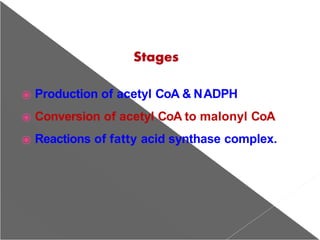
⦿ Production of acetyl CoA & NADPH
⦿ Conversion of acetyl CoA to malonyl CoA
⦿ Reactions of fatty acid synthase complex.
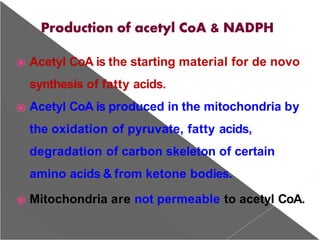
⦿ Acetyl CoA is the starting material for de novo
synthesis of fatty acids.
⦿ Acetyl CoA is produced in the mitochondria by
the oxidation of pyruvate, fatty acids,
degradation of carbon skeleton of certain
amino acids & from ketone bodies.
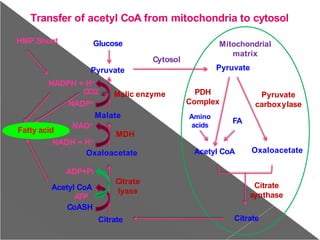
⦿ Mitochondria are not permeable to acetyl CoA.
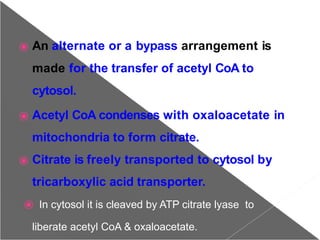
⦿ An alternate or a bypass arrangement is
made for the transfer of acetyl CoA to
cytosol.
⦿ Acetyl CoA condenses with oxaloacetate in
mitochondria to form citrate.
⦿ Citrate is freely transported to cytosol by
tricarboxylic acid transporter.
In cytosol it is cleaved by ATP citrate lyase to
liberate acetyl CoA & oxaloacetate.
Glucose
Oxaloacetate
Citrate
Mitochondrial
matrix
Pyruvate
Acetyl CoA
Citrate
Oxaloacetate
Amino
acids
FA
Pyruvate
carboxylase
PDH
Complex
Citrate
synthase
ADP+Pi
Acetyl CoA
ATP
CoASH
Citrate
lyase
MDH
NADH + H+
Pyruvate
NADPH + H+
HMP Shunt
CO2
NADP+
Malate
NAD+
Fatty acid
Cytosol
Transfer of acetyl CoA from mitochondria to cytosol
Malic enzyme
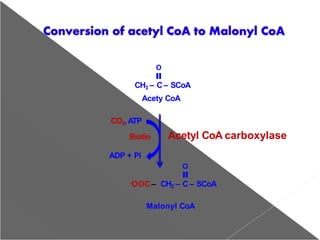
⦿ Acetyl CoA is carboxylated to malonyl CoA by
the enzyme acetyl CoA carboxylase.
⦿ This is an ATP-dependent reaction & requires
biotin for CO2fixation.
O
CH3 – C– SCoA
Acety CoA
ADP + Pi
O
-OOC– CH2 – C – SCoA
Malonyl CoA
Acetyl CoA carboxylase
CO2, ATP
Biotin
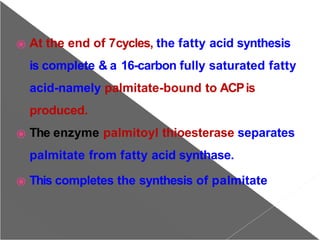
⦿ At the end of 7cycles, the fatty acid synthesis
is complete & a 16-carbon fully saturated fatty
acid-namely palmitate-bound to ACPis
produced.
⦿ The enzyme palmitoyl thioesterase separates
palmitate from fatty acid synthase.
⦿ This completes the synthesis of palmitate
⦿ The FAScomplex offers great efficiency that
is free from interference of other cellular
reactions for the synthesis of fatty acids.
⦿ There is a good coordination in the synthesis
of all enzymes of the FAS complex.
⦿ Fatty acid production is controlled by
enzymes, metabolites, end products,
hormones and dietary manipulations.
⦿ Acetyl CoA carboxylase:
⦿ This enzyme controls a committed step in
fatty acid synthesis.
⦿ Glucagon, epinephrine & norepinephrine
inactivate the enzyme by cAMP dependent
phosphorylation.
⦿ Insulin, dephosphorylates & activates the
enzyme.
⦿ Insulin promotes fatty acid synthesis while
glucagon inhibits.
⦿ Insulin stimulates tissue uptake of glucose &
conversion of pyruvate to acetyl CoA.
⦿ Consumption of high carbohydrate or fat-free
diet increases the synthesis of acetyl CoA
carboxylase & fatty acid synthase, which
promote fatty acid formation.
⦿ Fasting or high fat diet decreases fatty acid
production by reducing the synthesis of acetyl
CoA carboxylase & FAS.
⦿ The reducing equivalents for fatty acid
synthesis are provided by NADPH which
come either from citrate (acetyl CoA) .
fatty acid (1).pptx

fatty acid (1).pptx

  • 1.
  • 2.
    ⦿ De novosynthesis of fatty acids occurs in liver, kidney, adipose tissue & lactating mammary gland. ⦿ Enzymes are located in cytosomal fraction of the cell. ⦿ It is called as extramitochondrial or cytoplasmic fatty acid synthase system.
  • 3.
    ⦿ Major fattyacid synthesized de novo is palmitic acid (16C saturated fatty acid). ⦿ It occurs in liver, adipose tissue, kidney, brain & lactating mammary glands. ⦿ Acetyl CoA is the source of carbon atoms.
  • 4.
    ⦿ Every moleculeof acetyl CoA delivered to cytoplasm, one molecule of NADPH is formed. ⦿ ATPsupplies energy.
  • 5.
    ⦿ Production ofacetyl CoA & NADPH ⦿ Conversion of acetyl CoA to malonyl CoA ⦿ Reactions of fatty acid synthase complex.
  • 6.
    ⦿ Acetyl CoAis the starting material for de novo synthesis of fatty acids. ⦿ Acetyl CoA is produced in the mitochondria by the oxidation of pyruvate, fatty acids, degradation of carbon skeleton of certain amino acids & from ketone bodies. ⦿ Mitochondria are not permeable to acetyl CoA.
  • 7.
    ⦿ An alternateor a bypass arrangement is made for the transfer of acetyl CoA to cytosol. ⦿ Acetyl CoA condenses with oxaloacetate in mitochondria to form citrate. ⦿ Citrate is freely transported to cytosol by tricarboxylic acid transporter. In cytosol it is cleaved by ATP citrate lyase to liberate acetyl CoA & oxaloacetate.
  • 8.
    Glucose Oxaloacetate Citrate Mitochondrial matrix Pyruvate Acetyl CoA Citrate Oxaloacetate Amino acids FA Pyruvate carboxylase PDH Complex Citrate synthase ADP+Pi Acetyl CoA ATP CoASH Citrate lyase MDH NADH+ H+ Pyruvate NADPH + H+ HMP Shunt CO2 NADP+ Malate NAD+ Fatty acid Cytosol Transfer of acetyl CoA from mitochondria to cytosol Malic enzyme
  • 9.
    ⦿ Acetyl CoAis carboxylated to malonyl CoA by the enzyme acetyl CoA carboxylase. ⦿ This is an ATP-dependent reaction & requires biotin for CO2fixation.
  • 10.
    O CH3 – C–SCoA Acety CoA ADP + Pi O -OOC– CH2 – C – SCoA Malonyl CoA Acetyl CoA carboxylase CO2, ATP Biotin
  • 11.
    ⦿ At theend of 7cycles, the fatty acid synthesis is complete & a 16-carbon fully saturated fatty acid-namely palmitate-bound to ACPis produced. ⦿ The enzyme palmitoyl thioesterase separates palmitate from fatty acid synthase. ⦿ This completes the synthesis of palmitate
  • 12.
    ⦿ The FAScomplexoffers great efficiency that is free from interference of other cellular reactions for the synthesis of fatty acids. ⦿ There is a good coordination in the synthesis of all enzymes of the FAS complex.
  • 13.
    ⦿ Fatty acidproduction is controlled by enzymes, metabolites, end products, hormones and dietary manipulations. ⦿ Acetyl CoA carboxylase: ⦿ This enzyme controls a committed step in fatty acid synthesis.
  • 14.
    ⦿ Glucagon, epinephrine& norepinephrine inactivate the enzyme by cAMP dependent phosphorylation.
  • 15.
    ⦿ Insulin, dephosphorylates& activates the enzyme. ⦿ Insulin promotes fatty acid synthesis while glucagon inhibits. ⦿ Insulin stimulates tissue uptake of glucose & conversion of pyruvate to acetyl CoA.
  • 16.
    ⦿ Consumption ofhigh carbohydrate or fat-free diet increases the synthesis of acetyl CoA carboxylase & fatty acid synthase, which promote fatty acid formation. ⦿ Fasting or high fat diet decreases fatty acid production by reducing the synthesis of acetyl CoA carboxylase & FAS.
  • 17.
    ⦿ The reducingequivalents for fatty acid synthesis are provided by NADPH which come either from citrate (acetyl CoA) .