Fall 2 0 1 4 
Laureen A. Rimmer 
Focus 23 
Appropriate Level of Care 
and the 2-Midnight Rule 
Where it Stands as of NOW... 
By Edward J. Niewiadomski, MD and Laureen A. Rimmer, RHIA, CPHQ, CHC 
Edward J. Niewiadomski 
continued on page 24 
Effective October 1, 2013, The Centers for Medicare 
and Medicaid Services (CMS) implemented a new rule, the 
“2-Midnight Rule” that is intended to clarify which patients are 
sick enough to be admitted to a hospital by adding “midnight” 
as a point in time for determining inpatient length of stay and 
requiring physicians to certify that they have the expectation 
of care surpassing two midnights. Medicare would then pay 
inpatient hospital rates. Prior to this rule, CMS outlined 
observation care as short term, and generally would not exceed 
24 hours but could be up to 48 hours in rare and exceptional 
cases. It is important to note that a New Jersey State regulation 
stipulates a length of stay criteria of less than 24 hours for 
observation services. The New Jersey Department of Health 
and Senior Services, N.J.A.C., Title 8, Chapter 43G-32.21 
outlines the state standards for observation services and 
scope which is more stringent than the CMS guidance on 
observation services. 
The key elements of the 2-Midnight rule require docu-mentation 
in the medical record for medical necessity 
and a presumption of the length of stay. The focus of the 
documentation requirements for Medicare inpatient admission 
is as follows: 
• Inpatient admission order at the time of admission 
by a physician or qualified practitioner licensed by state 
to admit inpatients and who has admitting privileges; 
• Physician certification of medical necessity includes 
(before discharge): 
 Inpatient admission order signed/authenticated by 
the physician or countersigned, if needed; 
 Dated order; 
 Reason for inpatient services, including diagnosis, 
patient history, patient comorbidities, severity of 
signs & symptoms, risk of adverse events, current 
medical needs requiring inpatient care, plan of care, 
and plans for post hospital care; and 
 Estimated length of stay (expected to stay at least 2 
midnights). 
There are other circum-stances 
supporting short inpa-tient 
stays, exceptions to the 
2-Midnight benchmark, based 
upon CMS guidance which 
are as follows: 
• Procedures defined as 
“Inpatient–Only” 
• Unforeseen beneficiary 
death 
• Unforeseen transfer 
• Unforeseen departure 
against medical advice 
• Unforeseen clinical im-provement 
• Election of hospice care in lieu of continued treatment 
in the hospital 
• Mechanical ventilation initiated during present visit 
Documentation in the medical record, as always, is critical to 
explain what happened during the episode of care. Physicians 
need to tell the story of the patient by outlining the above, which 
will provide auditors with the reasons for the inpatient status. 
The 2-Midnight presumption and the 2-Midnight 
Benchmark 
The 2-Midnight presumption and benchmark are outlined 
in CMS-1599-F. The 2-Midnight presumption specifies that 
hospital stays spanning two or more midnights, after the 
beneficiary is formally admitted as an inpatient based upon 
the physician order, will be presumed to be reasonable and 
necessary for inpatient status, as long as the stay in the hospital is 
medically necessary. CMS will direct Medicare Administrative 
Contractors (MACs) not to focus medical reviews on stays 
spanning at least two midnights after admission. MACs may 
review these claims as part of routine monitoring activity or as 
part of other target reviews and/or in the event of evidence of
Fall 2 0 1 4 
continued from page 23 
systematic gaming, abuse or delays in the provision of care to 
qualify for the 2-Midnight presumption. 
The 2-Midnight benchmark represents when an inpatient 
admission is generally appropriate for Medicare coverage and 
Part A inpatient payment. For purposes of determining whether 
the 2-Midnight benchmark was met, CMS will direct MACs to 
consider time the beneficiary spent receiving outpatient services 
within the hospital prior to inpatient admission, in addition to 
the post-admission duration of care. The pre-admission time 
may include services such as observation services, treatment 
in the emergency department (ED), and procedures provided 
in the operating room or other treatment area. MLN Matters 
Number: MM8586 was released January 24, 2014 to provide 
clarification to hospitals regarding the billing of inpatient hos-pital 
stays to track the total, contiguous outpatient care prior 
to inpatient admission to the hospital. CMS has redefined oc-currence 
span code 72 which allows providers to voluntarily 
identify those claims in which the 2-Midnight benchmark was 
met because the beneficiary was treated as an outpatient in the 
hospital prior to the formal inpatient order and admission. 
From the issuance of the Inpatient Prospective Payment 
System (IPPS) Final Rule CMS 1599-F for Fiscal Year (FY) 
2014 on August 19, 2013 to the soon to be published IPPS 
Final Rule FY 2015, CMS-1607-F on August 22, 2014 to the 
Outpatient Prospective Payment System (OPPS) Proposed 
Rule for Calendar Year (CY) 2015, the public comments and 
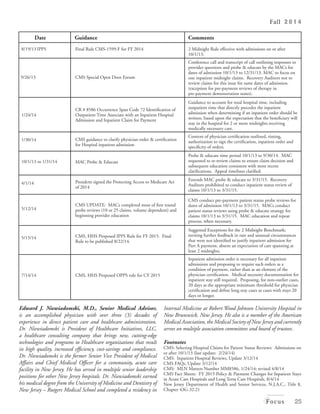
CMS guidance evolves. The table on page 25 outlines the 
milestones in this regulatory journey. In spite of the OPPS 
Proposed Rule for CY 2015 which proposes 20 days as the 
appropriate minimum threshold for physician certification, 
these regulations have been and continue to be effective as 
of October 1, 2013. In spite of the OPPS CY 15 proposal, 
clinical documentation in the medical record drives medical 
necessity for inpatient hospital stay. Physician documentation 
needs to be specific and explicit. 
Best practice Today 
Currently, no specific procedures or forms are required. 
The physician certification may be entered on various forms, 
notes or records (with appropriate signatures) included in 
the medical record, or on a special form, so long as there is a 
separate signed statement for each certification. In the absence 
of specific certification forms, the medical record elements 
identified above may be sufficient to meet the initial inpatient 
certification requirements for each component. 
Collaboration of the revenue cycle team, inclusive of Case 
Management, Patient Access Services, Health Information 
Management, Clinical Documentation Improvement and 
Patient Financial Services with the physicians is the key strategy 
to success. Understanding the clinical processes, electronic 
24 Focus 
health record interfaces to the billing system and validating 
the patient status concurrently are essential. How would your 
organization answer these questions?: 
• What is the Case Management model to support con-current 
physician decision making on the patient status; 
inpatient vs. observation vs. outpatient? 
• Are there case managers in the ED to collaborate with 
the ED physicians, hospitalists and/or community phy-sicians 
to assess the clinical picture of the patient, ensure 
the medical record tells the story and then places the 
patient in the appropriate status? 
• Is there strong physician leadership to monitor obser-vation 
patients timely and make the next appropriate 
clinical decisions? 
• What is the role of the Utilization Review Committee 
and Physician Advisors? 
• Are physicians educated and do they have the tools 
needed to support the clinical decision making? 
• Are the clinical and financial metrics implemented and 
assessed for improvement opportunities? 
• Are there policies for observation billing, use of occur-rence 
span code 72, inpatient only procedures? 
• Is there auditing of hospital systems, policies and proce-dures 
for compliance? 
• Is there a process to aggressively appeal cases that appear 
to meet inpatient criteria? 
As CMS continues to state, the decision to admit a patient 
as an inpatient is a complex medical decision based upon many 
factors including the risk of an adverse event during the period 
considered for hospitalization. The MACs will continue their 
probe and educate while the Recovery Auditors will be in a 
holding pattern by not conducting inpatient status review of 
claims through March 31, 2015. Hospitals need to monitor 
the regulatory advisories and remain diligent and compliant in 
meeting the CMS requirements for the 2-Midnight Rule. 
About the authors 
Laureen A. Rimmer, RHIA, CPHQ, CHC, Director, 
Coding and Compliance at BESLER Consulting has over 
twenty-five (25) years of experience in health information 
management administration, performance improvement, 
utilization management, medical staff operations and 
physician practice management. Laureen’s health information 
management experiences, as well as operational experiences, have 
provided key expertise in Recovery Audit Contractor (RAC) 
engagements for the firm. Laureen has extensive experience with 
Joint Commission accreditation, post survey intervention, as well 
as CMS/State licensure compliance and has been instrumental in 
implementing change in departmental operational engagements 
for the firm. Laureen is a Registered Health Information 
Administrator, Certified Professional in Healthcare Quality 
and Certified in Healthcare Compliance.
Fall 2 0 1 4 
Focus 25 
date Guidance Comments 
8/19/13 IPPS Final Rule CMS-1599-F for FY 2014 2 Midnight Rule effective with admissions on or after 
10/1/13. 
9/26/13 CMS Special Open Door Forum 
Conference call and transcript of call outlining responses to 
provider questions and probe & educate by the MACs for 
dates of admission 10/1/13 to 12/31/13. MAC to focus on 
one inpatient midnight claims. Recovery Auditors not to 
review claims for this issue for same dates of admission. 
(exception for pre-payment reviews of therapy in 
pre-payment demonstration states). 
1/24/14 
CR # 8586 Occurrence Span Code 72 Identification of 
Outpatient Time Associate with an Inpatient Hospital 
Admission and Inpatient Claim for Payment 
Guidance to account for total hospital time, including 
outpatient time that directly precedes the inpatient 
admission when determining if an inpatient order should be 
written, based upon the expectation that the beneficiary will 
stay in the hospital for 2 or more midnights receiving 
medically necessary care. 
1/30/14 CMS guidance to clarify physician order & certification 
for Hospital inpatient admission 
Content of physician certification outlined, timing, 
authorization to sign the certification, inpatient order and 
specificity of orders. 
10/1/13 to 1/31/14 MAC Probe & Educate 
Probe & educate time period 10/1/13 to 9/30/14. MAC 
requested to re-review claims to ensure claim decision and 
subsequent education consistent with most recent 
clarifications. Appeal timelines clarified. 
4/1/14 President signed the Protecting Access to Medicare Act 
of 2014 
Extends MAC probe & educate to 3/31/15. Recovery 
Auditors prohibited to conduct inpatient status review of 
claims 10/1/13 to 3/31/15. 
5/12/14 
CMS UPDATE: MACs completed most of first round 
probe reviews (10 or 25 claims, volume dependent) and 
beginning provider education 
CMS conduct pre-payment patient status probe reviews for 
dates of admission 10/1/13 to 3/31/15. MACs conduct 
patient status reviews using probe & educate strategy for 
claims 10/1/13 to 3/31/15. MAC education and repeat 
process, when necessary. 
5/15/14 CMS, HHS Proposed IPPS Rule for FY 2015. Final 
Rule to be published 8/22/14. 
Suggested Exceptions for the 2 Midnight Benchmark; 
inviting further feedback in rare and unusual circumstances 
that were not identified to justify inpatient admission for 
Part A payment, absent an expectation of care spanning at 
least 2 midnights. 
7/14/14 CMS, HHS Proposed OPPS rule for CY 2015 
Inpatient admission order is necessary for all inpatient 
admissions and proposing to require such orders as a 
condition of payment, rather than as an element of the 
physician certification. Medical necessity documentation for 
inpatient stay still required. Proposing, for non-outlier cases, 
20 days as the appropriate minimum threshold for physician 
certification and define long stay cases as cases with stays 20 
days or longer. 
Edward J. Niewiadomski, M.D., Senior Medical 
Advisor, at BESLER Consulting is an accomplished 
physician with over three (3) decades of experience in 
direct patient care and healthcare administration. Dr. 
Niewiadomski is President of Healthcare Initiatives, LLC, a 
healthcare consulting company that brings new, cutting-edge 
technologies and programs to Healthcare organizations that 
result in high quality, increased efficiency, cost-savings and 
compliance. Dr. Niewiadomski is the former Senior Vice 
President of Medical Affairs and Chief Medical Officer for a 
community, acute care facility in New Jersey. He has served in 
multiple senior leadership positions for other New Jersey hospitals. 
Dr. Niewiadomski earned his medical degree from the University 
of Medicine and Dentistry of New Jersey – Rutgers Medical School 
and completed a residency in 
Internal Medicine at Robert Wood Johnson University Hospital in 
New Brunswick, New Jersey. He also is a member of the American 
Medical Association, the Medical Society of New Jersey and currently 
serves on multiple association committees and board of trustees. 
Footnotes 
CMS: Selecting Hospital Claims for Patient Status Reviews: Admissions on 
or after 10/1/13 (last update: 2/24/14) 
CMS: Inpatient Hospital Reviews, Update 3/12/14 
CMS FAQs, Update 3/12/14 
CMS: MLN Matters Number MM8586, 1/24/14; revised 4/8/14 
CMS Fact Sheets: FY 2015 Policy & Payment Changes for Inpatient Stays 
in Acute Care Hospitals and Long Term Care Hospitals, 8/4/14 
New Jersey Department of Health and Senior Services, N.J.A.C., Title 8, 
Chapter 43G-32.21

Appropriate Level of Care and the 2-Midnight Rule Where it Stands as of NOW...

  • 1.
    Fall 2 01 4 Laureen A. Rimmer Focus 23 Appropriate Level of Care and the 2-Midnight Rule Where it Stands as of NOW... By Edward J. Niewiadomski, MD and Laureen A. Rimmer, RHIA, CPHQ, CHC Edward J. Niewiadomski continued on page 24 Effective October 1, 2013, The Centers for Medicare and Medicaid Services (CMS) implemented a new rule, the “2-Midnight Rule” that is intended to clarify which patients are sick enough to be admitted to a hospital by adding “midnight” as a point in time for determining inpatient length of stay and requiring physicians to certify that they have the expectation of care surpassing two midnights. Medicare would then pay inpatient hospital rates. Prior to this rule, CMS outlined observation care as short term, and generally would not exceed 24 hours but could be up to 48 hours in rare and exceptional cases. It is important to note that a New Jersey State regulation stipulates a length of stay criteria of less than 24 hours for observation services. The New Jersey Department of Health and Senior Services, N.J.A.C., Title 8, Chapter 43G-32.21 outlines the state standards for observation services and scope which is more stringent than the CMS guidance on observation services. The key elements of the 2-Midnight rule require docu-mentation in the medical record for medical necessity and a presumption of the length of stay. The focus of the documentation requirements for Medicare inpatient admission is as follows: • Inpatient admission order at the time of admission by a physician or qualified practitioner licensed by state to admit inpatients and who has admitting privileges; • Physician certification of medical necessity includes (before discharge):  Inpatient admission order signed/authenticated by the physician or countersigned, if needed;  Dated order;  Reason for inpatient services, including diagnosis, patient history, patient comorbidities, severity of signs & symptoms, risk of adverse events, current medical needs requiring inpatient care, plan of care, and plans for post hospital care; and  Estimated length of stay (expected to stay at least 2 midnights). There are other circum-stances supporting short inpa-tient stays, exceptions to the 2-Midnight benchmark, based upon CMS guidance which are as follows: • Procedures defined as “Inpatient–Only” • Unforeseen beneficiary death • Unforeseen transfer • Unforeseen departure against medical advice • Unforeseen clinical im-provement • Election of hospice care in lieu of continued treatment in the hospital • Mechanical ventilation initiated during present visit Documentation in the medical record, as always, is critical to explain what happened during the episode of care. Physicians need to tell the story of the patient by outlining the above, which will provide auditors with the reasons for the inpatient status. The 2-Midnight presumption and the 2-Midnight Benchmark The 2-Midnight presumption and benchmark are outlined in CMS-1599-F. The 2-Midnight presumption specifies that hospital stays spanning two or more midnights, after the beneficiary is formally admitted as an inpatient based upon the physician order, will be presumed to be reasonable and necessary for inpatient status, as long as the stay in the hospital is medically necessary. CMS will direct Medicare Administrative Contractors (MACs) not to focus medical reviews on stays spanning at least two midnights after admission. MACs may review these claims as part of routine monitoring activity or as part of other target reviews and/or in the event of evidence of
  • 2.
    Fall 2 01 4 continued from page 23 systematic gaming, abuse or delays in the provision of care to qualify for the 2-Midnight presumption. The 2-Midnight benchmark represents when an inpatient admission is generally appropriate for Medicare coverage and Part A inpatient payment. For purposes of determining whether the 2-Midnight benchmark was met, CMS will direct MACs to consider time the beneficiary spent receiving outpatient services within the hospital prior to inpatient admission, in addition to the post-admission duration of care. The pre-admission time may include services such as observation services, treatment in the emergency department (ED), and procedures provided in the operating room or other treatment area. MLN Matters Number: MM8586 was released January 24, 2014 to provide clarification to hospitals regarding the billing of inpatient hos-pital stays to track the total, contiguous outpatient care prior to inpatient admission to the hospital. CMS has redefined oc-currence span code 72 which allows providers to voluntarily identify those claims in which the 2-Midnight benchmark was met because the beneficiary was treated as an outpatient in the hospital prior to the formal inpatient order and admission. From the issuance of the Inpatient Prospective Payment System (IPPS) Final Rule CMS 1599-F for Fiscal Year (FY) 2014 on August 19, 2013 to the soon to be published IPPS Final Rule FY 2015, CMS-1607-F on August 22, 2014 to the Outpatient Prospective Payment System (OPPS) Proposed Rule for Calendar Year (CY) 2015, the public comments and CMS guidance evolves. The table on page 25 outlines the milestones in this regulatory journey. In spite of the OPPS Proposed Rule for CY 2015 which proposes 20 days as the appropriate minimum threshold for physician certification, these regulations have been and continue to be effective as of October 1, 2013. In spite of the OPPS CY 15 proposal, clinical documentation in the medical record drives medical necessity for inpatient hospital stay. Physician documentation needs to be specific and explicit. Best practice Today Currently, no specific procedures or forms are required. The physician certification may be entered on various forms, notes or records (with appropriate signatures) included in the medical record, or on a special form, so long as there is a separate signed statement for each certification. In the absence of specific certification forms, the medical record elements identified above may be sufficient to meet the initial inpatient certification requirements for each component. Collaboration of the revenue cycle team, inclusive of Case Management, Patient Access Services, Health Information Management, Clinical Documentation Improvement and Patient Financial Services with the physicians is the key strategy to success. Understanding the clinical processes, electronic 24 Focus health record interfaces to the billing system and validating the patient status concurrently are essential. How would your organization answer these questions?: • What is the Case Management model to support con-current physician decision making on the patient status; inpatient vs. observation vs. outpatient? • Are there case managers in the ED to collaborate with the ED physicians, hospitalists and/or community phy-sicians to assess the clinical picture of the patient, ensure the medical record tells the story and then places the patient in the appropriate status? • Is there strong physician leadership to monitor obser-vation patients timely and make the next appropriate clinical decisions? • What is the role of the Utilization Review Committee and Physician Advisors? • Are physicians educated and do they have the tools needed to support the clinical decision making? • Are the clinical and financial metrics implemented and assessed for improvement opportunities? • Are there policies for observation billing, use of occur-rence span code 72, inpatient only procedures? • Is there auditing of hospital systems, policies and proce-dures for compliance? • Is there a process to aggressively appeal cases that appear to meet inpatient criteria? As CMS continues to state, the decision to admit a patient as an inpatient is a complex medical decision based upon many factors including the risk of an adverse event during the period considered for hospitalization. The MACs will continue their probe and educate while the Recovery Auditors will be in a holding pattern by not conducting inpatient status review of claims through March 31, 2015. Hospitals need to monitor the regulatory advisories and remain diligent and compliant in meeting the CMS requirements for the 2-Midnight Rule. About the authors Laureen A. Rimmer, RHIA, CPHQ, CHC, Director, Coding and Compliance at BESLER Consulting has over twenty-five (25) years of experience in health information management administration, performance improvement, utilization management, medical staff operations and physician practice management. Laureen’s health information management experiences, as well as operational experiences, have provided key expertise in Recovery Audit Contractor (RAC) engagements for the firm. Laureen has extensive experience with Joint Commission accreditation, post survey intervention, as well as CMS/State licensure compliance and has been instrumental in implementing change in departmental operational engagements for the firm. Laureen is a Registered Health Information Administrator, Certified Professional in Healthcare Quality and Certified in Healthcare Compliance.
  • 3.
    Fall 2 01 4 Focus 25 date Guidance Comments 8/19/13 IPPS Final Rule CMS-1599-F for FY 2014 2 Midnight Rule effective with admissions on or after 10/1/13. 9/26/13 CMS Special Open Door Forum Conference call and transcript of call outlining responses to provider questions and probe & educate by the MACs for dates of admission 10/1/13 to 12/31/13. MAC to focus on one inpatient midnight claims. Recovery Auditors not to review claims for this issue for same dates of admission. (exception for pre-payment reviews of therapy in pre-payment demonstration states). 1/24/14 CR # 8586 Occurrence Span Code 72 Identification of Outpatient Time Associate with an Inpatient Hospital Admission and Inpatient Claim for Payment Guidance to account for total hospital time, including outpatient time that directly precedes the inpatient admission when determining if an inpatient order should be written, based upon the expectation that the beneficiary will stay in the hospital for 2 or more midnights receiving medically necessary care. 1/30/14 CMS guidance to clarify physician order & certification for Hospital inpatient admission Content of physician certification outlined, timing, authorization to sign the certification, inpatient order and specificity of orders. 10/1/13 to 1/31/14 MAC Probe & Educate Probe & educate time period 10/1/13 to 9/30/14. MAC requested to re-review claims to ensure claim decision and subsequent education consistent with most recent clarifications. Appeal timelines clarified. 4/1/14 President signed the Protecting Access to Medicare Act of 2014 Extends MAC probe & educate to 3/31/15. Recovery Auditors prohibited to conduct inpatient status review of claims 10/1/13 to 3/31/15. 5/12/14 CMS UPDATE: MACs completed most of first round probe reviews (10 or 25 claims, volume dependent) and beginning provider education CMS conduct pre-payment patient status probe reviews for dates of admission 10/1/13 to 3/31/15. MACs conduct patient status reviews using probe & educate strategy for claims 10/1/13 to 3/31/15. MAC education and repeat process, when necessary. 5/15/14 CMS, HHS Proposed IPPS Rule for FY 2015. Final Rule to be published 8/22/14. Suggested Exceptions for the 2 Midnight Benchmark; inviting further feedback in rare and unusual circumstances that were not identified to justify inpatient admission for Part A payment, absent an expectation of care spanning at least 2 midnights. 7/14/14 CMS, HHS Proposed OPPS rule for CY 2015 Inpatient admission order is necessary for all inpatient admissions and proposing to require such orders as a condition of payment, rather than as an element of the physician certification. Medical necessity documentation for inpatient stay still required. Proposing, for non-outlier cases, 20 days as the appropriate minimum threshold for physician certification and define long stay cases as cases with stays 20 days or longer. Edward J. Niewiadomski, M.D., Senior Medical Advisor, at BESLER Consulting is an accomplished physician with over three (3) decades of experience in direct patient care and healthcare administration. Dr. Niewiadomski is President of Healthcare Initiatives, LLC, a healthcare consulting company that brings new, cutting-edge technologies and programs to Healthcare organizations that result in high quality, increased efficiency, cost-savings and compliance. Dr. Niewiadomski is the former Senior Vice President of Medical Affairs and Chief Medical Officer for a community, acute care facility in New Jersey. He has served in multiple senior leadership positions for other New Jersey hospitals. Dr. Niewiadomski earned his medical degree from the University of Medicine and Dentistry of New Jersey – Rutgers Medical School and completed a residency in Internal Medicine at Robert Wood Johnson University Hospital in New Brunswick, New Jersey. He also is a member of the American Medical Association, the Medical Society of New Jersey and currently serves on multiple association committees and board of trustees. Footnotes CMS: Selecting Hospital Claims for Patient Status Reviews: Admissions on or after 10/1/13 (last update: 2/24/14) CMS: Inpatient Hospital Reviews, Update 3/12/14 CMS FAQs, Update 3/12/14 CMS: MLN Matters Number MM8586, 1/24/14; revised 4/8/14 CMS Fact Sheets: FY 2015 Policy & Payment Changes for Inpatient Stays in Acute Care Hospitals and Long Term Care Hospitals, 8/4/14 New Jersey Department of Health and Senior Services, N.J.A.C., Title 8, Chapter 43G-32.21