Viterion Digital Health Perspectives #1
CMS’ FINAL RULE BENEFITS REMOTE CHRONIC CARE
MANAGEMENT FOR QUALIFIED MEDICARE BENEFICIARIES
Key findings from CMS’ Final Rule for CY 2015 regarding
chronic care management (CCM) requirements for Medicare
FFS patients with multiple chronic conditions, telehealth
inclusion in non-face-to-face CCM and performance
qualifications.
CARE COORDINATION
WITH TELEHEALTH
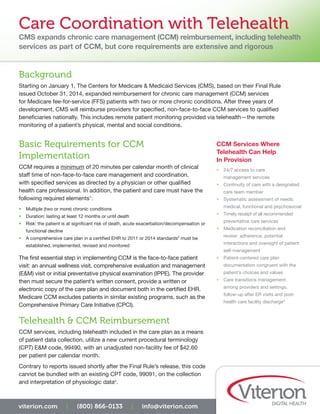
Care Coordination with Telehealth
CMS expands chronic care management (CCM) reimbursement, including telehealth
services as part of CCM, but core requirements are extensive and rigorous
CCM Services Where
Telehealth Can Help
In Provision
•	 24/7 access to care
management services
•	 Continuity of care with a designated
care team member
•	 Systematic assessment of needs:
medical, functional and psychosocial
•	 Timely receipt of all recommended
preventative care services
•	 Medication reconciliation and
review: adherence, potential
interactions and oversight of patient
self-management
•	 Patient-centered care plan
documentation congruent with the
patient’s choices and values
•	 Care transitions management:
among providers and settings,
follow-up after ER visits and post-
health care facility discharge3
viterion.com | (800) 866-0133 | info@viterion.com
Background
Starting on January 1, The Centers for Medicare & Medicaid Services (CMS), based on their Final Rule
issued October 31, 2014, expanded reimbursement for chronic care management (CCM) services
for Medicare fee-for-service (FFS) patients with two or more chronic conditions. After three years of
development, CMS will reimburse providers for specified, non-face-to-face CCM services to qualified
beneficiaries nationally. This includes remote patient monitoring provided via telehealth—the remote
monitoring of a patient’s physical, mental and social conditions.
Basic Requirements for CCM
Implementation
CCM requires a minimum of 20 minutes per calendar month of clinical
staff time of non-face-to-face care management and coordination,
with specified services as directed by a physician or other qualified
health care professional. In addition, the patient and care must have the
following required elements1
:
•	 Multiple (two or more) chronic conditions
•	 Duration: lasting at least 12 months or until death
•	 Risk: the patient is at significant risk of death, acute exacerbation/decompensation or
functional decline
•	 A comprehensive care plan in a certified EHR to 2011 or 2014 standards2
must be
established, implemented, revised and monitored
The first essential step in implementing CCM is the face-to-face patient
visit: an annual wellness visit, comprehensive evaluation and management
(E&M) visit or initial preventative physical examination (IPPE). The provider
then must secure the patient’s written consent, provide a written or
electronic copy of the care plan and document both in the certified EHR.
Medicare CCM excludes patients in similar existing programs, such as the
Comprehensive Primary Care Initiative (CPCI).
Telehealth & CCM Reimbursement
CCM services, including telehealth included in the care plan as a means
of patient data collection, utilize a new current procedural terminology
(CPT) E&M code, 99490, with an unadjusted non-facility fee of $42.60
per patient per calendar month.
Contrary to reports issued shortly after the Final Rule’s release, this code
cannot be bundled with an existing CPT code, 99091, on the collection
and interpretation of physiologic data4
.
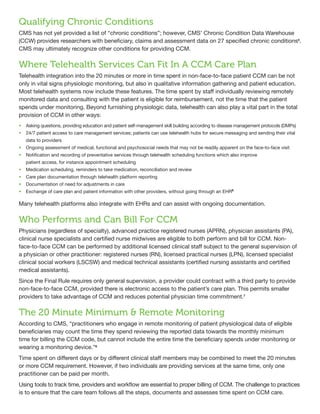
Qualifying Chronic Conditions
CMS has not yet provided a list of “chronic conditions”; however, CMS’ Chronic Condition Data Warehouse
(CCW) provides researchers with beneficiary, claims and assessment data on 27 specified chronic conditions5
.
CMS may ultimately recognize other conditions for providing CCM.
Where Telehealth Services Can Fit In A CCM Care Plan
Telehealth integration into the 20 minutes or more in time spent in non-face-to-face patient CCM can be not
only in vital signs physiologic monitoring, but also in qualitative information gathering and patient education.
Most telehealth systems now include these features. The time spent by staff individually reviewing remotely
monitored data and consulting with the patient is eligible for reimbursement, not the time that the patient
spends under monitoring. Beyond furnishing physiologic data, telehealth can also play a vital part in the total
provision of CCM in other ways:
•	 Asking questions, providing education and patient self-management skill building according to disease management protocols (DMPs)
•	 24/7 patient access to care management services; patients can use telehealth hubs for secure messaging and sending their vital
data to providers
•	 Ongoing assessment of medical, functional and psychosocial needs that may not be readily apparent on the face-to-face visit
•	 Notification and recording of preventative services through telehealth scheduling functions which also improve
patient access, for instance appointment scheduling
•	 Medication scheduling, reminders to take medication, reconciliation and review
•	 Care plan documentation through telehealth platform reporting
•	 Documentation of need for adjustments in care
•	 Exchange of care plan and patient information with other providers, without going through an EHR6
Many telehealth platforms also integrate with EHRs and can assist with ongoing documentation.
Who Performs and Can Bill For CCM
Physicians (regardless of specialty), advanced practice registered nurses (APRN), physician assistants (PA),
clinical nurse specialists and certified nurse midwives are eligible to both perform and bill for CCM. Non-
face-to-face CCM can be performed by additional licensed clinical staff subject to the general supervision of
a physician or other practitioner: registered nurses (RN), licensed practical nurses (LPN), licensed specialist
clinical social workers (LSCSW) and medical technical assistants (certified nursing assistants and certified
medical assistants).
Since the Final Rule requires only general supervision, a provider could contract with a third party to provide
non-face-to-face CCM, provided there is electronic access to the patient’s care plan. This permits smaller
providers to take advantage of CCM and reduces potential physician time commitment.7
The 20 Minute Minimum & Remote Monitoring
According to CMS, “practitioners who engage in remote monitoring of patient physiological data of eligible
beneficiaries may count the time they spend reviewing the reported data towards the monthly minimum
time for billing the CCM code, but cannot include the entire time the beneficiary spends under monitoring or
wearing a monitoring device.”8
Time spent on different days or by different clinical staff members may be combined to meet the 20 minutes
or more CCM requirement. However, if two individuals are providing services at the same time, only one
practitioner can be paid per month.
Using tools to track time, providers and workflow are essential to proper billing of CCM. The challenge to practices
is to ensure that the care team follows all the steps, documents and assesses time spent on CCM care.
Providers should be aware that CMS typically proposes changes to service elements in the Final Rule during
the year using notice and comment rulemaking. This guide is intended as an overview, and also utilizes
interpretations from a variety of sources as noted on the next page.
NOTES
1
Final Rule, page 451
2
“...at a minimum, the edition(s) of certification criteria that is acceptable for purposes of the EHR Incentive
Programs as of December 31st
of the calendar year preceding each PFS payment year” Final Rule, page 474.
3
AAFP, Summary of the 2015 final Medicare physician fee schedule, page 2; Final Rule, pages 490-492, table 33
4
ATA, “Update on CMS Payment Decisions”
5
CMS, Chronic Conditions Data Warehouse, https://www.ccwdata.org/web/guest/condition-categories
Acquired Hypothyroidism; Acute Myocardial Infarction; Alzheimer’s Disease; Alzheimer’s Disease Related Disorders, or Senile
Dementia; Anemia; Asthma; Atrial Fibrillation; Benign Prostatic Hyperplasia; Cancer (Colorectal, Endometrial, Breast, Lung, and
Prostate); Cataract; Chronic Kidney Disease; Chronic Obstructive Pulmonary Disease; Depression; Diabetes; Glaucoma; Heart
Failure; Hip/Pelvic Fracture; Hyperlipidemia; Hypertension; Ischemic Heart Disease; Osteoporosis; Rheumatoid
Arthritis/Osteoarthritis; and Stroke/Transient Ischemic Attack
6
Final Rule, page 479-480
7
Final Rule, page 457-460
8
Final Rule, page 486
REFERENCES
American Association of Family Physicians (AAFP), Summary of the 2015 final Medicare physician fee schedule (as of 11/17/2014)
http://www.aafp.org/dam/AAFP/documents/advocacy/payment/medicare/feesched/ES-2015MPFS-110514.pdf
American Telemedicine Association (ATA), “Update on CMS Payment Decisions - Two Steps Forward, One Back,” November 7, 2014, http://www.
americantelemed.org/news-landing/2014/11/07/update-on-cms-payment-decisions---two-steps-forward-one-back#.VNphTPnF_Zd
Centers for Medicare and Medicaid Services, Chronic Conditions Data Warehouse, ccwdata.org
Department of Health and Human Services, Centers for Medicare & Medicaid Services, Medicare Program; Revisions to Payment Policies under the
Physician Fee Schedule, Clinical Laboratory Fee Schedule, Access to Identifiable Data for the Center for Medicare and Medicaid Innovation Models
& Other Revisions to Part B for CY 2015 [CMS-1612-FC], pages 442-496 (CCM) and 186-201 (Telehealth). [Final Rule] Publication Date November 13,
2014. Pages 442-496 (CCM).
Amy Lerman, Epstein Becker Green, “CMS Expands Telehealth Reimbursement in New Rule”, TechHealth Perspectives, November 5, 2014
Pershing Yoakley & Associates, PC, Chronic Care Management, 2015 Medicare Physician Fee Schedule Final Rule (November 2014)
This material has been prepared for general informational purposes only. The information contained herein has been gathered from sources deemed to
be reliable, but the accuracy and completeness of the information are not guaranteed.
Viterion Digital Health is a pioneer in remote patient home monitoring and telehealth. Viterion’s patient reporting provides actionable clinical insights
for optimal care decisions, enables management of large populations with significant multiple chronic conditions and assists in risk stratification, cost
avoidance and improving patient quality of life. We partner with health systems including the VA, hospitals, Long Term Care providers, ACOs and health
plans. Founded in 2003 by Bayer HealthCare and Panasonic Corporation, Viterion is now part of NSD Co., Ltd., a leading international, publicly traded
IT services company impacting healthcare globally.
Viterion Corporation
565 Taxter Road, Suite 175
Elmsford, NY 10523
(800) 866-0133 info@viterion.com
© 2015 Viterion Corporation MS-VC1-03/15-1
viterion.com | (800) 866-0133 | info@viterion.com

Viterion Digital Health Perspectives

  • 1.
    Viterion Digital HealthPerspectives #1 CMS’ FINAL RULE BENEFITS REMOTE CHRONIC CARE MANAGEMENT FOR QUALIFIED MEDICARE BENEFICIARIES Key findings from CMS’ Final Rule for CY 2015 regarding chronic care management (CCM) requirements for Medicare FFS patients with multiple chronic conditions, telehealth inclusion in non-face-to-face CCM and performance qualifications. CARE COORDINATION WITH TELEHEALTH
  • 2.
    Care Coordination withTelehealth CMS expands chronic care management (CCM) reimbursement, including telehealth services as part of CCM, but core requirements are extensive and rigorous CCM Services Where Telehealth Can Help In Provision • 24/7 access to care management services • Continuity of care with a designated care team member • Systematic assessment of needs: medical, functional and psychosocial • Timely receipt of all recommended preventative care services • Medication reconciliation and review: adherence, potential interactions and oversight of patient self-management • Patient-centered care plan documentation congruent with the patient’s choices and values • Care transitions management: among providers and settings, follow-up after ER visits and post- health care facility discharge3 viterion.com | (800) 866-0133 | info@viterion.com Background Starting on January 1, The Centers for Medicare & Medicaid Services (CMS), based on their Final Rule issued October 31, 2014, expanded reimbursement for chronic care management (CCM) services for Medicare fee-for-service (FFS) patients with two or more chronic conditions. After three years of development, CMS will reimburse providers for specified, non-face-to-face CCM services to qualified beneficiaries nationally. This includes remote patient monitoring provided via telehealth—the remote monitoring of a patient’s physical, mental and social conditions. Basic Requirements for CCM Implementation CCM requires a minimum of 20 minutes per calendar month of clinical staff time of non-face-to-face care management and coordination, with specified services as directed by a physician or other qualified health care professional. In addition, the patient and care must have the following required elements1 : • Multiple (two or more) chronic conditions • Duration: lasting at least 12 months or until death • Risk: the patient is at significant risk of death, acute exacerbation/decompensation or functional decline • A comprehensive care plan in a certified EHR to 2011 or 2014 standards2 must be established, implemented, revised and monitored The first essential step in implementing CCM is the face-to-face patient visit: an annual wellness visit, comprehensive evaluation and management (E&M) visit or initial preventative physical examination (IPPE). The provider then must secure the patient’s written consent, provide a written or electronic copy of the care plan and document both in the certified EHR. Medicare CCM excludes patients in similar existing programs, such as the Comprehensive Primary Care Initiative (CPCI). Telehealth & CCM Reimbursement CCM services, including telehealth included in the care plan as a means of patient data collection, utilize a new current procedural terminology (CPT) E&M code, 99490, with an unadjusted non-facility fee of $42.60 per patient per calendar month. Contrary to reports issued shortly after the Final Rule’s release, this code cannot be bundled with an existing CPT code, 99091, on the collection and interpretation of physiologic data4 .
  • 3.
    Qualifying Chronic Conditions CMShas not yet provided a list of “chronic conditions”; however, CMS’ Chronic Condition Data Warehouse (CCW) provides researchers with beneficiary, claims and assessment data on 27 specified chronic conditions5 . CMS may ultimately recognize other conditions for providing CCM. Where Telehealth Services Can Fit In A CCM Care Plan Telehealth integration into the 20 minutes or more in time spent in non-face-to-face patient CCM can be not only in vital signs physiologic monitoring, but also in qualitative information gathering and patient education. Most telehealth systems now include these features. The time spent by staff individually reviewing remotely monitored data and consulting with the patient is eligible for reimbursement, not the time that the patient spends under monitoring. Beyond furnishing physiologic data, telehealth can also play a vital part in the total provision of CCM in other ways: • Asking questions, providing education and patient self-management skill building according to disease management protocols (DMPs) • 24/7 patient access to care management services; patients can use telehealth hubs for secure messaging and sending their vital data to providers • Ongoing assessment of medical, functional and psychosocial needs that may not be readily apparent on the face-to-face visit • Notification and recording of preventative services through telehealth scheduling functions which also improve patient access, for instance appointment scheduling • Medication scheduling, reminders to take medication, reconciliation and review • Care plan documentation through telehealth platform reporting • Documentation of need for adjustments in care • Exchange of care plan and patient information with other providers, without going through an EHR6 Many telehealth platforms also integrate with EHRs and can assist with ongoing documentation. Who Performs and Can Bill For CCM Physicians (regardless of specialty), advanced practice registered nurses (APRN), physician assistants (PA), clinical nurse specialists and certified nurse midwives are eligible to both perform and bill for CCM. Non- face-to-face CCM can be performed by additional licensed clinical staff subject to the general supervision of a physician or other practitioner: registered nurses (RN), licensed practical nurses (LPN), licensed specialist clinical social workers (LSCSW) and medical technical assistants (certified nursing assistants and certified medical assistants). Since the Final Rule requires only general supervision, a provider could contract with a third party to provide non-face-to-face CCM, provided there is electronic access to the patient’s care plan. This permits smaller providers to take advantage of CCM and reduces potential physician time commitment.7 The 20 Minute Minimum & Remote Monitoring According to CMS, “practitioners who engage in remote monitoring of patient physiological data of eligible beneficiaries may count the time they spend reviewing the reported data towards the monthly minimum time for billing the CCM code, but cannot include the entire time the beneficiary spends under monitoring or wearing a monitoring device.”8 Time spent on different days or by different clinical staff members may be combined to meet the 20 minutes or more CCM requirement. However, if two individuals are providing services at the same time, only one practitioner can be paid per month. Using tools to track time, providers and workflow are essential to proper billing of CCM. The challenge to practices is to ensure that the care team follows all the steps, documents and assesses time spent on CCM care.
  • 4.
    Providers should beaware that CMS typically proposes changes to service elements in the Final Rule during the year using notice and comment rulemaking. This guide is intended as an overview, and also utilizes interpretations from a variety of sources as noted on the next page. NOTES 1 Final Rule, page 451 2 “...at a minimum, the edition(s) of certification criteria that is acceptable for purposes of the EHR Incentive Programs as of December 31st of the calendar year preceding each PFS payment year” Final Rule, page 474. 3 AAFP, Summary of the 2015 final Medicare physician fee schedule, page 2; Final Rule, pages 490-492, table 33 4 ATA, “Update on CMS Payment Decisions” 5 CMS, Chronic Conditions Data Warehouse, https://www.ccwdata.org/web/guest/condition-categories Acquired Hypothyroidism; Acute Myocardial Infarction; Alzheimer’s Disease; Alzheimer’s Disease Related Disorders, or Senile Dementia; Anemia; Asthma; Atrial Fibrillation; Benign Prostatic Hyperplasia; Cancer (Colorectal, Endometrial, Breast, Lung, and Prostate); Cataract; Chronic Kidney Disease; Chronic Obstructive Pulmonary Disease; Depression; Diabetes; Glaucoma; Heart Failure; Hip/Pelvic Fracture; Hyperlipidemia; Hypertension; Ischemic Heart Disease; Osteoporosis; Rheumatoid Arthritis/Osteoarthritis; and Stroke/Transient Ischemic Attack 6 Final Rule, page 479-480 7 Final Rule, page 457-460 8 Final Rule, page 486 REFERENCES American Association of Family Physicians (AAFP), Summary of the 2015 final Medicare physician fee schedule (as of 11/17/2014) http://www.aafp.org/dam/AAFP/documents/advocacy/payment/medicare/feesched/ES-2015MPFS-110514.pdf American Telemedicine Association (ATA), “Update on CMS Payment Decisions - Two Steps Forward, One Back,” November 7, 2014, http://www. americantelemed.org/news-landing/2014/11/07/update-on-cms-payment-decisions---two-steps-forward-one-back#.VNphTPnF_Zd Centers for Medicare and Medicaid Services, Chronic Conditions Data Warehouse, ccwdata.org Department of Health and Human Services, Centers for Medicare & Medicaid Services, Medicare Program; Revisions to Payment Policies under the Physician Fee Schedule, Clinical Laboratory Fee Schedule, Access to Identifiable Data for the Center for Medicare and Medicaid Innovation Models & Other Revisions to Part B for CY 2015 [CMS-1612-FC], pages 442-496 (CCM) and 186-201 (Telehealth). [Final Rule] Publication Date November 13, 2014. Pages 442-496 (CCM). Amy Lerman, Epstein Becker Green, “CMS Expands Telehealth Reimbursement in New Rule”, TechHealth Perspectives, November 5, 2014 Pershing Yoakley & Associates, PC, Chronic Care Management, 2015 Medicare Physician Fee Schedule Final Rule (November 2014) This material has been prepared for general informational purposes only. The information contained herein has been gathered from sources deemed to be reliable, but the accuracy and completeness of the information are not guaranteed. Viterion Digital Health is a pioneer in remote patient home monitoring and telehealth. Viterion’s patient reporting provides actionable clinical insights for optimal care decisions, enables management of large populations with significant multiple chronic conditions and assists in risk stratification, cost avoidance and improving patient quality of life. We partner with health systems including the VA, hospitals, Long Term Care providers, ACOs and health plans. Founded in 2003 by Bayer HealthCare and Panasonic Corporation, Viterion is now part of NSD Co., Ltd., a leading international, publicly traded IT services company impacting healthcare globally. Viterion Corporation 565 Taxter Road, Suite 175 Elmsford, NY 10523 (800) 866-0133 info@viterion.com © 2015 Viterion Corporation MS-VC1-03/15-1 viterion.com | (800) 866-0133 | info@viterion.com