CONFIDENTIAL. This document contains Cargill Confidential information. Disclosure, use or reproduction outside Cargill or inside
Cargill, to or by those who do not have a need to know is prohibited. © 2021 Cargill, Incorporated. All rights reserved.
A brief introduction to HOP
Human and
Organizational
Performance
© 2021 Cargill, Incorporated. All rights reserved. 2
Cargill Human and Organizational Performance
Human and
Organizational
Performance
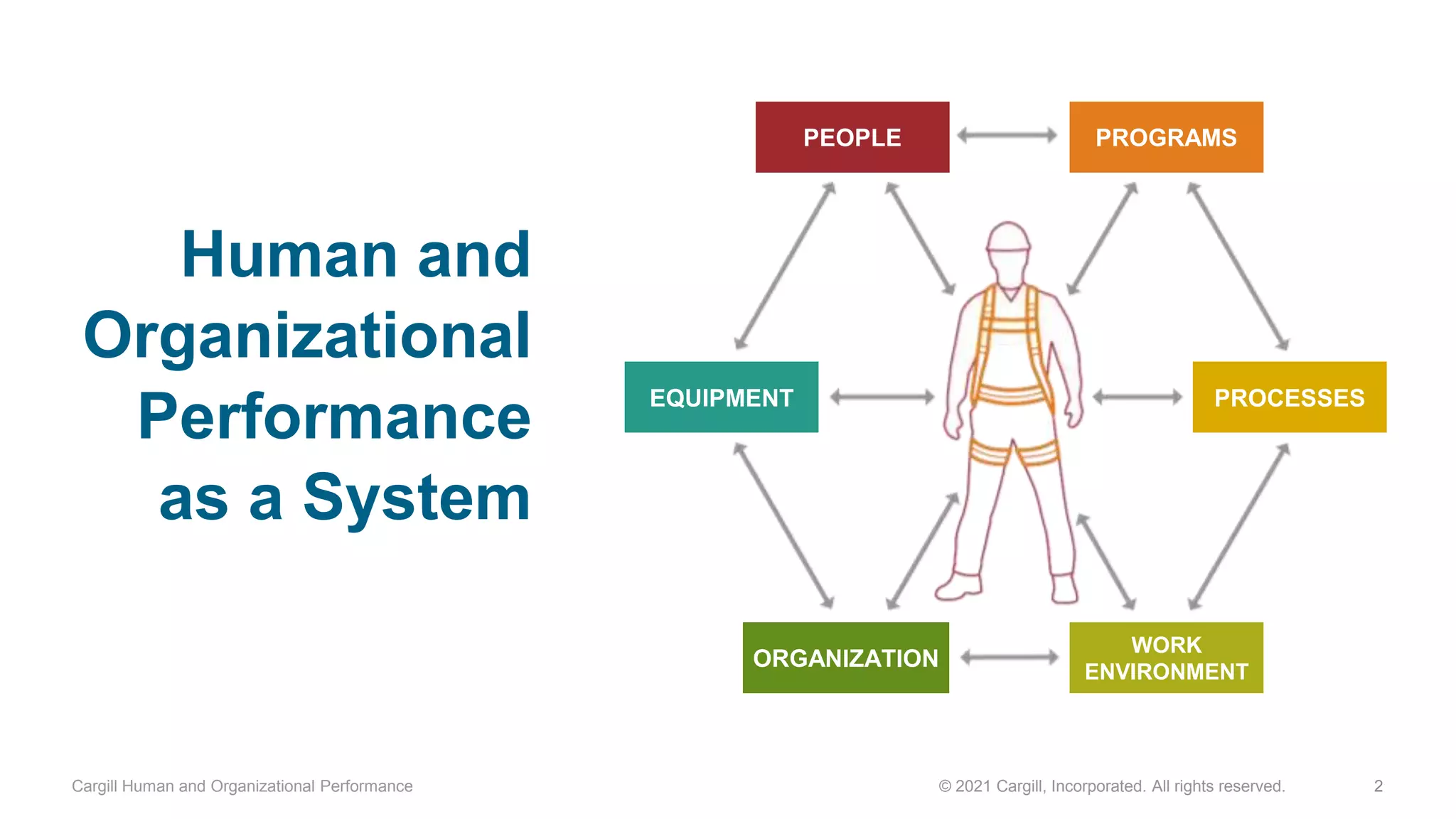
as a System
ORGANIZATION
WORK
ENVIRONMENT
PEOPLE PROGRAMS
EQUIPMENT PROCESSES
© 2021 Cargill, Incorporated. All rights reserved.
ORGANIZATION
WORK
ENVIRONMENT
PEOPLE PROGRAMS
EQUIPMENT PROCESSES
Understanding Human and Organizational Performance
3
Cargill Human and Organizational Performance
HOP Systems Model
• Helps us understand the complex
systems we work in every day
• Changes or deficiencies in one part of
our system affect the others
• Employees are experts at adapting to
changes and optimizing our systems
• “A bad system will beat a good
person every time.” – W.E. Deming
© 2021 Cargill, Incorporated. All rights reserved.
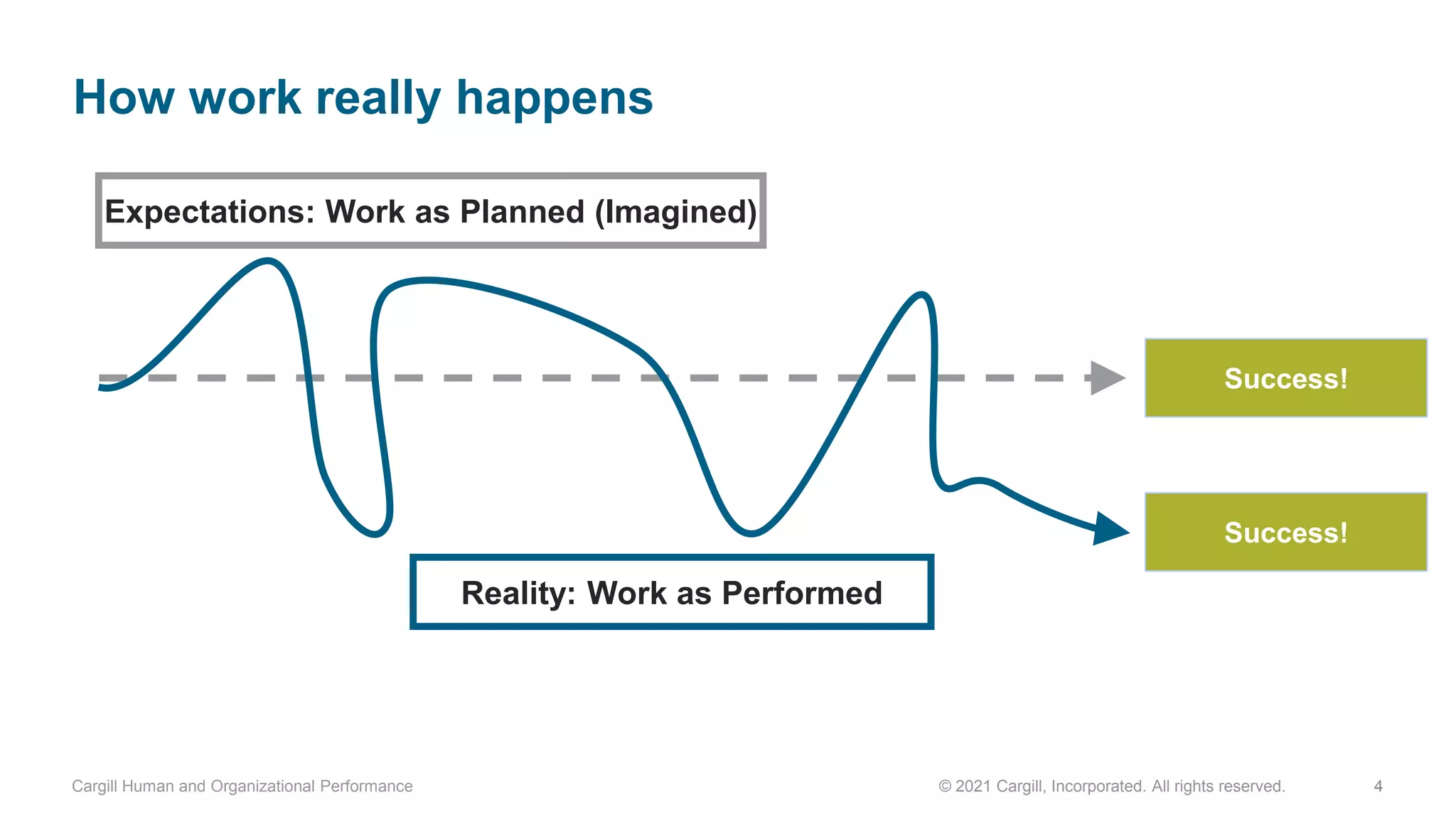
How work really happens
4
Cargill Human and Organizational Performance
Reality: Work as Performed
Success!
Success!
Expectations: Work as Planned (Imagined)
4 Cargill’s Safety Journey © 2014 Cargill, Incorporated. All rights reserved.
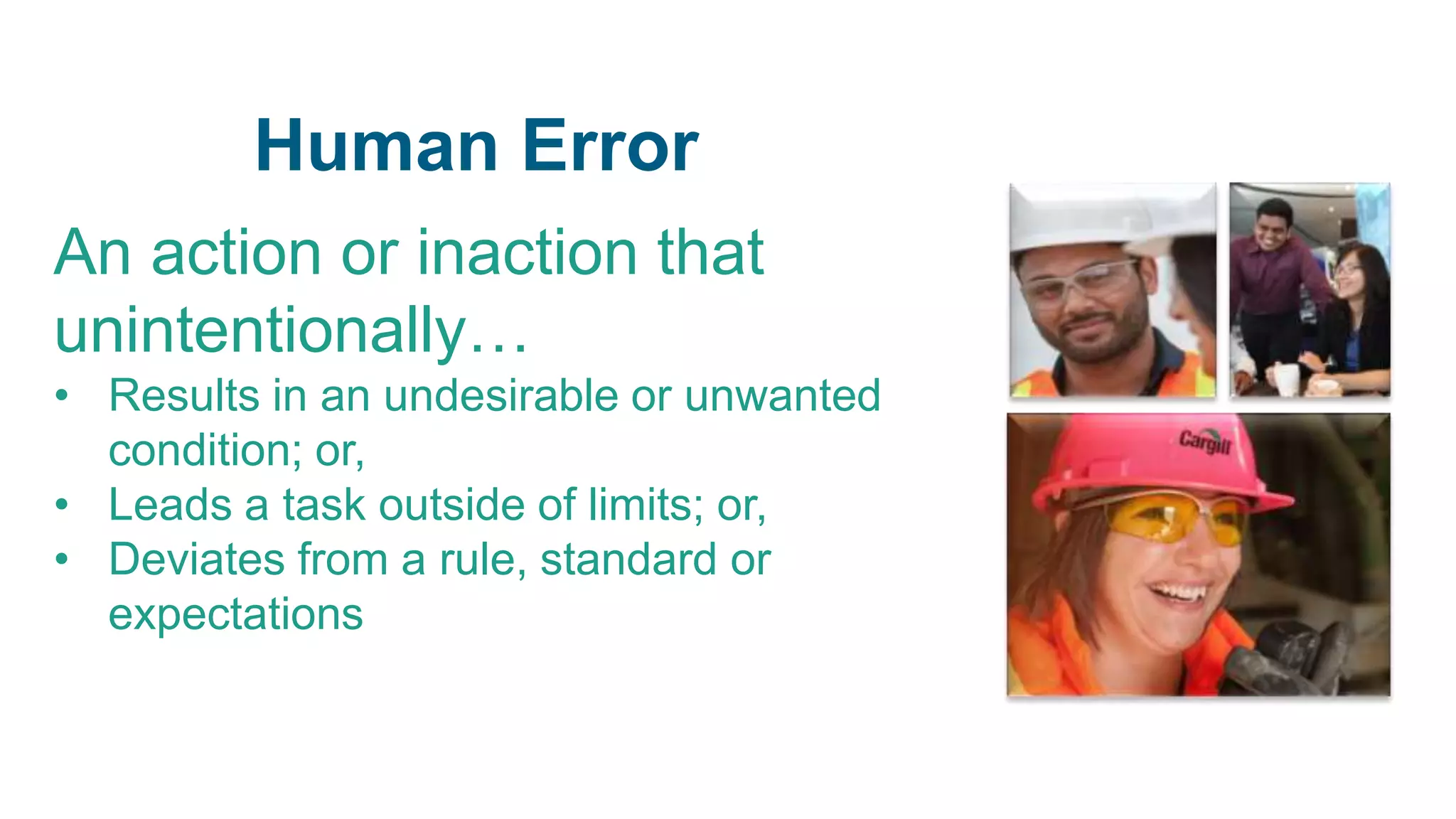
Human Error
An action or inaction that
unintentionally…
• Results in an undesirable or unwanted
condition; or,
• Leads a task outside of limits; or,
• Deviates from a rule, standard or
expectations
4 Cargill’s Safety Journey © 2014 Cargill, Incorporated. All rights reserved.
The Impact of Human Error at Work
20%
Machine and
Equipment
Failure
Workplace Injury
80%
Human
Error
4 Cargill’s Safety Journey © 2014 Cargill, Incorporated. All rights reserved.
Common Causes of Human Error
4
20%
Machine and
Equipment
Failure
80%
Human
Error
70%
30%
Workplace Injury Causes
Organizational
Weaknesses
Individual
Mistakes
20%
Machine &
Equipment
Failure
80%
Human
Error
Workplace Injury
© 2021 Cargill, Incorporated. All rights reserved.
More about errors…
8
Count the number of times the letter “f”
appears in the sentence below
Finished files are the result of years
of scientific study combined with the
experience of years.
Cargill Human and Organizational Performance
© 2021 Cargill, Incorporated. All rights reserved.
More about errors…
9
How many f’s?
Finished files are the result of years
of scientific study combined with the
experience of years.
Cargill Human and Organizational Performance
© 2021 Cargill, Incorporated. All rights reserved.
Human Error
10
Cargill Human and Organizational Performance
• An action or inaction that unintentionally:
– Results in an undesirable or unwanted condition OR
– Leads a task or system outside of limits OR
– Deviates from a set of rules, standards, or expectations
• Humans are error-making machines
• Error is not a choice
• Many errors do not impact performance
– Your people are experts at identifying that an error has occurred and
correcting the issue before something bad can happen
© 2021 Cargill, Incorporated. All rights reserved.
Human Error
11
Cargill Human and Organizational Performance
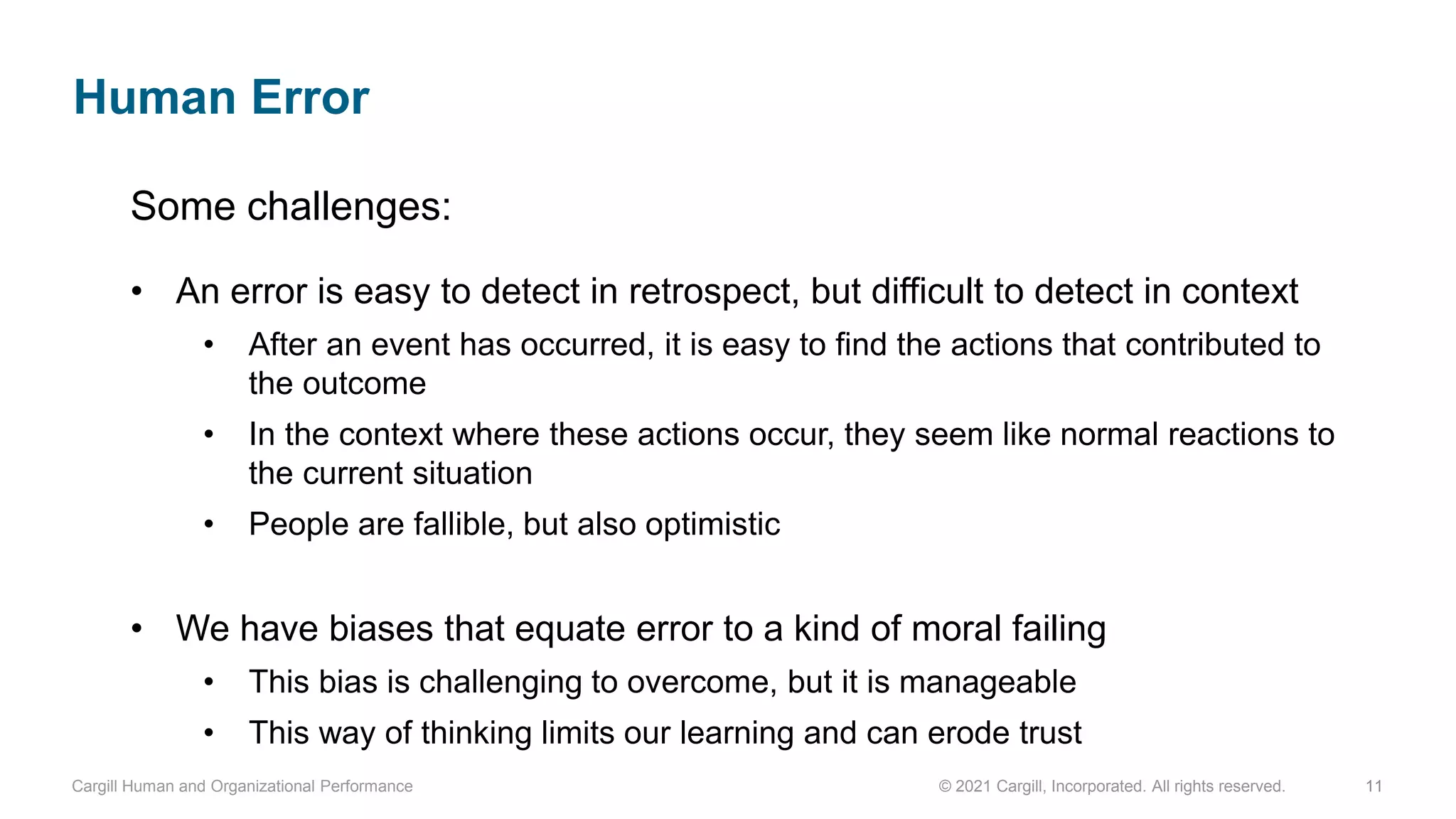
Some challenges:
• An error is easy to detect in retrospect, but difficult to detect in context
• After an event has occurred, it is easy to find the actions that contributed to
the outcome
• In the context where these actions occur, they seem like normal reactions to
the current situation
• People are fallible, but also optimistic
• We have biases that equate error to a kind of moral failing
• This bias is challenging to overcome, but it is manageable
• This way of thinking limits our learning and can erode trust
© 2021 Cargill, Incorporated. All rights reserved.
Defining Human Error
12
Cargill Human and Organizational Performance
Our mission:
• Build and maintain systems that can tolerate
and recover from the errors that will be made
• Make it easy to do the right thing and harder to
do the wrong thing
• Look for situations where an error could lead to
life altering or life ending events
• Value near misses as significant learning
opportunities
• Look for what went well in our systems’
responses and what did not respond well
• Determine if we are good or if we are lucky
© 2021 Cargill, Incorporated. All rights reserved.
Focusing on SIF
13
Cargill Human and Organizational Performance
SIF – Serious Injuries and Fatalities
• Cargill has 12 LIFEsaver activities where we are
more likely to have a SIF exposure or SIF event
• Appling HOP thinking and methods helps us:
• Identify systemic drivers and weaknesses
• Look for single-point vulnerabilities
• Verify the presence and capacity of the
controls that keep us safe
• Learn how well we support our employees and
contractors performing high risk work
Guiding Principles
Positive Reinforcement
Builds Trust
We Learn From
Past Incidents
Deviations Are
Rarely Malicious
People Make
Mistakes*
Error-likely Situations
are Preventable
Organization
Influences Behavior**
Leadership
Response Matters
*Derived from The Human Contribution, James Reason pg. 37 **Derived from Leading with Safety, Thomas Krause pgs. 16 and 17
People achieve high
performance because
of encouragement and
reinforcement from
leaders, peers and
subordinates.
Events can be avoided
through an
understanding of the
reasons mistakes
occur and lessons
learned.
Deviations are rarely
malicious, but well-
meaning behaviors,
intended to get the job
done.
People are fallible, and
even the best people
make mistakes.
Error-likely situations
are predictable,
manageable, and
preventable
Individual behavior is
influenced by
organizational
processes and values.
How leaders respond
to mistakes and
deviations matters.
© 2021 Cargill, Incorporated. All rights reserved.
Some Ideas to Take Home
15
Cargill Human and Organizational Performance
ORGANIZATION
WORK
ENVIRONMENT
PEOPLE PROGRAMS
EQUIPMENT PROCESSES
“People do what they do , at the time
they do it, for reasons that make
sense to them at that time.”
Sidney Dekker
• People base decisions on their understanding
of the context around them and the objectives
to be achieved
• If we cannot make sense of someone’s
decision, we likely do not understand the
context influencing that person
• We cannot manage what we do not understand
• Less information will not make us smarter
© 2021 Cargill, Incorporated. All rights reserved.
Some Ideas to Take Home
16
Cargill Human and Organizational Performance
“We can learn and improve, or we
can blame and punish. We cannot do
both.”
Todd Conklin
• Blame fixes nothing
• Learning and improving is a deliberate strategy
that requires reinforcement and demonstration
• This idea does not remove individual
accountability
• Watch and listen for counterfactual statements
• “Employee failed to follow procedure.”
• “SOP was not used as directed.”
• “Team failed to recognize a risk/hazard/issue.”
We Learn From
Past Incidents
Deviations Are
Rarely Malicious
Organization
Influences Behavior**
Leadership
Response Matters
Events can be avoided
through an
understanding of the
reasons mistakes
occur and lessons
learned.
Deviations are rarely
malicious, but well-
meaning behaviors,
intended to get the job
done.
Individual behavior is
influenced by
organizational
processes and values.
How leaders respond
to mistakes and
deviations matters.
© 2021 Cargill, Incorporated. All rights reserved.
Some Ideas to Take Home
17
Cargill Human and Organizational Performance
Shift from asking “why” to asking “how”
Rob Fisher
• The words we use influences the context and culture of
our organization
• Shifting our language to asking “how” influences the
way people look at events and opens the door to a
deeper, more impactful learning
• Asking “why” too early can cut learning short because
people try to draw conclusions or causes from limited
data
Leadership
Response Matters
How leaders respond
to mistakes and
deviations matters.
© 2021 Cargill, Incorporated. All rights reserved.
Where to Learn More…
18
Cargill Human and Organizational Performance
© 2021 Cargill, Incorporated. All rights reserved.
Where to Learn More…
19
Cargill Human and Organizational Performance
© 2021 Cargill, Incorporated. All rights reserved.
Where to Learn More…
20
Cargill Human and Organizational Performance
youtube.com/user/sidneydekker
© 2021 Cargill, Incorporated. All rights reserved.
Thank You
Ben Ferguson, CSP
Ben_Ferguson@Cargill.com
linkedin.com/in/benfergusoncsp
© 2021 Cargill, Incorporated. All rights reserved. 22
Cargill Human and Organizational Performance

2. Human and Organizational Performance

  • 1.
    CONFIDENTIAL. This documentcontains Cargill Confidential information. Disclosure, use or reproduction outside Cargill or inside Cargill, to or by those who do not have a need to know is prohibited. © 2021 Cargill, Incorporated. All rights reserved. A brief introduction to HOP Human and Organizational Performance
  • 2.
    © 2021 Cargill,Incorporated. All rights reserved. 2 Cargill Human and Organizational Performance Human and Organizational Performance as a System ORGANIZATION WORK ENVIRONMENT PEOPLE PROGRAMS EQUIPMENT PROCESSES
  • 3.
    © 2021 Cargill,Incorporated. All rights reserved. ORGANIZATION WORK ENVIRONMENT PEOPLE PROGRAMS EQUIPMENT PROCESSES Understanding Human and Organizational Performance 3 Cargill Human and Organizational Performance HOP Systems Model • Helps us understand the complex systems we work in every day • Changes or deficiencies in one part of our system affect the others • Employees are experts at adapting to changes and optimizing our systems • “A bad system will beat a good person every time.” – W.E. Deming
  • 4.
    © 2021 Cargill,Incorporated. All rights reserved. How work really happens 4 Cargill Human and Organizational Performance Reality: Work as Performed Success! Success! Expectations: Work as Planned (Imagined)
  • 5.
    4 Cargill’s SafetyJourney © 2014 Cargill, Incorporated. All rights reserved. Human Error An action or inaction that unintentionally… • Results in an undesirable or unwanted condition; or, • Leads a task outside of limits; or, • Deviates from a rule, standard or expectations
  • 6.
    4 Cargill’s SafetyJourney © 2014 Cargill, Incorporated. All rights reserved. The Impact of Human Error at Work 20% Machine and Equipment Failure Workplace Injury 80% Human Error
  • 7.
    4 Cargill’s SafetyJourney © 2014 Cargill, Incorporated. All rights reserved. Common Causes of Human Error 4 20% Machine and Equipment Failure 80% Human Error 70% 30% Workplace Injury Causes Organizational Weaknesses Individual Mistakes 20% Machine & Equipment Failure 80% Human Error Workplace Injury
  • 8.
    © 2021 Cargill,Incorporated. All rights reserved. More about errors… 8 Count the number of times the letter “f” appears in the sentence below Finished files are the result of years of scientific study combined with the experience of years. Cargill Human and Organizational Performance
  • 9.
    © 2021 Cargill,Incorporated. All rights reserved. More about errors… 9 How many f’s? Finished files are the result of years of scientific study combined with the experience of years. Cargill Human and Organizational Performance
  • 10.
    © 2021 Cargill,Incorporated. All rights reserved. Human Error 10 Cargill Human and Organizational Performance • An action or inaction that unintentionally: – Results in an undesirable or unwanted condition OR – Leads a task or system outside of limits OR – Deviates from a set of rules, standards, or expectations • Humans are error-making machines • Error is not a choice • Many errors do not impact performance – Your people are experts at identifying that an error has occurred and correcting the issue before something bad can happen
  • 11.
    © 2021 Cargill,Incorporated. All rights reserved. Human Error 11 Cargill Human and Organizational Performance Some challenges: • An error is easy to detect in retrospect, but difficult to detect in context • After an event has occurred, it is easy to find the actions that contributed to the outcome • In the context where these actions occur, they seem like normal reactions to the current situation • People are fallible, but also optimistic • We have biases that equate error to a kind of moral failing • This bias is challenging to overcome, but it is manageable • This way of thinking limits our learning and can erode trust
  • 12.
    © 2021 Cargill,Incorporated. All rights reserved. Defining Human Error 12 Cargill Human and Organizational Performance Our mission: • Build and maintain systems that can tolerate and recover from the errors that will be made • Make it easy to do the right thing and harder to do the wrong thing • Look for situations where an error could lead to life altering or life ending events • Value near misses as significant learning opportunities • Look for what went well in our systems’ responses and what did not respond well • Determine if we are good or if we are lucky
  • 13.
    © 2021 Cargill,Incorporated. All rights reserved. Focusing on SIF 13 Cargill Human and Organizational Performance SIF – Serious Injuries and Fatalities • Cargill has 12 LIFEsaver activities where we are more likely to have a SIF exposure or SIF event • Appling HOP thinking and methods helps us: • Identify systemic drivers and weaknesses • Look for single-point vulnerabilities • Verify the presence and capacity of the controls that keep us safe • Learn how well we support our employees and contractors performing high risk work
  • 14.
    Guiding Principles Positive Reinforcement BuildsTrust We Learn From Past Incidents Deviations Are Rarely Malicious People Make Mistakes* Error-likely Situations are Preventable Organization Influences Behavior** Leadership Response Matters *Derived from The Human Contribution, James Reason pg. 37 **Derived from Leading with Safety, Thomas Krause pgs. 16 and 17 People achieve high performance because of encouragement and reinforcement from leaders, peers and subordinates. Events can be avoided through an understanding of the reasons mistakes occur and lessons learned. Deviations are rarely malicious, but well- meaning behaviors, intended to get the job done. People are fallible, and even the best people make mistakes. Error-likely situations are predictable, manageable, and preventable Individual behavior is influenced by organizational processes and values. How leaders respond to mistakes and deviations matters.
  • 15.
    © 2021 Cargill,Incorporated. All rights reserved. Some Ideas to Take Home 15 Cargill Human and Organizational Performance ORGANIZATION WORK ENVIRONMENT PEOPLE PROGRAMS EQUIPMENT PROCESSES “People do what they do , at the time they do it, for reasons that make sense to them at that time.” Sidney Dekker • People base decisions on their understanding of the context around them and the objectives to be achieved • If we cannot make sense of someone’s decision, we likely do not understand the context influencing that person • We cannot manage what we do not understand • Less information will not make us smarter
  • 16.
    © 2021 Cargill,Incorporated. All rights reserved. Some Ideas to Take Home 16 Cargill Human and Organizational Performance “We can learn and improve, or we can blame and punish. We cannot do both.” Todd Conklin • Blame fixes nothing • Learning and improving is a deliberate strategy that requires reinforcement and demonstration • This idea does not remove individual accountability • Watch and listen for counterfactual statements • “Employee failed to follow procedure.” • “SOP was not used as directed.” • “Team failed to recognize a risk/hazard/issue.” We Learn From Past Incidents Deviations Are Rarely Malicious Organization Influences Behavior** Leadership Response Matters Events can be avoided through an understanding of the reasons mistakes occur and lessons learned. Deviations are rarely malicious, but well- meaning behaviors, intended to get the job done. Individual behavior is influenced by organizational processes and values. How leaders respond to mistakes and deviations matters.
  • 17.
    © 2021 Cargill,Incorporated. All rights reserved. Some Ideas to Take Home 17 Cargill Human and Organizational Performance Shift from asking “why” to asking “how” Rob Fisher • The words we use influences the context and culture of our organization • Shifting our language to asking “how” influences the way people look at events and opens the door to a deeper, more impactful learning • Asking “why” too early can cut learning short because people try to draw conclusions or causes from limited data Leadership Response Matters How leaders respond to mistakes and deviations matters.
  • 18.
    © 2021 Cargill,Incorporated. All rights reserved. Where to Learn More… 18 Cargill Human and Organizational Performance
  • 19.
    © 2021 Cargill,Incorporated. All rights reserved. Where to Learn More… 19 Cargill Human and Organizational Performance
  • 20.
    © 2021 Cargill,Incorporated. All rights reserved. Where to Learn More… 20 Cargill Human and Organizational Performance youtube.com/user/sidneydekker
  • 21.
    © 2021 Cargill,Incorporated. All rights reserved. Thank You Ben Ferguson, CSP Ben_Ferguson@Cargill.com linkedin.com/in/benfergusoncsp
  • 22.
    © 2021 Cargill,Incorporated. All rights reserved. 22 Cargill Human and Organizational Performance