A grammatical categoryis a set
of syntactic features that express
meanings from the same
conceptual domain, occur in
contrast to each other, and are
typically expressed in the same
fashion.
3.
The following listof grammatical
categories will be exposed
through the nominal categories
(number, gender, person, case,
degree, definitiness) and then
the verbal categories (tense,
aspect, mood, and voice).
4.
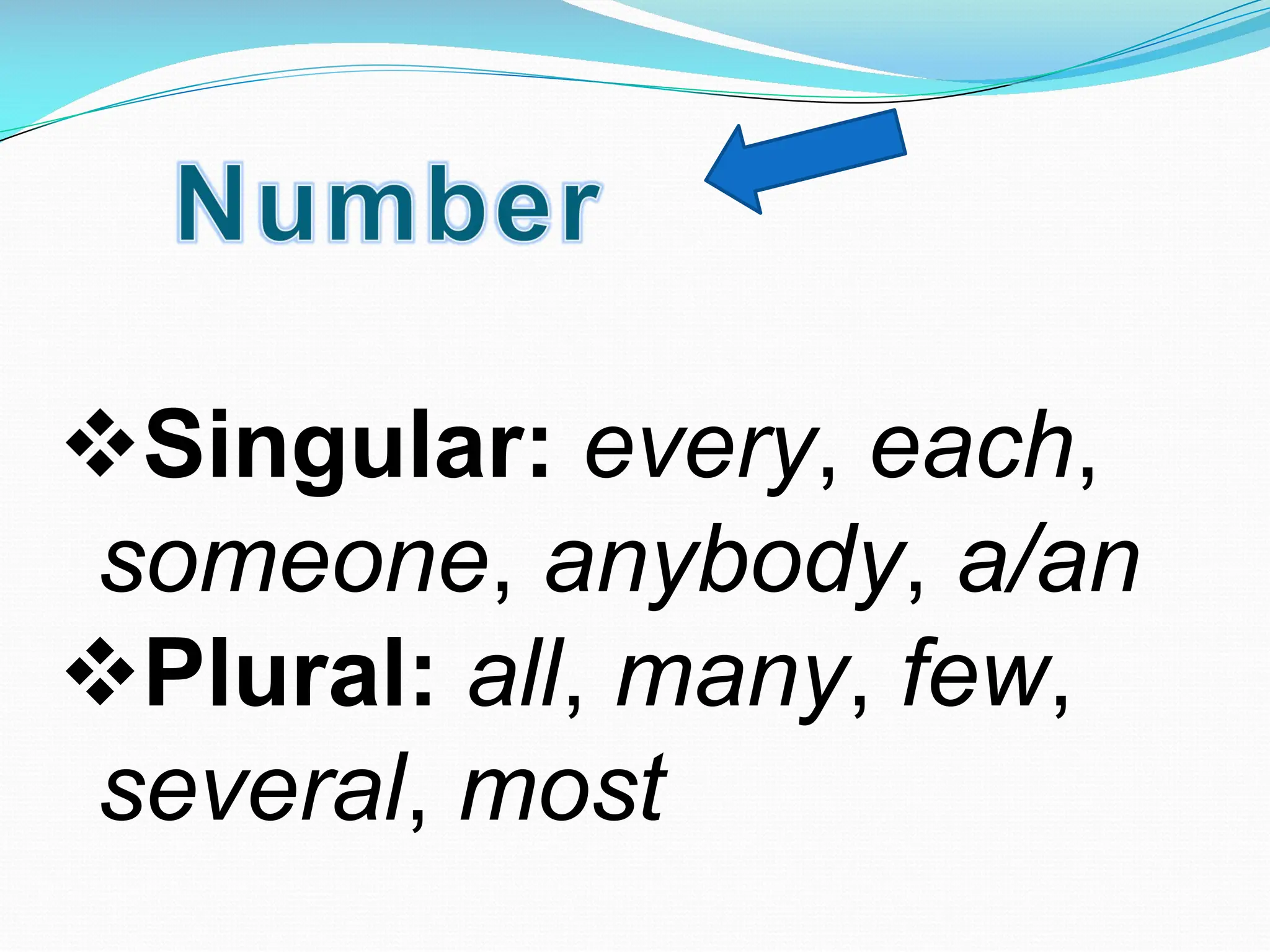
This first categoryis relatively simple. There are two terms
of this category in English: singular (the concept of one) and
plural (the concept of more than one). Number is expressed
by inflection, generally by -s:
vIn count nouns (dog/dogs)
vIn demonstratives (this/these, that/those)
vIn the 1st and 3rd p of personal pronouns (I/we),
possessive determiners (my/our), possessive pronouns
(mine/ours), and reflexive pronouns (myself/ourselves),
but not in the 2nd person. Number is also expressed by
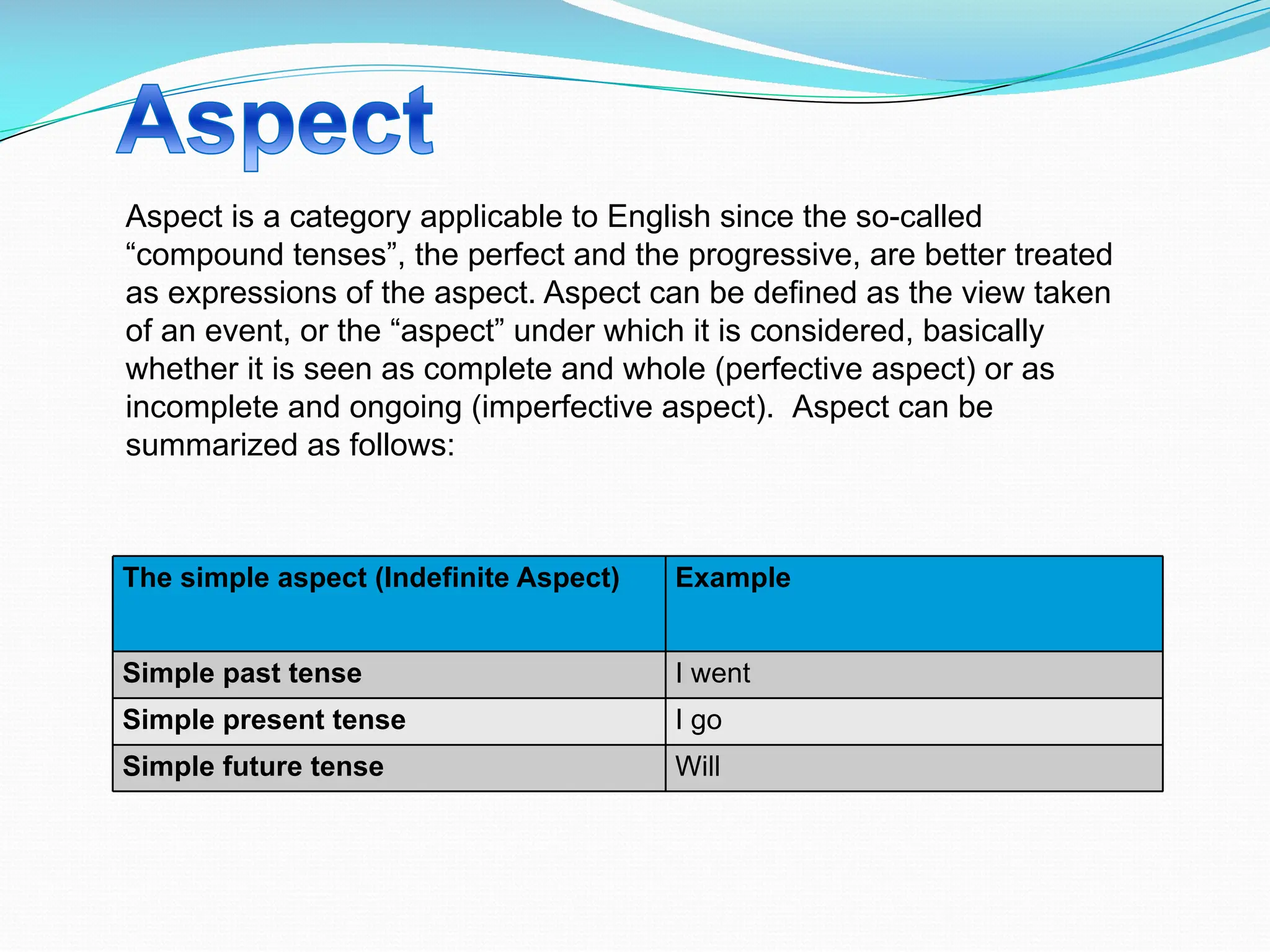
distinct forms of certain pronouns and adjectives:
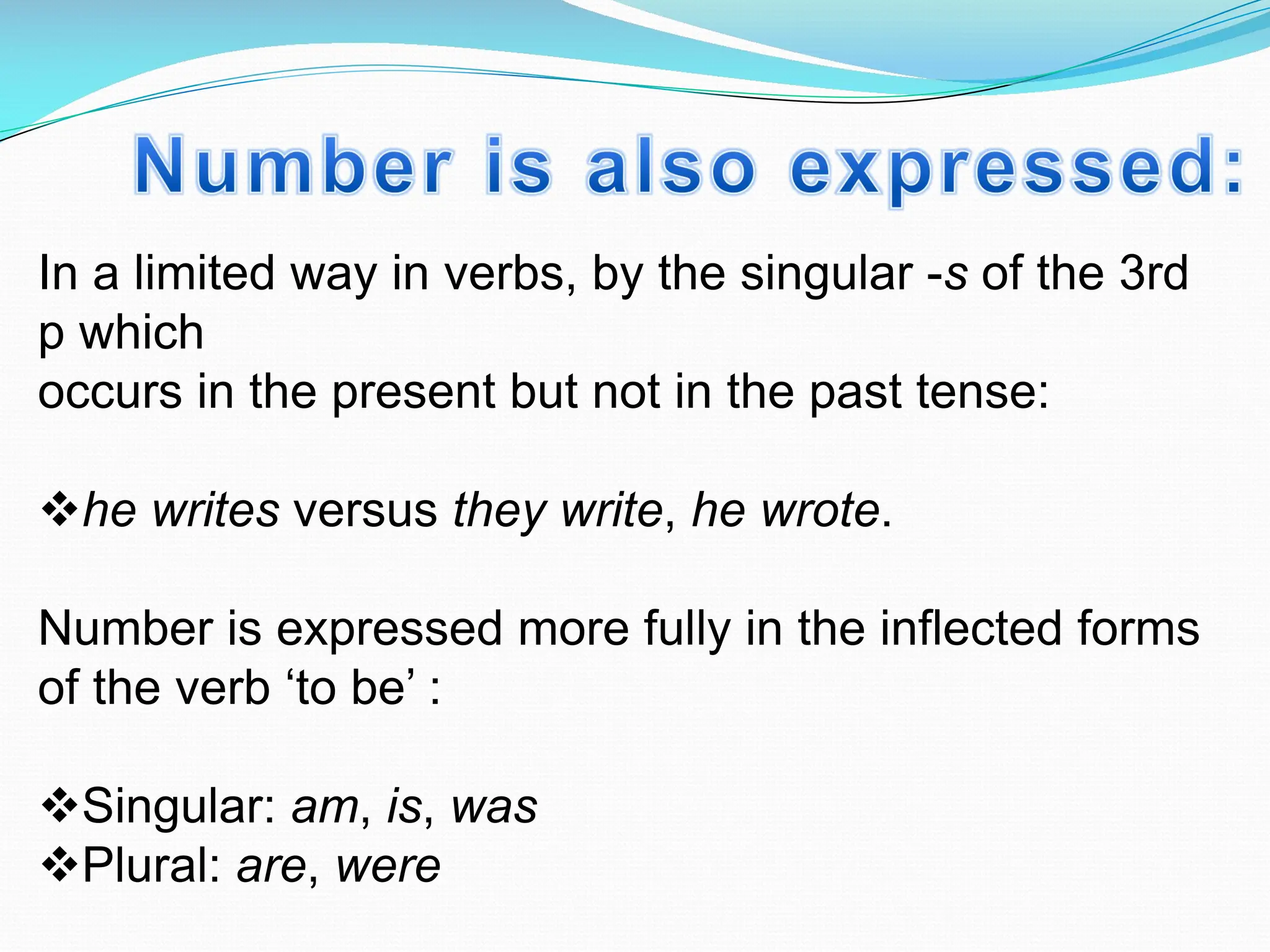
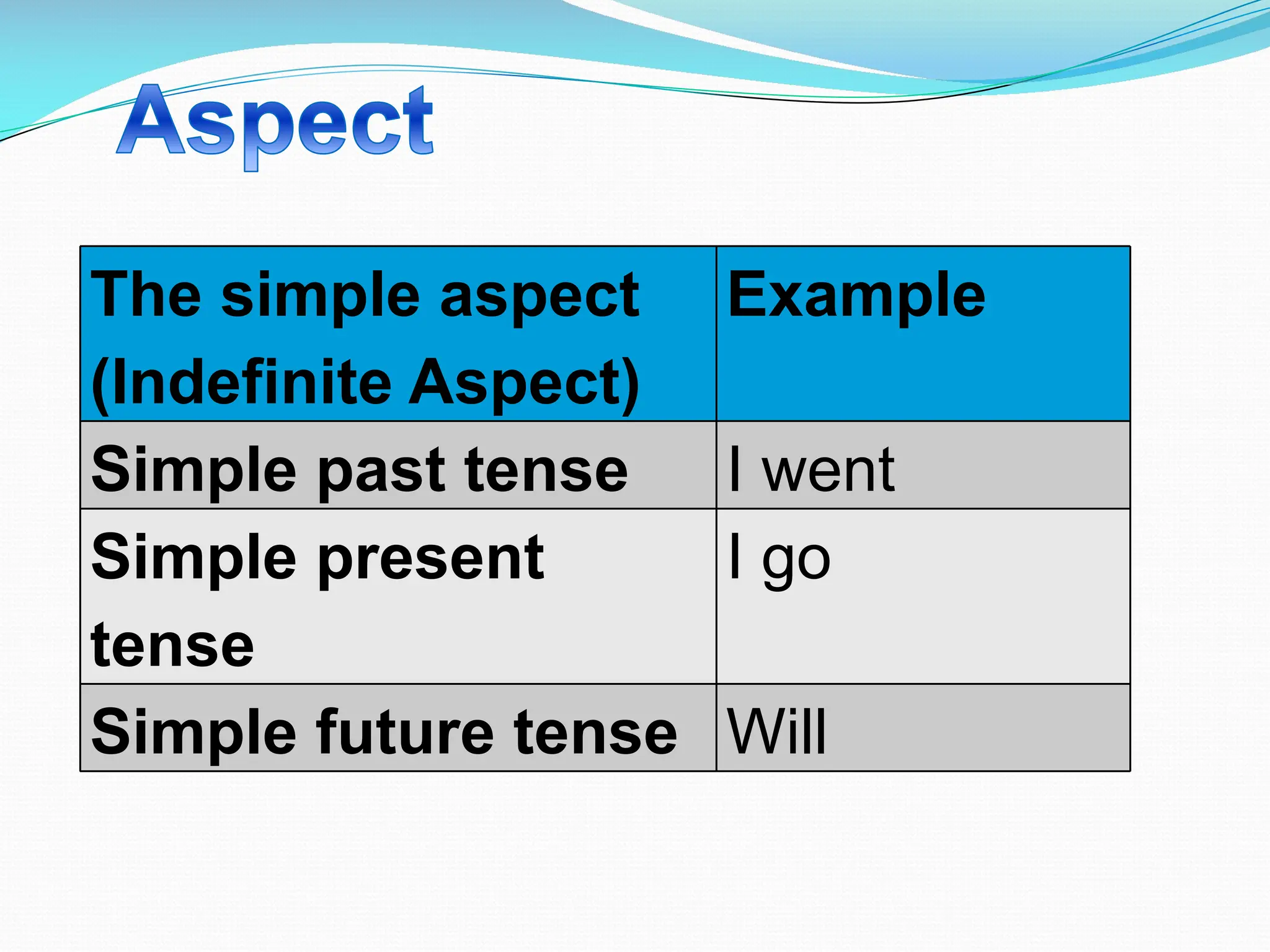
In a limitedway in verbs, by the singular -s of the 3rd
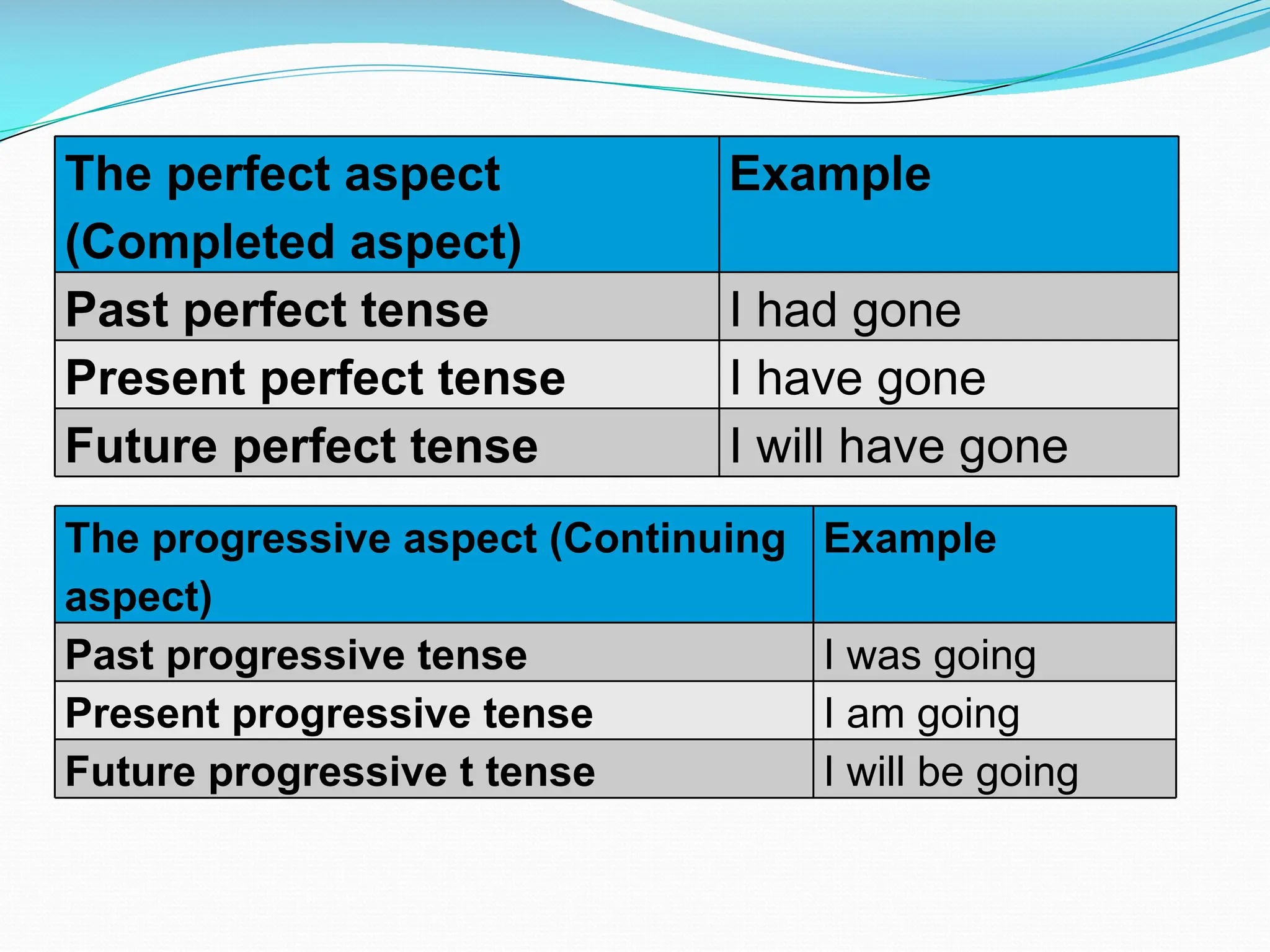
p which
occurs in the present but not in the past tense:
vhe writes versus they write, he wrote.
Number is expressed more fully in the inflected forms
of the verb ‘to be’ :
vSingular: am, is, was
vPlural: are, were
7.
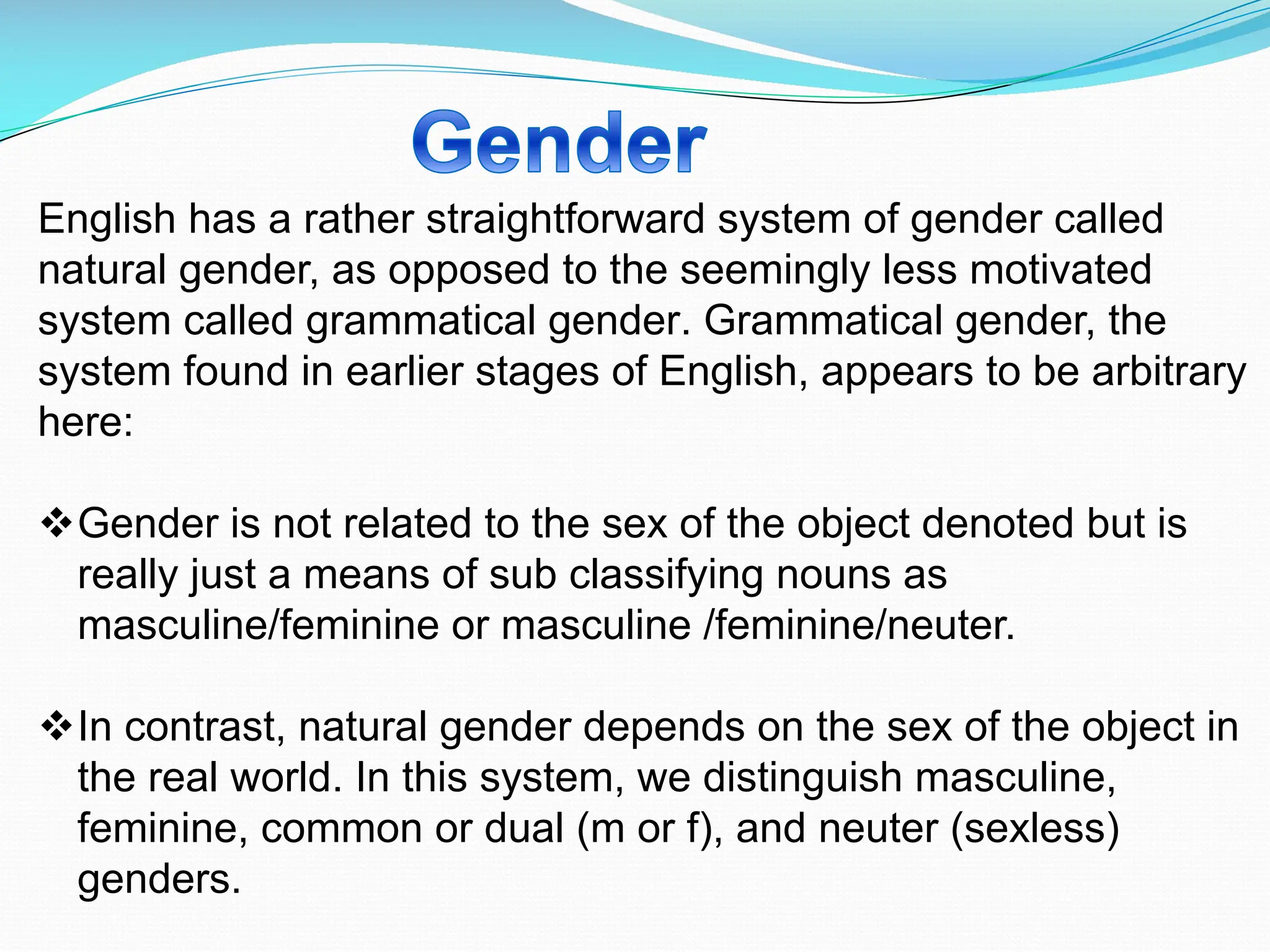
English has arather straightforward system of gender called
natural gender, as opposed to the seemingly less motivated
system called grammatical gender. Grammatical gender, the
system found in earlier stages of English, appears to be arbitrary
here:
vGender is not related to the sex of the object denoted but is
really just a means of sub classifying nouns as
masculine/feminine or masculine /feminine/neuter.
vIn contrast, natural gender depends on the sex of the object in
the real world. In this system, we distinguish masculine,
feminine, common or dual (m or f), and neuter (sexless)
genders.
8.
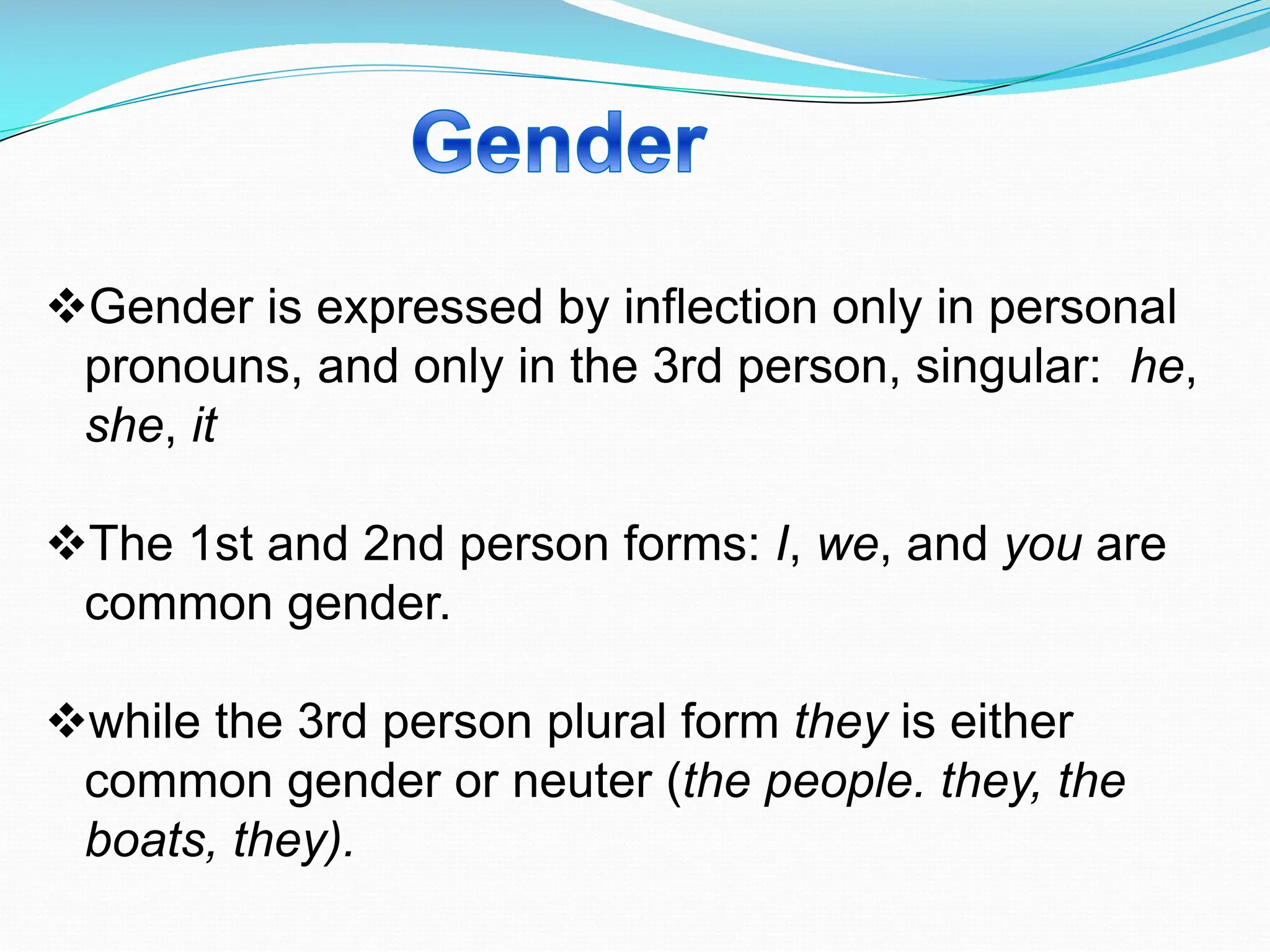
vGender is expressedby inflection only in personal
pronouns, and only in the 3rd person, singular: he,
she, it
vThe 1st and 2nd person forms: I, we, and you are
common gender.
vwhile the 3rd person plural form they is either
common gender or neuter (the people. they, the
boats, they).
9.
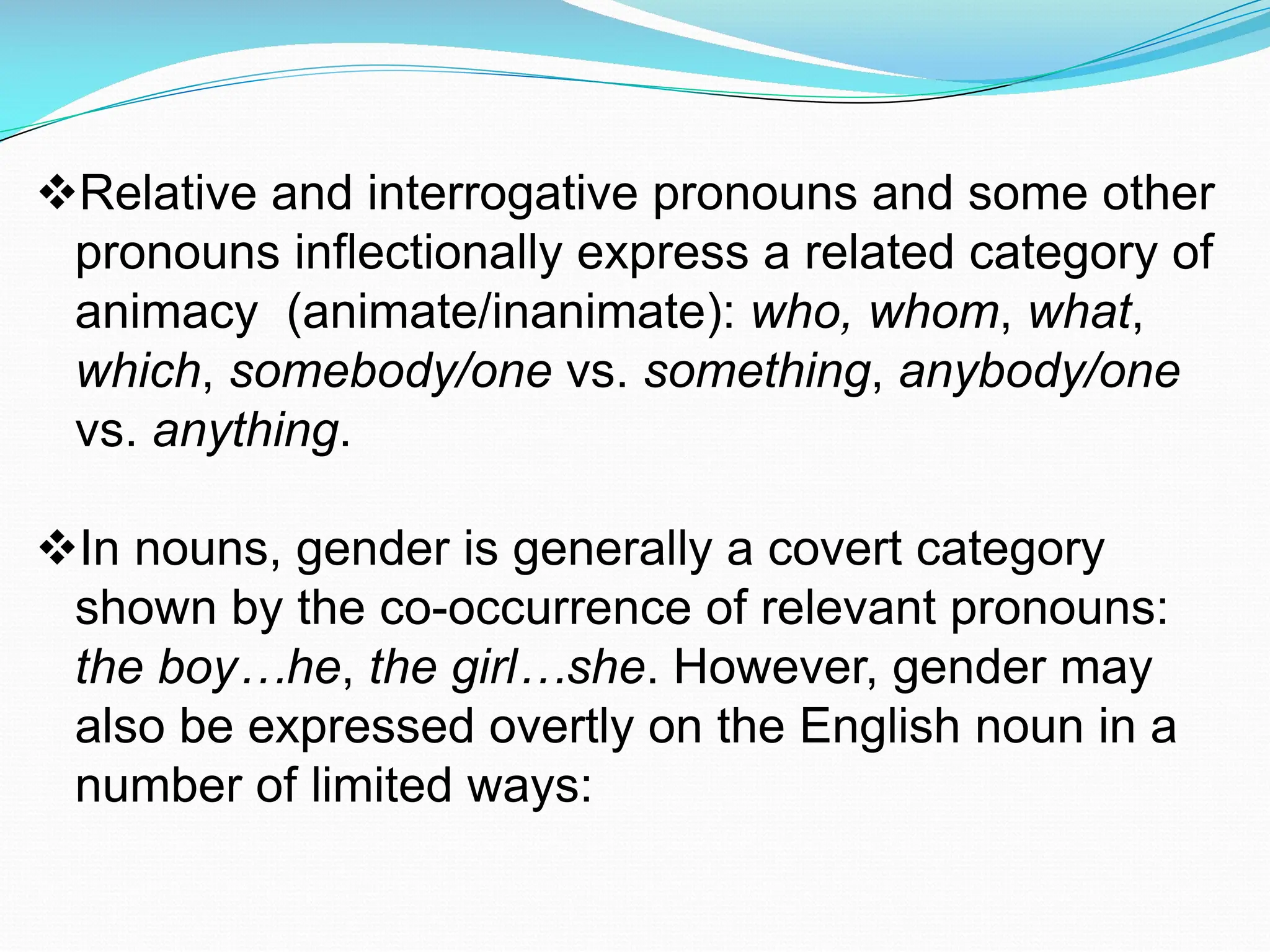
vRelative and interrogativepronouns and some other
pronouns inflectionally express a related category of
animacy (animate/inanimate): who, whom, what,
which, somebody/one vs. something, anybody/one
vs. anything.
vIn nouns, gender is generally a covert category
shown by the co-occurrence of relevant pronouns:
the boy…he, the girl…she. However, gender may
also be expressed overtly on the English noun in a
number of limited ways:
10.
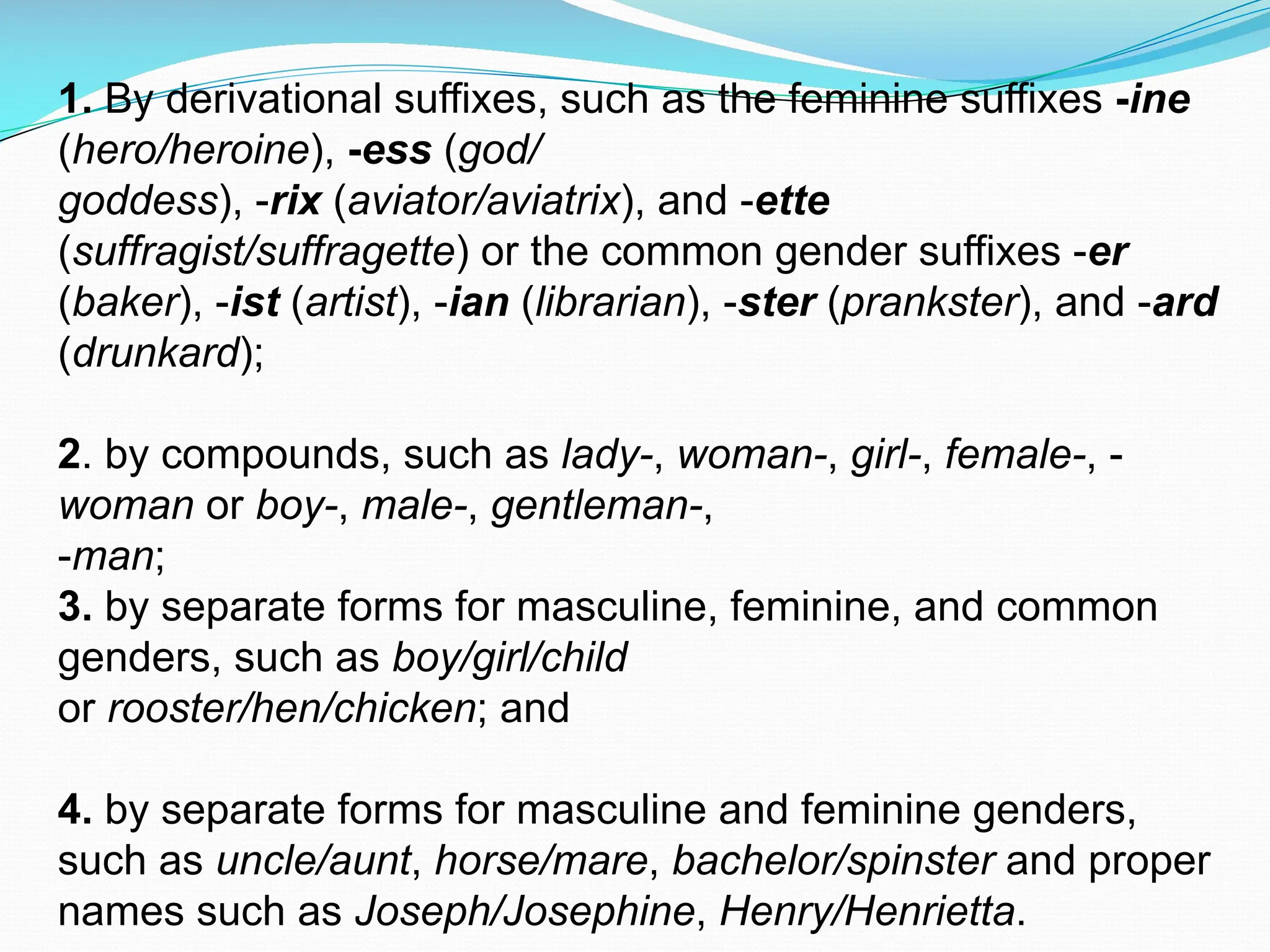
1. By derivationalsuffixes, such as the feminine suffixes -ine
(hero/heroine), -ess (god/
goddess), -rix (aviator/aviatrix), and -ette
(suffragist/suffragette) or the common gender suffixes -er
(baker), -ist (artist), -ian (librarian), -ster (prankster), and -ard
(drunkard);
2. by compounds, such as lady-, woman-, girl-, female-, -
woman or boy-, male-, gentleman-,
-man;
3. by separate forms for masculine, feminine, and common
genders, such as boy/girl/child
or rooster/hen/chicken; and
4. by separate forms for masculine and feminine genders,
such as uncle/aunt, horse/mare, bachelor/spinster and proper
names such as Joseph/Josephine, Henry/Henrietta.
11.
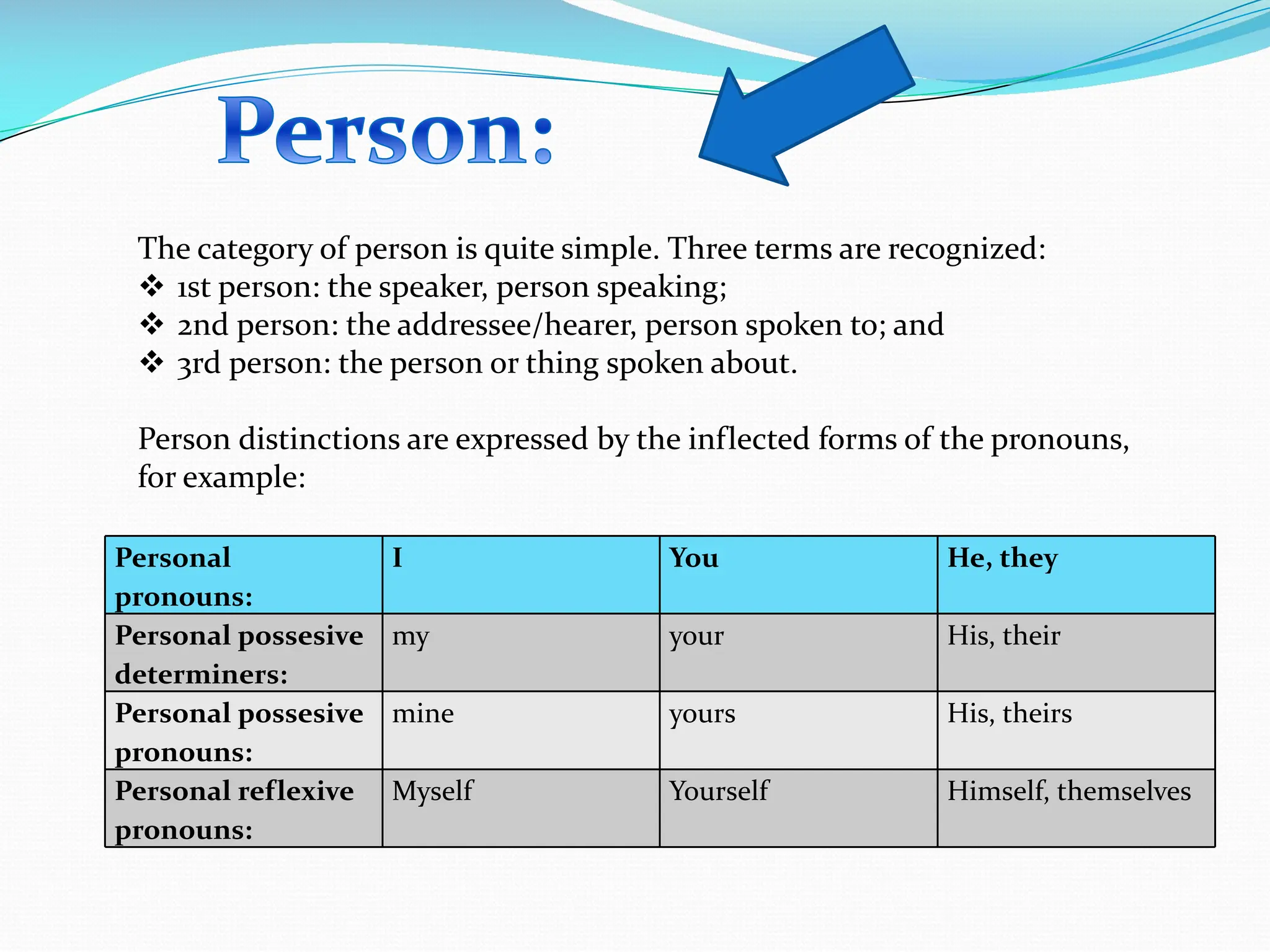
The category ofperson is quite simple. Three terms are recognized:
v 1st person: the speaker, person speaking;
v 2nd person: the addressee/hearer, person spoken to; and
v 3rd person: the person or thing spoken about.
Person distinctions are expressed by the inflected forms of the pronouns,
for example:
Personal
pronouns:
I You He, they
Personal possesive
determiners:
my your His, their
Personal possesive
pronouns:
mine yours His, theirs
Personal reflexive
pronouns:
Myself Yourself Himself, themselves
12.
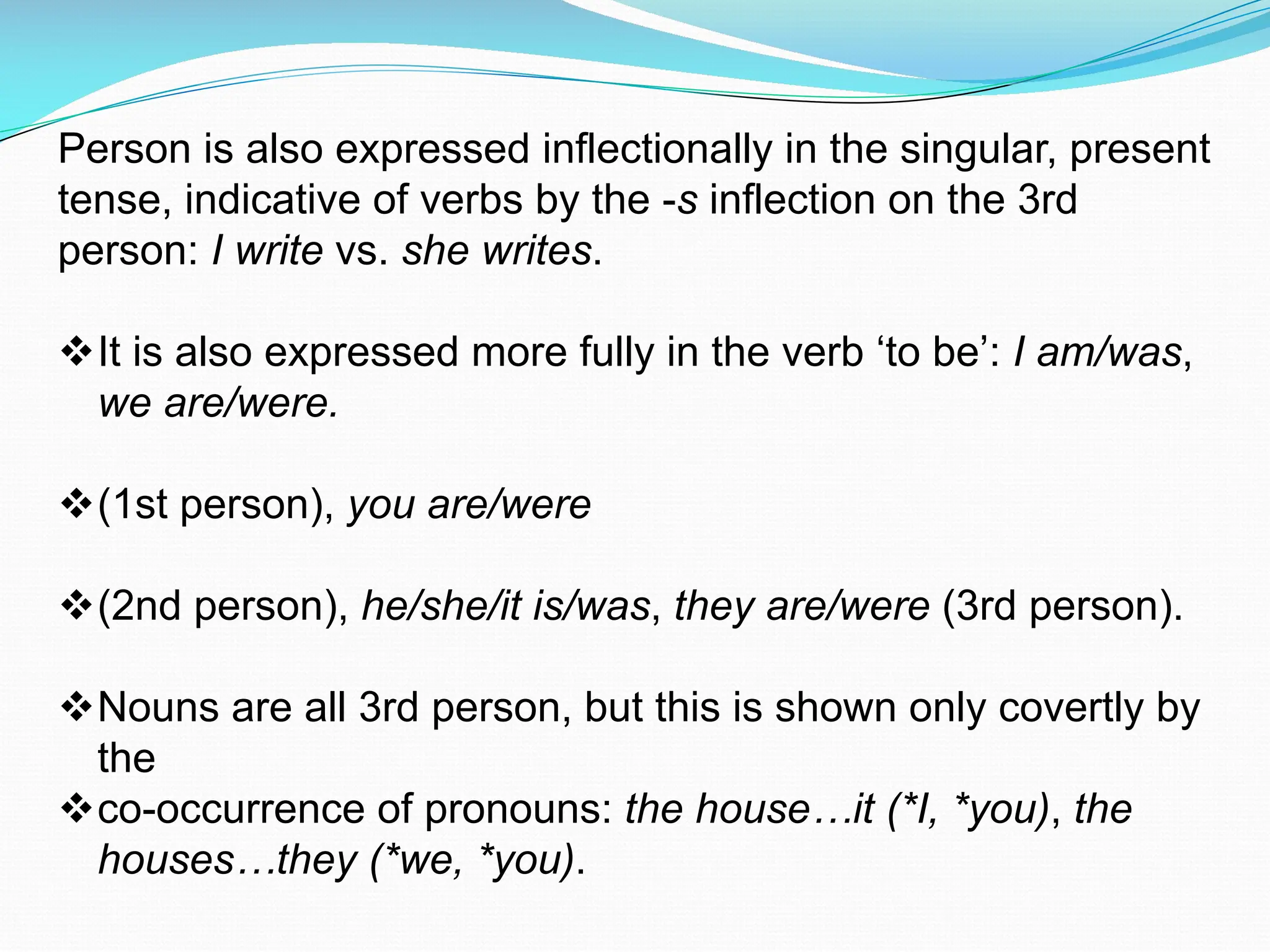
Person is alsoexpressed inflectionally in the singular, present
tense, indicative of verbs by the -s inflection on the 3rd
person: I write vs. she writes.
vIt is also expressed more fully in the verb ‘to be’: I am/was,
we are/were.
v(1st person), you are/were
v(2nd person), he/she/it is/was, they are/were (3rd person).
vNouns are all 3rd person, but this is shown only covertly by
the
vco-occurrence of pronouns: the house…it (*I, *you), the
houses…they (*we, *you).
13.
Case is oneof the more difficult
categories. It may be defined rather
simply as an indication of the
function of a noun phrase, or the
relationship of a noun phrase to a
verb or to other noun phrases in the
sentence.
14.
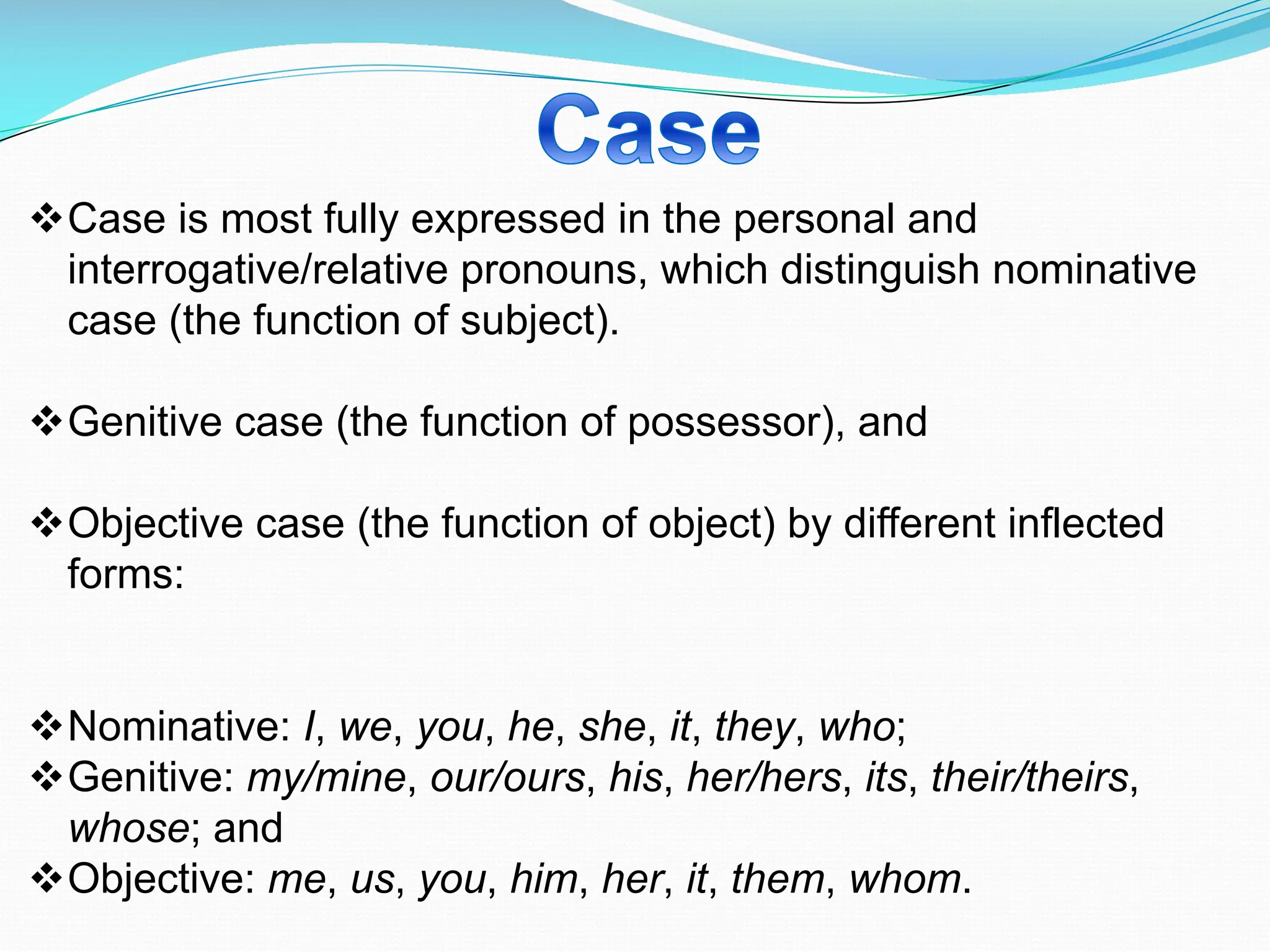
vCase is mostfully expressed in the personal and
interrogative/relative pronouns, which distinguish nominative
case (the function of subject).
vGenitive case (the function of possessor), and
vObjective case (the function of object) by different inflected
forms:
vNominative: I, we, you, he, she, it, they, who;
vGenitive: my/mine, our/ours, his, her/hers, its, their/theirs,
whose; and
vObjective: me, us, you, him, her, it, them, whom.
15.
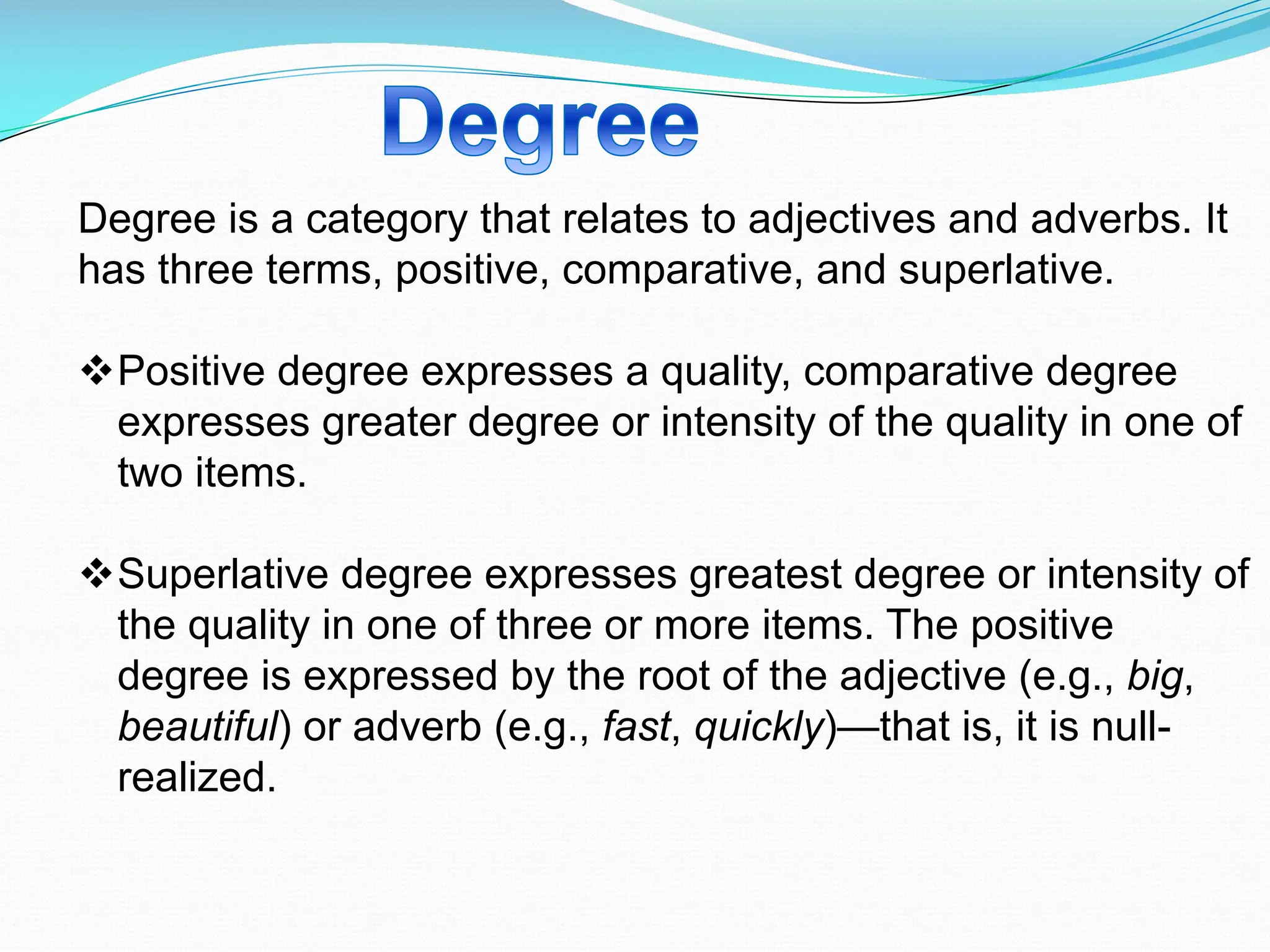
Degree is acategory that
relates to adjectives and
adverbs. It has three terms,
positive, comparative, and
superlative.
16.
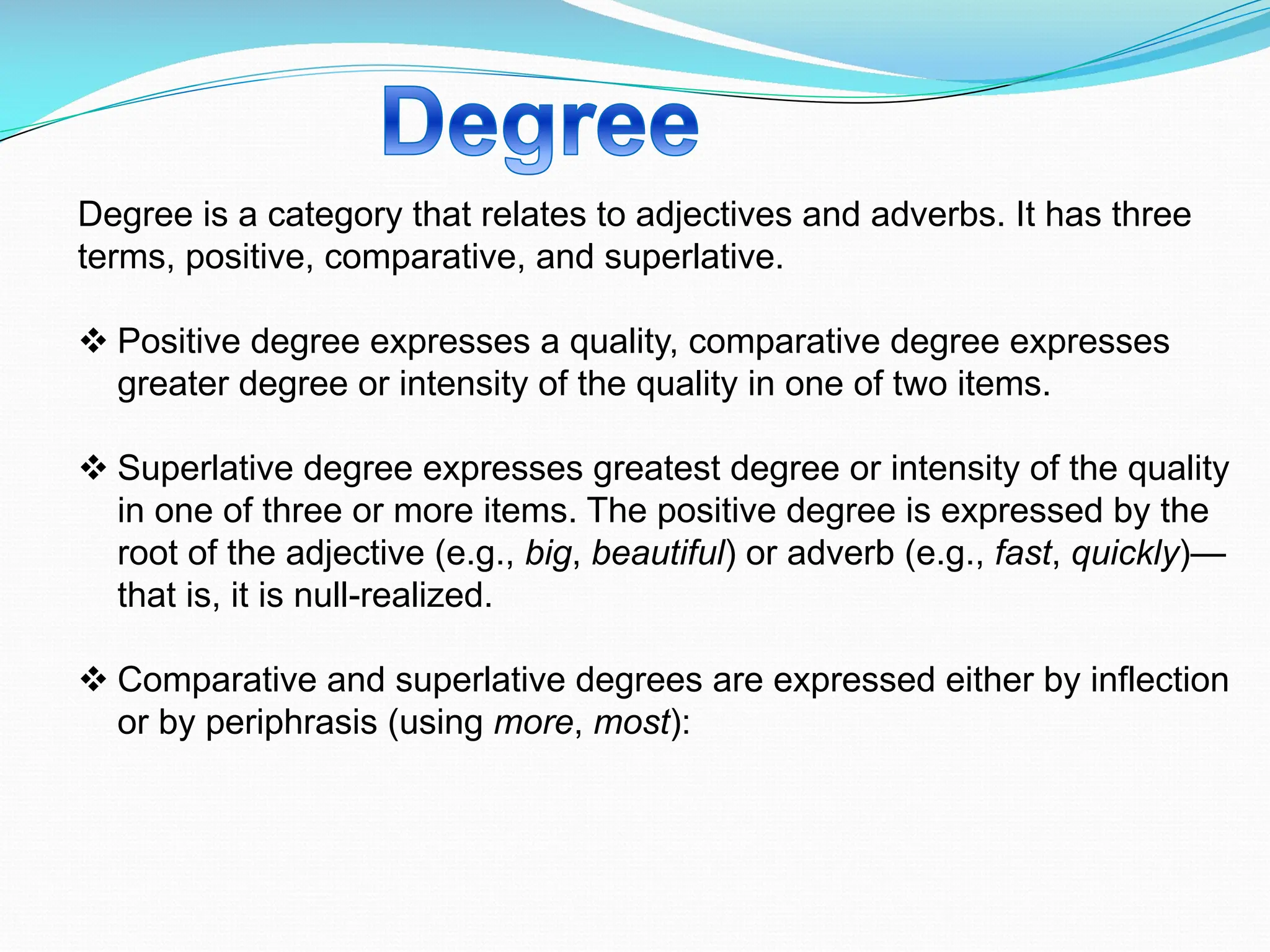
Degree is acategory that relates to
adjectives and adverbs. It has three terms,
positive, comparative, and superlative.
vPositive degree expresses a quality,
comparative degree expresses greater
degree or intensity of the quality in one
of two items.
17.
Degree is acategory that relates to adjectives and adverbs. It
has three terms, positive, comparative, and superlative.
vPositive degree expresses a quality, comparative degree
expresses greater degree or intensity of the quality in one of
two items.
vSuperlative degree expresses greatest degree or intensity of
the quality in one of three or more items. The positive
degree is expressed by the root of the adjective (e.g., big,
beautiful) or adverb (e.g., fast, quickly)—that is, it is null-
realized.
18.
Degree is acategory that relates to adjectives and adverbs. It has three
terms, positive, comparative, and superlative.
v Positive degree expresses a quality, comparative degree expresses
greater degree or intensity of the quality in one of two items.
v Superlative degree expresses greatest degree or intensity of the quality
in one of three or more items. The positive degree is expressed by the
root of the adjective (e.g., big, beautiful) or adverb (e.g., fast, quickly)—
that is, it is null-realized.
v Comparative and superlative degrees are expressed either by inflection
or by periphrasis (using more, most):
19.
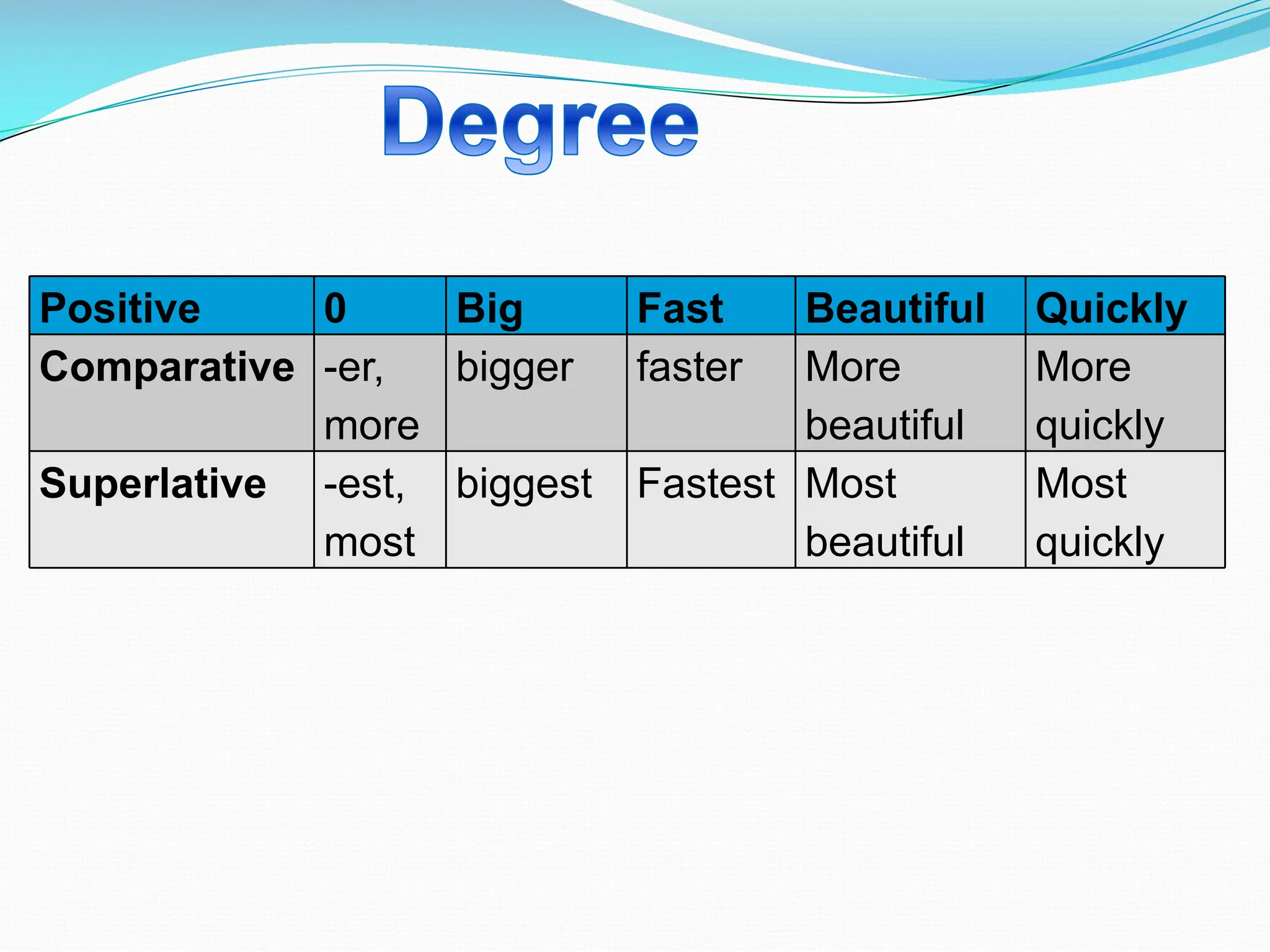
Positive 0 BigFast Beautiful Quickly
Comparative -er,
more
bigger faster More
beautiful
More
quickly
Superlative -est,
most
biggest Fastest Most
beautiful
Most
quickly
20.
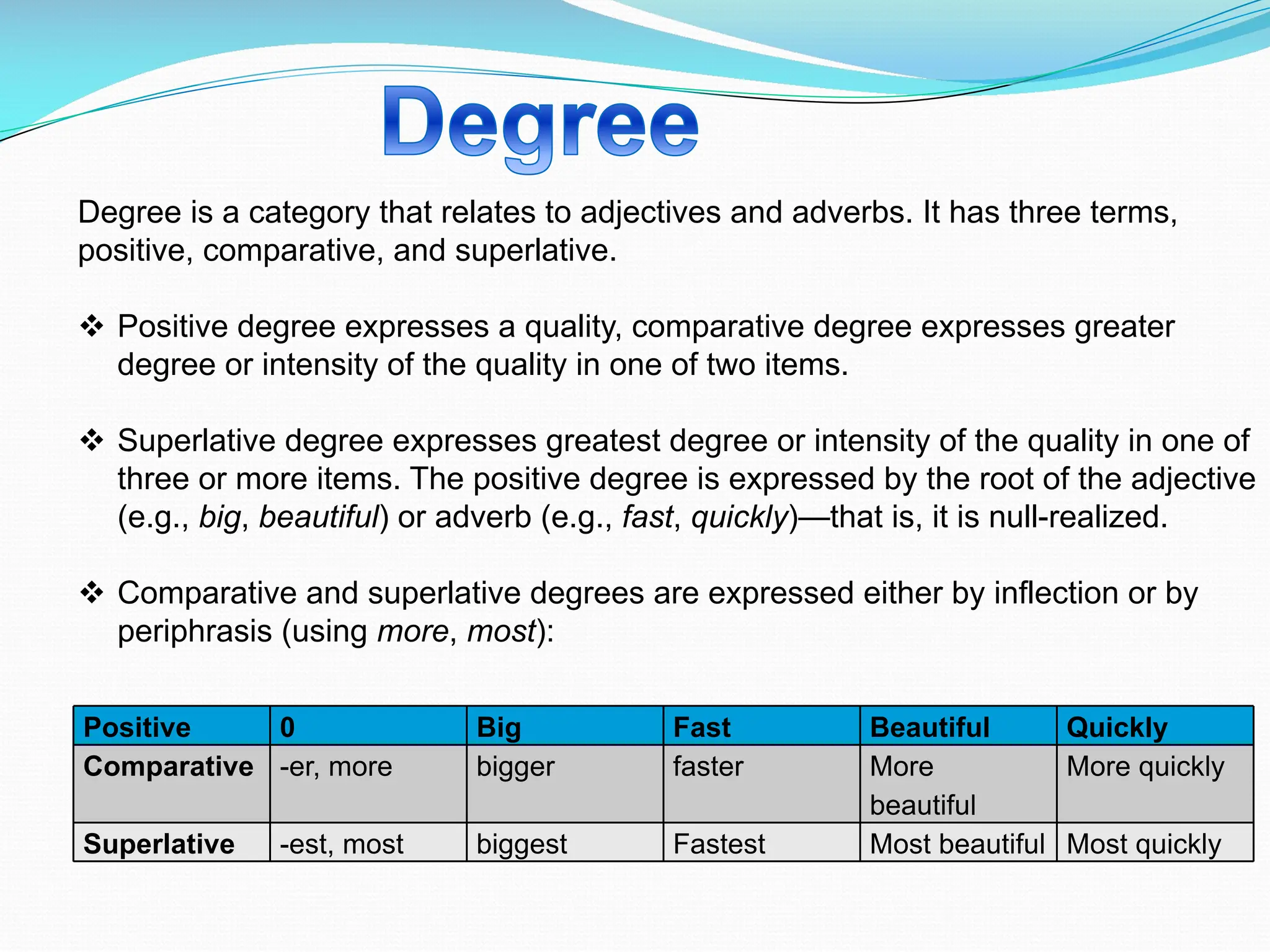
Degree is acategory that relates to adjectives and adverbs. It has three terms,
positive, comparative, and superlative.
v Positive degree expresses a quality, comparative degree expresses greater
degree or intensity of the quality in one of two items.
v Superlative degree expresses greatest degree or intensity of the quality in one of
three or more items. The positive degree is expressed by the root of the adjective
(e.g., big, beautiful) or adverb (e.g., fast, quickly)—that is, it is null-realized.
v Comparative and superlative degrees are expressed either by inflection or by
periphrasis (using more, most):
Positive 0 Big Fast Beautiful Quickly
Comparative -er, more bigger faster More
beautiful
More quickly
Superlative -est, most biggest Fastest Most beautiful Most quickly
21.
The concepts ofdefiniteness and
indefiniteness are intuitively quite simple:
vDefinite denotes a referent (a thing in the real
world denoted by a noun) which is known,
familiar, or identified to the speaker and
hearer.
vIndefinite denotes a referent which is novel,
unfamiliar, or not known.
22.
v“Definite” and “indefinite”are terms which are
usually applied to noun phrases.
vIn English, the is referred to as “the definite
article”, and a/an as “the indefinite article”.
Noun phrases which begin with the (e.g. the
Queen of England, the book), which are also
called “definite descriptions”, are generally
taken to be prototypical examples of definite
noun phrases in English.
23.
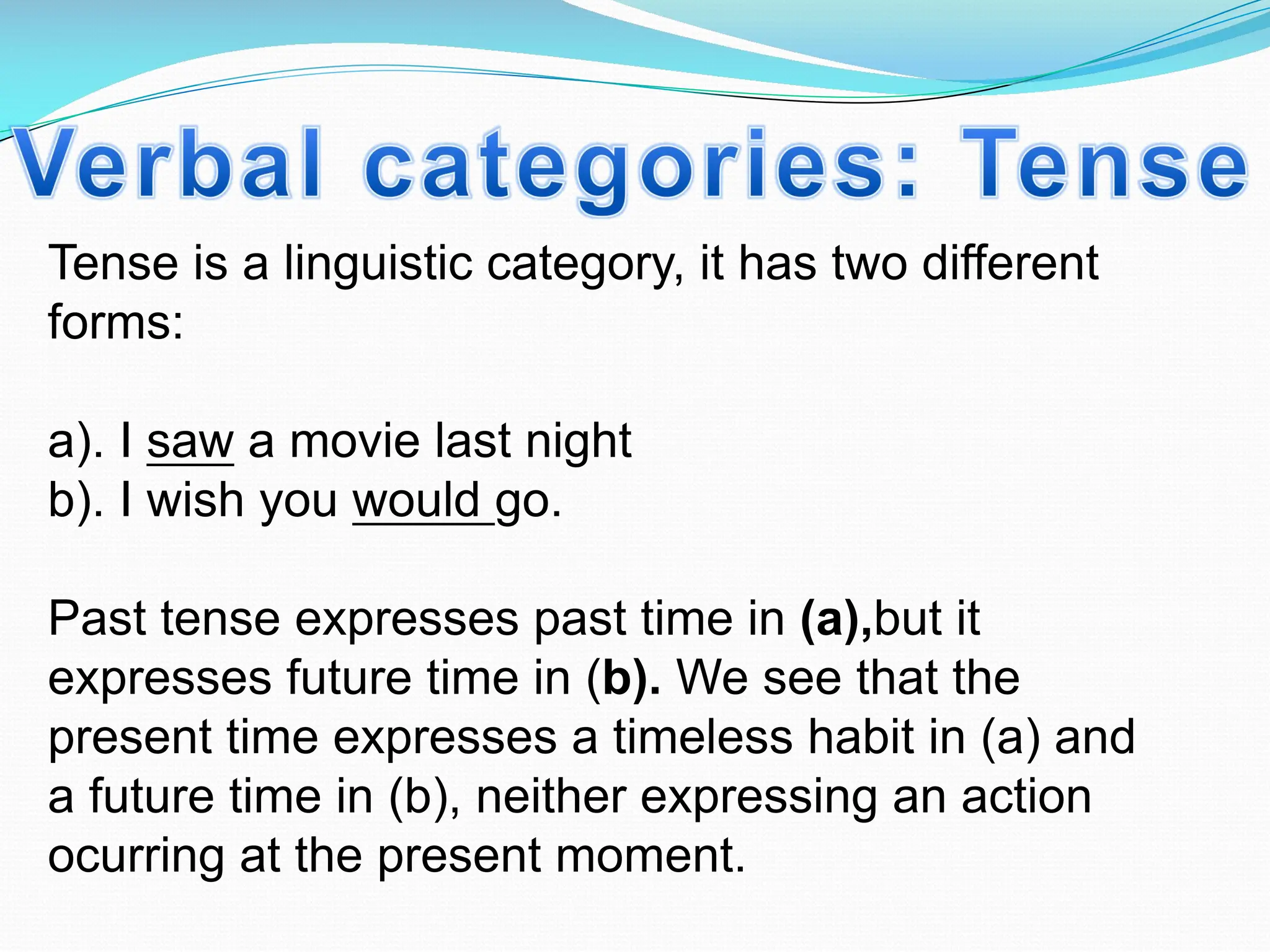
Tense is alinguistic category, it has two different
forms:
a). I saw a movie last night
b). I wish you would go.
Past tense expresses past time in (a),but it
expresses future time in (b). We see that the
present time expresses a timeless habit in (a) and
a future time in (b), neither expressing an action
ocurring at the present moment.
24.
By these criteria,English has only two
tense distinctions, past and present:
(work/worked).
In the second case however, there is
assumed to be a universal set of
grammatical categories and terms, which for
tense are past, present, and future, by
periphrasis (as in I will work).
25.
Aspect is acategory applicable to English
since the so-called “compound tenses”, the
perfect and the progressive, are better treated
as expressions of the aspect. Aspect can be
defined as the view taken of an event, or the
“aspect” under which it is considered, basically
whether it is seen as complete and whole
(perfective aspect) or as incomplete and
ongoing (imperfective aspect). Aspect can be
summarized as follows:
26.
Aspect is acategory applicable to English since the so-called
“compound tenses”, the perfect and the progressive, are better treated
as expressions of the aspect. Aspect can be defined as the view taken
of an event, or the “aspect” under which it is considered, basically
whether it is seen as complete and whole (perfective aspect) or as
incomplete and ongoing (imperfective aspect). Aspect can be
summarized as follows:
The simple aspect (Indefinite Aspect) Example
Simple past tense I went
Simple present tense I go
Simple future tense Will
27.
The simple aspect
(IndefiniteAspect)
Example
Simple past tense I went
Simple present
tense
I go
Simple future tense Will
28.
The perfect aspect
(Completedaspect)
Example
Past perfect tense I had gone
Present perfect tense I have gone
Future perfect tense I will have gone
The progressive aspect (Continuing
aspect)
Example
Past progressive tense I was going
Present progressive tense I am going
Future progressive t tense I will be going
29.
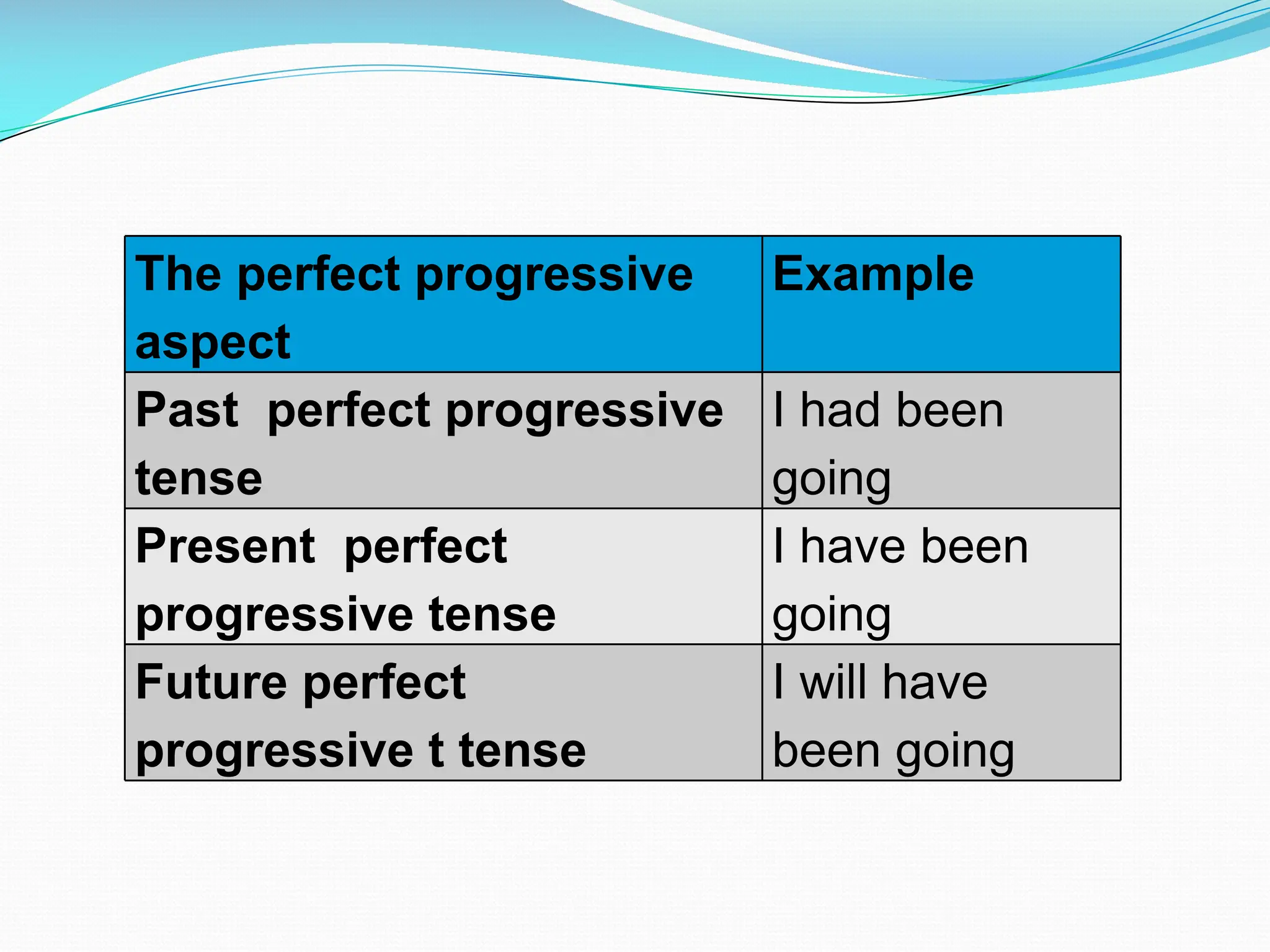
The perfect progressive
aspect
Example
Pastperfect progressive
tense
I had been
going
Present perfect
progressive tense
I have been
going
Future perfect
progressive t tense
I will have
been going
30.
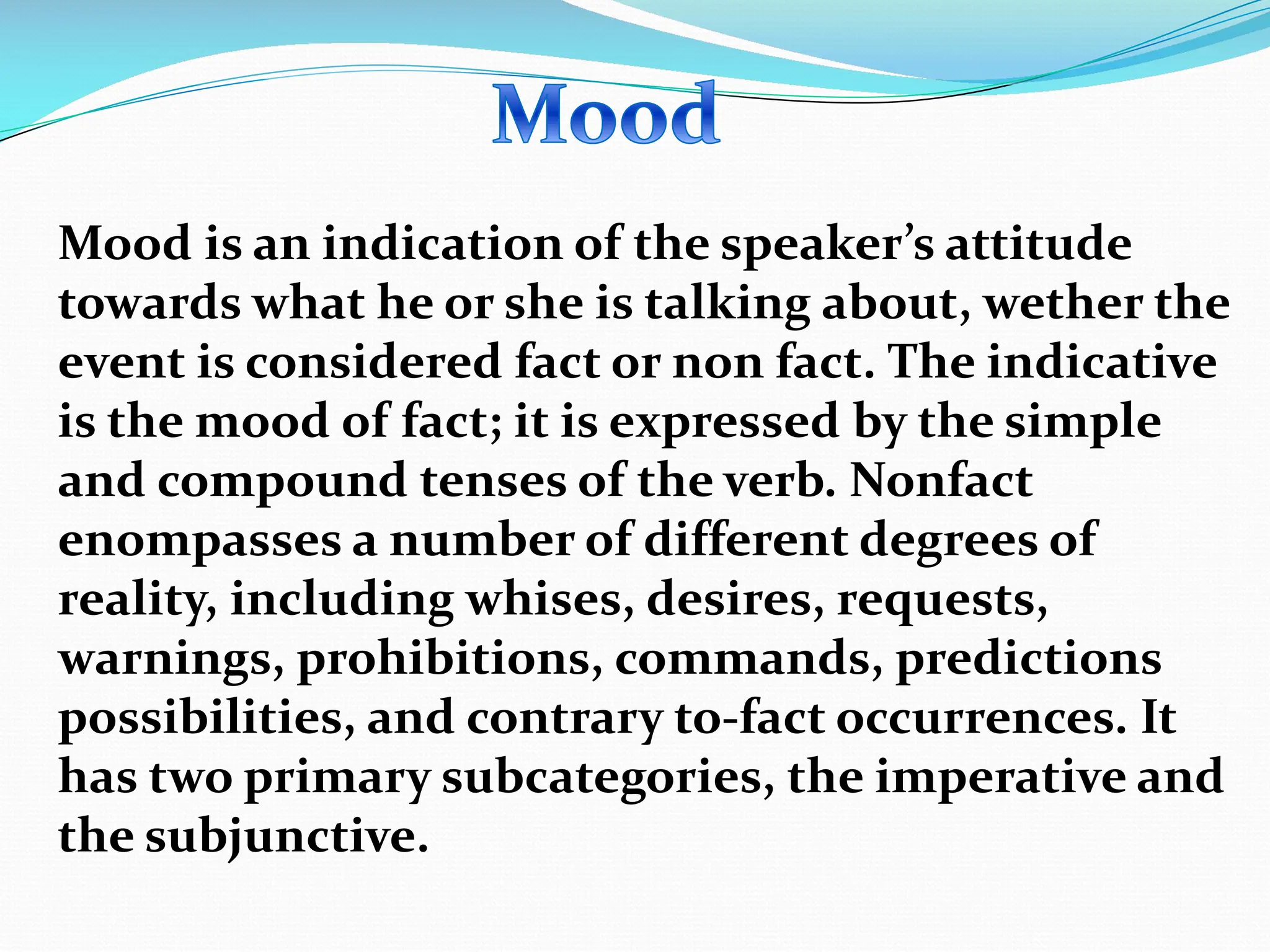
Mood is anindication of the speaker’s attitude
towards what he or she is talking about, wether the
event is considered fact or non fact. The indicative
is the mood of fact; it is expressed by the simple
and compound tenses of the verb. Nonfact
enompasses a number of different degrees of
reality, including whises, desires, requests,
warnings, prohibitions, commands, predictions
possibilities, and contrary to-fact occurrences. It
has two primary subcategories, the imperative and
the subjunctive.
31.
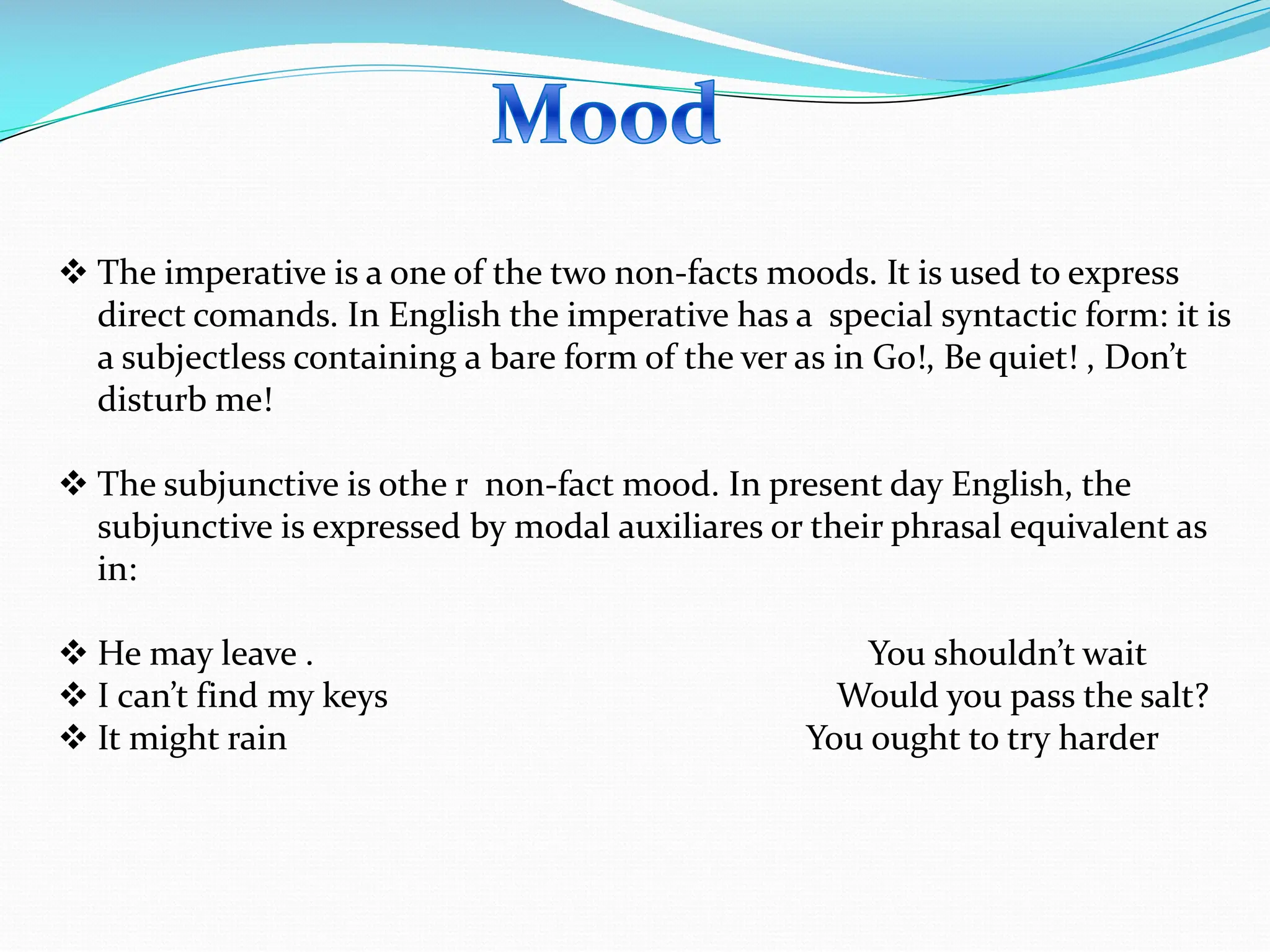
v The imperativeis a one of the two non-facts moods. It is used to express
direct comands. In English the imperative has a special syntactic form: it is
a subjectless containing a bare form of the ver as in Go!, Be quiet! , Don’t
disturb me!
v The subjunctive is othe r non-fact mood. In present day English, the
subjunctive is expressed by modal auxiliares or their phrasal equivalent as
in:
v He may leave . You shouldn’t wait
v I can’t find my keys Would you pass the salt?
v It might rain You ought to try harder
32.
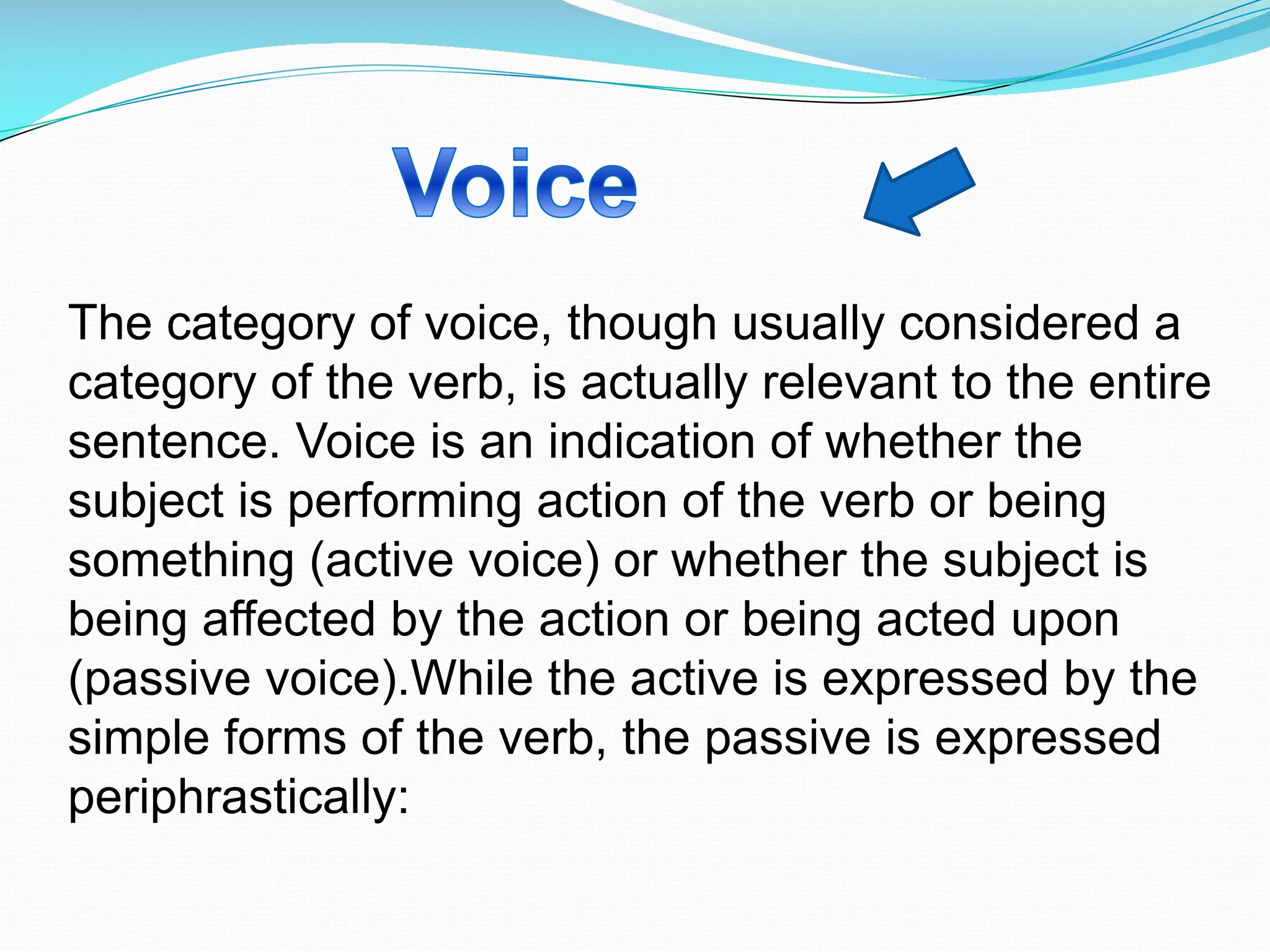
The category ofvoice, though usually considered a
category of the verb, is actually relevant to the entire
sentence. Voice is an indication of whether the
subject is performing action of the verb or being
something (active voice) or whether the subject is
being affected by the action or being acted upon
(passive voice).While the active is expressed by the
simple forms of the verb, the passive is expressed
periphrastically:
33.
vBy be +the past participle, as
in The report was written (by
the committee); or
vBy get + the past participle, as
in The criminal got caught (by
the police).
34.
We can approachthe categories from a different
perspective by noting
which different parts of speech each of the
grammatical categories is relevant to:
vNouns: number, gender, case, (person), and
definiteness;
vPronouns: number, gender, case, and person;
vAdjec tives and some adverbs: degree; and
vV erbs: number, person, tense, aspect, mood, and
voice.
35.
vTraditionally, eight wordclasses are
recognized: noun, verb, adjective,
adverb, pronoun, preposition,
conjunction and interjection (or
article).
36.
vA noun isa word which is used to
denote a person (traffic warden, woman,
Prime Minister, pianist etc.)
vA concrete or abstract entity (binoculars,
fork, field, truth, incoherence etc.)
vOr a place (office, garden, railway
station).
37.
These are allcommon nouns;
there are also proper
nouns which are the names of a
specific person, place, event etc.,
usually starting with a capital letter,
for example:
York , John, Christmas, Saturday.
38.
Proper nouns aredistinguished from
common nouns in that they denote a
unique referent; they cannot, therefore, be
pluralized. Count nouns denote items that
are individuated and can be pluralized
and counted, while mass (noncount)
nouns denote substances that exist in
bulk or unspecified quantities.
39.
A group ofwords cannot be described
as a sentence or a clause unless at
least one of the words is a verb. In
some ways, we can describe it as the
most important part of speech
because it is the 'action' word that
tells the listener or reader what is
happening in the sentence.
40.
vVerbs can be‘action’ words
like run, initiate, judge, throw, but they can also
denote less active notions and have more to do with
mental processes and perceptions,
like see, know, think and so on.
vThere are several distributional tests for the
category verb; these serve to subclassify verbs.
Certain verbs, known as transitive verbs, such as
buy, break, learn, give, or hit, may precede noun
phrases:
41.
An adjective givesthe reader or
speaker extra information about
a noun or delimits it in some way.
It can occur in two positions in a
phrase:
42.
vbefore the nounas in clear
water, beautiful beaches, a
terrible decision. The adjectives
in these examples are said to
be attributive.
43.
vfollowing any formof the
verb be (e.g. am, is, was, been)
and similar verbs
(seem, appear ,become) as in the
water became clear, the beaches
are beautiful. These adjectives are
inpredicative position.
44.
The traditional approachto adverbs has
been to assign mainly those words which
are made from adjectives by the addition of
the ending –ly (quickly, hopelessly), plus
certain other words which are difficult to
classify, like not, just and soon.
45.
vTheir main functionis to qualify the
action of the verb in the clause in
some way, but they can also be used
to add more information to an
adjective or other adverb
e.g. awfully good, incredibly slowly.
46.
vThe class ofadverbs is
very wide-ranging in form
and is used to add
comments to many of the
other word classes.
47.
vA small numberof
what are traditionally
recognized as adverbs take
the comparative inflectional
endings -er and -est, but most
are uninflected.
48.
vPronouns are usuallytreated as a special sub-class
of nouns. This is because they stand in for a noun
or group of nouns. They are limited in number and
belong to what is called a closed set, that is, a
group of words to which new members are, for
practical purposes, not allowed. Some examples of
pronouns
are: I, you, he, she, our, its, something, an
yone and so on.
49.
Prepositions allow usto talk about the way in
which two parts of a sentence are related to
each other. They include words like in, on,
under, beside, through, inside, before,
opposite. More often than not, these
relationships are to do with either time or
space, but other types of relationship, such as
possession, cause and effect and method can
be expressed by using prepositions.
50.
v Unless theyare part of a verb
(getin, pick up, switch off),
prepositions are always followed by
a phrase containing a noun – at
school, in the summer, over the
moon and so on.
vThere are twotypes of conjunction. The first
is the coordinating conjunction. This type is
always used to connect elements that share
the same grammatical status, that is, main
clause to main clause, verb to verb, noun to
noun, adjective to adjective and so on.
53.
vThe second typeis
the subordinating conjunction,
which most often joins two or more
unequal clauses to one another.
Typically a main clause will be
connected to a subordinate clause.
54.
An interjection isa word
used to express a
particular emotion or
sentiment on the part of the
speaker.
55.
v Filled pausessuch as uh, er, um are also considered
interjections. Interjections are often placed at the beginning
of a sentence.
vAn interjection is sometimes expressed as a single word or
non-sentence phrase, followed by a punctuation mark.
vConventions like Hi, Bye and Goodbye are interjections, as
are exclamations like Cheers! and Hooray!. They are very
often characterized by exclamation marks depending on
the stress of the attitude or the force of the emotion they
are expressing.
56.
Laurel J. Brinton,Donna Brinton. The Linguistic Structure of Modern English. Jobn
Benjamins Publishing, 2010. Pages 1-358
Wikipedia. (n.d). Interjection. Retrieved from:
https://en.wikipedia.org/wiki/Interjection
TESOL-direct. (n.d). Word classes in English grammar. Retrieved from:
https://www.tesol-direct.com/guide-to-english-grammar/word-classes
Grammar -Monster. (n.d). What is the aspect of a Verb? Retrieved from:
http://www.grammar-monster.com/glossary/aspect.htm
Barbara Abbot. Definitie and indefinite. Encyclopedia of Language and Linguistics,
2nd edition. Retrieved from: https://www.msu.edu/~abbottb/def&inde.pdf