Download free for 30 days
Sign in
Upload
Language (EN)
Support
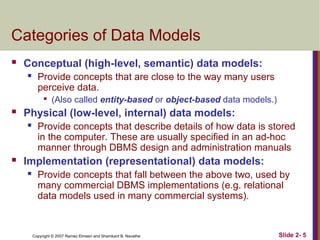
Business
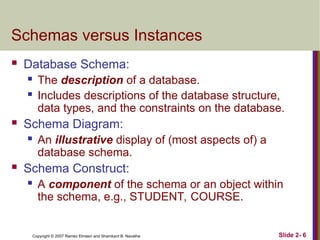
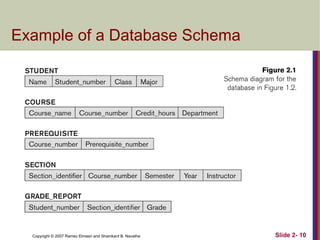
Mobile
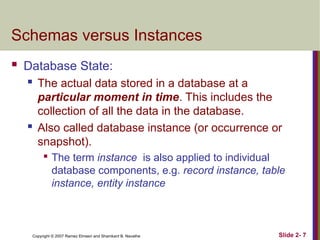
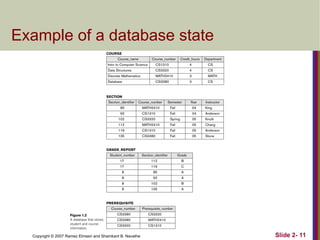
Social Media
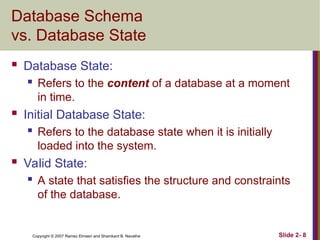
Marketing
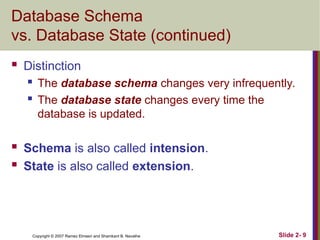
Technology
Art & Photos
Career
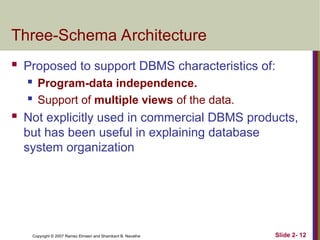
Design
Education
Presentations & Public Speaking
Government & Nonprofit
Healthcare
Internet
Law
Leadership & Management
Automotive
Engineering
Software
Recruiting & HR
Retail
Sales
Services
Science
Small Business & Entrepreneurship
Food
Environment
Economy & Finance
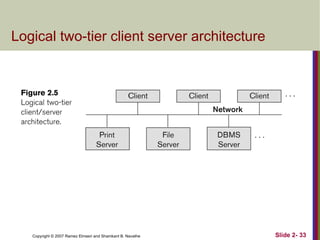
Data & Analytics
Investor Relations
Sports
Spiritual
News & Politics
Travel
Self Improvement
Real Estate
Entertainment & Humor
Health & Medicine
Devices & Hardware
Lifestyle
Change Language
Language
English
Español
Português
Français
Deutsche
Cancel
Save
Submit search
EN
Uploaded by
vivekananda34
PPT, PDF
34 views
ch02-Database System Concepts and Architecture.ppt
Chapter 2 of navathe book
Engineering
◦
Read more
0
Save
Share
Embed
Embed presentation
Download
Download to read offline
1
/ 53
2
/ 53
3
/ 53
4
/ 53
5
/ 53
6
/ 53
7
/ 53
8
/ 53
9
/ 53
10
/ 53
11
/ 53
12
/ 53
13
/ 53
14
/ 53
15
/ 53
16
/ 53
17
/ 53
18
/ 53
19
/ 53
20
/ 53
21
/ 53
22
/ 53
23
/ 53
24
/ 53
25
/ 53
26
/ 53
27
/ 53
28
/ 53
29
/ 53
30
/ 53
31
/ 53
32
/ 53
33
/ 53
34
/ 53
35
/ 53
36
/ 53
37
/ 53
38
/ 53
39
/ 53
40
/ 53
41
/ 53
42
/ 53
43
/ 53
44
/ 53
45
/ 53
46
/ 53
47
/ 53
48
/ 53
49
/ 53
50
/ 53
51
/ 53
52
/ 53
53
/ 53
More Related Content
PPT
ch02-Database System Concepts and Architecture.ppt
by
KalsoomTahir2
PPT
ch02-Database System Concepts and Architecture.ppt
by
examlab57
PDF
ch02-Database System Concepts and Architecture.pdf
by
BasirKhan22
PPT
ch02-Database System Concepts and Architecture.ppt
by
COMPUTERSCIENCEDhari
PPT
Chapter02 database system in computer.ppt
by
ubaidullah75790
PPT
Chapter02.ppt
by
MemMem25
PDF
Chapter 2 data base system normalization.pdf
by
hendmohamed98
PDF
2 database system concepts and architecture
by
Kumar
ch02-Database System Concepts and Architecture.ppt
by
KalsoomTahir2
ch02-Database System Concepts and Architecture.ppt
by
examlab57
ch02-Database System Concepts and Architecture.pdf
by
BasirKhan22
ch02-Database System Concepts and Architecture.ppt
by
COMPUTERSCIENCEDhari
Chapter02 database system in computer.ppt
by
ubaidullah75790
Chapter02.ppt
by
MemMem25
Chapter 2 data base system normalization.pdf
by
hendmohamed98
2 database system concepts and architecture
by
Kumar
Similar to ch02-Database System Concepts and Architecture.ppt
PPT
Chapter02
by
Reham Maher El-Safarini
PPTX
Database Design in Database Management Systems
by
Sudha Kar
PPT
Introduction to 3 tier architecture of DBMS basics and details
by
ShrutiArora343479
PDF
Database System Concepts and Architecture
by
sontumax
PPT
ch02-Database System Concepts and Architecture.ppt
by
KalsoomBajwa
PDF
Chapter (Two) The best lecture PowerPoint
by
afendimohammed288
PPT
Chap gshsiiajsbbJAIOAJB68292uhsbiw8622.ppt
by
SagniTolasa
PPT
database slide what is database and its types .ppt
by
atif11nh
PPTX
Database system concepts
by
Dr. Jasmine Beulah Gnanadurai
PDF
APznzaa8jyCqEfOzIXqwAqxTBkpfxFd1OHN5G6XprVbamkoLUf3KcvZywfO4T71wgjvmg7lDxEuM5...
by
prabhdeeprai46
PDF
Database Management system, database architecture unikkkkkkkkkkkkkkk
by
sandhyakiran10
PPT
Database system concepts
by
Kumar
PDF
Chapter 2.pdfChapter 2.pdfChapter 2.pdfChapter 2.pdf
by
temesgenabebe1
PPT
Database Management Systems.ppt
by
tahakhan699813
PPT
Database concepts and Archeticture Ch2 with in class Activities
by
Zainab Almugbel
PPTX
Fundamentals of database system - Database System Concepts and Architecture
by
Mustafa Kamel Mohammadi
PPTX
Lec02_Database System Concepts and Architecture_part1.pptx
by
AhmedSalama337512
PPTX
Module 1 - Chapter 2.pptx
by
SoniaDevi15
PDF
chap1.pdf
by
ezaldeen2013
PPT
Bsc cs ii-dbms- u-ii-database system concepts and architecture
by
Rai University
Chapter02
by
Reham Maher El-Safarini
Database Design in Database Management Systems
by
Sudha Kar
Introduction to 3 tier architecture of DBMS basics and details
by
ShrutiArora343479
Database System Concepts and Architecture
by
sontumax
ch02-Database System Concepts and Architecture.ppt
by
KalsoomBajwa
Chapter (Two) The best lecture PowerPoint
by
afendimohammed288
Chap gshsiiajsbbJAIOAJB68292uhsbiw8622.ppt
by
SagniTolasa
database slide what is database and its types .ppt
by
atif11nh
Database system concepts
by
Dr. Jasmine Beulah Gnanadurai
APznzaa8jyCqEfOzIXqwAqxTBkpfxFd1OHN5G6XprVbamkoLUf3KcvZywfO4T71wgjvmg7lDxEuM5...
by
prabhdeeprai46
Database Management system, database architecture unikkkkkkkkkkkkkkk
by
sandhyakiran10
Database system concepts
by
Kumar
Chapter 2.pdfChapter 2.pdfChapter 2.pdfChapter 2.pdf
by
temesgenabebe1
Database Management Systems.ppt
by
tahakhan699813
Database concepts and Archeticture Ch2 with in class Activities
by
Zainab Almugbel
Fundamentals of database system - Database System Concepts and Architecture
by
Mustafa Kamel Mohammadi
Lec02_Database System Concepts and Architecture_part1.pptx
by
AhmedSalama337512
Module 1 - Chapter 2.pptx
by
SoniaDevi15
chap1.pdf
by
ezaldeen2013
Bsc cs ii-dbms- u-ii-database system concepts and architecture
by
Rai University
More from vivekananda34
PPTX
Distilled Module2_Chapter3_NoSQL.pptx
by
vivekananda34
PPTX
Distilled Module1_Chapter2_NoSQL.pptx
by
vivekananda34
PPT
Universal Human Values L 10 HB Self V5.ppt
by
vivekananda34
PPT
Universal Human Values L 9 HB Body - Instrument of Self V3.ppt
by
vivekananda34
PPT
Universal Human Values L 8 HB Needs of Self-Body v2.ppt
by
vivekananda34
PPT
Universal Human Values L 7 HB Self-Body V2.ppt
by
vivekananda34
PPT
ch03-Data Modeling Using the Entity-Relationship (ER) Model (1).ppt
by
vivekananda34
Distilled Module2_Chapter3_NoSQL.pptx
by
vivekananda34
Distilled Module1_Chapter2_NoSQL.pptx
by
vivekananda34
Universal Human Values L 10 HB Self V5.ppt
by
vivekananda34
Universal Human Values L 9 HB Body - Instrument of Self V3.ppt
by
vivekananda34
Universal Human Values L 8 HB Needs of Self-Body v2.ppt
by
vivekananda34
Universal Human Values L 7 HB Self-Body V2.ppt
by
vivekananda34
ch03-Data Modeling Using the Entity-Relationship (ER) Model (1).ppt
by
vivekananda34
Recently uploaded
PPTX
Why Precision Matters CO2 N2 Gas Filling Systems Neometrix
by
Neometrix_Engineering_Pvt_Ltd
PDF
Performance_Metrics_Evolution_DannyJiang
by
Danny Jiang
PDF
Finite Automata With Output - Moore and Mealy Machines definitions and Solved...
by
NileshPardeshi28
PDF
EPC vs Reality: The Schedule That Was Never Possible
by
Ganesh Kumar
PPTX
Steam Turbines basicsproperties power plant-1.pptx
by
AjitParwani
PPTX
Ortho Graphic Projections for civil engineering.pptx
by
UmairAli575718
PPTX
Hospital Management System Project- 220180107010.pptx
by
pravjo279
PDF
Java Programming core java and basics concepts
by
Harish Khodke
PPTX
70,000 RPM Aerospace Bearing Testing – Why High-Speed Validation Is Critical
by
Neometrix_Engineering_Pvt_Ltd
PDF
A wire harness (also called a wiring harness or cable harness)
by
abhinandankondekar2
PPTX
CFP_Unit 3 Decision Control and Looping Statements
by
pawarbhaktiit
PPTX
Symmetrical faults in power system .pptx
by
Rased Khan
PDF
Performance Benchmarking Strategies for AI/HPC/EdgeAI
by
Danny Jiang
PPTX
Design and Development of Friction Stir Welding joints of Aluminium and Coppe...
by
NareshKumarSingh12
PPT
5.1 Basic concept and hierarchy.ppt1234564
by
Chetansingh768231
PPTX
Unit I – Introduction to Devops Deployment Pipeline & Design Options Deploym...
by
venkadeshr123
PDF
Flexibility Matrix Method of Analysis- Part B
by
Dr. Nitin Naik
PPTX
Why Hydraulic Flushing Should Never Be Skipped Before Commissioning
by
Neometrix_Engineering_Pvt_Ltd
PDF
SURAJIT PARAMANIK_ME_3RD_THERMODYNAMICS.pdf
by
astikparamanik1970
PPTX
CFP_Unit 5. Structure and Functions pptx
by
pawarbhaktiit
Why Precision Matters CO2 N2 Gas Filling Systems Neometrix
by
Neometrix_Engineering_Pvt_Ltd
Performance_Metrics_Evolution_DannyJiang
by
Danny Jiang
Finite Automata With Output - Moore and Mealy Machines definitions and Solved...
by
NileshPardeshi28
EPC vs Reality: The Schedule That Was Never Possible
by
Ganesh Kumar
Steam Turbines basicsproperties power plant-1.pptx
by
AjitParwani
Ortho Graphic Projections for civil engineering.pptx
by
UmairAli575718
Hospital Management System Project- 220180107010.pptx
by
pravjo279
Java Programming core java and basics concepts
by
Harish Khodke
70,000 RPM Aerospace Bearing Testing – Why High-Speed Validation Is Critical
by
Neometrix_Engineering_Pvt_Ltd
A wire harness (also called a wiring harness or cable harness)
by
abhinandankondekar2
CFP_Unit 3 Decision Control and Looping Statements
by
pawarbhaktiit
Symmetrical faults in power system .pptx
by
Rased Khan
Performance Benchmarking Strategies for AI/HPC/EdgeAI
by
Danny Jiang
Design and Development of Friction Stir Welding joints of Aluminium and Coppe...
by
NareshKumarSingh12
5.1 Basic concept and hierarchy.ppt1234564
by
Chetansingh768231
Unit I – Introduction to Devops Deployment Pipeline & Design Options Deploym...
by
venkadeshr123
Flexibility Matrix Method of Analysis- Part B
by
Dr. Nitin Naik
Why Hydraulic Flushing Should Never Be Skipped Before Commissioning
by
Neometrix_Engineering_Pvt_Ltd
SURAJIT PARAMANIK_ME_3RD_THERMODYNAMICS.pdf
by
astikparamanik1970
CFP_Unit 5. Structure and Functions pptx
by
pawarbhaktiit
ch02-Database System Concepts and Architecture.ppt
1.
Copyright © 2007
Ramez Elmasri and Shamkant B. Navathe Chapter 2 Database System Concepts and Architecture
2.
Copyright © 2007
Ramez Elmasri and Shamkant B. Navathe Slide 2- 2 Outline Data Models and Their Categories History of Data Models Schemas, Instances, and States Three-Schema Architecture Data Independence DBMS Languages and Interfaces Database System Utilities and Tools Centralized and Client-Server Architectures Classification of DBMSs
3.
Copyright © 2007
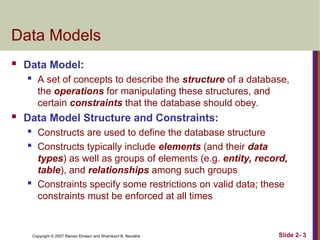
Ramez Elmasri and Shamkant B. Navathe Slide 2- 3 Data Models Data Model: A set of concepts to describe the structure of a database, the operations for manipulating these structures, and certain constraints that the database should obey. Data Model Structure and Constraints: Constructs are used to define the database structure Constructs typically include elements (and their data types) as well as groups of elements (e.g. entity, record, table), and relationships among such groups Constraints specify some restrictions on valid data; these constraints must be enforced at all times
4.
Copyright © 2007
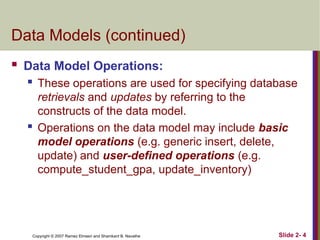
Ramez Elmasri and Shamkant B. Navathe Slide 2- 4 Data Models (continued) Data Model Operations: These operations are used for specifying database retrievals and updates by referring to the constructs of the data model. Operations on the data model may include basic model operations (e.g. generic insert, delete, update) and user-defined operations (e.g. compute_student_gpa, update_inventory)
5.
Copyright © 2007
Ramez Elmasri and Shamkant B. Navathe Slide 2- 5 Categories of Data Models Conceptual (high-level, semantic) data models: Provide concepts that are close to the way many users perceive data. (Also called entity-based or object-based data models.) Physical (low-level, internal) data models: Provide concepts that describe details of how data is stored in the computer. These are usually specified in an ad-hoc manner through DBMS design and administration manuals Implementation (representational) data models: Provide concepts that fall between the above two, used by many commercial DBMS implementations (e.g. relational data models used in many commercial systems).
6.
Copyright © 2007
Ramez Elmasri and Shamkant B. Navathe Slide 2- 6 Schemas versus Instances Database Schema: The description of a database. Includes descriptions of the database structure, data types, and the constraints on the database. Schema Diagram: An illustrative display of (most aspects of) a database schema. Schema Construct: A component of the schema or an object within the schema, e.g., STUDENT, COURSE.
7.
Copyright © 2007
Ramez Elmasri and Shamkant B. Navathe Slide 2- 7 Schemas versus Instances Database State: The actual data stored in a database at a particular moment in time. This includes the collection of all the data in the database. Also called database instance (or occurrence or snapshot). The term instance is also applied to individual database components, e.g. record instance, table instance, entity instance
8.
Copyright © 2007
Ramez Elmasri and Shamkant B. Navathe Slide 2- 8 Database Schema vs. Database State Database State: Refers to the content of a database at a moment in time. Initial Database State: Refers to the database state when it is initially loaded into the system. Valid State: A state that satisfies the structure and constraints of the database.
9.
Copyright © 2007
Ramez Elmasri and Shamkant B. Navathe Slide 2- 9 Database Schema vs. Database State (continued) Distinction The database schema changes very infrequently. The database state changes every time the database is updated. Schema is also called intension. State is also called extension.
10.
Copyright © 2007
Ramez Elmasri and Shamkant B. Navathe Slide 2- 10 Example of a Database Schema
11.
Copyright © 2007
Ramez Elmasri and Shamkant B. Navathe Slide 2- 11 Example of a database state
12.
Copyright © 2007
Ramez Elmasri and Shamkant B. Navathe Slide 2- 12 Three-Schema Architecture Proposed to support DBMS characteristics of: Program-data independence. Support of multiple views of the data. Not explicitly used in commercial DBMS products, but has been useful in explaining database system organization
13.
Copyright © 2007
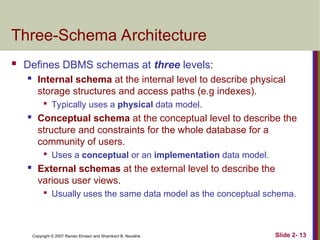
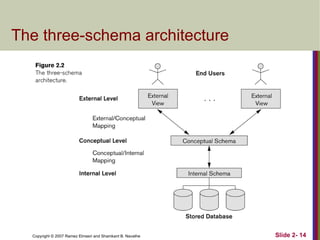
Ramez Elmasri and Shamkant B. Navathe Slide 2- 13 Three-Schema Architecture Defines DBMS schemas at three levels: Internal schema at the internal level to describe physical storage structures and access paths (e.g indexes). Typically uses a physical data model. Conceptual schema at the conceptual level to describe the structure and constraints for the whole database for a community of users. Uses a conceptual or an implementation data model. External schemas at the external level to describe the various user views. Usually uses the same data model as the conceptual schema.
14.
Copyright © 2007
Ramez Elmasri and Shamkant B. Navathe Slide 2- 14 The three-schema architecture
15.
Copyright © 2007
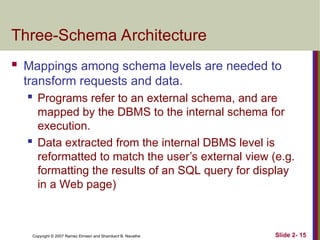
Ramez Elmasri and Shamkant B. Navathe Slide 2- 15 Three-Schema Architecture Mappings among schema levels are needed to transform requests and data. Programs refer to an external schema, and are mapped by the DBMS to the internal schema for execution. Data extracted from the internal DBMS level is reformatted to match the user’s external view (e.g. formatting the results of an SQL query for display in a Web page)
16.
Copyright © 2007
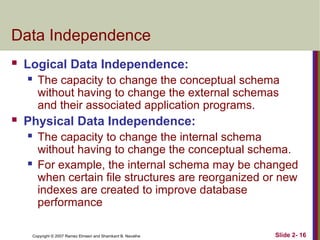
Ramez Elmasri and Shamkant B. Navathe Slide 2- 16 Data Independence Logical Data Independence: The capacity to change the conceptual schema without having to change the external schemas and their associated application programs. Physical Data Independence: The capacity to change the internal schema without having to change the conceptual schema. For example, the internal schema may be changed when certain file structures are reorganized or new indexes are created to improve database performance
17.
Copyright © 2007
Ramez Elmasri and Shamkant B. Navathe Slide 2- 17 Data Independence (continued) When a schema at a lower level is changed, only the mappings between this schema and higher- level schemas need to be changed in a DBMS that fully supports data independence. The higher-level schemas themselves are unchanged. Hence, the application programs need not be changed since they refer to the external schemas.
18.
Copyright © 2007
Ramez Elmasri and Shamkant B. Navathe Slide 2- 18 DBMS Languages Data Definition Language (DDL) Data Manipulation Language (DML) High-Level or Non-procedural Languages: These include the relational language SQL May be used in a standalone way or may be embedded in a programming language Low Level or Procedural Languages: These must be embedded in a programming language
19.
Copyright © 2007
Ramez Elmasri and Shamkant B. Navathe Slide 2- 19 DBMS Languages Data Definition Language (DDL): Used by the DBA and database designers to specify the conceptual schema of a database. In many DBMSs, the DDL is also used to define internal and external schemas (views). In some DBMSs, separate storage definition language (SDL) and view definition language (VDL) are used to define internal and external schemas. SDL is typically realized via DBMS commands provided to the DBA and database designers
20.
Copyright © 2007
Ramez Elmasri and Shamkant B. Navathe Slide 2- 20 DBMS Languages Data Manipulation Language (DML): Used to specify database retrievals and updates DML commands (data sublanguage) can be embedded in a general-purpose programming language (host language), such as COBOL, C, C+ +, or Java. A library of functions can also be provided to access the DBMS from a programming language Alternatively, stand-alone DML commands can be applied directly (called a query language).
21.
Copyright © 2007
Ramez Elmasri and Shamkant B. Navathe Slide 2- 21 Types of DML High Level or Non-procedural Language: For example, the SQL relational language Are “set”-oriented and specify what data to retrieve rather than how to retrieve it. Also called declarative languages. Low Level or Procedural Language: Retrieve data one record-at-a-time; Constructs such as looping are needed to retrieve multiple records, along with positioning pointers.
22.
Copyright © 2007
Ramez Elmasri and Shamkant B. Navathe Slide 2- 22 DBMS Interfaces Stand-alone query language interfaces Example: Entering SQL queries at the DBMS interactive SQL interface (e.g. SQL*Plus in ORACLE) Programmer interfaces for embedding DML in programming languages User-friendly interfaces Menu-based, forms-based, graphics-based, etc.
23.
Copyright © 2007
Ramez Elmasri and Shamkant B. Navathe Slide 2- 23 DBMS Programming Language Interfaces Programmer interfaces for embedding DML in a programming languages: Embedded Approach: e.g embedded SQL (for C, C++, etc.), SQLJ (for Java) Procedure Call Approach: e.g. JDBC for Java, ODBC for other programming languages Database Programming Language Approach: e.g. ORACLE has PL/SQL, a programming language based on SQL; language incorporates SQL and its data types as integral components
24.
Copyright © 2007
Ramez Elmasri and Shamkant B. Navathe Slide 2- 24 User-Friendly DBMS Interfaces Menu-based, popular for browsing on the web Apps for Mobile Devices Forms-based, designed for naïve users Graphics-based (Point and Click, Drag and Drop, etc.) Natural language: requests in written English Combinations of the above: For example, both menus and forms used extensively in Web database interfaces
25.
Copyright © 2007
Ramez Elmasri and Shamkant B. Navathe Slide 2- 25 Other DBMS Interfaces Speech as Input and Output Web Browser as an interface/Keyword based Database Seach Parametric interfaces, e.g., bank tellers using function keys. Interfaces for the DBA: Creating user accounts, granting authorizations Setting system parameters Changing schemas or access paths
26.
Copyright © 2007
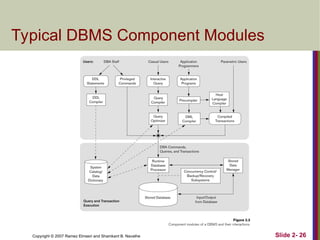
Ramez Elmasri and Shamkant B. Navathe Slide 2- 26 Typical DBMS Component Modules
27.
Copyright © 2007
Ramez Elmasri and Shamkant B. Navathe Slide 2- 27 Database System Utilities To perform certain functions such as: Loading data stored in files into a database. Includes data conversion tools. Backing up the database periodically on tape. Reorganizing database file structures. Report generation utilities. Performance monitoring utilities. Other functions, such as sorting, user monitoring, data compression, etc.
28.
Copyright © 2007
Ramez Elmasri and Shamkant B. Navathe Slide 2- 28 Other Tools Data dictionary / repository: Used to store schema descriptions and other information such as design decisions, application program descriptions, user information, usage standards, etc. Active data dictionary is accessed by DBMS software and users/DBA. Passive data dictionary is accessed by users/DBA only.
29.
Copyright © 2007
Ramez Elmasri and Shamkant B. Navathe Slide 2- 29 Other Tools Application Development Environments and CASE (computer-aided software engineering) tools: Examples: PowerBuilder (Sybase) JBuilder (Borland) JDeveloper 10G (Oracle)
30.
Copyright © 2007
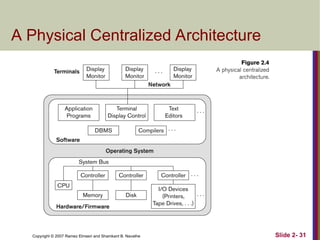
Ramez Elmasri and Shamkant B. Navathe Slide 2- 30 Centralized and Client-Server DBMS Architectures Centralized DBMS: Combines everything into single system including- DBMS software, hardware, application programs, and user interface processing software. User can still connect through a remote terminal – however, all processing is done at centralized site.
31.
Copyright © 2007
Ramez Elmasri and Shamkant B. Navathe Slide 2- 31 A Physical Centralized Architecture
32.
Copyright © 2007
Ramez Elmasri and Shamkant B. Navathe Slide 2- 32 Basic 2-tier Client-Server Architectures Specialized Servers with Specialized functions Print server File server DBMS server Web server Email server Clients can access the specialized servers as needed
33.
Copyright © 2007
Ramez Elmasri and Shamkant B. Navathe Slide 2- 33 Logical two-tier client server architecture
34.
Copyright © 2007
Ramez Elmasri and Shamkant B. Navathe Slide 2- 34 Clients Provide appropriate interfaces through a client software module to access and utilize the various server resources. Clients may be diskless machines or PCs or Workstations with disks with only the client software installed. Connected to the servers via some form of a network. (LAN: local area network, wireless network, etc.)
35.
Copyright © 2007
Ramez Elmasri and Shamkant B. Navathe Slide 2- 35 DBMS Server Provides database query and transaction services to the clients Relational DBMS servers are often called SQL servers, query servers, or transaction servers Applications running on clients utilize an Application Program Interface (API) to access server databases via standard interface such as: ODBC: Open Database Connectivity standard JDBC: for Java programming access Client and server must install appropriate client module and server module software for ODBC or JDBC
36.
Copyright © 2007
Ramez Elmasri and Shamkant B. Navathe Slide 2- 36 Two Tier Client-Server Architecture A client program may connect to several DBMSs, sometimes called the data sources. In general, data sources can be files or other non-DBMS software that manages data. Other variations of clients are possible: e.g., in some object DBMSs, more functionality is transferred to clients including data dictionary functions, optimization and recovery across multiple servers, etc.
37.
Copyright © 2007
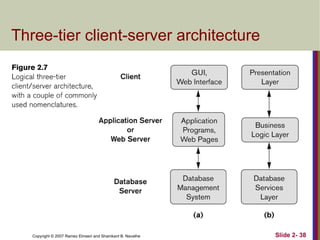
Ramez Elmasri and Shamkant B. Navathe Slide 2- 37 Three Tier Client-Server Architecture Common for Web applications Intermediate Layer called Application Server or Web Server: Stores the web connectivity software and the business logic part of the application used to access the corresponding data from the database server Acts like a conduit for sending partially processed data between the database server and the client. Three-tier Architecture Can Enhance Security: Database server only accessible via middle tier Clients cannot directly access database server
38.
Copyright © 2007
Ramez Elmasri and Shamkant B. Navathe Slide 2- 38 Three-tier client-server architecture
39.
Copyright © 2007
Ramez Elmasri and Shamkant B. Navathe Slide 2- 39 Classification of DBMSs Based on the data model used Traditional: Relational (SQL systems), Network, Hierarchical. Emerging: Object-oriented, Object-relational. Document-based, graph-based, column-based and key value based : Recently- big data systems also known as key-value storage systems and NOSQL systems) using data models
40.
Copyright © 2007
Ramez Elmasri and Shamkant B. Navathe Slide 2- 40 Classification of DBMSs Based on number of users Single-user (typically used with personal computers) vs. multi-user (most DBMSs). Based on number of sites Centralized (uses a single computer with one database) vs. distributed (uses multiple computers, multiple databases)
41.
Copyright © 2007
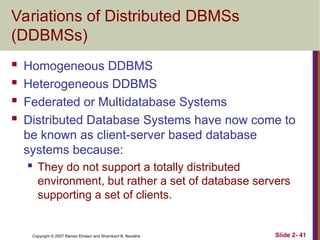
Ramez Elmasri and Shamkant B. Navathe Slide 2- 41 Variations of Distributed DBMSs (DDBMSs) Homogeneous DDBMS Heterogeneous DDBMS Federated or Multidatabase Systems Distributed Database Systems have now come to be known as client-server based database systems because: They do not support a totally distributed environment, but rather a set of database servers supporting a set of clients.
42.
Copyright © 2007
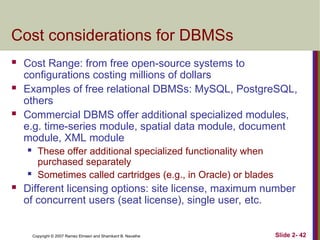
Ramez Elmasri and Shamkant B. Navathe Slide 2- 42 Cost considerations for DBMSs Cost Range: from free open-source systems to configurations costing millions of dollars Examples of free relational DBMSs: MySQL, PostgreSQL, others Commercial DBMS offer additional specialized modules, e.g. time-series module, spatial data module, document module, XML module These offer additional specialized functionality when purchased separately Sometimes called cartridges (e.g., in Oracle) or blades Different licensing options: site license, maximum number of concurrent users (seat license), single user, etc.
43.
Copyright © 2007
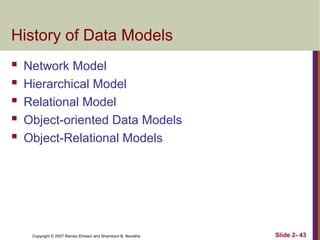
Ramez Elmasri and Shamkant B. Navathe Slide 2- 43 History of Data Models Network Model Hierarchical Model Relational Model Object-oriented Data Models Object-Relational Models
44.
Copyright © 2007
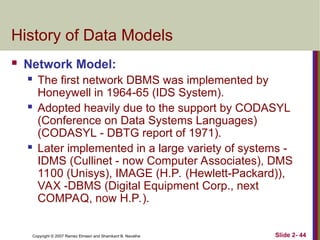
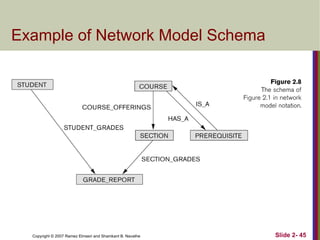
Ramez Elmasri and Shamkant B. Navathe Slide 2- 44 History of Data Models Network Model: The first network DBMS was implemented by Honeywell in 1964-65 (IDS System). Adopted heavily due to the support by CODASYL (Conference on Data Systems Languages) (CODASYL - DBTG report of 1971). Later implemented in a large variety of systems - IDMS (Cullinet - now Computer Associates), DMS 1100 (Unisys), IMAGE (H.P. (Hewlett-Packard)), VAX -DBMS (Digital Equipment Corp., next COMPAQ, now H.P.).
45.
Copyright © 2007
Ramez Elmasri and Shamkant B. Navathe Slide 2- 45 Example of Network Model Schema
46.
Copyright © 2007
Ramez Elmasri and Shamkant B. Navathe Slide 2- 46 Network Model Advantages: Network Model is able to model complex relationships and represents semantics of add/delete on the relationships. Can handle most situations for modeling using record types and relationship types. Language is navigational; uses constructs like FIND, FIND member, FIND owner, FIND NEXT within set, GET, etc. Programmers can do optimal navigation through the database.
47.
Copyright © 2007
Ramez Elmasri and Shamkant B. Navathe Slide 2- 47 Network Model Disadvantages: Navigational and procedural nature of processing Database contains a complex array of pointers that thread through a set of records. Little scope for automated “query optimization”
48.
Copyright © 2007
Ramez Elmasri and Shamkant B. Navathe Slide 2- 48 History of Data Models Hierarchical Data Model: Initially implemented in a joint effort by IBM and North American Rockwell around 1965. Resulted in the IMS family of systems. IBM’s IMS product had (and still has) a very large customer base worldwide Hierarchical model was formalized based on the IMS system Other systems based on this model: System 2k (SAS inc.)
49.
Copyright © 2007
Ramez Elmasri and Shamkant B. Navathe Slide 2- 49 Hierarchical Model Advantages: Simple to construct and operate Corresponds to a number of natural hierarchically organized domains, e.g., organization (“org”) chart Language is simple: Uses constructs like GET, GET UNIQUE, GET NEXT, GET NEXT WITHIN PARENT, etc. Disadvantages: Navigational and procedural nature of processing Database is visualized as a linear arrangement of records Little scope for "query optimization"
50.
Copyright © 2007
Ramez Elmasri and Shamkant B. Navathe Slide 2- 50 History of Data Models Relational Model: Proposed in 1970 by E.F. Codd (IBM), first commercial system in 1981-82. Now in several commercial products (e.g. DB2, ORACLE, MS SQL Server, SYBASE, INFORMIX). Several free open source implementations, e.g. MySQL, PostgreSQL Currently most dominant for developing database applications. SQL relational standards: SQL-89 (SQL1), SQL-92 (SQL2), SQL-99, SQL3, … Chapters 5 through 11 describe this model in detail
51.
Copyright © 2007
Ramez Elmasri and Shamkant B. Navathe Slide 2- 51 History of Data Models Object-oriented Data Models: Several models have been proposed for implementing in a database system. One set comprises models of persistent O-O Programming Languages such as C++ (e.g., in OBJECTSTORE or VERSANT), and Smalltalk (e.g., in GEMSTONE). Additionally, systems like O2, ORION (at MCC - then ITASCA), IRIS (at H.P.- used in Open OODB). Object Database Standard: ODMG-93, ODMG-version 2.0, ODMG-version 3.0. Chapters 20 and 21 describe this model.
52.
Copyright © 2007
Ramez Elmasri and Shamkant B. Navathe Slide 2- 52 History of Data Models Object-Relational Models: Most Recent Trend. Started with Informix Universal Server. Relational systems incorporate concepts from object databases leading to object-relational. Exemplified in the latest versions of Oracle-10i, DB2, and SQL Server and other DBMSs. Standards included in SQL-99 and expected to be enhanced in future SQL standards. Chapter 22 describes this model.
53.
Copyright © 2007
Ramez Elmasri and Shamkant B. Navathe Slide 2- 53 Summary Data Models and Their Categories History of Data Models Schemas, Instances, and States Three-Schema Architecture Data Independence DBMS Languages and Interfaces Database System Utilities and Tools Centralized and Client-Server Architectures Classification of DBMSs
Download