Entrepreneurship Session-2
Ratan Tata Every Tata has his legacy and Ratan Tata, the man with a rare mix of grace, composure and steely nerves, has created his own by winning the Corus . Battle against odds just as he steered the people's car project at Singur in West Bengal.
True Entrepreneur Ratan Tata was named the Ernst & Young Entrepreneur of The Year 2003.  The Tata Trusts are the unsung heroes of an extraordinary saga of philanthropy that has enriched the country and its citizens in more ways than can be quantified
Reason for venturing: Tata and Corus will become the world’s fifth-largest steelmaking firm . Ensuring global presence. Low-cost country with raw material availability . Strong and growing economy. Indigenous raw materials . Rising consumer demand and infrastructure needs
Simple Definitions Entrepreneurs … people who create and grow enterprises   Entrepreneurship … the process through which entrepreneurs create and grow enterprises. Entrepreneurship development …  the infrastructure of public and private policies and practices that foster and support entrepreneurship.
What is Entrepreneurship? Entrepreneurship is a dynamic form of social and economic behavior in which people respond to  environmental signals  about the  availability of opportunities  and the  resources  with which they can be exploited. Rae and Carswell
Entrepreneur: What's In a Definition?   "Entrepreneurship is the  recognition  and  pursuit of opportunity  without regard to the resources you currently control, with  confidence that you can succeed , with the  flexibility to change  course as necessary, and with the  will to rebound from setbacks."
What do we mean by entrepreneurship contd…. There is only one definition of ”entrepreneur” An entrepreneur is someone who gets something  new  done.”   Peter Drucker
What is Entrepreneurship? An entrepreneur is a person who sees opportunity, sizes up its value, and finds the resources to make the most of it. Jim Nelson University of Idaho
The American Heritage Dictionary defines an entrepreneur to be "a person who organizes, operates, and assumes the risk for business ventures."
The art of entrepreneurship is the art of modern leadership.   Ability to discover an investment opportunity and to organize an enterprise. Taking risk and making the necessary investments under conditions of uncertainty.
The art of entrepreneurship is the art of modern leadership. Ability to bring together and put to use other factors of production capital, labour, land
Entrepreneurship: Creation of corporate wealth by leveraging sweat equity,innovation and brilliant vision,a well thought out strategy and flawless execution.
What is critical factor ? Over population ? Food Shortage ? National resources shortage ? Energy Shortage ? Lack of Technology? Then what's the critical factor????
The factor…. Unique aptitude of innovation. Urge for change. Ability to utilize present day technology. There is dire shortage of appropriate economic innovator and implementer….
The psychology of successful entreprenuers Shared vision: A marketable idea: A sound strategy and implementable plan: A layer of competent management: A shared value system: Professionalism:
The psychology of successful entreprenuers Spirit of sacrifice: Pride in creation of wealth: Leadership by example:
A general admiration for the entrepreneur a general admiration for the entrepreneur who has a skill and bravely jumps into the middle of the fire hoping not to get burned.
Characteristics of Entrepreneurs Entrepreneurs have: A passion for what they do. The creativity and ability to innovate. A sense of independence and self- reliance. (Usually) a high level of self confidence. A willingness and capability (though not necessarily capacity or preference) for taking risks.
Characteristics of Entrepreneurs Versatile knowledge. Energetic and Diligent. Responsive to suggestions. Responsive to critism. Dynamic Leader. Resourceful and preserving
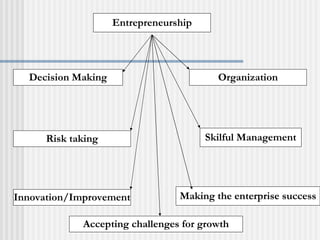
Accepting challenges for growth Entrepreneurship Organization Decision Making Skilful Management Risk taking Making the enterprise success Innovation/Improvement
Characteristics of Entrepreneurs Entrepreneurs do not (usually) have: A tolerance for organizational bureaucracies A penchant for following rules A structured approach to developing and implementing ideas The foresight to plan a course of action once the idea is implemented and established
Specific entrepreneurship areas Business ideas and development Products or services Marketing Management Financial management
Entrepreneurs vs. managers Management skills include: Technical production skills Knowledge of marketing skills Organizational and human resource skills Financial skills Ability to develop simple tasks to solve complicated problems Ability to find complete and efficient solutions to problems
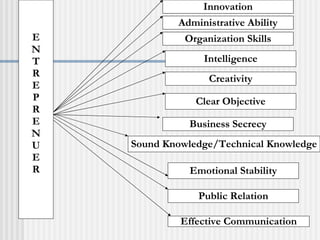
E N T R E P R E N U E R Innovation Administrative Ability Organization Skills Intelligence Creativity Clear Objective Business Secrecy Sound Knowledge/Technical Knowledge Emotional Stability Public Relation Effective Communication
The People Who are the “people?” The men and women starting and running the business Also includes outside parties who provide key services or resources Accountants Lawyers Suppliers
The Opportunity Is the market: Large? Rapidly growing? Both? Is the industry now, or can it become, structurally attractive? It is easier to gain market share from a growing market than from a stagnant one
The entrepreneur is solely and fully responsible for his funds. Said differently, you could conclude that the entrepreneur has to be reasonably sure of the success of his ideation. Whereas, failure of intrapreneurship probably just means the company has a loss of profit from its other businesses. Entrepreneurship Pg 1.4
Is an entrepreneur a manager? Yes. Is a manager an entrepreneur? Not necessarily! There are just a few essential differences Entrepreneurship Pg 1.4
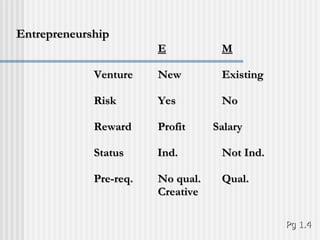
Entrepreneurship E M Venture New Existing Risk Yes No Reward Profit   Salary Status   Ind. Not Ind. Pre-req. No qual. Qual. Creative Pg 1.4
Motivation: Entreprenuer has dignity,self respect,values,sentiments,aspirations. Economic betterment and social upliftment motivates differentiates them. They have some basic values and responsibilities.
The business of motivation Factors of motivation: Educational background. Occupational experience. Desire to work independently. Desire to branch out manufacturing. Family background. Assistance from financial instututions
The business of motivation Availability of technology Other factors-demand of particular product etc.
Factors: Internal  External
Factors Internal to Entrepreneurs Strong desire to do something in life. Technical knowledge/manufacturing experience. Business experience in the same or related line.
Factors external to entrepreneurs:   Financial assistance from institutional sources. Machinery on hire/purchase. Attitude of the Govt. Encourage from big business. Heavy Demand. Profit Margin.
Seven keys to motivation that may prove helpful   Inspiration: Setting goals: Networking: Reward Yourself:
Other Traits: Self –confidence: Ability in themselves. Long term involvement: Long term commitment to the projects High Level Energy: Ability to work long
Entrepreneurial Leadership: Give positive feedback for good job. Initiate confidence in employees. Be fair and objective, not vindictive. Practice what is preached,donot ask for something that employees are not willing to do.
Entrepreneurial Leadership: Down to earth, person to person approach. Be compassionate and understanding. Create an atmosphere of acceptance and trust. Classification of priorities. Be available for discussion. Talk openly and give straight answers.
Administrative competence: The leader should understand his /her job. Understand employees job. Utilizing peoples skill effectively. Be concerned with employees and work flow. Get tough when necessary. Provide proper human resource for all levels.
Types of Entrepreneurs: Spontaneous Entrepreneurs (pure entrepreneurs): Motivated by their desire. Natural ,and no external motivation required. Strength in creative abilities.
Types of Entrepreneurs: Motivated Entrepreneurs: Motivated by their desire to make use of tech/professional expertise. They possess-confidence,initiative ,boldness. Provides new products/service to consumers.
Types of Entrepreneurs: Innovative business ventures.
Types of Entrepreneurs: Induced Entrepreneurs: Induced by policy of government.
Some study details: Managing entrepreneurs :chief motive is security. Innovative entrepreneurs: primarily looks for excitement. Controlling entrepreneurs who become entrepreneurs to fulfill their desire for power. The Opportunistic type, who was driven by expectations of financial gain,
Some study details: The “Push” type, driven by negative “push” reasons for starting a business,
Basically four strategies: Customer partnership strategy :concentrating on few large customers. Niche strategy : with highly focused product and market scope. Cost leader: with high emphasis on cost control. Investment promotion strategy :which invest heavily in promotion and brand building, as well as product development.
Entrepreneurial Attitude: Tendency to take moderate risk: An eye for economic opportunity: Imaginative: Initiative: Believe,to change environment: Enjoy freedom of expression
Entrepreneurial Attitude: Analyzing situation and planning action. Find satisfaction from successful completion of task:
Innovation, Entrepreneurship & Intrapreneurship
Corporate Entrepreneurship Concerned with innovation that leads to new corporate divisions or subsidiary ventures.
Entrepreneural Businesses Family businesses Franchises Home based businesses
Commitment to Excellence Understand the customer. Provide quality products and services. Knowledge and expertise, esp. business. Details. Continuous learning. Commit time and effort.

2

  • 1.
  • 2.
    Ratan Tata EveryTata has his legacy and Ratan Tata, the man with a rare mix of grace, composure and steely nerves, has created his own by winning the Corus . Battle against odds just as he steered the people's car project at Singur in West Bengal.
  • 3.
    True Entrepreneur RatanTata was named the Ernst & Young Entrepreneur of The Year 2003. The Tata Trusts are the unsung heroes of an extraordinary saga of philanthropy that has enriched the country and its citizens in more ways than can be quantified
  • 4.
    Reason for venturing:Tata and Corus will become the world’s fifth-largest steelmaking firm . Ensuring global presence. Low-cost country with raw material availability . Strong and growing economy. Indigenous raw materials . Rising consumer demand and infrastructure needs
  • 5.
    Simple Definitions Entrepreneurs… people who create and grow enterprises Entrepreneurship … the process through which entrepreneurs create and grow enterprises. Entrepreneurship development … the infrastructure of public and private policies and practices that foster and support entrepreneurship.
  • 6.
    What is Entrepreneurship?Entrepreneurship is a dynamic form of social and economic behavior in which people respond to environmental signals about the availability of opportunities and the resources with which they can be exploited. Rae and Carswell
  • 7.
    Entrepreneur: What's Ina Definition? "Entrepreneurship is the recognition and pursuit of opportunity without regard to the resources you currently control, with confidence that you can succeed , with the flexibility to change course as necessary, and with the will to rebound from setbacks."
  • 8.
    What do wemean by entrepreneurship contd…. There is only one definition of ”entrepreneur” An entrepreneur is someone who gets something new done.” Peter Drucker
  • 9.
    What is Entrepreneurship?An entrepreneur is a person who sees opportunity, sizes up its value, and finds the resources to make the most of it. Jim Nelson University of Idaho
  • 10.
    The American HeritageDictionary defines an entrepreneur to be "a person who organizes, operates, and assumes the risk for business ventures."
  • 11.
    The art ofentrepreneurship is the art of modern leadership. Ability to discover an investment opportunity and to organize an enterprise. Taking risk and making the necessary investments under conditions of uncertainty.
  • 12.
    The art ofentrepreneurship is the art of modern leadership. Ability to bring together and put to use other factors of production capital, labour, land
  • 13.
    Entrepreneurship: Creation ofcorporate wealth by leveraging sweat equity,innovation and brilliant vision,a well thought out strategy and flawless execution.
  • 14.
    What is criticalfactor ? Over population ? Food Shortage ? National resources shortage ? Energy Shortage ? Lack of Technology? Then what's the critical factor????
  • 15.
    The factor…. Uniqueaptitude of innovation. Urge for change. Ability to utilize present day technology. There is dire shortage of appropriate economic innovator and implementer….
  • 16.
    The psychology ofsuccessful entreprenuers Shared vision: A marketable idea: A sound strategy and implementable plan: A layer of competent management: A shared value system: Professionalism:
  • 17.
    The psychology ofsuccessful entreprenuers Spirit of sacrifice: Pride in creation of wealth: Leadership by example:
  • 18.
    A general admirationfor the entrepreneur a general admiration for the entrepreneur who has a skill and bravely jumps into the middle of the fire hoping not to get burned.
  • 19.
    Characteristics of EntrepreneursEntrepreneurs have: A passion for what they do. The creativity and ability to innovate. A sense of independence and self- reliance. (Usually) a high level of self confidence. A willingness and capability (though not necessarily capacity or preference) for taking risks.
  • 20.
    Characteristics of EntrepreneursVersatile knowledge. Energetic and Diligent. Responsive to suggestions. Responsive to critism. Dynamic Leader. Resourceful and preserving
  • 21.
    Accepting challenges forgrowth Entrepreneurship Organization Decision Making Skilful Management Risk taking Making the enterprise success Innovation/Improvement
  • 22.
    Characteristics of EntrepreneursEntrepreneurs do not (usually) have: A tolerance for organizational bureaucracies A penchant for following rules A structured approach to developing and implementing ideas The foresight to plan a course of action once the idea is implemented and established
  • 23.
    Specific entrepreneurship areasBusiness ideas and development Products or services Marketing Management Financial management
  • 24.
    Entrepreneurs vs. managersManagement skills include: Technical production skills Knowledge of marketing skills Organizational and human resource skills Financial skills Ability to develop simple tasks to solve complicated problems Ability to find complete and efficient solutions to problems
  • 25.
    E N TR E P R E N U E R Innovation Administrative Ability Organization Skills Intelligence Creativity Clear Objective Business Secrecy Sound Knowledge/Technical Knowledge Emotional Stability Public Relation Effective Communication
  • 26.
    The People Whoare the “people?” The men and women starting and running the business Also includes outside parties who provide key services or resources Accountants Lawyers Suppliers
  • 27.
    The Opportunity Isthe market: Large? Rapidly growing? Both? Is the industry now, or can it become, structurally attractive? It is easier to gain market share from a growing market than from a stagnant one
  • 28.
    The entrepreneur issolely and fully responsible for his funds. Said differently, you could conclude that the entrepreneur has to be reasonably sure of the success of his ideation. Whereas, failure of intrapreneurship probably just means the company has a loss of profit from its other businesses. Entrepreneurship Pg 1.4
  • 29.
    Is an entrepreneura manager? Yes. Is a manager an entrepreneur? Not necessarily! There are just a few essential differences Entrepreneurship Pg 1.4
  • 30.
    Entrepreneurship E MVenture New Existing Risk Yes No Reward Profit Salary Status Ind. Not Ind. Pre-req. No qual. Qual. Creative Pg 1.4
  • 31.
    Motivation: Entreprenuer hasdignity,self respect,values,sentiments,aspirations. Economic betterment and social upliftment motivates differentiates them. They have some basic values and responsibilities.
  • 32.
    The business ofmotivation Factors of motivation: Educational background. Occupational experience. Desire to work independently. Desire to branch out manufacturing. Family background. Assistance from financial instututions
  • 33.
    The business ofmotivation Availability of technology Other factors-demand of particular product etc.
  • 34.
  • 35.
    Factors Internal toEntrepreneurs Strong desire to do something in life. Technical knowledge/manufacturing experience. Business experience in the same or related line.
  • 36.
    Factors external toentrepreneurs: Financial assistance from institutional sources. Machinery on hire/purchase. Attitude of the Govt. Encourage from big business. Heavy Demand. Profit Margin.
  • 37.
    Seven keys tomotivation that may prove helpful Inspiration: Setting goals: Networking: Reward Yourself:
  • 38.
    Other Traits: Self–confidence: Ability in themselves. Long term involvement: Long term commitment to the projects High Level Energy: Ability to work long
  • 39.
    Entrepreneurial Leadership: Givepositive feedback for good job. Initiate confidence in employees. Be fair and objective, not vindictive. Practice what is preached,donot ask for something that employees are not willing to do.
  • 40.
    Entrepreneurial Leadership: Downto earth, person to person approach. Be compassionate and understanding. Create an atmosphere of acceptance and trust. Classification of priorities. Be available for discussion. Talk openly and give straight answers.
  • 41.
    Administrative competence: Theleader should understand his /her job. Understand employees job. Utilizing peoples skill effectively. Be concerned with employees and work flow. Get tough when necessary. Provide proper human resource for all levels.
  • 42.
    Types of Entrepreneurs:Spontaneous Entrepreneurs (pure entrepreneurs): Motivated by their desire. Natural ,and no external motivation required. Strength in creative abilities.
  • 43.
    Types of Entrepreneurs:Motivated Entrepreneurs: Motivated by their desire to make use of tech/professional expertise. They possess-confidence,initiative ,boldness. Provides new products/service to consumers.
  • 44.
    Types of Entrepreneurs:Innovative business ventures.
  • 45.
    Types of Entrepreneurs:Induced Entrepreneurs: Induced by policy of government.
  • 46.
    Some study details:Managing entrepreneurs :chief motive is security. Innovative entrepreneurs: primarily looks for excitement. Controlling entrepreneurs who become entrepreneurs to fulfill their desire for power. The Opportunistic type, who was driven by expectations of financial gain,
  • 47.
    Some study details:The “Push” type, driven by negative “push” reasons for starting a business,
  • 48.
    Basically four strategies:Customer partnership strategy :concentrating on few large customers. Niche strategy : with highly focused product and market scope. Cost leader: with high emphasis on cost control. Investment promotion strategy :which invest heavily in promotion and brand building, as well as product development.
  • 49.
    Entrepreneurial Attitude: Tendencyto take moderate risk: An eye for economic opportunity: Imaginative: Initiative: Believe,to change environment: Enjoy freedom of expression
  • 50.
    Entrepreneurial Attitude: Analyzingsituation and planning action. Find satisfaction from successful completion of task:
  • 51.
  • 52.
    Corporate Entrepreneurship Concernedwith innovation that leads to new corporate divisions or subsidiary ventures.
  • 53.
    Entrepreneural Businesses Familybusinesses Franchises Home based businesses
  • 54.
    Commitment to ExcellenceUnderstand the customer. Provide quality products and services. Knowledge and expertise, esp. business. Details. Continuous learning. Commit time and effort.