Entrepreneur, Entrepreneurship & Intrapreneur
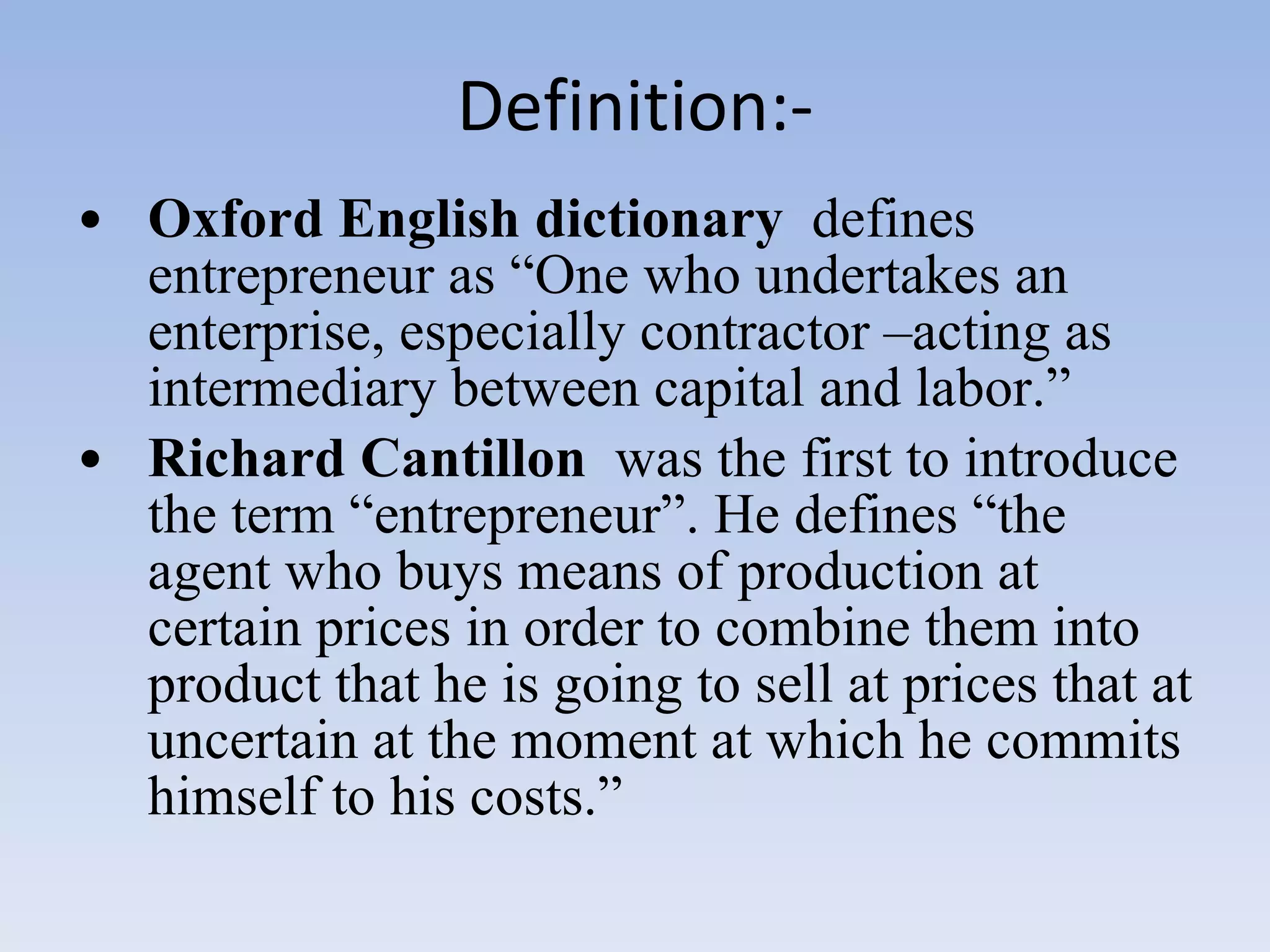
Definition:- Oxford English dictionary   defines entrepreneur as “One who undertakes an enterprise, especially contractor –acting as intermediary between capital and labor.” Richard Cantillon  was the first to introduce the term “entrepreneur”. He defines “the agent who buys means of production at certain prices in order to combine them into product that he is going to sell at prices that at uncertain at the moment at which he commits himself to his costs.”
3 .  J.B.Say  “an Entrepreneur is the economic agent who unites all the means of production, the labor force of the one and the capital or land of the others and who finds in the value of the products which result from their employment , the reconstitution of the entire capital that he utilizes and the value of the wages , the interest and the rent which he pays as well as the profit belonging to himself”. 4.  Evans  “entrepreneurs are persons who initiate, organize, manage and control the affairs of a business unit that combines the factors of production to supply goods & services whether business pertains to agriculture ,industry trade or profession”
Characteristics of an entrepreneur
 
Characteristics of an “IDEAL” entrepreneur
Entrepreneurship stimulants Focus on capital formation. Transformation of scientific and technical development Supportive government programmes. Availability of required training and inputs. Collaborative relationship between business and resources.  Environment conducive for innovation.
 
Summary of Entrepreneur
Entrepreneurship
ENTERPRENEURIAL SKILL
DEFINITIONS OF ENTREPRENEURSHIP According to A.H Cole, “Entrepreneurship is the purposeful activity of an individual or group of associated individuals, undertaken to initiate, maintain or aggrandize profit by production or distribution of economic goods or services.” Benjamin Higgins has defined entrepreneurship as “ Entrepreneurship means the function of foreseeing investment and production opportunity, organizing and enterprise to undertake a new selecting top managers for the day to day of an operation of an enterprise.” According to B. C. Tandon , “Entrepreneurship means the function of creating something new, organizing and co-ordination and undertaking risk and handling economic uncertainty
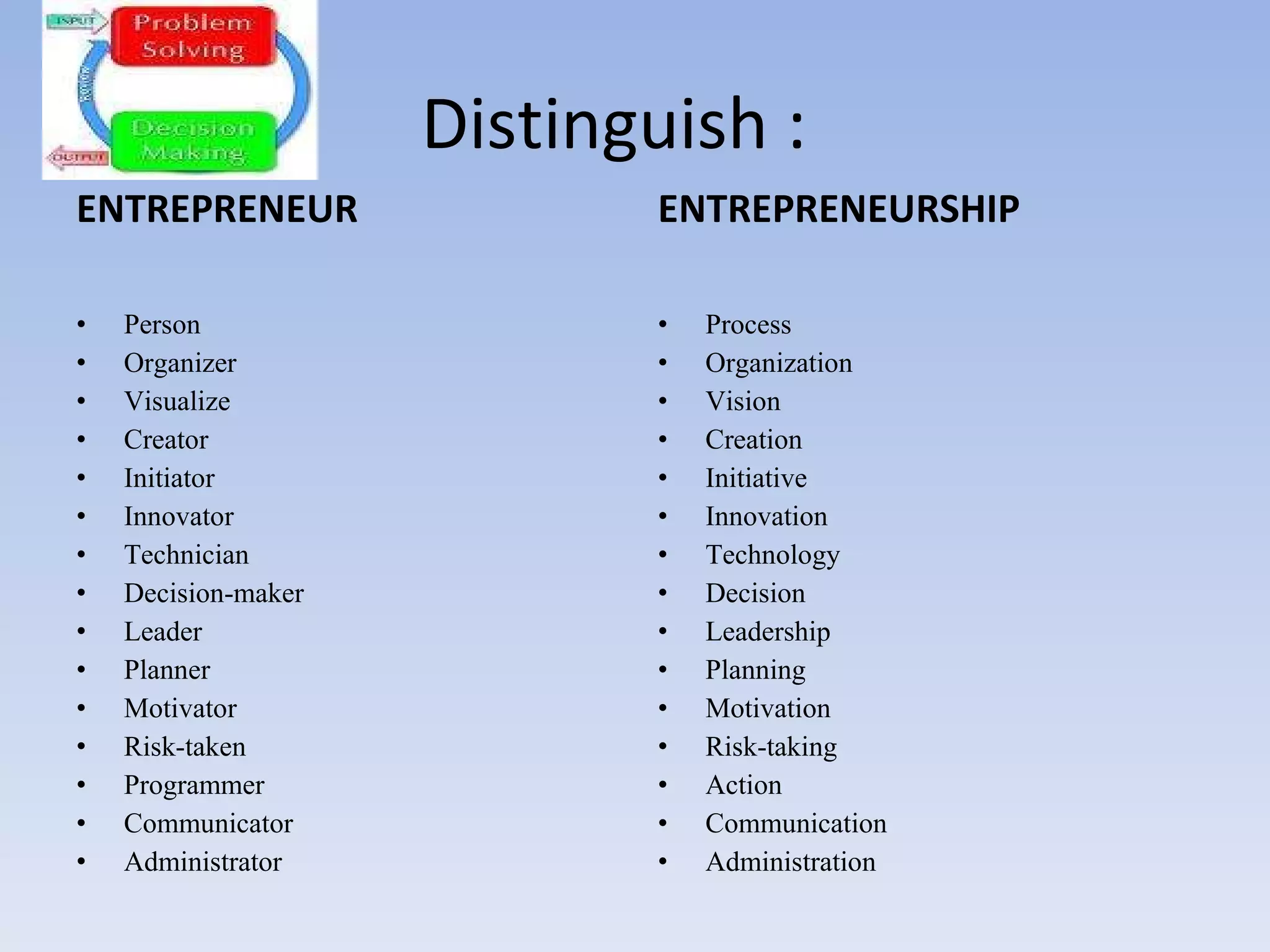
Distinguish : ENTREPRENEUR Person Organizer Visualize Creator Initiator Innovator Technician Decision-maker Leader Planner Motivator Risk-taken Programmer Communicator Administrator ENTREPRENEURSHIP Process Organization Vision Creation Initiative Innovation Technology Decision Leadership Planning Motivation Risk-taking Action Communication Administration
CHARACTERISTICS OF ENTREPRENEURSHIP
FUNCTIONS AND SCOPE OF ENTREPRENEURSHIP
FACTORS AFFECTING ENTREPRENEURIAL GROWTH
SOCIAL ENTREPRENEURSHIP Social entrepreneurs are individuals with innovative solutions to society’s most pressing social problems.  They are ambitious and persistent, tackling major social issues and offering new ideas for wide-scale change . A social entrepreneur recognizes a social problem and uses entrepreneurial principles to organize, create, and manage a venture to make social change. Unlike business entrepreneurs they don’t measures performance in profit and returns, but assess success by the impact they have on society and often work through nonprofits and citizen groups. They call themselves social entrepreneur, and their ‘business’ is to make the work a better place.
Intrapreneur
Definition & meaning An intrapreneur is defined as “any of the dreamer who do” those who take hand on responsibility of creating innovation of any kind within the organisation. The intrapreneur may be creator or inventor but he is always a dreamer who finds out how to turn an idea into a profitable reality.
Characteristics of intrapreneurial environment
Intrapreneur Qualities
Intrapreneur Characteristics
The intrapreneur’s Ten Commandments Do any job needed to make your project work. Find people to help you. Honour your sponsor. Be true to tour goals, but be realistic about the ways to achieve them Remember it is easier to ask for forgiveness than for permission.  Work secretly as long as you can Follow your intuition about the people you choose & work only with the best. Come to work each day willing to be fined. Prevent any orders aimed to stopping your dreams. Never bet on a race unless you are running in it.
Classification of intrapreneurs
Some companies started by intrepreneurs. Google Yahoo You tube facebook
Theories of entrepreneurship
The Economic Theory- B.C.Tandon He describes the Functions of an entrepreneur in a developing economy in the context of the environmental forces.i.e economic, rural ,political and culture. Accordingly the entrepreneur must posses: Ability of organization & administration. Technological knowledge , alertness to know opportunities ,willingness to accept change & ability to initiate and Capacity to assume risk and self confidence Tact ,patience and power of observation & ability of discrimination. Perseverance  to overcome obstruction and fear. Capacity to pick and choose associates and subordinates and delegate authority to inspire loyalty. Role like that of  a “strike who keeps the fire burning.”.
Leibenstein’s X efficiency theory X-efficiency is the degree of ineffiency in the use of resources in the wrong way, within the firm for productive potential. The entrepreneur has to complete the production efficiently with proper inputs and improve flow of information in market by gap filling in the economy
Sociological Theory- Peter Marris  “ To assemble or reassemble from what is available ,very concrete kind of imagination ,to see what other have missed ,sensitivity to business and social environment ,zest in industrial development and entrepreneurial courage are the factors that make an entrepreneur.”
Psychological Theory -Schumpeter He believes that entrepreneurs are motivated by will  to power, will to find a private kingdom or will to conquer. The main characteristics are: An institutional capacity to see things in a way which afterward proves correct, Energy of will and mind to overcome fixed habits of thought and The capacity to withstand social opposition .
Harvard school theory – Cole  Entrepreneurship comprises any purposeful activity that initiate , maintain or develop a profit – oriented business ,in interaction with internal  ,economic ,political and social circumstances of business. Entrepreneurs operate under fairly uncertain circumstances.
Theory of High Achievement –Mc Clelland Mc Clelland identified two characteristics of entrepreneurship for decision making under uncertainty .  He stressed the need of achievement and the tendency to strive for success. People with high (N-Ach) are not influenced by profits as it is just a measure of success and competency.
Theory of Profit- Knight Knight identifies the entrepreneur as a recipient of pure profit. Uncertainty can be identified by priority reasoning or statistical inference.
Peter Drucker’s theory  Entrepreneurs need to search purposefully for the sources of innovation ,the changes and their symptoms that indicate opportunities for successful innovation and they need to know and apply the principles of successful innovations.
Hagen views on entrepreneurship  “ creative innovation is the fundamental feature of economic growth. An entrepreneur is described as a creative problem solver interested in things that are practical. While facing a problem he feels a sense of increased pleasure and tolerates disorder without disorders.” Innovation requires creativity and individuals who are creativity can only bring about economic growth. “ the withdrawal of status respect” Four different types of personalities would emerge .t they are:
Four different types of personalities
Myths of entrepreneurship Entrepreneur s are born not. They are academic and social misfits They fit an ideal profile All you need is money and luck  to be an entrepreneur A great idea is only ingredient in a recipe for success. My best friend will be a great business partner. Having a boss is a great fun. I can make lots of money. I’ll definitely become successful Life must be much simpler if I work for myself.
Success steps
Thank you

Entrepreneurship

  • 1.
  • 2.
    Definition:- Oxford Englishdictionary defines entrepreneur as “One who undertakes an enterprise, especially contractor –acting as intermediary between capital and labor.” Richard Cantillon was the first to introduce the term “entrepreneur”. He defines “the agent who buys means of production at certain prices in order to combine them into product that he is going to sell at prices that at uncertain at the moment at which he commits himself to his costs.”
  • 3.
    3 . J.B.Say “an Entrepreneur is the economic agent who unites all the means of production, the labor force of the one and the capital or land of the others and who finds in the value of the products which result from their employment , the reconstitution of the entire capital that he utilizes and the value of the wages , the interest and the rent which he pays as well as the profit belonging to himself”. 4. Evans “entrepreneurs are persons who initiate, organize, manage and control the affairs of a business unit that combines the factors of production to supply goods & services whether business pertains to agriculture ,industry trade or profession”
  • 4.
  • 5.
  • 6.
    Characteristics of an“IDEAL” entrepreneur
  • 7.
    Entrepreneurship stimulants Focuson capital formation. Transformation of scientific and technical development Supportive government programmes. Availability of required training and inputs. Collaborative relationship between business and resources. Environment conducive for innovation.
  • 8.
  • 9.
  • 10.
  • 11.
  • 12.
    DEFINITIONS OF ENTREPRENEURSHIPAccording to A.H Cole, “Entrepreneurship is the purposeful activity of an individual or group of associated individuals, undertaken to initiate, maintain or aggrandize profit by production or distribution of economic goods or services.” Benjamin Higgins has defined entrepreneurship as “ Entrepreneurship means the function of foreseeing investment and production opportunity, organizing and enterprise to undertake a new selecting top managers for the day to day of an operation of an enterprise.” According to B. C. Tandon , “Entrepreneurship means the function of creating something new, organizing and co-ordination and undertaking risk and handling economic uncertainty
  • 13.
    Distinguish : ENTREPRENEURPerson Organizer Visualize Creator Initiator Innovator Technician Decision-maker Leader Planner Motivator Risk-taken Programmer Communicator Administrator ENTREPRENEURSHIP Process Organization Vision Creation Initiative Innovation Technology Decision Leadership Planning Motivation Risk-taking Action Communication Administration
  • 14.
  • 15.
    FUNCTIONS AND SCOPEOF ENTREPRENEURSHIP
  • 16.
  • 17.
    SOCIAL ENTREPRENEURSHIP Socialentrepreneurs are individuals with innovative solutions to society’s most pressing social problems. They are ambitious and persistent, tackling major social issues and offering new ideas for wide-scale change . A social entrepreneur recognizes a social problem and uses entrepreneurial principles to organize, create, and manage a venture to make social change. Unlike business entrepreneurs they don’t measures performance in profit and returns, but assess success by the impact they have on society and often work through nonprofits and citizen groups. They call themselves social entrepreneur, and their ‘business’ is to make the work a better place.
  • 18.
  • 19.
    Definition & meaningAn intrapreneur is defined as “any of the dreamer who do” those who take hand on responsibility of creating innovation of any kind within the organisation. The intrapreneur may be creator or inventor but he is always a dreamer who finds out how to turn an idea into a profitable reality.
  • 20.
  • 21.
  • 22.
  • 23.
    The intrapreneur’s TenCommandments Do any job needed to make your project work. Find people to help you. Honour your sponsor. Be true to tour goals, but be realistic about the ways to achieve them Remember it is easier to ask for forgiveness than for permission. Work secretly as long as you can Follow your intuition about the people you choose & work only with the best. Come to work each day willing to be fined. Prevent any orders aimed to stopping your dreams. Never bet on a race unless you are running in it.
  • 24.
  • 25.
    Some companies startedby intrepreneurs. Google Yahoo You tube facebook
  • 26.
  • 27.
  • 28.
    The Economic Theory-B.C.Tandon He describes the Functions of an entrepreneur in a developing economy in the context of the environmental forces.i.e economic, rural ,political and culture. Accordingly the entrepreneur must posses: Ability of organization & administration. Technological knowledge , alertness to know opportunities ,willingness to accept change & ability to initiate and Capacity to assume risk and self confidence Tact ,patience and power of observation & ability of discrimination. Perseverance to overcome obstruction and fear. Capacity to pick and choose associates and subordinates and delegate authority to inspire loyalty. Role like that of a “strike who keeps the fire burning.”.
  • 29.
    Leibenstein’s X efficiencytheory X-efficiency is the degree of ineffiency in the use of resources in the wrong way, within the firm for productive potential. The entrepreneur has to complete the production efficiently with proper inputs and improve flow of information in market by gap filling in the economy
  • 30.
    Sociological Theory- PeterMarris “ To assemble or reassemble from what is available ,very concrete kind of imagination ,to see what other have missed ,sensitivity to business and social environment ,zest in industrial development and entrepreneurial courage are the factors that make an entrepreneur.”
  • 31.
    Psychological Theory -SchumpeterHe believes that entrepreneurs are motivated by will to power, will to find a private kingdom or will to conquer. The main characteristics are: An institutional capacity to see things in a way which afterward proves correct, Energy of will and mind to overcome fixed habits of thought and The capacity to withstand social opposition .
  • 32.
    Harvard school theory– Cole Entrepreneurship comprises any purposeful activity that initiate , maintain or develop a profit – oriented business ,in interaction with internal ,economic ,political and social circumstances of business. Entrepreneurs operate under fairly uncertain circumstances.
  • 33.
    Theory of HighAchievement –Mc Clelland Mc Clelland identified two characteristics of entrepreneurship for decision making under uncertainty . He stressed the need of achievement and the tendency to strive for success. People with high (N-Ach) are not influenced by profits as it is just a measure of success and competency.
  • 34.
    Theory of Profit-Knight Knight identifies the entrepreneur as a recipient of pure profit. Uncertainty can be identified by priority reasoning or statistical inference.
  • 35.
    Peter Drucker’s theory Entrepreneurs need to search purposefully for the sources of innovation ,the changes and their symptoms that indicate opportunities for successful innovation and they need to know and apply the principles of successful innovations.
  • 36.
    Hagen views onentrepreneurship “ creative innovation is the fundamental feature of economic growth. An entrepreneur is described as a creative problem solver interested in things that are practical. While facing a problem he feels a sense of increased pleasure and tolerates disorder without disorders.” Innovation requires creativity and individuals who are creativity can only bring about economic growth. “ the withdrawal of status respect” Four different types of personalities would emerge .t they are:
  • 37.
    Four different typesof personalities
  • 38.
    Myths of entrepreneurshipEntrepreneur s are born not. They are academic and social misfits They fit an ideal profile All you need is money and luck to be an entrepreneur A great idea is only ingredient in a recipe for success. My best friend will be a great business partner. Having a boss is a great fun. I can make lots of money. I’ll definitely become successful Life must be much simpler if I work for myself.
  • 39.
  • 40.