Entrepreneurship Management
- Prof. J.C. Saboo
What do you mean by…
Entrepreneur
(oxford dictionary): Person who undertakes an
enterprise with chances of profit or loss.
Enterprise (oxford dictionary): Bold
Undertaking
Entrepreneur-New Encyclopedia Britannica:
An individual who bears the risk of operating
business in the face of uncertainty about the
future conditions.
Common Meaning: one who starts his own, new
and small business
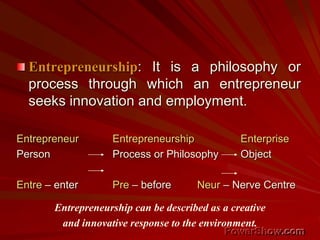
Entrepreneurship: It is a philosophy or
process through which an entrepreneur
seeks innovation and employment.
Entrepreneur Entrepreneurship Enterprise
Person Process or Philosophy Object
Entre – enter Pre – before Neur – Nerve Centre
Entrepreneurship can be described as a creative
and innovative response to the environment.
Entrepreneurship Theories
1600: French verb- Entreprendre – to undertake
1700: Person bearing Risks of Profit in a fixed
price contract (Risk)
1725: Richard Cantillon – Person bearing risks
is different from Capital Supplier (Risk)
1803: J. B. Say – Shifts economic resources out
of an area of lower into an area of higher
productivity & greater yields (Value Addition)
1934: Joseph Schumpeter – Innovator and
develops untried technology (Productivity &
Innovation)
Entrepreneurship Theories…
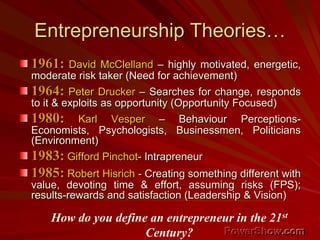
1961: David McClelland – highly motivated, energetic,
moderate risk taker (Need for achievement)
1964: Peter Drucker – Searches for change, responds
to it & exploits as opportunity (Opportunity Focused)
1980: Karl Vesper – Behaviour Perceptions-
Economists, Psychologists, Businessmen, Politicians
(Environment)
1983: Gifford Pinchot- Intrapreneur
1985: Robert Hisrich - Creating something different with
value, devoting time & effort, assuming risks (FPS);
results-rewards and satisfaction (Leadership & Vision)
How do you define an entrepreneur in the 21st
Century?
Entrepreneurship
“Is the process of creating something
different with value by devoting the
necessary time and effort, assuming the
accompanying financial, psychic, social
risks and receiving the resulting
rewards of monetary and personal
satisfaction and independence”
The Nature and Development of
Entrepreneurship
Entrepreneur stems from
French Verb Entreprendre
means between – taker or go between
New Definition involves four aspects:
The creation process
The devotion of time and efforts
The assumption of risks
Rewards of independence, satisfaction, money.
To an Individual
Self Employment
Employment for near & dear
Prolonged career for next generations
Freedom to use own ideas - Innovation
and creativity
Unlimited income / higher retained income
Independence
Satisfaction
To the Nation
Provides larger employment
Results in wider distribution of wealth
Mobilizes local resources, skills and
savings
Accelerates the pace of economic
development
Stimulates innovation & efficiency
Factors favouring
Entrepreneurship
Growth of education- science, technology
& management
Developed infrastructure facilities
Financial assistance
Training facilities
Protective and promotional policies
Globalization
Think of numerous other factors?
What makes a Successful
Entrepreneur?
The urge for achievement
Determination to win
Win-Win Personality
Willingness to take moderate risks
Ability to identify & explore
opportunities
Analytical ability to take strategic
decisions
Perseverance
Flexibility
Capacity to plan and organize
Preparedness to undergo physical and
emotional stress
Positive self concept
Future orientation: Vision
Ethics and Values :Mission
Who can be an Entrepreneur?
Who can take moderate risks
Who has ability to work hard
Who can capitalize on opportunities
Who has some financial strength
Who feels the need for achievement
Who has desire for responsibility
Who has perception of probability of success
Who gets stimulation by feedback
Who possess skills in organizing
Who can be male or female
Who may not have previous experience
Characteristics of an
Entrepreneur
Mental ability
Clear objectives
Business secrecy
H.R. ability
Communication ability
Technical knowledge
Achievement-oriented
Perseverance
Ethical
Motivator
Self-confident
Long term
involvement
High energy level
Problem solver
Initiator
Goal setter
Risk taker
Key elements of entrepreneur
Innovation
Vision
Ethics & Values
Organizing Skills
Risk taking
Need for Achievement
Study the Profile of a Successful Entrepreneur and
identify six key elements in order of priority
Entrepreneur’s Background and
Characteristics
Family environment
Education
Age
Physical attributes
Marital status
Working history
Family contacts
Professional contacts
Personal values
Lifestyle
Analyze your Personality
Feelings about Control
Feelings about Independence
Willingness to take Risks
What is a job competency?
It is knowledge, skills and attitude
Knowledge – collection and retention of
information.
Skills are ability to do something well
(hard and soft skills)
Motives are reasons for doing something
(need)
Traits – characteristics way in, which a person
responds.
Attitude reflects the way of thinking and acting
(Self and others determine the attitude)
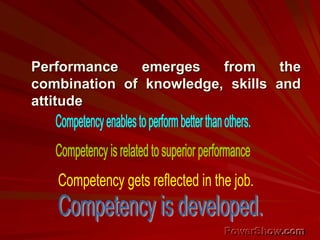
Performance emerges from the
combination of knowledge, skills and
attitude
Initiative
– Taking actions that go beyond job requirements or
demands of the situation.
– Doing things on own before being asked for or being
forced by the events.
– Taking actions to start the business and expand into new
areas, products and services.
Seeing & acting on opportunities
– Looking for and taking actions to seize opportunities
– Seeing and acting on opportunities for business
development or for personal growth.
– Seeing unusual opportunities
– Seizing opportunities, need, procuring and mobilizing
necessary resources.
Persistence
– Taking repeated actions to overcome obstacles that
get in the way of achieving goals
– Taking actions in the face of obstacles.
– Ensuring all efforts to solve a problem or barrier.
Information seeking
– Taking action s on own to help reach objectives.
– Personally undertaking a research or analysis to find
out answers to some problem.
– Seeking information to clarify what is needed.
– Using networks to obtain information.
Concern for high quality of work
– Doing things that meet or beat existing
standard of excellence.
– Stating a desire to produce work of high
quality
– Comparing work favorably to that of others.
– Making all out efforts to ensure the quality of
product or services.
Work commitment to contract
– Placing highest priority for getting a job
completed.
– Taking all the effort to complete a job.
– Accepting responsibilities for failures.
– Expressing utmost concern for the customers
– Readiness to work at any level to get work
done.
Efficiency Orientation
– Constantly looking for ways to do things faster or with
fewer resources or at a lesser cost.
– Using business tools to increase personal or
professional efficiency.
– Expressing concern for assessing cost versus reward
of some improvements, changes or action.
Systematic Planning
– Developing and using logical steps to reach goals.
– Breaking a large task into several sub tasks.
– Developing plans after duly anticipating obstacles.
– Evaluating alternatives on merits and demerits.
Problem Solving
– Identifying and applying new ideas to reach the goals.
– Identifying the root cause of the problem.
– Developing strategies in the light of objectives,
resources, and constraints.
– Generating new ideas or innovative solutions.
Self Confidence
– Having a strong belief in own abilities.
– Sticking with own judgment in the face of opposition
or early lack of success.
– Doing something for which chances of success are
not very fair.
Persuasion
– Persuading others successfully
– Selling someone an idea, product or service.
– Making someone agree to provide resources
– Convincing with confidence, competence and respect.
Use of Influence Strategies
– Using a variety of strategies to influence others
successfully
– Developing professional and business contacts.
– Using influential people to get own things done.
– Carefully limiting the information to be given to others
– Using others authority and resources, but remaining
ethical
Assertiveness
– Confronting problems and issues with other directly
– Speaking politely but firmly.
– Telling others clearly what they have to do
– Reprimanding those who fail to perform as expected
however close they may be.
Monitoring
– Ensuring smooth progress of project or work.
– Personally supervising all aspects of the work to its
completion.
– Developing a system of supervision and monitoring.
Concern for other’s welfare
– Having a concern and taking actions to
improve other’s welfare.
– Responding positively to employees specific
needs.
– Having a concern for the welfare of
employees, their families and society at large.
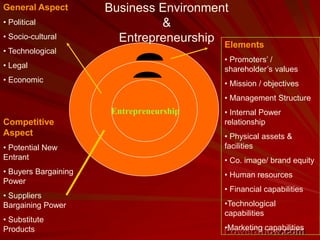
Entrepreneurship
Elements
• Promoters’ /
shareholder’s values
• Mission / objectives
• Management Structure
• Internal Power
relationship
• Physical assets &
facilities
• Co. image/ brand equity
• Human resources
• Financial capabilities
•Technological
capabilities
•Marketing capabilities
General Aspect
• Political
• Socio-cultural
• Technological
• Legal
• Economic
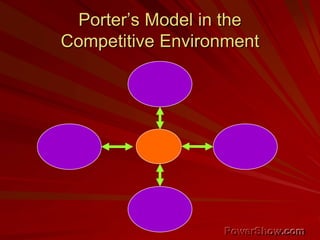
Competitive
Aspect
• Potential New
Entrant
• Buyers Bargaining
Power
• Suppliers
Bargaining Power
• Substitute
Products
Business Environment
&
Entrepreneurship
Environment
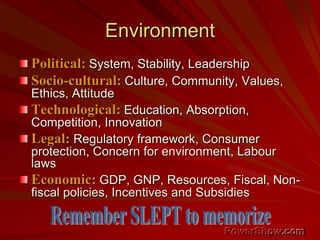
Political: System, Stability, Leadership
Socio-cultural: Culture, Community, Values,
Ethics, Attitude
Technological: Education, Absorption,
Competition, Innovation
Legal: Regulatory framework, Consumer
protection, Concern for environment, Labour
laws
Economic: GDP, GNP, Resources, Fiscal, Non-
fiscal policies, Incentives and Subsidies
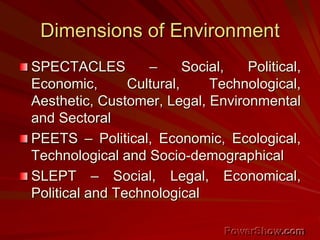
Dimensions of Environment
SPECTACLES – Social, Political,
Economic, Cultural, Technological,
Aesthetic, Customer, Legal, Environmental
and Sectoral
PEETS – Political, Economic, Ecological,
Technological and Socio-demographical
SLEPT – Social, Legal, Economical,
Political and Technological
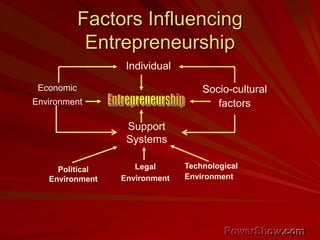
Factors Influencing
Entrepreneurship
Individual
Economic
Environment
Socio-cultural
factors
Support
Systems
Political
Environment
Legal
Environment
Technological
Environment
Porter’s Model in the
Competitive Environment
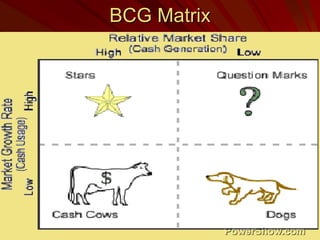
BCG Matrix
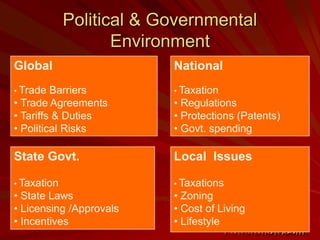
Political & Governmental
Environment
Global
• Trade Barriers
• Trade Agreements
• Tariffs & Duties
• Political Risks
National
• Taxation
• Regulations
• Protections (Patents)
• Govt. spending
State Govt.
• Taxation
• State Laws
• Licensing /Approvals
• Incentives
Local Issues
• Taxations
• Zoning
• Cost of Living
• Lifestyle
Environmental Analysis
Scanning to detect change (identify key
elements and their characteristics)
Monitoring to track development (that affect the
survival and profitability of the new business)
Forecasting to project the future (such as level of
prices, inflation, interest rates, availability of
funds, market share, market growth, etc.
Assessing to interpret data (what does it all
mean to the entrepreneur?)
Entrepreneurship and Economic
Development
Entrepreneur’s set up Enterprises
Entrepreneurs combines resources, put their time and
efforts and produce goods or services
What they contribute – productivity, output, value
addition, income and employment
Entrepreneurship is a “Low Cost Strategy”.
Entrepreneurs perform the crucial role themselves
The spirit of Entrepreneurship – Drive, achieving higher
goals, creativity, innovative attitude.
A dynamic society emerges and the spirit spreads like a
chain reaction.
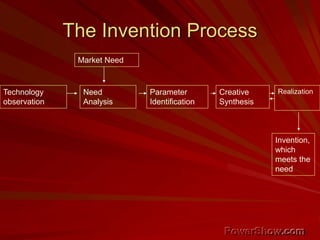
The Invention Process
Market Need
Technology
observation
Need
Analysis
Parameter
Identification
Creative
Synthesis
Realization
Invention,
which
meets the
need
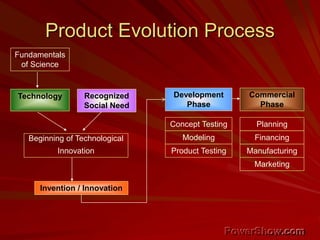
Product Evolution Process
Fundamentals
of Science
Recognized
Social Need
Beginning of Technological
Innovation
Invention / Innovation
Planning
Financing
Manufacturing
Marketing
Concept Testing
Development
Phase
Commercial
Phase
Technology
Modeling
Product Testing
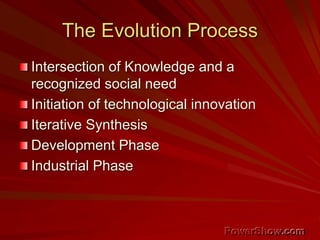
The Evolution Process
Intersection of Knowledge and a
recognized social need
Initiation of technological innovation
Iterative Synthesis
Development Phase
Industrial Phase
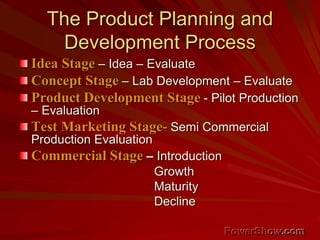
The Product Planning and
Development Process
Idea Stage – Idea – Evaluate
Concept Stage – Lab Development – Evaluate
Product Development Stage - Pilot Production
– Evaluation
Test Marketing Stage- Semi Commercial
Production Evaluation
Commercial Stage – Introduction
Growth
Maturity
Decline
Commercialization
Role of Government
Role of Corporate – Intrapreneurship
Role of Individuals – Entrepreneurship
Development of Technology
– Utilization of materials
– Exploitation & transformation of energy
– Understanding and application of Scientific
Principles
The Role of Government
– Promotional
– Neutral
– Regulatory
The Role of Smaller firm
T- High, M-High – Large skilled resources,
financial backing. Act as a Supplier or Sub –Contractor
T- High, M-Low - Specialist firm, access to low cost
research
T-Low, M-High – Linkage with well-established
channels
T-Low, M- Low – Well Suited to small firm
Low Tech – High Volume Financial Ability
High Tech – Low Volume Strategic Ability
Emerging Options – Franchisee; Sub-contractor
Entrepreneurship and Management Students
Enterprises in protected economy can be mismanaged.
Enterprises in competitive environment are essentially
to be managed.
A Management Graduate is a person trained to
manage an enterprise. Naturally, he will deliver the best
results.
A Management Graduate should not be just a Job
Seeker. He can and should take the role of Job
Provider.
Experience even from HBS confirm that more
Management Graduates take Entrepreneurial Role
(after some experience) and their income is higher than
their colleagues who are in job.
“AnEntrepreneur has to be a Manager.
But a Managerneed not be an Entrepreneur”
Entrepreneurial Decision Process
Pull Factors
– Perception of
Advantages
– Spotting an Opportunity
– Government Policies
– Motivation from
Biographies or Success
Stories
– Influenced by Culture,
Community, Family
Background, Teachers,
Peers, etc.
Push Factors
– Job
Dissatisfaction
– Relocation
– Lay-off
– Retirement
– Boredom
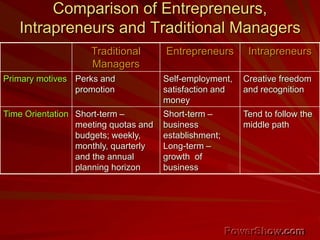
Comparison of Entrepreneurs,
Intrapreneurs and Traditional Managers
Traditional
Managers
Entrepreneurs Intrapreneurs
Primary motives Perks and
promotion
Self-employment,
satisfaction and
money
Creative freedom
and recognition
Time Orientation Short-term –
meeting quotas and
budgets; weekly,
monthly, quarterly
and the annual
planning horizon
Short-term –
business
establishment;
Long-term –
growth of
business
Tend to follow the
middle path
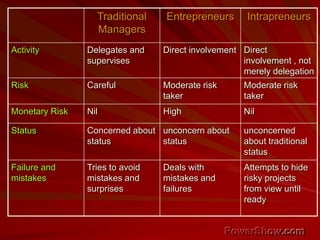
Traditional
Managers
Entrepreneurs Intrapreneurs
Activity Delegates and
supervises
Direct involvement Direct
involvement , not
merely delegation
Risk Careful Moderate risk
taker
Moderate risk
taker
Monetary Risk Nil High Nil
Status Concerned about
status
unconcern about
status
unconcerned
about traditional
status
Failure and
mistakes
Tries to avoid
mistakes and
surprises
Deals with
mistakes and
failures
Attempts to hide
risky projects
from view until
ready
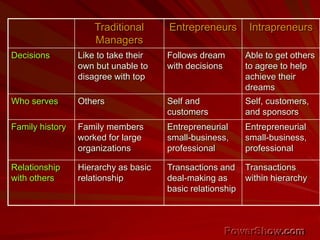
Traditional
Managers
Entrepreneurs Intrapreneurs
Decisions Like to take their
own but unable to
disagree with top
Follows dream
with decisions
Able to get others
to agree to help
achieve their
dreams
Who serves Others Self and
customers
Self, customers,
and sponsors
Family history Family members
worked for large
organizations
Entrepreneurial
small-business,
professional
Entrepreneurial
small-business,
professional
Relationship
with others
Hierarchy as basic
relationship
Transactions and
deal-making as
basic relationship
Transactions
within hierarchy
Entrepreneurship Management Defined

Entrepreneurship Management Defined

  • 1.
  • 2.
    What do youmean by… Entrepreneur (oxford dictionary): Person who undertakes an enterprise with chances of profit or loss. Enterprise (oxford dictionary): Bold Undertaking Entrepreneur-New Encyclopedia Britannica: An individual who bears the risk of operating business in the face of uncertainty about the future conditions. Common Meaning: one who starts his own, new and small business
  • 3.
    Entrepreneurship: It isa philosophy or process through which an entrepreneur seeks innovation and employment. Entrepreneur Entrepreneurship Enterprise Person Process or Philosophy Object Entre – enter Pre – before Neur – Nerve Centre Entrepreneurship can be described as a creative and innovative response to the environment.
  • 4.
    Entrepreneurship Theories 1600: Frenchverb- Entreprendre – to undertake 1700: Person bearing Risks of Profit in a fixed price contract (Risk) 1725: Richard Cantillon – Person bearing risks is different from Capital Supplier (Risk) 1803: J. B. Say – Shifts economic resources out of an area of lower into an area of higher productivity & greater yields (Value Addition) 1934: Joseph Schumpeter – Innovator and develops untried technology (Productivity & Innovation)
  • 5.
    Entrepreneurship Theories… 1961: DavidMcClelland – highly motivated, energetic, moderate risk taker (Need for achievement) 1964: Peter Drucker – Searches for change, responds to it & exploits as opportunity (Opportunity Focused) 1980: Karl Vesper – Behaviour Perceptions- Economists, Psychologists, Businessmen, Politicians (Environment) 1983: Gifford Pinchot- Intrapreneur 1985: Robert Hisrich - Creating something different with value, devoting time & effort, assuming risks (FPS); results-rewards and satisfaction (Leadership & Vision) How do you define an entrepreneur in the 21st Century?
  • 6.
    Entrepreneurship “Is the processof creating something different with value by devoting the necessary time and effort, assuming the accompanying financial, psychic, social risks and receiving the resulting rewards of monetary and personal satisfaction and independence”
  • 7.
    The Nature andDevelopment of Entrepreneurship Entrepreneur stems from French Verb Entreprendre means between – taker or go between New Definition involves four aspects: The creation process The devotion of time and efforts The assumption of risks Rewards of independence, satisfaction, money.
  • 9.
    To an Individual SelfEmployment Employment for near & dear Prolonged career for next generations Freedom to use own ideas - Innovation and creativity Unlimited income / higher retained income Independence Satisfaction
  • 10.
    To the Nation Provideslarger employment Results in wider distribution of wealth Mobilizes local resources, skills and savings Accelerates the pace of economic development Stimulates innovation & efficiency
  • 11.
    Factors favouring Entrepreneurship Growth ofeducation- science, technology & management Developed infrastructure facilities Financial assistance Training facilities Protective and promotional policies Globalization Think of numerous other factors?
  • 12.
    What makes aSuccessful Entrepreneur? The urge for achievement Determination to win Win-Win Personality Willingness to take moderate risks Ability to identify & explore opportunities Analytical ability to take strategic decisions
  • 13.
    Perseverance Flexibility Capacity to planand organize Preparedness to undergo physical and emotional stress Positive self concept Future orientation: Vision Ethics and Values :Mission
  • 14.
    Who can bean Entrepreneur? Who can take moderate risks Who has ability to work hard Who can capitalize on opportunities Who has some financial strength Who feels the need for achievement Who has desire for responsibility Who has perception of probability of success Who gets stimulation by feedback Who possess skills in organizing Who can be male or female Who may not have previous experience
  • 15.
    Characteristics of an Entrepreneur Mentalability Clear objectives Business secrecy H.R. ability Communication ability Technical knowledge Achievement-oriented Perseverance Ethical Motivator Self-confident Long term involvement High energy level Problem solver Initiator Goal setter Risk taker
  • 16.
    Key elements ofentrepreneur Innovation Vision Ethics & Values Organizing Skills Risk taking Need for Achievement Study the Profile of a Successful Entrepreneur and identify six key elements in order of priority
  • 17.
    Entrepreneur’s Background and Characteristics Familyenvironment Education Age Physical attributes Marital status Working history Family contacts Professional contacts Personal values Lifestyle
  • 18.
    Analyze your Personality Feelingsabout Control Feelings about Independence Willingness to take Risks
  • 19.
    What is ajob competency? It is knowledge, skills and attitude Knowledge – collection and retention of information. Skills are ability to do something well (hard and soft skills) Motives are reasons for doing something (need) Traits – characteristics way in, which a person responds. Attitude reflects the way of thinking and acting (Self and others determine the attitude)
  • 20.
    Performance emerges fromthe combination of knowledge, skills and attitude
  • 21.
    Initiative – Taking actionsthat go beyond job requirements or demands of the situation. – Doing things on own before being asked for or being forced by the events. – Taking actions to start the business and expand into new areas, products and services. Seeing & acting on opportunities – Looking for and taking actions to seize opportunities – Seeing and acting on opportunities for business development or for personal growth. – Seeing unusual opportunities – Seizing opportunities, need, procuring and mobilizing necessary resources.
  • 22.
    Persistence – Taking repeatedactions to overcome obstacles that get in the way of achieving goals – Taking actions in the face of obstacles. – Ensuring all efforts to solve a problem or barrier. Information seeking – Taking action s on own to help reach objectives. – Personally undertaking a research or analysis to find out answers to some problem. – Seeking information to clarify what is needed. – Using networks to obtain information.
  • 23.
    Concern for highquality of work – Doing things that meet or beat existing standard of excellence. – Stating a desire to produce work of high quality – Comparing work favorably to that of others. – Making all out efforts to ensure the quality of product or services.
  • 24.
    Work commitment tocontract – Placing highest priority for getting a job completed. – Taking all the effort to complete a job. – Accepting responsibilities for failures. – Expressing utmost concern for the customers – Readiness to work at any level to get work done.
  • 25.
    Efficiency Orientation – Constantlylooking for ways to do things faster or with fewer resources or at a lesser cost. – Using business tools to increase personal or professional efficiency. – Expressing concern for assessing cost versus reward of some improvements, changes or action. Systematic Planning – Developing and using logical steps to reach goals. – Breaking a large task into several sub tasks. – Developing plans after duly anticipating obstacles. – Evaluating alternatives on merits and demerits.
  • 26.
    Problem Solving – Identifyingand applying new ideas to reach the goals. – Identifying the root cause of the problem. – Developing strategies in the light of objectives, resources, and constraints. – Generating new ideas or innovative solutions. Self Confidence – Having a strong belief in own abilities. – Sticking with own judgment in the face of opposition or early lack of success. – Doing something for which chances of success are not very fair.
  • 27.
    Persuasion – Persuading otherssuccessfully – Selling someone an idea, product or service. – Making someone agree to provide resources – Convincing with confidence, competence and respect. Use of Influence Strategies – Using a variety of strategies to influence others successfully – Developing professional and business contacts. – Using influential people to get own things done. – Carefully limiting the information to be given to others – Using others authority and resources, but remaining ethical
  • 28.
    Assertiveness – Confronting problemsand issues with other directly – Speaking politely but firmly. – Telling others clearly what they have to do – Reprimanding those who fail to perform as expected however close they may be. Monitoring – Ensuring smooth progress of project or work. – Personally supervising all aspects of the work to its completion. – Developing a system of supervision and monitoring.
  • 29.
    Concern for other’swelfare – Having a concern and taking actions to improve other’s welfare. – Responding positively to employees specific needs. – Having a concern for the welfare of employees, their families and society at large.
  • 30.
    Entrepreneurship Elements • Promoters’ / shareholder’svalues • Mission / objectives • Management Structure • Internal Power relationship • Physical assets & facilities • Co. image/ brand equity • Human resources • Financial capabilities •Technological capabilities •Marketing capabilities General Aspect • Political • Socio-cultural • Technological • Legal • Economic Competitive Aspect • Potential New Entrant • Buyers Bargaining Power • Suppliers Bargaining Power • Substitute Products Business Environment & Entrepreneurship
  • 31.
    Environment Political: System, Stability,Leadership Socio-cultural: Culture, Community, Values, Ethics, Attitude Technological: Education, Absorption, Competition, Innovation Legal: Regulatory framework, Consumer protection, Concern for environment, Labour laws Economic: GDP, GNP, Resources, Fiscal, Non- fiscal policies, Incentives and Subsidies
  • 32.
    Dimensions of Environment SPECTACLES– Social, Political, Economic, Cultural, Technological, Aesthetic, Customer, Legal, Environmental and Sectoral PEETS – Political, Economic, Ecological, Technological and Socio-demographical SLEPT – Social, Legal, Economical, Political and Technological
  • 33.
  • 34.
    Porter’s Model inthe Competitive Environment
  • 35.
  • 36.
    Political & Governmental Environment Global •Trade Barriers • Trade Agreements • Tariffs & Duties • Political Risks National • Taxation • Regulations • Protections (Patents) • Govt. spending State Govt. • Taxation • State Laws • Licensing /Approvals • Incentives Local Issues • Taxations • Zoning • Cost of Living • Lifestyle
  • 37.
    Environmental Analysis Scanning todetect change (identify key elements and their characteristics) Monitoring to track development (that affect the survival and profitability of the new business) Forecasting to project the future (such as level of prices, inflation, interest rates, availability of funds, market share, market growth, etc. Assessing to interpret data (what does it all mean to the entrepreneur?)
  • 38.
    Entrepreneurship and Economic Development Entrepreneur’sset up Enterprises Entrepreneurs combines resources, put their time and efforts and produce goods or services What they contribute – productivity, output, value addition, income and employment Entrepreneurship is a “Low Cost Strategy”. Entrepreneurs perform the crucial role themselves The spirit of Entrepreneurship – Drive, achieving higher goals, creativity, innovative attitude. A dynamic society emerges and the spirit spreads like a chain reaction.
  • 39.
    The Invention Process MarketNeed Technology observation Need Analysis Parameter Identification Creative Synthesis Realization Invention, which meets the need
  • 40.
    Product Evolution Process Fundamentals ofScience Recognized Social Need Beginning of Technological Innovation Invention / Innovation Planning Financing Manufacturing Marketing Concept Testing Development Phase Commercial Phase Technology Modeling Product Testing
  • 41.
    The Evolution Process Intersectionof Knowledge and a recognized social need Initiation of technological innovation Iterative Synthesis Development Phase Industrial Phase
  • 42.
    The Product Planningand Development Process Idea Stage – Idea – Evaluate Concept Stage – Lab Development – Evaluate Product Development Stage - Pilot Production – Evaluation Test Marketing Stage- Semi Commercial Production Evaluation Commercial Stage – Introduction Growth Maturity Decline
  • 43.
    Commercialization Role of Government Roleof Corporate – Intrapreneurship Role of Individuals – Entrepreneurship
  • 44.
    Development of Technology –Utilization of materials – Exploitation & transformation of energy – Understanding and application of Scientific Principles The Role of Government – Promotional – Neutral – Regulatory
  • 45.
    The Role ofSmaller firm T- High, M-High – Large skilled resources, financial backing. Act as a Supplier or Sub –Contractor T- High, M-Low - Specialist firm, access to low cost research T-Low, M-High – Linkage with well-established channels T-Low, M- Low – Well Suited to small firm Low Tech – High Volume Financial Ability High Tech – Low Volume Strategic Ability Emerging Options – Franchisee; Sub-contractor
  • 46.
    Entrepreneurship and ManagementStudents Enterprises in protected economy can be mismanaged. Enterprises in competitive environment are essentially to be managed. A Management Graduate is a person trained to manage an enterprise. Naturally, he will deliver the best results. A Management Graduate should not be just a Job Seeker. He can and should take the role of Job Provider. Experience even from HBS confirm that more Management Graduates take Entrepreneurial Role (after some experience) and their income is higher than their colleagues who are in job. “AnEntrepreneur has to be a Manager. But a Managerneed not be an Entrepreneur”
  • 47.
    Entrepreneurial Decision Process PullFactors – Perception of Advantages – Spotting an Opportunity – Government Policies – Motivation from Biographies or Success Stories – Influenced by Culture, Community, Family Background, Teachers, Peers, etc. Push Factors – Job Dissatisfaction – Relocation – Lay-off – Retirement – Boredom
  • 48.
    Comparison of Entrepreneurs, Intrapreneursand Traditional Managers Traditional Managers Entrepreneurs Intrapreneurs Primary motives Perks and promotion Self-employment, satisfaction and money Creative freedom and recognition Time Orientation Short-term – meeting quotas and budgets; weekly, monthly, quarterly and the annual planning horizon Short-term – business establishment; Long-term – growth of business Tend to follow the middle path
  • 49.
    Traditional Managers Entrepreneurs Intrapreneurs Activity Delegatesand supervises Direct involvement Direct involvement , not merely delegation Risk Careful Moderate risk taker Moderate risk taker Monetary Risk Nil High Nil Status Concerned about status unconcern about status unconcerned about traditional status Failure and mistakes Tries to avoid mistakes and surprises Deals with mistakes and failures Attempts to hide risky projects from view until ready
  • 50.
    Traditional Managers Entrepreneurs Intrapreneurs Decisions Liketo take their own but unable to disagree with top Follows dream with decisions Able to get others to agree to help achieve their dreams Who serves Others Self and customers Self, customers, and sponsors Family history Family members worked for large organizations Entrepreneurial small-business, professional Entrepreneurial small-business, professional Relationship with others Hierarchy as basic relationship Transactions and deal-making as basic relationship Transactions within hierarchy