Proportions
Proportions
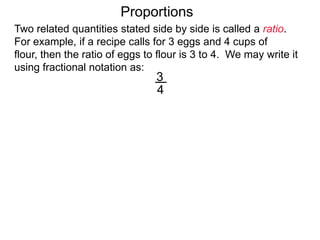
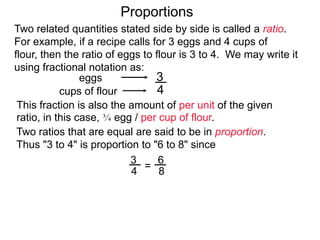
Two related quantities stated side by side is called a ratio.
Proportions
Two related quantities stated side by side is called a ratio.
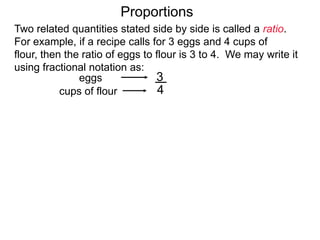
For example, if a recipe calls for 3 eggs and 4 cups of flour,
then the ratio of eggs to flour is 3 to 4.
3
4
eggs
cups of flour
Proportions
Two related quantities stated side by side is called a ratio.
For example, if a recipe calls for 3 eggs and 4 cups of flour,
then the ratio of eggs to flour is 3 to 4.
We may write it using fractional notation as:
3
4
eggs
cups of flour
Proportions
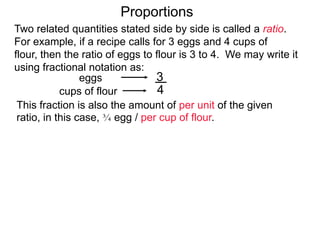
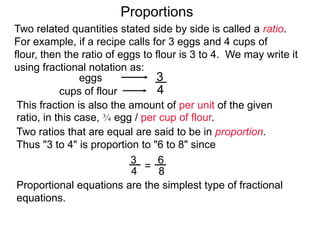
This fraction is also the amount of per unit of the given ratio,
in this case, 3/4 egg / per cup of flour.
Two related quantities stated side by side is called a ratio.
For example, if a recipe calls for 3 eggs and 4 cups of flour,
then the ratio of eggs to flour is 3 to 4.
We may write it using fractional notation as:
(egg / per cup of flour)
3
4
eggs
cups of flour
Proportions
This fraction is also the amount of per unit of the given ratio,
in this case, 3/4 egg / per cup of flour.
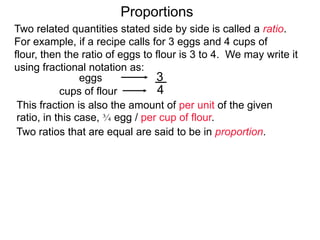
Two ratios that are equal are said to be in proportion.
Two related quantities stated side by side is called a ratio.
For example, if a recipe calls for 3 eggs and 4 cups of flour,
then the ratio of eggs to flour is 3 to 4.
We may write it using fractional notation as:
(egg / per cup of flour)
3
4
eggs
cups of flour
Proportions
This fraction is also the amount of per unit of the given ratio,
in this case, 3/4 egg / per cup of flour.
Two ratios that are equal are said to be in proportion.
Thus "3 to 4" is proportion to "6 to 8" since
3
4 =
6
8
Two related quantities stated side by side is called a ratio.
For example, if a recipe calls for 3 eggs and 4 cups of flour,
then the ratio of eggs to flour is 3 to 4.
We may write it using fractional notation as:
(egg / per cup of flour)
3
4
eggs
cups of flour
Proportions
This fraction is also the amount of per unit of the given ratio,
in this case, 3/4 egg / per cup of flour.
Two ratios that are equal are said to be in proportion.
Thus "3 to 4" is proportion to "6 to 8" since
3
4 =
6
8
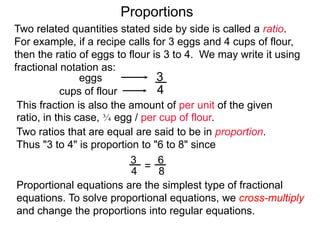
Proportion–equations are the simplest type of fractional
equations.
Two related quantities stated side by side is called a ratio.
For example, if a recipe calls for 3 eggs and 4 cups of flour,
then the ratio of eggs to flour is 3 to 4.
We may write it using fractional notation as:
(egg / per cup of flour)
3
4
eggs
cups of flour
Proportions
This fraction is also the amount of per unit of the given ratio,
in this case, 3/4 egg / per cup of flour.
Two ratios that are equal are said to be in proportion.
Thus "3 to 4" is proportion to "6 to 8" since
3
4 =
6
8
Proportion–equations are the simplest type of fractional
equations. To solve proportional equations, cross-multiply
and change the proportions into regular equations.
Two related quantities stated side by side is called a ratio.
For example, if a recipe calls for 3 eggs and 4 cups of flour,
then the ratio of eggs to flour is 3 to 4.
We may write it using fractional notation as:
(egg / per cup of flour)
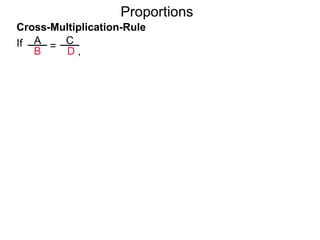
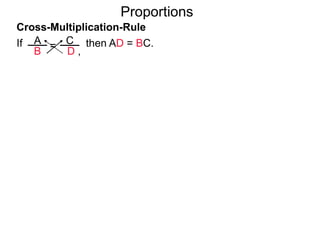
A
B
C
D ,
=If
Cross-Multiplication-Rule
Proportions
A
B
C
D ,
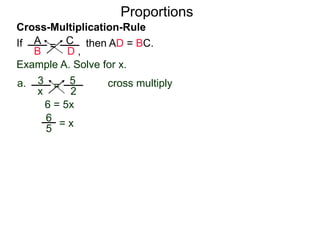
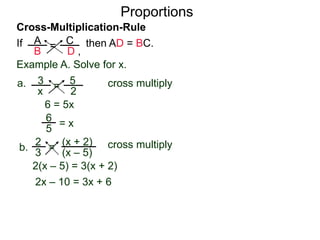
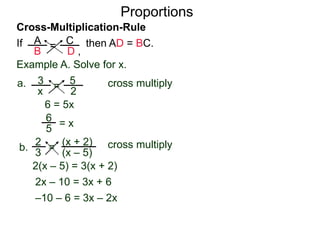
=If then AD = BC.
Cross-Multiplication-Rule
Proportions
A
B
C
D ,
=If then AD = BC.
Cross-Multiplication-Rule
Proportions
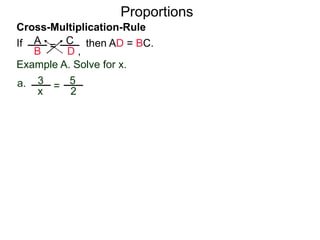
Example A. Solve for x.
3
x
5
2
=a.
A
B
C
D ,
=If then AD = BC.
Cross-Multiplication-Rule
Proportions
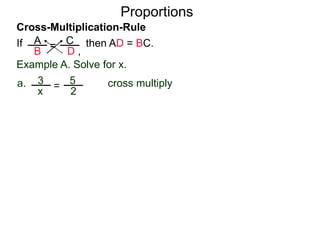
Example A. Solve for x.
3
x
5
2
=a. cross multiply
A
B
C
D ,
=If then AD = BC.
Cross-Multiplication-Rule
Proportions
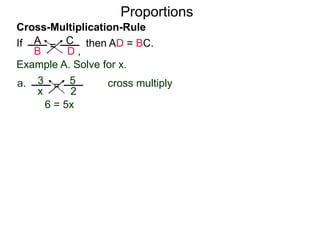
Example A. Solve for x.
3
x
5
2
=a. cross multiply
6 = 5x
A
B
C
D ,
=If then AD = BC.
Cross-Multiplication-Rule
Proportions
Example A. Solve for x.
3
x
5
2
=a. cross multiply
6 = 5x
= x5
6
A
B
C
D ,
=If then AD = BC.
Cross-Multiplication-Rule
Proportions
Example A. Solve for x.
3
x
5
2
=a. cross multiply
6 = 5x
= x
2
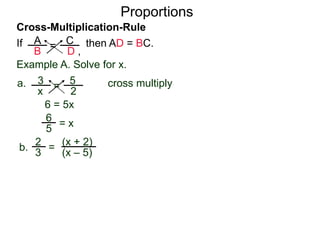
3
(x + 2)
(x – 5)
=b.
5
6
A
B
C
D ,
=If then AD = BC.
Cross-Multiplication-Rule
Proportions
Example A. Solve for x.
3
x
5
2
=a. cross multiply
6 = 5x
= x5
6
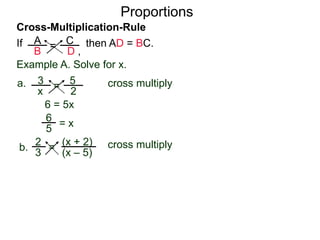
2
3
(x + 2)
(x – 5)
=b. cross multiply
A
B
C
D ,
=If then AD = BC.
Cross-Multiplication-Rule
Proportions
Example A. Solve for x.
3
x
5
2
=a. cross multiply
6 = 5x
= x
2
3
(x + 2)
(x – 5)
=b. cross multiply
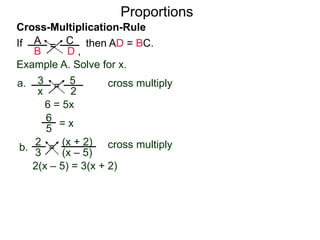
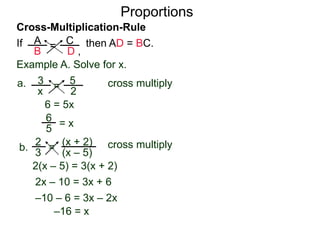
2(x – 5) = 3(x + 2)
5
6
A
B
C
D ,
=If then AD = BC.
Cross-Multiplication-Rule
Proportions
Example A. Solve for x.
3
x
5
2
=a. cross multiply
6 = 5x
= x
2
3
(x + 2)
(x – 5)
=b. cross multiply
2(x – 5) = 3(x + 2)
2x – 10 = 3x + 6
5
6
A
B
C
D ,
=If then AD = BC.
Cross-Multiplication-Rule
Proportions
Example A. Solve for x.
3
x
5
2
=a. cross multiply
6 = 5x
= x
2
3
(x + 2)
(x – 5)
=b. cross multiply
2(x – 5) = 3(x + 2)
2x – 10 = 3x + 6
–10 – 6 = 3x – 2x
5
6
A
B
C
D ,
=If then AD = BC.
Cross-Multiplication-Rule
Proportions
Example A. Solve for x.
3
x
5
2
=a. cross multiply
6 = 5x
= x
2
3
(x + 2)
(x – 5)
=b. cross multiply
2(x – 5) = 3(x + 2)
2x – 10 = 3x + 6
–10 – 6 = 3x – 2x
–16 = x
5
6
Proportions
When setting up a proportional equation for a word problem,
the two quantities for the same type of measurement must
occupy the same position in the fractions
Proportions
When setting up a proportional equation for a word problem,
the two quantities for the same type of measurement must
occupy the same position in the fractions i.e. both must be in
numerator, or both must be in the denominator.
Proportions
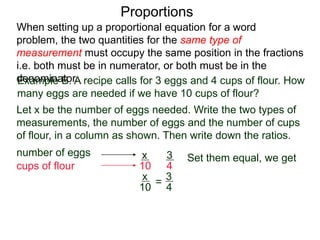
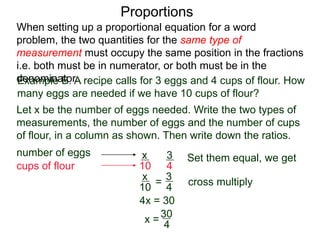
Example B. A recipe calls for 3 eggs and 4 cups of flour.
How many eggs are needed if we have 10 cups of flour?
When setting up a proportional equation for a word problem,
the two quantities for the same type of measurement must
occupy the same position in the fractions i.e. both must be in
numerator, or both must be in the denominator.
Proportions
Example B. A recipe calls for 3 eggs and 4 cups of flour. How
many eggs are needed if we have 10 cups of flour?
Let x be the number of eggs needed.
When setting up a proportional equation for a word problem,
the two quantities for the same type of measurement must
occupy the same position in the fractions i.e. both must be in
numerator, or both must be in the denominator.
Proportions
Example B. A recipe calls for 3 eggs and 4 cups of flour.
How many eggs are needed if we have 10 cups of flour?
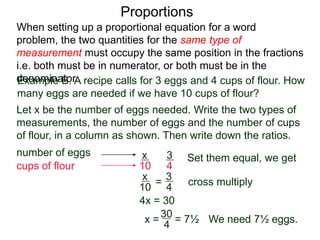
Let x be the number of eggs needed. Write the two types of
measurements, the number of eggs and the number of cups
of flour, in a column as shown.
When setting up a proportional equation for a word problem,
the two quantities for the same type of measurement must
occupy the same position in the fractions i.e. both must be in
numerator, or both must be in the denominator.
Proportions
Example B. A recipe calls for 3 eggs and 4 cups of flour.
How many eggs are needed if we have 10 cups of flour?
Let x be the number of eggs needed. Write the two types of
measurements, the number of eggs and the number of cups
of flour, in a column as shown.
number of eggs
cups of flour
When setting up a proportional equation for a word problem,
the two quantities for the same type of measurement must
occupy the same position in the fractions i.e. both must be in
numerator, or both must be in the denominator.
Proportions
Example B. A recipe calls for 3 eggs and 4 cups of flour.
How many eggs are needed if we have 10 cups of flour?
Let x be the number of eggs needed. Write the two types of
measurements, the number of eggs and the number of cups
of flour, in a column as shown. Then write down the ratios.
number of eggs
cups of flour
When setting up a proportional equation for a word problem,
the two quantities for the same type of measurement must
occupy the same position in the fractions i.e. both must be in
numerator, or both must be in the denominator.
Proportions
Example B. A recipe calls for 3 eggs and 4 cups of flour.
How many eggs are needed if we have 10 cups of flour?
Let x be the number of eggs needed. Write the two types of
measurements, the number of eggs and the number of cups
of flour, in a column as shown. Then write down the ratios.
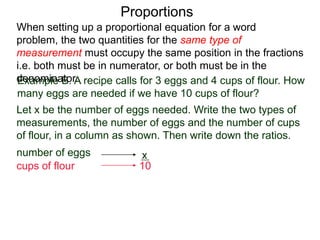
number of eggs
cups of flour
x
10
When setting up a proportional equation for a word problem,
the two quantities for the same type of measurement must
occupy the same position in the fractions i.e. both must be in
numerator, or both must be in the denominator.
Proportions
Example B. A recipe calls for 3 eggs and 4 cups of flour.
How many eggs are needed if we have 10 cups of flour?
Let x be the number of eggs needed. Write the two types of
measurements, the number of eggs and the number of cups
of flour, in a column as shown. Then write down the ratios.
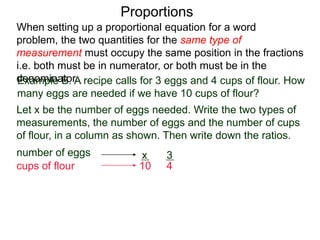
number of eggs
cups of flour
3
4
x
10
When setting up a proportional equation for a word problem,
the two quantities for the same type of measurement must
occupy the same position in the fractions i.e. both must be in
numerator, or both must be in the denominator.
Proportions
Example B. A recipe calls for 3 eggs and 4 cups of flour.
How many eggs are needed if we have 10 cups of flour?
Let x be the number of eggs needed. Write the two types of
measurements, the number of eggs and the number of cups
of flour, in a column as shown. Then write down the ratios.
number of eggs
cups of flour
3
4
x
10
=
Set them equal, we get
x
10
3
4
When setting up a proportional equation for a word problem,
the two quantities for the same type of measurement must
occupy the same position in the fractions i.e. both must be in
numerator, or both must be in the denominator.
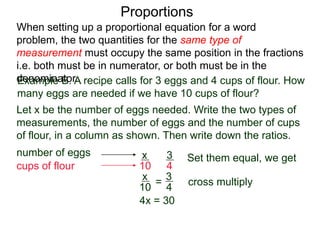
Proportions
Example B. A recipe calls for 3 eggs and 4 cups of flour.
How many eggs are needed if we have 10 cups of flour?
Let x be the number of eggs needed. Write the two types of
measurements, the number of eggs and the number of cups
of flour, in a column as shown. Then write down the ratios.
number of eggs
cups of flour
3
4
x
10
=
Set them equal, we get
x
10
3
4
cross multiply
4x = 30
When setting up a proportional equation for a word problem,
the two quantities for the same type of measurement must
occupy the same position in the fractions i.e. both must be in
numerator, or both must be in the denominator.
Proportions
Example B. A recipe calls for 3 eggs and 4 cups of flour.
How many eggs are needed if we have 10 cups of flour?
Let x be the number of eggs needed. Write the two types of
measurements, the number of eggs and the number of cups
of flour, in a column as shown. Then write down the ratios.
number of eggs
cups of flour
3
4
x
10
=
Set them equal, we get
x
10
3
4
cross multiply
4x = 30
x =
30
4
When setting up a proportional equation for a word problem,
the two quantities for the same type of measurement must
occupy the same position in the fractions i.e. both must be in
numerator, or both must be in the denominator.
Proportions
Example B. A recipe calls for 3 eggs and 4 cups of flour.
How many eggs are needed if we have 10 cups of flour?
Let x be the number of eggs needed. Write the two types of
measurements, the number of eggs and the number of cups
of flour, in a column as shown. Then write down the ratios.
number of eggs
cups of flour
3
4
x
10
=
Set them equal, we get
x
10
3
4
cross multiply
4x = 30
x =
30
4
= 7½ We need 7½ eggs.
When setting up a proportional equation for a word problem,
the two quantities for the same type of measurement must
occupy the same position in the fractions i.e. both must be in
numerator, or both must be in the denominator.
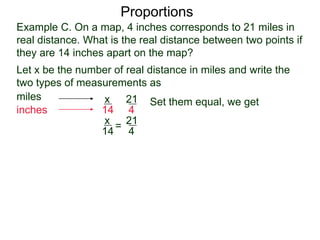
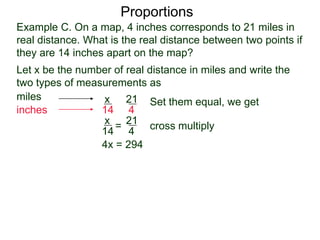
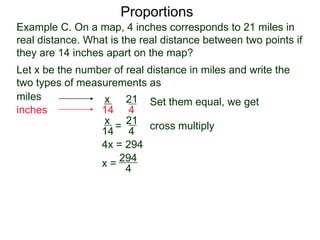
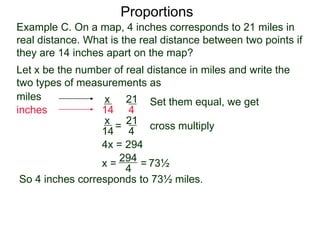
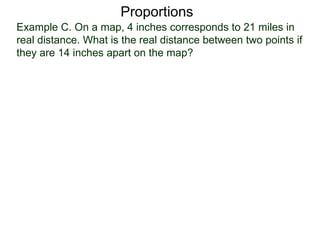
Example C. On a map, 4 inches corresponds to 21 miles in
real distance. What is the real distance between two points
if they are 14 inches apart on the map?
Proportions
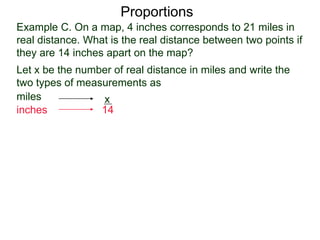
Example C. On a map, 4 inches corresponds to 21 miles in
real distance. What is the real distance between two points
if they are 14 inches apart on the map?
Proportions
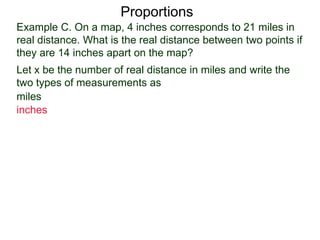
Let x be the number of real distance in miles and write the
two types of measurements as
Example C. On a map, 4 inches corresponds to 21 miles in
real distance. What is the real distance between two points
if they are 14 inches apart on the map?
Proportions
Let x be the number of real distance in miles and write the
two types of measurements as
miles
inches
Example C. On a map, 4 inches corresponds to 21 miles in
real distance. What is the real distance between two points
if they are 14 inches apart on the map?
Proportions
Let x be the number of real distance in miles and write the
two types of measurements as
miles
inches
x
14
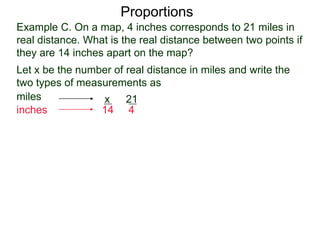
Example C. On a map, 4 inches corresponds to 21 miles in
real distance. What is the real distance between two points
if they are 14 inches apart on the map?
Proportions
Let x be the number of real distance in miles and write the
two types of measurements as
miles
inches
21
4
x
14
Example C. On a map, 4 inches corresponds to 21 miles in
real distance. What is the real distance between two points
if they are 14 inches apart on the map?
Proportions
Let x be the number of real distance in miles and write the
two types of measurements as
miles
inches
21
4
x
14
Set them equal, we get
21
4
x
14
=
Example C. On a map, 4 inches corresponds to 21 miles in
real distance. What is the real distance between two points
if they are 14 inches apart on the map?
Proportions
Let x be the number of real distance in miles and write the
two types of measurements as
miles
inches
21
4
x
14
Set them equal, we get
21
4
x
14
= cross multiply
4x = 294
Example C. On a map, 4 inches corresponds to 21 miles in
real distance. What is the real distance between two points
if they are 14 inches apart on the map?
Proportions
Let x be the number of real distance in miles and write the
two types of measurements as
miles
inches
21
4
x
14
Set them equal, we get
21
4
x
14
= cross multiply
4x = 294
x =
294
4
Example C. On a map, 4 inches corresponds to 21 miles in
real distance. What is the real distance between two points
if they are 14 inches apart on the map?
Proportions
Let x be the number of real distance in miles and write the
two types of measurements as
miles
inches
21
4
x
14
Set them equal, we get
21
4
x
14
= cross multiply
4x = 294
x =
294
4
= 73½
So 4 inches corresponds to 73½ miles.
Proportions
Geometric proportion gives us the sense of “similarity”, that is,
objects that are of the same shape but different sizes.
Proportions
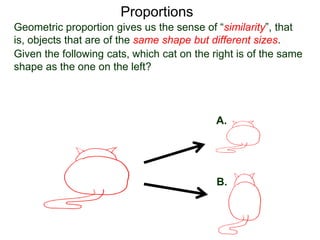
Given the following cats, which cat on the right is of the same
shape as the one on the left?
A.
B.
Geometric proportion gives us the sense of “similarity”, that is,
objects that are of the same shape but different sizes.
Proportions
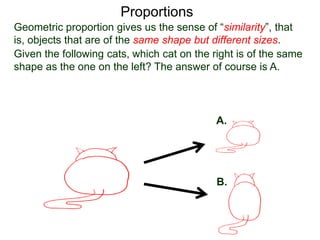
Given the following cats, which cat on the right is of the same
shape as the one on the left? The answer of course is A.
A.
B.
Geometric proportion gives us the sense of “similarity”, that is,
objects that are of the same shape but different sizes.
Proportions
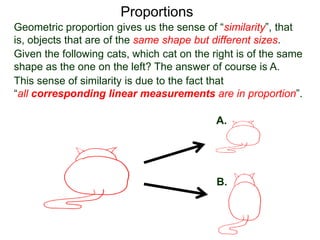
Given the following cats, which cat on the right is of the same
shape as the one on the left? The answer of course is A.
A.
B.
This sense of similarity is due to the fact that
“all corresponding linear measurements are in proportion”.
Geometric proportion gives us the sense of “similarity”, that is,
objects that are of the same shape but different sizes.
Proportions
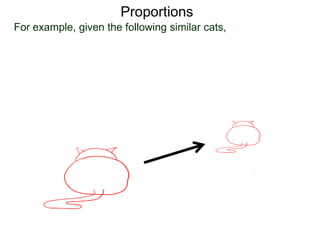
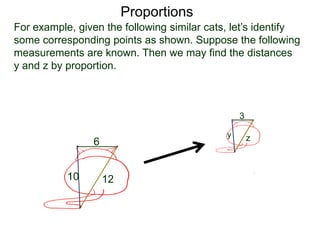
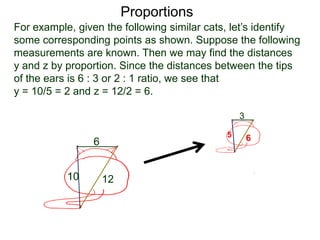
For example, given the following similar cats,
Proportions
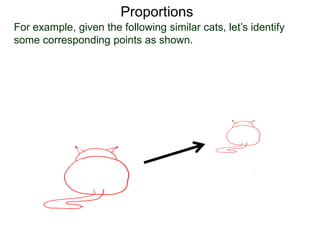
For example, given the following similar cats, let’s identify
some corresponding points as shown.
Proportions
B.
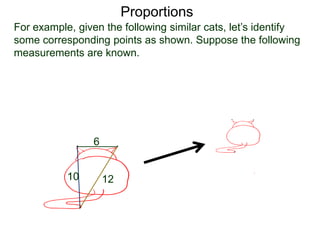
For example, given the following similar cats, let’s identify
some corresponding points as shown. Suppose the following
measurements are known.
6
10 12
Proportions
B.
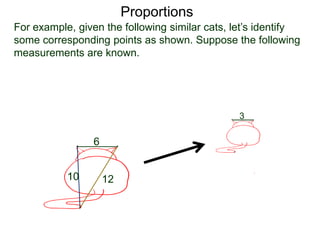
For example, given the following similar cats, let’s identify
some corresponding points as shown. Suppose the following
measurements are known.
6
10 12
3
Proportions
B.
For example, given the following similar cats, let’s identify
some corresponding points as shown. Suppose the following
measurements are known. Then we may find the distances
y and z by proportion.
6
10 12
3
y z
Proportions
B.
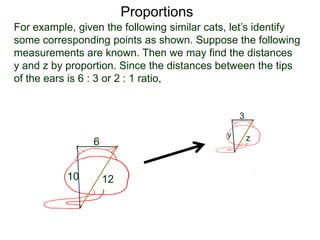
For example, given the following similar cats, let’s identify
some corresponding points as shown. Suppose the following
measurements are known. Then we may find the distances
y and z by proportion. Since the distances between the tips
of the ears is 6 : 3 or 2 : 1 ratio,
6
10 12
3
y z
Proportions
B.
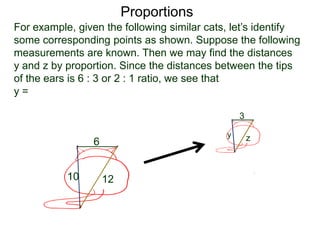
For example, given the following similar cats, let’s identify
some corresponding points as shown. Suppose the following
measurements are known. Then we may find the distances
y and z by proportion. Since the distances between the tips
of the ears is 6 : 3 or 2 : 1 ratio, we see that
y =
6
10 12
3
y z
Proportions
B.
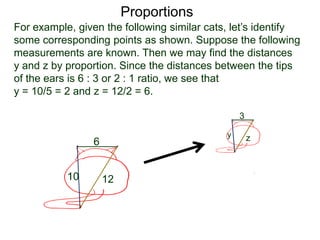
For example, given the following similar cats, let’s identify
some corresponding points as shown. Suppose the following
measurements are known. Then we may find the distances
y and z by proportion. Since the distances between the tips
of the ears is 6 : 3 or 2 : 1 ratio, we see that
y = 10/5 = 2 and z = 12/2 = 6.
6
10 12
3
y z
Proportions
6
10 12
3
5 6
For example, given the following similar cats, let’s identify
some corresponding points as shown. Suppose the following
measurements are known. Then we may find the distances
y and z by proportion. Since the distances between the tips
of the ears is 6 : 3 or 2 : 1 ratio, we see that
y = 10/5 = 2 and z = 12/2 = 6.
Proportions
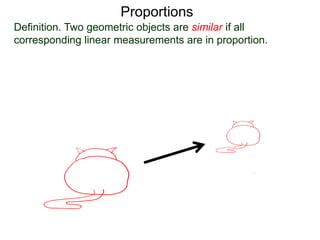
Definition. Two geometric objects are similar if all
corresponding linear measurements are in proportion.
B.
Proportions
Definition. Two geometric objects are similar if all
corresponding linear measurements are in proportion.
B.
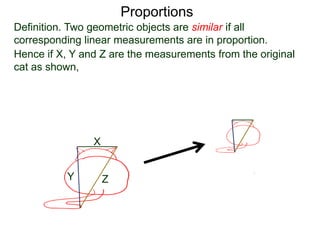
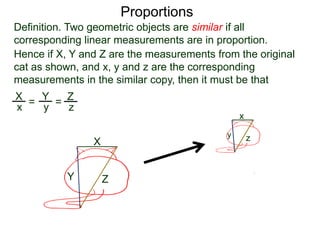
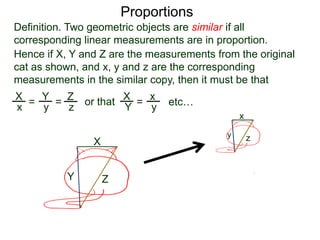
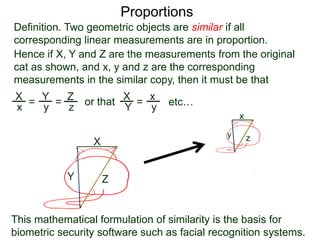
Hence if X, Y and Z are the measurements from the original
cat as shown,
X
Y Z
Proportions
Definition. Two geometric objects are similar if all
corresponding linear measurements are in proportion.
B.
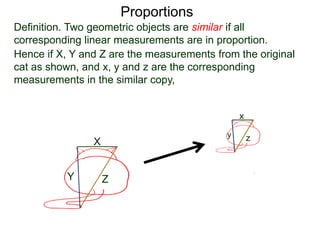
Hence if X, Y and Z are the measurements from the original
cat as shown, and x, y and z are the corresponding
measurements in the similar copy,
X
Y Z
x
y z
Proportions
Definition. Two geometric objects are similar if all
corresponding linear measurements are in proportion.
B.
Hence if X, Y and Z are the measurements from the original
cat as shown, and x, y and z are the corresponding
measurements in the similar copy, then it must be that
X
Y Z
x
y z
X
x =
Y
y =
Z
z
Proportions
Definition. Two geometric objects are similar if all
corresponding linear measurements are in proportion.
B.
Hence if X, Y and Z are the measurements from the original
cat as shown, and x, y and z are the corresponding
measurements in the similar copy, then it must be that
X
Y Z
x
y z
X
x =
Y
y =
Z
z
or that X
Y =
x
y etc…
Proportions
Definition. Two geometric objects are similar if all
corresponding linear measurements are in proportion.
B.
Hence if X, Y and Z are the measurements from the original
cat as shown, and x, y and z are the corresponding
measurements in the similar copy, then it must be that
X
Y Z
x
y z
X
x =
Y
y =
Z
z
or that X
Y =
x
y etc…
This mathematical formulation of similarity is the basis for
biometric security software such as facial recognition systems.
Proportions
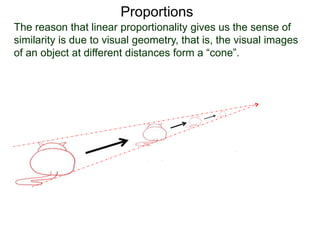
The reason that linear proportionality gives us the sense of
similarity is due to visual geometry, that is, the visual images
of an object at different distances form a “cone”.
Proportions
The reason that linear proportionality gives us the sense of
similarity is due to visual geometry, that is, the visual images
of an object at different distances form a “cone”.
Proportions
The reason that linear proportionality gives us the sense of
similarity is due to visual geometry, that is, the visual images
of an object at different distances form a “cone”.
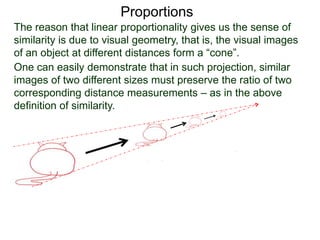
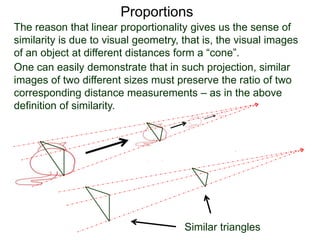
One can easily demonstrate that in such projection, similar
images of two different sizes must preserve the ratio of two
corresponding distance measurements – as in the above
definition of similarity.
Proportions
The reason that linear proportionality gives us the sense of
similarity is due to visual geometry, that is, the visual images
of an object at different distances form a “cone”.
One can easily demonstrate that in such projection, similar
images of two different sizes must preserve the ratio of two
corresponding distance measurements – as in the above
definition of similarity.
Similar triangles
Proportions
In the definition of similarity, the measurements in proportion
must be linear.
Proportions
In the definition of similarity, the measurements in proportion
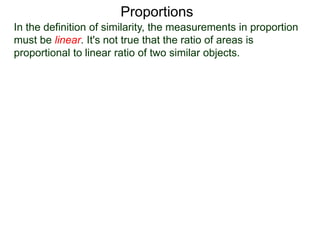
must be linear. It's not true that the ratio of areas is
proportional to linear ratio of two similar objects.
Proportions
In the definition of similarity, the measurements in proportion
must be linear. It's not true that the ratio of areas is
proportional to linear ratio of two similar objects.
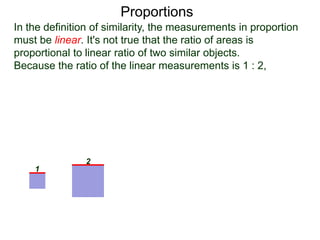
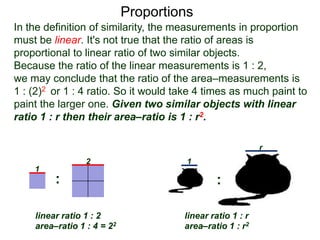
Because the ratio of the linear measurements is 1 : 2,
1
2
Proportions
In the definition of similarity, the measurements in proportion
must be linear. It's not true that the ratio of areas is
proportional to linear ratio of two similar objects.
Because the ratio of the linear measurements is 1 : 2,
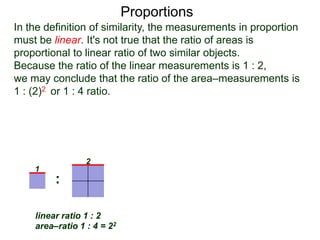
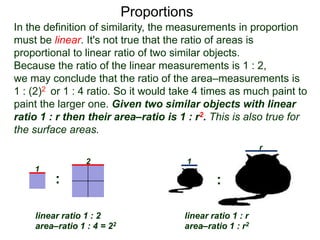
we may conclude that the ratio of the area–measurements is
1 : (2)2 or 1 : 4 ratio.
1
2
linear ratio 1 : 2
area–ratio 1 : 4 = 22
:
Proportions
1
2
linear ratio 1 : 2
area–ratio 1 : 4 = 22
:
In the definition of similarity, the measurements in proportion
must be linear. It's not true that the ratio of areas is
proportional to linear ratio of two similar objects.
Because the ratio of the linear measurements is 1 : 2,
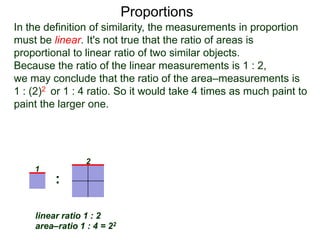
we may conclude that the ratio of the area–measurements is
1 : (2)2 or 1 : 4 ratio. So it would take 4 times as much paint to
paint the larger one.
Proportions
1
2
linear ratio 1 : 2
area–ratio 1 : 4 = 22
linear ratio 1 : r
area–ratio 1 : r2
1
r
: :
In the definition of similarity, the measurements in proportion
must be linear. It's not true that the ratio of areas is
proportional to linear ratio of two similar objects.
Because the ratio of the linear measurements is 1 : 2,
we may conclude that the ratio of the area–measurements is
1 : (2)2 or 1 : 4 ratio. So it would take 4 times as much paint to
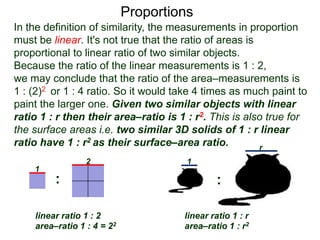
paint the larger one. Given two similar objects with linear
ratio 1 : r then their area–ratio is 1 : r2.
Proportions
1
2
linear ratio 1 : 2
area–ratio 1 : 4 = 22
linear ratio 1 : r
area–ratio 1 : r2
1
r
: :
In the definition of similarity, the measurements in proportion
must be linear. It's not true that the ratio of areas is
proportional to linear ratio of two similar objects.
Because the ratio of the linear measurements is 1 : 2,
we may conclude that the ratio of the area–measurements is
1 : (2)2 or 1 : 4 ratio. So it would take 4 times as much paint to
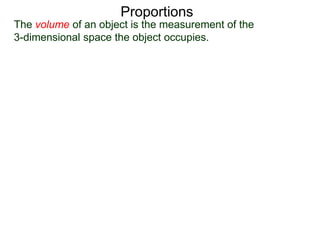
paint the larger one. Given two similar objects with linear
ratio 1 : r then their area–ratio is 1 : r2. This is also true for
the surface areas.
Proportions
1
2
linear ratio 1 : 2
area–ratio 1 : 4 = 22
linear ratio 1 : r
area–ratio 1 : r2
1
r
: :
In the definition of similarity, the measurements in proportion
must be linear. It's not true that the ratio of areas is
proportional to linear ratio of two similar objects.
Because the ratio of the linear measurements is 1 : 2,
we may conclude that the ratio of the area–measurements is
1 : (2)2 or 1 : 4 ratio. So it would take 4 times as much paint to
paint the larger one. Given two similar objects with linear
ratio 1 : r then their area–ratio is 1 : r2. This is also true for
the surface areas i.e. two similar 3D solids of 1 : r linear
ratio have 1 : r2 as their surface–area ratio.
Proportions
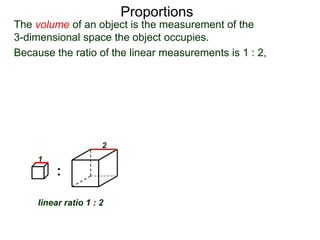
The volume of an object is the measurement of the
3-dimensional space the object occupies.
Proportions
Because the ratio of the linear measurements is 1 : 2,
:
linear ratio 1 : 2
1
2
The volume of an object is the measurement of the
3-dimensional space the object occupies.
Proportions
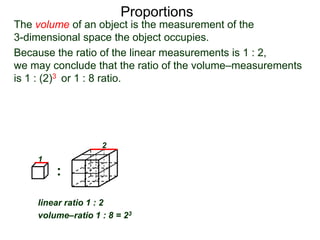
Because the ratio of the linear measurements is 1 : 2,
we may conclude that the ratio of the volume–measurements
is 1 : (2)3 or 1 : 8 ratio.
:
linear ratio 1 : 2
volume–ratio 1 : 8 = 23
1
2
The volume of an object is the measurement of the
3-dimensional space the object occupies.
Proportions
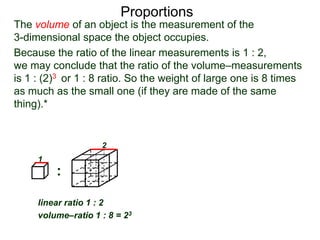
Because the ratio of the linear measurements is 1 : 2,
we may conclude that the ratio of the volume–measurements
is 1 : (2)3 or 1 : 8 ratio. So the weight of large one is 8 times
as much as the small one (if they are made of the same
thing).*
:
linear ratio 1 : 2
volume–ratio 1 : 8 = 23
1
2
The volume of an object is the measurement of the
3-dimensional space the object occupies.
Proportions
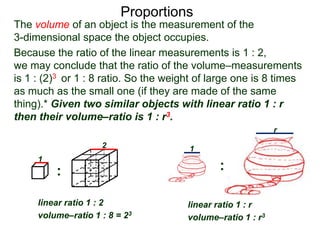
Because the ratio of the linear measurements is 1 : 2,
we may conclude that the ratio of the volume–measurements
is 1 : (2)3 or 1 : 8 ratio. So the weight of large one is 8 times
as much as the small one (if they are made of the same
thing).* Given two similar objects with linear ratio 1 : r
then their volume–ratio is 1 : r3.
linear ratio 1 : r
volume–ratio 1 : r3
::
linear ratio 1 : 2
volume–ratio 1 : 8 = 23
1
2 1
r
The volume of an object is the measurement of the
3-dimensional space the object occupies.
The Golden Ratio
Proportions
The Golden Ratio
Proportions
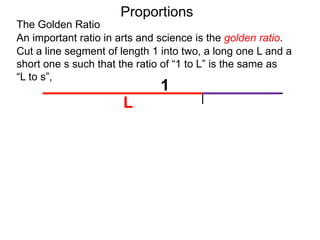
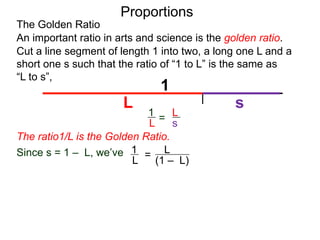
An important ratio in arts and science is the golden ratio.
The Golden Ratio
Proportions
An important ratio in arts and science is the golden ratio.
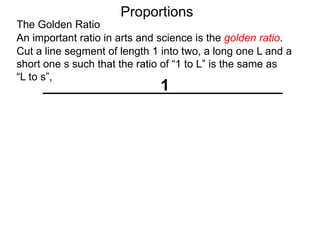
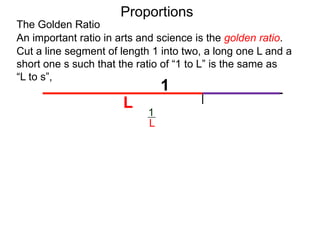
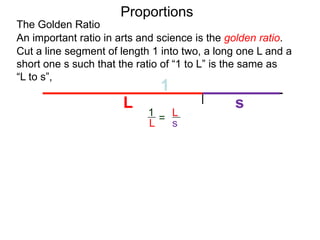
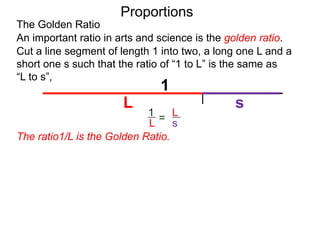
Cut a line segment of length 1 into two, a long one L and a
short one s such that the ratio of “1 to L” is the same as
“L to s”,
The Golden Ratio
Proportions
An important ratio in arts and science is the golden ratio.
Cut a line segment of length 1 into two, a long one L and a
short one s such that the ratio of “1 to L” is the same as
“L to s”,
1
The Golden Ratio
Proportions
Cut a line segment of length 1 into two, a long one L and a
short one s such that the ratio of “1 to L” is the same as
“L to s”,
1
L
An important ratio in arts and science is the golden ratio.
The Golden Ratio
Proportions
Cut a line segment of length 1 into two, a long one L and a
short one s such that the ratio of “1 to L” is the same as
“L to s”,
1
L
An important ratio in arts and science is the golden ratio.
1
L
The Golden Ratio
Proportions
Cut a line segment of length 1 into two, a long one L and a
short one s such that the ratio of “1 to L” is the same as
“L to s”,
1
L s
An important ratio in arts and science is the golden ratio.
L
s
1
L =
The Golden Ratio
Proportions
Cut a line segment of length 1 into two, a long one L and a
short one s such that the ratio of “1 to L” is the same as
“L to s”,
1
L s
An important ratio in arts and science is the golden ratio.
L
s
1
L =
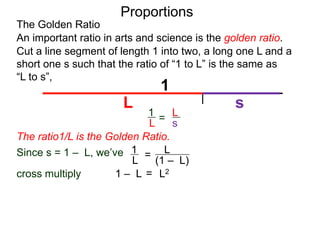
The ratio1/L is the Golden Ratio.
The Golden Ratio
Proportions
L
(1 – L)
1
L
Cut a line segment of length 1 into two, a long one L and a
short one s such that the ratio of “1 to L” is the same as
“L to s”,
1
L s
An important ratio in arts and science is the golden ratio.
L
s
1
L =
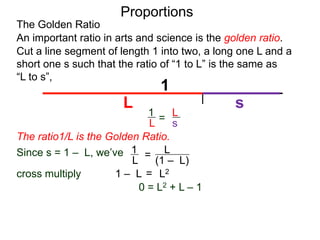
Since s = 1 – L, we’ve
=
The ratio1/L is the Golden Ratio.
The Golden Ratio
Proportions
L
(1 – L)
1
L
cross multiply
Cut a line segment of length 1 into two, a long one L and a
short one s such that the ratio of “1 to L” is the same as
“L to s”,
1
L s
An important ratio in arts and science is the golden ratio.
L
s
1
L =
Since s = 1 – L, we’ve
=
1 – L
=
L2
The ratio1/L is the Golden Ratio.
The Golden Ratio
Proportions
L
(1 – L)
1
L
cross multiply
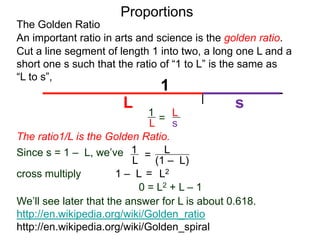
0 = L2 + L – 1
Cut a line segment of length 1 into two, a long one L and a
short one s such that the ratio of “1 to L” is the same as
“L to s”,
1
L s
An important ratio in arts and science is the golden ratio.
L
s
1
L =
Since s = 1 – L, we’ve
=
1 – L
=
L2
The ratio1/L is the Golden Ratio.
The Golden Ratio
Proportions
L
(1 – L)
1
L
cross multiply
0 = L2 + L – 1
Cut a line segment of length 1 into two, a long one L and a
short one s such that the ratio of “1 to L” is the same as
“L to s”,
1
L s
An important ratio in arts and science is the golden ratio.
L
s
1
L =
Since s = 1 – L, we’ve
=
1 – L
=
L2
We’ll see later that the answer for L is about 0.618.
http://en.wikipedia.org/wiki/Golden_ratio
http://en.wikipedia.org/wiki/Golden_spiral
The ratio1/L is the Golden Ratio.
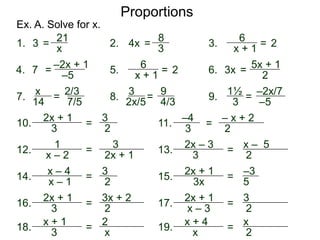
Ex. A. Solve for x.
Proportions
3
2
2x + 1
3
=
21
x
3 =1.
–2x/7
–5
1½
3
=9.
2.
6
2=3.
x + 1
–57 =4. –2x + 1 6
=5. x + 1 23x =6. 5x + 1
3
4x =
8
2/3
7/5
x
14
=7.
9
4/3
3
2x/5
=8.
10. – x + 2
2
–4
3 =11.
3
2x + 1
1
x – 2
=12.
x – 5
2
2x – 3
3
=13.
3
2
x – 4
x – 1
=14.
–3
5
2x + 1
3x
=15.
3x + 2
2
2x + 1
3
=16. 3
2
2x + 1
x – 3
=17.
2
x
x + 1
3
=18.
x
2
x + 4
x
=19.
1
2
Ex. B. (Solve each problem. It’s easier if fractional proportions
are rewritten as proportions of integers.)
Proportions
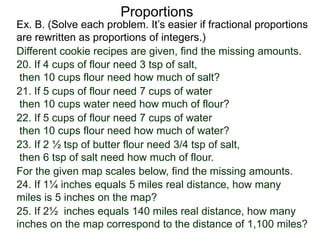
20. If 4 cups of flour need 3 tsp of salt,
then 10 cups flour need how much of salt?
Different cookie recipes are given, find the missing amounts.
21. If 5 cups of flour need 7 cups of water
then 10 cups water need how much of flour?
23. If 2 ½ tsp of butter flour need 3/4 tsp of salt,
then 6 tsp of salt need how much of flour.
22. If 5 cups of flour need 7 cups of water
then 10 cups flour need how much of water?
24. If 1¼ inches equals 5 miles real distance, how many
miles is 5 inches on the map?
For the given map scales below, find the missing amounts.
25. If 2½ inches equals 140 miles real distance, how many
inches on the map correspond to the distance of 1,100 miles?
Proportions
A. B. C.
3
4
1
5
5
6
26. x
20 x
20
6
27.
x
3x + 4 2xx+2
15 x
x
2x – 3
28.
29. 30. 31.
32–37. Find the surface areas of each cat above if A’s surface
area is 2 ft2, B’s surfaces area is 7 ft2. and C’s is 280 ft2?
Ex. C. 26 – 31. Solve for x. Use the given A, B and C,.
38–43. Find the weight of each cat above if cat A is 20 lbs,
cat B is 8 lb. and cat C is 350 lb?

2 3 proportions

  • 1.
  • 2.
    Proportions Two related quantitiesstated side by side is called a ratio.
  • 3.
    Proportions Two related quantitiesstated side by side is called a ratio. For example, if a recipe calls for 3 eggs and 4 cups of flour, then the ratio of eggs to flour is 3 to 4.
  • 4.
    3 4 eggs cups of flour Proportions Tworelated quantities stated side by side is called a ratio. For example, if a recipe calls for 3 eggs and 4 cups of flour, then the ratio of eggs to flour is 3 to 4. We may write it using fractional notation as:
  • 5.
    3 4 eggs cups of flour Proportions Thisfraction is also the amount of per unit of the given ratio, in this case, 3/4 egg / per cup of flour. Two related quantities stated side by side is called a ratio. For example, if a recipe calls for 3 eggs and 4 cups of flour, then the ratio of eggs to flour is 3 to 4. We may write it using fractional notation as: (egg / per cup of flour)
  • 6.
    3 4 eggs cups of flour Proportions Thisfraction is also the amount of per unit of the given ratio, in this case, 3/4 egg / per cup of flour. Two ratios that are equal are said to be in proportion. Two related quantities stated side by side is called a ratio. For example, if a recipe calls for 3 eggs and 4 cups of flour, then the ratio of eggs to flour is 3 to 4. We may write it using fractional notation as: (egg / per cup of flour)
  • 7.
    3 4 eggs cups of flour Proportions Thisfraction is also the amount of per unit of the given ratio, in this case, 3/4 egg / per cup of flour. Two ratios that are equal are said to be in proportion. Thus "3 to 4" is proportion to "6 to 8" since 3 4 = 6 8 Two related quantities stated side by side is called a ratio. For example, if a recipe calls for 3 eggs and 4 cups of flour, then the ratio of eggs to flour is 3 to 4. We may write it using fractional notation as: (egg / per cup of flour)
  • 8.
    3 4 eggs cups of flour Proportions Thisfraction is also the amount of per unit of the given ratio, in this case, 3/4 egg / per cup of flour. Two ratios that are equal are said to be in proportion. Thus "3 to 4" is proportion to "6 to 8" since 3 4 = 6 8 Proportion–equations are the simplest type of fractional equations. Two related quantities stated side by side is called a ratio. For example, if a recipe calls for 3 eggs and 4 cups of flour, then the ratio of eggs to flour is 3 to 4. We may write it using fractional notation as: (egg / per cup of flour)
  • 9.
    3 4 eggs cups of flour Proportions Thisfraction is also the amount of per unit of the given ratio, in this case, 3/4 egg / per cup of flour. Two ratios that are equal are said to be in proportion. Thus "3 to 4" is proportion to "6 to 8" since 3 4 = 6 8 Proportion–equations are the simplest type of fractional equations. To solve proportional equations, cross-multiply and change the proportions into regular equations. Two related quantities stated side by side is called a ratio. For example, if a recipe calls for 3 eggs and 4 cups of flour, then the ratio of eggs to flour is 3 to 4. We may write it using fractional notation as: (egg / per cup of flour)
  • 10.
  • 11.
    A B C D , =If thenAD = BC. Cross-Multiplication-Rule Proportions
  • 12.
    A B C D , =If thenAD = BC. Cross-Multiplication-Rule Proportions Example A. Solve for x. 3 x 5 2 =a.
  • 13.
    A B C D , =If thenAD = BC. Cross-Multiplication-Rule Proportions Example A. Solve for x. 3 x 5 2 =a. cross multiply
  • 14.
    A B C D , =If thenAD = BC. Cross-Multiplication-Rule Proportions Example A. Solve for x. 3 x 5 2 =a. cross multiply 6 = 5x
  • 15.
    A B C D , =If thenAD = BC. Cross-Multiplication-Rule Proportions Example A. Solve for x. 3 x 5 2 =a. cross multiply 6 = 5x = x5 6
  • 16.
    A B C D , =If thenAD = BC. Cross-Multiplication-Rule Proportions Example A. Solve for x. 3 x 5 2 =a. cross multiply 6 = 5x = x 2 3 (x + 2) (x – 5) =b. 5 6
  • 17.
    A B C D , =If thenAD = BC. Cross-Multiplication-Rule Proportions Example A. Solve for x. 3 x 5 2 =a. cross multiply 6 = 5x = x5 6 2 3 (x + 2) (x – 5) =b. cross multiply
  • 18.
    A B C D , =If thenAD = BC. Cross-Multiplication-Rule Proportions Example A. Solve for x. 3 x 5 2 =a. cross multiply 6 = 5x = x 2 3 (x + 2) (x – 5) =b. cross multiply 2(x – 5) = 3(x + 2) 5 6
  • 19.
    A B C D , =If thenAD = BC. Cross-Multiplication-Rule Proportions Example A. Solve for x. 3 x 5 2 =a. cross multiply 6 = 5x = x 2 3 (x + 2) (x – 5) =b. cross multiply 2(x – 5) = 3(x + 2) 2x – 10 = 3x + 6 5 6
  • 20.
    A B C D , =If thenAD = BC. Cross-Multiplication-Rule Proportions Example A. Solve for x. 3 x 5 2 =a. cross multiply 6 = 5x = x 2 3 (x + 2) (x – 5) =b. cross multiply 2(x – 5) = 3(x + 2) 2x – 10 = 3x + 6 –10 – 6 = 3x – 2x 5 6
  • 21.
    A B C D , =If thenAD = BC. Cross-Multiplication-Rule Proportions Example A. Solve for x. 3 x 5 2 =a. cross multiply 6 = 5x = x 2 3 (x + 2) (x – 5) =b. cross multiply 2(x – 5) = 3(x + 2) 2x – 10 = 3x + 6 –10 – 6 = 3x – 2x –16 = x 5 6
  • 22.
    Proportions When setting upa proportional equation for a word problem, the two quantities for the same type of measurement must occupy the same position in the fractions
  • 23.
    Proportions When setting upa proportional equation for a word problem, the two quantities for the same type of measurement must occupy the same position in the fractions i.e. both must be in numerator, or both must be in the denominator.
  • 24.
    Proportions Example B. Arecipe calls for 3 eggs and 4 cups of flour. How many eggs are needed if we have 10 cups of flour? When setting up a proportional equation for a word problem, the two quantities for the same type of measurement must occupy the same position in the fractions i.e. both must be in numerator, or both must be in the denominator.
  • 25.
    Proportions Example B. Arecipe calls for 3 eggs and 4 cups of flour. How many eggs are needed if we have 10 cups of flour? Let x be the number of eggs needed. When setting up a proportional equation for a word problem, the two quantities for the same type of measurement must occupy the same position in the fractions i.e. both must be in numerator, or both must be in the denominator.
  • 26.
    Proportions Example B. Arecipe calls for 3 eggs and 4 cups of flour. How many eggs are needed if we have 10 cups of flour? Let x be the number of eggs needed. Write the two types of measurements, the number of eggs and the number of cups of flour, in a column as shown. When setting up a proportional equation for a word problem, the two quantities for the same type of measurement must occupy the same position in the fractions i.e. both must be in numerator, or both must be in the denominator.
  • 27.
    Proportions Example B. Arecipe calls for 3 eggs and 4 cups of flour. How many eggs are needed if we have 10 cups of flour? Let x be the number of eggs needed. Write the two types of measurements, the number of eggs and the number of cups of flour, in a column as shown. number of eggs cups of flour When setting up a proportional equation for a word problem, the two quantities for the same type of measurement must occupy the same position in the fractions i.e. both must be in numerator, or both must be in the denominator.
  • 28.
    Proportions Example B. Arecipe calls for 3 eggs and 4 cups of flour. How many eggs are needed if we have 10 cups of flour? Let x be the number of eggs needed. Write the two types of measurements, the number of eggs and the number of cups of flour, in a column as shown. Then write down the ratios. number of eggs cups of flour When setting up a proportional equation for a word problem, the two quantities for the same type of measurement must occupy the same position in the fractions i.e. both must be in numerator, or both must be in the denominator.
  • 29.
    Proportions Example B. Arecipe calls for 3 eggs and 4 cups of flour. How many eggs are needed if we have 10 cups of flour? Let x be the number of eggs needed. Write the two types of measurements, the number of eggs and the number of cups of flour, in a column as shown. Then write down the ratios. number of eggs cups of flour x 10 When setting up a proportional equation for a word problem, the two quantities for the same type of measurement must occupy the same position in the fractions i.e. both must be in numerator, or both must be in the denominator.
  • 30.
    Proportions Example B. Arecipe calls for 3 eggs and 4 cups of flour. How many eggs are needed if we have 10 cups of flour? Let x be the number of eggs needed. Write the two types of measurements, the number of eggs and the number of cups of flour, in a column as shown. Then write down the ratios. number of eggs cups of flour 3 4 x 10 When setting up a proportional equation for a word problem, the two quantities for the same type of measurement must occupy the same position in the fractions i.e. both must be in numerator, or both must be in the denominator.
  • 31.
    Proportions Example B. Arecipe calls for 3 eggs and 4 cups of flour. How many eggs are needed if we have 10 cups of flour? Let x be the number of eggs needed. Write the two types of measurements, the number of eggs and the number of cups of flour, in a column as shown. Then write down the ratios. number of eggs cups of flour 3 4 x 10 = Set them equal, we get x 10 3 4 When setting up a proportional equation for a word problem, the two quantities for the same type of measurement must occupy the same position in the fractions i.e. both must be in numerator, or both must be in the denominator.
  • 32.
    Proportions Example B. Arecipe calls for 3 eggs and 4 cups of flour. How many eggs are needed if we have 10 cups of flour? Let x be the number of eggs needed. Write the two types of measurements, the number of eggs and the number of cups of flour, in a column as shown. Then write down the ratios. number of eggs cups of flour 3 4 x 10 = Set them equal, we get x 10 3 4 cross multiply 4x = 30 When setting up a proportional equation for a word problem, the two quantities for the same type of measurement must occupy the same position in the fractions i.e. both must be in numerator, or both must be in the denominator.
  • 33.
    Proportions Example B. Arecipe calls for 3 eggs and 4 cups of flour. How many eggs are needed if we have 10 cups of flour? Let x be the number of eggs needed. Write the two types of measurements, the number of eggs and the number of cups of flour, in a column as shown. Then write down the ratios. number of eggs cups of flour 3 4 x 10 = Set them equal, we get x 10 3 4 cross multiply 4x = 30 x = 30 4 When setting up a proportional equation for a word problem, the two quantities for the same type of measurement must occupy the same position in the fractions i.e. both must be in numerator, or both must be in the denominator.
  • 34.
    Proportions Example B. Arecipe calls for 3 eggs and 4 cups of flour. How many eggs are needed if we have 10 cups of flour? Let x be the number of eggs needed. Write the two types of measurements, the number of eggs and the number of cups of flour, in a column as shown. Then write down the ratios. number of eggs cups of flour 3 4 x 10 = Set them equal, we get x 10 3 4 cross multiply 4x = 30 x = 30 4 = 7½ We need 7½ eggs. When setting up a proportional equation for a word problem, the two quantities for the same type of measurement must occupy the same position in the fractions i.e. both must be in numerator, or both must be in the denominator.
  • 35.
    Example C. Ona map, 4 inches corresponds to 21 miles in real distance. What is the real distance between two points if they are 14 inches apart on the map? Proportions
  • 36.
    Example C. Ona map, 4 inches corresponds to 21 miles in real distance. What is the real distance between two points if they are 14 inches apart on the map? Proportions Let x be the number of real distance in miles and write the two types of measurements as
  • 37.
    Example C. Ona map, 4 inches corresponds to 21 miles in real distance. What is the real distance between two points if they are 14 inches apart on the map? Proportions Let x be the number of real distance in miles and write the two types of measurements as miles inches
  • 38.
    Example C. Ona map, 4 inches corresponds to 21 miles in real distance. What is the real distance between two points if they are 14 inches apart on the map? Proportions Let x be the number of real distance in miles and write the two types of measurements as miles inches x 14
  • 39.
    Example C. Ona map, 4 inches corresponds to 21 miles in real distance. What is the real distance between two points if they are 14 inches apart on the map? Proportions Let x be the number of real distance in miles and write the two types of measurements as miles inches 21 4 x 14
  • 40.
    Example C. Ona map, 4 inches corresponds to 21 miles in real distance. What is the real distance between two points if they are 14 inches apart on the map? Proportions Let x be the number of real distance in miles and write the two types of measurements as miles inches 21 4 x 14 Set them equal, we get 21 4 x 14 =
  • 41.
    Example C. Ona map, 4 inches corresponds to 21 miles in real distance. What is the real distance between two points if they are 14 inches apart on the map? Proportions Let x be the number of real distance in miles and write the two types of measurements as miles inches 21 4 x 14 Set them equal, we get 21 4 x 14 = cross multiply 4x = 294
  • 42.
    Example C. Ona map, 4 inches corresponds to 21 miles in real distance. What is the real distance between two points if they are 14 inches apart on the map? Proportions Let x be the number of real distance in miles and write the two types of measurements as miles inches 21 4 x 14 Set them equal, we get 21 4 x 14 = cross multiply 4x = 294 x = 294 4
  • 43.
    Example C. Ona map, 4 inches corresponds to 21 miles in real distance. What is the real distance between two points if they are 14 inches apart on the map? Proportions Let x be the number of real distance in miles and write the two types of measurements as miles inches 21 4 x 14 Set them equal, we get 21 4 x 14 = cross multiply 4x = 294 x = 294 4 = 73½ So 4 inches corresponds to 73½ miles.
  • 44.
    Proportions Geometric proportion givesus the sense of “similarity”, that is, objects that are of the same shape but different sizes.
  • 45.
    Proportions Given the followingcats, which cat on the right is of the same shape as the one on the left? A. B. Geometric proportion gives us the sense of “similarity”, that is, objects that are of the same shape but different sizes.
  • 46.
    Proportions Given the followingcats, which cat on the right is of the same shape as the one on the left? The answer of course is A. A. B. Geometric proportion gives us the sense of “similarity”, that is, objects that are of the same shape but different sizes.
  • 47.
    Proportions Given the followingcats, which cat on the right is of the same shape as the one on the left? The answer of course is A. A. B. This sense of similarity is due to the fact that “all corresponding linear measurements are in proportion”. Geometric proportion gives us the sense of “similarity”, that is, objects that are of the same shape but different sizes.
  • 48.
    Proportions For example, giventhe following similar cats,
  • 49.
    Proportions For example, giventhe following similar cats, let’s identify some corresponding points as shown.
  • 50.
    Proportions B. For example, giventhe following similar cats, let’s identify some corresponding points as shown. Suppose the following measurements are known. 6 10 12
  • 51.
    Proportions B. For example, giventhe following similar cats, let’s identify some corresponding points as shown. Suppose the following measurements are known. 6 10 12 3
  • 52.
    Proportions B. For example, giventhe following similar cats, let’s identify some corresponding points as shown. Suppose the following measurements are known. Then we may find the distances y and z by proportion. 6 10 12 3 y z
  • 53.
    Proportions B. For example, giventhe following similar cats, let’s identify some corresponding points as shown. Suppose the following measurements are known. Then we may find the distances y and z by proportion. Since the distances between the tips of the ears is 6 : 3 or 2 : 1 ratio, 6 10 12 3 y z
  • 54.
    Proportions B. For example, giventhe following similar cats, let’s identify some corresponding points as shown. Suppose the following measurements are known. Then we may find the distances y and z by proportion. Since the distances between the tips of the ears is 6 : 3 or 2 : 1 ratio, we see that y = 6 10 12 3 y z
  • 55.
    Proportions B. For example, giventhe following similar cats, let’s identify some corresponding points as shown. Suppose the following measurements are known. Then we may find the distances y and z by proportion. Since the distances between the tips of the ears is 6 : 3 or 2 : 1 ratio, we see that y = 10/5 = 2 and z = 12/2 = 6. 6 10 12 3 y z
  • 56.
    Proportions 6 10 12 3 5 6 Forexample, given the following similar cats, let’s identify some corresponding points as shown. Suppose the following measurements are known. Then we may find the distances y and z by proportion. Since the distances between the tips of the ears is 6 : 3 or 2 : 1 ratio, we see that y = 10/5 = 2 and z = 12/2 = 6.
  • 57.
    Proportions Definition. Two geometricobjects are similar if all corresponding linear measurements are in proportion. B.
  • 58.
    Proportions Definition. Two geometricobjects are similar if all corresponding linear measurements are in proportion. B. Hence if X, Y and Z are the measurements from the original cat as shown, X Y Z
  • 59.
    Proportions Definition. Two geometricobjects are similar if all corresponding linear measurements are in proportion. B. Hence if X, Y and Z are the measurements from the original cat as shown, and x, y and z are the corresponding measurements in the similar copy, X Y Z x y z
  • 60.
    Proportions Definition. Two geometricobjects are similar if all corresponding linear measurements are in proportion. B. Hence if X, Y and Z are the measurements from the original cat as shown, and x, y and z are the corresponding measurements in the similar copy, then it must be that X Y Z x y z X x = Y y = Z z
  • 61.
    Proportions Definition. Two geometricobjects are similar if all corresponding linear measurements are in proportion. B. Hence if X, Y and Z are the measurements from the original cat as shown, and x, y and z are the corresponding measurements in the similar copy, then it must be that X Y Z x y z X x = Y y = Z z or that X Y = x y etc…
  • 62.
    Proportions Definition. Two geometricobjects are similar if all corresponding linear measurements are in proportion. B. Hence if X, Y and Z are the measurements from the original cat as shown, and x, y and z are the corresponding measurements in the similar copy, then it must be that X Y Z x y z X x = Y y = Z z or that X Y = x y etc… This mathematical formulation of similarity is the basis for biometric security software such as facial recognition systems.
  • 63.
    Proportions The reason thatlinear proportionality gives us the sense of similarity is due to visual geometry, that is, the visual images of an object at different distances form a “cone”.
  • 64.
    Proportions The reason thatlinear proportionality gives us the sense of similarity is due to visual geometry, that is, the visual images of an object at different distances form a “cone”.
  • 65.
    Proportions The reason thatlinear proportionality gives us the sense of similarity is due to visual geometry, that is, the visual images of an object at different distances form a “cone”. One can easily demonstrate that in such projection, similar images of two different sizes must preserve the ratio of two corresponding distance measurements – as in the above definition of similarity.
  • 66.
    Proportions The reason thatlinear proportionality gives us the sense of similarity is due to visual geometry, that is, the visual images of an object at different distances form a “cone”. One can easily demonstrate that in such projection, similar images of two different sizes must preserve the ratio of two corresponding distance measurements – as in the above definition of similarity. Similar triangles
  • 67.
    Proportions In the definitionof similarity, the measurements in proportion must be linear.
  • 68.
    Proportions In the definitionof similarity, the measurements in proportion must be linear. It's not true that the ratio of areas is proportional to linear ratio of two similar objects.
  • 69.
    Proportions In the definitionof similarity, the measurements in proportion must be linear. It's not true that the ratio of areas is proportional to linear ratio of two similar objects. Because the ratio of the linear measurements is 1 : 2, 1 2
  • 70.
    Proportions In the definitionof similarity, the measurements in proportion must be linear. It's not true that the ratio of areas is proportional to linear ratio of two similar objects. Because the ratio of the linear measurements is 1 : 2, we may conclude that the ratio of the area–measurements is 1 : (2)2 or 1 : 4 ratio. 1 2 linear ratio 1 : 2 area–ratio 1 : 4 = 22 :
  • 71.
    Proportions 1 2 linear ratio 1: 2 area–ratio 1 : 4 = 22 : In the definition of similarity, the measurements in proportion must be linear. It's not true that the ratio of areas is proportional to linear ratio of two similar objects. Because the ratio of the linear measurements is 1 : 2, we may conclude that the ratio of the area–measurements is 1 : (2)2 or 1 : 4 ratio. So it would take 4 times as much paint to paint the larger one.
  • 72.
    Proportions 1 2 linear ratio 1: 2 area–ratio 1 : 4 = 22 linear ratio 1 : r area–ratio 1 : r2 1 r : : In the definition of similarity, the measurements in proportion must be linear. It's not true that the ratio of areas is proportional to linear ratio of two similar objects. Because the ratio of the linear measurements is 1 : 2, we may conclude that the ratio of the area–measurements is 1 : (2)2 or 1 : 4 ratio. So it would take 4 times as much paint to paint the larger one. Given two similar objects with linear ratio 1 : r then their area–ratio is 1 : r2.
  • 73.
    Proportions 1 2 linear ratio 1: 2 area–ratio 1 : 4 = 22 linear ratio 1 : r area–ratio 1 : r2 1 r : : In the definition of similarity, the measurements in proportion must be linear. It's not true that the ratio of areas is proportional to linear ratio of two similar objects. Because the ratio of the linear measurements is 1 : 2, we may conclude that the ratio of the area–measurements is 1 : (2)2 or 1 : 4 ratio. So it would take 4 times as much paint to paint the larger one. Given two similar objects with linear ratio 1 : r then their area–ratio is 1 : r2. This is also true for the surface areas.
  • 74.
    Proportions 1 2 linear ratio 1: 2 area–ratio 1 : 4 = 22 linear ratio 1 : r area–ratio 1 : r2 1 r : : In the definition of similarity, the measurements in proportion must be linear. It's not true that the ratio of areas is proportional to linear ratio of two similar objects. Because the ratio of the linear measurements is 1 : 2, we may conclude that the ratio of the area–measurements is 1 : (2)2 or 1 : 4 ratio. So it would take 4 times as much paint to paint the larger one. Given two similar objects with linear ratio 1 : r then their area–ratio is 1 : r2. This is also true for the surface areas i.e. two similar 3D solids of 1 : r linear ratio have 1 : r2 as their surface–area ratio.
  • 75.
    Proportions The volume ofan object is the measurement of the 3-dimensional space the object occupies.
  • 76.
    Proportions Because the ratioof the linear measurements is 1 : 2, : linear ratio 1 : 2 1 2 The volume of an object is the measurement of the 3-dimensional space the object occupies.
  • 77.
    Proportions Because the ratioof the linear measurements is 1 : 2, we may conclude that the ratio of the volume–measurements is 1 : (2)3 or 1 : 8 ratio. : linear ratio 1 : 2 volume–ratio 1 : 8 = 23 1 2 The volume of an object is the measurement of the 3-dimensional space the object occupies.
  • 78.
    Proportions Because the ratioof the linear measurements is 1 : 2, we may conclude that the ratio of the volume–measurements is 1 : (2)3 or 1 : 8 ratio. So the weight of large one is 8 times as much as the small one (if they are made of the same thing).* : linear ratio 1 : 2 volume–ratio 1 : 8 = 23 1 2 The volume of an object is the measurement of the 3-dimensional space the object occupies.
  • 79.
    Proportions Because the ratioof the linear measurements is 1 : 2, we may conclude that the ratio of the volume–measurements is 1 : (2)3 or 1 : 8 ratio. So the weight of large one is 8 times as much as the small one (if they are made of the same thing).* Given two similar objects with linear ratio 1 : r then their volume–ratio is 1 : r3. linear ratio 1 : r volume–ratio 1 : r3 :: linear ratio 1 : 2 volume–ratio 1 : 8 = 23 1 2 1 r The volume of an object is the measurement of the 3-dimensional space the object occupies.
  • 80.
  • 81.
    The Golden Ratio Proportions Animportant ratio in arts and science is the golden ratio.
  • 82.
    The Golden Ratio Proportions Animportant ratio in arts and science is the golden ratio. Cut a line segment of length 1 into two, a long one L and a short one s such that the ratio of “1 to L” is the same as “L to s”,
  • 83.
    The Golden Ratio Proportions Animportant ratio in arts and science is the golden ratio. Cut a line segment of length 1 into two, a long one L and a short one s such that the ratio of “1 to L” is the same as “L to s”, 1
  • 84.
    The Golden Ratio Proportions Cuta line segment of length 1 into two, a long one L and a short one s such that the ratio of “1 to L” is the same as “L to s”, 1 L An important ratio in arts and science is the golden ratio.
  • 85.
    The Golden Ratio Proportions Cuta line segment of length 1 into two, a long one L and a short one s such that the ratio of “1 to L” is the same as “L to s”, 1 L An important ratio in arts and science is the golden ratio. 1 L
  • 86.
    The Golden Ratio Proportions Cuta line segment of length 1 into two, a long one L and a short one s such that the ratio of “1 to L” is the same as “L to s”, 1 L s An important ratio in arts and science is the golden ratio. L s 1 L =
  • 87.
    The Golden Ratio Proportions Cuta line segment of length 1 into two, a long one L and a short one s such that the ratio of “1 to L” is the same as “L to s”, 1 L s An important ratio in arts and science is the golden ratio. L s 1 L = The ratio1/L is the Golden Ratio.
  • 88.
    The Golden Ratio Proportions L (1– L) 1 L Cut a line segment of length 1 into two, a long one L and a short one s such that the ratio of “1 to L” is the same as “L to s”, 1 L s An important ratio in arts and science is the golden ratio. L s 1 L = Since s = 1 – L, we’ve = The ratio1/L is the Golden Ratio.
  • 89.
    The Golden Ratio Proportions L (1– L) 1 L cross multiply Cut a line segment of length 1 into two, a long one L and a short one s such that the ratio of “1 to L” is the same as “L to s”, 1 L s An important ratio in arts and science is the golden ratio. L s 1 L = Since s = 1 – L, we’ve = 1 – L = L2 The ratio1/L is the Golden Ratio.
  • 90.
    The Golden Ratio Proportions L (1– L) 1 L cross multiply 0 = L2 + L – 1 Cut a line segment of length 1 into two, a long one L and a short one s such that the ratio of “1 to L” is the same as “L to s”, 1 L s An important ratio in arts and science is the golden ratio. L s 1 L = Since s = 1 – L, we’ve = 1 – L = L2 The ratio1/L is the Golden Ratio.
  • 91.
    The Golden Ratio Proportions L (1– L) 1 L cross multiply 0 = L2 + L – 1 Cut a line segment of length 1 into two, a long one L and a short one s such that the ratio of “1 to L” is the same as “L to s”, 1 L s An important ratio in arts and science is the golden ratio. L s 1 L = Since s = 1 – L, we’ve = 1 – L = L2 We’ll see later that the answer for L is about 0.618. http://en.wikipedia.org/wiki/Golden_ratio http://en.wikipedia.org/wiki/Golden_spiral The ratio1/L is the Golden Ratio.
  • 92.
    Ex. A. Solvefor x. Proportions 3 2 2x + 1 3 = 21 x 3 =1. –2x/7 –5 1½ 3 =9. 2. 6 2=3. x + 1 –57 =4. –2x + 1 6 =5. x + 1 23x =6. 5x + 1 3 4x = 8 2/3 7/5 x 14 =7. 9 4/3 3 2x/5 =8. 10. – x + 2 2 –4 3 =11. 3 2x + 1 1 x – 2 =12. x – 5 2 2x – 3 3 =13. 3 2 x – 4 x – 1 =14. –3 5 2x + 1 3x =15. 3x + 2 2 2x + 1 3 =16. 3 2 2x + 1 x – 3 =17. 2 x x + 1 3 =18. x 2 x + 4 x =19. 1 2
  • 93.
    Ex. B. (Solveeach problem. It’s easier if fractional proportions are rewritten as proportions of integers.) Proportions 20. If 4 cups of flour need 3 tsp of salt, then 10 cups flour need how much of salt? Different cookie recipes are given, find the missing amounts. 21. If 5 cups of flour need 7 cups of water then 10 cups water need how much of flour? 23. If 2 ½ tsp of butter flour need 3/4 tsp of salt, then 6 tsp of salt need how much of flour. 22. If 5 cups of flour need 7 cups of water then 10 cups flour need how much of water? 24. If 1¼ inches equals 5 miles real distance, how many miles is 5 inches on the map? For the given map scales below, find the missing amounts. 25. If 2½ inches equals 140 miles real distance, how many inches on the map correspond to the distance of 1,100 miles?
  • 94.
    Proportions A. B. C. 3 4 1 5 5 6 26.x 20 x 20 6 27. x 3x + 4 2xx+2 15 x x 2x – 3 28. 29. 30. 31. 32–37. Find the surface areas of each cat above if A’s surface area is 2 ft2, B’s surfaces area is 7 ft2. and C’s is 280 ft2? Ex. C. 26 – 31. Solve for x. Use the given A, B and C,. 38–43. Find the weight of each cat above if cat A is 20 lbs, cat B is 8 lb. and cat C is 350 lb?