Cross Multiplication
Back to Algebra–Ready Review Content.
In this section we look at the useful procedure of cross
multiplcation.
Cross Multiplication
In this section we look at the useful procedure of cross
multiplcation.
Cross Multiplication
In this section we look at the useful procedure of cross
multiplcation.
Cross Multiplication
Many procedures with two fractions utilize the operation of
cross– multiplication as shown below.
Cross Multiplication
In this section we look at the useful procedure of cross
multiplcation.
a
b
c
d
Cross Multiplication
Many procedures with two fractions utilize the operation of
cross– multiplication as shown below.
Cross Multiplication
In this section we look at the useful procedure of cross
multiplcation.
a
b
c
d
Cross Multiplication
Many procedures with two fractions utilize the operation of
cross– multiplication as shown below.
Cross Multiplication
In this section we look at the useful procedure of cross
multiplcation.
a
b
c
d
Cross Multiplication
Many procedures with two fractions utilize the operation of
cross– multiplication as shown below.
ad bc
Cross Multiplication
In this section we look at the useful procedure of cross
multiplcation.
a
b
c
d
Cross Multiplication
Many procedures with two fractions utilize the operation of
cross– multiplication as shown below.
Take the denominators and multiply them diagonally across.
ad bc
Cross Multiplication
In this section we look at the useful procedure of cross
multiplcation.
What we get are two numbers.
a
b
c
d
Cross Multiplication
Many procedures with two fractions utilize the operation of
cross– multiplication as shown below.
Take the denominators and multiply them diagonally across.
ad bc
Cross Multiplication
In this section we look at the useful procedure of cross
multiplcation.
What we get are two numbers.
a
b
c
d
Cross Multiplication
Many procedures with two fractions utilize the operation of
cross– multiplication as shown below.
Take the denominators and multiply them diagonally across.
ad bc
Make sure that the denominators cross over and up so the
numerators stay put.
Cross Multiplication
In this section we look at the useful procedure of cross
multiplcation.
What we get are two numbers.
a
b
c
d
Cross Multiplication
Many procedures with two fractions utilize the operation of
cross– multiplication as shown below.
Take the denominators and multiply them diagonally across.
ad bc
Make sure that the denominators cross over and up so the
numerators stay put. Do not cross downward as shown
here. a
b
c
d
adbc
Cross Multiplication
In this section we look at the useful procedure of cross
multiplcation.
What we get are two numbers.
a
b
c
d
Cross Multiplication
Many procedures with two fractions utilize the operation of
cross– multiplication as shown below.
Take the denominators and multiply them diagonally across.
ad bc
Make sure that the denominators cross over and up so the
numerators stay put. Do not cross downward as shown
here. a
b
c
d
adbc
Cross Multiplication
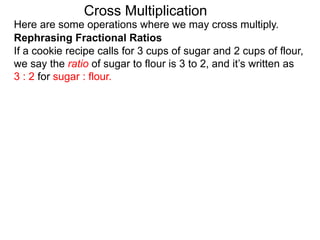
Here are some operations where we may cross multiply.
Cross Multiplication
Here are some operations where we may cross multiply.
Rephrasing Fractional Ratios
Cross Multiplication
Here are some operations where we may cross multiply.
Rephrasing Fractional Ratios
If a cookie recipe calls for 3 cups of sugar and 2 cups of flour,
we say the ratio of sugar to flour is 3 to 2,
Cross Multiplication
Here are some operations where we may cross multiply.
Rephrasing Fractional Ratios
If a cookie recipe calls for 3 cups of sugar and 2 cups of flour,
we say the ratio of sugar to flour is 3 to 2, and it’s written as
3 : 2 for sugar : flour.
Cross Multiplication
Here are some operations where we may cross multiply.
Rephrasing Fractional Ratios
If a cookie recipe calls for 3 cups of sugar and 2 cups of flour,
we say the ratio of sugar to flour is 3 to 2, and it’s written as
3 : 2 for sugar : flour. Or we said the ratio of flour : sugar is
2 : 3.
Cross Multiplication
Here are some operations where we may cross multiply.
Rephrasing Fractional Ratios
If a cookie recipe calls for 3 cups of sugar and 2 cups of flour,
we say the ratio of sugar to flour is 3 to 2, and it’s written as
3 : 2 for sugar : flour. Or we said the ratio of flour : sugar is
2 : 3. For most people a recipe that calls for the fractional ratio
of 3/4 cup sugar to 2/3 cup of flour is confusing.
Cross Multiplication
Here are some operations where we may cross multiply.
Rephrasing Fractional Ratios
If a cookie recipe calls for 3 cups of sugar and 2 cups of flour,
we say the ratio of sugar to flour is 3 to 2, and it’s written as
3 : 2 for sugar : flour. Or we said the ratio of flour : sugar is
2 : 3. For most people a recipe that calls for the fractional ratio
of 3/4 cup sugar to 2/3 cup of flour is confusing. It’s better to
cross multiply to rewrite this ratio in whole numbers.
Cross Multiplication
Here are some operations where we may cross multiply.
Rephrasing Fractional Ratios
If a cookie recipe calls for 3 cups of sugar and 2 cups of flour,
we say the ratio of sugar to flour is 3 to 2, and it’s written as
3 : 2 for sugar : flour. Or we said the ratio of flour : sugar is
2 : 3. For most people a recipe that calls for the fractional ratio
of 3/4 cup sugar to 2/3 cup of flour is confusing. It’s better to
cross multiply to rewrite this ratio in whole numbers.
Example A.
rewrite a recipe that calls for the fractional ratio of 3/4 cup
sugar to 2/3 cup of flour into ratio of whole numbers.
Cross Multiplication
Here are some operations where we may cross multiply.
Rephrasing Fractional Ratios
If a cookie recipe calls for 3 cups of sugar and 2 cups of flour,
we say the ratio of sugar to flour is 3 to 2, and it’s written as
3 : 2 for sugar : flour. Or we said the ratio of flour : sugar is
2 : 3. For most people a recipe that calls for the fractional ratio
of 3/4 cup sugar to 2/3 cup of flour is confusing. It’s better to
cross multiply to rewrite this ratio in whole numbers.
Example A.
rewrite a recipe that calls for the fractional ratio of 3/4 cup
sugar to 2/3 cup of flour into ratio of whole numbers.
Write 3/4 cup of sugar as and 2/3 cup of flour as3
4
S
2
3
F.
Cross Multiplication
Here are some operations where we may cross multiply.
Rephrasing Fractional Ratios
If a cookie recipe calls for 3 cups of sugar and 2 cups of flour,
we say the ratio of sugar to flour is 3 to 2, and it’s written as
3 : 2 for sugar : flour. Or we said the ratio of flour : sugar is
2 : 3. For most people a recipe that calls for the fractional ratio
of 3/4 cup sugar to 2/3 cup of flour is confusing. It’s better to
cross multiply to rewrite this ratio in whole numbers.
Example A.
rewrite a recipe that calls for the fractional ratio of 3/4 cup
sugar to 2/3 cup of flour into ratio of whole numbers.
Write 3/4 cup of sugar as and 2/3 cup of flour as3
4
S
2
3
F.
We have the ratio 3
4
S : 2
3
F
Cross Multiplication
Here are some operations where we may cross multiply.
Rephrasing Fractional Ratios
If a cookie recipe calls for 3 cups of sugar and 2 cups of flour,
we say the ratio of sugar to flour is 3 to 2, and it’s written as
3 : 2 for sugar : flour. Or we said the ratio of flour : sugar is
2 : 3. For most people a recipe that calls for the fractional ratio
of 3/4 cup sugar to 2/3 cup of flour is confusing. It’s better to
cross multiply to rewrite this ratio in whole numbers.
Example A.
rewrite a recipe that calls for the fractional ratio of 3/4 cup
sugar to 2/3 cup of flour into ratio of whole numbers.
Write 3/4 cup of sugar as and 2/3 cup of flour as3
4
S
2
3
F.
We have the ratio 3
4
S : 2
3
F cross multiply we’ve 9S : 8F.
Cross Multiplication
Here are some operations where we may cross multiply.
Rephrasing Fractional Ratios
If a cookie recipe calls for 3 cups of sugar and 2 cups of flour,
we say the ratio of sugar to flour is 3 to 2, and it’s written as
3 : 2 for sugar : flour. Or we said the ratio of flour : sugar is
2 : 3. For most people a recipe that calls for the fractional ratio
of 3/4 cup sugar to 2/3 cup of flour is confusing. It’s better to
cross multiply to rewrite this ratio in whole numbers.
Example A.
rewrite a recipe that calls for the fractional ratio of 3/4 cup
sugar to 2/3 cup of flour into ratio of whole numbers.
Write 3/4 cup of sugar as and 2/3 cup of flour as3
4
S
2
3
F.
We have the ratio 3
4
S : 2
3
F cross multiply we’ve 9S : 8F.
Hence in integers, the ratio is 9 : 8 for sugar : flour.
Cross Multiplication
Here are some operations where we may cross multiply.
Rephrasing Fractional Ratios
If a cookie recipe calls for 3 cups of sugar and 2 cups of flour,
we say the ratio of sugar to flour is 3 to 2, and it’s written as
3 : 2 for sugar : flour. Or we said the ratio of flour : sugar is
2 : 3. For most people a recipe that calls for the fractional ratio
of 3/4 cup sugar to 2/3 cup of flour is confusing. It’s better to
cross multiply to rewrite this ratio in whole numbers.
Example A.
rewrite a recipe that calls for the fractional ratio of 3/4 cup
sugar to 2/3 cup of flour into ratio of whole numbers.
Write 3/4 cup of sugar as and 2/3 cup of flour as3
4
S
2
3
F.
We have the ratio 3
4
S : 2
3
F cross multiply we’ve 9S : 8F.
Hence in integers, the ratio is 9 : 8 for sugar : flour.
Cross Multiplication
Remark: A ratio such as 8 : 4 should be simplified to 2 : 1.
Cross–Multiplication Test for Comparing Two Fractions
Cross Multiplication
Cross–Multiplication Test for Comparing Two Fractions
Cross Multiplication
When comparing two fractions to see which is larger and
which is smaller.
Cross–Multiplication Test for Comparing Two Fractions
Cross Multiplication
When comparing two fractions to see which is larger and
which is smaller. Cross–multiply them, the side with the larger
product corresponds to the larger fraction.
Cross–Multiplication Test for Comparing Two Fractions
Cross Multiplication
When comparing two fractions to see which is larger and
which is smaller. Cross–multiply them, the side with the larger
product corresponds to the larger fraction.
In particular, if the cross multiplication products are the same
then the fraction are the same.
Cross–Multiplication Test for Comparing Two Fractions
Hence cross– multiply
Cross Multiplication
When comparing two fractions to see which is larger and
which is smaller. Cross–multiply them, the side with the larger
product corresponds to the larger fraction.
In particular, if the cross multiplication products are the same
then the fraction are the same.
3
5
9
15
Cross–Multiplication Test for Comparing Two Fractions
Hence cross– multiply
Cross Multiplication
When comparing two fractions to see which is larger and
which is smaller. Cross–multiply them, the side with the larger
product corresponds to the larger fraction.
In particular, if the cross multiplication products are the same
then the fraction are the same.
3
5
9
15
=45 45
we get
Cross–Multiplication Test for Comparing Two Fractions
Hence cross– multiply
Cross Multiplication
When comparing two fractions to see which is larger and
which is smaller. Cross–multiply them, the side with the larger
product corresponds to the larger fraction.
In particular, if the cross multiplication products are the same
then the fraction are the same.
3
5
9
15
=45 45 so
3
5
9
15=
we get
Cross–Multiplication Test for Comparing Two Fractions
Hence cross– multiply
Cross Multiplication
When comparing two fractions to see which is larger and
which is smaller. Cross–multiply them, the side with the larger
product corresponds to the larger fraction.
In particular, if the cross multiplication products are the same
then the fraction are the same.
3
5
9
15
=45 45 so
3
5
9
15=
we get
3
5
5
8
Cross–Multiplication Test for Comparing Two Fractions
Hence cross– multiply
Cross Multiplication
When comparing two fractions to see which is larger and
which is smaller. Cross–multiply them, the side with the larger
product corresponds to the larger fraction.
In particular, if the cross multiplication products are the same
then the fraction are the same.
3
5
9
15
=45 45 so
3
5
9
15=
we get
Cross– multiply 3
5
5
8
Cross–Multiplication Test for Comparing Two Fractions
Hence cross– multiply
Cross Multiplication
When comparing two fractions to see which is larger and
which is smaller. Cross–multiply them, the side with the larger
product corresponds to the larger fraction.
In particular, if the cross multiplication products are the same
then the fraction are the same.
3
5
9
15
=45 45 so
3
5
9
15=
we get
Cross– multiply 3
5
5
8
24 25
we get
Cross–Multiplication Test for Comparing Two Fractions
Hence cross– multiply
Cross Multiplication
When comparing two fractions to see which is larger and
which is smaller. Cross–multiply them, the side with the larger
product corresponds to the larger fraction.
In particular, if the cross multiplication products are the same
then the fraction are the same.
3
5
9
15
=45 45 so
3
5
9
15=
we get
Cross– multiply 3
5
5
8
24 25
we get
moreless
Cross–Multiplication Test for Comparing Two Fractions
Hence cross– multiply
Cross Multiplication
When comparing two fractions to see which is larger and
which is smaller. Cross–multiply them, the side with the larger
product corresponds to the larger fraction.
In particular, if the cross multiplication products are the same
then the fraction are the same.
3
5
9
15
=45 45 so
3
5
9
15=
we get
Cross– multiply 3
5
5
8
24 25
Hence 3
5
5
8
is less than
we get
moreless
.
Cross–Multiplication Test for Comparing Two Fractions
Hence cross– multiply
Cross Multiplication
When comparing two fractions to see which is larger and
which is smaller. Cross–multiply them, the side with the larger
product corresponds to the larger fraction.
In particular, if the cross multiplication products are the same
then the fraction are the same.
3
5
9
15
=45 45 so
3
5
9
15=
we get
Cross– multiply 3
5
5
8
24 25
Hence 3
5
5
8
is less than
we get
moreless
.
(Which is more 7
11
9
14
or ? Do it by inspection.)
Cross–Multiplication for Addition or Subtraction
Cross Multiplication
Cross–Multiplication for Addition or Subtraction
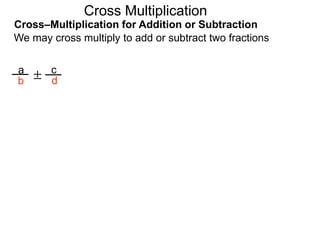
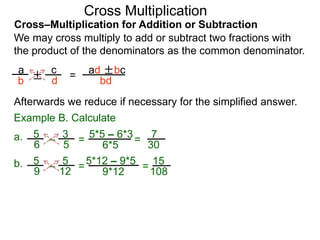
We may cross multiply to add or subtract two fractions
Cross Multiplication
Cross–Multiplication for Addition or Subtraction
We may cross multiply to add or subtract two fractions
a
b
c
d
±
Cross Multiplication
Cross–Multiplication for Addition or Subtraction
We may cross multiply to add or subtract two fractions
a
b
c
d± =
ad ±bc
Cross Multiplication
Cross–Multiplication for Addition or Subtraction
a
b
c
d± =
ad ±bc
Cross Multiplication
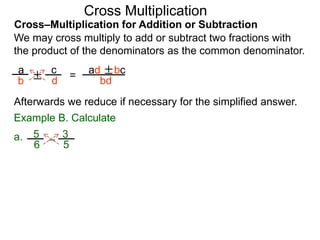
We may cross multiply to add or subtract two fractions with
the product of the denominators as the common denominator.
Cross–Multiplication for Addition or Subtraction
a
b
c
d± =
ad ±bc
bd
Cross Multiplication
We may cross multiply to add or subtract two fractions with
the product of the denominators as the common denominator.
Cross–Multiplication for Addition or Subtraction
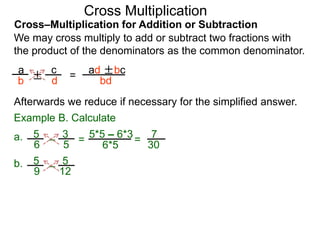
We may cross multiply to add or subtract two fractions with
the product of the denominators as the common denominator.
a
b
c
d
Afterwards we reduce if necessary for the simplified answer.
± =
ad ±bc
bd
Cross Multiplication
Cross–Multiplication for Addition or Subtraction
We may cross multiply to add or subtract two fractions with
the product of the denominators as the common denominator.
a
b
c
d
Afterwards we reduce if necessary for the simplified answer.
Example B. Calculate
± =
ad ±bc
bd
3
5
5
6 –a.
Cross Multiplication
Cross–Multiplication for Addition or Subtraction
We may cross multiply to add or subtract two fractions with
the product of the denominators as the common denominator.
a
b
c
d
Afterwards we reduce if necessary for the simplified answer.
Example B. Calculate
± =
ad ±bc
bd
3
5
5
6 –a.
Cross Multiplication
Cross–Multiplication for Addition or Subtraction
We may cross multiply to add or subtract two fractions with
the product of the denominators as the common denominator.
a
b
c
d
Afterwards we reduce if necessary for the simplified answer.
Example B. Calculate
± =
ad ±bc
bd
3
5
5
6 – =
5*5 – 6*3
6*5
a.
Cross Multiplication
Cross–Multiplication for Addition or Subtraction
We may cross multiply to add or subtract two fractions with
the product of the denominators as the common denominator.
a
b
c
d
Afterwards we reduce if necessary for the simplified answer.
Example B. Calculate
± =
ad ±bc
bd
3
5
5
6 – =
5*5 – 6*3
6*5
7
30
=a.
Cross Multiplication
Cross–Multiplication for Addition or Subtraction
We may cross multiply to add or subtract two fractions with
the product of the denominators as the common denominator.
a
b
c
d
Afterwards we reduce if necessary for the simplified answer.
Example B. Calculate
± =
ad ±bc
bd
3
5
5
6 – =
5*5 – 6*3
6*5
7
30
=a.
5
12
5
9
–b.
Cross Multiplication
Cross–Multiplication for Addition or Subtraction
We may cross multiply to add or subtract two fractions with
the product of the denominators as the common denominator.
a
b
c
d
Afterwards we reduce if necessary for the simplified answer.
Example B. Calculate
± =
ad ±bc
bd
3
5
5
6 – =
5*5 – 6*3
6*5
7
30
=a.
5
12
5
9
–b.
Cross Multiplication
Cross–Multiplication for Addition or Subtraction
We may cross multiply to add or subtract two fractions with
the product of the denominators as the common denominator.
a
b
c
d
Afterwards we reduce if necessary for the simplified answer.
Example B. Calculate
± =
ad ±bc
bd
3
5
5
6 – =
5*5 – 6*3
6*5
7
30
=a.
5
12
5
9
– =5*12 – 9*5
9*12
b.
Cross Multiplication
Cross–Multiplication for Addition or Subtraction
We may cross multiply to add or subtract two fractions with
the product of the denominators as the common denominator.
a
b
c
d
Afterwards we reduce if necessary for the simplified answer.
Example B. Calculate
± =
ad ±bc
bd
3
5
5
6 – =
5*5 – 6*3
6*5
7
30
=a.
5
12
5
9
– =5*12 – 9*5
9*12
15
108
=b.
Cross Multiplication
Cross–Multiplication for Addition or Subtraction
We may cross multiply to add or subtract two fractions with
the product of the denominators as the common denominator.
a
b
c
d
Afterwards we reduce if necessary for the simplified answer.
Example B. Calculate
± =
ad ±bc
bd
3
5
5
6 – =
5*5 – 6*3
6*5
7
30
=a.
5
12
5
9
– =5*12 – 9*5
9*12
15
108
=b. 5
36=
Cross Multiplication
Cross–Multiplication for Addition or Subtraction
We may cross multiply to add or subtract two fractions with
the product of the denominators as the common denominator.
a
b
c
d
Afterwards we reduce if necessary for the simplified answer.
Example B. Calculate
± =
ad ±bc
bd
3
5
5
6 – =
5*5 – 6*3
6*5
7
30
=a.
5
12
5
9
– =5*12 – 9*5
9*12
15
108
=b. 5
36=
Cross Multiplication
In a. the LCD = 30 = 6*5 so the crossing method is the same as
the Multiplier Method.
Cross–Multiplication for Addition or Subtraction
We may cross multiply to add or subtract two fractions with
the product of the denominators as the common denominator.
a
b
c
d
Afterwards we reduce if necessary for the simplified answer.
Example B. Calculate
± =
ad ±bc
bd
3
5
5
6 – =
5*5 – 6*3
6*5
7
30
=a.
5
12
5
9
– =5*12 – 9*5
9*12
15
108
=b. 5
36=
Cross Multiplication
In a. the LCD = 30 = 6*5 so the crossing method is the same as
the Multiplier Method. However in b. the crossing method
yielded an answer that needed to be reduced.
Cross–Multiplication for Addition or Subtraction
We may cross multiply to add or subtract two fractions with
the product of the denominators as the common denominator.
a
b
c
d
Afterwards we reduce if necessary for the simplified answer.
Example B. Calculate
± =
ad ±bc
bd
3
5
5
6 – =
5*5 – 6*3
6*5
7
30
=a.
5
12
5
9
– =5*12 – 9*5
9*12
15
108
=b. 5
36=
Cross Multiplication
In a. the LCD = 30 = 6*5 so the crossing method is the same as
the Multiplier Method. However in b. the crossing method
yielded an answer that needed to be reduced. we need both
methods.
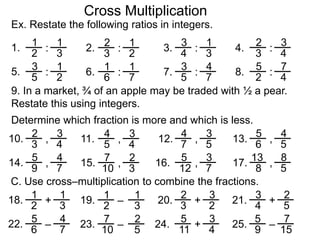
Ex. Restate the following ratios in integers.
9. In a market, ¾ of an apple may be traded with ½ a pear.
Restate this using integers.
1
2
1
3
:1. 2. 3. 4.2
3
1
2:
3
4
1
3
:
2
3
3
4
:
3
5
1
2
:5. 6. 7. 8.1
6
1
7
:
3
5
4
7
:
5
2
7
4
:
Determine which fraction is more and which is less.
2
3
3
4
,10. 11. 12. 13.4
5
3
4,
4
7
3
5
,
5
6
4
5
,
5
9
4
7,14. 15. 16. 17.7
10
2
3
,
5
12
3
7,
13
8
8
5,
1
2
1
3
+18. 19. 20. 21.1
2
1
3
–
2
3
3
2
+
3
4
2
5
+
5
6
4
7
–22. 23. 24. 25.7
10
2
5
–
5
11
3
4
+
5
9
7
15
–
Cross Multiplication
C. Use cross–multiplication to combine the fractions.

16 on cross multiplication

  • 1.
    Cross Multiplication Back toAlgebra–Ready Review Content.
  • 2.
    In this sectionwe look at the useful procedure of cross multiplcation. Cross Multiplication
  • 3.
    In this sectionwe look at the useful procedure of cross multiplcation. Cross Multiplication Cross Multiplication
  • 4.
    In this sectionwe look at the useful procedure of cross multiplcation. Cross Multiplication Many procedures with two fractions utilize the operation of cross– multiplication as shown below. Cross Multiplication
  • 5.
    In this sectionwe look at the useful procedure of cross multiplcation. a b c d Cross Multiplication Many procedures with two fractions utilize the operation of cross– multiplication as shown below. Cross Multiplication
  • 6.
    In this sectionwe look at the useful procedure of cross multiplcation. a b c d Cross Multiplication Many procedures with two fractions utilize the operation of cross– multiplication as shown below. Cross Multiplication
  • 7.
    In this sectionwe look at the useful procedure of cross multiplcation. a b c d Cross Multiplication Many procedures with two fractions utilize the operation of cross– multiplication as shown below. ad bc Cross Multiplication
  • 8.
    In this sectionwe look at the useful procedure of cross multiplcation. a b c d Cross Multiplication Many procedures with two fractions utilize the operation of cross– multiplication as shown below. Take the denominators and multiply them diagonally across. ad bc Cross Multiplication
  • 9.
    In this sectionwe look at the useful procedure of cross multiplcation. What we get are two numbers. a b c d Cross Multiplication Many procedures with two fractions utilize the operation of cross– multiplication as shown below. Take the denominators and multiply them diagonally across. ad bc Cross Multiplication
  • 10.
    In this sectionwe look at the useful procedure of cross multiplcation. What we get are two numbers. a b c d Cross Multiplication Many procedures with two fractions utilize the operation of cross– multiplication as shown below. Take the denominators and multiply them diagonally across. ad bc Make sure that the denominators cross over and up so the numerators stay put. Cross Multiplication
  • 11.
    In this sectionwe look at the useful procedure of cross multiplcation. What we get are two numbers. a b c d Cross Multiplication Many procedures with two fractions utilize the operation of cross– multiplication as shown below. Take the denominators and multiply them diagonally across. ad bc Make sure that the denominators cross over and up so the numerators stay put. Do not cross downward as shown here. a b c d adbc Cross Multiplication
  • 12.
    In this sectionwe look at the useful procedure of cross multiplcation. What we get are two numbers. a b c d Cross Multiplication Many procedures with two fractions utilize the operation of cross– multiplication as shown below. Take the denominators and multiply them diagonally across. ad bc Make sure that the denominators cross over and up so the numerators stay put. Do not cross downward as shown here. a b c d adbc Cross Multiplication
  • 13.
    Here are someoperations where we may cross multiply. Cross Multiplication
  • 14.
    Here are someoperations where we may cross multiply. Rephrasing Fractional Ratios Cross Multiplication
  • 15.
    Here are someoperations where we may cross multiply. Rephrasing Fractional Ratios If a cookie recipe calls for 3 cups of sugar and 2 cups of flour, we say the ratio of sugar to flour is 3 to 2, Cross Multiplication
  • 16.
    Here are someoperations where we may cross multiply. Rephrasing Fractional Ratios If a cookie recipe calls for 3 cups of sugar and 2 cups of flour, we say the ratio of sugar to flour is 3 to 2, and it’s written as 3 : 2 for sugar : flour. Cross Multiplication
  • 17.
    Here are someoperations where we may cross multiply. Rephrasing Fractional Ratios If a cookie recipe calls for 3 cups of sugar and 2 cups of flour, we say the ratio of sugar to flour is 3 to 2, and it’s written as 3 : 2 for sugar : flour. Or we said the ratio of flour : sugar is 2 : 3. Cross Multiplication
  • 18.
    Here are someoperations where we may cross multiply. Rephrasing Fractional Ratios If a cookie recipe calls for 3 cups of sugar and 2 cups of flour, we say the ratio of sugar to flour is 3 to 2, and it’s written as 3 : 2 for sugar : flour. Or we said the ratio of flour : sugar is 2 : 3. For most people a recipe that calls for the fractional ratio of 3/4 cup sugar to 2/3 cup of flour is confusing. Cross Multiplication
  • 19.
    Here are someoperations where we may cross multiply. Rephrasing Fractional Ratios If a cookie recipe calls for 3 cups of sugar and 2 cups of flour, we say the ratio of sugar to flour is 3 to 2, and it’s written as 3 : 2 for sugar : flour. Or we said the ratio of flour : sugar is 2 : 3. For most people a recipe that calls for the fractional ratio of 3/4 cup sugar to 2/3 cup of flour is confusing. It’s better to cross multiply to rewrite this ratio in whole numbers. Cross Multiplication
  • 20.
    Here are someoperations where we may cross multiply. Rephrasing Fractional Ratios If a cookie recipe calls for 3 cups of sugar and 2 cups of flour, we say the ratio of sugar to flour is 3 to 2, and it’s written as 3 : 2 for sugar : flour. Or we said the ratio of flour : sugar is 2 : 3. For most people a recipe that calls for the fractional ratio of 3/4 cup sugar to 2/3 cup of flour is confusing. It’s better to cross multiply to rewrite this ratio in whole numbers. Example A. rewrite a recipe that calls for the fractional ratio of 3/4 cup sugar to 2/3 cup of flour into ratio of whole numbers. Cross Multiplication
  • 21.
    Here are someoperations where we may cross multiply. Rephrasing Fractional Ratios If a cookie recipe calls for 3 cups of sugar and 2 cups of flour, we say the ratio of sugar to flour is 3 to 2, and it’s written as 3 : 2 for sugar : flour. Or we said the ratio of flour : sugar is 2 : 3. For most people a recipe that calls for the fractional ratio of 3/4 cup sugar to 2/3 cup of flour is confusing. It’s better to cross multiply to rewrite this ratio in whole numbers. Example A. rewrite a recipe that calls for the fractional ratio of 3/4 cup sugar to 2/3 cup of flour into ratio of whole numbers. Write 3/4 cup of sugar as and 2/3 cup of flour as3 4 S 2 3 F. Cross Multiplication
  • 22.
    Here are someoperations where we may cross multiply. Rephrasing Fractional Ratios If a cookie recipe calls for 3 cups of sugar and 2 cups of flour, we say the ratio of sugar to flour is 3 to 2, and it’s written as 3 : 2 for sugar : flour. Or we said the ratio of flour : sugar is 2 : 3. For most people a recipe that calls for the fractional ratio of 3/4 cup sugar to 2/3 cup of flour is confusing. It’s better to cross multiply to rewrite this ratio in whole numbers. Example A. rewrite a recipe that calls for the fractional ratio of 3/4 cup sugar to 2/3 cup of flour into ratio of whole numbers. Write 3/4 cup of sugar as and 2/3 cup of flour as3 4 S 2 3 F. We have the ratio 3 4 S : 2 3 F Cross Multiplication
  • 23.
    Here are someoperations where we may cross multiply. Rephrasing Fractional Ratios If a cookie recipe calls for 3 cups of sugar and 2 cups of flour, we say the ratio of sugar to flour is 3 to 2, and it’s written as 3 : 2 for sugar : flour. Or we said the ratio of flour : sugar is 2 : 3. For most people a recipe that calls for the fractional ratio of 3/4 cup sugar to 2/3 cup of flour is confusing. It’s better to cross multiply to rewrite this ratio in whole numbers. Example A. rewrite a recipe that calls for the fractional ratio of 3/4 cup sugar to 2/3 cup of flour into ratio of whole numbers. Write 3/4 cup of sugar as and 2/3 cup of flour as3 4 S 2 3 F. We have the ratio 3 4 S : 2 3 F cross multiply we’ve 9S : 8F. Cross Multiplication
  • 24.
    Here are someoperations where we may cross multiply. Rephrasing Fractional Ratios If a cookie recipe calls for 3 cups of sugar and 2 cups of flour, we say the ratio of sugar to flour is 3 to 2, and it’s written as 3 : 2 for sugar : flour. Or we said the ratio of flour : sugar is 2 : 3. For most people a recipe that calls for the fractional ratio of 3/4 cup sugar to 2/3 cup of flour is confusing. It’s better to cross multiply to rewrite this ratio in whole numbers. Example A. rewrite a recipe that calls for the fractional ratio of 3/4 cup sugar to 2/3 cup of flour into ratio of whole numbers. Write 3/4 cup of sugar as and 2/3 cup of flour as3 4 S 2 3 F. We have the ratio 3 4 S : 2 3 F cross multiply we’ve 9S : 8F. Hence in integers, the ratio is 9 : 8 for sugar : flour. Cross Multiplication
  • 25.
    Here are someoperations where we may cross multiply. Rephrasing Fractional Ratios If a cookie recipe calls for 3 cups of sugar and 2 cups of flour, we say the ratio of sugar to flour is 3 to 2, and it’s written as 3 : 2 for sugar : flour. Or we said the ratio of flour : sugar is 2 : 3. For most people a recipe that calls for the fractional ratio of 3/4 cup sugar to 2/3 cup of flour is confusing. It’s better to cross multiply to rewrite this ratio in whole numbers. Example A. rewrite a recipe that calls for the fractional ratio of 3/4 cup sugar to 2/3 cup of flour into ratio of whole numbers. Write 3/4 cup of sugar as and 2/3 cup of flour as3 4 S 2 3 F. We have the ratio 3 4 S : 2 3 F cross multiply we’ve 9S : 8F. Hence in integers, the ratio is 9 : 8 for sugar : flour. Cross Multiplication Remark: A ratio such as 8 : 4 should be simplified to 2 : 1.
  • 26.
    Cross–Multiplication Test forComparing Two Fractions Cross Multiplication
  • 27.
    Cross–Multiplication Test forComparing Two Fractions Cross Multiplication When comparing two fractions to see which is larger and which is smaller.
  • 28.
    Cross–Multiplication Test forComparing Two Fractions Cross Multiplication When comparing two fractions to see which is larger and which is smaller. Cross–multiply them, the side with the larger product corresponds to the larger fraction.
  • 29.
    Cross–Multiplication Test forComparing Two Fractions Cross Multiplication When comparing two fractions to see which is larger and which is smaller. Cross–multiply them, the side with the larger product corresponds to the larger fraction. In particular, if the cross multiplication products are the same then the fraction are the same.
  • 30.
    Cross–Multiplication Test forComparing Two Fractions Hence cross– multiply Cross Multiplication When comparing two fractions to see which is larger and which is smaller. Cross–multiply them, the side with the larger product corresponds to the larger fraction. In particular, if the cross multiplication products are the same then the fraction are the same. 3 5 9 15
  • 31.
    Cross–Multiplication Test forComparing Two Fractions Hence cross– multiply Cross Multiplication When comparing two fractions to see which is larger and which is smaller. Cross–multiply them, the side with the larger product corresponds to the larger fraction. In particular, if the cross multiplication products are the same then the fraction are the same. 3 5 9 15 =45 45 we get
  • 32.
    Cross–Multiplication Test forComparing Two Fractions Hence cross– multiply Cross Multiplication When comparing two fractions to see which is larger and which is smaller. Cross–multiply them, the side with the larger product corresponds to the larger fraction. In particular, if the cross multiplication products are the same then the fraction are the same. 3 5 9 15 =45 45 so 3 5 9 15= we get
  • 33.
    Cross–Multiplication Test forComparing Two Fractions Hence cross– multiply Cross Multiplication When comparing two fractions to see which is larger and which is smaller. Cross–multiply them, the side with the larger product corresponds to the larger fraction. In particular, if the cross multiplication products are the same then the fraction are the same. 3 5 9 15 =45 45 so 3 5 9 15= we get 3 5 5 8
  • 34.
    Cross–Multiplication Test forComparing Two Fractions Hence cross– multiply Cross Multiplication When comparing two fractions to see which is larger and which is smaller. Cross–multiply them, the side with the larger product corresponds to the larger fraction. In particular, if the cross multiplication products are the same then the fraction are the same. 3 5 9 15 =45 45 so 3 5 9 15= we get Cross– multiply 3 5 5 8
  • 35.
    Cross–Multiplication Test forComparing Two Fractions Hence cross– multiply Cross Multiplication When comparing two fractions to see which is larger and which is smaller. Cross–multiply them, the side with the larger product corresponds to the larger fraction. In particular, if the cross multiplication products are the same then the fraction are the same. 3 5 9 15 =45 45 so 3 5 9 15= we get Cross– multiply 3 5 5 8 24 25 we get
  • 36.
    Cross–Multiplication Test forComparing Two Fractions Hence cross– multiply Cross Multiplication When comparing two fractions to see which is larger and which is smaller. Cross–multiply them, the side with the larger product corresponds to the larger fraction. In particular, if the cross multiplication products are the same then the fraction are the same. 3 5 9 15 =45 45 so 3 5 9 15= we get Cross– multiply 3 5 5 8 24 25 we get moreless
  • 37.
    Cross–Multiplication Test forComparing Two Fractions Hence cross– multiply Cross Multiplication When comparing two fractions to see which is larger and which is smaller. Cross–multiply them, the side with the larger product corresponds to the larger fraction. In particular, if the cross multiplication products are the same then the fraction are the same. 3 5 9 15 =45 45 so 3 5 9 15= we get Cross– multiply 3 5 5 8 24 25 Hence 3 5 5 8 is less than we get moreless .
  • 38.
    Cross–Multiplication Test forComparing Two Fractions Hence cross– multiply Cross Multiplication When comparing two fractions to see which is larger and which is smaller. Cross–multiply them, the side with the larger product corresponds to the larger fraction. In particular, if the cross multiplication products are the same then the fraction are the same. 3 5 9 15 =45 45 so 3 5 9 15= we get Cross– multiply 3 5 5 8 24 25 Hence 3 5 5 8 is less than we get moreless . (Which is more 7 11 9 14 or ? Do it by inspection.)
  • 39.
    Cross–Multiplication for Additionor Subtraction Cross Multiplication
  • 40.
    Cross–Multiplication for Additionor Subtraction We may cross multiply to add or subtract two fractions Cross Multiplication
  • 41.
    Cross–Multiplication for Additionor Subtraction We may cross multiply to add or subtract two fractions a b c d ± Cross Multiplication
  • 42.
    Cross–Multiplication for Additionor Subtraction We may cross multiply to add or subtract two fractions a b c d± = ad ±bc Cross Multiplication
  • 43.
    Cross–Multiplication for Additionor Subtraction a b c d± = ad ±bc Cross Multiplication We may cross multiply to add or subtract two fractions with the product of the denominators as the common denominator.
  • 44.
    Cross–Multiplication for Additionor Subtraction a b c d± = ad ±bc bd Cross Multiplication We may cross multiply to add or subtract two fractions with the product of the denominators as the common denominator.
  • 45.
    Cross–Multiplication for Additionor Subtraction We may cross multiply to add or subtract two fractions with the product of the denominators as the common denominator. a b c d Afterwards we reduce if necessary for the simplified answer. ± = ad ±bc bd Cross Multiplication
  • 46.
    Cross–Multiplication for Additionor Subtraction We may cross multiply to add or subtract two fractions with the product of the denominators as the common denominator. a b c d Afterwards we reduce if necessary for the simplified answer. Example B. Calculate ± = ad ±bc bd 3 5 5 6 –a. Cross Multiplication
  • 47.
    Cross–Multiplication for Additionor Subtraction We may cross multiply to add or subtract two fractions with the product of the denominators as the common denominator. a b c d Afterwards we reduce if necessary for the simplified answer. Example B. Calculate ± = ad ±bc bd 3 5 5 6 –a. Cross Multiplication
  • 48.
    Cross–Multiplication for Additionor Subtraction We may cross multiply to add or subtract two fractions with the product of the denominators as the common denominator. a b c d Afterwards we reduce if necessary for the simplified answer. Example B. Calculate ± = ad ±bc bd 3 5 5 6 – = 5*5 – 6*3 6*5 a. Cross Multiplication
  • 49.
    Cross–Multiplication for Additionor Subtraction We may cross multiply to add or subtract two fractions with the product of the denominators as the common denominator. a b c d Afterwards we reduce if necessary for the simplified answer. Example B. Calculate ± = ad ±bc bd 3 5 5 6 – = 5*5 – 6*3 6*5 7 30 =a. Cross Multiplication
  • 50.
    Cross–Multiplication for Additionor Subtraction We may cross multiply to add or subtract two fractions with the product of the denominators as the common denominator. a b c d Afterwards we reduce if necessary for the simplified answer. Example B. Calculate ± = ad ±bc bd 3 5 5 6 – = 5*5 – 6*3 6*5 7 30 =a. 5 12 5 9 –b. Cross Multiplication
  • 51.
    Cross–Multiplication for Additionor Subtraction We may cross multiply to add or subtract two fractions with the product of the denominators as the common denominator. a b c d Afterwards we reduce if necessary for the simplified answer. Example B. Calculate ± = ad ±bc bd 3 5 5 6 – = 5*5 – 6*3 6*5 7 30 =a. 5 12 5 9 –b. Cross Multiplication
  • 52.
    Cross–Multiplication for Additionor Subtraction We may cross multiply to add or subtract two fractions with the product of the denominators as the common denominator. a b c d Afterwards we reduce if necessary for the simplified answer. Example B. Calculate ± = ad ±bc bd 3 5 5 6 – = 5*5 – 6*3 6*5 7 30 =a. 5 12 5 9 – =5*12 – 9*5 9*12 b. Cross Multiplication
  • 53.
    Cross–Multiplication for Additionor Subtraction We may cross multiply to add or subtract two fractions with the product of the denominators as the common denominator. a b c d Afterwards we reduce if necessary for the simplified answer. Example B. Calculate ± = ad ±bc bd 3 5 5 6 – = 5*5 – 6*3 6*5 7 30 =a. 5 12 5 9 – =5*12 – 9*5 9*12 15 108 =b. Cross Multiplication
  • 54.
    Cross–Multiplication for Additionor Subtraction We may cross multiply to add or subtract two fractions with the product of the denominators as the common denominator. a b c d Afterwards we reduce if necessary for the simplified answer. Example B. Calculate ± = ad ±bc bd 3 5 5 6 – = 5*5 – 6*3 6*5 7 30 =a. 5 12 5 9 – =5*12 – 9*5 9*12 15 108 =b. 5 36= Cross Multiplication
  • 55.
    Cross–Multiplication for Additionor Subtraction We may cross multiply to add or subtract two fractions with the product of the denominators as the common denominator. a b c d Afterwards we reduce if necessary for the simplified answer. Example B. Calculate ± = ad ±bc bd 3 5 5 6 – = 5*5 – 6*3 6*5 7 30 =a. 5 12 5 9 – =5*12 – 9*5 9*12 15 108 =b. 5 36= Cross Multiplication In a. the LCD = 30 = 6*5 so the crossing method is the same as the Multiplier Method.
  • 56.
    Cross–Multiplication for Additionor Subtraction We may cross multiply to add or subtract two fractions with the product of the denominators as the common denominator. a b c d Afterwards we reduce if necessary for the simplified answer. Example B. Calculate ± = ad ±bc bd 3 5 5 6 – = 5*5 – 6*3 6*5 7 30 =a. 5 12 5 9 – =5*12 – 9*5 9*12 15 108 =b. 5 36= Cross Multiplication In a. the LCD = 30 = 6*5 so the crossing method is the same as the Multiplier Method. However in b. the crossing method yielded an answer that needed to be reduced.
  • 57.
    Cross–Multiplication for Additionor Subtraction We may cross multiply to add or subtract two fractions with the product of the denominators as the common denominator. a b c d Afterwards we reduce if necessary for the simplified answer. Example B. Calculate ± = ad ±bc bd 3 5 5 6 – = 5*5 – 6*3 6*5 7 30 =a. 5 12 5 9 – =5*12 – 9*5 9*12 15 108 =b. 5 36= Cross Multiplication In a. the LCD = 30 = 6*5 so the crossing method is the same as the Multiplier Method. However in b. the crossing method yielded an answer that needed to be reduced. we need both methods.
  • 58.
    Ex. Restate thefollowing ratios in integers. 9. In a market, ¾ of an apple may be traded with ½ a pear. Restate this using integers. 1 2 1 3 :1. 2. 3. 4.2 3 1 2: 3 4 1 3 : 2 3 3 4 : 3 5 1 2 :5. 6. 7. 8.1 6 1 7 : 3 5 4 7 : 5 2 7 4 : Determine which fraction is more and which is less. 2 3 3 4 ,10. 11. 12. 13.4 5 3 4, 4 7 3 5 , 5 6 4 5 , 5 9 4 7,14. 15. 16. 17.7 10 2 3 , 5 12 3 7, 13 8 8 5, 1 2 1 3 +18. 19. 20. 21.1 2 1 3 – 2 3 3 2 + 3 4 2 5 + 5 6 4 7 –22. 23. 24. 25.7 10 2 5 – 5 11 3 4 + 5 9 7 15 – Cross Multiplication C. Use cross–multiplication to combine the fractions.