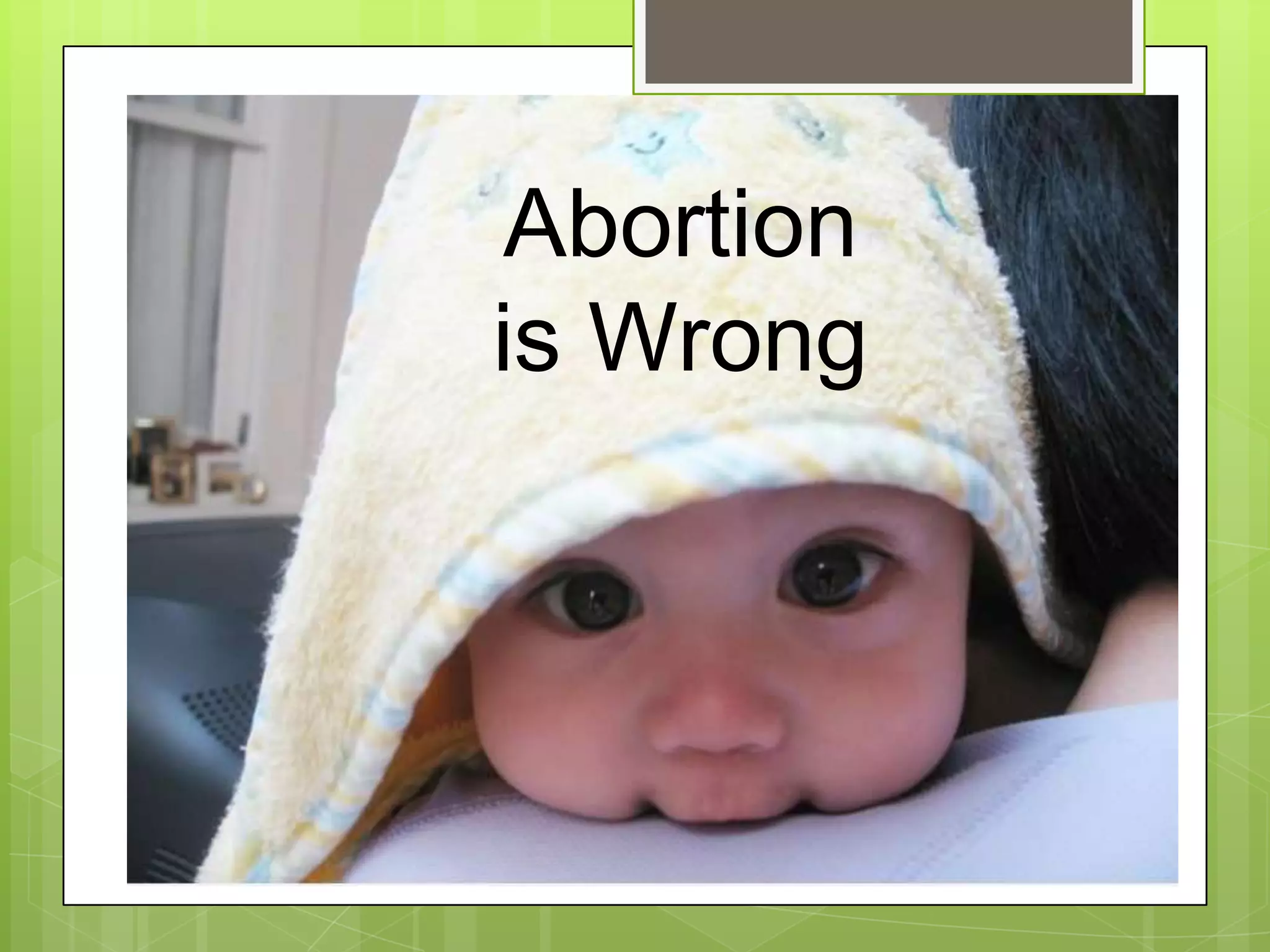

Abortion
is Wrong
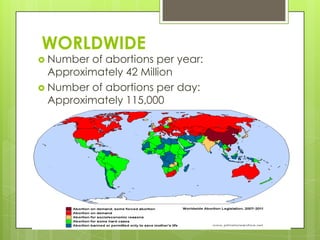
WORLDWIDE
 Number of abortions per year:
  Approximately 42 Million
 Number of abortions per day:
  Approximately 115,000
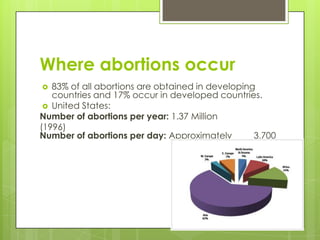
Where abortions occur
  83% of all abortions are obtained in developing
   countries and 17% occur in developed countries.
  United States:
Number of abortions per year: 1.37 Million
(1996)
Number of abortions per day: Approximately        3,700
Why women have abortions
• 1% of all abortions occur because of rape or
  incest; 6% of abortions occur because of
  potential health problems regarding either the
  mother or child, and 93% of all abortions
  occur for social reasons (i.e. the child is
  unwanted or inconvenient).
Who's having abortions
(income)?
 Women  with family incomes less than
 $15,000 obtain 28.7% of all abortions;
 Women with family incomes between
 $15,000 and $29,999 obtain 19.5%; Women
 with family incomes between $30,000 and
 $59,999 obtain 38.0%; Women with family
 incomes over $60,000 obtain 13.8%.
Who's having abortions
(marital status)?
 64.4%of all abortions are performed on
 never-married women; Married women
 account for 18.4% of all abortions and
 divorced women obtain 9.4%.
ABORTION FATALITY
   In 2007, 6 women died as a result of
    complications from known legal induced
    abortion.
   The number of deaths attributable to legal
    induced abortion was highest before the
    1980s.
   In 1972 (the year before abortion was
    federally legalized), a total of 24 women died
    from causes known to be associated with
    legal abortions, and 39 died as a result of
    known illegal abortions.
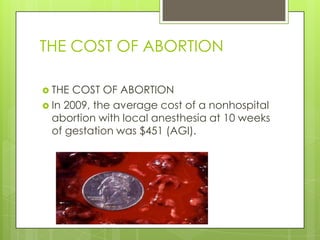
THE COST OF ABORTION

 THE COST OF ABORTION
 In 2009, the average cost of a nonhospital
  abortion with local anesthesia at 10 weeks
  of gestation was $451 (AGI).
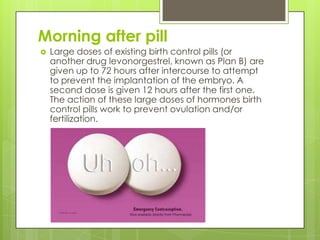
Morning after pill
   Large doses of existing birth control pills (or
    another drug levonorgestrel, known as Plan B) are
    given up to 72 hours after intercourse to attempt
    to prevent the implantation of the embryo. A
    second dose is given 12 hours after the first one.
    The action of these large doses of hormones birth
    control pills work to prevent ovulation and/or
    fertilization.
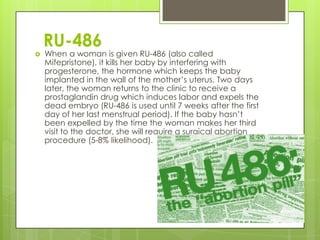
RU-486
   When a woman is given RU-486 (also called
    Mifepristone), it kills her baby by interfering with
    progesterone, the hormone which keeps the baby
    implanted in the wall of the mother’s uterus. Two days
    later, the woman returns to the clinic to receive a
    prostaglandin drug which induces labor and expels the
    dead embryo (RU-486 is used until 7 weeks after the first
    day of her last menstrual period). If the baby hasn’t
    been expelled by the time the woman makes her third
    visit to the doctor, she will require a surgical abortion
    procedure (5-8% likelihood).
At what gestational ages are
abortions performed:
 52% of all abortions occur before the 9th
 week of pregnancy, 25% happen
 between the 9th & 10th week, 12%
 happen between the 11th and 12th
 week, 6% happen between the 13th &
 15th week, 4% happen between the 16th
 & 20th week, and 1% of all abortions
 (16,450/yr.) happen after the 20th week of
 pregnancy.
Some things to think about
   When you total up all forms of abortion, including those caused by
    the abortion drug RU 486, the grand total comes to more than a
    million abortions performed in the United States every single year.
   The number of American babies killed by abortion each year is
    roughly equal to the number of U.S. military deaths that have
    occurred in all of the wars that the United States has ever been
    involved in combined.
    Approximately 3,000 Americans lost their lives as a result of the
    destruction of the World Trade Center towers on 9/11. Every single
    day, more than 3,000 American babies are killed by abortion.
   The average cost of a vaginal birth with no complications in the
    United States is now over $9,000.
   Planned Parenthood received more than 487 million dollars from
    the federal government during 2010.
Abortion
   Studies confirming women who have
    abortions face both depression and other
    mental health problems.
   Other recent studies from the last two years
    provide nearly irrefutable evidence that
    abortion affects women in a myriad of ways
    — making it so they face everything from
    depression and relationship problems to PTSD
    and elevated risks for abusing drugs or
    alcohol.
   Approximately 52 percent of the early
    abortion group and 67 percent of the late
    term abortion group met the American
    Psychological Association’s criteria for post-
    traumatic stress disorder symptoms
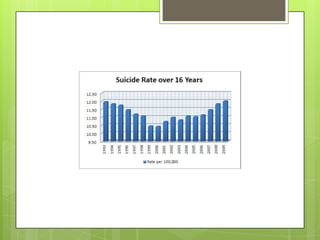
   The survey also found the suicide rate among
    women who had an abortion was six times
    higher than for women who had given birth in
    the prior year and double that of women who
    had miscarriages.
   In the year following a pregnancy event, women
    who choose abortion have a SIX times higher suicide
    rate than women who choose to deliver.
   A baby boy abandoned by doctors to die after a
    botched abortion was found to be still alive the next
    morning and died the following day.

   The 22-week infant later died in intensive care at a
    hospital in the mother's home town of Rossano in
    southern Italy.

   The case has reignited controversy on the legality of
    abortion in the devoutly Roman Catholic country.
 Don Marquis argues that killing is wrong
 because it robs the victim of a future-all
 possible ―experiences, activities, projects,
 and enjoyments.‖ In the same way,
 abortion is almost always wrong because
 it deprives the fetus of an experienced
 future.
Statistics
   California 214,190 abortions in 2008
   Ney York 153,110 abortions in 2008
   Wyoming 90 abortions on 2008
       ABORTION AND MINORS
           40% of minors having an abortion report that neither of their
            parents knew about the abortion
       ABORTION AND CONTRACEPTION
           Induced abortions usually result from unintended pregnancies,
            which often occur despite the use of contraception (CDC).
           54% of women having abortions used a contraceptive method
            during the month they became pregnant. Among those women,
            76% of pill users and 49% of condom users reported using the
            methods inconsistently, while 13% of pill users and 14% of condom
            users reported correct use (AGI).
           9 in 10 women at risk of unintended pregnancy are using a
            contraceptive method (AGI).
Stats cont.
   THE COST OF ABORTION
       Abortion Pill ("At home" abortion)1      $525.00
       Surgical Abortion up to 13 weeks1
       with General Anesthesia           $450.00
       with Local Anesthesia $425.00
       Surgical Abortion over 13 weeks1,2
       13.5 to 16.0 weeks        $765.00
       16.5 to 18.0 weeks        $975.00
       18.5 to 19.0 weeks        $1,175.00
       19.5 to 21.5 weeks        $2,165.00
   HOW ARE ABORTIONS PERFORMED?
       In 2008, 84.6% of abortions were performed by curettage (which
        includes dilatation and evacuation). Most curettage abortions are
        suction procedures (CDC).
   WHEN DO ABORTIONS OCCUR?
       88-92% of all abortions happen during the first trimester, prior to the
        13th week of gestation (AGI/CDC).
       In 2008, 7.3% of all abortions were performed at 14-20 weeks'
        gestation; 1.3% were performed at ≥21 weeks' gestation (CDC).
       Percentage of 2008 Reported Abortions by Weeks of Gestation*
        (CDC):
       ≤6 wks :30.7% 7 wks 18.1%           8 wks 14.0%           9 wks 9.6%
        10 wks 6.8% 11 wks 5.3%             12 wks 4.0%     13 wks 2.9%
        14-15 wks 3.5%            16-17 wks 2.0%     18-20 wks 1.9%
           ≥21 wks1.3%
WHY ARE ABORTIONS
PERFORMED?
   On average, women give at least 3 reasons
    for choosing abortion: 3/4 say that having a
    baby would interfere with work, school or
    other responsibilities; about 3/4 say they
    cannot afford a child; and 1/2 say they do
    not want to be a single parent or are having
    problems with their husband or partner.
   Only 12% of women included a physical
    problem with their health among reasons for
    having an abortion.
   One per cent (of aborting women) reported
    that they were the survivors of rape.
ANNUAL ABORTION STATISTICS
   In 2008, approximately 1.21 million abortions
    took place in the U.S., down from an
    estimated 1.29 million in 2002, 1.31 million in
    2000 and 1.36 million in 1996. From 1973
    through 2008, nearly 50 million legal abortions
    have occurred in the U.S.
   In 2008, the highest number of reported
    abortions occurred in New York (124,867),
    NYC (89,469), Florida (86,817) and Texas
    (81,366); the fewest occurred in Wyoming
    (≤4), South Dakota (848), North Dakota
    (1,386), and Idaho (1,481).
Abortions in the United States
   Total number of abortions in the U.S. 1973-
    2011: 54.5 million+

   234 abortions per 1,000 live births (according
    to the Centers for Disease Control)
   Abortions per year: 1.2 million
   Abortions per day: 3,288
   Abortions per hour: 137
   9 abortions every 4 minutes
   1 abortion every 26 seconds
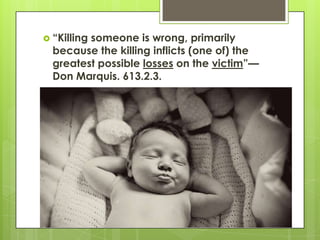
 “Killing
         someone is wrong, primarily
  because the killing inflicts (one of) the
  greatest possible losses on the victim”—
  Don Marquis. 613.2.3.
   Life is non arguably the greatest gift/treasure.
   (I would rather feel something than absolutely
    nothing. Subjective, yes, but ―Life is what you make
    it‖.)
   Choice [[Insert the ―I don’t want to live on this planet
    anymore‖ meme]]
   (How can someone else decide who gets to live? Life
    can be miserable at times, but life is filled with
    plateaus that you must overcome. If you really
    despise your existence that much, by all means go
    ahead and commit suicide (but please seek help
    first). It’s inevitably up to the individual.)
   Deprives us of experiences, activities, projects, and other enjoyments.
   (Possible counter argument: Also deprives the mother of such
    experiences.)
   Nothing is 100% pregnancy proof except for the abstinence of sex. This
    doesn’t mean necessarily to completely rid of someone’s pleasure/bond
    with your partner because of that possibility, just be AWARE that it is a
    possibility. Also, would you really take away a person’s greatest gift, just
    to make your life easier? Comfort > life?
   [[insert picture of kids happy playing together or something. LOL]]
   What could have been
   (There are always questions about who that fetus/baby could have
    been. Who would have that person affected? If they had any
    contributions to society/to the world? Would I have been able to
    support the baby if I decided to have it?)
   (Counter argument: What about Hitler?) [[Insert picture of Hitler and
    Gandhi side by side]]
   His acts were despicable and overall morally wrong. Are we going to
    stop having babies because of that fear of our kin becoming evil
    entities? There are also good people being born, don’t forget that
    (Gandhi). We also learn from our past and vow to never make the same
    mistakes, hopefully.
   ― How complete an account of the wrongness of
    killing does the value of a future-like-ours account
    have to be in order that the wrongness of abortion
    is a consequence?‖ –Don Marquis. 617.1.2.
   (If killing is wrong, does that make the
    discontinuation of potential life wrong also?)
   Discontinuation account- ending someone’s life
    outside the womb. (Obviously immoral)
   Desire account- preventing the life of someone
    outside the womb. (Is this immoral also? We say
    yes.)
   Taking away the potential of life is morally
    wrong. It doesn’t matter where you end the
    life.
   (Inside or outside of womb, you’re still
    considered killing)
   Removing a baby from your womb is not like
    removing a limb or tissue from your body. It
    does not have the potential to grow or think
    like a human being. It cannot live on its’ own.
    Whereas a fetus have every potential to grow
    and eventually contribute to society.
 EX:Imagine a nursing home. Some say
 they lack valuable human futures and are
 unable to respond at all anymore. It is still
 wrong to kill them just because they can’t
 contribute to society nor react to their
 surroundings, right? How does it make it
 morally permissible to terminate a fetus,
 which has the fullest life potential?

1st pia. 2

  • 1.
  • 2.
    WORLDWIDE  Number ofabortions per year: Approximately 42 Million  Number of abortions per day: Approximately 115,000
  • 3.
    Where abortions occur  83% of all abortions are obtained in developing countries and 17% occur in developed countries.  United States: Number of abortions per year: 1.37 Million (1996) Number of abortions per day: Approximately 3,700
  • 4.
    Why women haveabortions • 1% of all abortions occur because of rape or incest; 6% of abortions occur because of potential health problems regarding either the mother or child, and 93% of all abortions occur for social reasons (i.e. the child is unwanted or inconvenient).
  • 5.
    Who's having abortions (income)? Women with family incomes less than $15,000 obtain 28.7% of all abortions; Women with family incomes between $15,000 and $29,999 obtain 19.5%; Women with family incomes between $30,000 and $59,999 obtain 38.0%; Women with family incomes over $60,000 obtain 13.8%.
  • 6.
    Who's having abortions (maritalstatus)?  64.4%of all abortions are performed on never-married women; Married women account for 18.4% of all abortions and divorced women obtain 9.4%.
  • 7.
    ABORTION FATALITY  In 2007, 6 women died as a result of complications from known legal induced abortion.  The number of deaths attributable to legal induced abortion was highest before the 1980s.  In 1972 (the year before abortion was federally legalized), a total of 24 women died from causes known to be associated with legal abortions, and 39 died as a result of known illegal abortions.
  • 8.
    THE COST OFABORTION  THE COST OF ABORTION  In 2009, the average cost of a nonhospital abortion with local anesthesia at 10 weeks of gestation was $451 (AGI).
  • 9.
    Morning after pill  Large doses of existing birth control pills (or another drug levonorgestrel, known as Plan B) are given up to 72 hours after intercourse to attempt to prevent the implantation of the embryo. A second dose is given 12 hours after the first one. The action of these large doses of hormones birth control pills work to prevent ovulation and/or fertilization.
  • 10.
    RU-486  When a woman is given RU-486 (also called Mifepristone), it kills her baby by interfering with progesterone, the hormone which keeps the baby implanted in the wall of the mother’s uterus. Two days later, the woman returns to the clinic to receive a prostaglandin drug which induces labor and expels the dead embryo (RU-486 is used until 7 weeks after the first day of her last menstrual period). If the baby hasn’t been expelled by the time the woman makes her third visit to the doctor, she will require a surgical abortion procedure (5-8% likelihood).
  • 11.
    At what gestationalages are abortions performed:  52% of all abortions occur before the 9th week of pregnancy, 25% happen between the 9th & 10th week, 12% happen between the 11th and 12th week, 6% happen between the 13th & 15th week, 4% happen between the 16th & 20th week, and 1% of all abortions (16,450/yr.) happen after the 20th week of pregnancy.
  • 12.
    Some things tothink about  When you total up all forms of abortion, including those caused by the abortion drug RU 486, the grand total comes to more than a million abortions performed in the United States every single year.  The number of American babies killed by abortion each year is roughly equal to the number of U.S. military deaths that have occurred in all of the wars that the United States has ever been involved in combined.  Approximately 3,000 Americans lost their lives as a result of the destruction of the World Trade Center towers on 9/11. Every single day, more than 3,000 American babies are killed by abortion.  The average cost of a vaginal birth with no complications in the United States is now over $9,000.  Planned Parenthood received more than 487 million dollars from the federal government during 2010.
  • 13.
  • 14.
    Studies confirming women who have abortions face both depression and other mental health problems.  Other recent studies from the last two years provide nearly irrefutable evidence that abortion affects women in a myriad of ways — making it so they face everything from depression and relationship problems to PTSD and elevated risks for abusing drugs or alcohol.
  • 15.
    Approximately 52 percent of the early abortion group and 67 percent of the late term abortion group met the American Psychological Association’s criteria for post- traumatic stress disorder symptoms  The survey also found the suicide rate among women who had an abortion was six times higher than for women who had given birth in the prior year and double that of women who had miscarriages.
  • 17.
    In the year following a pregnancy event, women who choose abortion have a SIX times higher suicide rate than women who choose to deliver.  A baby boy abandoned by doctors to die after a botched abortion was found to be still alive the next morning and died the following day.  The 22-week infant later died in intensive care at a hospital in the mother's home town of Rossano in southern Italy.  The case has reignited controversy on the legality of abortion in the devoutly Roman Catholic country.
  • 20.
     Don Marquisargues that killing is wrong because it robs the victim of a future-all possible ―experiences, activities, projects, and enjoyments.‖ In the same way, abortion is almost always wrong because it deprives the fetus of an experienced future.
  • 21.
    Statistics  California 214,190 abortions in 2008  Ney York 153,110 abortions in 2008  Wyoming 90 abortions on 2008  ABORTION AND MINORS  40% of minors having an abortion report that neither of their parents knew about the abortion  ABORTION AND CONTRACEPTION  Induced abortions usually result from unintended pregnancies, which often occur despite the use of contraception (CDC).  54% of women having abortions used a contraceptive method during the month they became pregnant. Among those women, 76% of pill users and 49% of condom users reported using the methods inconsistently, while 13% of pill users and 14% of condom users reported correct use (AGI).  9 in 10 women at risk of unintended pregnancy are using a contraceptive method (AGI).
  • 22.
    Stats cont.  THE COST OF ABORTION  Abortion Pill ("At home" abortion)1 $525.00  Surgical Abortion up to 13 weeks1  with General Anesthesia $450.00  with Local Anesthesia $425.00  Surgical Abortion over 13 weeks1,2  13.5 to 16.0 weeks $765.00  16.5 to 18.0 weeks $975.00  18.5 to 19.0 weeks $1,175.00  19.5 to 21.5 weeks $2,165.00
  • 23.
    HOW ARE ABORTIONS PERFORMED?  In 2008, 84.6% of abortions were performed by curettage (which includes dilatation and evacuation). Most curettage abortions are suction procedures (CDC).  WHEN DO ABORTIONS OCCUR?  88-92% of all abortions happen during the first trimester, prior to the 13th week of gestation (AGI/CDC).  In 2008, 7.3% of all abortions were performed at 14-20 weeks' gestation; 1.3% were performed at ≥21 weeks' gestation (CDC).  Percentage of 2008 Reported Abortions by Weeks of Gestation* (CDC):  ≤6 wks :30.7% 7 wks 18.1% 8 wks 14.0% 9 wks 9.6% 10 wks 6.8% 11 wks 5.3% 12 wks 4.0% 13 wks 2.9% 14-15 wks 3.5% 16-17 wks 2.0% 18-20 wks 1.9% ≥21 wks1.3%
  • 24.
    WHY ARE ABORTIONS PERFORMED?  On average, women give at least 3 reasons for choosing abortion: 3/4 say that having a baby would interfere with work, school or other responsibilities; about 3/4 say they cannot afford a child; and 1/2 say they do not want to be a single parent or are having problems with their husband or partner.  Only 12% of women included a physical problem with their health among reasons for having an abortion.  One per cent (of aborting women) reported that they were the survivors of rape.
  • 25.
    ANNUAL ABORTION STATISTICS  In 2008, approximately 1.21 million abortions took place in the U.S., down from an estimated 1.29 million in 2002, 1.31 million in 2000 and 1.36 million in 1996. From 1973 through 2008, nearly 50 million legal abortions have occurred in the U.S.  In 2008, the highest number of reported abortions occurred in New York (124,867), NYC (89,469), Florida (86,817) and Texas (81,366); the fewest occurred in Wyoming (≤4), South Dakota (848), North Dakota (1,386), and Idaho (1,481).
  • 26.
    Abortions in theUnited States  Total number of abortions in the U.S. 1973- 2011: 54.5 million+  234 abortions per 1,000 live births (according to the Centers for Disease Control)  Abortions per year: 1.2 million  Abortions per day: 3,288  Abortions per hour: 137  9 abortions every 4 minutes  1 abortion every 26 seconds
  • 27.
     “Killing someone is wrong, primarily because the killing inflicts (one of) the greatest possible losses on the victim”— Don Marquis. 613.2.3.
  • 28.
    Life is non arguably the greatest gift/treasure.  (I would rather feel something than absolutely nothing. Subjective, yes, but ―Life is what you make it‖.)  Choice [[Insert the ―I don’t want to live on this planet anymore‖ meme]]  (How can someone else decide who gets to live? Life can be miserable at times, but life is filled with plateaus that you must overcome. If you really despise your existence that much, by all means go ahead and commit suicide (but please seek help first). It’s inevitably up to the individual.)
  • 29.
    Deprives us of experiences, activities, projects, and other enjoyments.  (Possible counter argument: Also deprives the mother of such experiences.)  Nothing is 100% pregnancy proof except for the abstinence of sex. This doesn’t mean necessarily to completely rid of someone’s pleasure/bond with your partner because of that possibility, just be AWARE that it is a possibility. Also, would you really take away a person’s greatest gift, just to make your life easier? Comfort > life?  [[insert picture of kids happy playing together or something. LOL]]  What could have been  (There are always questions about who that fetus/baby could have been. Who would have that person affected? If they had any contributions to society/to the world? Would I have been able to support the baby if I decided to have it?)  (Counter argument: What about Hitler?) [[Insert picture of Hitler and Gandhi side by side]]  His acts were despicable and overall morally wrong. Are we going to stop having babies because of that fear of our kin becoming evil entities? There are also good people being born, don’t forget that (Gandhi). We also learn from our past and vow to never make the same mistakes, hopefully.
  • 30.
    ― How complete an account of the wrongness of killing does the value of a future-like-ours account have to be in order that the wrongness of abortion is a consequence?‖ –Don Marquis. 617.1.2.  (If killing is wrong, does that make the discontinuation of potential life wrong also?)  Discontinuation account- ending someone’s life outside the womb. (Obviously immoral)  Desire account- preventing the life of someone outside the womb. (Is this immoral also? We say yes.)
  • 31.
    Taking away the potential of life is morally wrong. It doesn’t matter where you end the life.  (Inside or outside of womb, you’re still considered killing)  Removing a baby from your womb is not like removing a limb or tissue from your body. It does not have the potential to grow or think like a human being. It cannot live on its’ own. Whereas a fetus have every potential to grow and eventually contribute to society.
  • 32.
     EX:Imagine anursing home. Some say they lack valuable human futures and are unable to respond at all anymore. It is still wrong to kill them just because they can’t contribute to society nor react to their surroundings, right? How does it make it morally permissible to terminate a fetus, which has the fullest life potential?