REPRODUCTIVE
SYSTEM
Unit 6 – Lesson 1
What is reproduction?
•Procreation
•Produce offspring
•Specialized organs
•Diff. bet. male and female
REPRODUCTIVE
ORGANS
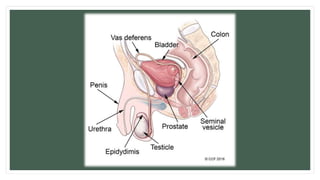
Male Reproductive Organs
•Produce and release sperm
•Sperm = male gamete
•6 main parts
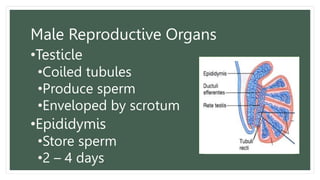
Male Reproductive Organs
•Testicle
•Coiled tubules
•Produce sperm
•Enveloped by scrotum
•Epididymis
•Store sperm
•2 – 4 days
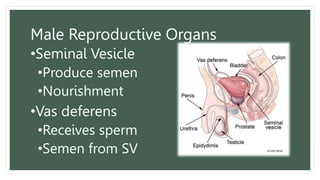
Male Reproductive Organs
•Seminal Vesicle
•Produce semen
•Nourishment
•Vas deferens
•Receives sperm
•Semen from SV
Male Reproductive Organs
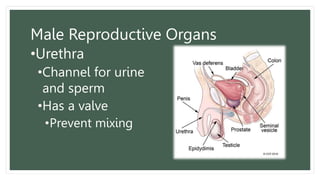
•Urethra
•Channel for urine
and sperm
•Has a valve
•Prevent mixing
Male Reproductive Organs
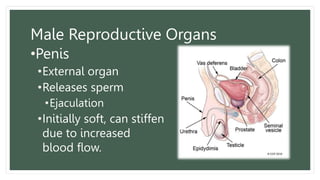
•Penis
•External organ
•Releases sperm
•Ejaculation
•Initially soft, can stiffen
due to increased
blood flow.
Female Reproductive Organs
•Produce egg cells, incubates embryos
•Egg cell = female gamete
•6 main parts
Female Reproductive Organs
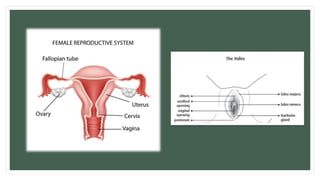
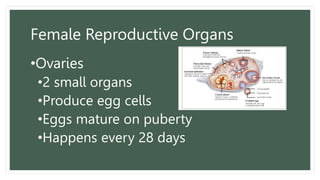
•Ovaries
•2 small organs
•Produce egg cells
•Eggs mature on puberty
•Happens every 28 days
Female Reproductive Organs
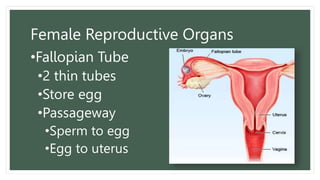
•Fallopian Tube
•2 thin tubes
•Store egg
•Passageway
•Sperm to egg
•Egg to uterus
Female Reproductive Organs
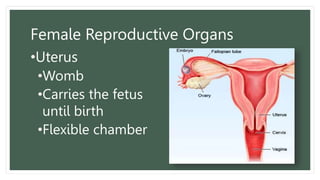
•Uterus
•Womb
•Carries the fetus
until birth
•Flexible chamber
Female Reproductive Organs
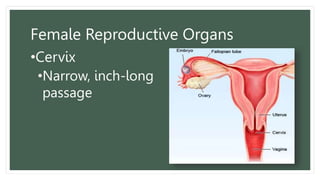
•Cervix
•Narrow, inch-long
passage
Female Reproductive Organs
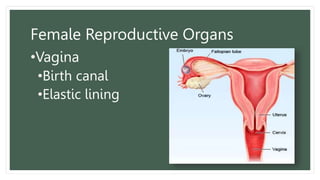
•Vagina
•Birth canal
•Elastic lining
Female Reproductive Organs
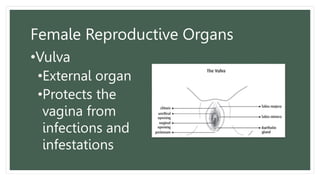
•Vulva
•External organ
•Protects the
vagina from
infections and
infestations
Assignment
In preparation for our next topic, answer the
following questions:
•What are the different stages of a developing
embryo?
•Give two diseases of the reproductive system,
and give a brief description of each.
MENSTRUAL CYCLE
Menstruation
•Start bet. 11 and 15
•Monthly shedding of blood
•Lining of uterus (endometrium)
•Thickens for carriage
•Pregnancy doesn’t happen
•21 – 35 days per cycle
Menstrual Cycle
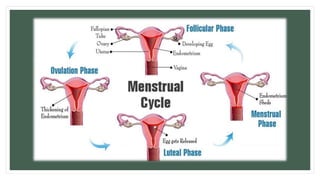
•Four phases
•Menstrual Phase
•Follicular Phase
•Ovulation
•Luteal Phase
Menstrual Cycle
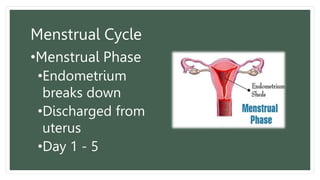
•Menstrual Phase
•Endometrium
breaks down
•Discharged from
uterus
•Day 1 - 5
Menstrual Cycle
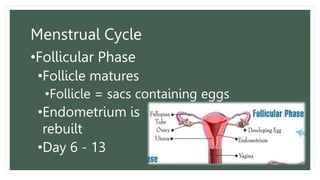
•Follicular Phase
•Follicle matures
•Follicle = sacs containing eggs
•Endometrium is
rebuilt
•Day 6 - 13
Menstrual Cycle
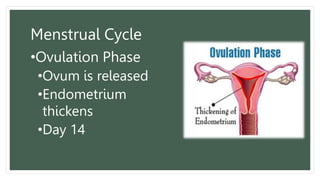
•Ovulation Phase
•Ovum is released
•Endometrium
thickens
•Day 14
Menstrual Cycle
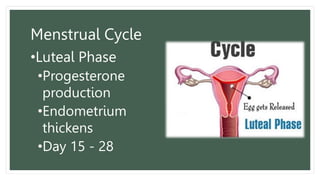
•Luteal Phase
•Progesterone
production
•Endometrium
thickens
•Day 15 - 28
EMBRYONIC
DEVELOPMENT
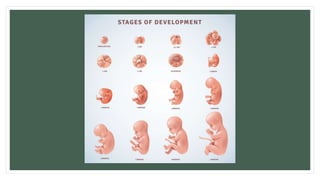
Stages of Embryonic Development
•Fertilization
•Fusion of egg and sperm
•Produces a zygote
•Later becomes the fetus
•5 main stages
Stages of Embryonic Development
•Fertilization
•Cleavage
•Gastrulation
•Organogenesis
•Specialization and Growth
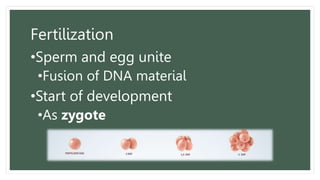
Fertilization
•Sperm and egg unite
•Fusion of DNA material
•Start of development
•As zygote
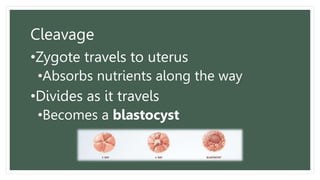
Cleavage
•Zygote travels to uterus
•Absorbs nutrients along the way
•Divides as it travels
•Becomes a blastocyst
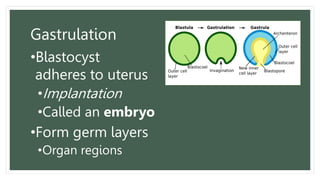
Gastrulation
•Blastocyst
adheres to uterus
•Implantation
•Called an embryo
•Form germ layers
•Organ regions
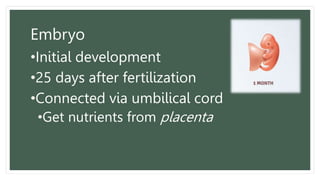
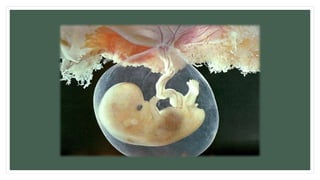
Embryo
•Initial development
•25 days after fertilization
•Connected via umbilical cord
•Get nutrients from placenta
Organogenesis
•Cell differentiation
•Form major organs
Specialization and Growth
•Organs develop unique structures
•Enlarge in size
•Known as fetus
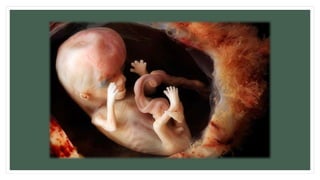
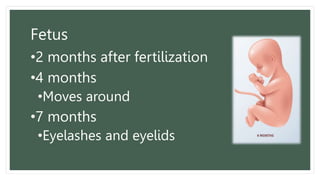
Fetus
•2 months after fertilization
•4 months
•Moves around
•7 months
•Eyelashes and eyelids
DISEASES OF THE
REPRODUCTIVE
SYSTEM
Diseases
•Either caused by:
•Genetics
•Infection
•STDs
STDs
•Sexually Transmitted Diseases
•During sexual contact
•Avoid by sexual fidelity
Chlamydia
•Transmission
•Sexual contact
•Infection as newborns
•Chlamydia trachomatis
Chlamydia
•Symptoms
•Painful urination
•Bleeding
•Abdominal pain
Chlamydia
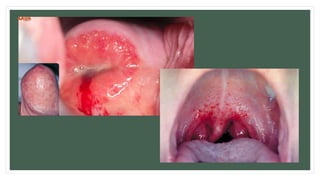
•Female
•Cervix, rectum or throat
•Male
•Urethra, rectum or throat
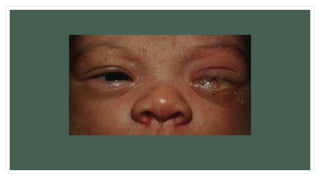
•Newborn
•Eye and lung infection
Chlamydia
•Treatment
•Antibiotics
•No sexual contact
Genital Herpes
•Tender, painful blisters
•Swollen glands, fever
•Newborns
•Minor symptoms
•Brain damage
•death
Genital Herpes
•Transmission
•Contact with blisters / viruses
•Infection as newborns
Genital Herpes
•Treatment
•No sexual contact
•Viruses are shed continuously
•No cure
Gonorrhea
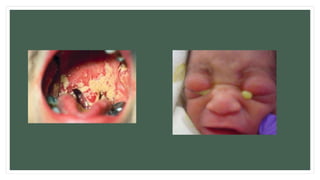
•Pus discharge
•Sexual organs
•Throat
•Eyes for newborns
Gonorrhea
•Transmission
•Sexual contact
•Infection as newborns
•Neisseria gonorrhoeae
Gonorrhea
•Treatment
•Antibiotics
•No sexual activity
Syphilis
•4 stages
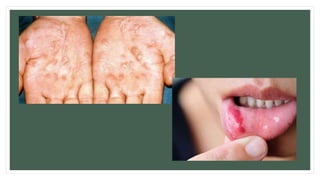
•Painless sores
•Rashes, fever, hair loss, swollen glands
•Latent
Syphilis
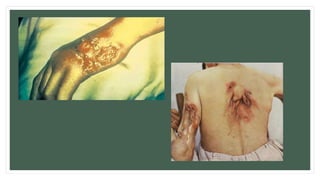
•Spasms, Numbness, Dementia,
Blindness, Death
•Newborns
•Damaged eyes, skin, liver and bones
Syphilis
•Transmission
•Sexual contact during first 2 phases
•Infection as newborns
Syphilis
•Treatment
•Antibiotics in the first 2 stages
•Hard to cure at later stages
•No sexual activity

1-Reproductive-System-1.pptxheevhndhagdw