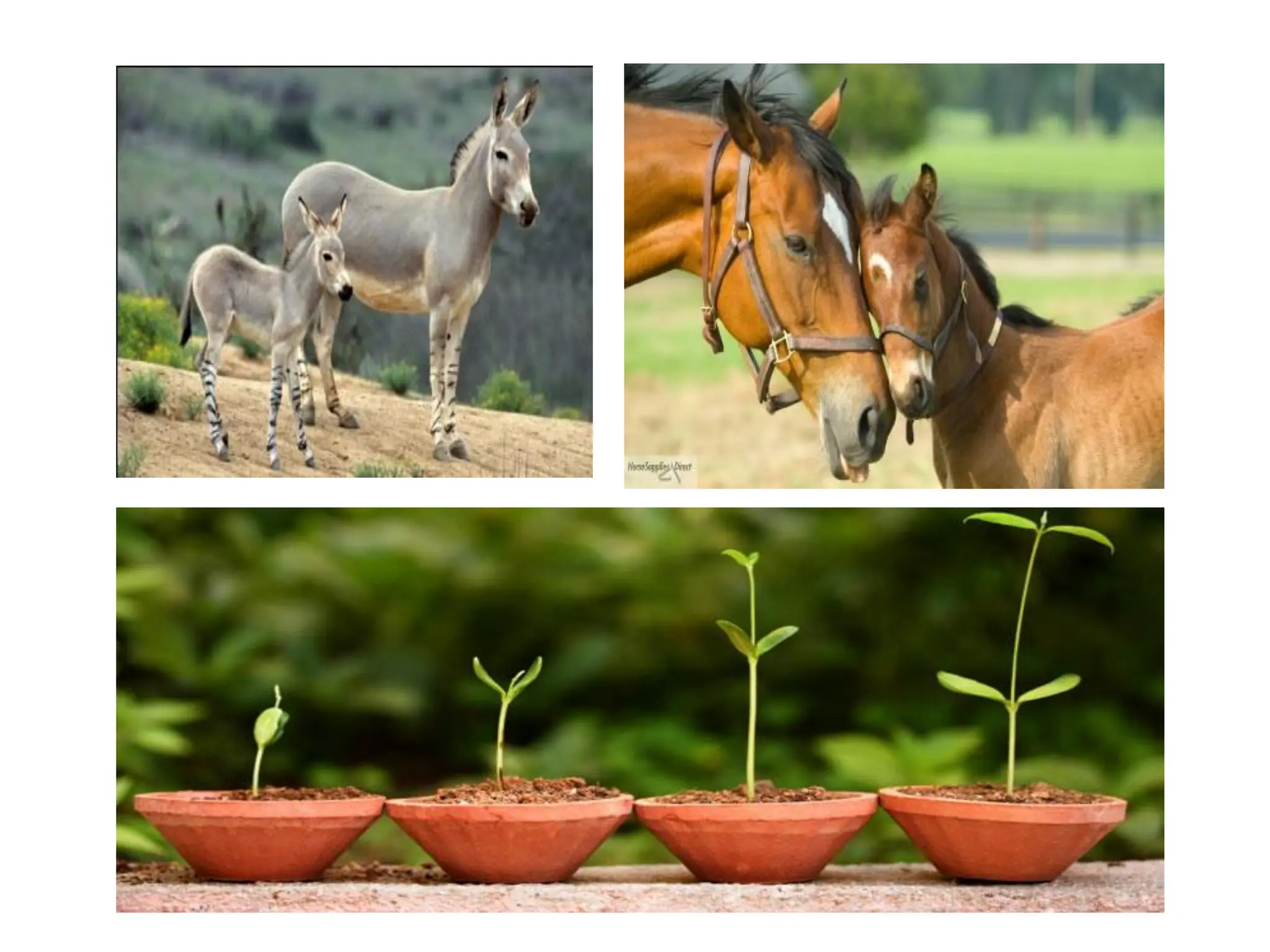
reproduction
SB0014
syafa @ ums.edu.my
Pusat Persediaan Sains dan Teknologi
Universiti Malaysia Sabah
Topic Outline
• Human reproductive system
• Roles of hormones
• Sexual reproductive of flowering plant
• Asexual reproduction in animal and
plant
At the end of this chapter, student should be able to
describe about human reproductive system, roles of
hormones and sexual reproduction for flowering plant.
Also, understand the asexual reproduction in animal
and plant
from puberty to menopause,
fertility and contraception
Despite being one of the most important processes in nature, human
reproduction is still widely misunderstood by many of us.
Here, you will learn about human reproduction by exploring the underlying
biology, the most common myths, and the latest medical advances.
To help you understand the realities of making babies, having babies,
and not having babies.
Human
reproductive
system
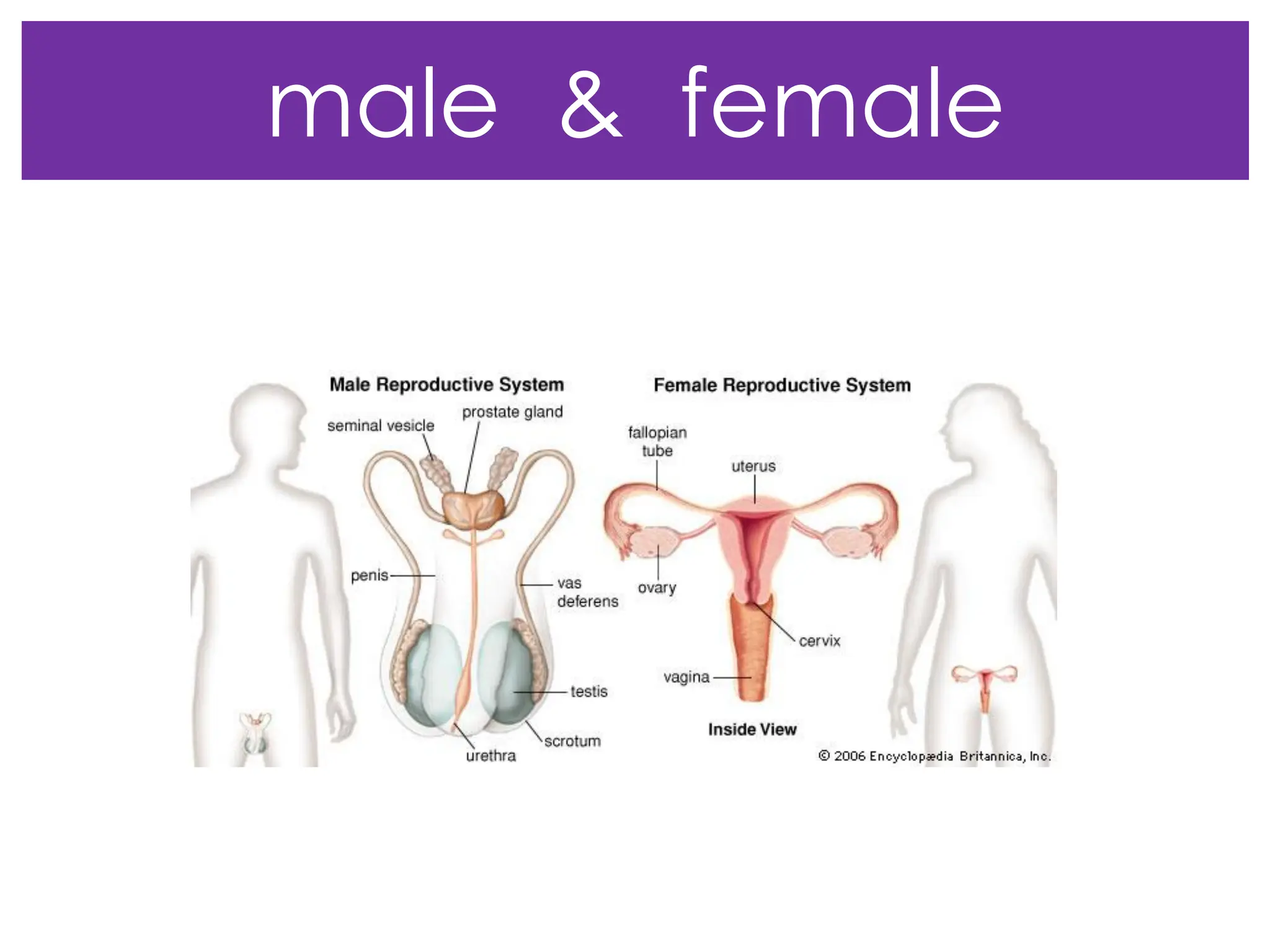
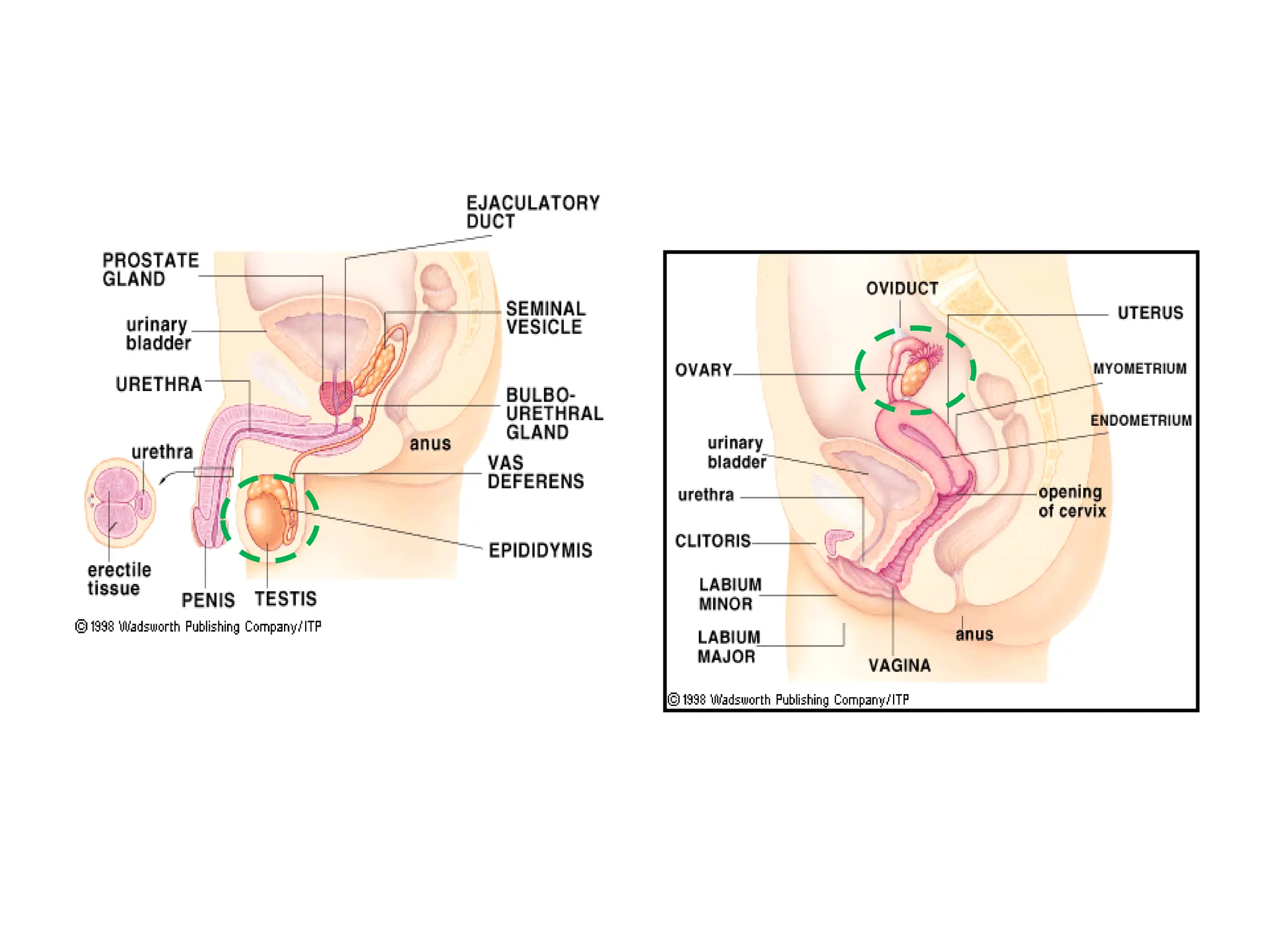
male & female
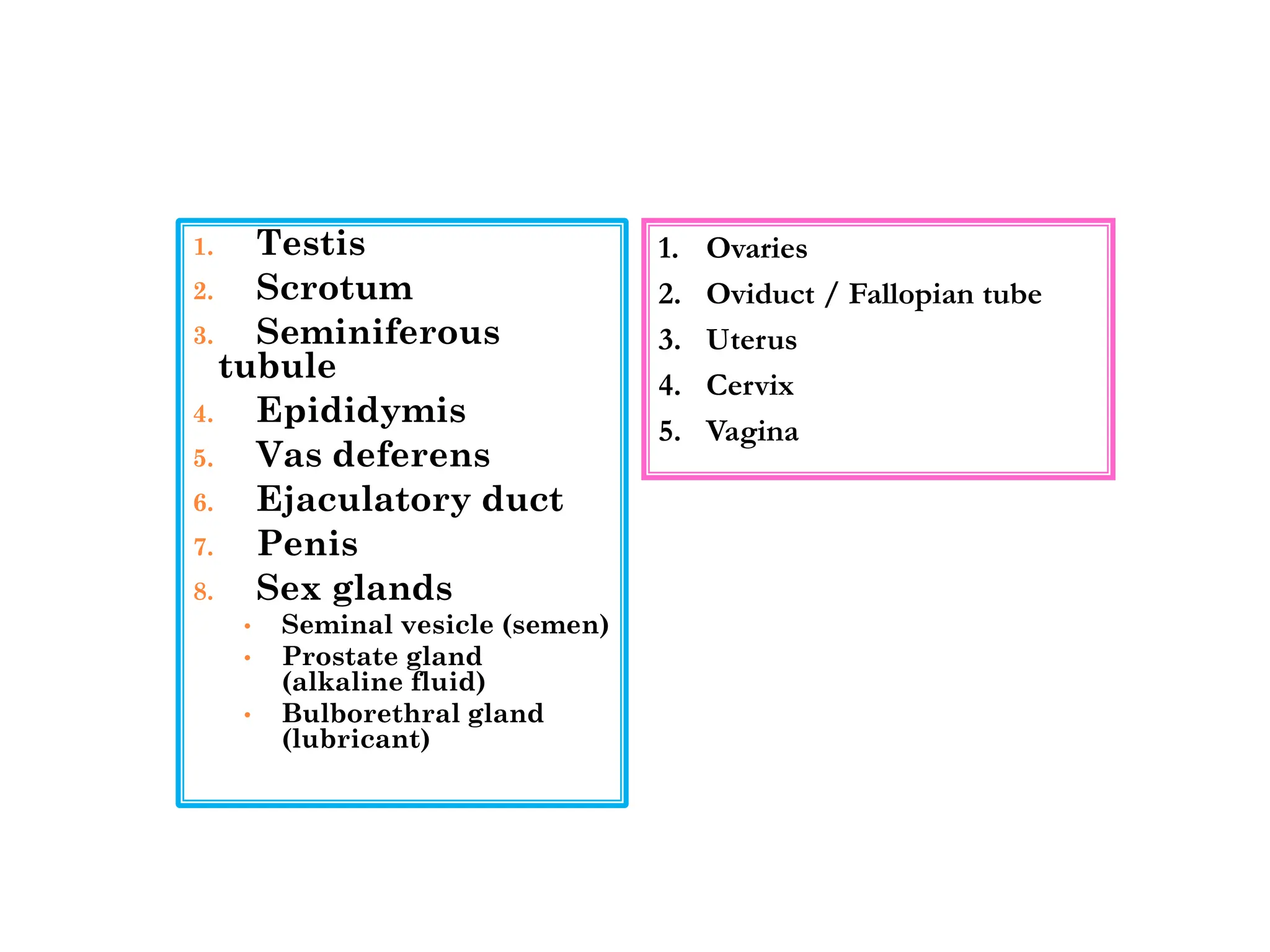
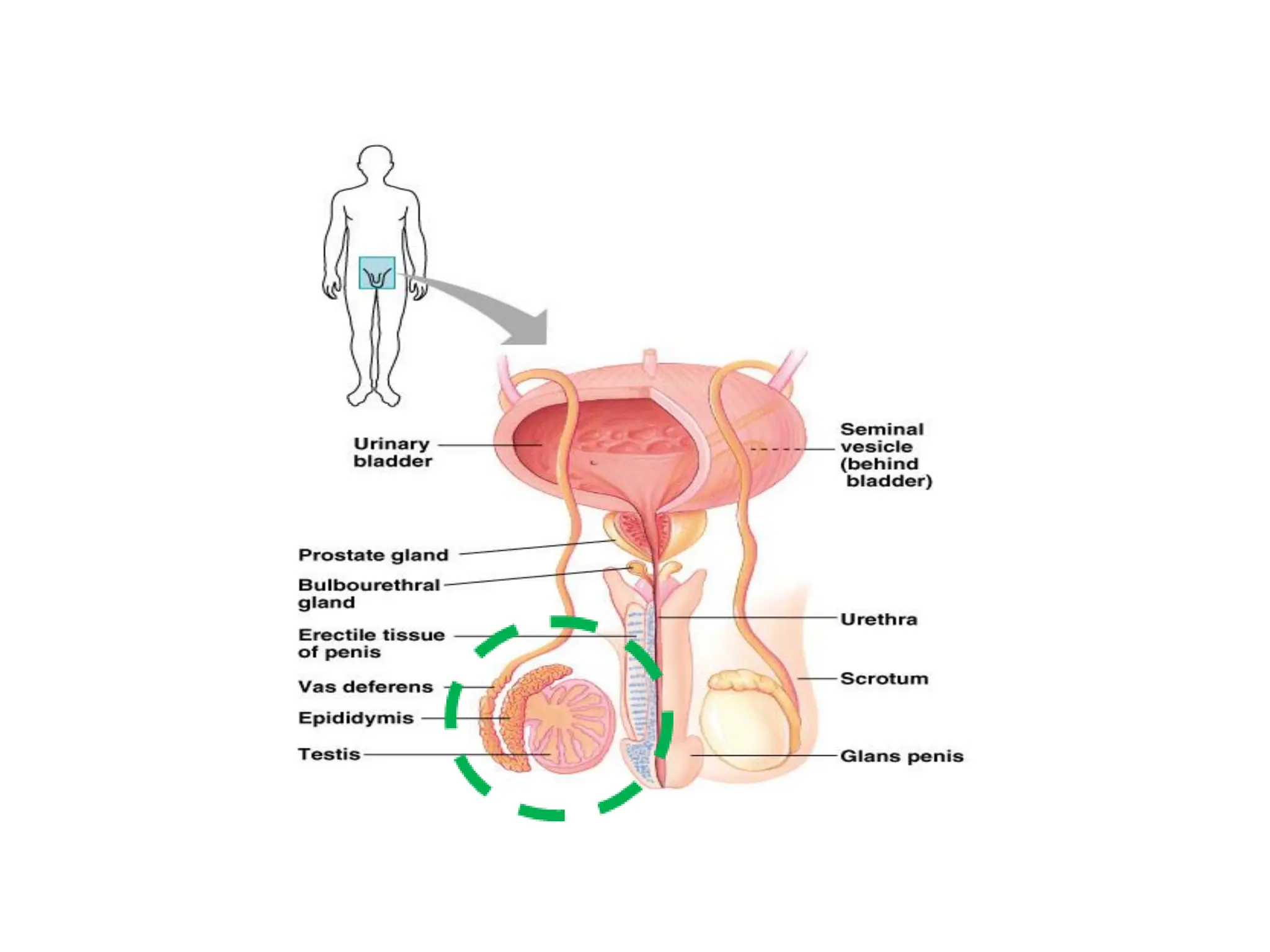
1. Testis
2. Scrotum
3. Seminiferous
tubule
4. Epididymis
5. Vas deferens
6. Ejaculatory duct
7. Penis
8. Sex glands
• Seminal vesicle (semen)
• Prostate gland
(alkaline fluid)
• Bulborethral gland
(lubricant)
1. Ovaries
2. Oviduct / Fallopian tube
3. Uterus
4. Cervix
5. Vagina
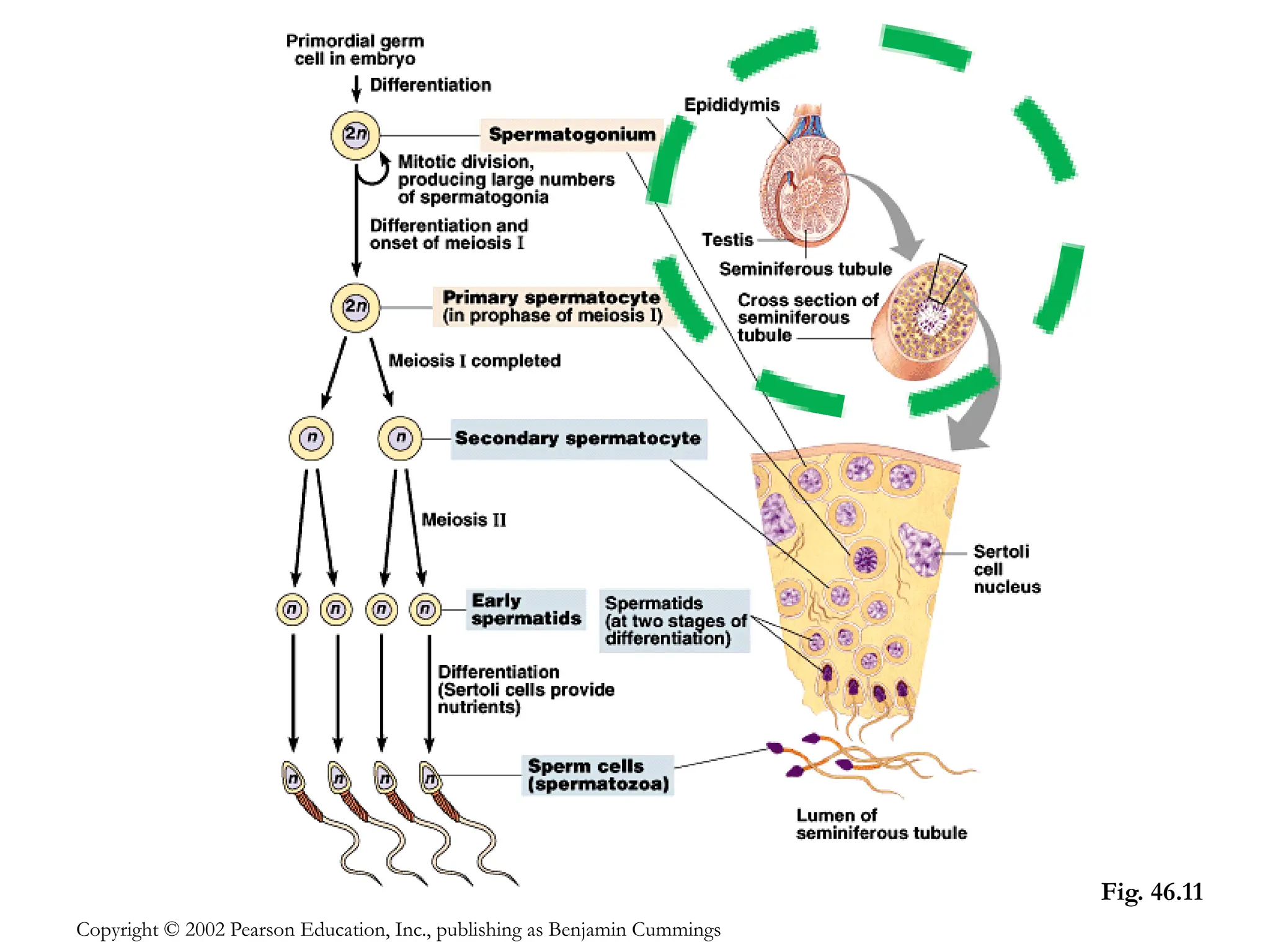
• Spermatogenesis
• Oogenesis
gametogenesis
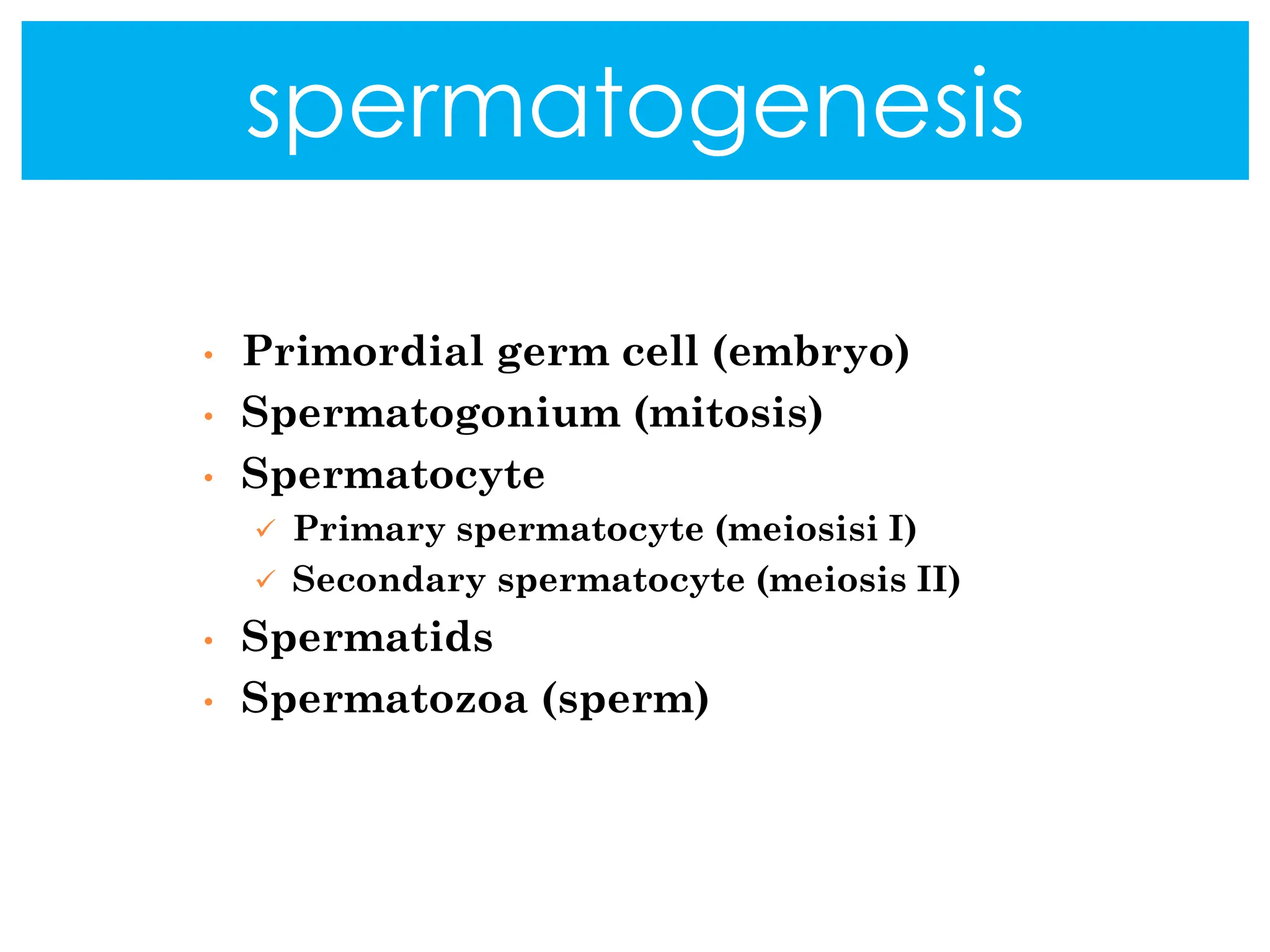
• Primordial germ cell (embryo)
• Spermatogonium (mitosis)
• Spermatocyte
✓ Primary spermatocyte (meiosisi I)
✓ Secondary spermatocyte (meiosis II)
• Spermatids
• Spermatozoa (sperm)
spermatogenesis
Fig. 46.11
Copyright © 2002 Pearson Education, Inc., publishing as Benjamin Cummings
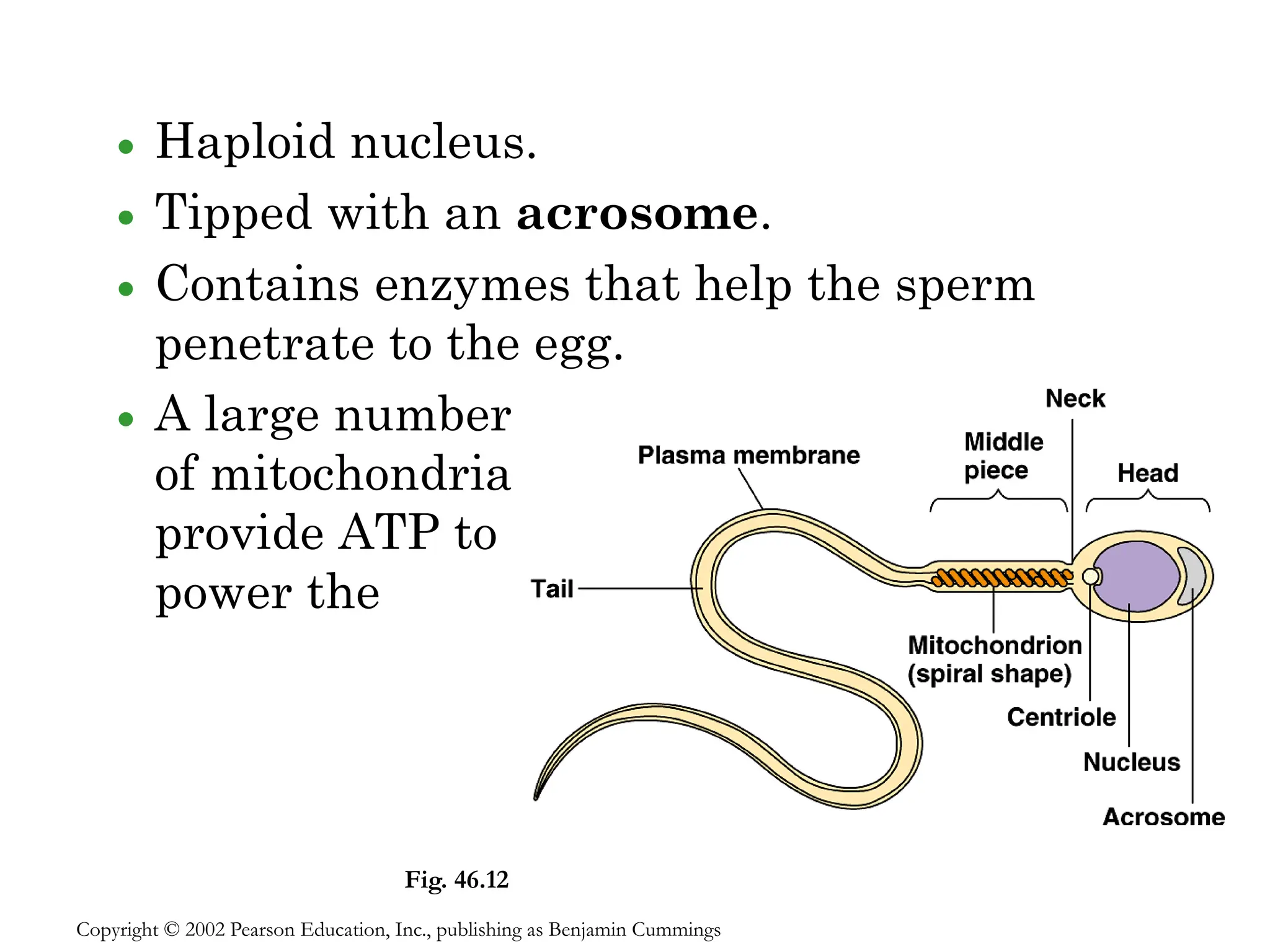
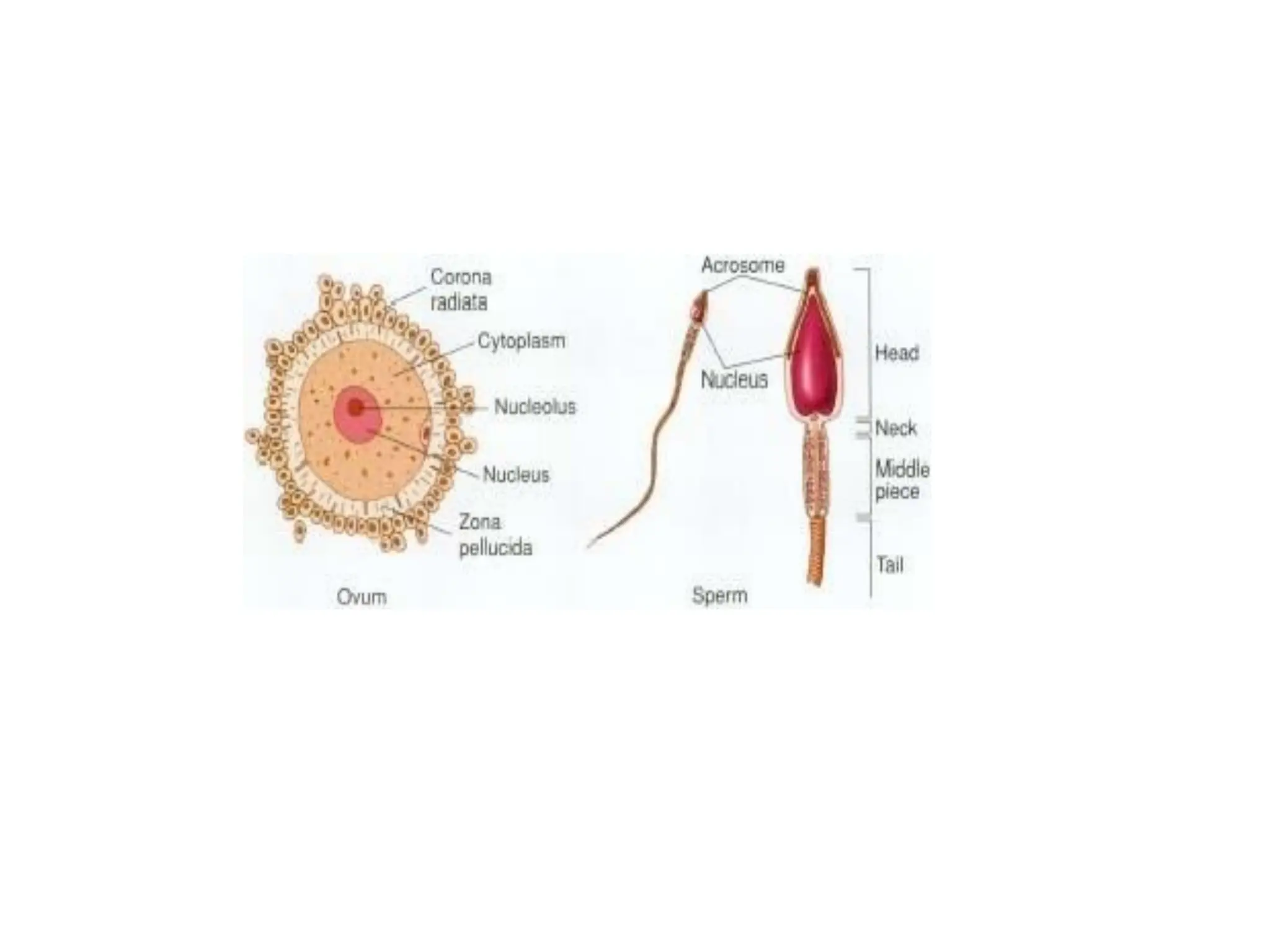
Sperm structure:
• Haploid nucleus.
• Tipped with an acrosome.
• Contains enzymes that help the sperm
penetrate to the egg.
• A large number
of mitochondria
provide ATP to
power the
flagellum.
Copyright © 2002 Pearson Education, Inc., publishing as Benjamin Cummings
Fig. 46.12
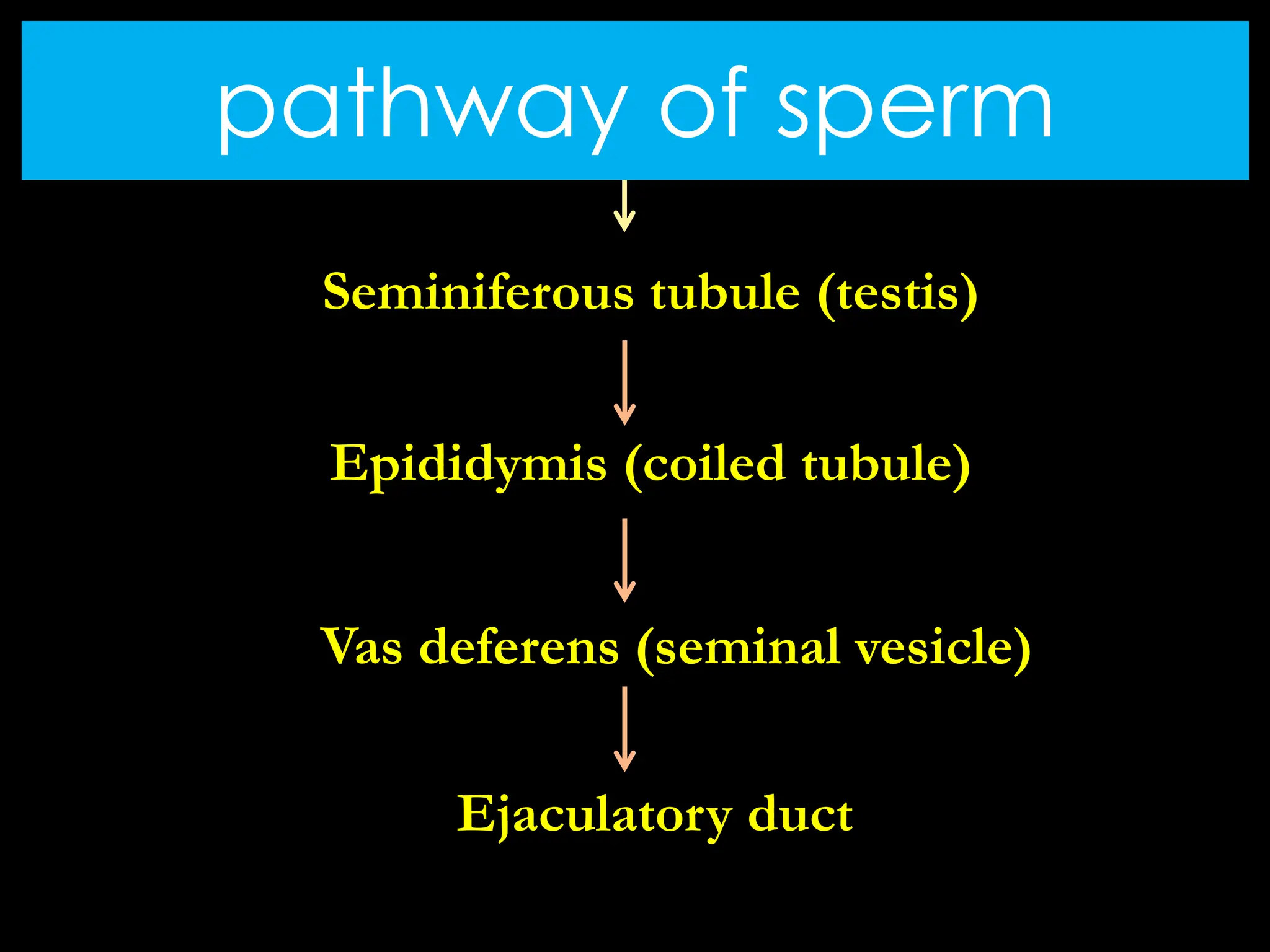
PATHWAY OF SPERM
Seminiferous tubule (testis)
Ejaculatory duct
Vas deferens (seminal vesicle)
Epididymis (coiled tubule)
pathway of sperm
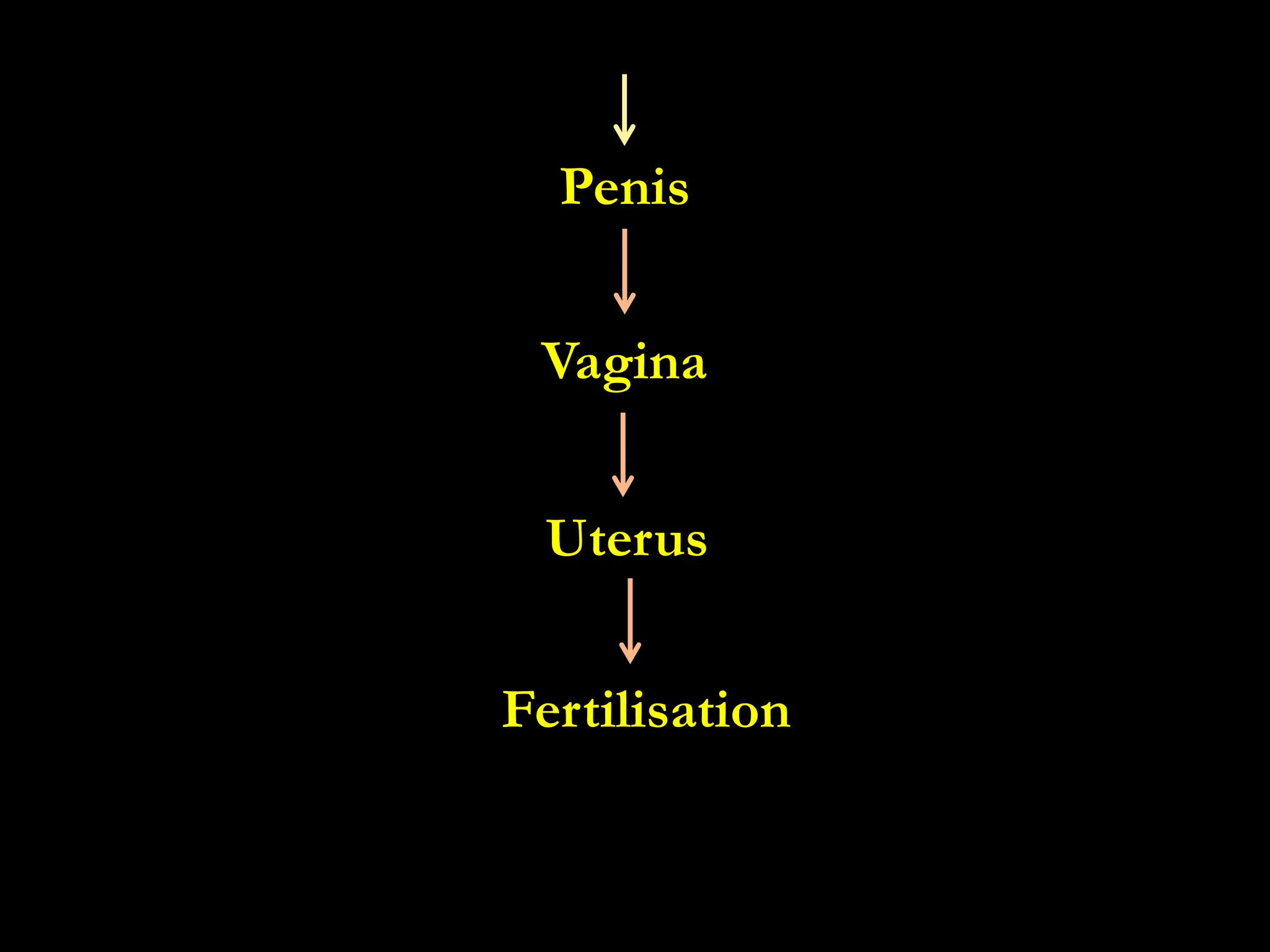
Penis
Fertilisation
Uterus
Vagina
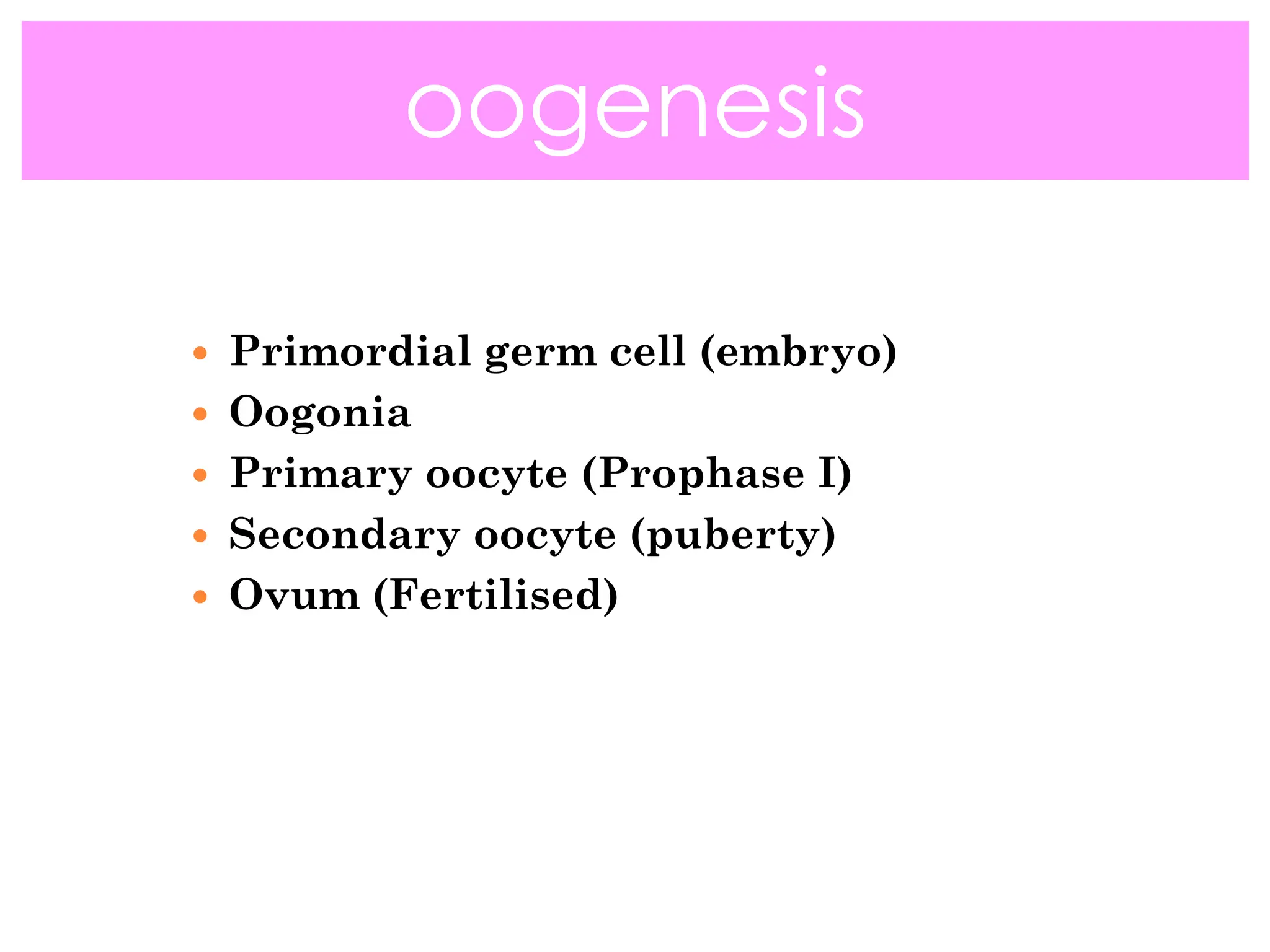
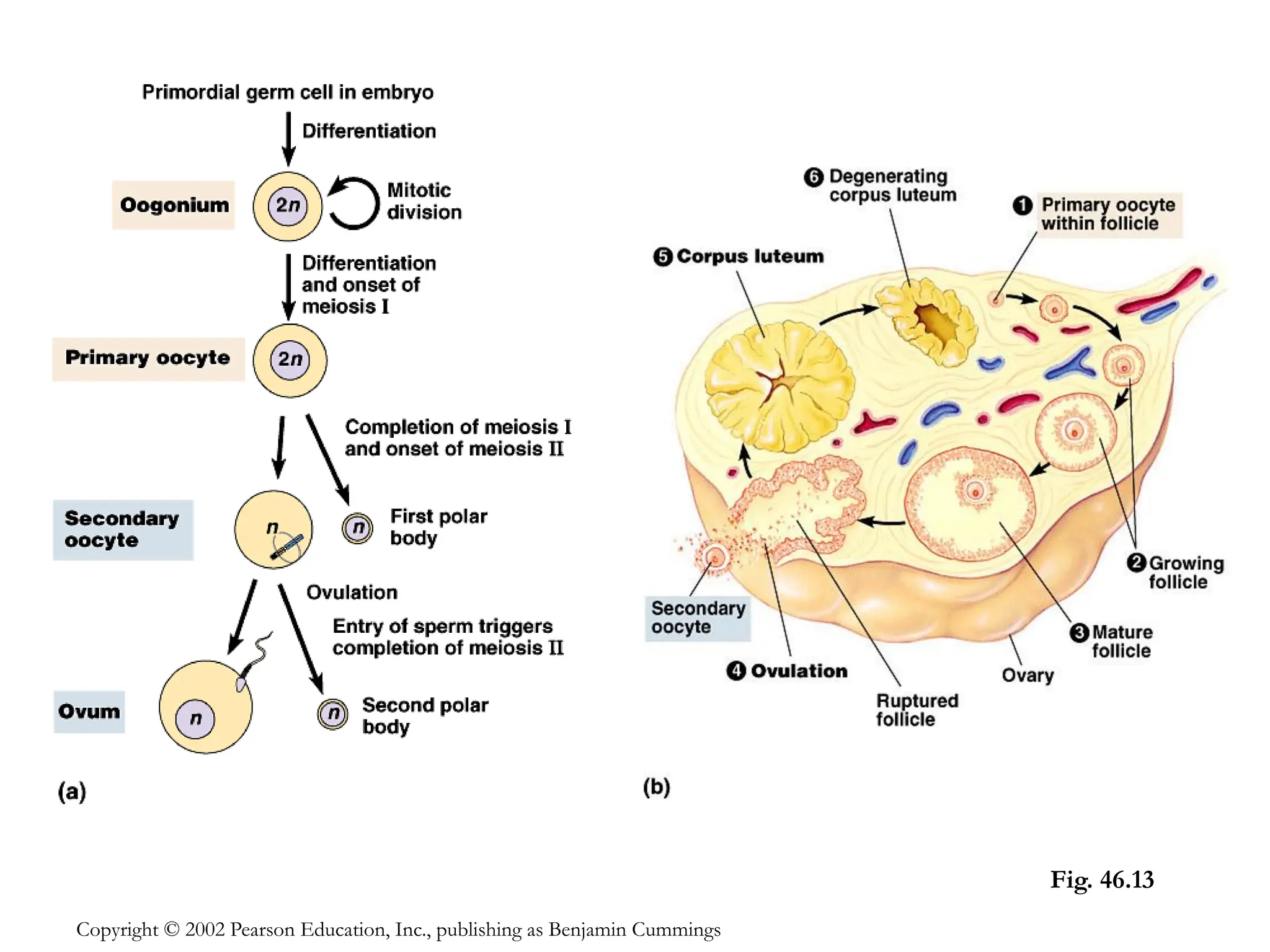
 Primordial germ cell (embryo)
 Oogonia
 Primary oocyte (Prophase I)
 Secondary oocyte (puberty)
 Ovum (Fertilised)
oogenesis
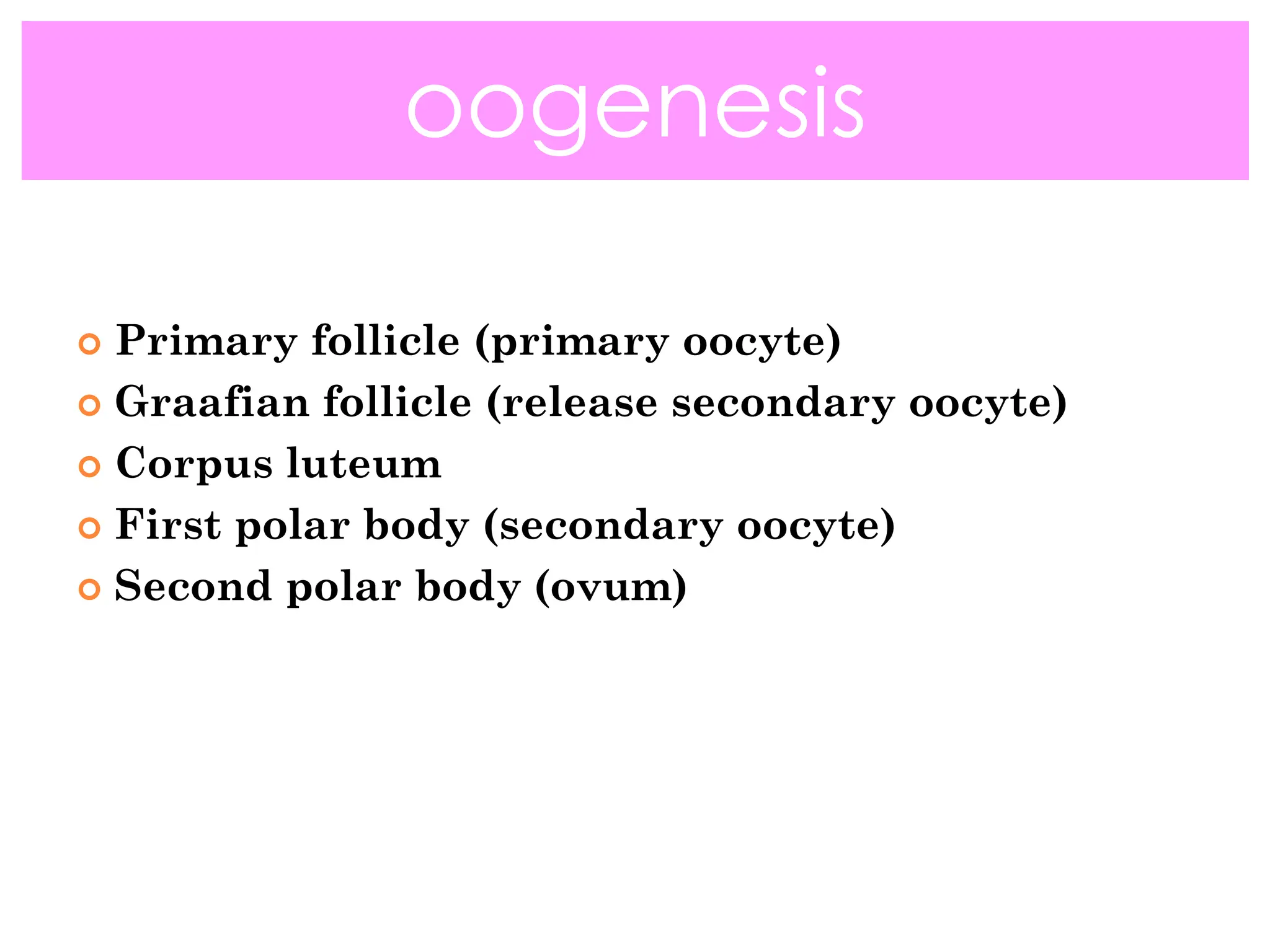
 Primary follicle (primary oocyte)
 Graafian follicle (release secondary oocyte)
 Corpus luteum
 First polar body (secondary oocyte)
 Second polar body (ovum)
oogenesis
Fig. 46.13
Copyright © 2002 Pearson Education, Inc., publishing as Benjamin Cummings
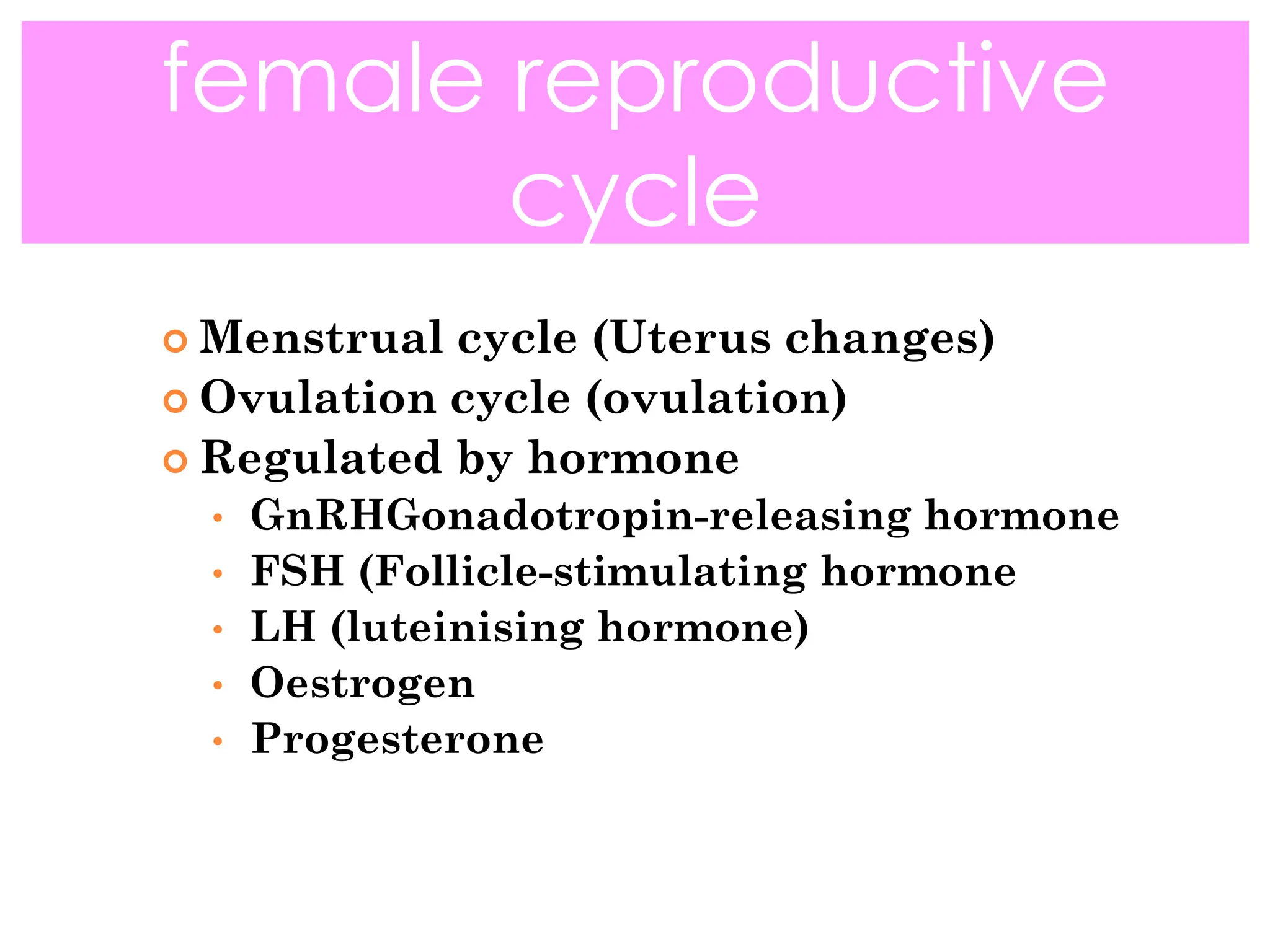
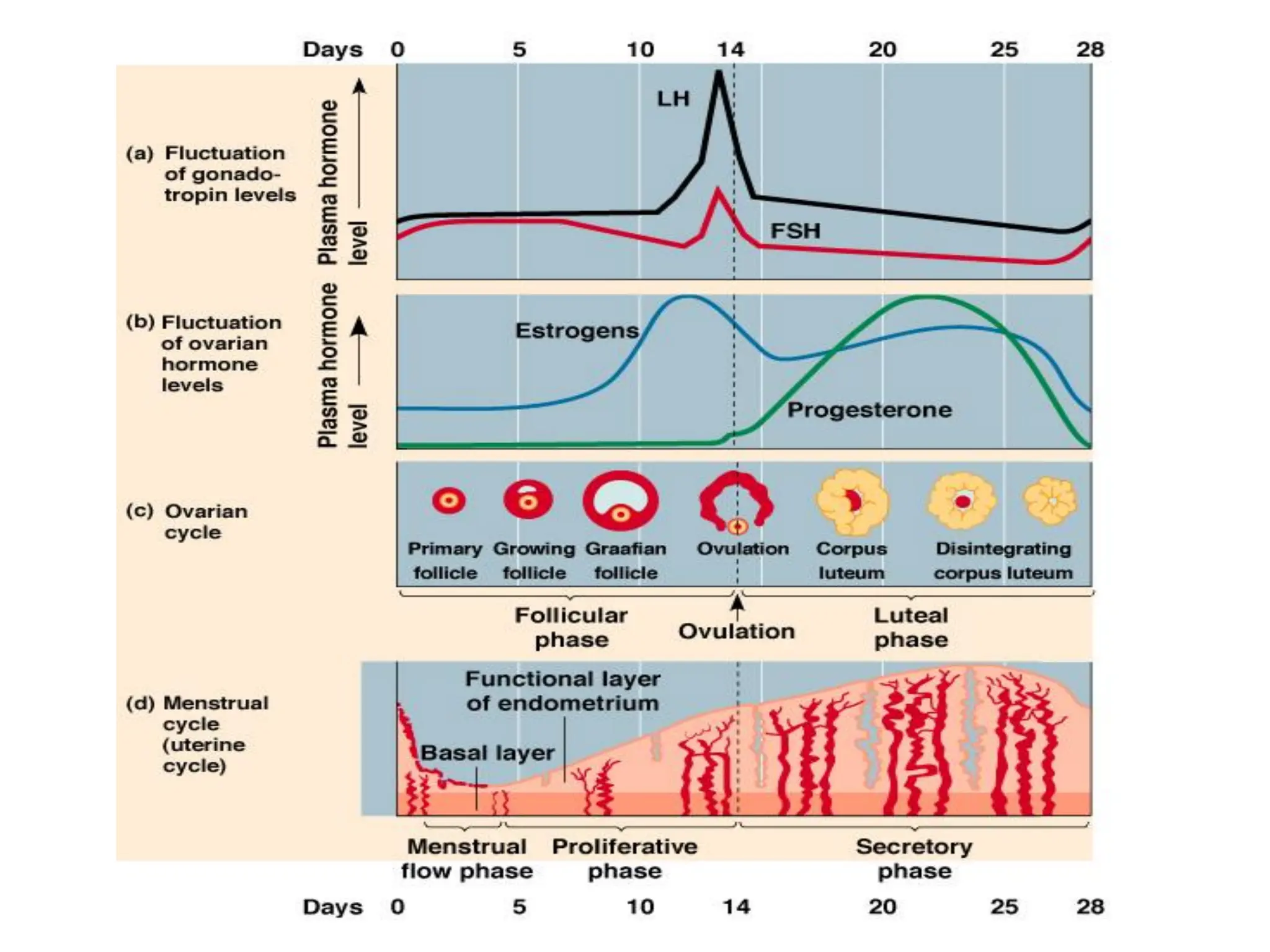
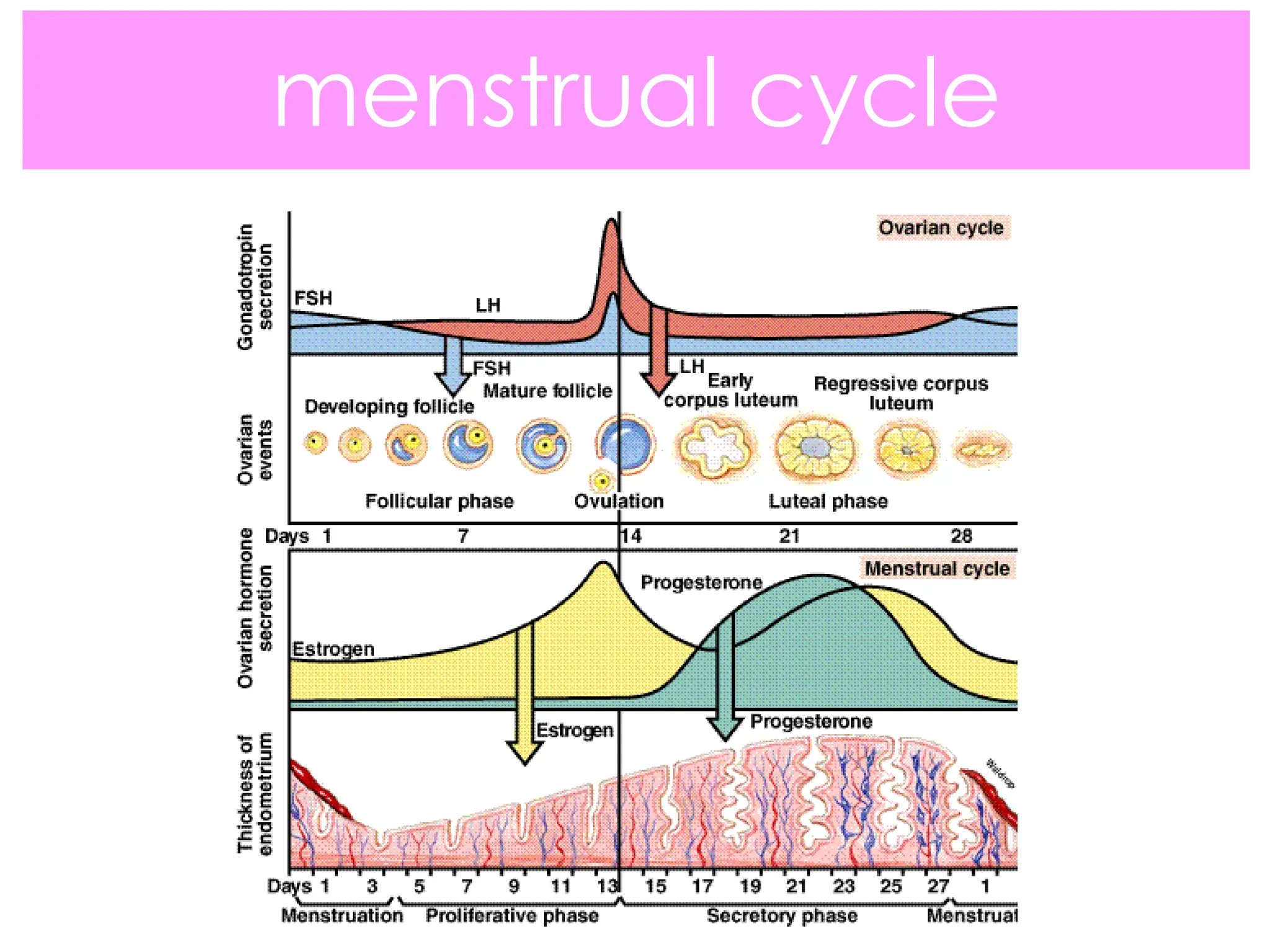
 Menstrual cycle (Uterus changes)
 Ovulation cycle (ovulation)
 Regulated by hormone
• GnRHGonadotropin-releasing hormone
• FSH (Follicle-stimulating hormone
• LH (luteinising hormone)
• Oestrogen
• Progesterone
female reproductive
cycle
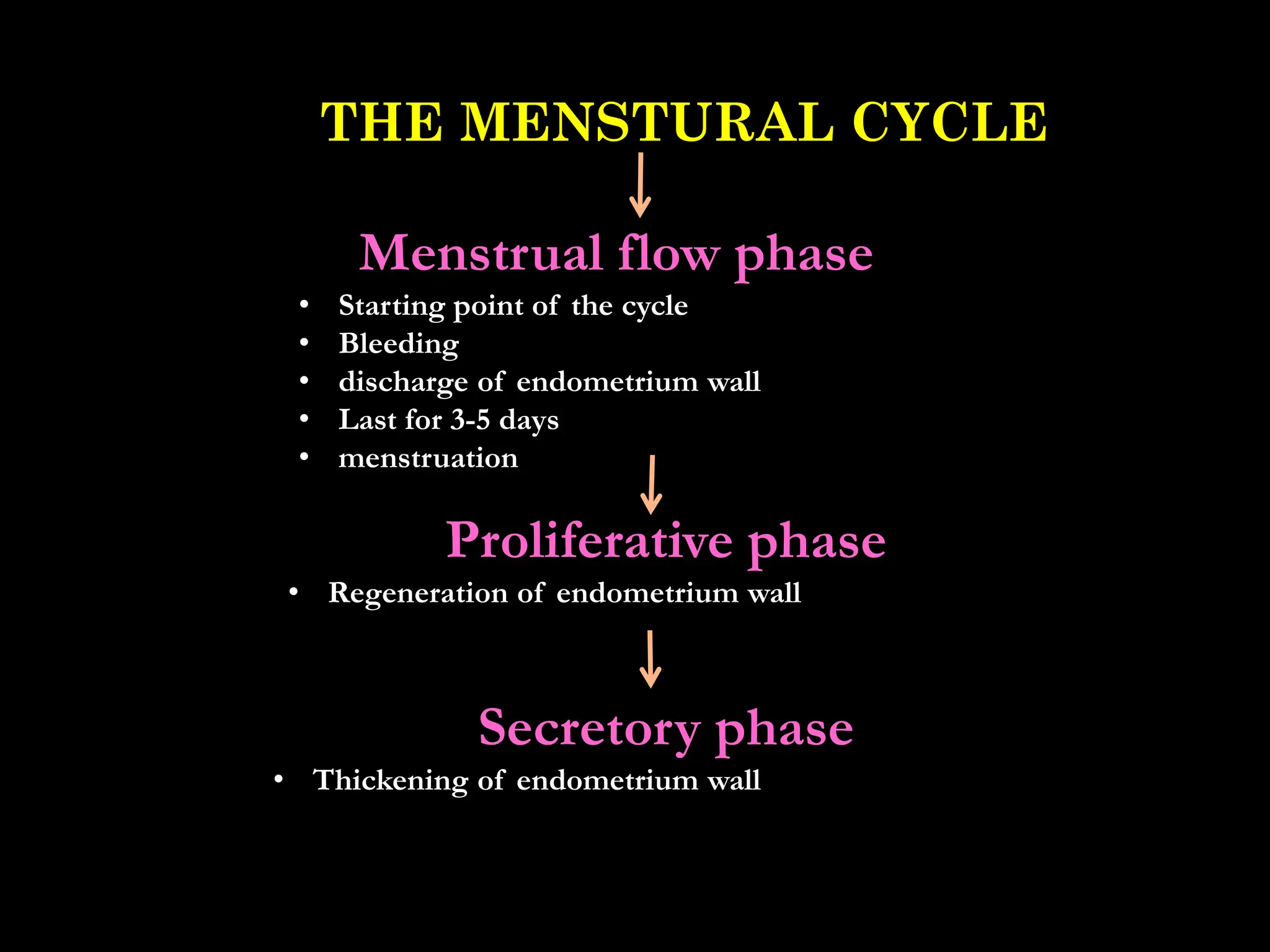
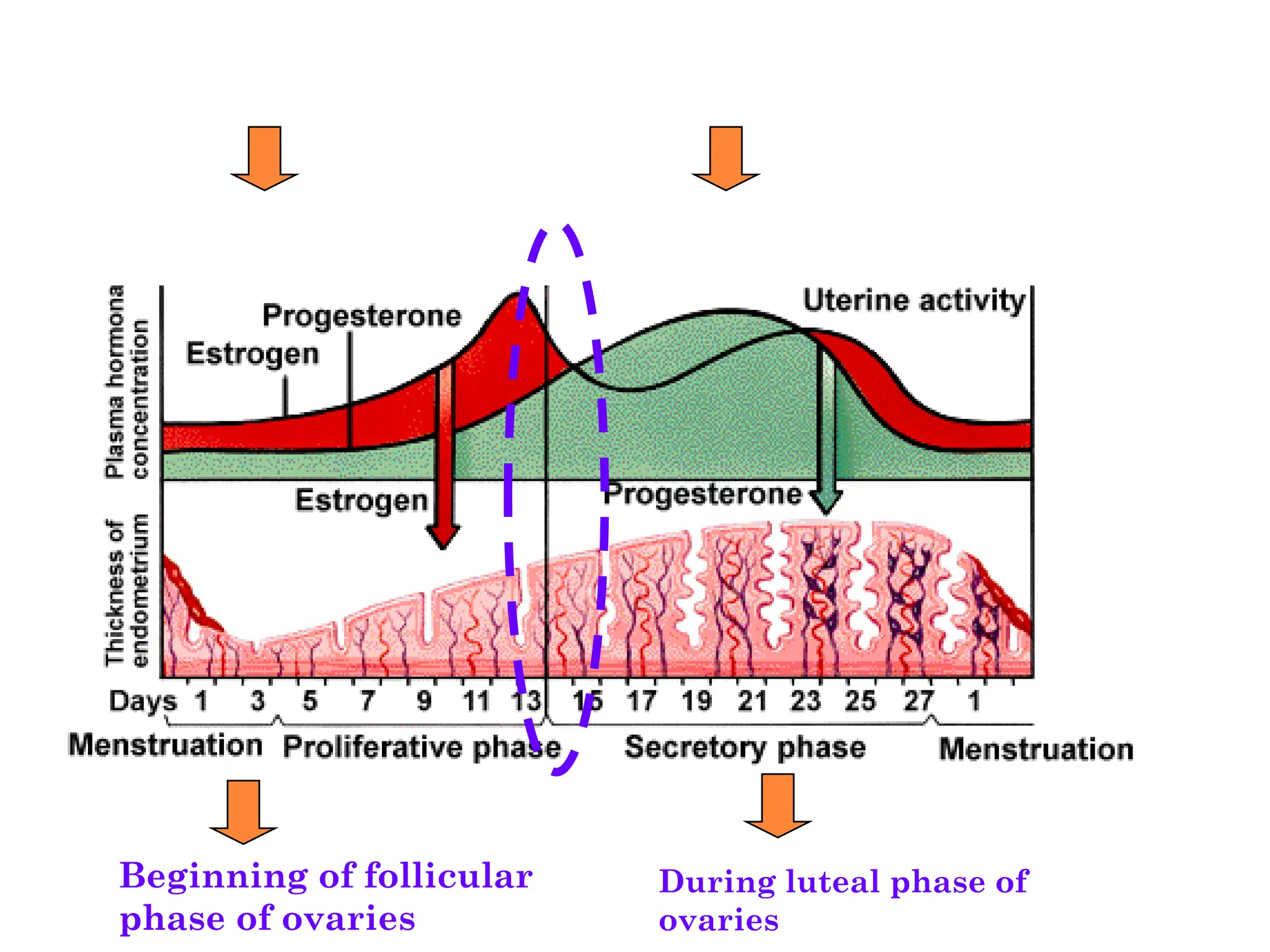
THE MENSTURAL CYCLE
Menstrual flow phase
• Starting point of the cycle
• Bleeding
• discharge of endometrium wall
• Last for 3-5 days
• menstruation
Secretory phase
• Thickening of endometrium wall
Proliferative phase
• Regeneration of endometrium wall
menstrual cycle
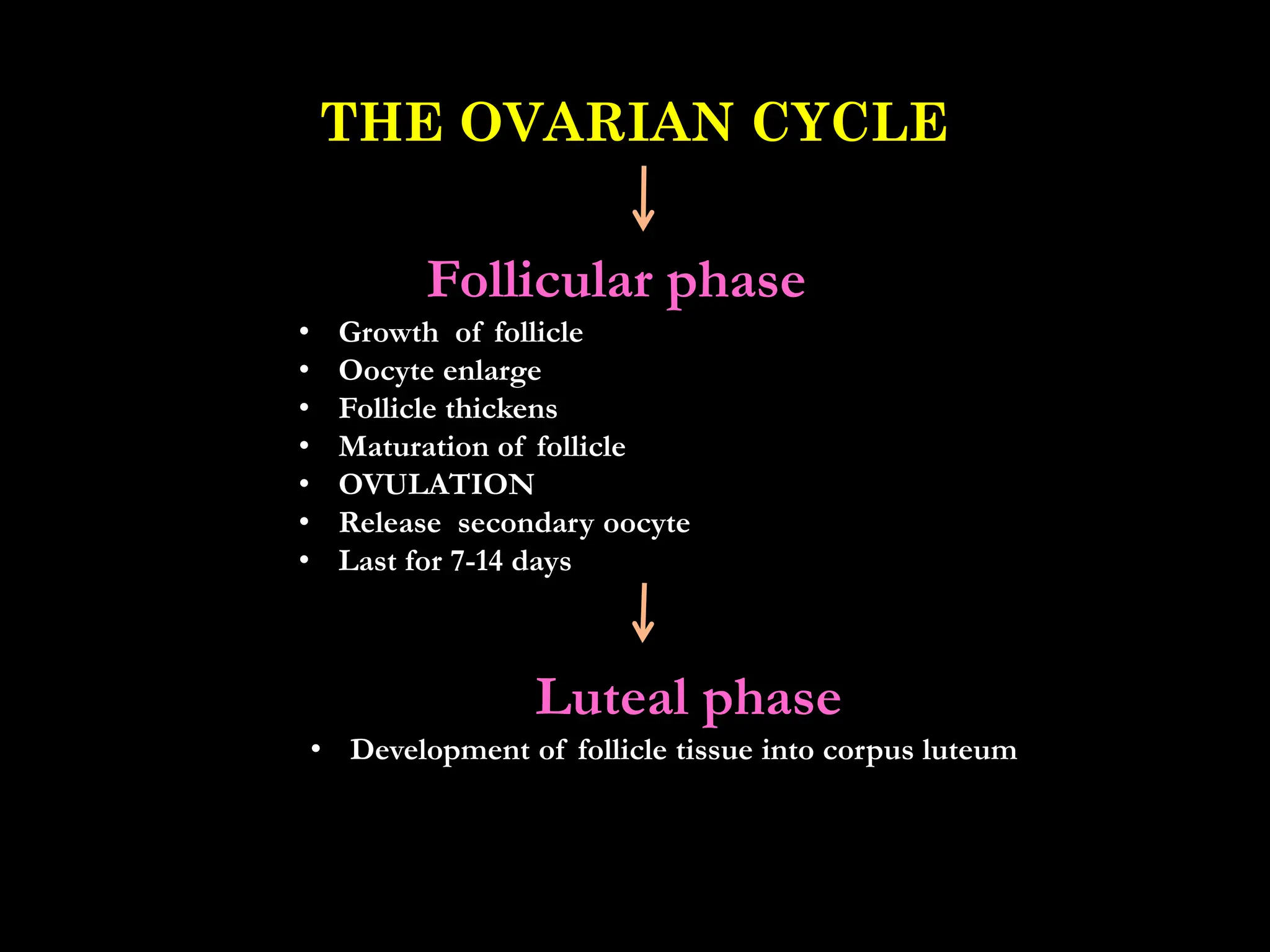
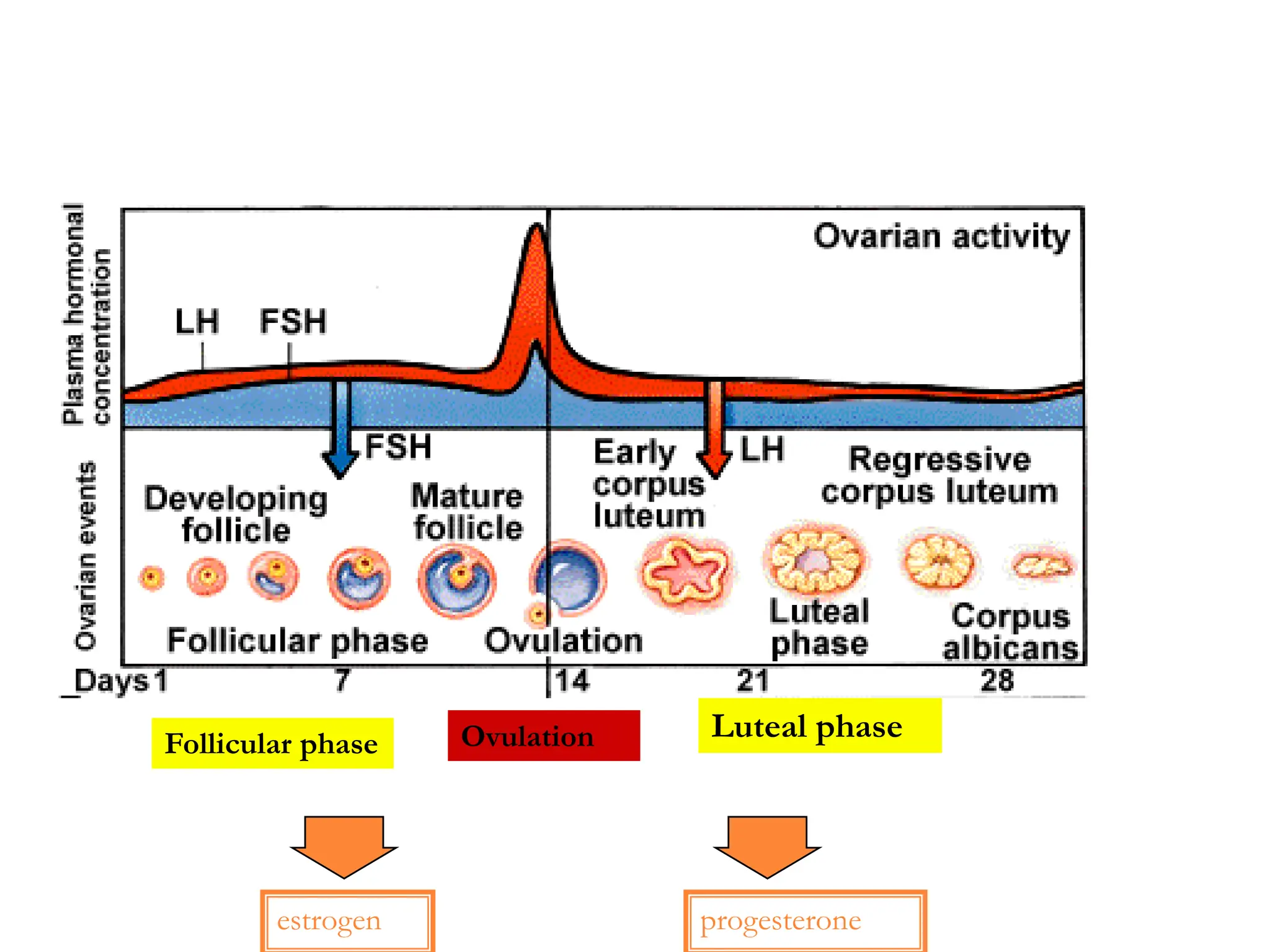
THE OVARIAN CYCLE
Follicular phase
• Growth of follicle
• Oocyte enlarge
• Follicle thickens
• Maturation of follicle
• OVULATION
• Release secondary oocyte
• Last for 7-14 days
Luteal phase
• Development of follicle tissue into corpus luteum
estrogen progesterone
Follicular phase
Luteal phase
Ovulation
Beginning of follicular
phase of ovaries
During luteal phase of
ovaries
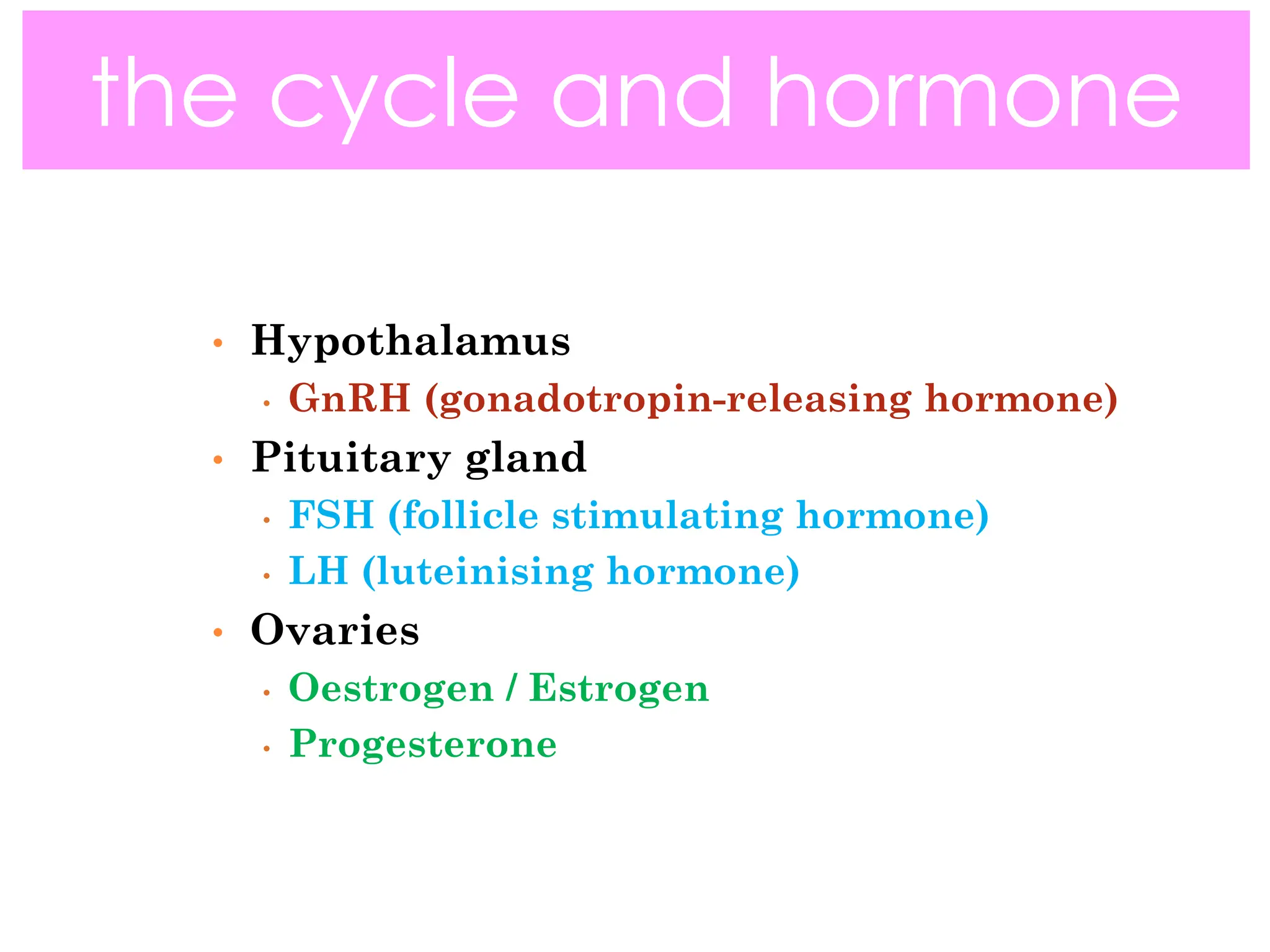
• Hypothalamus
• GnRH (gonadotropin-releasing hormone)
• Pituitary gland
• FSH (follicle stimulating hormone)
• LH (luteinising hormone)
• Ovaries
• Oestrogen / Estrogen
• Progesterone
the cycle and hormone
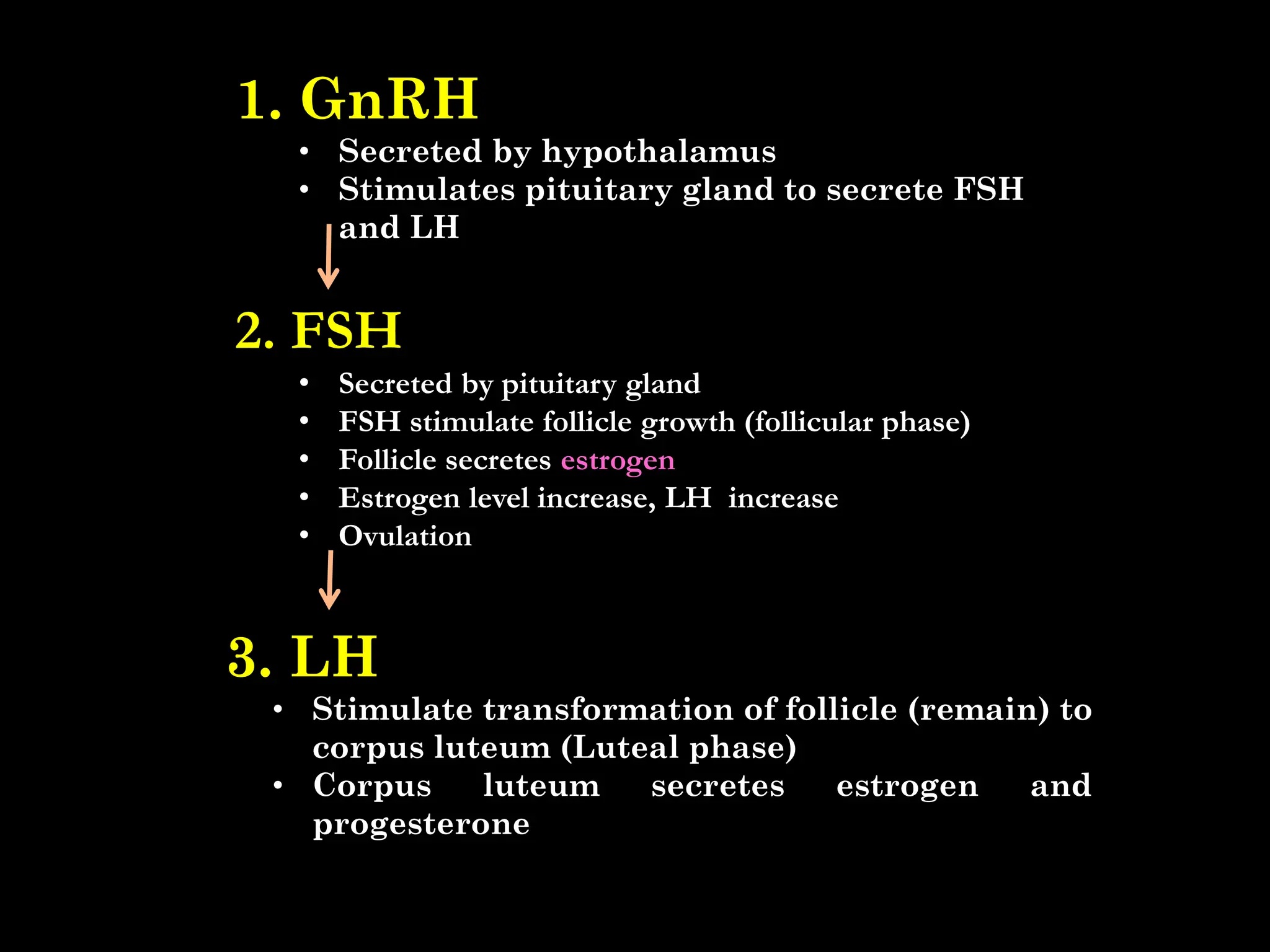
2. FSH
• Secreted by pituitary gland
• FSH stimulate follicle growth (follicular phase)
• Follicle secretes estrogen
• Estrogen level increase, LH increase
• Ovulation
3. LH
• Stimulate transformation of follicle (remain) to
corpus luteum (Luteal phase)
• Corpus luteum secretes estrogen and
progesterone
1. GnRH
• Secreted by hypothalamus
• Stimulates pituitary gland to secrete FSH
and LH
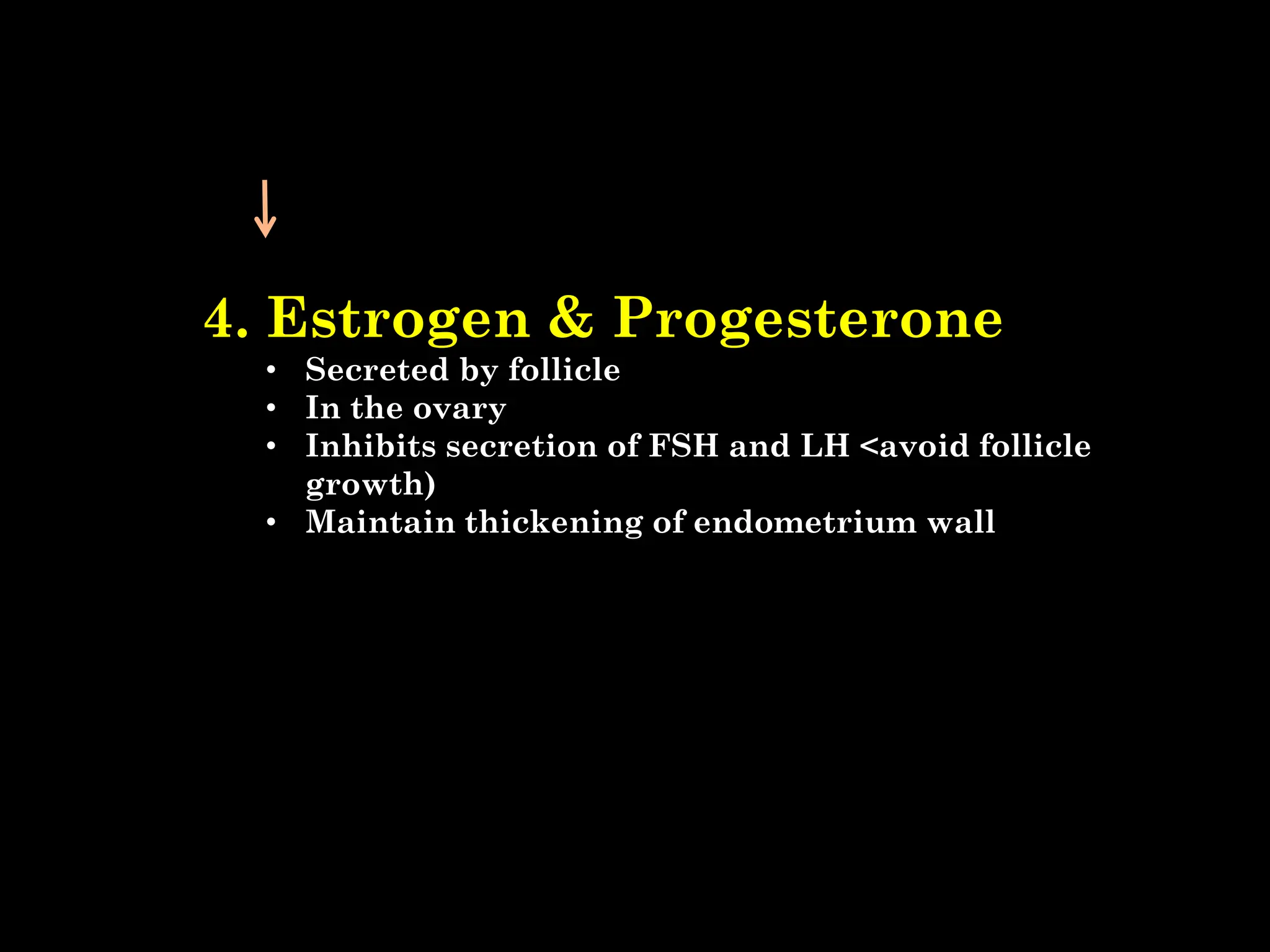
4. Estrogen & Progesterone
• Secreted by follicle
• In the ovary
• Inhibits secretion of FSH and LH <avoid follicle
growth)
• Maintain thickening of endometrium wall
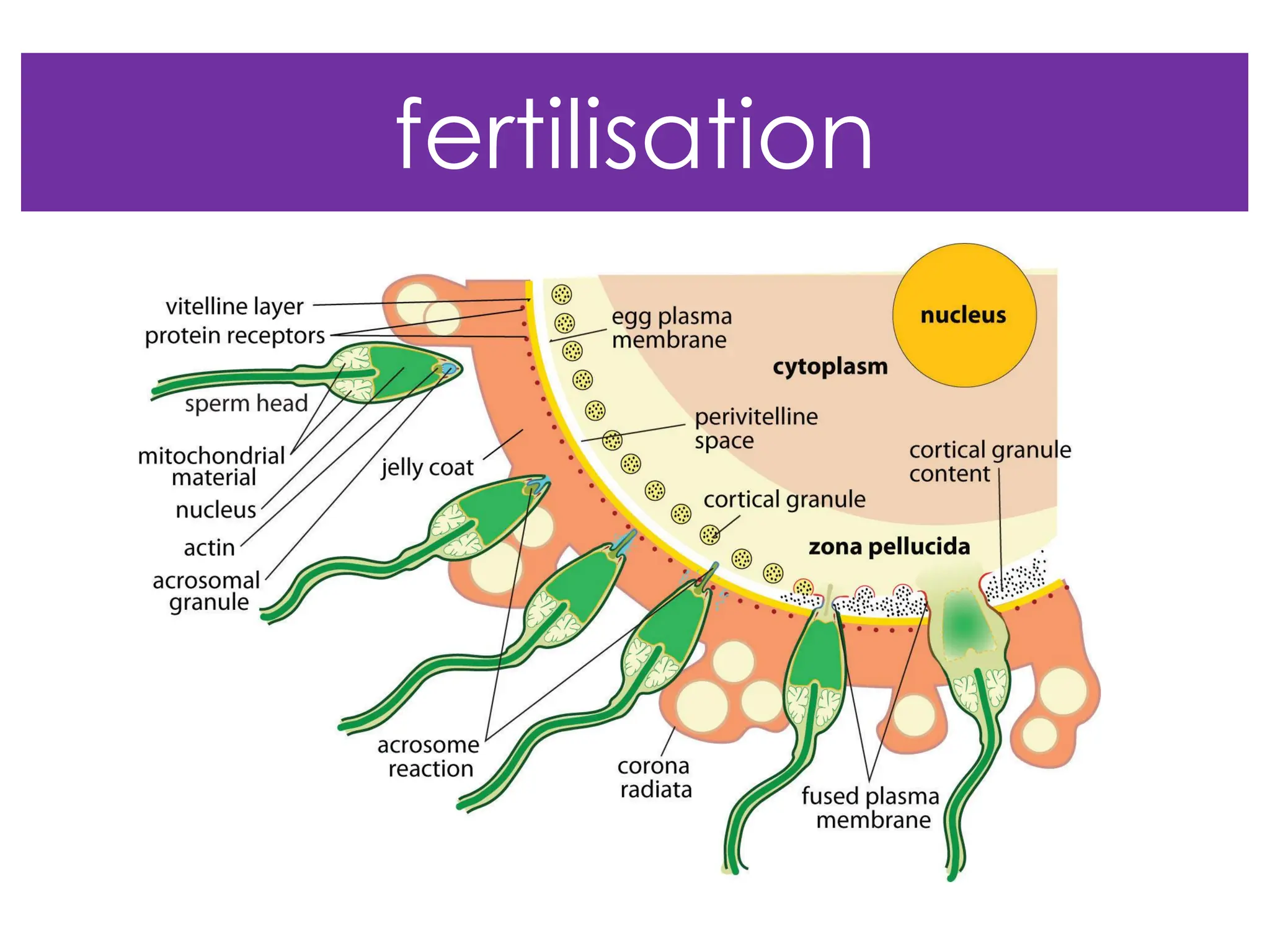
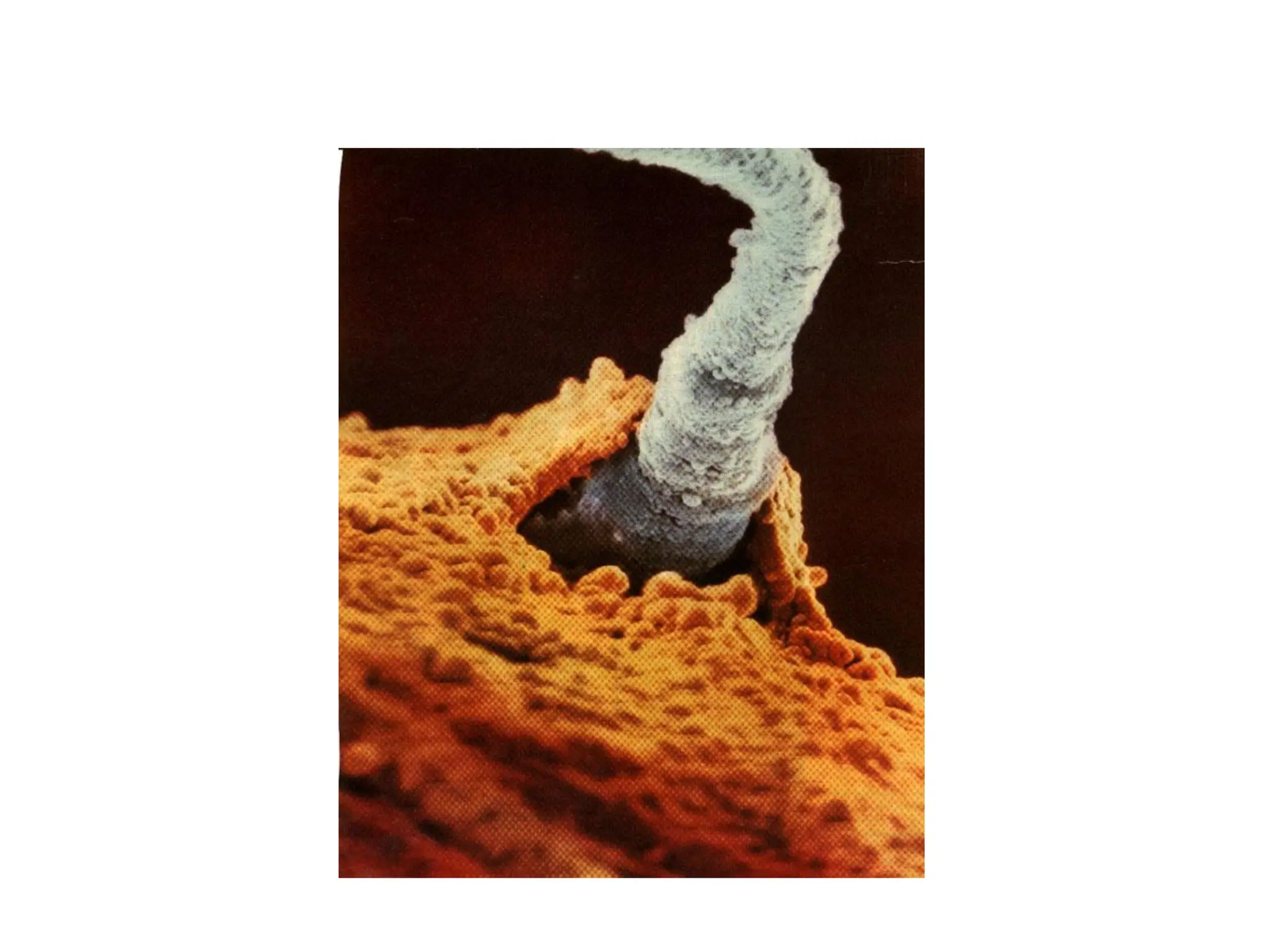
fertilisation
CONCEPTION
Human
foetal
development
 Sperm and ovum fertilised
• conception
 Pregnancy
• Gestation
 Birth
• parturition
 Zygote
 Embryo
 Foetus
 Embyogenesis
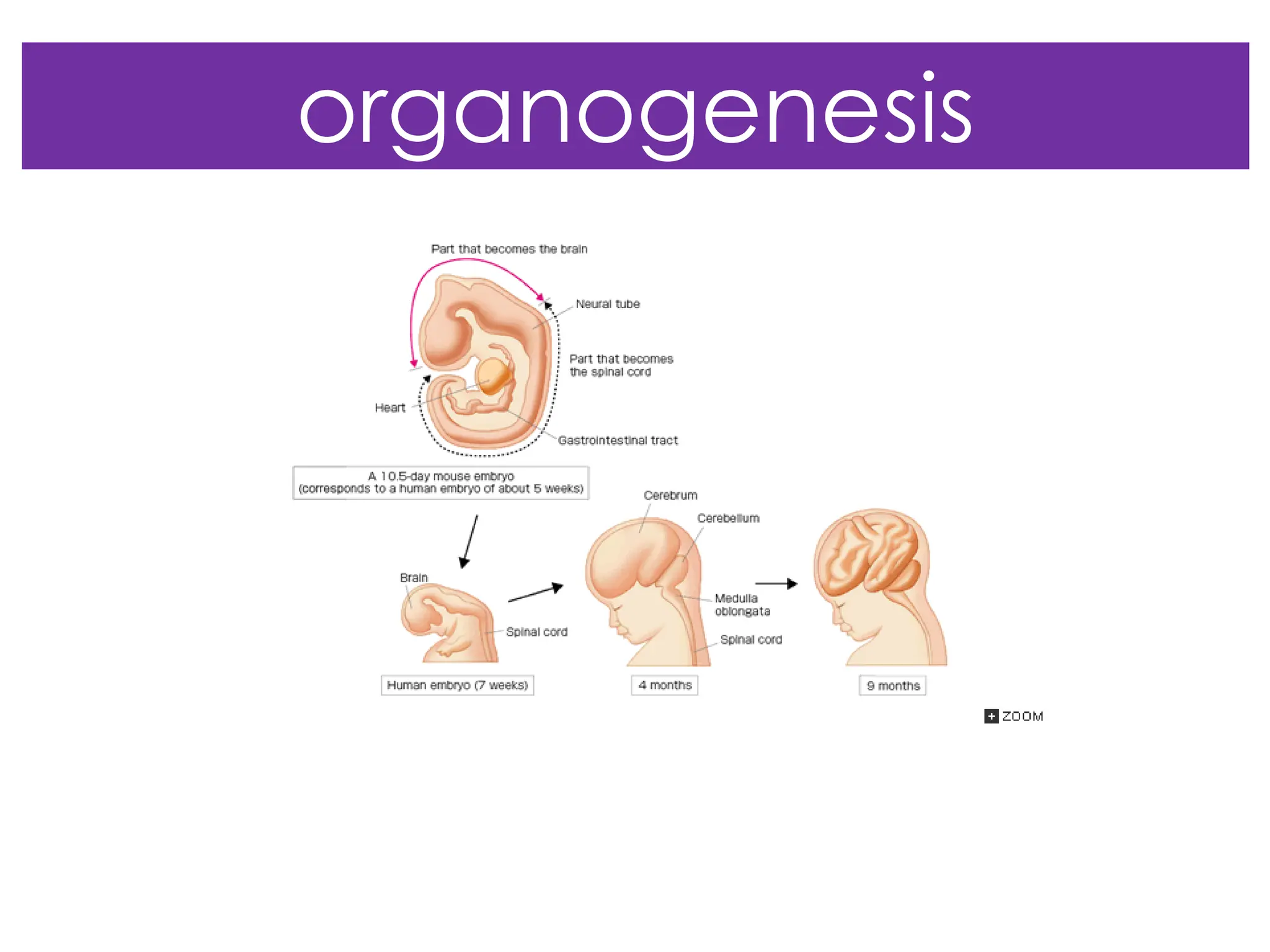
 Organogenesis
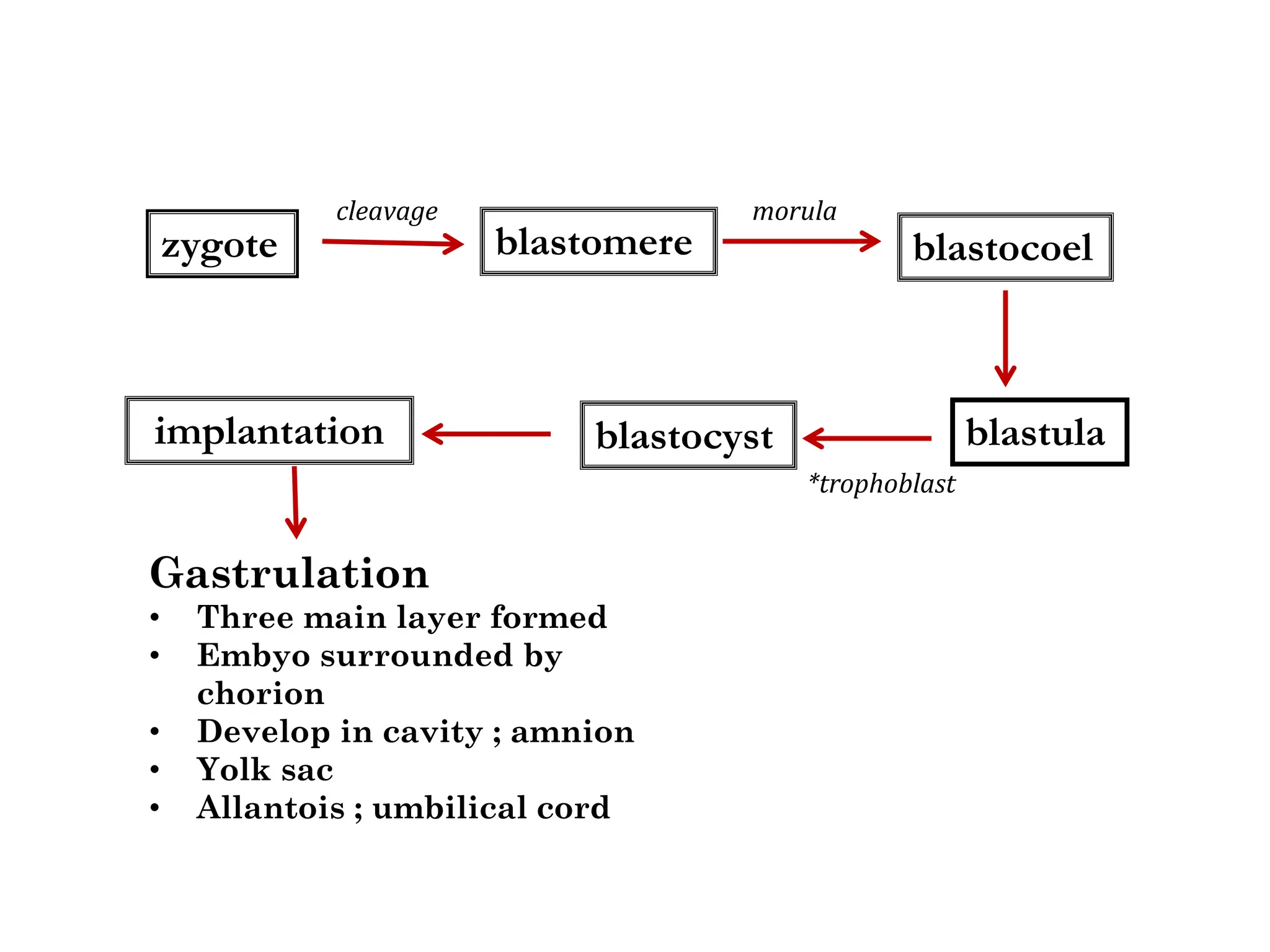
zygote
blastocyst blastula
blastocoel
blastomere
cleavage morula
implantation
*trophoblast
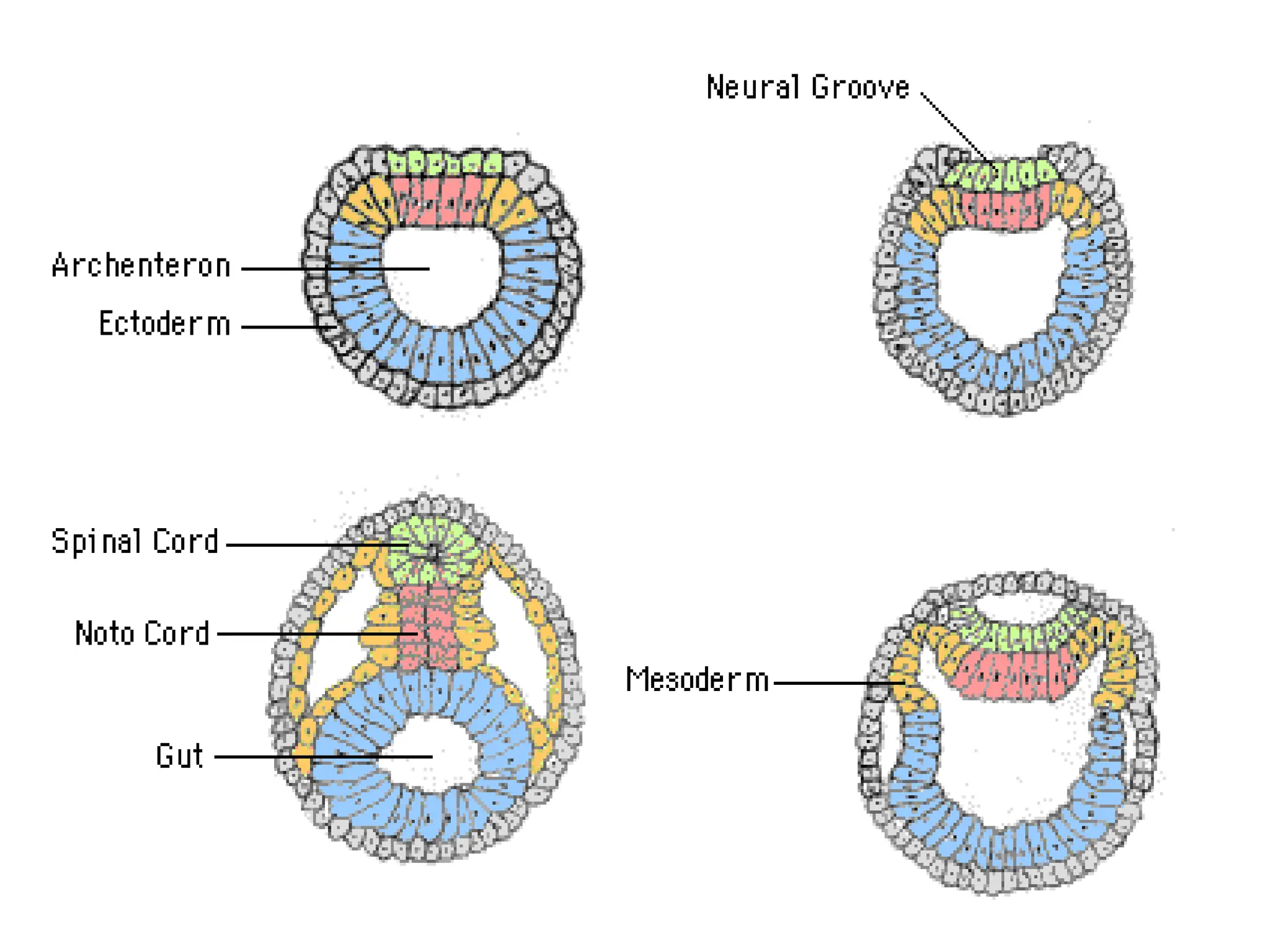
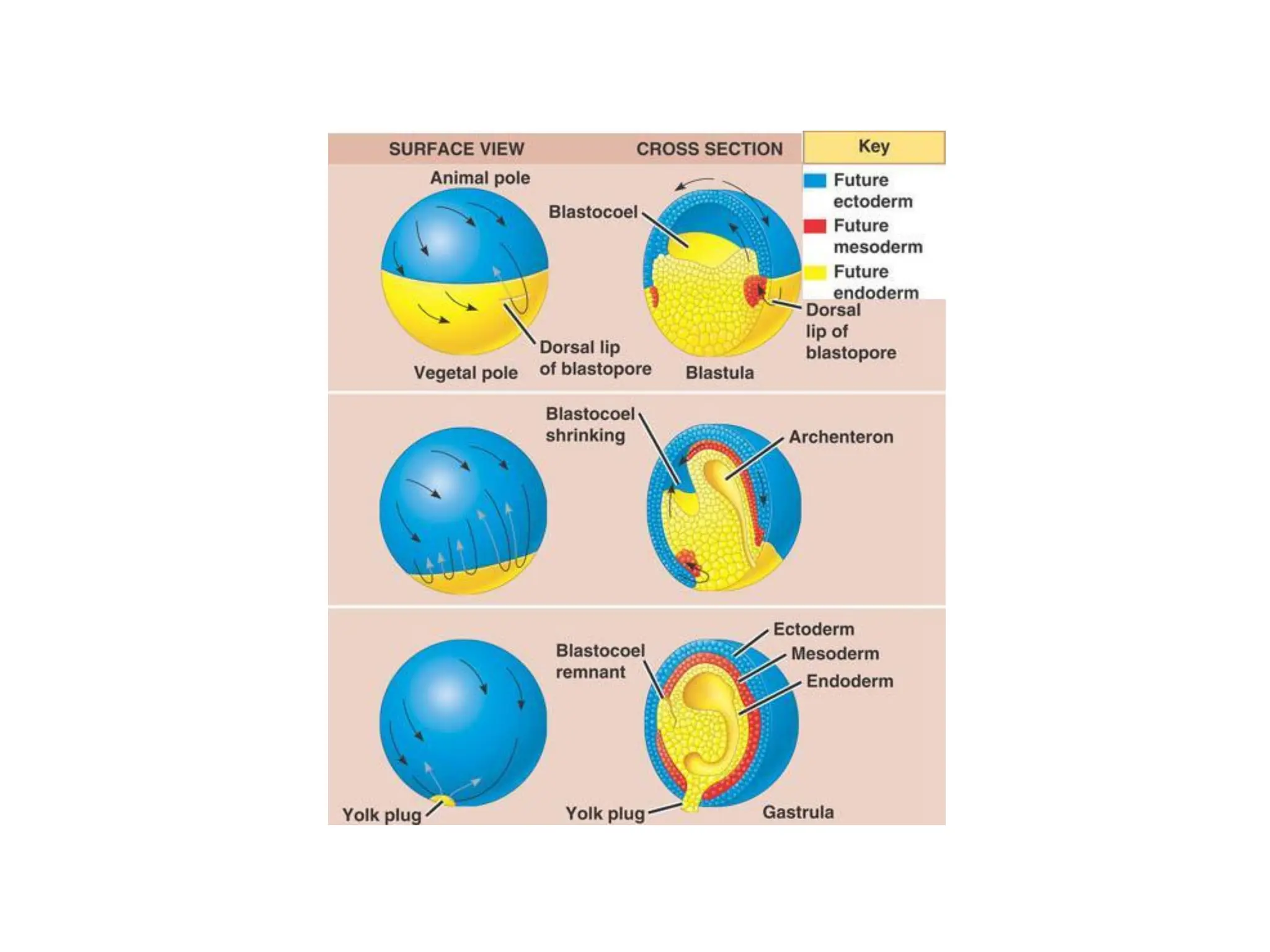
Gastrulation
• Three main layer formed
• Embyo surrounded by
chorion
• Develop in cavity ; amnion
• Yolk sac
• Allantois ; umbilical cord
organogenesis
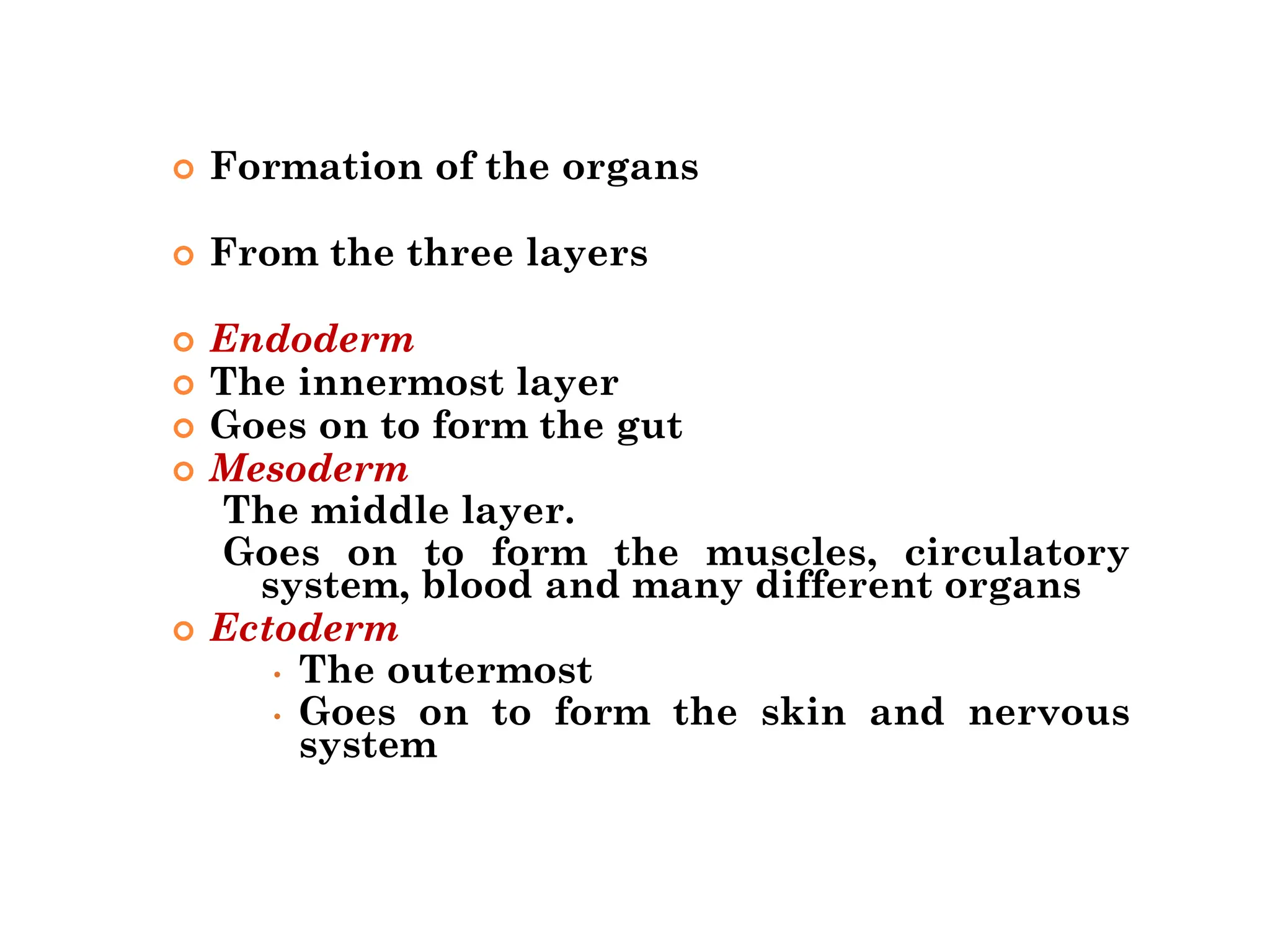
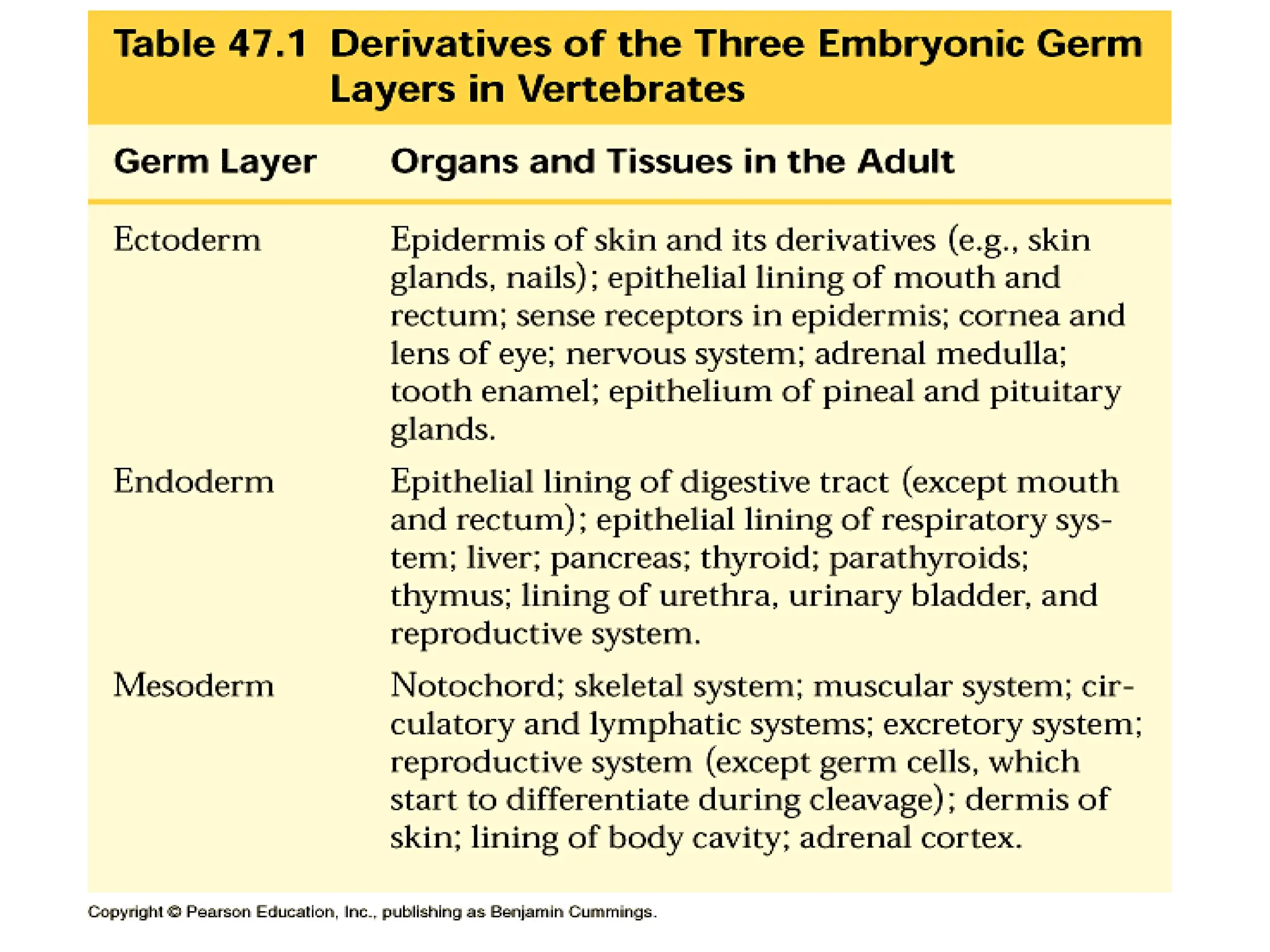
 Formation of the organs
 From the three layers
 Endoderm
 The innermost layer
 Goes on to form the gut
 Mesoderm
The middle layer.
Goes on to form the muscles, circulatory
system, blood and many different organs
 Ectoderm
• The outermost
• Goes on to form the skin and nervous
system
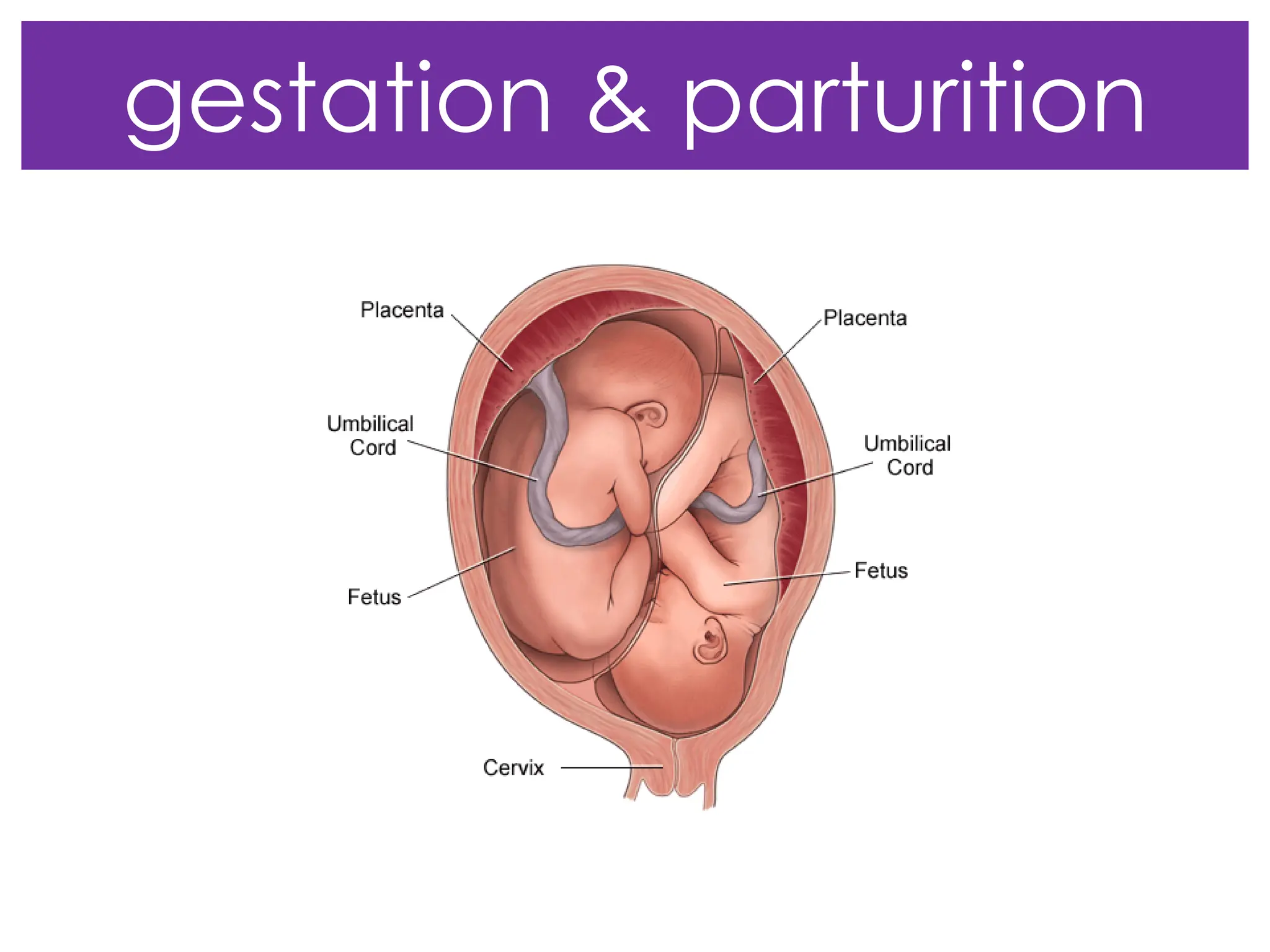
gestation & parturition
❖ Pregnancy is preceded by conception and
continues until birth
❖ In placental mammals, pregnancy is the
condition of carrying one or more embryos
❖A human pregnancy averages 266
days/38
weeks/9 months
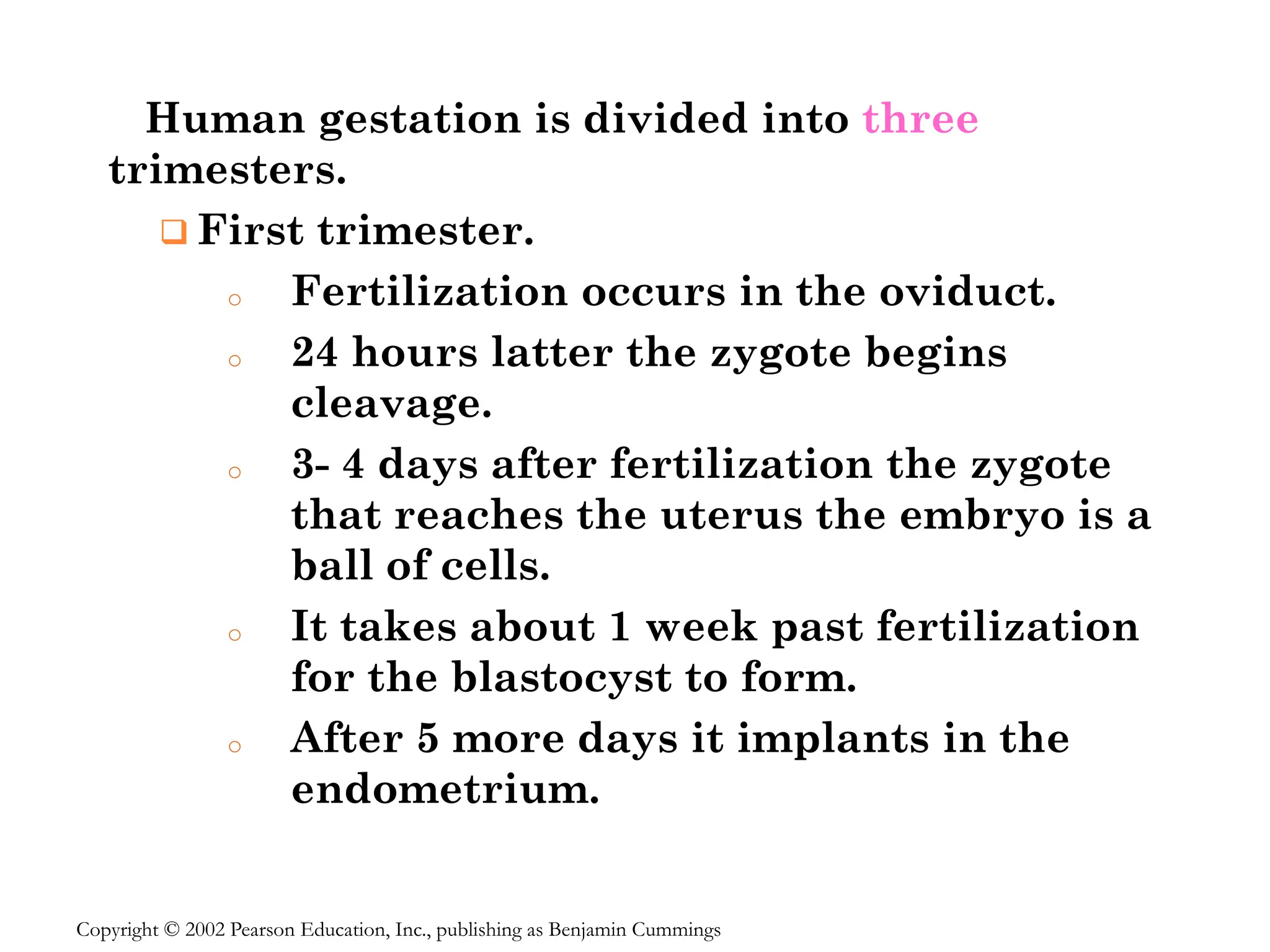
Human gestation is divided into three
trimesters.
❑ First trimester.
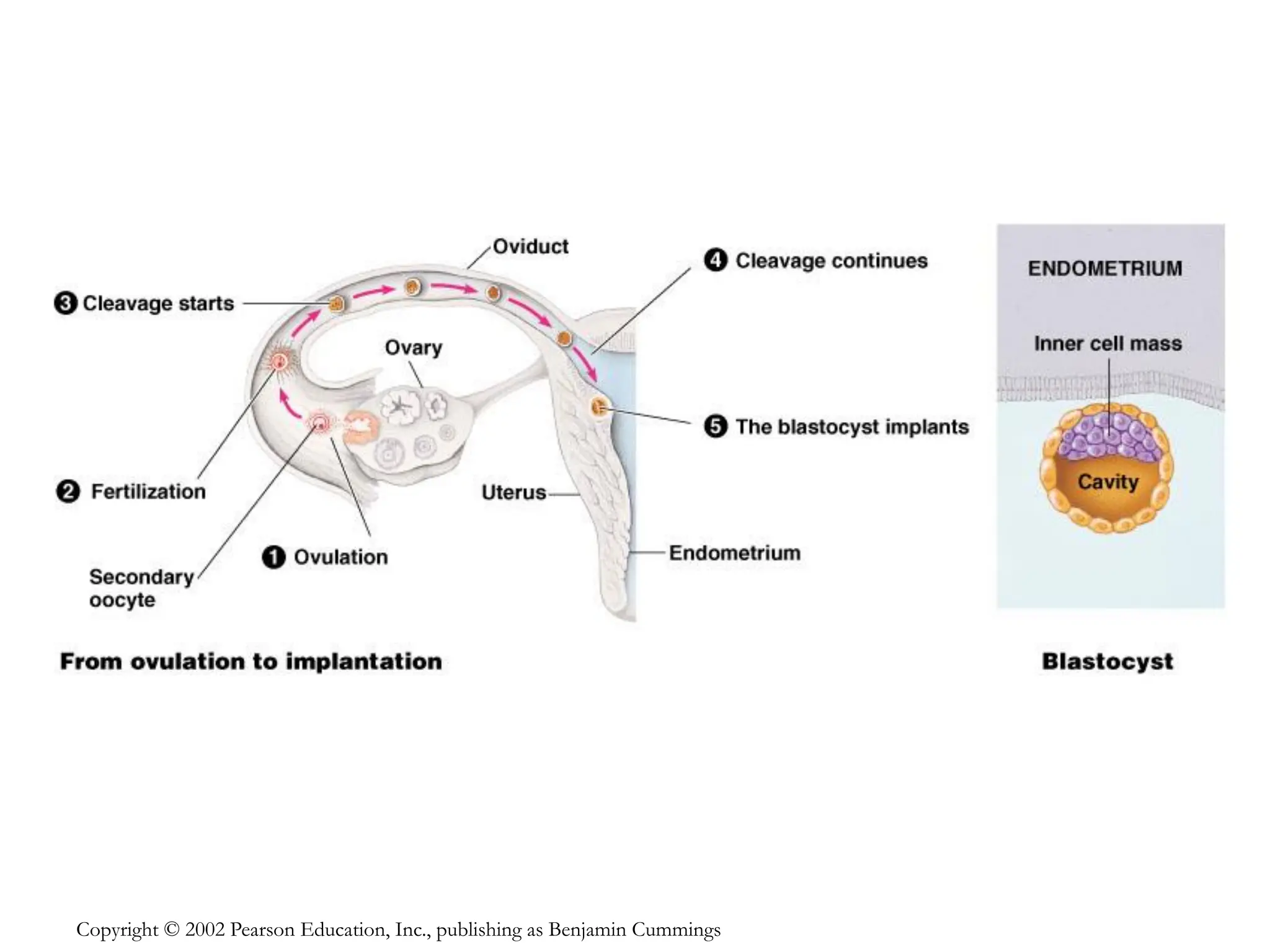
o Fertilization occurs in the oviduct.
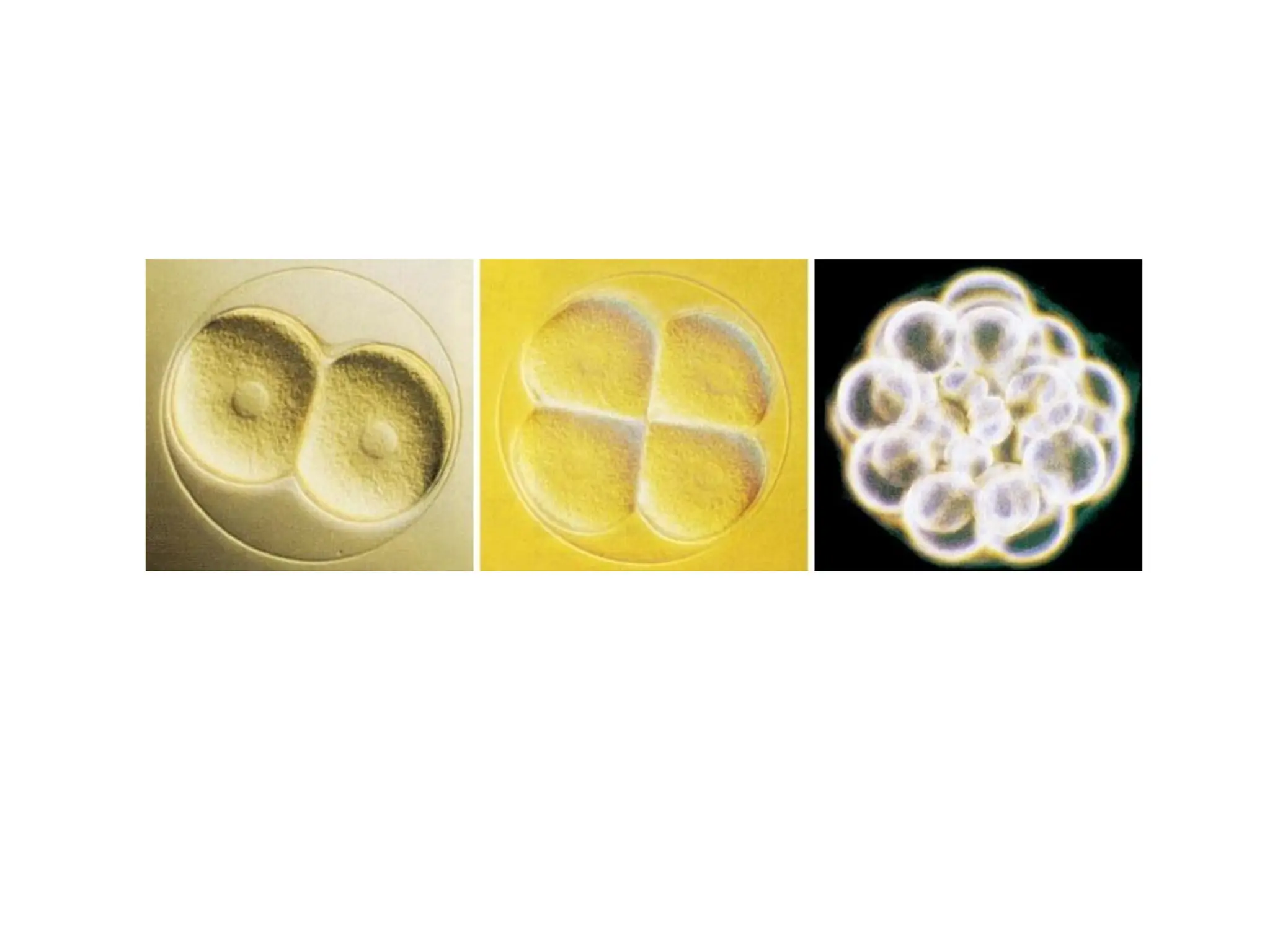
o 24 hours latter the zygote begins
cleavage.
o 3- 4 days after fertilization the zygote
that reaches the uterus the embryo is a
ball of cells.
o It takes about 1 week past fertilization
for the blastocyst to form.
o After 5 more days it implants in the
endometrium.
Copyright © 2002 Pearson Education, Inc., publishing as Benjamin Cummings
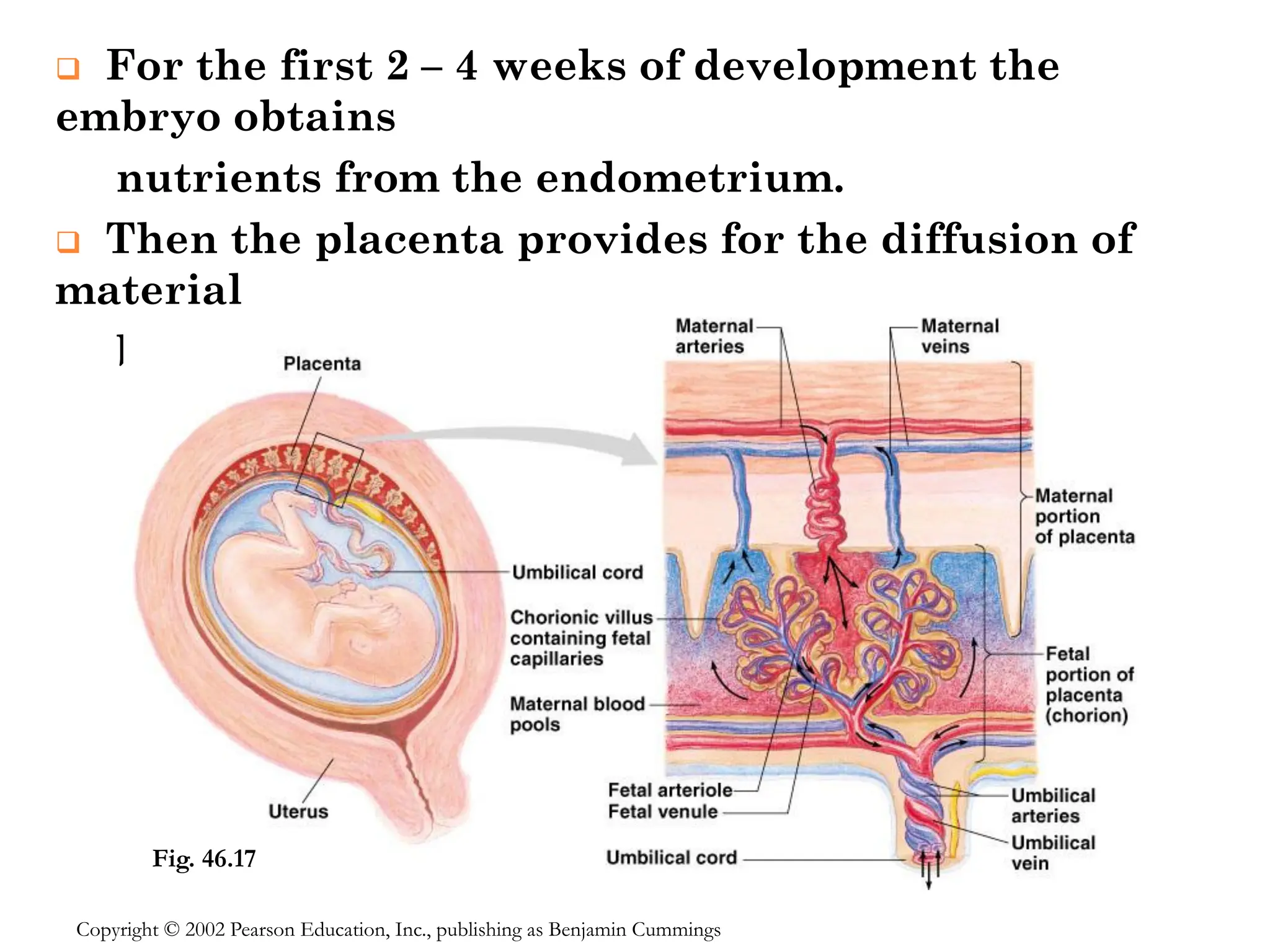
❑ For the first 2 – 4 weeks of development the
embryo obtains
nutrients from the endometrium.
❑ Then the placenta provides for the diffusion of
material
between maternal and embryonic circulations.
Fig. 46.17
Copyright © 2002 Pearson Education, Inc., publishing as Benjamin Cummings
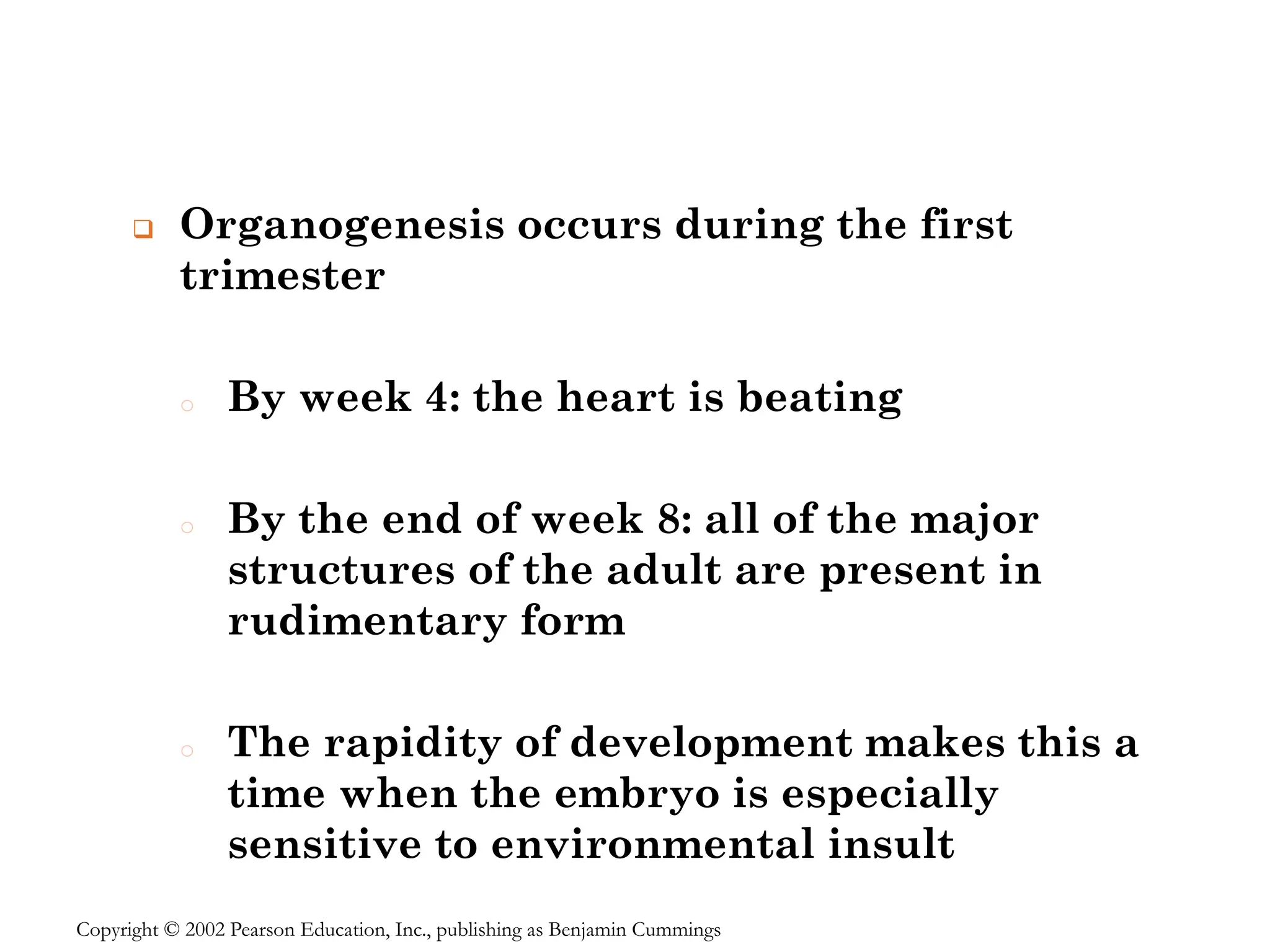
❑ Organogenesis occurs during the first
trimester
o By week 4: the heart is beating
o By the end of week 8: all of the major
structures of the adult are present in
rudimentary form
o The rapidity of development makes this a
time when the embryo is especially
sensitive to environmental insult
Copyright © 2002 Pearson Education, Inc., publishing as Benjamin Cummings
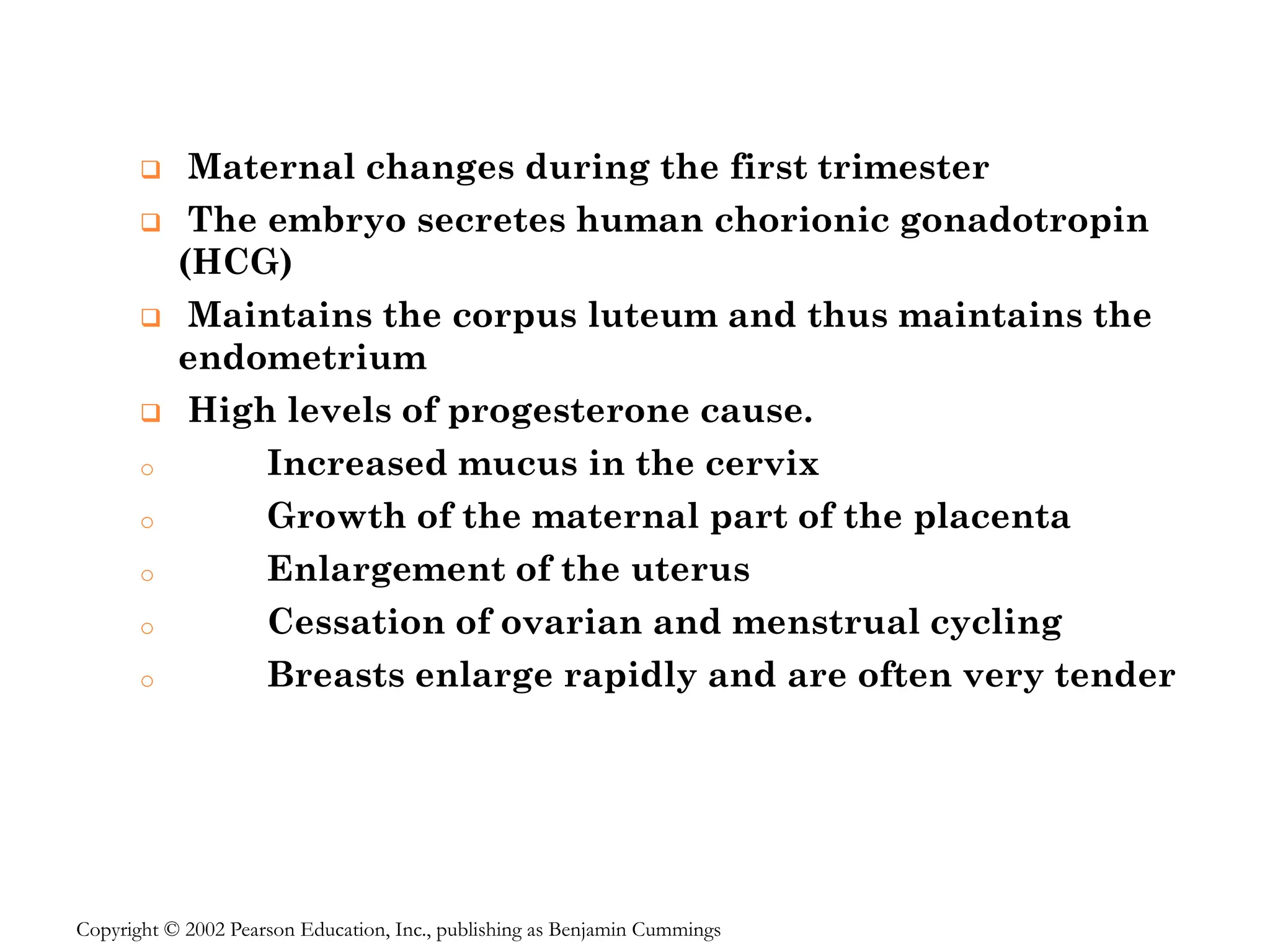
❑ Maternal changes during the first trimester
❑ The embryo secretes human chorionic gonadotropin
(HCG)
❑ Maintains the corpus luteum and thus maintains the
endometrium
❑ High levels of progesterone cause.
o Increased mucus in the cervix
o Growth of the maternal part of the placenta
o Enlargement of the uterus
o Cessation of ovarian and menstrual cycling
o Breasts enlarge rapidly and are often very tender
Copyright © 2002 Pearson Education, Inc., publishing as Benjamin Cummings
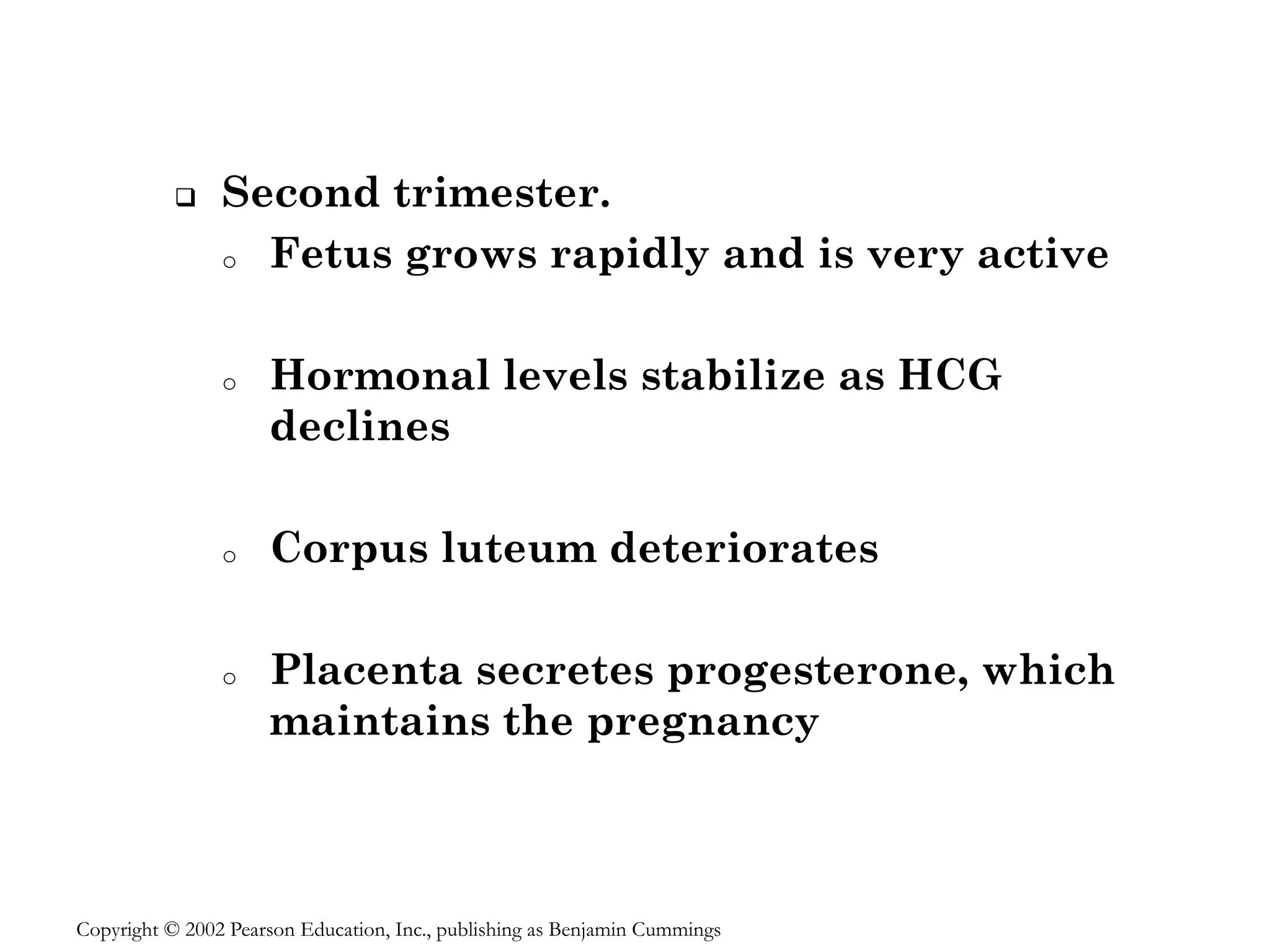
❑ Second trimester.
o Fetus grows rapidly and is very active
o Hormonal levels stabilize as HCG
declines
o Corpus luteum deteriorates
o Placenta secretes progesterone, which
maintains the pregnancy
Copyright © 2002 Pearson Education, Inc., publishing as Benjamin Cummings
❑ Third trimester
o Fetus grows rapidly
o Fetal activity may decrease as the fetus
fills the space available to it
o Maternal abdominal organs become
compressed and displaced
o Terminates with parturition
Copyright © 2002 Pearson Education, Inc., publishing as Benjamin Cummings
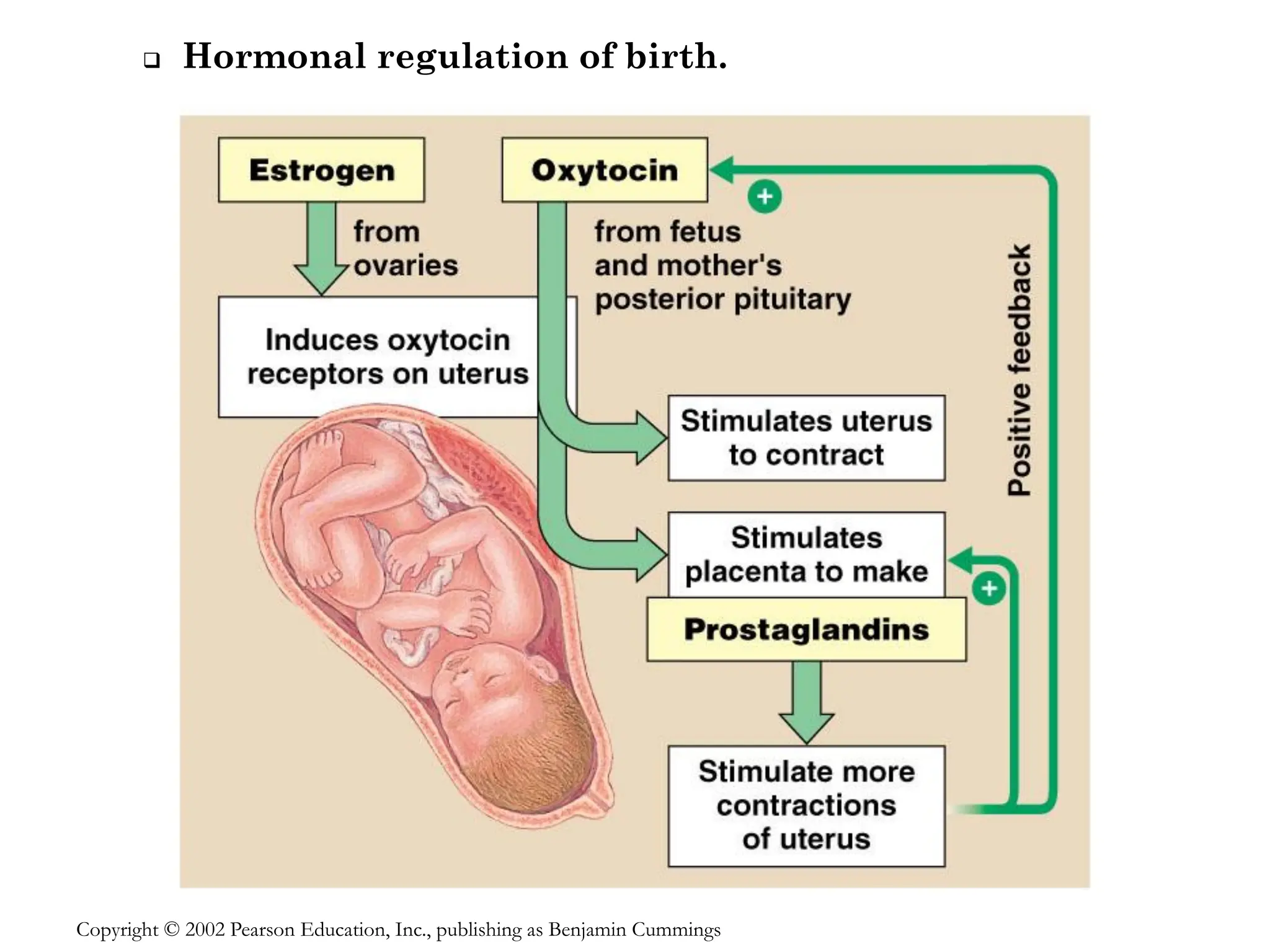
❑ Hormonal regulation of birth.
Copyright © 2002 Pearson Education, Inc., publishing as Benjamin Cummings
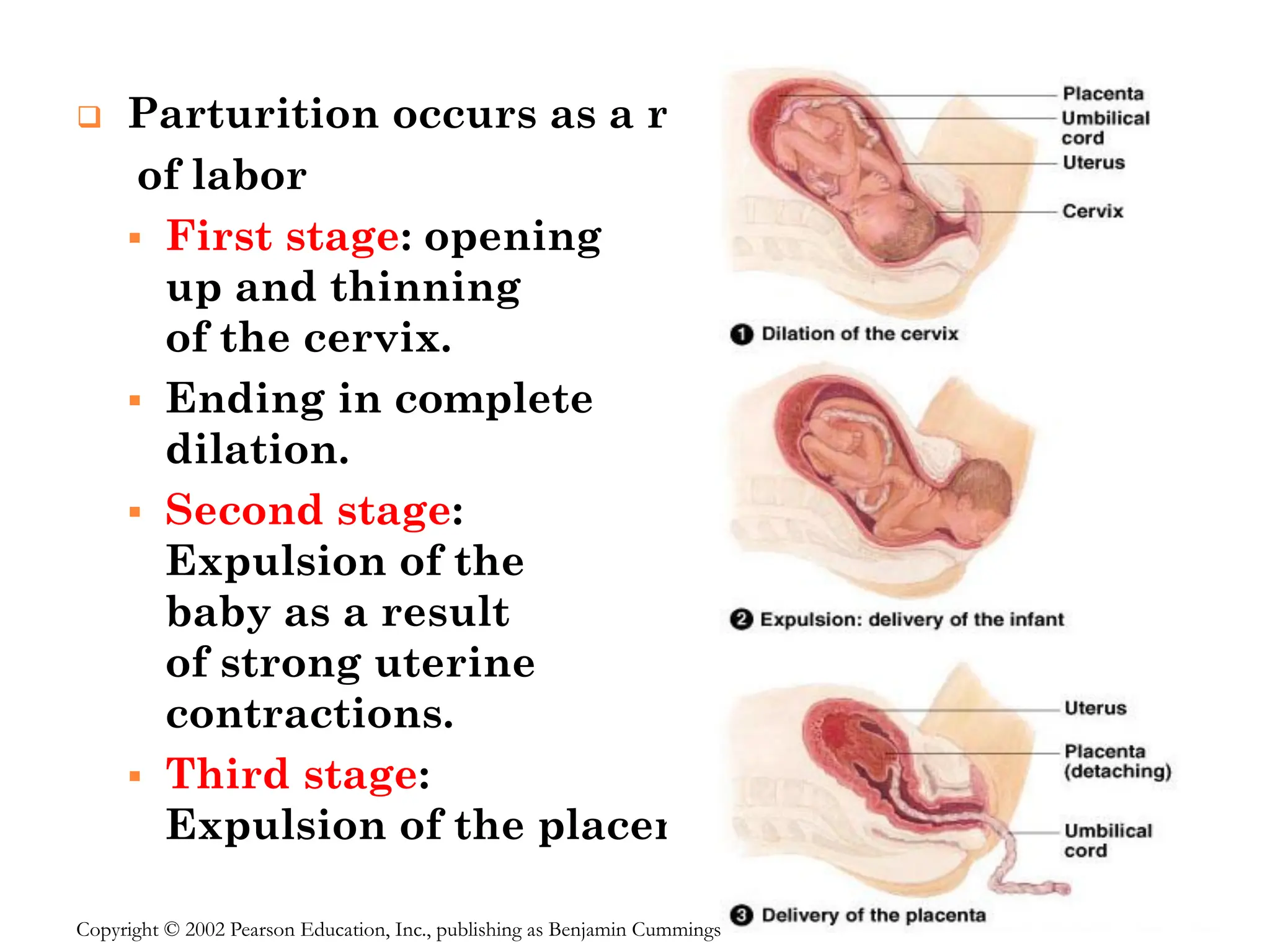
❑ Parturition occurs as a result
of labor
▪ First stage: opening
up and thinning
of the cervix.
▪ Ending in complete
dilation.
▪ Second stage:
Expulsion of the
baby as a result
of strong uterine
contractions.
▪ Third stage:
Expulsion of the placenta.
Copyright © 2002 Pearson Education, Inc., publishing as Benjamin Cummings
 Gestation
 HCG (human chorionic gonadotropin)
 Estrogen
 Progesterone
 Parturition
 Oxytocin
 Estrogen
 Progesterone
 Lactation
 Prolactin
 Oxytocin
 colostrum
roles of hormones
reproduction in plant
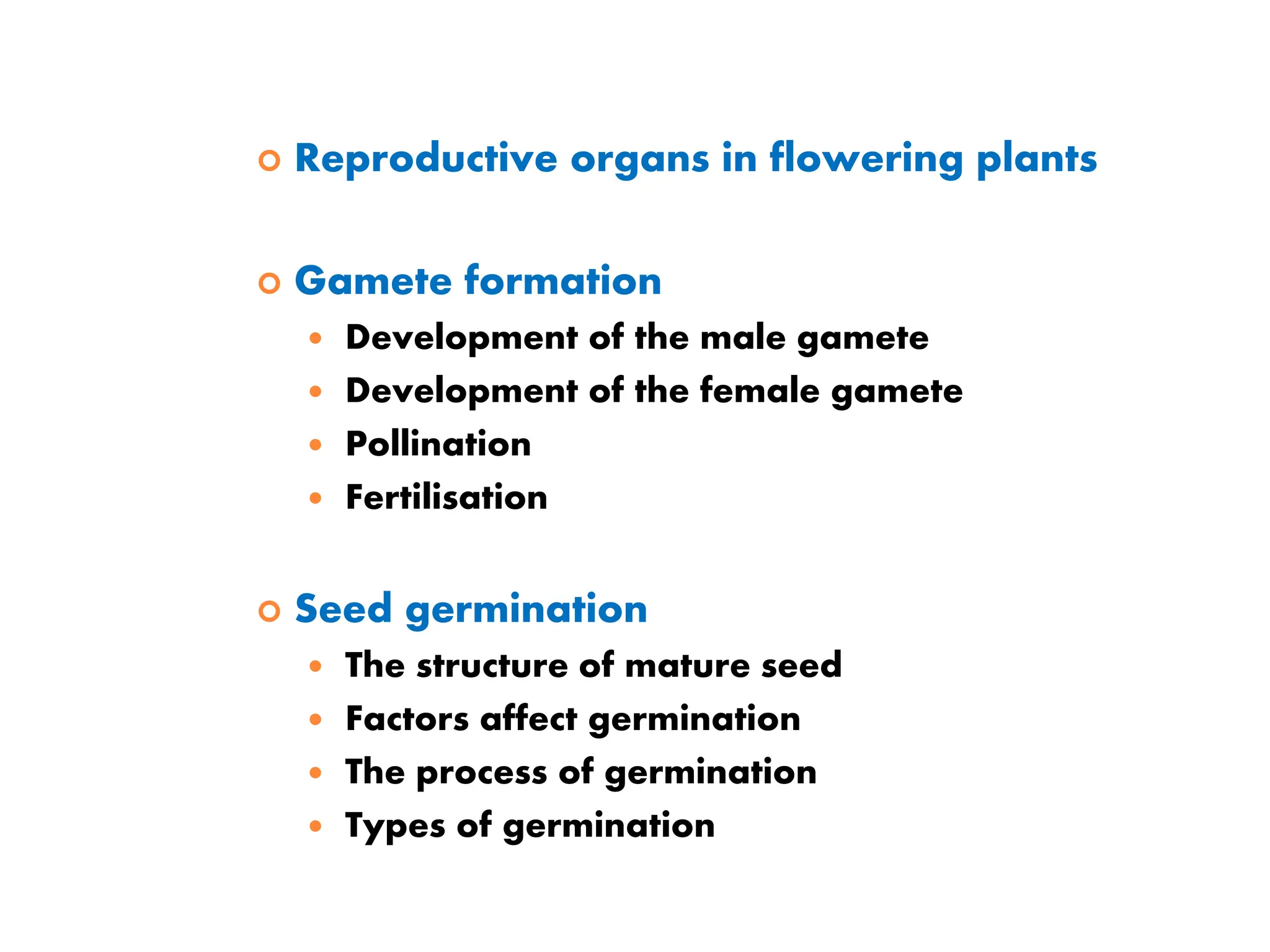
 Reproductive organs in flowering plants
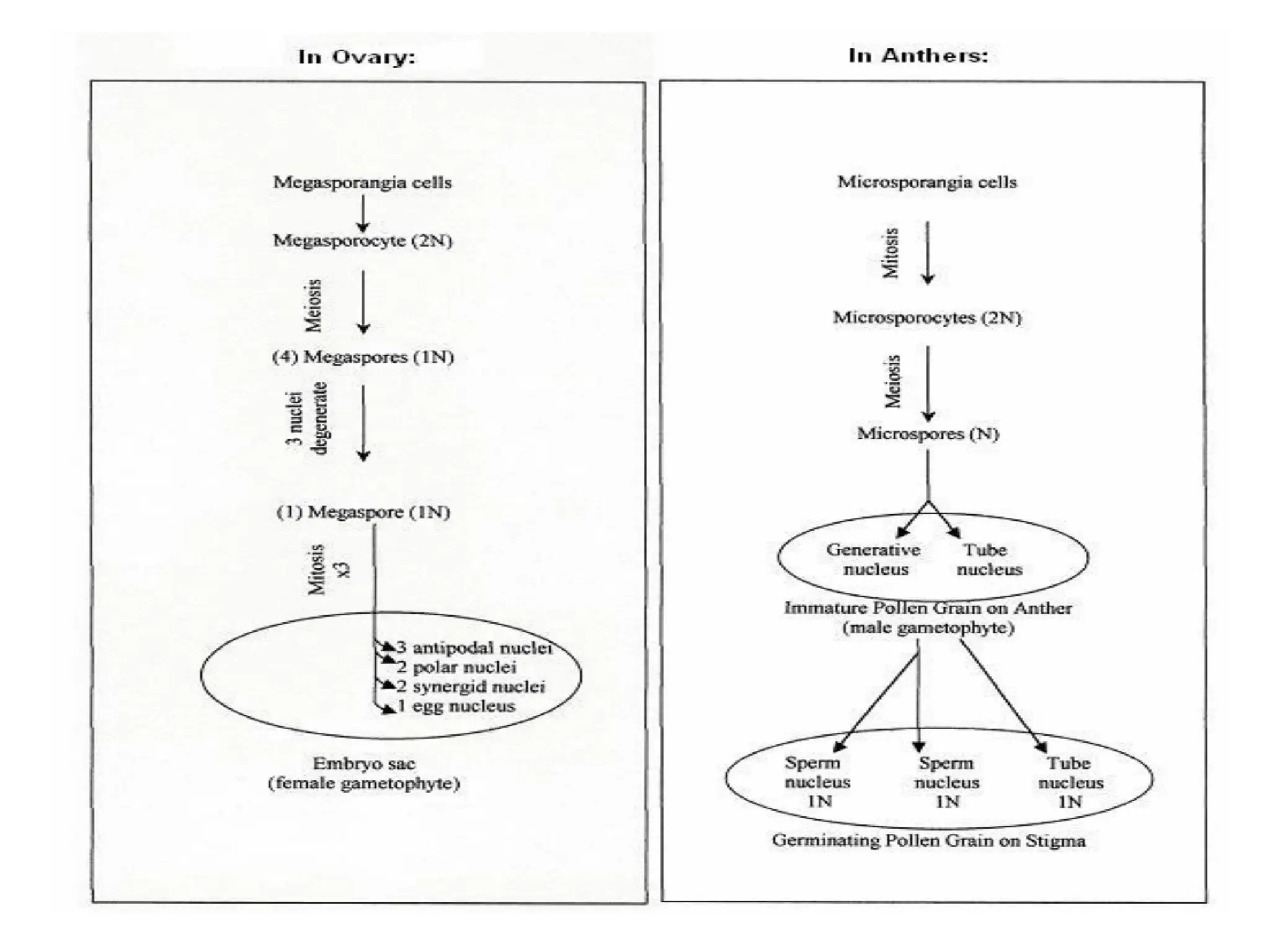
 Gamete formation
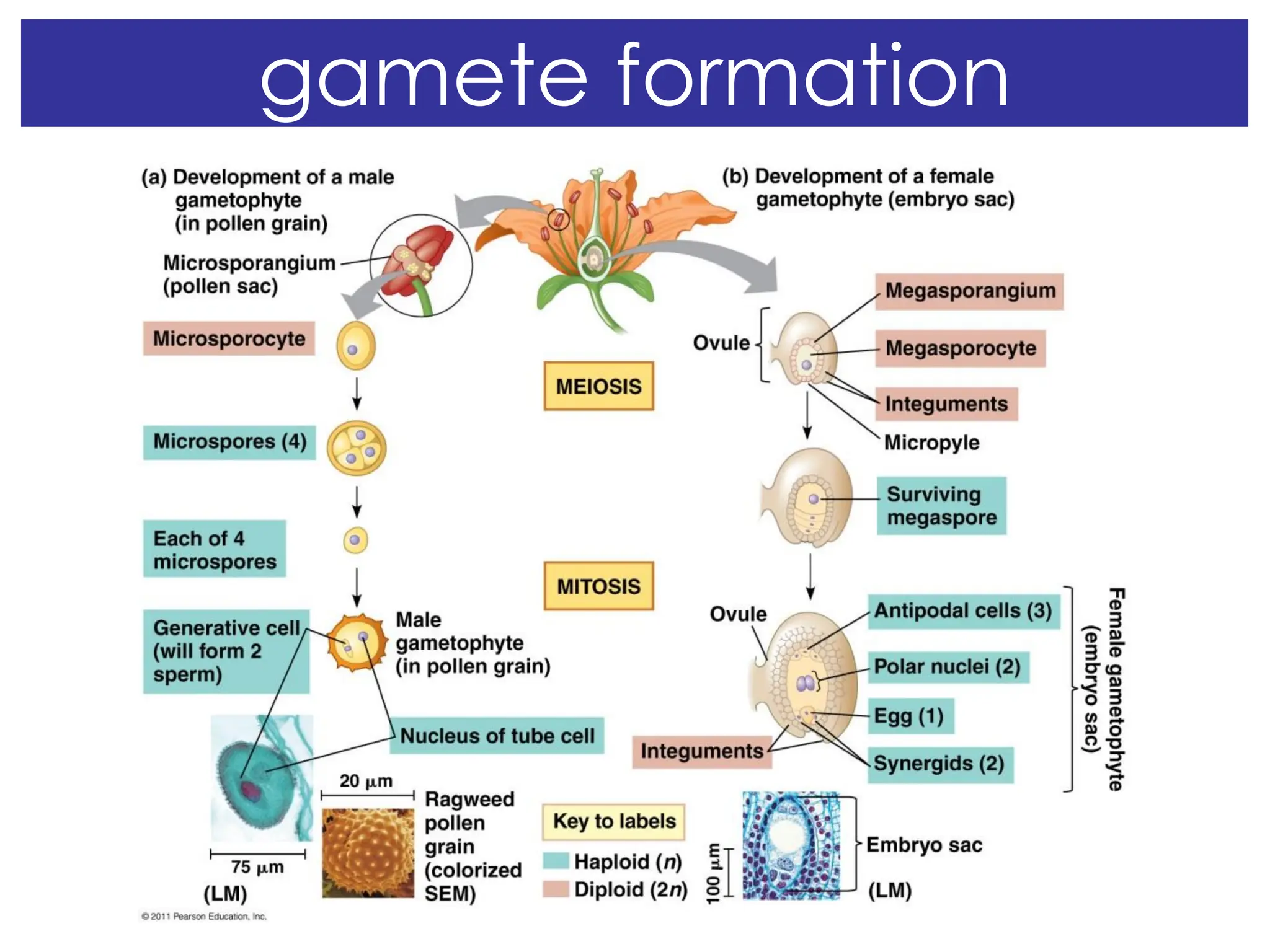
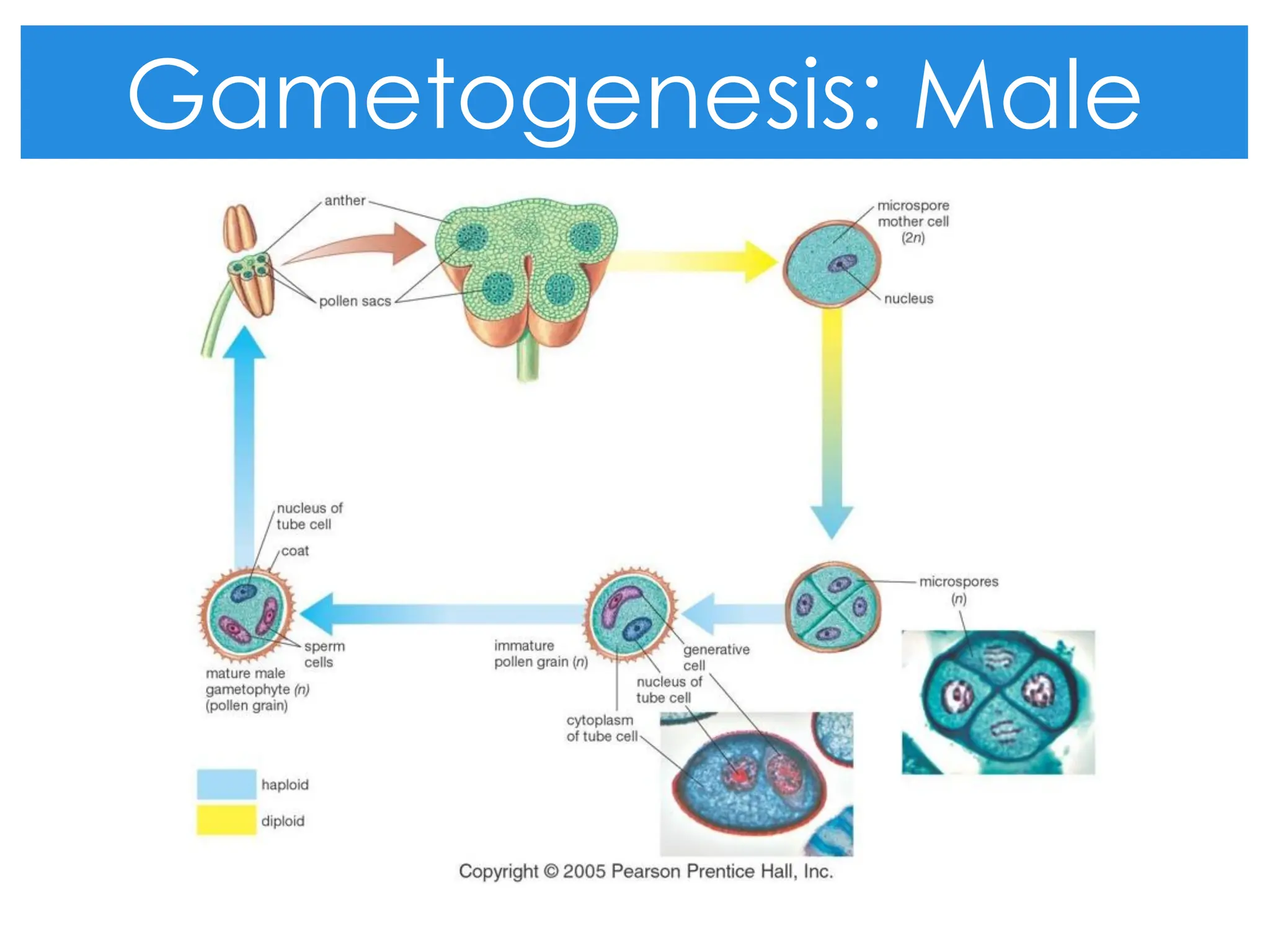
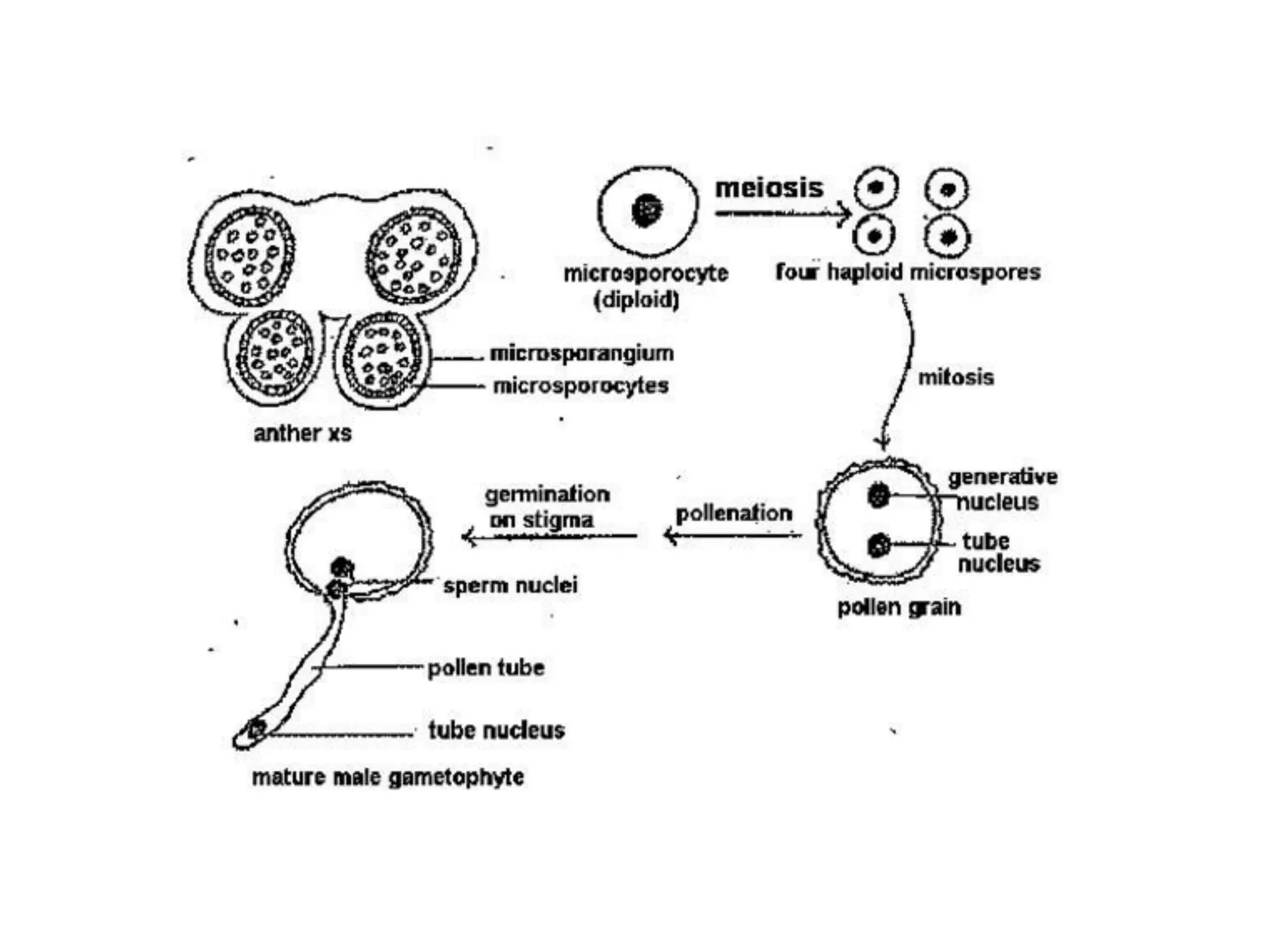
 Development of the male gamete
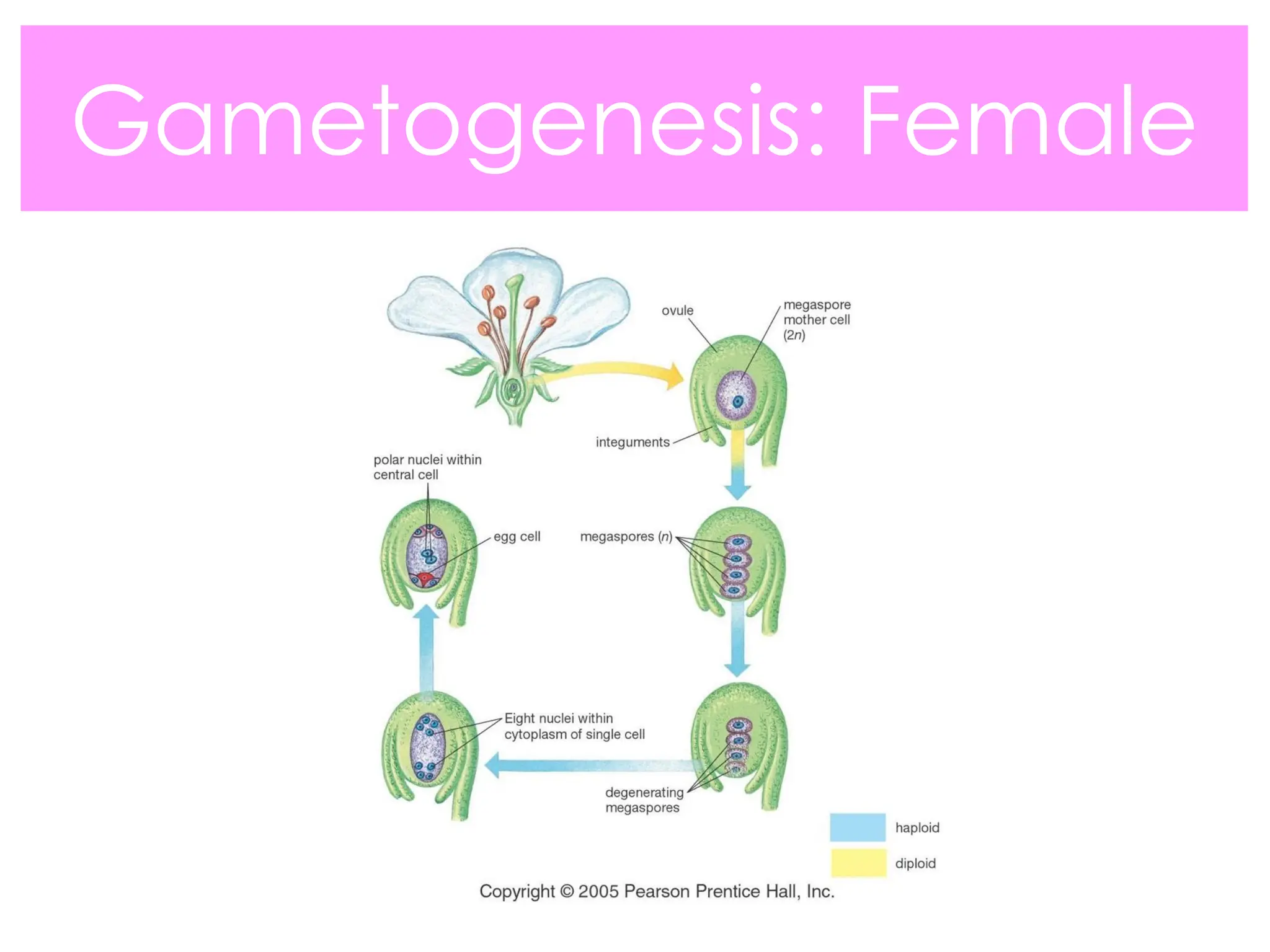
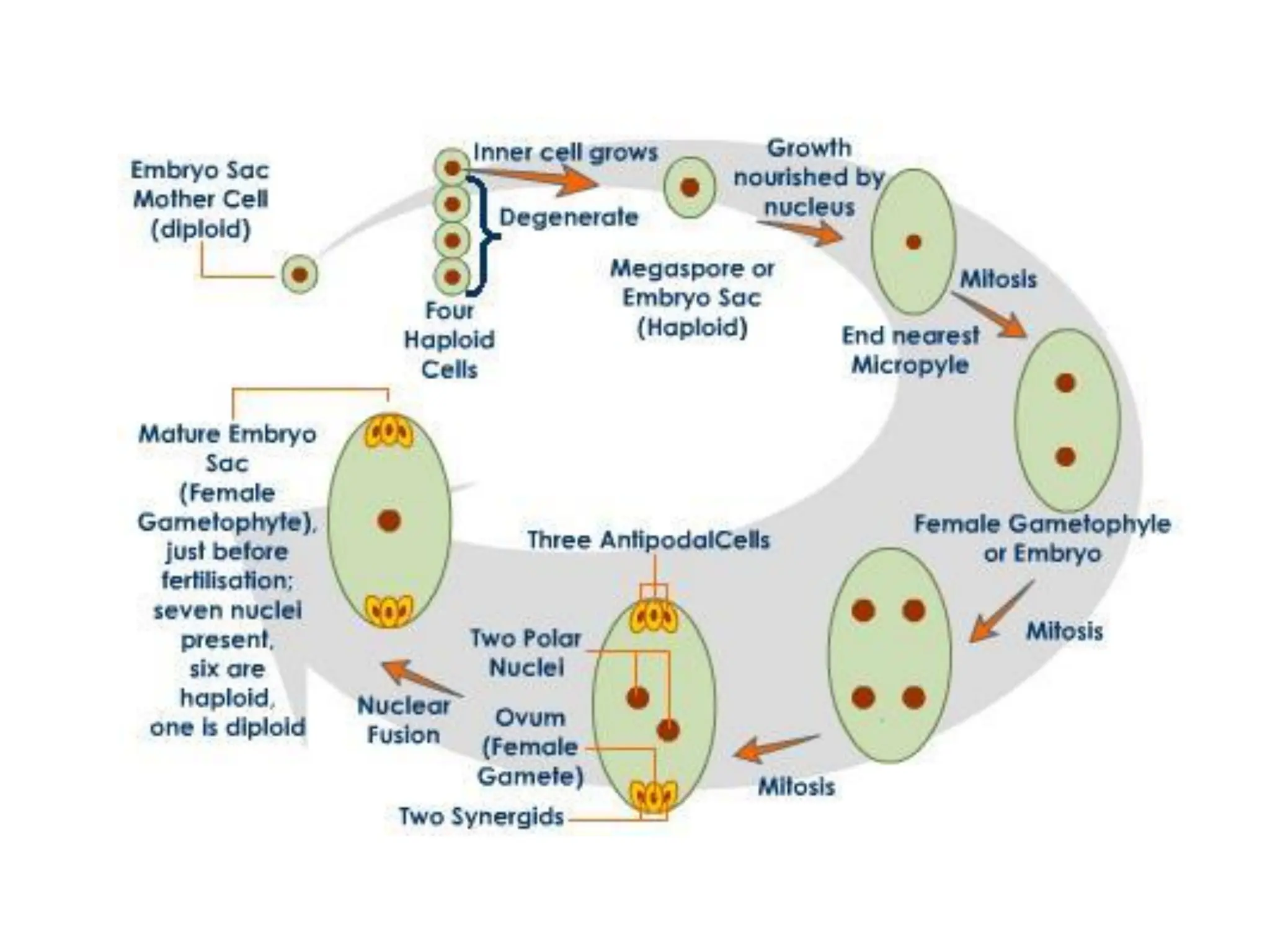
 Development of the female gamete
 Pollination
 Fertilisation
 Seed germination
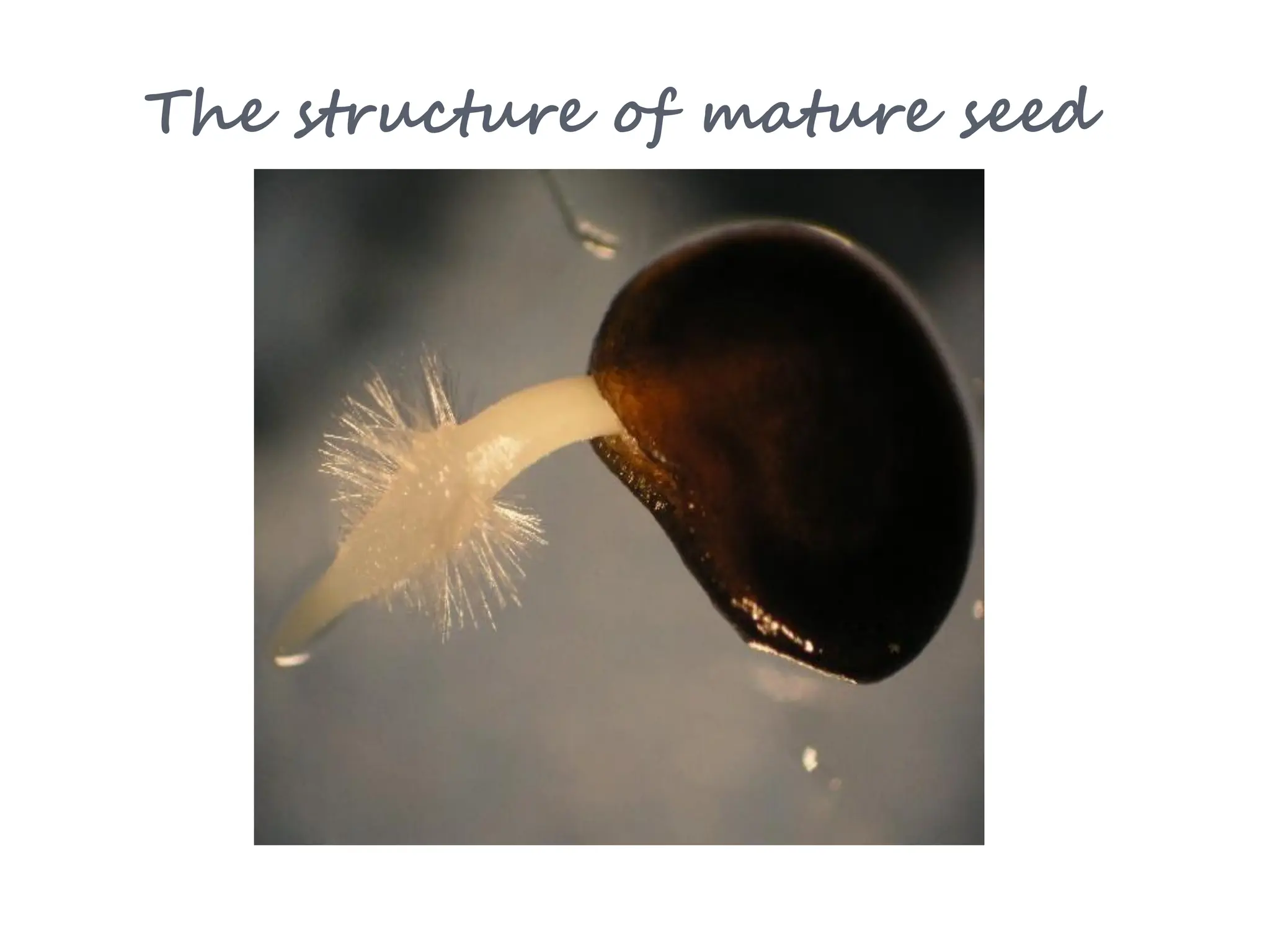
 The structure of mature seed
 Factors affect germination
 The process of germination
 Types of germination
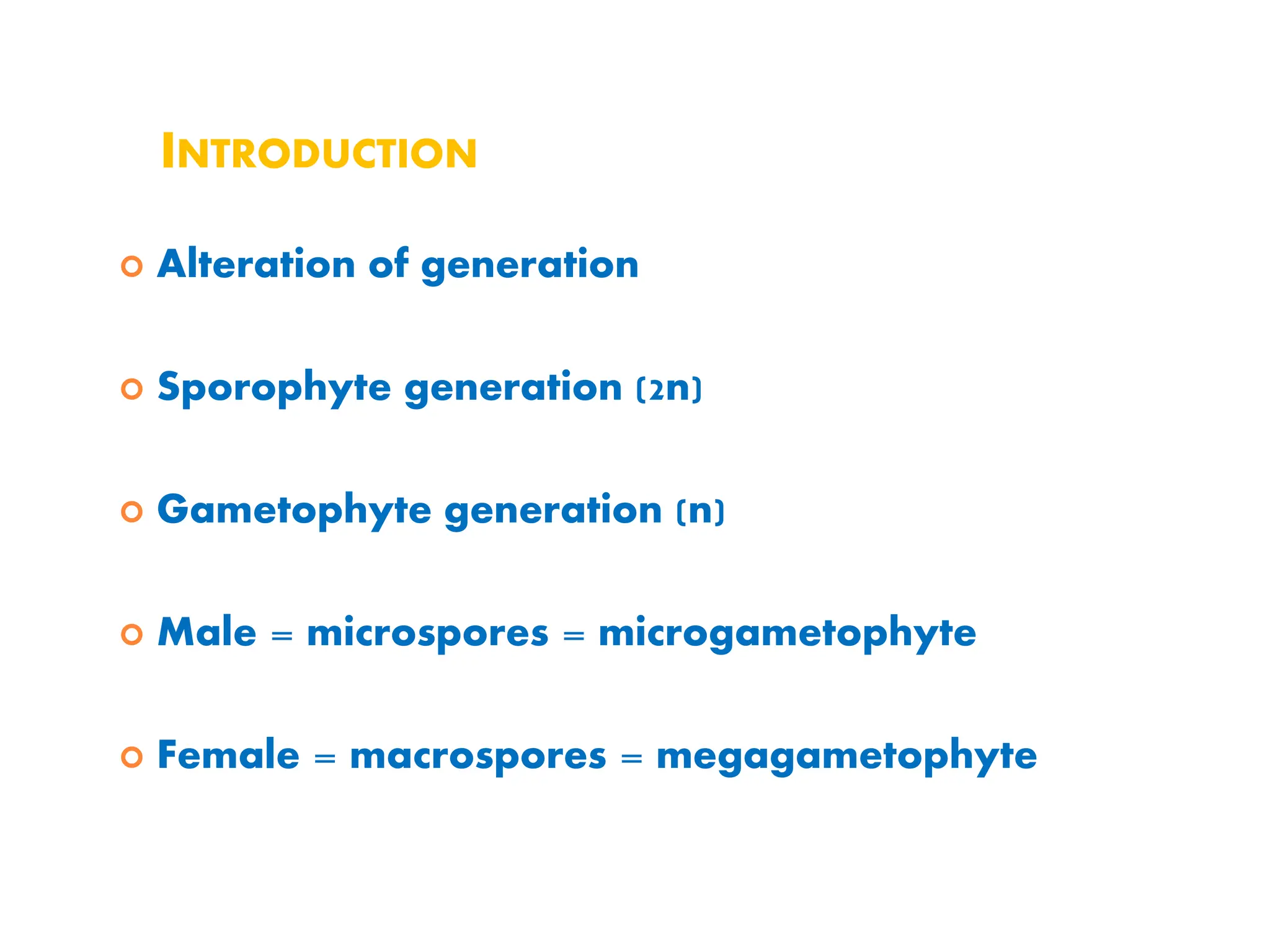
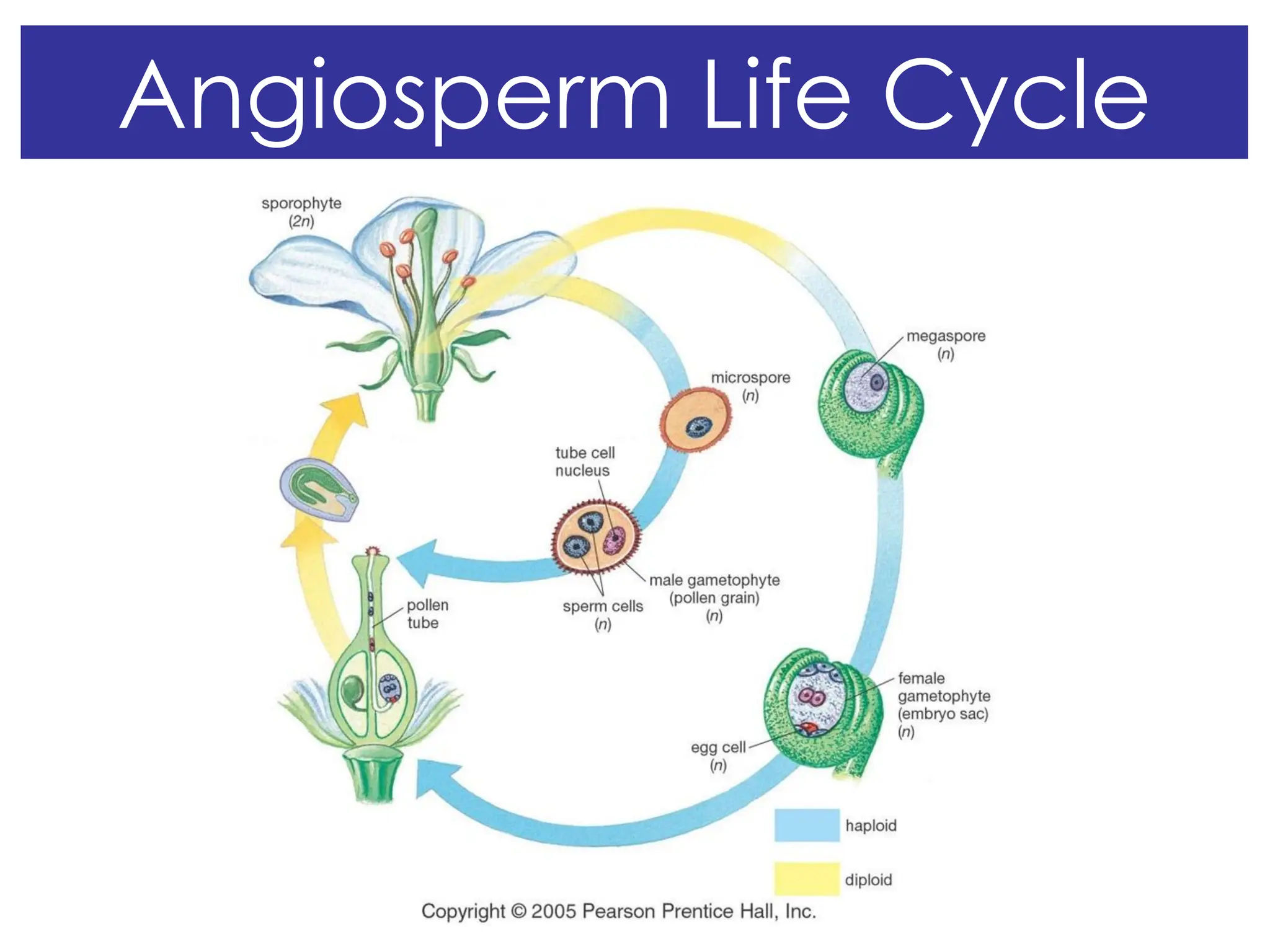
 Alteration of generation
 Sporophyte generation (2n)
 Gametophyte generation (n)
 Male = microspores = microgametophyte
 Female = macrospores = megagametophyte
INTRODUCTION
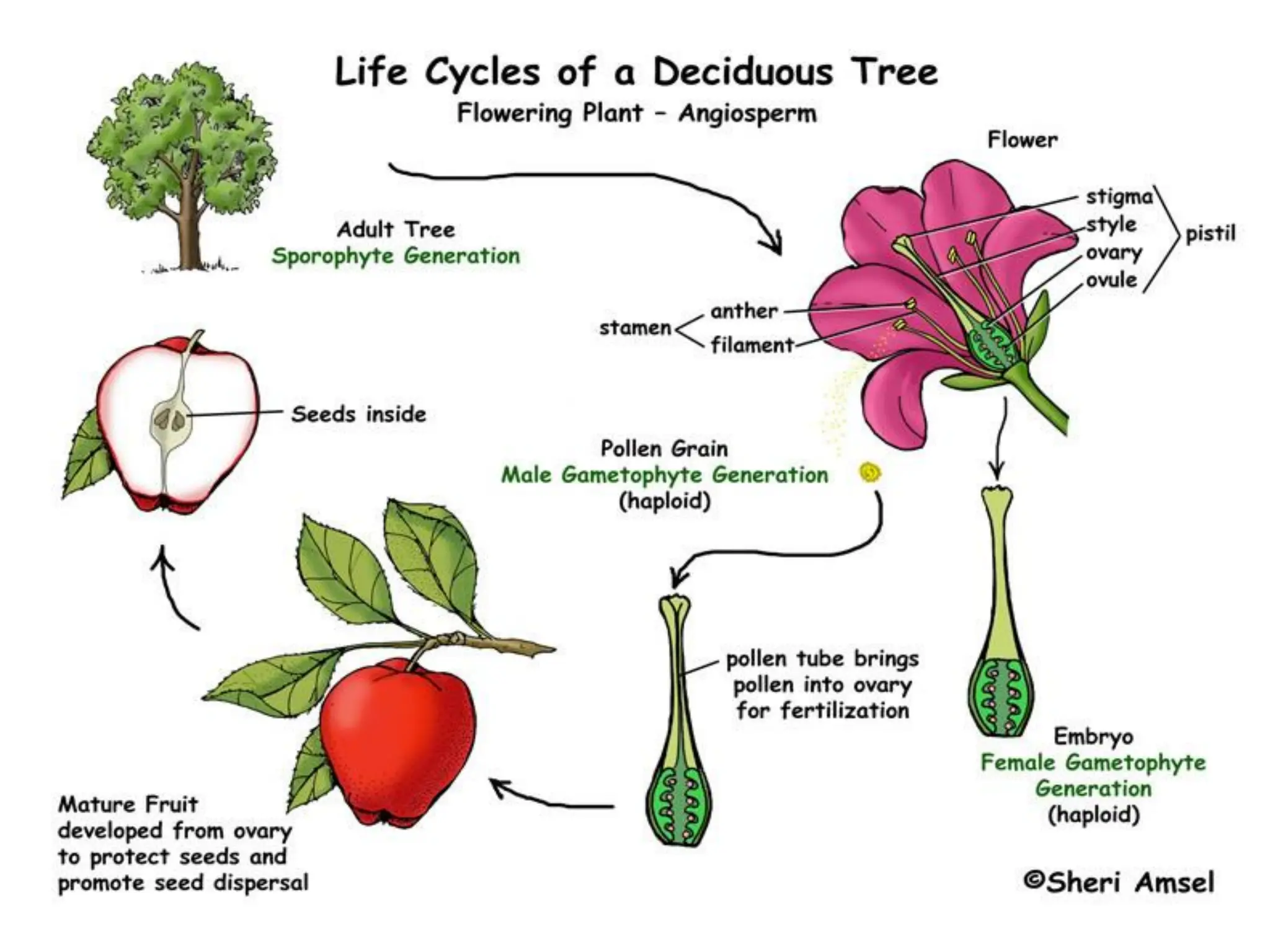
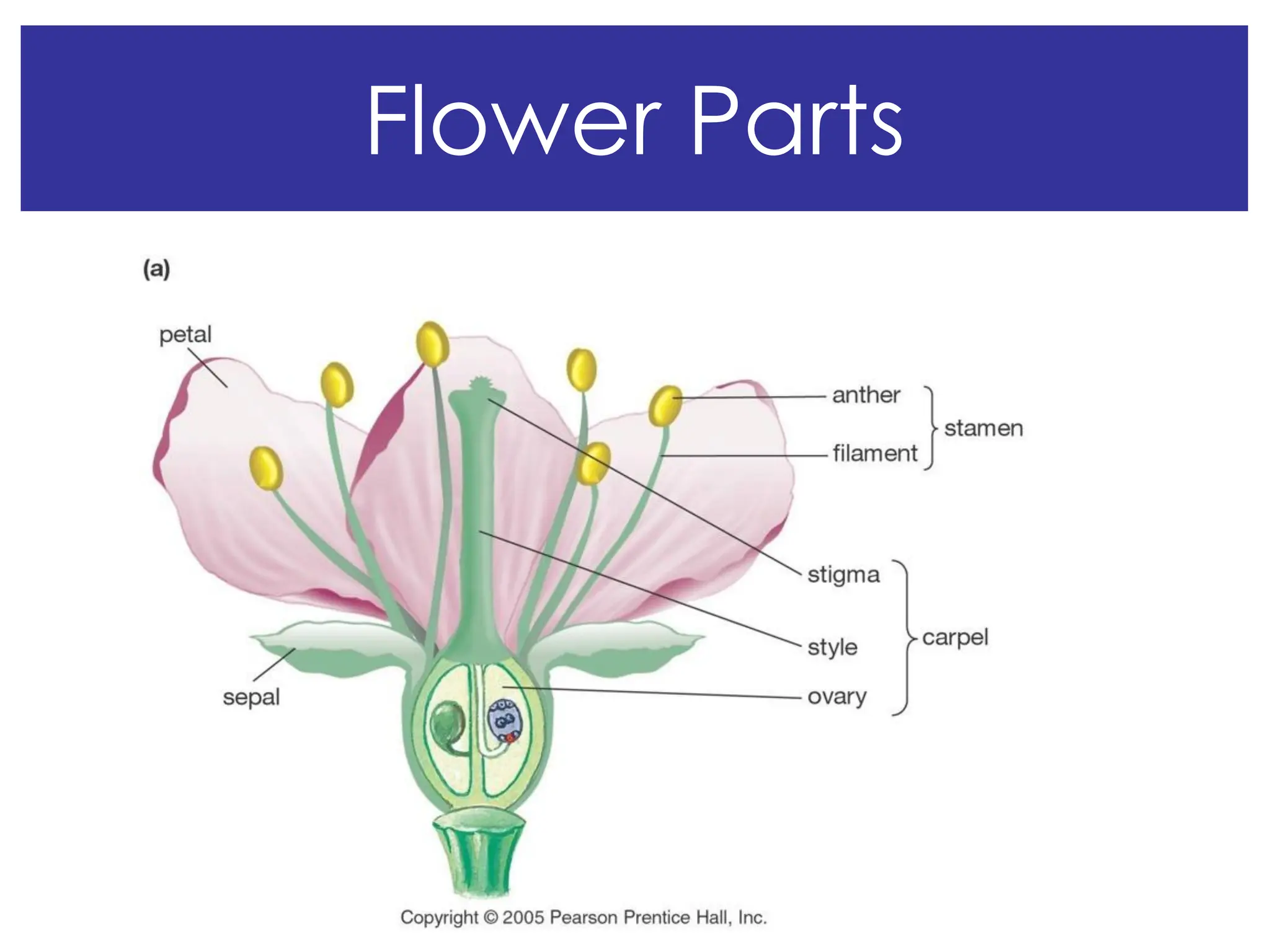
Flower Parts
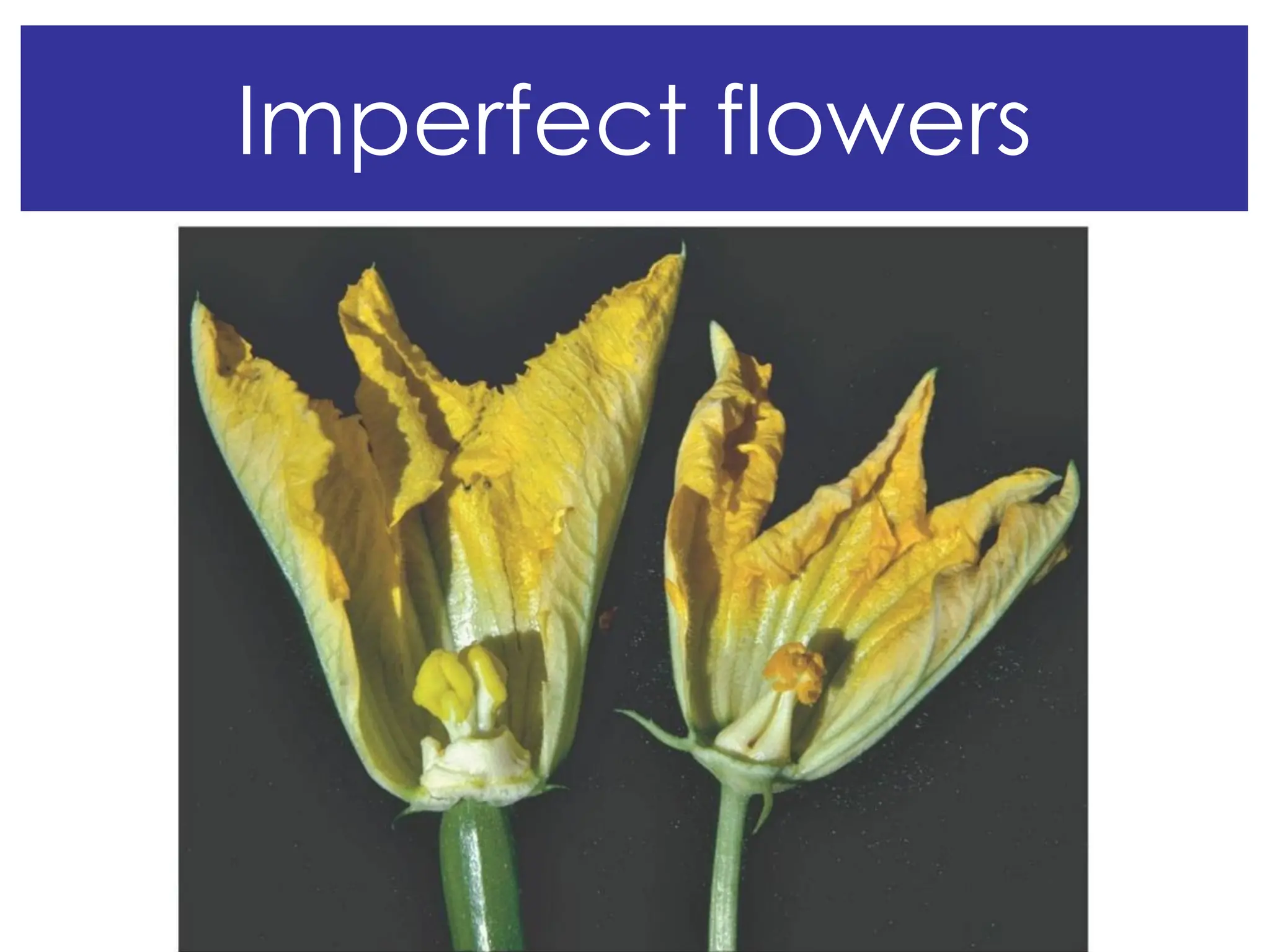
Imperfect flowers
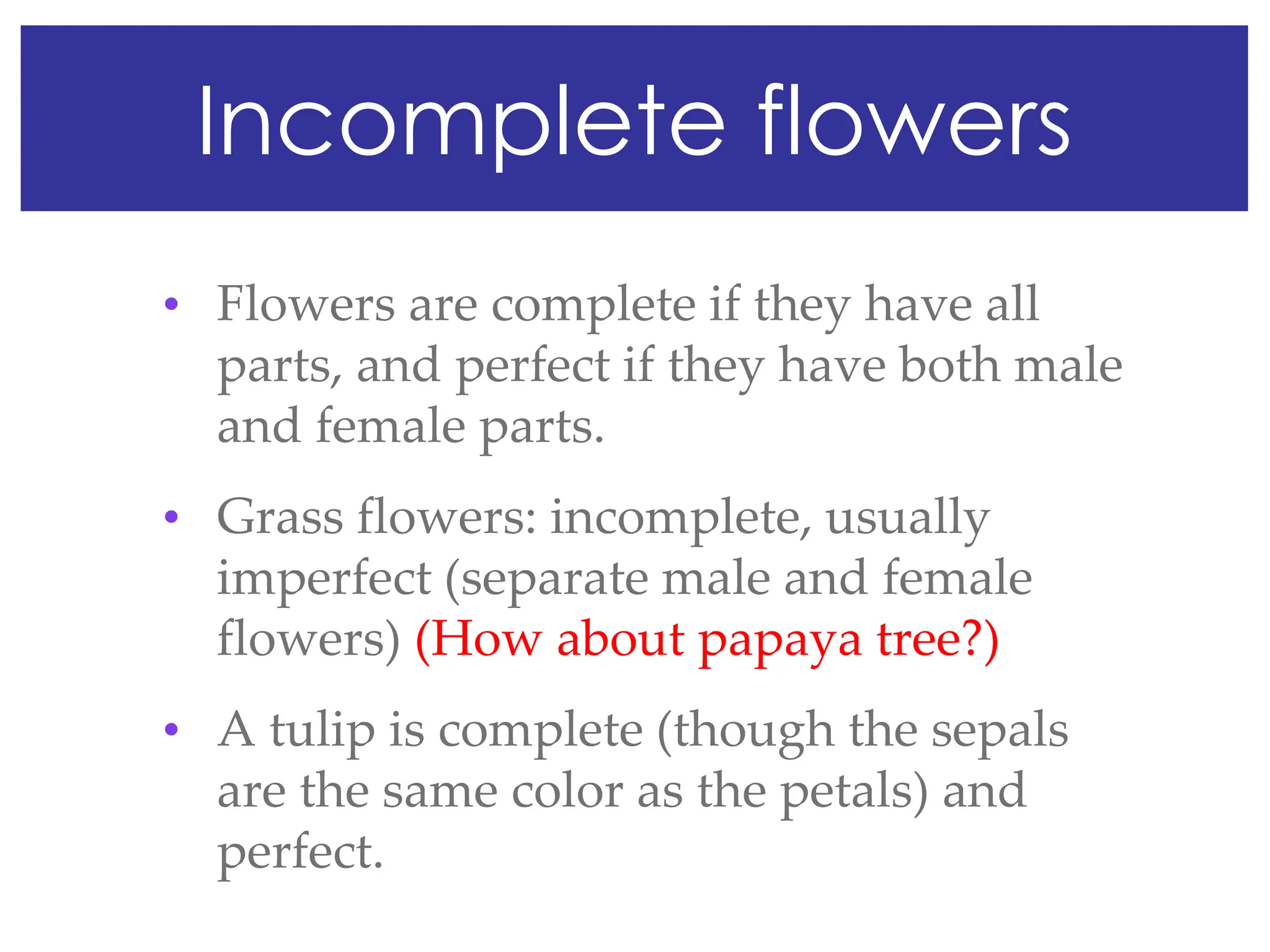
Incomplete flowers
• Flowers are complete if they have all
parts, and perfect if they have both male
and female parts.
• Grass flowers: incomplete, usually
imperfect (separate male and female
flowers) (How about papaya tree?)
• A tulip is complete (though the sepals
are the same color as the petals) and
perfect.
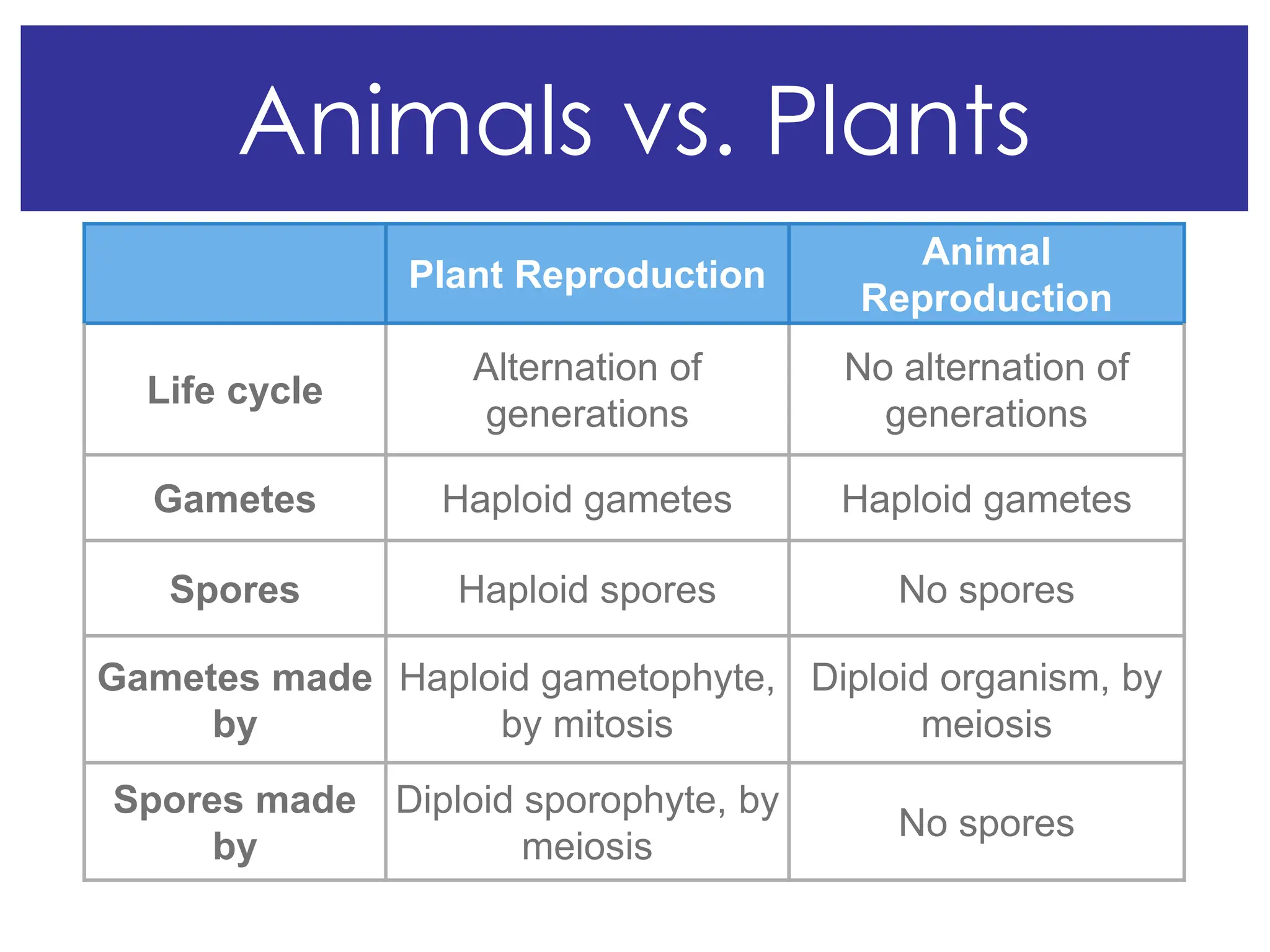
Animals vs. Plants
Plant Reproduction
Animal
Reproduction
Life cycle
Alternation of
generations
No alternation of
generations
Gametes Haploid gametes Haploid gametes
Spores Haploid spores No spores
Gametes made
by
Haploid gametophyte,
by mitosis
Diploid organism, by
meiosis
Spores made
by
Diploid sporophyte, by
meiosis
No spores
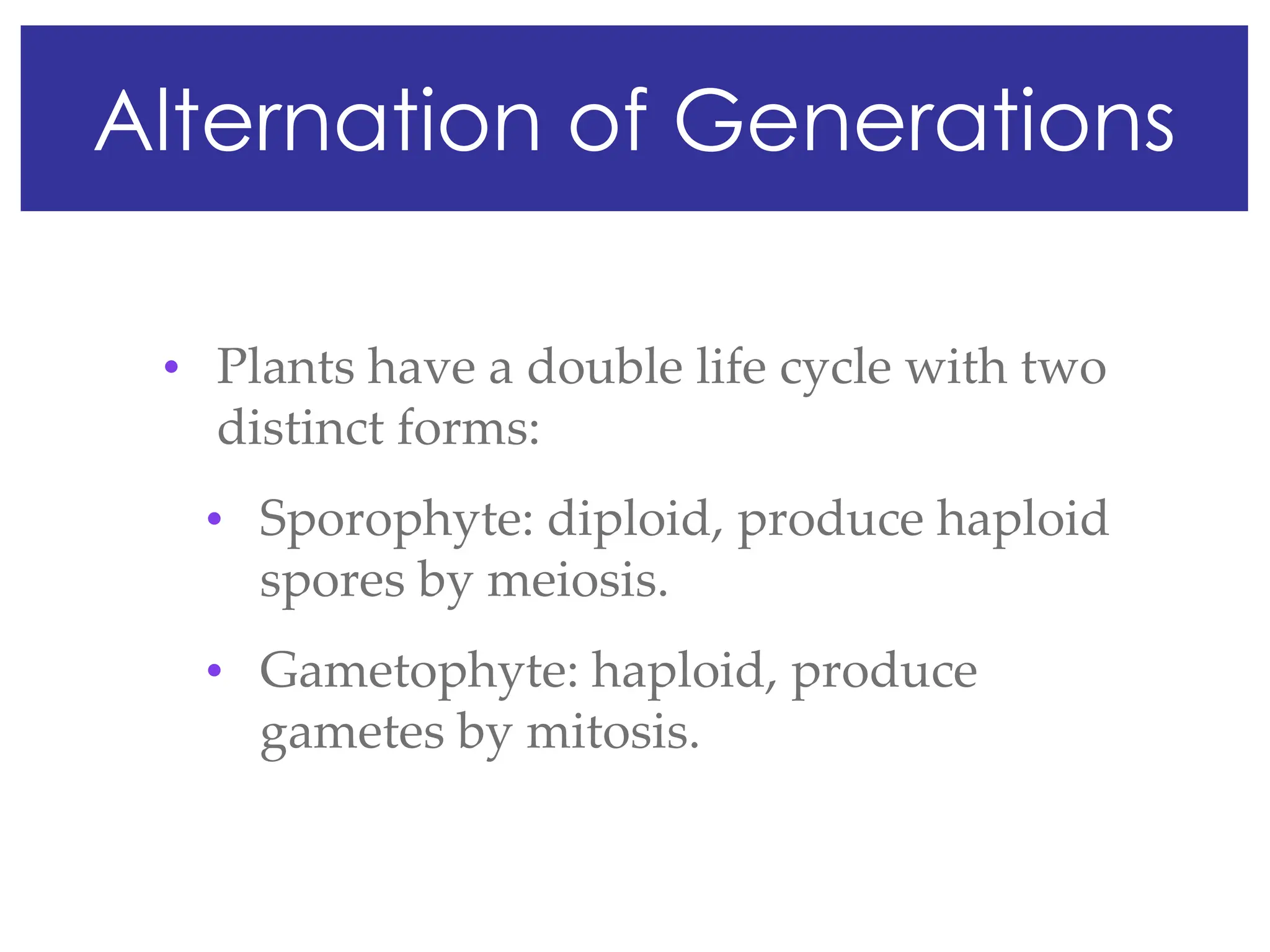
Alternation of Generations
• Plants have a double life cycle with two
distinct forms:
• Sporophyte: diploid, produce haploid
spores by meiosis.
• Gametophyte: haploid, produce
gametes by mitosis.
gamete formation
Angiosperm Life Cycle
Gametogenesis: Male
Gametogenesis: Female
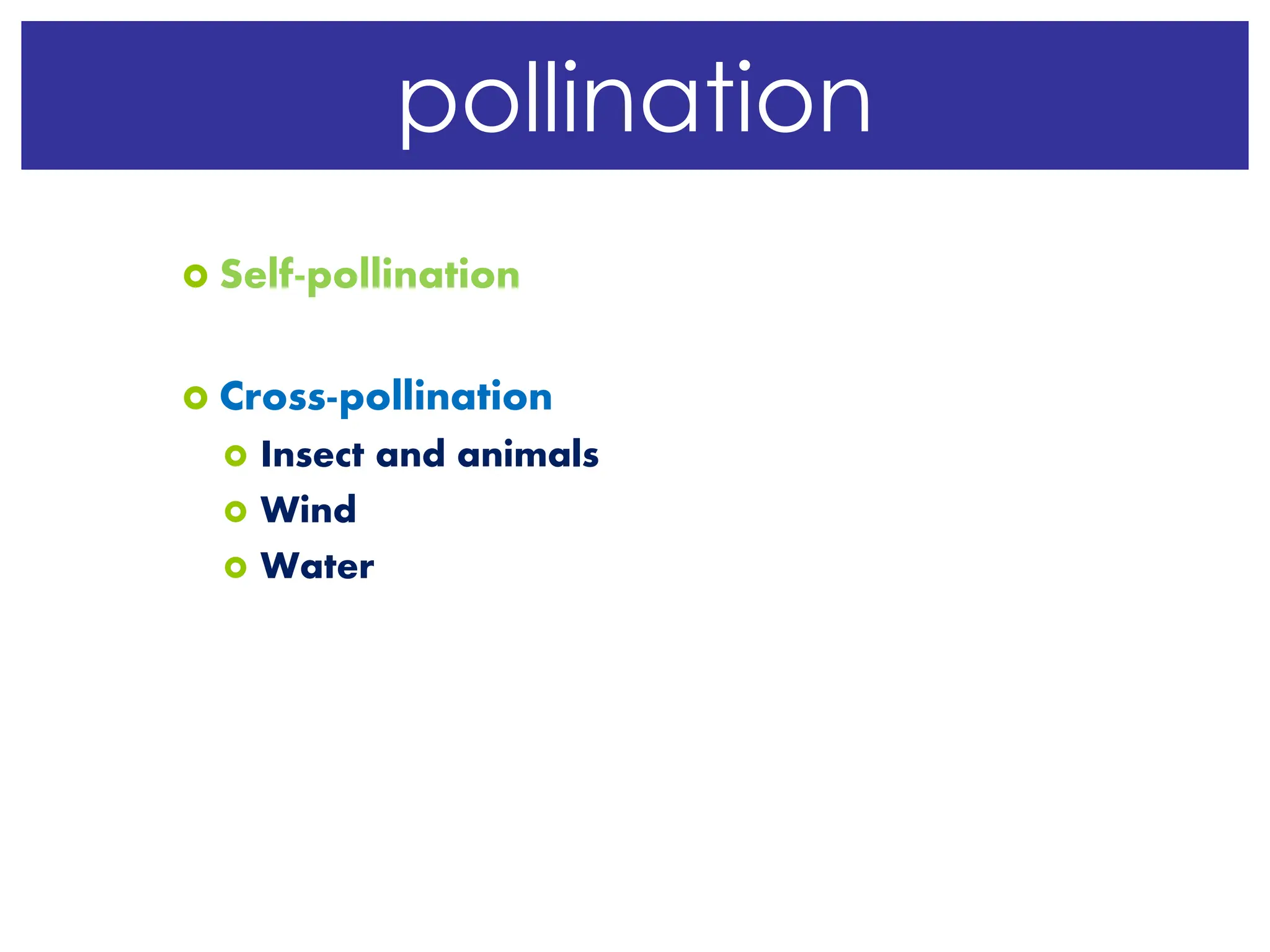
 Self-pollination
 Cross-pollination
 Insect and animals
 Wind
 Water
pollination
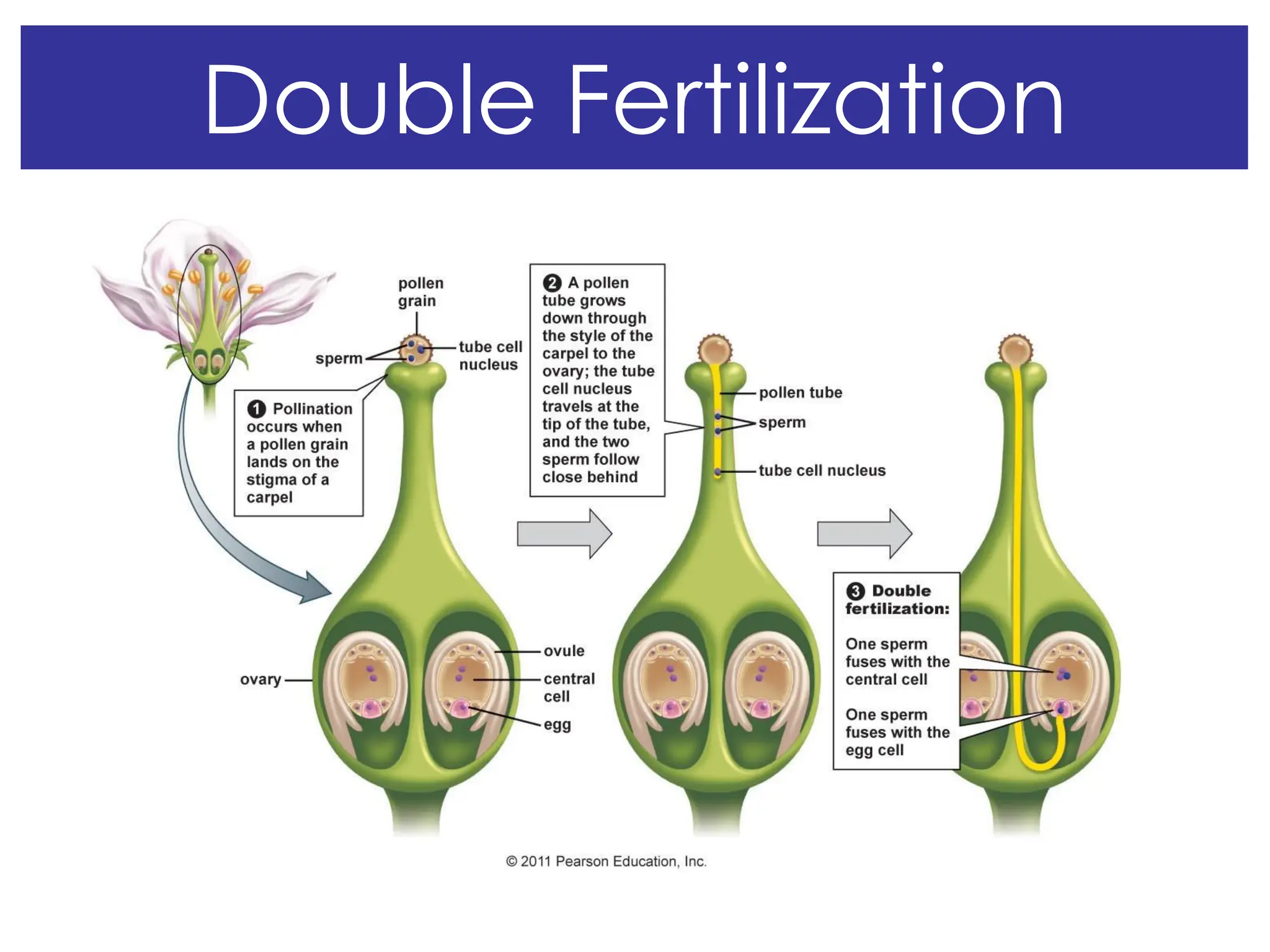
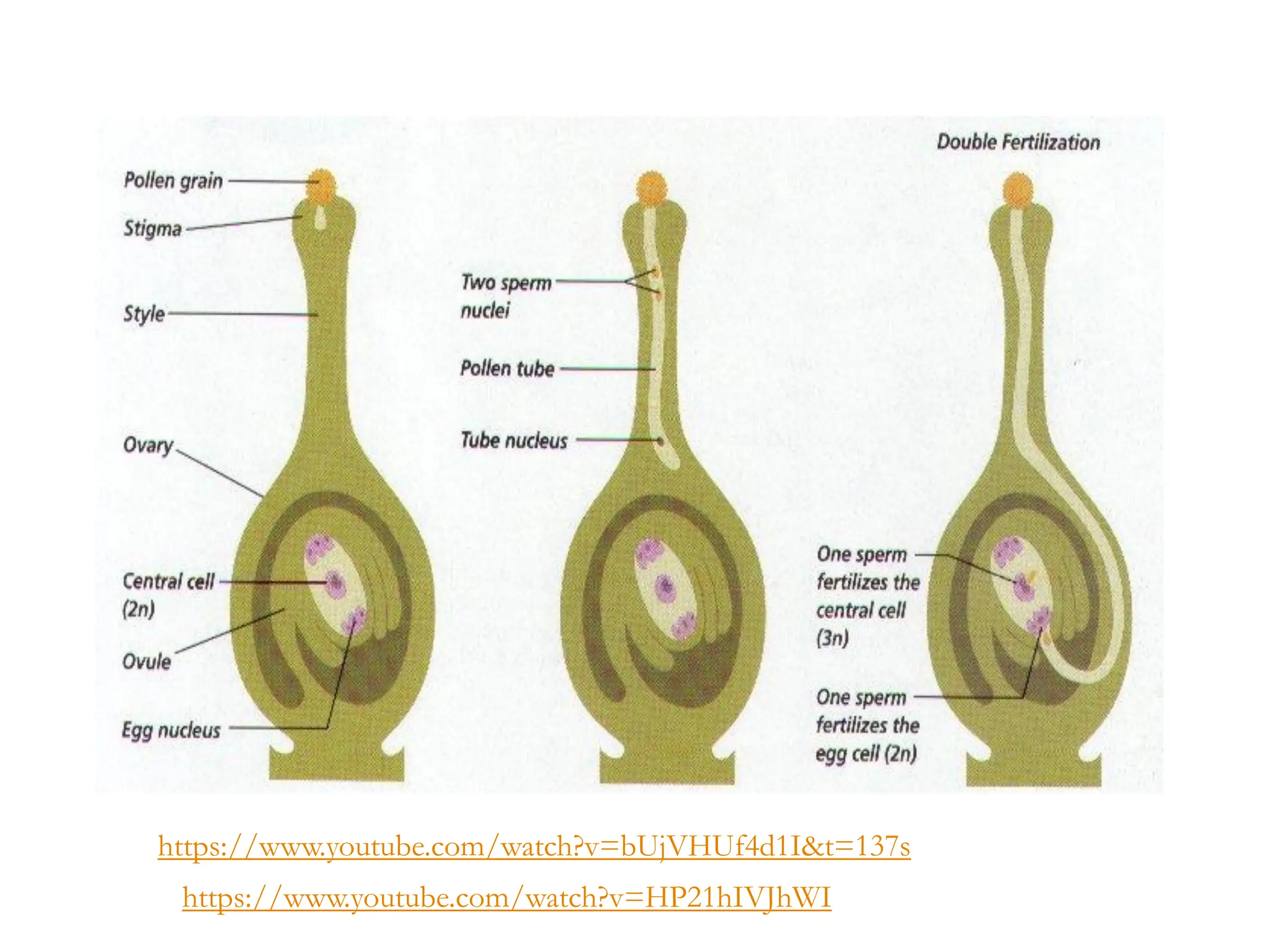
Double Fertilization
https://www.youtube.com/watch?v=bUjVHUf4d1I&t=137s
https://www.youtube.com/watch?v=HP21hIVJhWI
SEED GERMINATION
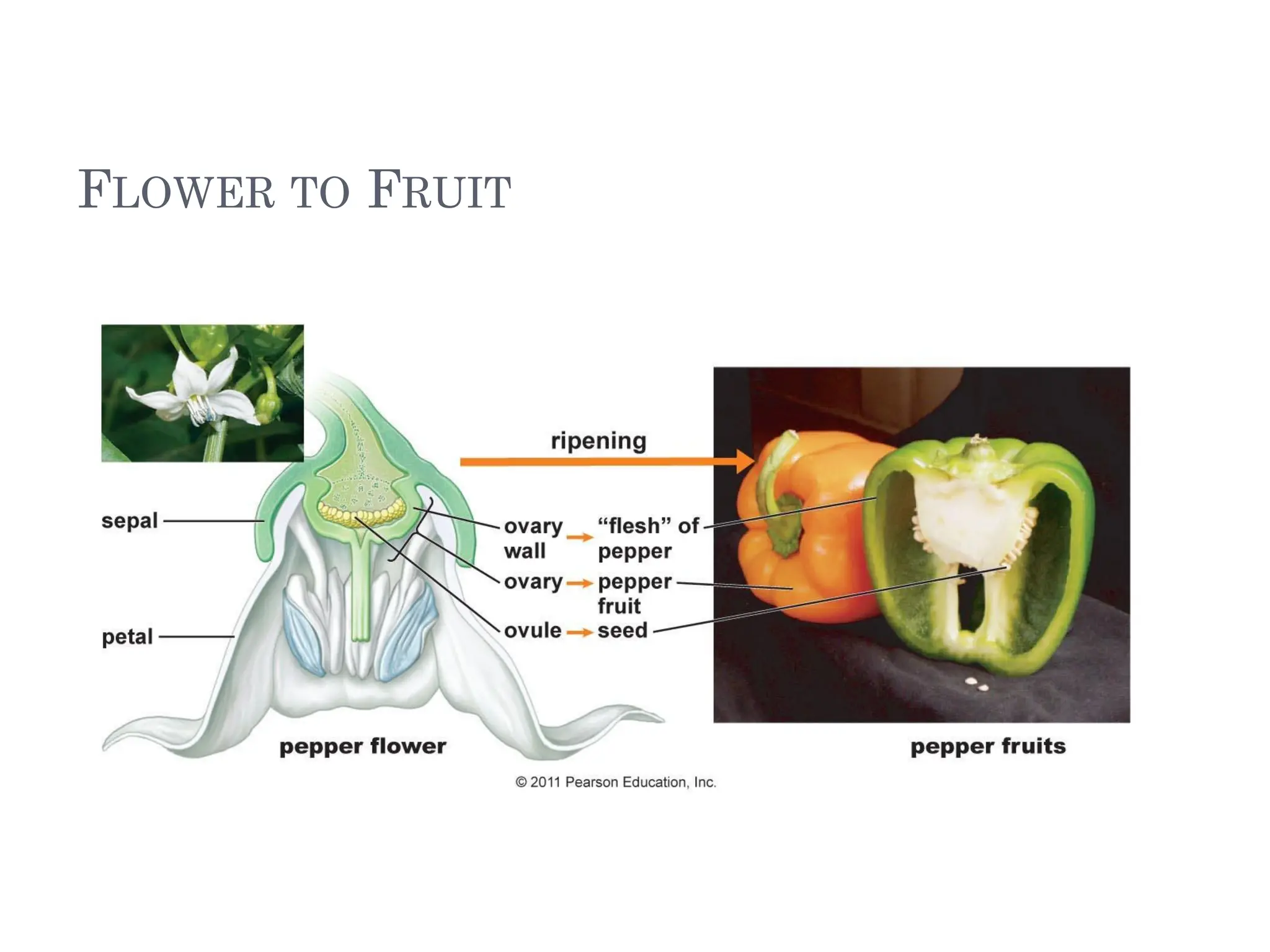
FLOWER TO FRUIT
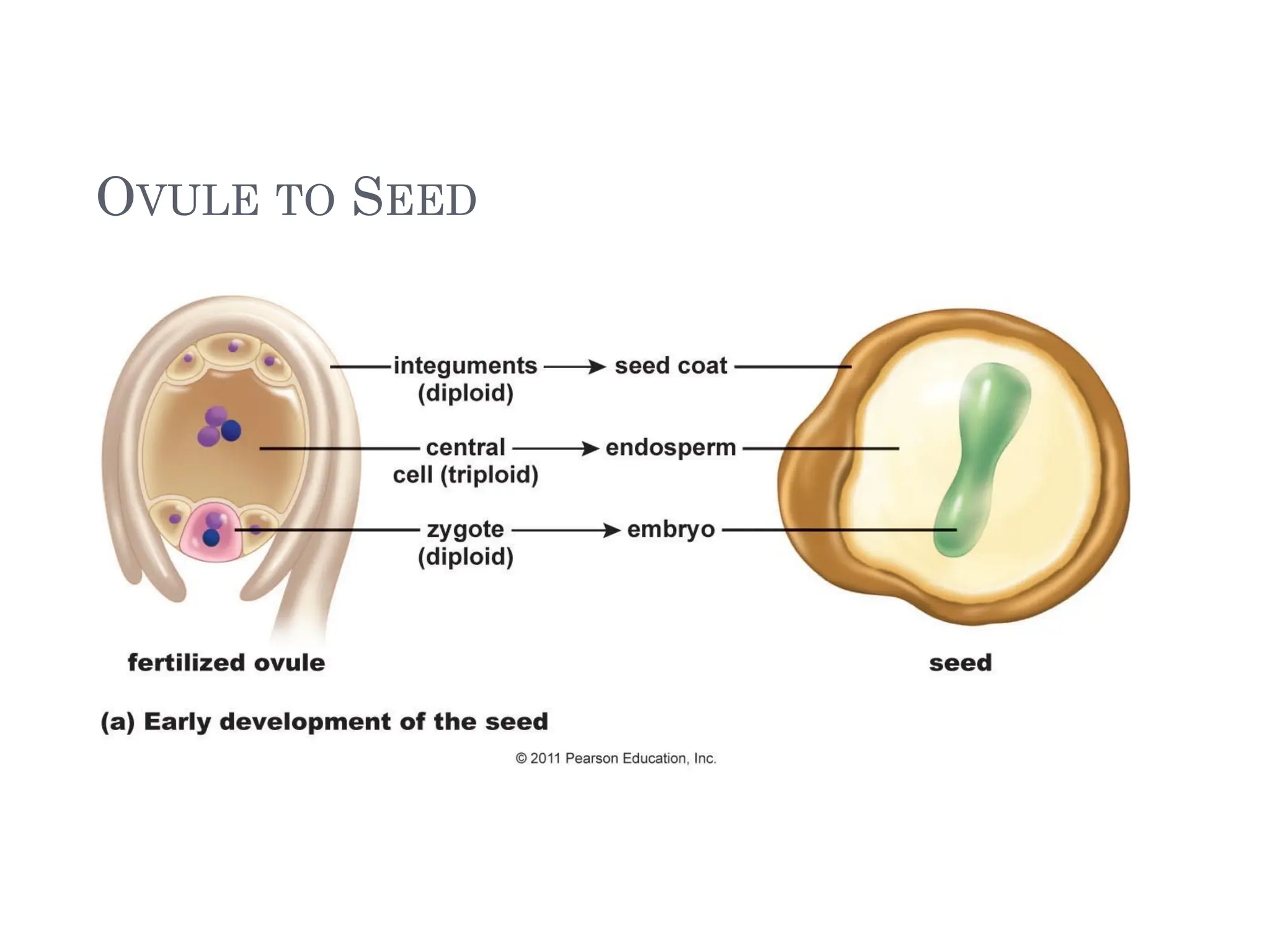
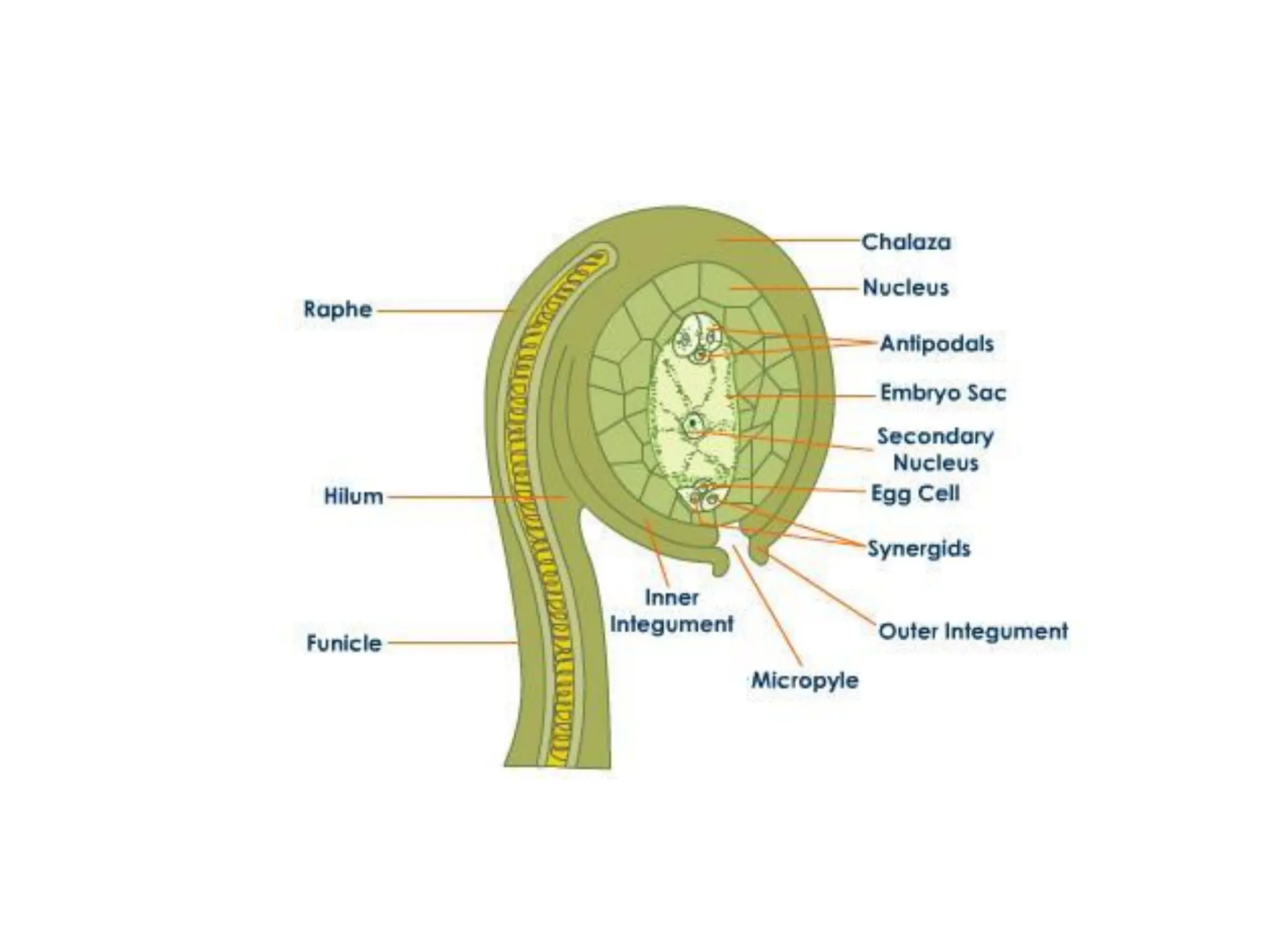
OVULE TO SEED
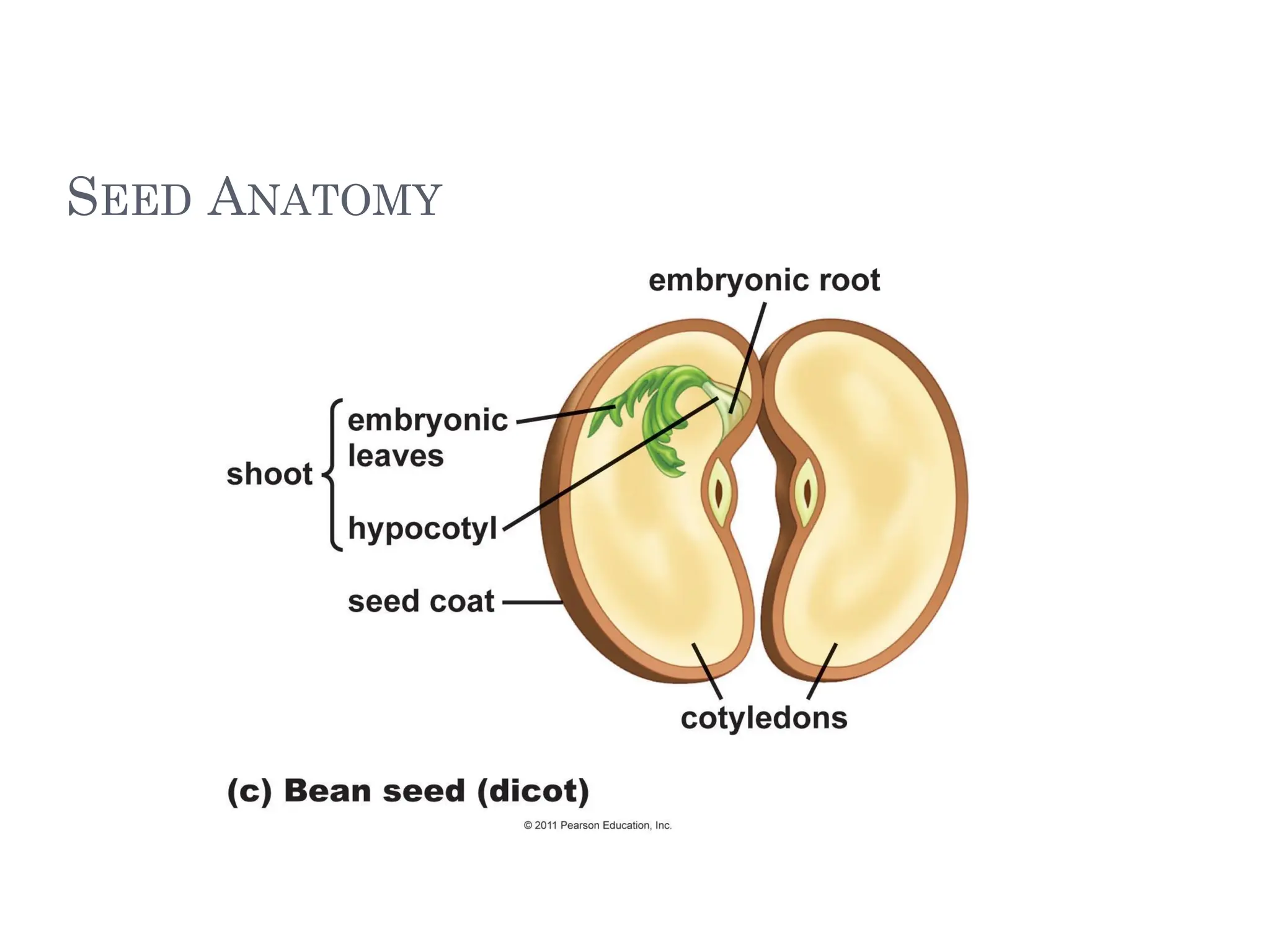
SEED ANATOMY
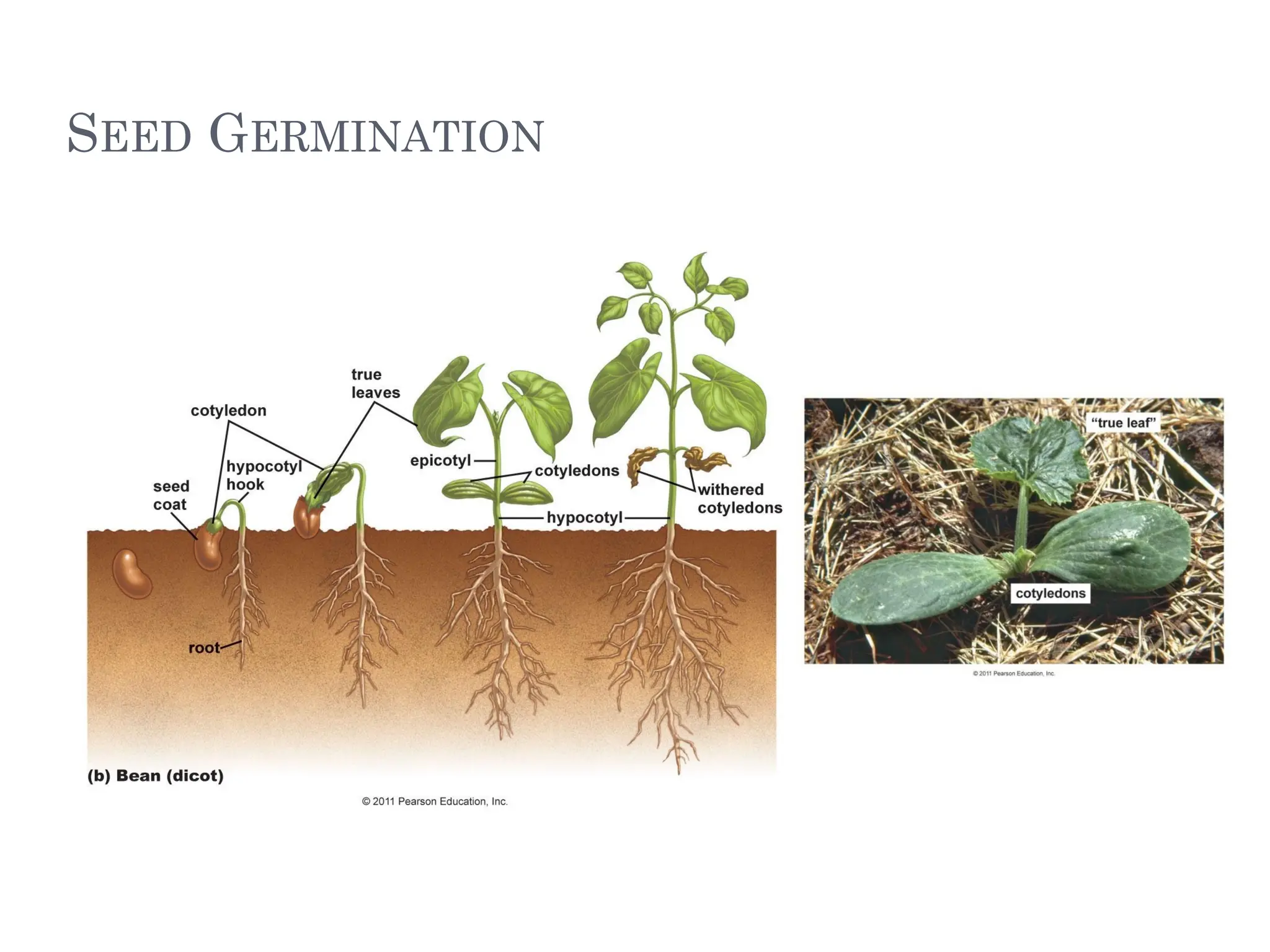
SEED GERMINATION
The structure of mature seed
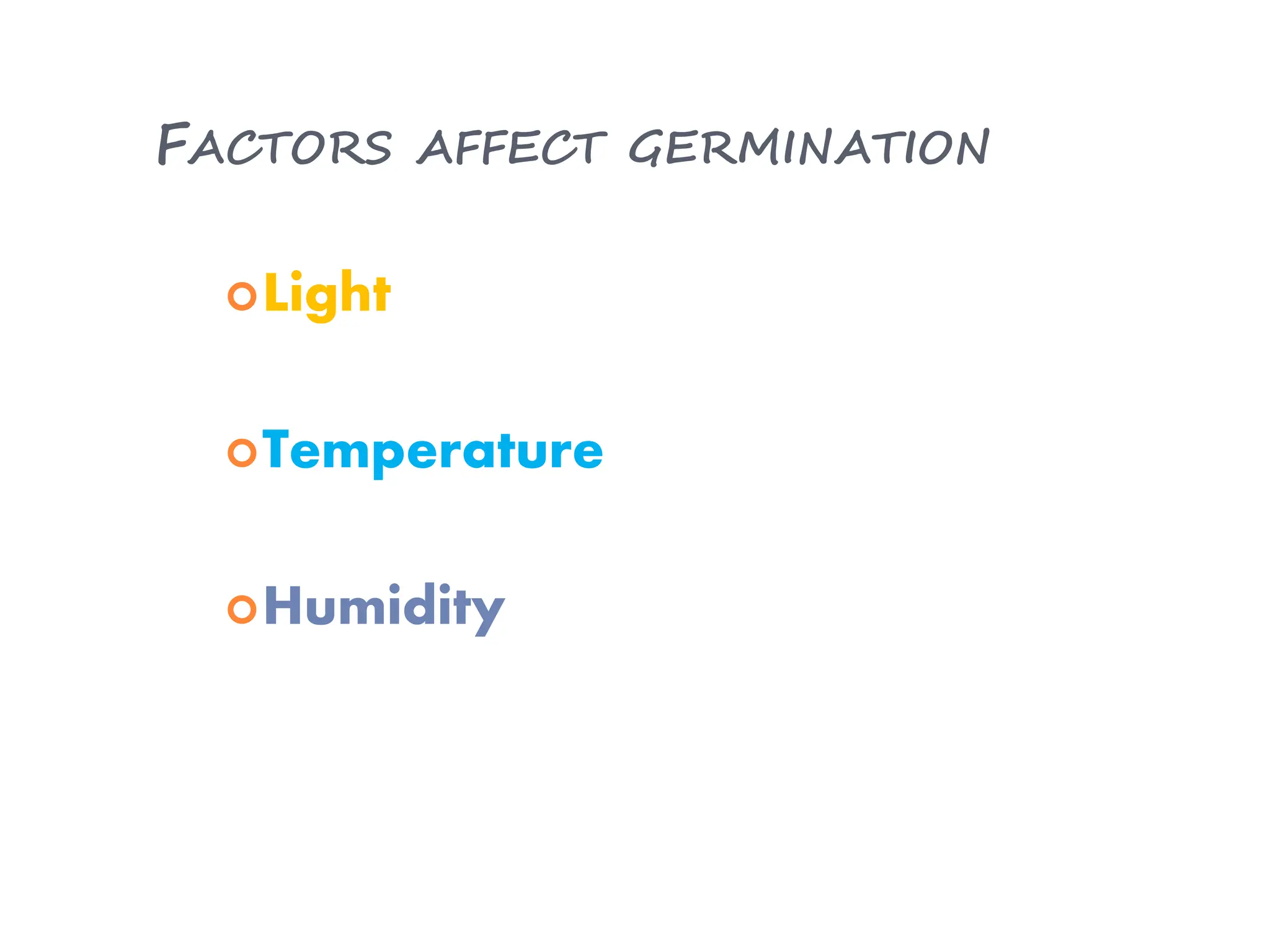
Light
Temperature
Humidity
FACTORS AFFECT GERMINATION
TYPES OF GERMINATION
Epigeal
Hypogeal
TYPES OF GERMINATION
ASEXUAL REPRODUCTION IN
PLANTS & ANIMALS
 Asexual reproduction is natural “cloning.”
Parts of the plant, such as leaves or
stems, produce roots and become an
independent plant.
 List some benefits and some drawbacks to
asexual reproduction.
Binary fission
Regeneration
Budding
Parthenogenesis
Sporulation
Vegetative propagation
THANK YOU FOR YOUR COOPERATION
☺
HAPPY HOLIDAY
https://www.youtube.com/watch?v=dYu-0rOnLpA

Lecture 8 - Reproduction and reproduce.pdf

  • 1.
    reproduction SB0014 syafa @ ums.edu.my PusatPersediaan Sains dan Teknologi Universiti Malaysia Sabah
  • 2.
    Topic Outline • Humanreproductive system • Roles of hormones • Sexual reproductive of flowering plant • Asexual reproduction in animal and plant At the end of this chapter, student should be able to describe about human reproductive system, roles of hormones and sexual reproduction for flowering plant. Also, understand the asexual reproduction in animal and plant
  • 3.
    from puberty tomenopause, fertility and contraception Despite being one of the most important processes in nature, human reproduction is still widely misunderstood by many of us. Here, you will learn about human reproduction by exploring the underlying biology, the most common myths, and the latest medical advances. To help you understand the realities of making babies, having babies, and not having babies.
  • 6.
  • 7.
  • 8.
    1. Testis 2. Scrotum 3.Seminiferous tubule 4. Epididymis 5. Vas deferens 6. Ejaculatory duct 7. Penis 8. Sex glands • Seminal vesicle (semen) • Prostate gland (alkaline fluid) • Bulborethral gland (lubricant) 1. Ovaries 2. Oviduct / Fallopian tube 3. Uterus 4. Cervix 5. Vagina
  • 10.
  • 11.
    • Primordial germcell (embryo) • Spermatogonium (mitosis) • Spermatocyte ✓ Primary spermatocyte (meiosisi I) ✓ Secondary spermatocyte (meiosis II) • Spermatids • Spermatozoa (sperm) spermatogenesis
  • 13.
    Fig. 46.11 Copyright ©2002 Pearson Education, Inc., publishing as Benjamin Cummings
  • 14.
    Sperm structure: • Haploidnucleus. • Tipped with an acrosome. • Contains enzymes that help the sperm penetrate to the egg. • A large number of mitochondria provide ATP to power the flagellum. Copyright © 2002 Pearson Education, Inc., publishing as Benjamin Cummings Fig. 46.12
  • 15.
    PATHWAY OF SPERM Seminiferoustubule (testis) Ejaculatory duct Vas deferens (seminal vesicle) Epididymis (coiled tubule) pathway of sperm
  • 16.
  • 17.
     Primordial germcell (embryo)  Oogonia  Primary oocyte (Prophase I)  Secondary oocyte (puberty)  Ovum (Fertilised) oogenesis
  • 18.
     Primary follicle(primary oocyte)  Graafian follicle (release secondary oocyte)  Corpus luteum  First polar body (secondary oocyte)  Second polar body (ovum) oogenesis
  • 20.
    Fig. 46.13 Copyright ©2002 Pearson Education, Inc., publishing as Benjamin Cummings
  • 22.
     Menstrual cycle(Uterus changes)  Ovulation cycle (ovulation)  Regulated by hormone • GnRHGonadotropin-releasing hormone • FSH (Follicle-stimulating hormone • LH (luteinising hormone) • Oestrogen • Progesterone female reproductive cycle
  • 24.
    THE MENSTURAL CYCLE Menstrualflow phase • Starting point of the cycle • Bleeding • discharge of endometrium wall • Last for 3-5 days • menstruation Secretory phase • Thickening of endometrium wall Proliferative phase • Regeneration of endometrium wall
  • 25.
  • 26.
    THE OVARIAN CYCLE Follicularphase • Growth of follicle • Oocyte enlarge • Follicle thickens • Maturation of follicle • OVULATION • Release secondary oocyte • Last for 7-14 days Luteal phase • Development of follicle tissue into corpus luteum
  • 27.
  • 28.
    Beginning of follicular phaseof ovaries During luteal phase of ovaries
  • 29.
    • Hypothalamus • GnRH(gonadotropin-releasing hormone) • Pituitary gland • FSH (follicle stimulating hormone) • LH (luteinising hormone) • Ovaries • Oestrogen / Estrogen • Progesterone the cycle and hormone
  • 30.
    2. FSH • Secretedby pituitary gland • FSH stimulate follicle growth (follicular phase) • Follicle secretes estrogen • Estrogen level increase, LH increase • Ovulation 3. LH • Stimulate transformation of follicle (remain) to corpus luteum (Luteal phase) • Corpus luteum secretes estrogen and progesterone 1. GnRH • Secreted by hypothalamus • Stimulates pituitary gland to secrete FSH and LH
  • 31.
    4. Estrogen &Progesterone • Secreted by follicle • In the ovary • Inhibits secretion of FSH and LH <avoid follicle growth) • Maintain thickening of endometrium wall
  • 32.
  • 33.
  • 34.
  • 35.
     Sperm andovum fertilised • conception  Pregnancy • Gestation  Birth • parturition
  • 36.
     Zygote  Embryo Foetus  Embyogenesis  Organogenesis
  • 38.
    zygote blastocyst blastula blastocoel blastomere cleavage morula implantation *trophoblast Gastrulation •Three main layer formed • Embyo surrounded by chorion • Develop in cavity ; amnion • Yolk sac • Allantois ; umbilical cord
  • 40.
  • 41.
     Formation ofthe organs  From the three layers  Endoderm  The innermost layer  Goes on to form the gut  Mesoderm The middle layer. Goes on to form the muscles, circulatory system, blood and many different organs  Ectoderm • The outermost • Goes on to form the skin and nervous system
  • 44.
  • 45.
    ❖ Pregnancy ispreceded by conception and continues until birth ❖ In placental mammals, pregnancy is the condition of carrying one or more embryos ❖A human pregnancy averages 266 days/38 weeks/9 months
  • 46.
    Human gestation isdivided into three trimesters. ❑ First trimester. o Fertilization occurs in the oviduct. o 24 hours latter the zygote begins cleavage. o 3- 4 days after fertilization the zygote that reaches the uterus the embryo is a ball of cells. o It takes about 1 week past fertilization for the blastocyst to form. o After 5 more days it implants in the endometrium. Copyright © 2002 Pearson Education, Inc., publishing as Benjamin Cummings
  • 47.
    Copyright © 2002Pearson Education, Inc., publishing as Benjamin Cummings
  • 48.
    ❑ For thefirst 2 – 4 weeks of development the embryo obtains nutrients from the endometrium. ❑ Then the placenta provides for the diffusion of material between maternal and embryonic circulations. Fig. 46.17 Copyright © 2002 Pearson Education, Inc., publishing as Benjamin Cummings
  • 49.
    ❑ Organogenesis occursduring the first trimester o By week 4: the heart is beating o By the end of week 8: all of the major structures of the adult are present in rudimentary form o The rapidity of development makes this a time when the embryo is especially sensitive to environmental insult Copyright © 2002 Pearson Education, Inc., publishing as Benjamin Cummings
  • 50.
    ❑ Maternal changesduring the first trimester ❑ The embryo secretes human chorionic gonadotropin (HCG) ❑ Maintains the corpus luteum and thus maintains the endometrium ❑ High levels of progesterone cause. o Increased mucus in the cervix o Growth of the maternal part of the placenta o Enlargement of the uterus o Cessation of ovarian and menstrual cycling o Breasts enlarge rapidly and are often very tender Copyright © 2002 Pearson Education, Inc., publishing as Benjamin Cummings
  • 51.
    ❑ Second trimester. oFetus grows rapidly and is very active o Hormonal levels stabilize as HCG declines o Corpus luteum deteriorates o Placenta secretes progesterone, which maintains the pregnancy Copyright © 2002 Pearson Education, Inc., publishing as Benjamin Cummings
  • 52.
    ❑ Third trimester oFetus grows rapidly o Fetal activity may decrease as the fetus fills the space available to it o Maternal abdominal organs become compressed and displaced o Terminates with parturition Copyright © 2002 Pearson Education, Inc., publishing as Benjamin Cummings
  • 53.
    ❑ Hormonal regulationof birth. Copyright © 2002 Pearson Education, Inc., publishing as Benjamin Cummings
  • 54.
    ❑ Parturition occursas a result of labor ▪ First stage: opening up and thinning of the cervix. ▪ Ending in complete dilation. ▪ Second stage: Expulsion of the baby as a result of strong uterine contractions. ▪ Third stage: Expulsion of the placenta. Copyright © 2002 Pearson Education, Inc., publishing as Benjamin Cummings
  • 55.
     Gestation  HCG(human chorionic gonadotropin)  Estrogen  Progesterone  Parturition  Oxytocin  Estrogen  Progesterone  Lactation  Prolactin  Oxytocin  colostrum roles of hormones
  • 56.
  • 57.
     Reproductive organsin flowering plants  Gamete formation  Development of the male gamete  Development of the female gamete  Pollination  Fertilisation  Seed germination  The structure of mature seed  Factors affect germination  The process of germination  Types of germination
  • 58.
     Alteration ofgeneration  Sporophyte generation (2n)  Gametophyte generation (n)  Male = microspores = microgametophyte  Female = macrospores = megagametophyte INTRODUCTION
  • 60.
  • 61.
  • 62.
    Incomplete flowers • Flowersare complete if they have all parts, and perfect if they have both male and female parts. • Grass flowers: incomplete, usually imperfect (separate male and female flowers) (How about papaya tree?) • A tulip is complete (though the sepals are the same color as the petals) and perfect.
  • 63.
    Animals vs. Plants PlantReproduction Animal Reproduction Life cycle Alternation of generations No alternation of generations Gametes Haploid gametes Haploid gametes Spores Haploid spores No spores Gametes made by Haploid gametophyte, by mitosis Diploid organism, by meiosis Spores made by Diploid sporophyte, by meiosis No spores
  • 64.
    Alternation of Generations •Plants have a double life cycle with two distinct forms: • Sporophyte: diploid, produce haploid spores by meiosis. • Gametophyte: haploid, produce gametes by mitosis.
  • 65.
  • 66.
  • 67.
  • 69.
  • 72.
     Self-pollination  Cross-pollination Insect and animals  Wind  Water pollination
  • 73.
  • 74.
  • 75.
  • 76.
  • 77.
  • 78.
  • 79.
  • 80.
    The structure ofmature seed
  • 82.
  • 83.
  • 84.
  • 85.
    ASEXUAL REPRODUCTION IN PLANTS& ANIMALS  Asexual reproduction is natural “cloning.” Parts of the plant, such as leaves or stems, produce roots and become an independent plant.  List some benefits and some drawbacks to asexual reproduction.
  • 86.
  • 87.
    THANK YOU FORYOUR COOPERATION ☺ HAPPY HOLIDAY
  • 88.