Objective Tree Analysis
Contents
1. Learning Objective
2. What is an Objective Tree Analysis?
3. Reformulating Problem Statements into Objective Statements
4. Steps in Formulating an Objective Tree
5. Examples of Objective Tree
6. Exercises
2
2. What is an Objective Tree Analysis
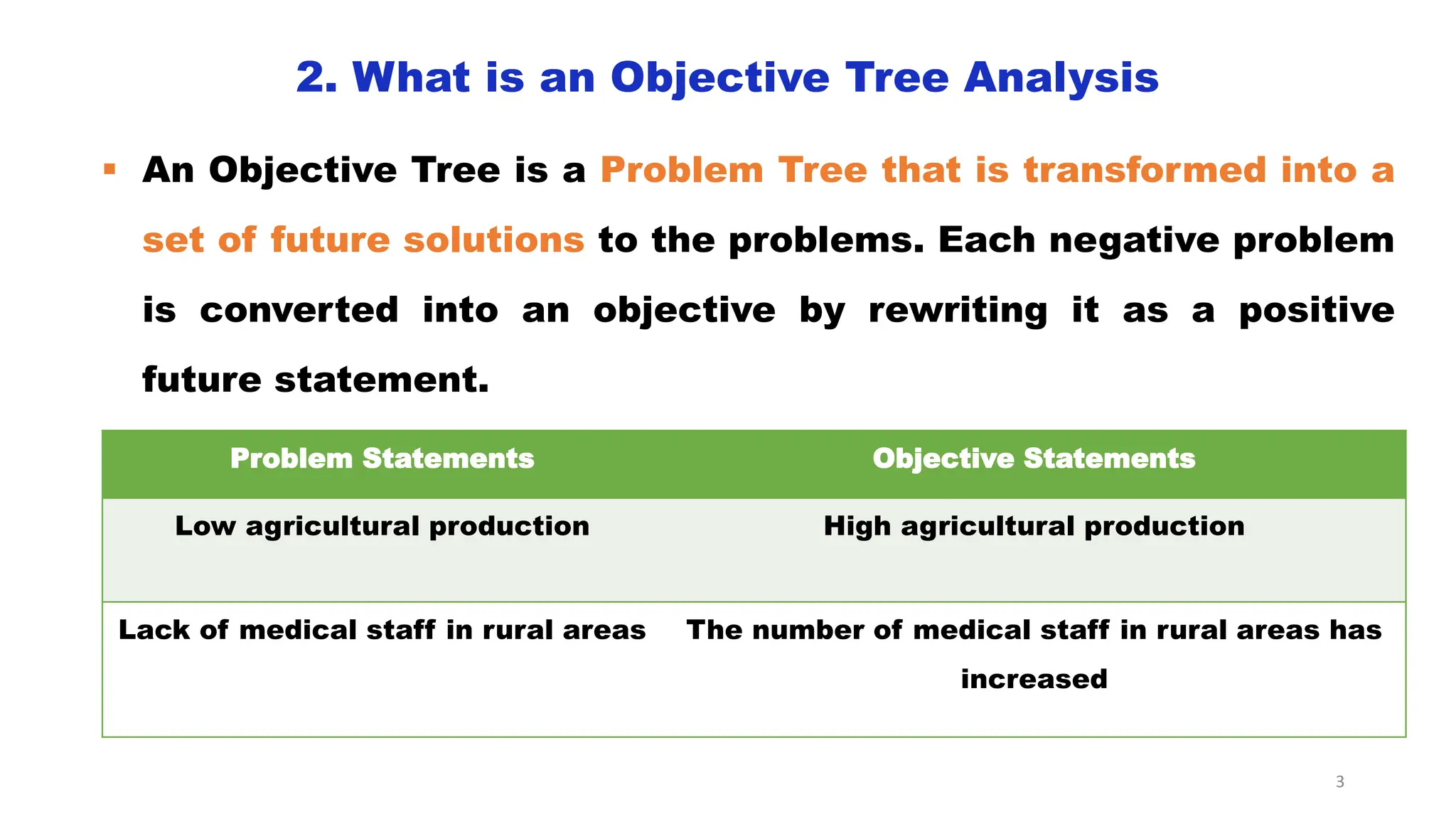
 An Objective Tree is a Problem Tree that is transformed into a
set of future solutions to the problems. Each negative problem
is converted into an objective by rewriting it as a positive
future statement.
3
Problem Statements Objective Statements
Low agricultural production High agricultural production
Lack of medical staff in rural areas The number of medical staff in rural areas has
increased
2. What is an Objective Tree Analysis
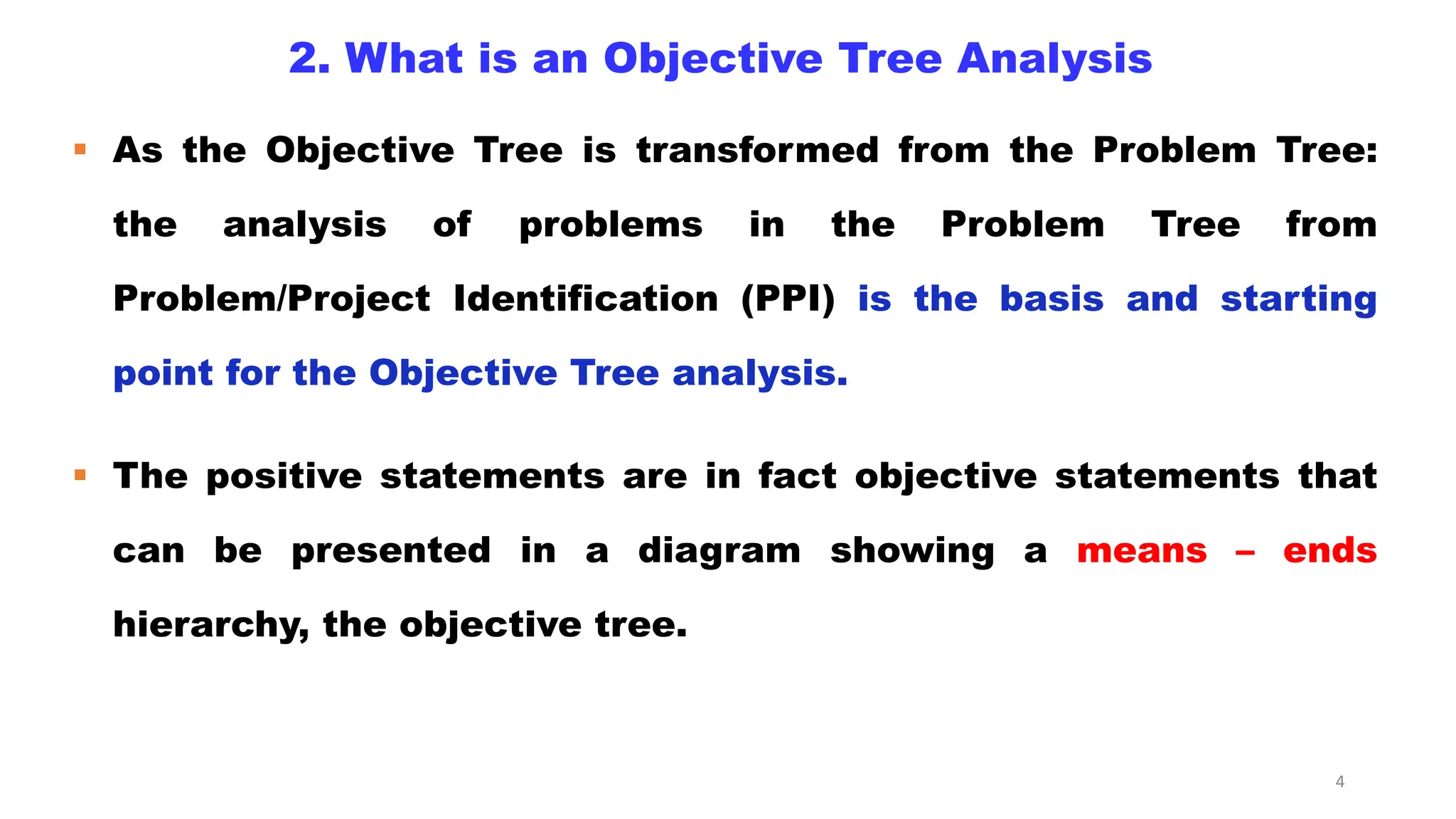
 As the Objective Tree is transformed from the Problem Tree:
the analysis of problems in the Problem Tree from
Problem/Project Identification (PPI) is the basis and starting
point for the Objective Tree analysis.
 The positive statements are in fact objective statements that
can be presented in a diagram showing a means – ends
hierarchy, the objective tree.
4
2. What is an Objective Tree Analysis
 The analysis of objective tree aims:
 Provide a clear overview of the desired future situation once
problems have been identified and reformulate into objectives;
 Verify the hierarchy of objectives;
 Illustrate the means-ends relationships in a diagram.
5
2. What is an Objective Tree Analysis
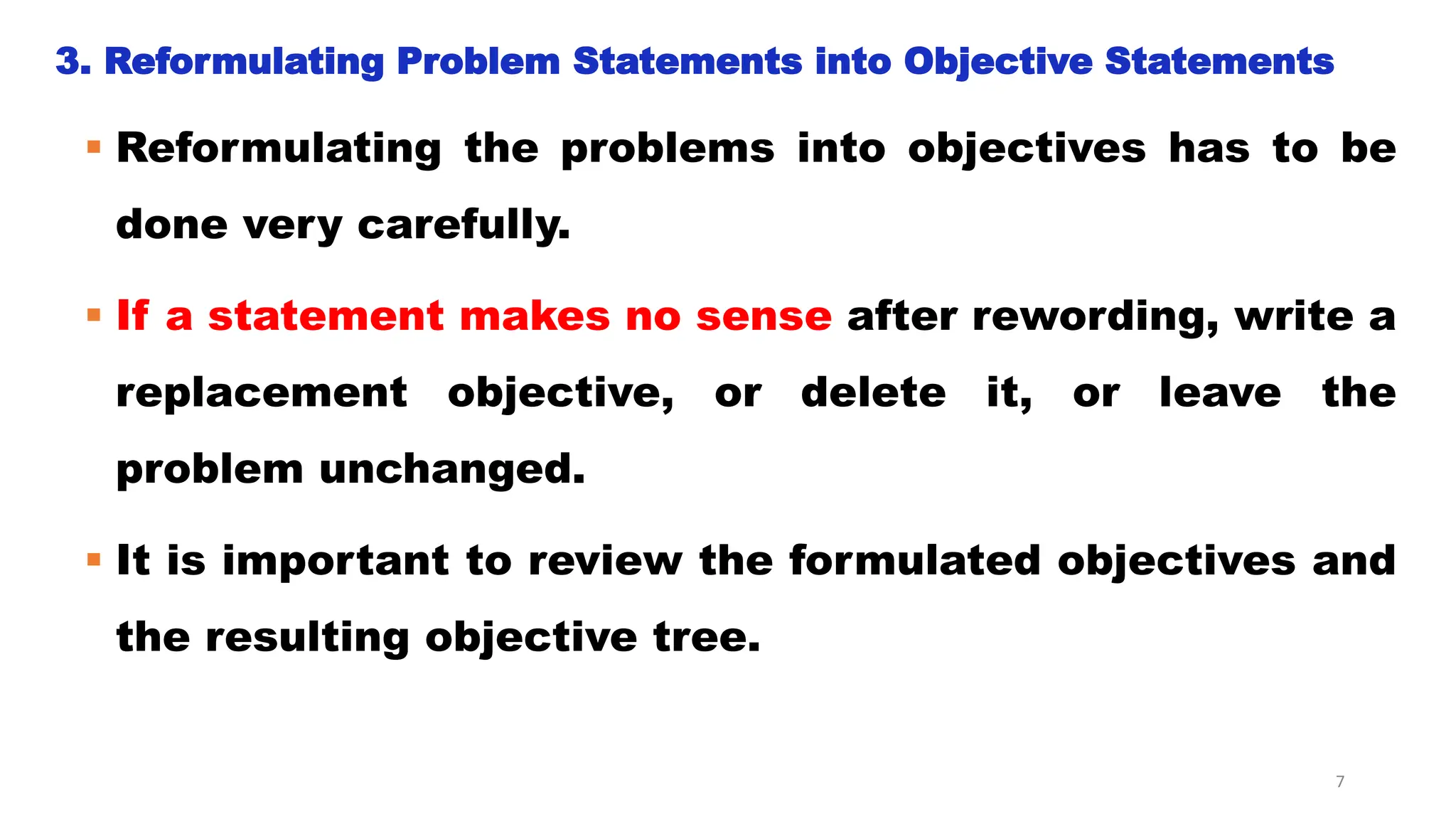
6
Problem Tree
Causes
Effects
Negative Statements
Means
Ends
Objective Tree
Positive
Statements
3. Reformulating Problem Statements into Objective Statements
 Reformulating the problems into objectives has to be
done very carefully.
 If a statement makes no sense after rewording, write a
replacement objective, or delete it, or leave the
problem unchanged.
 It is important to review the formulated objectives and
the resulting objective tree.
7
3. Reformulating Problem Statements into Objective Statements
 Problem statement: “lack of adequate rain levels”
cannot be transformed into “adequate rain levels
available” because it is an unrealistic objective. We
cannot intervene into the natural phenomenon by
predicting or hoping that there will be adequate rain.
This problem, however, could be rewritten as
“irrigation system established and operational” which
sounds more realistic and can be intervened.
8
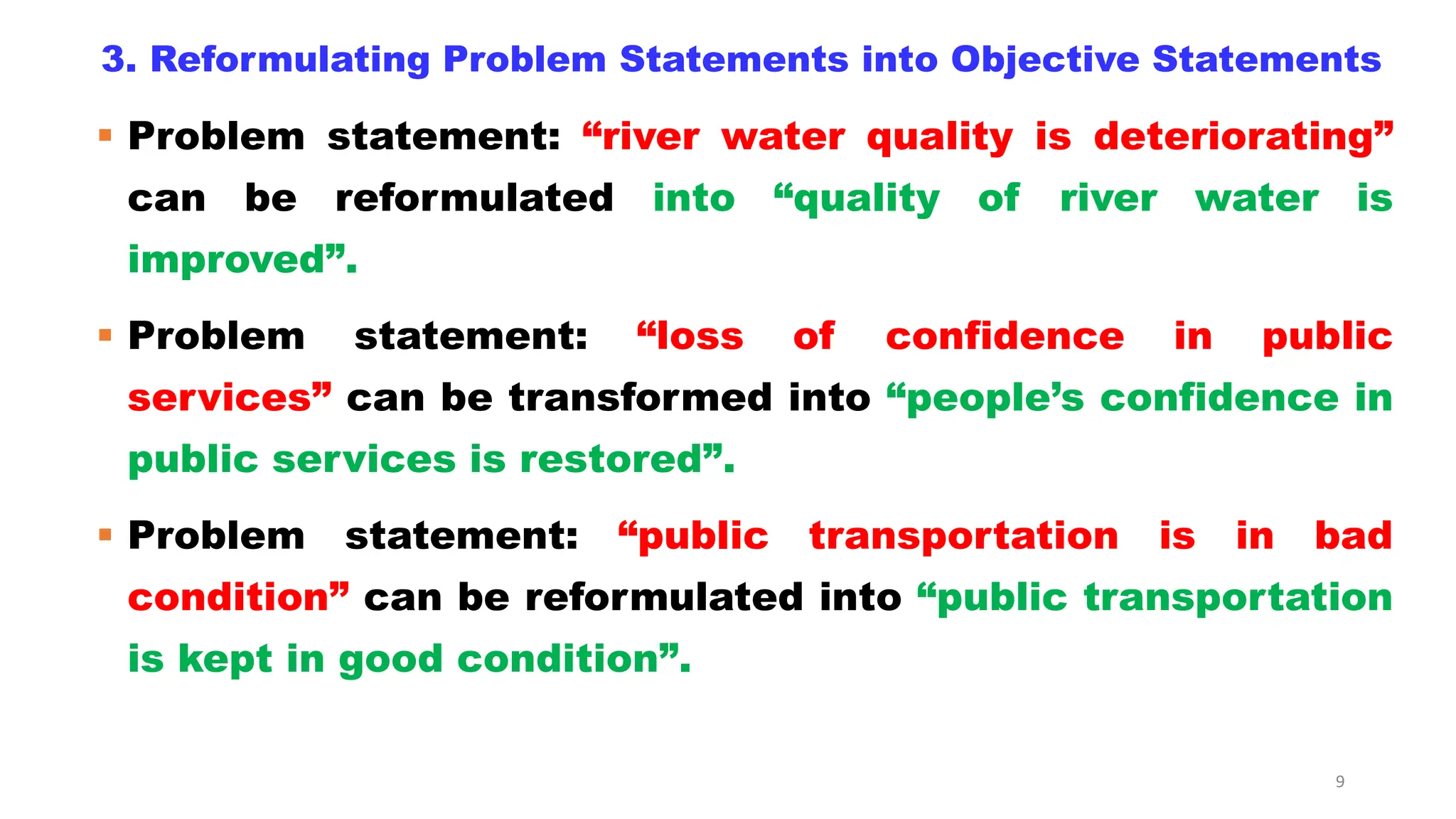
3. Reformulating Problem Statements into Objective Statements
 Problem statement: “river water quality is deteriorating”
can be reformulated into “quality of river water is
improved”.
 Problem statement: “loss of confidence in public
services” can be transformed into “people’s confidence in
public services is restored”.
 Problem statement: “public transportation is in bad
condition” can be reformulated into “public transportation
is kept in good condition”.
9
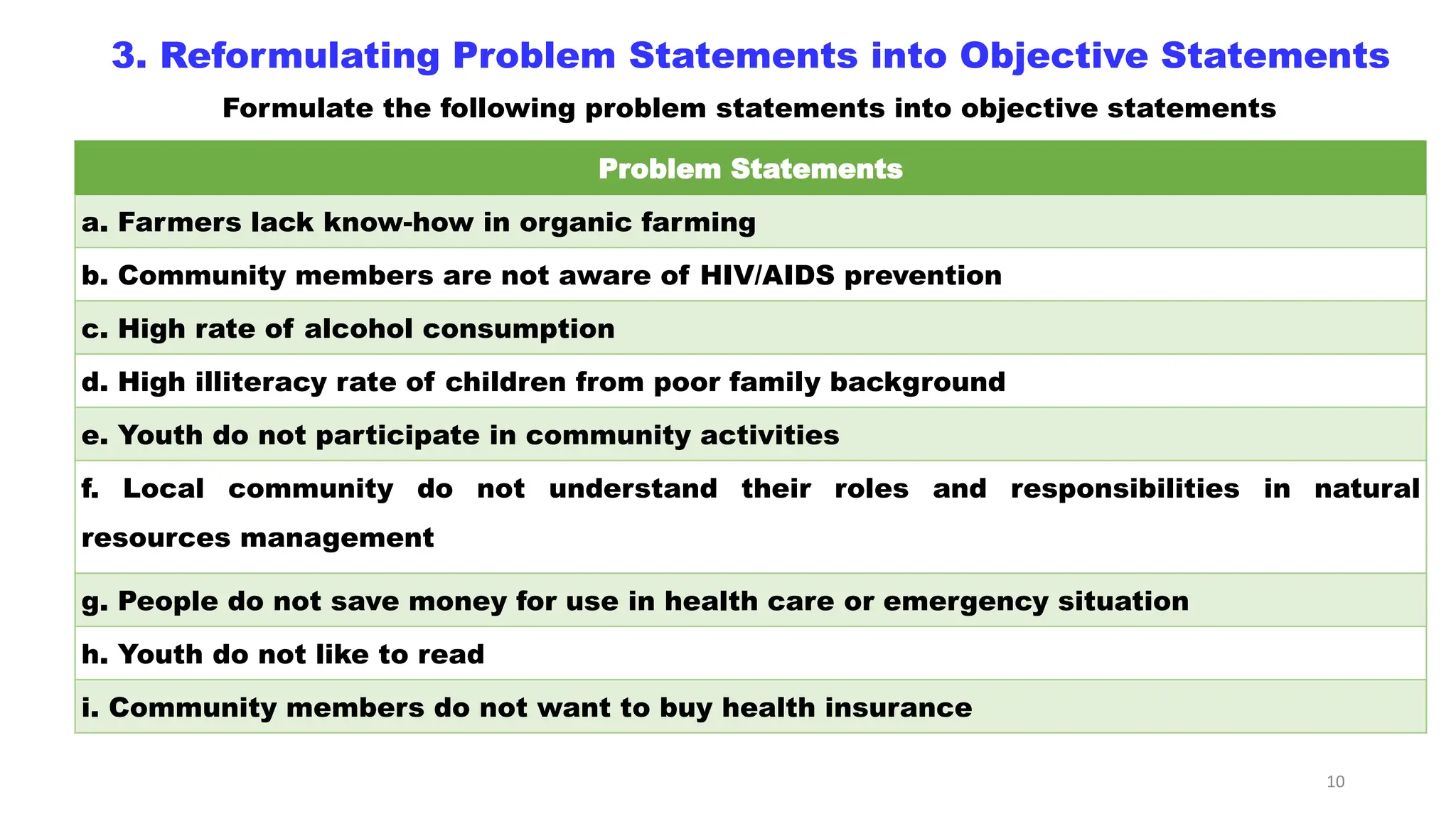
3. Reformulating Problem Statements into Objective Statements
Formulate the following problem statements into objective statements
10
Problem Statements
a. Farmers lack know-how in organic farming
b. Community members are not aware of HIV/AIDS prevention
c. High rate of alcohol consumption
d. High illiteracy rate of children from poor family background
e. Youth do not participate in community activities
f. Local community do not understand their roles and responsibilities in natural
resources management
g. People do not save money for use in health care or emergency situation
h. Youth do not like to read
i. Community members do not want to buy health insurance
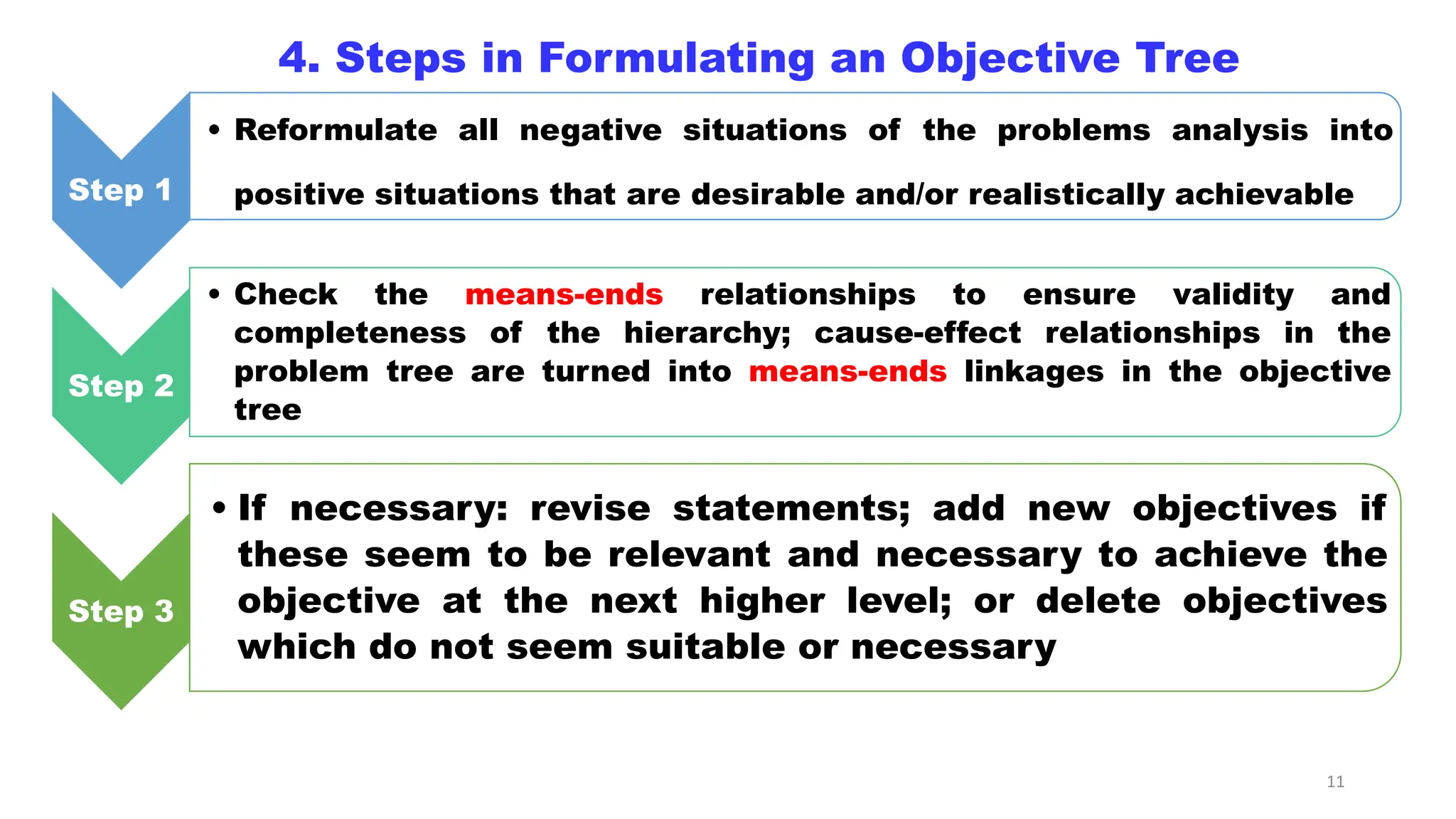
4. Steps in Formulating an Objective Tree
Step 1
• Reformulate all negative situations of the problems analysis into
positive situations that are desirable and/or realistically achievable
Step 2
• Check the means-ends relationships to ensure validity and
completeness of the hierarchy; cause-effect relationships in the
problem tree are turned into means-ends linkages in the objective
tree
Step 3
• If necessary: revise statements; add new objectives if
these seem to be relevant and necessary to achieve the
objective at the next higher level; or delete objectives
which do not seem suitable or necessary
11
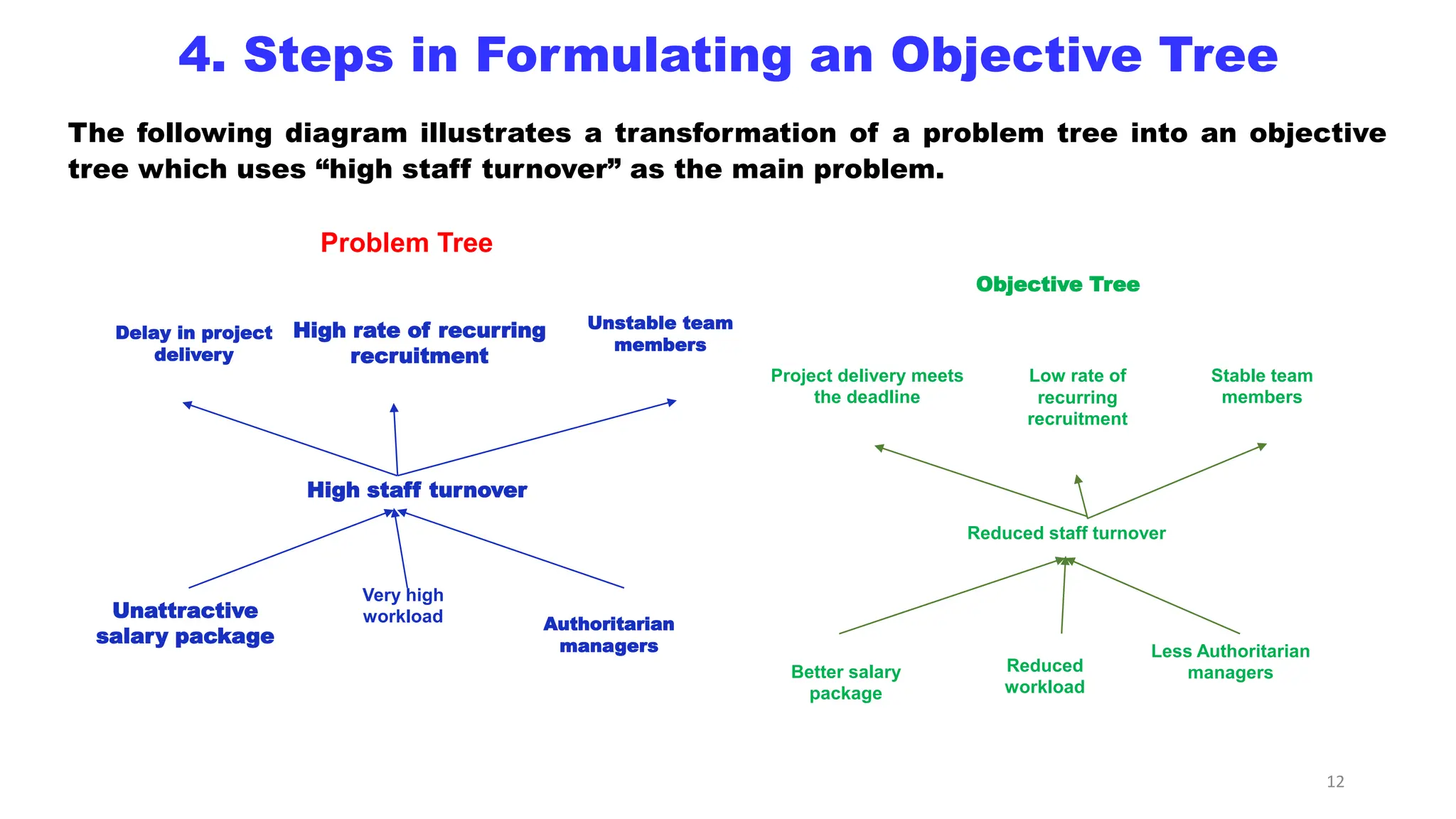
4. Steps in Formulating an Objective Tree
The following diagram illustrates a transformation of a problem tree into an objective
tree which uses “high staff turnover” as the main problem.
12
Problem Tree
High staff turnover
Delay in project
delivery
High rate of recurring
recruitment
Unstable team
members
Unattractive
salary package
Very high
workload Authoritarian
managers
Reduced staff turnover
Better salary
package
Reduced
workload
Less Authoritarian
managers
Project delivery meets
the deadline
Low rate of
recurring
recruitment
Stable team
members
Objective Tree
4. Steps in Formulating an Objective Tree
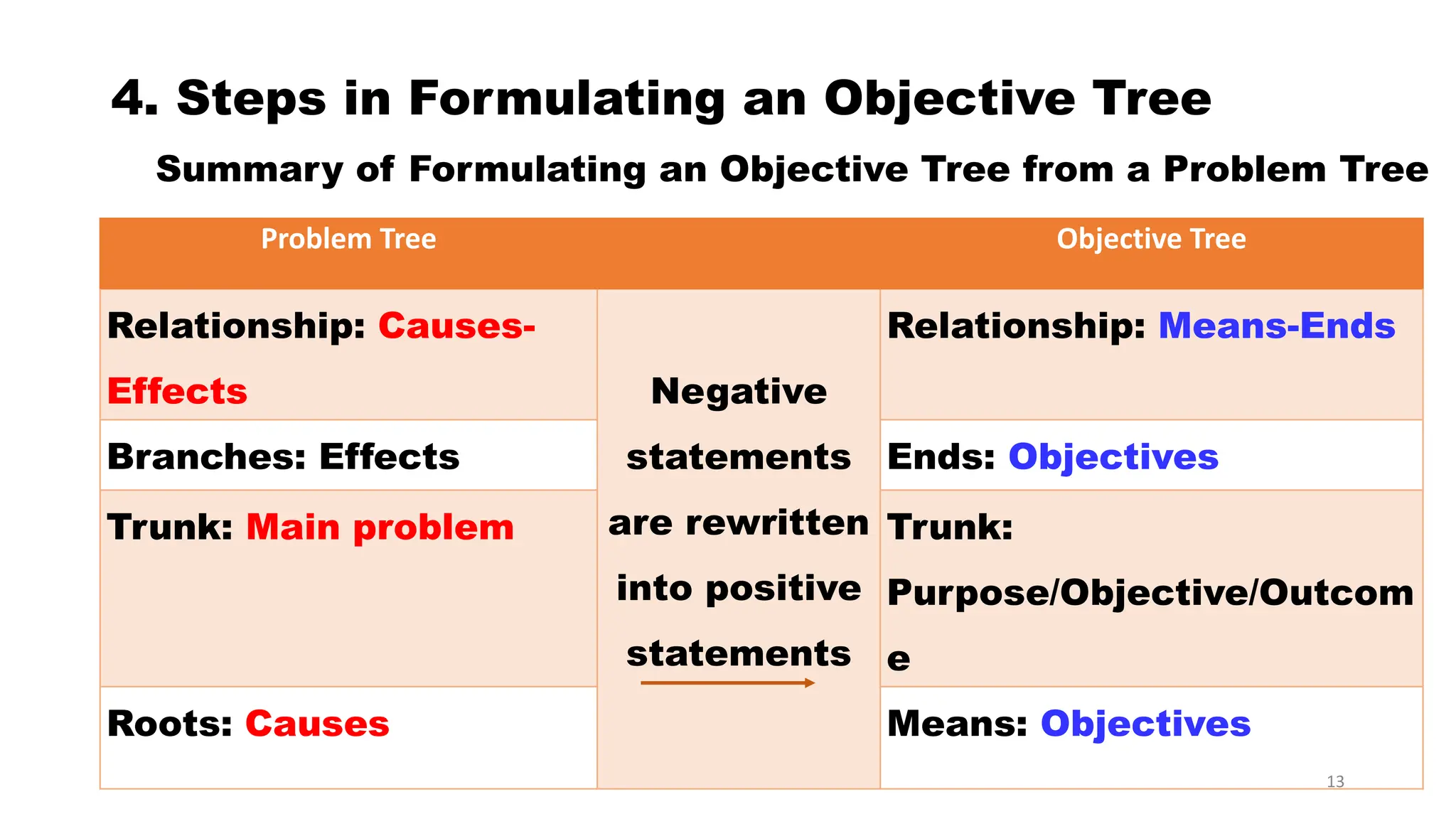
Summary of Formulating an Objective Tree from a Problem Tree
13
Problem Tree Objective Tree
Relationship: Causes-
Effects Negative
statements
are rewritten
into positive
statements
Relationship: Means-Ends
Branches: Effects Ends: Objectives
Trunk: Main problem Trunk:
Purpose/Objective/Outcom
e
Roots: Causes Means: Objectives
4. Steps in Formulating an Objective Tree
 Once complete, the objective tree provides a summary picture of the
desired future situation, including the indicative means by which ends
can be achieved.
 As with the problem tree, the objective tree should provide a
simplified but robust summary of reality. It is a tool to aid analysis
and presentation of ideas/objectives.
 Its main strength is that it keeps the analysis of potential project
objectives firmly based on addressing a range of clearly identified
priority problems.
14
5. Examples of Objective Tree
15
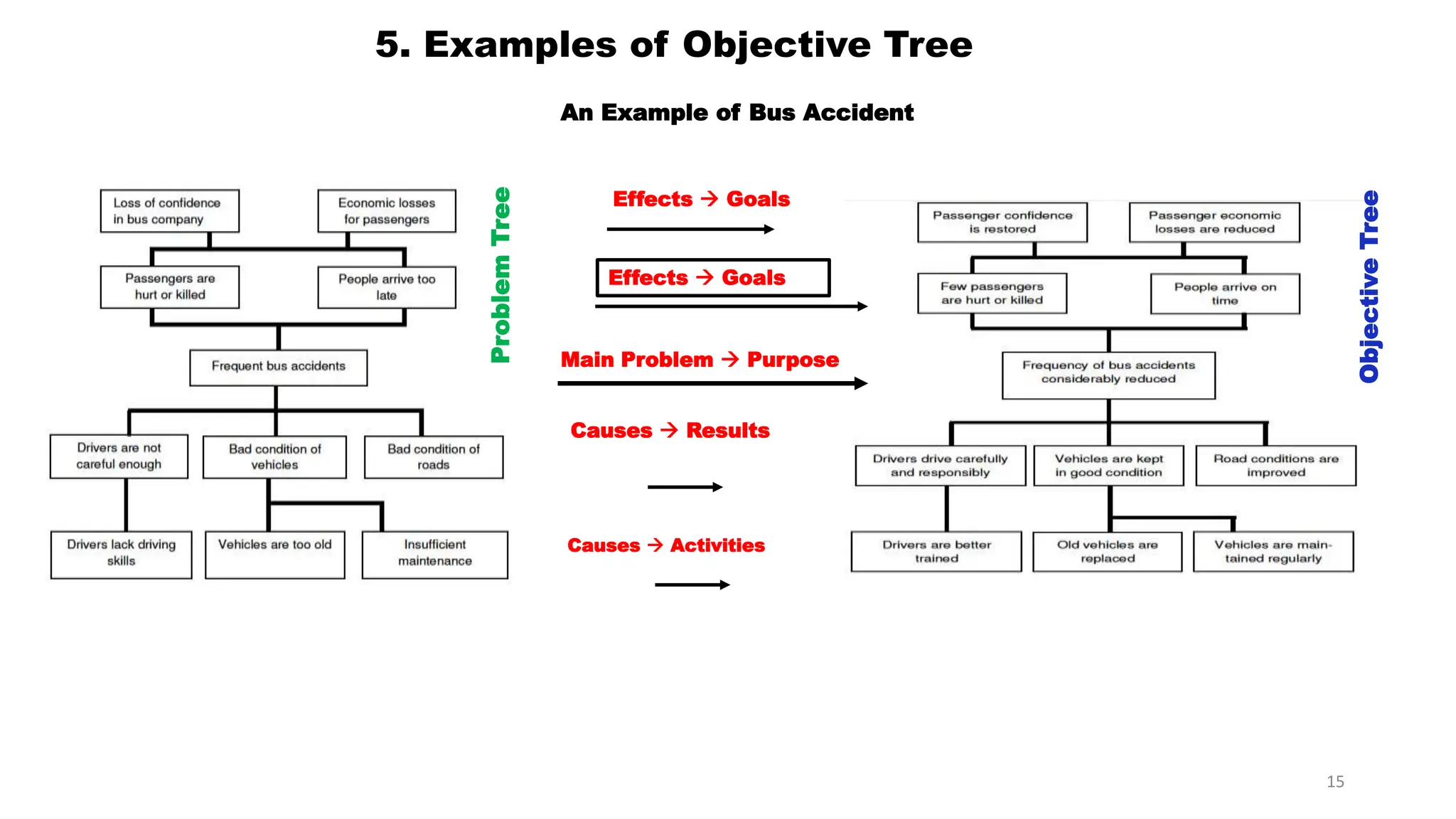
An Example of Bus Accident
Problem
Tree
Objective
Tree
Main Problem  Purpose
Effects  Goals
Causes  Results
Causes  Activities
Effects  Goals
5. Examples of Objective Tree
16
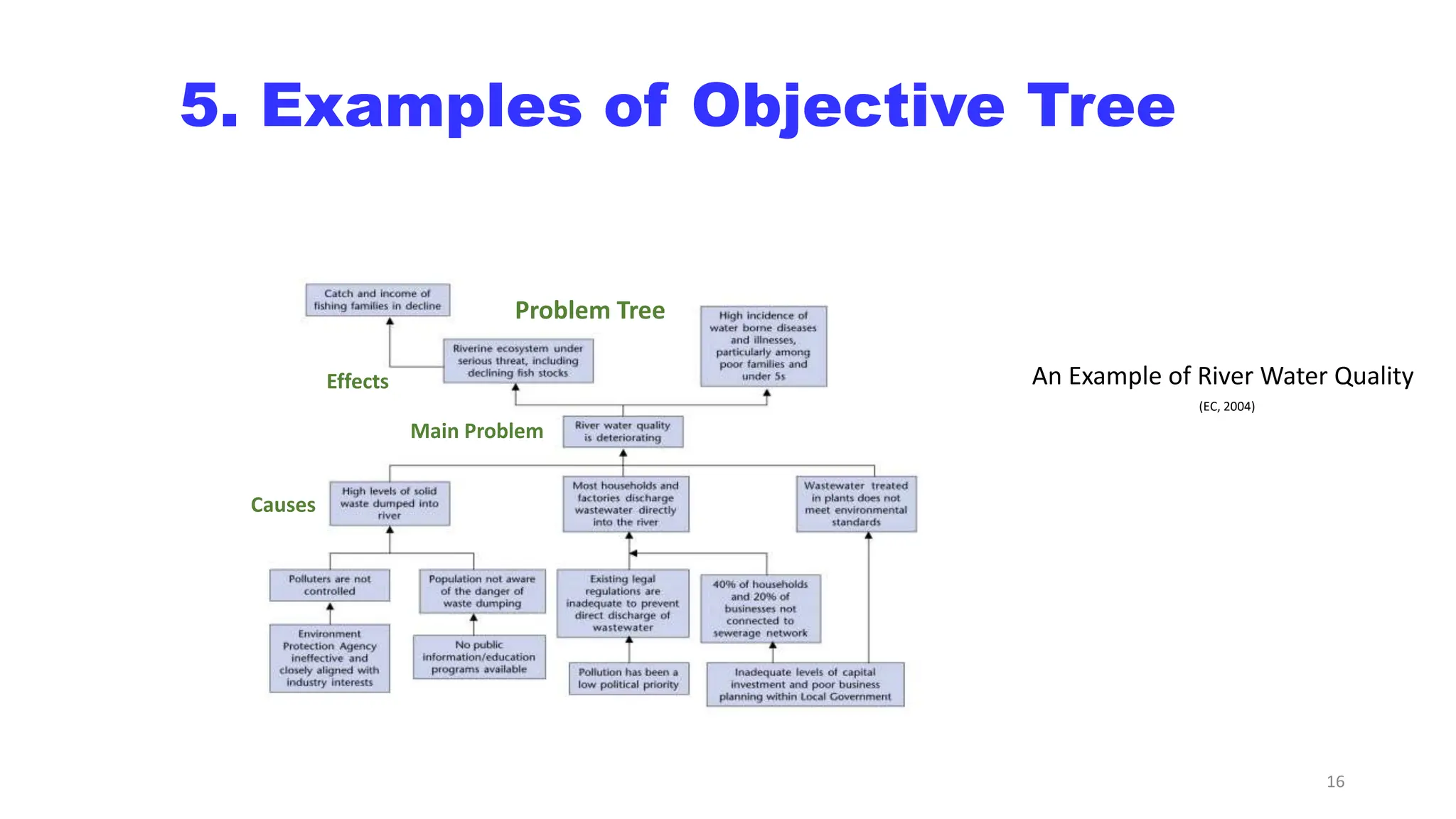
An Example of River Water Quality
(EC, 2004)
Problem Tree
Main Problem
Effects
Causes
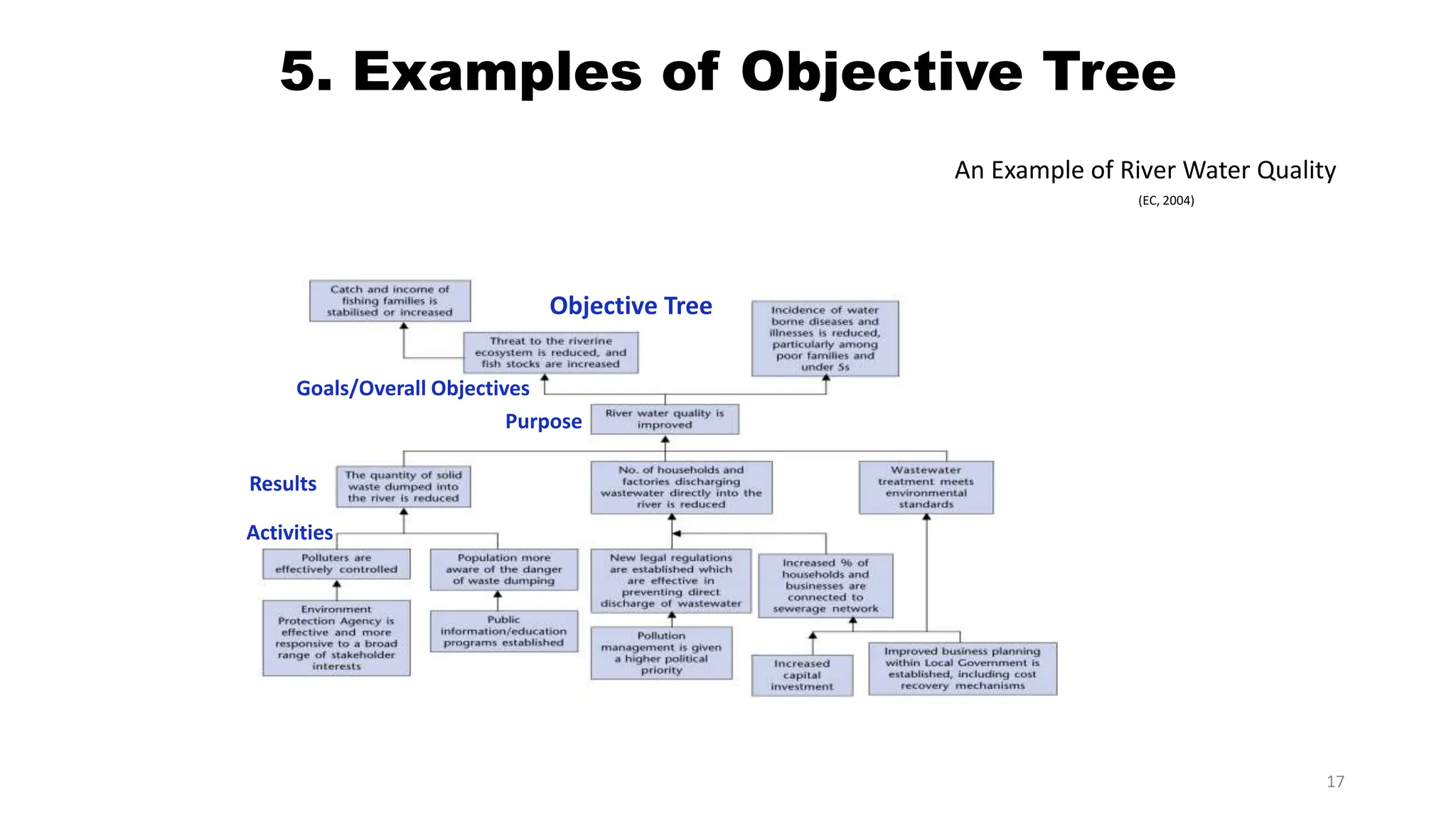
5. Examples of Objective Tree
17
An Example of River Water Quality
(EC, 2004)
Objective Tree
Purpose
Results
Goals/Overall Objectives
Activities

1.Objective Tree Analysis (1).pptx fundamental of project management needs objectivity tree analysis methods

  • 1.
  • 2.
    Contents 1. Learning Objective 2.What is an Objective Tree Analysis? 3. Reformulating Problem Statements into Objective Statements 4. Steps in Formulating an Objective Tree 5. Examples of Objective Tree 6. Exercises 2
  • 3.
    2. What isan Objective Tree Analysis  An Objective Tree is a Problem Tree that is transformed into a set of future solutions to the problems. Each negative problem is converted into an objective by rewriting it as a positive future statement. 3 Problem Statements Objective Statements Low agricultural production High agricultural production Lack of medical staff in rural areas The number of medical staff in rural areas has increased
  • 4.
    2. What isan Objective Tree Analysis  As the Objective Tree is transformed from the Problem Tree: the analysis of problems in the Problem Tree from Problem/Project Identification (PPI) is the basis and starting point for the Objective Tree analysis.  The positive statements are in fact objective statements that can be presented in a diagram showing a means – ends hierarchy, the objective tree. 4
  • 5.
    2. What isan Objective Tree Analysis  The analysis of objective tree aims:  Provide a clear overview of the desired future situation once problems have been identified and reformulate into objectives;  Verify the hierarchy of objectives;  Illustrate the means-ends relationships in a diagram. 5
  • 6.
    2. What isan Objective Tree Analysis 6 Problem Tree Causes Effects Negative Statements Means Ends Objective Tree Positive Statements
  • 7.
    3. Reformulating ProblemStatements into Objective Statements  Reformulating the problems into objectives has to be done very carefully.  If a statement makes no sense after rewording, write a replacement objective, or delete it, or leave the problem unchanged.  It is important to review the formulated objectives and the resulting objective tree. 7
  • 8.
    3. Reformulating ProblemStatements into Objective Statements  Problem statement: “lack of adequate rain levels” cannot be transformed into “adequate rain levels available” because it is an unrealistic objective. We cannot intervene into the natural phenomenon by predicting or hoping that there will be adequate rain. This problem, however, could be rewritten as “irrigation system established and operational” which sounds more realistic and can be intervened. 8
  • 9.
    3. Reformulating ProblemStatements into Objective Statements  Problem statement: “river water quality is deteriorating” can be reformulated into “quality of river water is improved”.  Problem statement: “loss of confidence in public services” can be transformed into “people’s confidence in public services is restored”.  Problem statement: “public transportation is in bad condition” can be reformulated into “public transportation is kept in good condition”. 9
  • 10.
    3. Reformulating ProblemStatements into Objective Statements Formulate the following problem statements into objective statements 10 Problem Statements a. Farmers lack know-how in organic farming b. Community members are not aware of HIV/AIDS prevention c. High rate of alcohol consumption d. High illiteracy rate of children from poor family background e. Youth do not participate in community activities f. Local community do not understand their roles and responsibilities in natural resources management g. People do not save money for use in health care or emergency situation h. Youth do not like to read i. Community members do not want to buy health insurance
  • 11.
    4. Steps inFormulating an Objective Tree Step 1 • Reformulate all negative situations of the problems analysis into positive situations that are desirable and/or realistically achievable Step 2 • Check the means-ends relationships to ensure validity and completeness of the hierarchy; cause-effect relationships in the problem tree are turned into means-ends linkages in the objective tree Step 3 • If necessary: revise statements; add new objectives if these seem to be relevant and necessary to achieve the objective at the next higher level; or delete objectives which do not seem suitable or necessary 11
  • 12.
    4. Steps inFormulating an Objective Tree The following diagram illustrates a transformation of a problem tree into an objective tree which uses “high staff turnover” as the main problem. 12 Problem Tree High staff turnover Delay in project delivery High rate of recurring recruitment Unstable team members Unattractive salary package Very high workload Authoritarian managers Reduced staff turnover Better salary package Reduced workload Less Authoritarian managers Project delivery meets the deadline Low rate of recurring recruitment Stable team members Objective Tree
  • 13.
    4. Steps inFormulating an Objective Tree Summary of Formulating an Objective Tree from a Problem Tree 13 Problem Tree Objective Tree Relationship: Causes- Effects Negative statements are rewritten into positive statements Relationship: Means-Ends Branches: Effects Ends: Objectives Trunk: Main problem Trunk: Purpose/Objective/Outcom e Roots: Causes Means: Objectives
  • 14.
    4. Steps inFormulating an Objective Tree  Once complete, the objective tree provides a summary picture of the desired future situation, including the indicative means by which ends can be achieved.  As with the problem tree, the objective tree should provide a simplified but robust summary of reality. It is a tool to aid analysis and presentation of ideas/objectives.  Its main strength is that it keeps the analysis of potential project objectives firmly based on addressing a range of clearly identified priority problems. 14
  • 15.
    5. Examples ofObjective Tree 15 An Example of Bus Accident Problem Tree Objective Tree Main Problem  Purpose Effects  Goals Causes  Results Causes  Activities Effects  Goals
  • 16.
    5. Examples ofObjective Tree 16 An Example of River Water Quality (EC, 2004) Problem Tree Main Problem Effects Causes
  • 17.
    5. Examples ofObjective Tree 17 An Example of River Water Quality (EC, 2004) Objective Tree Purpose Results Goals/Overall Objectives Activities