Page 1 of 6
ProblemTree&Objectives TreeTemplate
TOOL
Problem Tree
Purpose The ProblemTree isa methodforconductinga problemanalysis.Itisthe thoroughstudyof one or more problems(identifiedduringthe
assessmentstage),to identifytheircausesanddecide whetherandhowto addressthem. The aimof problemtree istostructure,
summarize andorganize the initial findingsof anassessment inthe formof a tree inorderto arrive at a clearerunderstandingof the
situationunderanalysis.
 Merelylistingandrankingproblemsdoesnotprovide forasufficientlydeepanalysisof the situation.
Information Sources 1. IFRC ProjectPlanningManual: 4.1.4: Problemanalysisusingthe “problemtree”tool (P.21-22)
2. IFRC ProjectPlanningManual:Annex1:How to create a problemtree (P.51-53)
3. Initial situation/needsassessment
4. Otherneedsassessmentdata
5. Projectteamexperience
Who The problemanalysisusingthe ProblemTree methodshouldbe coordinated/facilitatedbyone personwholeadsthe entire process.For
EDF projects thiswill oftenbe the LWRProgram Manager, butcan be a representative fromthe partneroreventhe LWR Country
Director.The factors to considerwhendeterminingthe leadforthisprocessishis/herfamiliaritywithtargetpopulation,familiaritywith
the resultsfromthe needsassessment,andexperience inusingthe ProblemTree method.
For restrictedprojects the personresponsible forthe completionof the ProblemTree aswell asthe remainingaspectsof the project
designisthe Technical DesignCoordinator,whoisselectedduringthe Proposal Kickoff Meeting.The TechnicalDesignCoordinator:
 Leadsthe technical designworkshop,includingproblemanalysisandlogical frameworkdevelopmentwithLWR,partnersand
technical experts.
 Writessectionsincluding: ProjectDesign Workbook,whichmayinclude ResultsFramework,LogFrame,ImplementationPlan
and/orPerformance MonitoringPlan(PMP) dependingondonorguidance.
For proposalsunderthe threshold ($500,000),the DecisionMakerwill identifythe Technical DesignFacilitator.Forproposalsoverthe
threshold,the DecisionMakerandthe DeputyDirectorfor NBDwill selectthe Technical DesignFacilitator.
* For furtherguidance onthe grantsacquisitionprocessplease refertothe LWR Grants AcquisitionManual.
When The ProblemTree analysiscomesafterthe needsassessmentandbefore startingworkonthe ObjectivesTree.
Recommendations  The ProblemTree methodisnotrequired,butaproblemanalysisshouldbe completedforall projectswhere applicable.
o The ProblemTree methodis a veryeffective tool andLWRrecommendsthatitbe usedas the primaryproblemanalysis
method.Nevertheless, LWR’spastproblemanalysismethodthattookthe formof a ProblemAnalysisbox canalsobe
used.
 For some restrictedfundingproposalsthe donormayspecifythe problemstatementorthe causes,orboth.
o In caseswhere the problemstatementisprovided,thenthe problemanalysisshouldfocusondeterminingonlythe
causesto that problem,basedonwhatisknownaboutthe target area/populationasa resultof the needsassessment.
o If both the problemstatementandthe causesare specifiedbythe donor,the problemanalysis isnotrequired. The
Page 2 of 6
ProblemTree&Objectives TreeTemplate
TOOL
designteamcan move directlytocompletingthe ObjectivesTree.
 It isrecommendedthatthe problemstatementandeachcause identifiedbe linkedtodatathat verifiesitsexistence inthe
target populationandthe degree towhichitaffectsthe targetpopulation.
o For example,if the projectgoal is"improvedagricultural productivity",the correspondingdescriptionof the cause
wouldbe "pooragricultural productivityinthe targetarea."The degree towhichthe cause affectsthe targetpopulation
wouldbe representedbyspecificdatawouldverifythe “howpoor”the agricultural productivityisinthe area(i.e.50%
reductionfromaverage inthe pastyear).
o The documentedsource maybe a LWR needsassessment,peeragencyneedsassessment,governmentreport,agency
report,or otherpublisheddocument
o This documentedsource is documentedinthe Project DesignWorkbookin the “Evidence forCause” tab.
 The processis as importantasthe product.The exercise shouldbe treatedasalearningexperience andanopportunityfor
differentviewsandintereststobe expressed.
 If necessary,the differentaspectsof aproblemareacan be furtherelaboratedthroughfocusgroupsorinterviews.
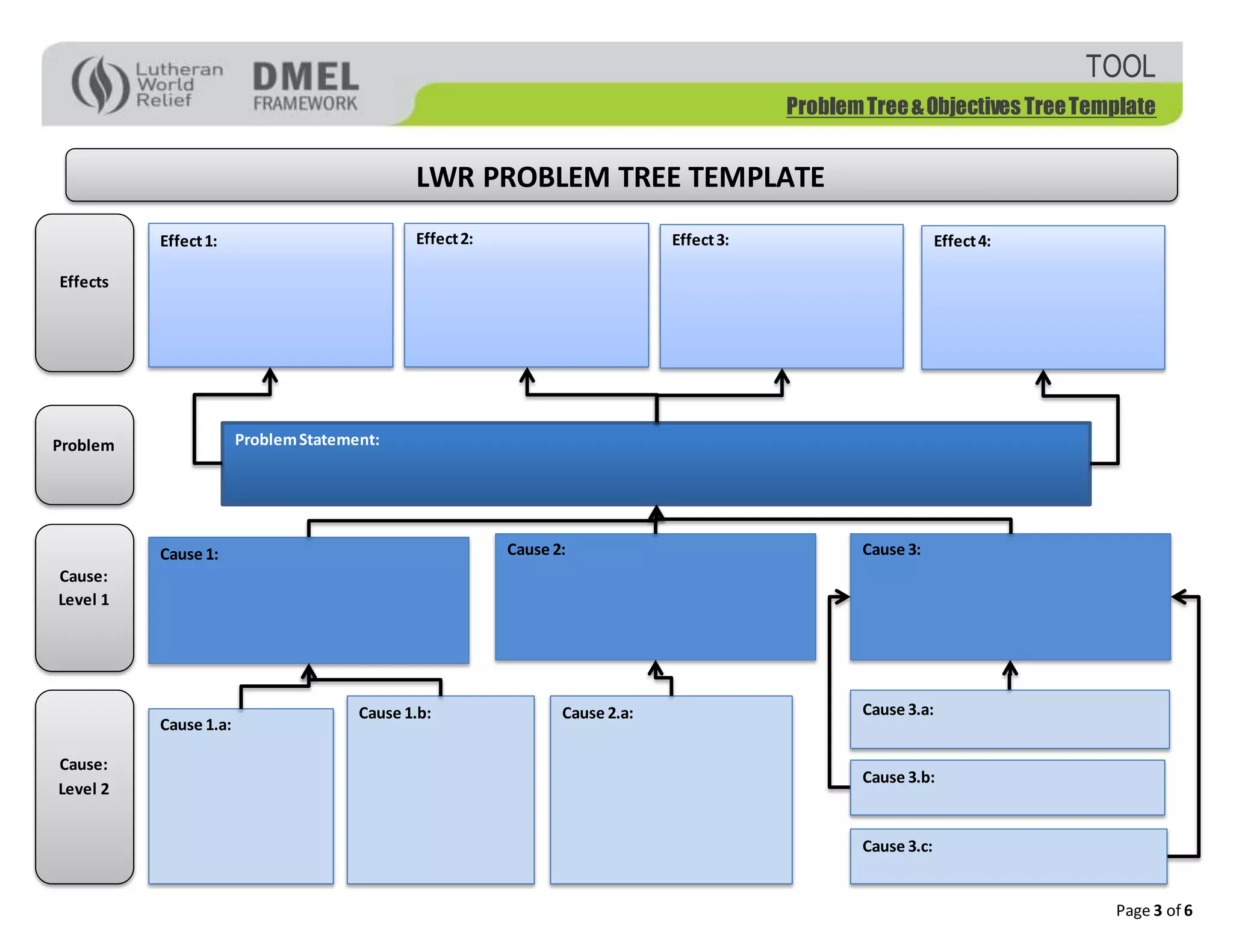
 The Word template providedisatypical graphical presentationof aproblemtree.The graphiccanbe manipulated(size and
numberof boxes) toreflectthe resultsof the ProblemTree analysis,whichisoftencompletedwithstickynotesand flipchart.
o If the Word template isuseditmustbe transferredtothe ProjectDesignWorkbook once completed.Todoso,copy the
whole graphicandpaste it intothe ProjectDesignWorkbook usingthe “Paste Special”functionandpaste itas a
“Picture (EnhancedMeta-file)”
o An alternative optionistotake a photoof the resultsandpaste itinto the ProjectDesignWorkbook.
KEY: Any methodorprogram can be usedto documentthe resultsof the ProblemTree inthe ProjectDesignWorkbook.Whatis
importantisthat the resultsare documented.
Tips  Completingthe problemanalysiscanbe complex therefore experience infacilitatingaproblemanalysisandfamiliaritywiththe
local contextisof utmostimportance whenselectingaleadcoordinator/facilitator.
 Whenthe problemtree iscreatedwiththe targetpopulation’sparticipation,the analysisof the problemisenrichedandjoint
learningamongall concernedismade possible.
 Doeseach cause-effectlink(illustratedbyarrows) make sense?Iseachlinkplausible?Whyorwhynot?
 How well have the causesgone downtothe roots?Are there anyunidentified rootcauses?
 What appearsto be the relative contributionof eachcausal stream(causeslinkedbyarrowsleadingtothe core problem
statement) tothe problem?
 Do some causesappearmore than once?Why isthis?
 Whichcausesshowsignificantinfluence?
Page 3 of 6
ProblemTree&Objectives TreeTemplate
TOOL
Problem
Effects
Cause:
Level 1
Cause:
Level 2
Effect2: Effect3:
ProblemStatement:
Cause 1.b:
Effect1: Effect4:
Cause 1: Cause 3:
Cause 2.a:
Cause 2:
Cause 1.a:
Cause 3.a:
Cause 3.c:
Cause 3.b:
LWR PROBLEM TREE TEMPLATE
Page 4 of 6
ProblemTree&Objectives TreeTemplate
TOOL
Objectives Tree
Purpose The ObjectivesTree isthe intermediate stepbetweenthe ProblemTree andthe ResultsFramework.The difference betweenthe
Objective Tree andthe ResultsFramework isthatthe Objective Tree showsALLpossible objectivesthatthe projectcouldchoose to
solve the problemidentifiedinthe ProblemTree analysis.The ResultsFramework showsthe final objectivesof the project,leavingout
those objectivesthatare not relevantorare too resource intensive.
It isa tool to aidanalysisandthe presentationof ideas.Itsmain strengthisthatitkeepsthe analysisof potential projectobjectives
firmlyrootedinaddressing arange of clearlyidentifiedpriorityproblems. Whereasproblemsanalysisseektoidentifycurrentnegative
conditions,objectivesanalysisaimstodisplayall possible solutionsandwill formthe foundationforthe project’sspecificstrategies. It
will helpto:
 Demonstrate anddescribe the situationinthe future if all the identifiedproblems were remedied
 Identifypossibleobjectives(intendedresults) andverifythe hierarchybetween them
 Illustrate andverifythe causal (means-ends)relationshipsthroughadiagram
 Establishprioritiesby:
o assessinghowrealisticthe achievementof some objectivesmaybe and
o identifyingadditional meansthatmaybe requiredtoachieve the intendedresults
Information Sources 1. IFRC ProjectPlanningManual: 4.2Developmentof objectives(P.22-24)
2. IFRC ProjectPlanningManual: Annex2:How to create and use an objectivestree (P.54-56)
3. ProblemTree results
Who The completionof the ObjectiveTree shouldbe coordinated/facilitatedbyone personwholeadsthe entire projectdesignprocess.For
EDF projects thiswill oftenbe the LWRProgram Manager, butcan be a representative fromthe partneroreventhe LWR Country
Director.The factors to considerwhendeterminingthe leadforthisprocessishis/herfamiliaritywithtargetpopulation,familiaritywith
the resultsfromthe needsassessment,andexperience in usingthe ObjectiveTree Method.
For restrictedprojects the personresponsible forthe completionof all aspectsof the projectdesignisthe TechnicalDesignCoordinator,
whois selectedduringthe Proposal Kickoff Meeting.The Technical DesignCoordinator:
 Leadsthe technical designworkshop,includingproblemanalysisandlogical frameworkdevelopmentwithLWR,partnersand
technical experts.
 Writessectionsincluding:ProjectDesignBook,whichmayincludeResultsFramework,LogFrame,ImplementationPlanand/or
Performance MonitoringPlan(PMP) dependingondonorguidance.
For proposalsunderthe threshold($500,000),the DecisionMakerwill identifythe Technical DesignFacilitator.Forproposalsoverthe
threshold,the Decision Makerandthe DeputyDirectorfor NBDwill selectthe Technical DesignFacilitator.
* For furtherguidance onthe grantsacquisitionprocessplease refertothe LWR Grants AcquisitionManual.
When The Objective Tree tool isusedafterthe ProblemTree iscompleted.The objectiveanalysisusingthe ObjectiveTree isthe intermediate
Page 5 of 6
ProblemTree&Objectives TreeTemplate
TOOL
stepbetweenthe creationof the ProblemTree andthe creationof the ResultsFramework.
Recommendations 1. There may be some causesnearthe bottomof the tree that are very general.They cannotbe turnedintoobjectivesthatcaneasily
be addressedbyan intervention. Instead,theyactas external factorsthatneedtobe consideredandassessedtoverify the
feasibilityof the intervention
2. As withthe ProblemTree the Wordtemplate providedisatypical graphical presentationof anobjective tree. The graphiccanbe
manipulated (size andnumberof boxes)toreflectthe resultsof the Objective Tree analysis,whichisoftencompletedwithsticky
notesandflipchart.
a. If the Word template isuseditmustbe transferredtothe ProjectDesignWorkbook once completed.Todoso,copy the
whole graphicandpaste it intothe ZeroDraft usingthe “Paste Special”functionandpaste itas a “Picture (Enhanced
Meta-file)”
b. An alternative optionistotake a photoof the resultsandpaste itinto the ProjectDesignWorkbook.
KEY: Any methodorprogram can be usedto documentthe resultsof the Objective Tree inthe ProjectDesignWorkbook.Whatis
importantisthat the resultsare documented.
Tips  Are the positive statementsandobjectivesclear?
 Have theybeenputintoa logical andreasonable orderthatshowsmeans-to-endslogic?
 Is there a needtoadd otherobjectives?
 How dothese objectivesdifferfromthe initialassessmentof howthe interventionshouldbe designed?
Page 6 of 6
ProblemTree&Objectives TreeTemplate
TOOL
GOAL
IMPACTS
OUTCOME
OUTPUT
Impact 2: Impact 3:
Goal:
Output 1.b:
Impact 1: Impact 4:
Outcome 1: Outcome 3:
Output 2.a:
Outcome 2:
Output 1.a: Output 3.a:
Output 3.c:
Output 3.b:
LWR OBJECTIVES TREE TEMPLATE

Lwr problem tree-objectives_tree_template

  • 1.
    Page 1 of6 ProblemTree&Objectives TreeTemplate TOOL Problem Tree Purpose The ProblemTree isa methodforconductinga problemanalysis.Itisthe thoroughstudyof one or more problems(identifiedduringthe assessmentstage),to identifytheircausesanddecide whetherandhowto addressthem. The aimof problemtree istostructure, summarize andorganize the initial findingsof anassessment inthe formof a tree inorderto arrive at a clearerunderstandingof the situationunderanalysis.  Merelylistingandrankingproblemsdoesnotprovide forasufficientlydeepanalysisof the situation. Information Sources 1. IFRC ProjectPlanningManual: 4.1.4: Problemanalysisusingthe “problemtree”tool (P.21-22) 2. IFRC ProjectPlanningManual:Annex1:How to create a problemtree (P.51-53) 3. Initial situation/needsassessment 4. Otherneedsassessmentdata 5. Projectteamexperience Who The problemanalysisusingthe ProblemTree methodshouldbe coordinated/facilitatedbyone personwholeadsthe entire process.For EDF projects thiswill oftenbe the LWRProgram Manager, butcan be a representative fromthe partneroreventhe LWR Country Director.The factors to considerwhendeterminingthe leadforthisprocessishis/herfamiliaritywithtargetpopulation,familiaritywith the resultsfromthe needsassessment,andexperience inusingthe ProblemTree method. For restrictedprojects the personresponsible forthe completionof the ProblemTree aswell asthe remainingaspectsof the project designisthe Technical DesignCoordinator,whoisselectedduringthe Proposal Kickoff Meeting.The TechnicalDesignCoordinator:  Leadsthe technical designworkshop,includingproblemanalysisandlogical frameworkdevelopmentwithLWR,partnersand technical experts.  Writessectionsincluding: ProjectDesign Workbook,whichmayinclude ResultsFramework,LogFrame,ImplementationPlan and/orPerformance MonitoringPlan(PMP) dependingondonorguidance. For proposalsunderthe threshold ($500,000),the DecisionMakerwill identifythe Technical DesignFacilitator.Forproposalsoverthe threshold,the DecisionMakerandthe DeputyDirectorfor NBDwill selectthe Technical DesignFacilitator. * For furtherguidance onthe grantsacquisitionprocessplease refertothe LWR Grants AcquisitionManual. When The ProblemTree analysiscomesafterthe needsassessmentandbefore startingworkonthe ObjectivesTree. Recommendations  The ProblemTree methodisnotrequired,butaproblemanalysisshouldbe completedforall projectswhere applicable. o The ProblemTree methodis a veryeffective tool andLWRrecommendsthatitbe usedas the primaryproblemanalysis method.Nevertheless, LWR’spastproblemanalysismethodthattookthe formof a ProblemAnalysisbox canalsobe used.  For some restrictedfundingproposalsthe donormayspecifythe problemstatementorthe causes,orboth. o In caseswhere the problemstatementisprovided,thenthe problemanalysisshouldfocusondeterminingonlythe causesto that problem,basedonwhatisknownaboutthe target area/populationasa resultof the needsassessment. o If both the problemstatementandthe causesare specifiedbythe donor,the problemanalysis isnotrequired. The
  • 2.
    Page 2 of6 ProblemTree&Objectives TreeTemplate TOOL designteamcan move directlytocompletingthe ObjectivesTree.  It isrecommendedthatthe problemstatementandeachcause identifiedbe linkedtodatathat verifiesitsexistence inthe target populationandthe degree towhichitaffectsthe targetpopulation. o For example,if the projectgoal is"improvedagricultural productivity",the correspondingdescriptionof the cause wouldbe "pooragricultural productivityinthe targetarea."The degree towhichthe cause affectsthe targetpopulation wouldbe representedbyspecificdatawouldverifythe “howpoor”the agricultural productivityisinthe area(i.e.50% reductionfromaverage inthe pastyear). o The documentedsource maybe a LWR needsassessment,peeragencyneedsassessment,governmentreport,agency report,or otherpublisheddocument o This documentedsource is documentedinthe Project DesignWorkbookin the “Evidence forCause” tab.  The processis as importantasthe product.The exercise shouldbe treatedasalearningexperience andanopportunityfor differentviewsandintereststobe expressed.  If necessary,the differentaspectsof aproblemareacan be furtherelaboratedthroughfocusgroupsorinterviews.  The Word template providedisatypical graphical presentationof aproblemtree.The graphiccanbe manipulated(size and numberof boxes) toreflectthe resultsof the ProblemTree analysis,whichisoftencompletedwithstickynotesand flipchart. o If the Word template isuseditmustbe transferredtothe ProjectDesignWorkbook once completed.Todoso,copy the whole graphicandpaste it intothe ProjectDesignWorkbook usingthe “Paste Special”functionandpaste itas a “Picture (EnhancedMeta-file)” o An alternative optionistotake a photoof the resultsandpaste itinto the ProjectDesignWorkbook. KEY: Any methodorprogram can be usedto documentthe resultsof the ProblemTree inthe ProjectDesignWorkbook.Whatis importantisthat the resultsare documented. Tips  Completingthe problemanalysiscanbe complex therefore experience infacilitatingaproblemanalysisandfamiliaritywiththe local contextisof utmostimportance whenselectingaleadcoordinator/facilitator.  Whenthe problemtree iscreatedwiththe targetpopulation’sparticipation,the analysisof the problemisenrichedandjoint learningamongall concernedismade possible.  Doeseach cause-effectlink(illustratedbyarrows) make sense?Iseachlinkplausible?Whyorwhynot?  How well have the causesgone downtothe roots?Are there anyunidentified rootcauses?  What appearsto be the relative contributionof eachcausal stream(causeslinkedbyarrowsleadingtothe core problem statement) tothe problem?  Do some causesappearmore than once?Why isthis?  Whichcausesshowsignificantinfluence?
  • 3.
    Page 3 of6 ProblemTree&Objectives TreeTemplate TOOL Problem Effects Cause: Level 1 Cause: Level 2 Effect2: Effect3: ProblemStatement: Cause 1.b: Effect1: Effect4: Cause 1: Cause 3: Cause 2.a: Cause 2: Cause 1.a: Cause 3.a: Cause 3.c: Cause 3.b: LWR PROBLEM TREE TEMPLATE
  • 4.
    Page 4 of6 ProblemTree&Objectives TreeTemplate TOOL Objectives Tree Purpose The ObjectivesTree isthe intermediate stepbetweenthe ProblemTree andthe ResultsFramework.The difference betweenthe Objective Tree andthe ResultsFramework isthatthe Objective Tree showsALLpossible objectivesthatthe projectcouldchoose to solve the problemidentifiedinthe ProblemTree analysis.The ResultsFramework showsthe final objectivesof the project,leavingout those objectivesthatare not relevantorare too resource intensive. It isa tool to aidanalysisandthe presentationof ideas.Itsmain strengthisthatitkeepsthe analysisof potential projectobjectives firmlyrootedinaddressing arange of clearlyidentifiedpriorityproblems. Whereasproblemsanalysisseektoidentifycurrentnegative conditions,objectivesanalysisaimstodisplayall possible solutionsandwill formthe foundationforthe project’sspecificstrategies. It will helpto:  Demonstrate anddescribe the situationinthe future if all the identifiedproblems were remedied  Identifypossibleobjectives(intendedresults) andverifythe hierarchybetween them  Illustrate andverifythe causal (means-ends)relationshipsthroughadiagram  Establishprioritiesby: o assessinghowrealisticthe achievementof some objectivesmaybe and o identifyingadditional meansthatmaybe requiredtoachieve the intendedresults Information Sources 1. IFRC ProjectPlanningManual: 4.2Developmentof objectives(P.22-24) 2. IFRC ProjectPlanningManual: Annex2:How to create and use an objectivestree (P.54-56) 3. ProblemTree results Who The completionof the ObjectiveTree shouldbe coordinated/facilitatedbyone personwholeadsthe entire projectdesignprocess.For EDF projects thiswill oftenbe the LWRProgram Manager, butcan be a representative fromthe partneroreventhe LWR Country Director.The factors to considerwhendeterminingthe leadforthisprocessishis/herfamiliaritywithtargetpopulation,familiaritywith the resultsfromthe needsassessment,andexperience in usingthe ObjectiveTree Method. For restrictedprojects the personresponsible forthe completionof all aspectsof the projectdesignisthe TechnicalDesignCoordinator, whois selectedduringthe Proposal Kickoff Meeting.The Technical DesignCoordinator:  Leadsthe technical designworkshop,includingproblemanalysisandlogical frameworkdevelopmentwithLWR,partnersand technical experts.  Writessectionsincluding:ProjectDesignBook,whichmayincludeResultsFramework,LogFrame,ImplementationPlanand/or Performance MonitoringPlan(PMP) dependingondonorguidance. For proposalsunderthe threshold($500,000),the DecisionMakerwill identifythe Technical DesignFacilitator.Forproposalsoverthe threshold,the Decision Makerandthe DeputyDirectorfor NBDwill selectthe Technical DesignFacilitator. * For furtherguidance onthe grantsacquisitionprocessplease refertothe LWR Grants AcquisitionManual. When The Objective Tree tool isusedafterthe ProblemTree iscompleted.The objectiveanalysisusingthe ObjectiveTree isthe intermediate
  • 5.
    Page 5 of6 ProblemTree&Objectives TreeTemplate TOOL stepbetweenthe creationof the ProblemTree andthe creationof the ResultsFramework. Recommendations 1. There may be some causesnearthe bottomof the tree that are very general.They cannotbe turnedintoobjectivesthatcaneasily be addressedbyan intervention. Instead,theyactas external factorsthatneedtobe consideredandassessedtoverify the feasibilityof the intervention 2. As withthe ProblemTree the Wordtemplate providedisatypical graphical presentationof anobjective tree. The graphiccanbe manipulated (size andnumberof boxes)toreflectthe resultsof the Objective Tree analysis,whichisoftencompletedwithsticky notesandflipchart. a. If the Word template isuseditmustbe transferredtothe ProjectDesignWorkbook once completed.Todoso,copy the whole graphicandpaste it intothe ZeroDraft usingthe “Paste Special”functionandpaste itas a “Picture (Enhanced Meta-file)” b. An alternative optionistotake a photoof the resultsandpaste itinto the ProjectDesignWorkbook. KEY: Any methodorprogram can be usedto documentthe resultsof the Objective Tree inthe ProjectDesignWorkbook.Whatis importantisthat the resultsare documented. Tips  Are the positive statementsandobjectivesclear?  Have theybeenputintoa logical andreasonable orderthatshowsmeans-to-endslogic?  Is there a needtoadd otherobjectives?  How dothese objectivesdifferfromthe initialassessmentof howthe interventionshouldbe designed?
  • 6.
    Page 6 of6 ProblemTree&Objectives TreeTemplate TOOL GOAL IMPACTS OUTCOME OUTPUT Impact 2: Impact 3: Goal: Output 1.b: Impact 1: Impact 4: Outcome 1: Outcome 3: Output 2.a: Outcome 2: Output 1.a: Output 3.a: Output 3.c: Output 3.b: LWR OBJECTIVES TREE TEMPLATE