Maintain Kitchen
Tools, Equipment and
Paraphernalia
Prepared by:
EVELYN J. SUBLAY
How many cups are
there in a 1 big can
of evaporated milk?
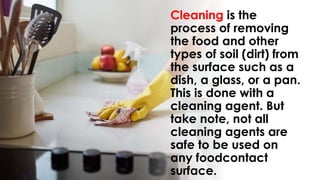
Cleaning is the
process of removing
the food and other
types of soil (dirt) from
the surface such as a
dish, a glass, or a pan.
This is done with a
cleaning agent. But
take note, not all
cleaning agents are
safe to be used on
any foodcontact
surface.
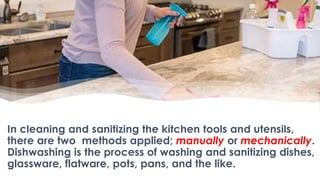
In cleaning and sanitizing the kitchen tools and utensils,
there are two methods applied; manually or mechanically.
Dishwashing is the process of washing and sanitizing dishes,
glassware, flatware, pots, pans, and the like.
Manual Dishwashing
Procedure
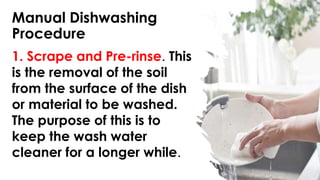
1. Scrape and Pre-rinse. This
is the removal of the soil
from the surface of the dish
or material to be washed.
The purpose of this is to
keep the wash water
cleaner for a longer while.
Manual Dishwashing
Procedure
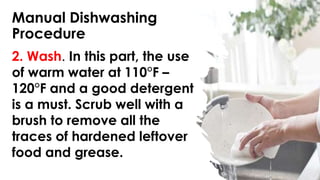
2. Wash. In this part, the use
of warm water at 110°F –
120°F and a good detergent
is a must. Scrub well with a
brush to remove all the
traces of hardened leftover
food and grease.
Manual Dishwashing
Procedure
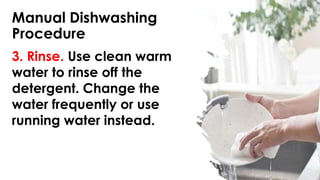
3. Rinse. Use clean warm
water to rinse off the
detergent. Change the
water frequently or use
running water instead.
Manual Dishwashing
Procedure
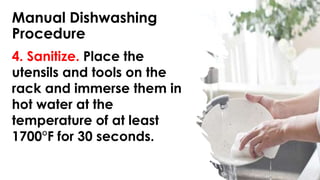
4. Sanitize. Place the
utensils and tools on the
rack and immerse them in
hot water at the
temperature of at least
1700°F for 30 seconds.
Manual Dishwashing
Procedure
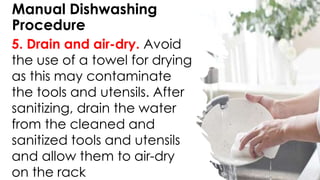
5. Drain and air-dry. Avoid
the use of a towel for drying
as this may contaminate
the tools and utensils. After
sanitizing, drain the water
from the cleaned and
sanitized tools and utensils
and allow them to air-dry
on the rack
Mechanical Dishwashing Procedure
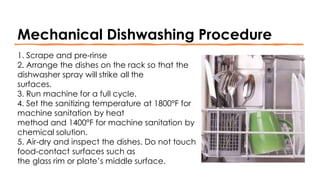
1. Scrape and pre-rinse
2. Arrange the dishes on the rack so that the
dishwasher spray will strike all the
surfaces.
3. Run machine for a full cycle.
4. Set the sanitizing temperature at 1800°F for
machine sanitation by heat
method and 1400°F for machine sanitation by
chemical solution.
5. Air-dry and inspect the dishes. Do not touch
food-contact surfaces such as
the glass rim or plate’s middle surface.
Sanitizing
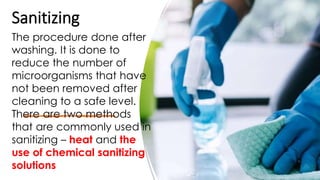
The procedure done after
washing. It is done to
reduce the number of
microorganisms that have
not been removed after
cleaning to a safe level.
There are two methods
that are commonly used in
sanitizing – heat and the
use of chemical sanitizing
solutions
Use of Heat Method
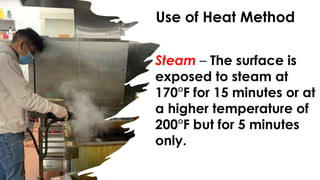
Steam – The surface is
exposed to steam at
170°F for 15 minutes or at
a higher temperature of
200°F but for 5 minutes
only.
Use of Heat Method
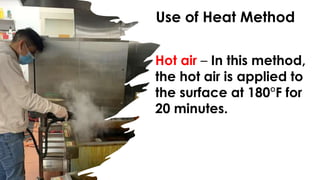
Hot air – In this method,
the hot air is applied to
the surface at 180°F for
20 minutes.
Use of Heat Method
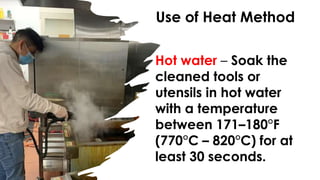
Hot water – Soak the
cleaned tools or
utensils in hot water
with a temperature
between 171–180°F
(770°C – 820°C) for at
least 30 seconds.
Use of Chemical
Sanitizing Solution
Chlorine
Advantages:
• Highly effective
• Generally inexpensive
• Not affected by hard
water and salts
Use of Chemical
Sanitizing Solution
Chlorine
Disadvantages:
• Can be corrosive and
irritating to the skin
• Weakens when stored
and exposed to light
Use of Chemical
Sanitizing Solution
Iodine
Advantages:
• Forms brown color that is
indicative of germicidal strength
• Not affected by hard water salts
• Less irritating to the skin than
chlorine
• The activity is not lost as rapidly
as chlorine in the presence of
organic matter.
Use of Chemical
Sanitizing Solution
Iodine
Disadvantages:
• Bacterial effectiveness decreases
greatly with an increase in pH
(most active at pH 3.0 and very
low acting at pH 7.0)
• Less effective against bacterial
spores and bacteriophage
(viruses that infect and replicate
bacteria) than chlorine
Maydiscolor equipment and
surfaces.
Learning Task No. 1: Complete the table by selecting the appropriate
chemical for cleaning and sanitizing the given kitchen tools, equipment
and paraphernalia below. Write your answer on a separate sheet of paper
Kitchen Toolsand
Equipment
CleaningAgentto
beUsed
Procedures
1. Oven
2. Knives
3. Refrigerator/freezer
Learning Task No. 2: Perform actual cleaning in your kitchen. Observe the
procedures how it is done. Arrange the following cleaning procedures
chronologically. Use A for the first step, B for second step and so on. Write
your answer on a separate sheet of paper.
1. Prepare diluted vinegar solution in a bucket. Dip your mop into the bucket,
wring the mop out and wipe across your kitchen floors.
2. Spray all-purpose cleaner onto kitchen surfaces and wipe off with a damp
cleaning rag.
3. Collect loose dust by sweeping the kitchen floor daily with a broom or
static
sweeper and wiping down surfaces with a cleaning rag.
4. Fill a few bowls with about 1/2 cup each of baking soda. Place these
around
your kitchen to absorb odor and keep the kitchen smelling fresh.
5. Make an all-purpose cleaner in a spray bottle.
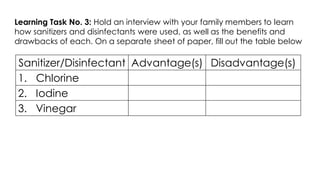
Learning Task No. 3: Hold an interview with your family members to learn
how sanitizers and disinfectants were used, as well as the benefits and
drawbacks of each. On a separate sheet of paper, fill out the table below
Sanitizer/Disinfectant Advantage(s) Disadvantage(s)
1. Chlorine
2. Iodine
3. Vinegar
Long Quiz 2: Read each question carefully
then write your answers in a separate paper.
1. The process of removing the food and
other types of soil from the surface such
as a dish, a glass, or a pan.
Long Quiz 2: Read each question carefully
then write your answers in a separate paper.
2. The process of washing (cleaning) and
sanitizing dishes, glassware, flatwares,
pots and pans.
Long Quiz 2: Read each question carefully
then write your answers in a separate paper.
3-4. Two methods of cleaning and
sanitizing.
Long Quiz 2: Read each question carefully
then write your answers in a separate paper.
5. What is the ideal temperature of water
used in washing dishes?
Long Quiz 2: Read each question carefully
then write your answers in a separate paper.
6. TRUE or FALSE
In rinsing kitchen tools and utensils, it is
ideal to use running water.
Long Quiz 2: Read each question carefully
then write your answers in a separate paper.
7. What is the appropriate temperature
used when sanitizing using manual
dishwashing?
Long Quiz 2: Read each question carefully
then write your answers in a separate paper.
8. TRUE or FALSE
In drying the washed kitchen tools
and utensils, use towel or air dry.
Long Quiz 2: Read each question carefully
then write your answers in a separate paper.
9. What is the appropriate temperature
for machine sanitation by heat method?
Long Quiz 2: Read each question carefully
then write your answers in a separate paper.
10. What is the appropriate temperature
for machine sanitation by chemical
solution?
Long Quiz 2: Read each question carefully
then write your answers in a separate paper.
11. What is the procedure done after
washing to reduce harmful
microorganisms?
Long Quiz 2: Read each question carefully
then write your answers in a separate paper.
12. When steaming utensils for 15 mins,
what is the appropriate temperature?
Long Quiz 2: Read each question carefully
then write your answers in a separate paper.
13. In using hot air method, the surface of
exposed at what temperature for 20
mins?
Long Quiz 2: Read each question carefully
then write your answers in a separate paper.
14. What is the indicator that iodine
solution has germicidal strength?
Long Quiz 2: Read each question carefully
then write your answers in a separate paper.
15. TRUE or FALSE
Iodine effectiveness decreases with
higher pH level.
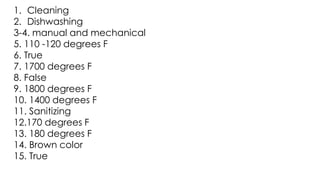
1. Cleaning
2. Dishwashing
3-4. manual and mechanical
5. 110 -120 degrees F
6. True
7. 1700 degrees F
8. False
9. 1800 degrees F
10. 1400 degrees F
11. Sanitizing
12.170 degrees F
13. 180 degrees F
14. Brown color
15. True

1LO2 Cleaning and Sanitizing.pdf

  • 1.
    Maintain Kitchen Tools, Equipmentand Paraphernalia Prepared by: EVELYN J. SUBLAY
  • 3.
    How many cupsare there in a 1 big can of evaporated milk?
  • 4.
    Cleaning is the processof removing the food and other types of soil (dirt) from the surface such as a dish, a glass, or a pan. This is done with a cleaning agent. But take note, not all cleaning agents are safe to be used on any foodcontact surface.
  • 5.
    In cleaning andsanitizing the kitchen tools and utensils, there are two methods applied; manually or mechanically. Dishwashing is the process of washing and sanitizing dishes, glassware, flatware, pots, pans, and the like.
  • 6.
    Manual Dishwashing Procedure 1. Scrapeand Pre-rinse. This is the removal of the soil from the surface of the dish or material to be washed. The purpose of this is to keep the wash water cleaner for a longer while.
  • 7.
    Manual Dishwashing Procedure 2. Wash.In this part, the use of warm water at 110°F – 120°F and a good detergent is a must. Scrub well with a brush to remove all the traces of hardened leftover food and grease.
  • 8.
    Manual Dishwashing Procedure 3. Rinse.Use clean warm water to rinse off the detergent. Change the water frequently or use running water instead.
  • 9.
    Manual Dishwashing Procedure 4. Sanitize.Place the utensils and tools on the rack and immerse them in hot water at the temperature of at least 1700°F for 30 seconds.
  • 10.
    Manual Dishwashing Procedure 5. Drainand air-dry. Avoid the use of a towel for drying as this may contaminate the tools and utensils. After sanitizing, drain the water from the cleaned and sanitized tools and utensils and allow them to air-dry on the rack
  • 11.
    Mechanical Dishwashing Procedure 1.Scrape and pre-rinse 2. Arrange the dishes on the rack so that the dishwasher spray will strike all the surfaces. 3. Run machine for a full cycle. 4. Set the sanitizing temperature at 1800°F for machine sanitation by heat method and 1400°F for machine sanitation by chemical solution. 5. Air-dry and inspect the dishes. Do not touch food-contact surfaces such as the glass rim or plate’s middle surface.
  • 12.
    Sanitizing The procedure doneafter washing. It is done to reduce the number of microorganisms that have not been removed after cleaning to a safe level. There are two methods that are commonly used in sanitizing – heat and the use of chemical sanitizing solutions
  • 13.
    Use of HeatMethod Steam – The surface is exposed to steam at 170°F for 15 minutes or at a higher temperature of 200°F but for 5 minutes only.
  • 14.
    Use of HeatMethod Hot air – In this method, the hot air is applied to the surface at 180°F for 20 minutes.
  • 15.
    Use of HeatMethod Hot water – Soak the cleaned tools or utensils in hot water with a temperature between 171–180°F (770°C – 820°C) for at least 30 seconds.
  • 16.
    Use of Chemical SanitizingSolution Chlorine Advantages: • Highly effective • Generally inexpensive • Not affected by hard water and salts
  • 17.
    Use of Chemical SanitizingSolution Chlorine Disadvantages: • Can be corrosive and irritating to the skin • Weakens when stored and exposed to light
  • 18.
    Use of Chemical SanitizingSolution Iodine Advantages: • Forms brown color that is indicative of germicidal strength • Not affected by hard water salts • Less irritating to the skin than chlorine • The activity is not lost as rapidly as chlorine in the presence of organic matter.
  • 19.
    Use of Chemical SanitizingSolution Iodine Disadvantages: • Bacterial effectiveness decreases greatly with an increase in pH (most active at pH 3.0 and very low acting at pH 7.0) • Less effective against bacterial spores and bacteriophage (viruses that infect and replicate bacteria) than chlorine Maydiscolor equipment and surfaces.
  • 20.
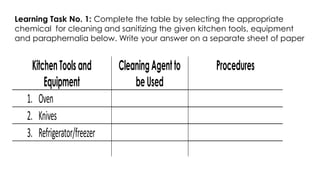
    Learning Task No.1: Complete the table by selecting the appropriate chemical for cleaning and sanitizing the given kitchen tools, equipment and paraphernalia below. Write your answer on a separate sheet of paper Kitchen Toolsand Equipment CleaningAgentto beUsed Procedures 1. Oven 2. Knives 3. Refrigerator/freezer
  • 21.
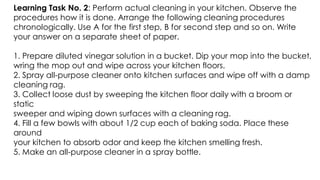
    Learning Task No.2: Perform actual cleaning in your kitchen. Observe the procedures how it is done. Arrange the following cleaning procedures chronologically. Use A for the first step, B for second step and so on. Write your answer on a separate sheet of paper. 1. Prepare diluted vinegar solution in a bucket. Dip your mop into the bucket, wring the mop out and wipe across your kitchen floors. 2. Spray all-purpose cleaner onto kitchen surfaces and wipe off with a damp cleaning rag. 3. Collect loose dust by sweeping the kitchen floor daily with a broom or static sweeper and wiping down surfaces with a cleaning rag. 4. Fill a few bowls with about 1/2 cup each of baking soda. Place these around your kitchen to absorb odor and keep the kitchen smelling fresh. 5. Make an all-purpose cleaner in a spray bottle.
  • 22.
    Learning Task No.3: Hold an interview with your family members to learn how sanitizers and disinfectants were used, as well as the benefits and drawbacks of each. On a separate sheet of paper, fill out the table below Sanitizer/Disinfectant Advantage(s) Disadvantage(s) 1. Chlorine 2. Iodine 3. Vinegar
  • 23.
    Long Quiz 2:Read each question carefully then write your answers in a separate paper. 1. The process of removing the food and other types of soil from the surface such as a dish, a glass, or a pan.
  • 24.
    Long Quiz 2:Read each question carefully then write your answers in a separate paper. 2. The process of washing (cleaning) and sanitizing dishes, glassware, flatwares, pots and pans.
  • 25.
    Long Quiz 2:Read each question carefully then write your answers in a separate paper. 3-4. Two methods of cleaning and sanitizing.
  • 26.
    Long Quiz 2:Read each question carefully then write your answers in a separate paper. 5. What is the ideal temperature of water used in washing dishes?
  • 27.
    Long Quiz 2:Read each question carefully then write your answers in a separate paper. 6. TRUE or FALSE In rinsing kitchen tools and utensils, it is ideal to use running water.
  • 28.
    Long Quiz 2:Read each question carefully then write your answers in a separate paper. 7. What is the appropriate temperature used when sanitizing using manual dishwashing?
  • 29.
    Long Quiz 2:Read each question carefully then write your answers in a separate paper. 8. TRUE or FALSE In drying the washed kitchen tools and utensils, use towel or air dry.
  • 30.
    Long Quiz 2:Read each question carefully then write your answers in a separate paper. 9. What is the appropriate temperature for machine sanitation by heat method?
  • 31.
    Long Quiz 2:Read each question carefully then write your answers in a separate paper. 10. What is the appropriate temperature for machine sanitation by chemical solution?
  • 32.
    Long Quiz 2:Read each question carefully then write your answers in a separate paper. 11. What is the procedure done after washing to reduce harmful microorganisms?
  • 33.
    Long Quiz 2:Read each question carefully then write your answers in a separate paper. 12. When steaming utensils for 15 mins, what is the appropriate temperature?
  • 34.
    Long Quiz 2:Read each question carefully then write your answers in a separate paper. 13. In using hot air method, the surface of exposed at what temperature for 20 mins?
  • 35.
    Long Quiz 2:Read each question carefully then write your answers in a separate paper. 14. What is the indicator that iodine solution has germicidal strength?
  • 36.
    Long Quiz 2:Read each question carefully then write your answers in a separate paper. 15. TRUE or FALSE Iodine effectiveness decreases with higher pH level.
  • 38.
    1. Cleaning 2. Dishwashing 3-4.manual and mechanical 5. 110 -120 degrees F 6. True 7. 1700 degrees F 8. False 9. 1800 degrees F 10. 1400 degrees F 11. Sanitizing 12.170 degrees F 13. 180 degrees F 14. Brown color 15. True