Electric
Machine
From:- Ashok Soni
BE (Electrical & Electronics)
GGCT Jabalpur
Classification of electrical machines
Electrical
machines
Static
Machine
Rotating
Machines
Transformer
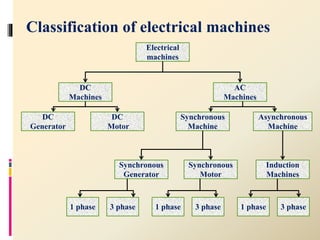
Classification of electrical machines
Electrical
machines
DC
Machines
AC
Machines
DC
Generator
DC
Motor
Asynchronous
Machine
Synchronous
Machine
Synchronous
Generator
Synchronous
Motor
Induction
Machines
1 phase 3 phase 1 phase 3 phase 1 phase 3 phase
DC Machines
Basically Dc machine divided in two parts:-
1. DC Generator
2. DC Motor
There are two types of generators, one is
AC generator and other is DC generator.
Whatever may be the types of generators, it
always converts mechanical power to
electrical power
DC Machines
There are two types of motor, one is AC
motor and other is DC motor. It is an electro-
mechanical device that converts electrical
energy to mechanical energy.
Generators is based on the fundamental
principle of Faraday’s laws of
Electromagnetic Induction.
DC Generator
Generators is based on the fundamental
principle of Faraday’s laws of
Electromagnetic Induction.
According to these law, when an
conductor moves in a magnetic field it cuts
magnetic lines force, due to which an emf is
induced in the conductor. The magnitude of
this induced emf depends upon the rate of
change of flux (magnetic line force) linkage
with the conductor.
DC Generator
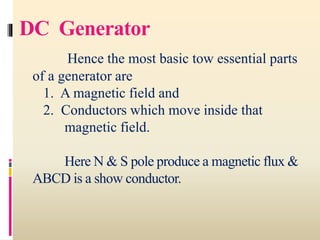
Hence the most basic tow essential parts
of a generator are
1. A magnetic field and
2. Conductors which move inside that
magnetic field.
Here N & S pole produce a magnetic flux &
ABCD is a show conductor.
DC Generator
DC Generator
DC Generator
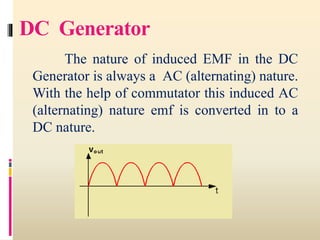
The nature of induced EMF in the DC
Generator is always a AC (alternating) nature.
With the help of commutator this induced AC
(alternating) nature emf is converted in to a
DC nature.
DC Generator
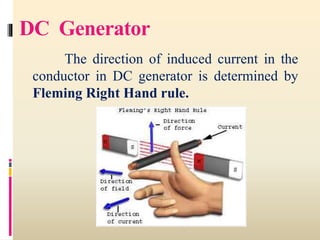
The direction of induced current in the
conductor in DC generator is determined by
Fleming Right Hand rule.
DC Generator
DC Motor
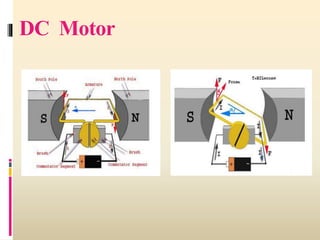
This DC or direct current
motor works on the principal, when a current
carrying conductor is placed in a magnetic
field, it experiences a torque and has a
tendency to move. This is known as motoring
action. If the direction of electric current in
the wire is reversed, the direction of rotation
also reverses.
DC Motor
DC Motor
When magnetic field and electric field
interact they produce a mechanical force, and
based on that the working principle of dc
motor established. The direction of rotation
of a this motor is given by Fleming’s left hand
rule,
DC Motor
The force which is experienced by DC
machine is determined by:-
F = BIL
where,
B = Flux Density
I = Current flowing in conductor
L = Length of conductor
Construction wise a DC motor is exactly
similar to a DC generator, but electrically it is
just the opposite.

1electricmachine 141125043532-conversion-gate02

  • 1.
    Electric Machine From:- Ashok Soni BE(Electrical & Electronics) GGCT Jabalpur
  • 2.
    Classification of electricalmachines Electrical machines Static Machine Rotating Machines Transformer
  • 3.
    Classification of electricalmachines Electrical machines DC Machines AC Machines DC Generator DC Motor Asynchronous Machine Synchronous Machine Synchronous Generator Synchronous Motor Induction Machines 1 phase 3 phase 1 phase 3 phase 1 phase 3 phase
  • 4.
    DC Machines Basically Dcmachine divided in two parts:- 1. DC Generator 2. DC Motor There are two types of generators, one is AC generator and other is DC generator. Whatever may be the types of generators, it always converts mechanical power to electrical power
  • 5.
    DC Machines There aretwo types of motor, one is AC motor and other is DC motor. It is an electro- mechanical device that converts electrical energy to mechanical energy. Generators is based on the fundamental principle of Faraday’s laws of Electromagnetic Induction.
  • 6.
    DC Generator Generators isbased on the fundamental principle of Faraday’s laws of Electromagnetic Induction. According to these law, when an conductor moves in a magnetic field it cuts magnetic lines force, due to which an emf is induced in the conductor. The magnitude of this induced emf depends upon the rate of change of flux (magnetic line force) linkage with the conductor.
  • 7.
    DC Generator Hence themost basic tow essential parts of a generator are 1. A magnetic field and 2. Conductors which move inside that magnetic field. Here N & S pole produce a magnetic flux & ABCD is a show conductor.
  • 8.
  • 9.
  • 10.
    DC Generator The natureof induced EMF in the DC Generator is always a AC (alternating) nature. With the help of commutator this induced AC (alternating) nature emf is converted in to a DC nature.
  • 11.
    DC Generator The directionof induced current in the conductor in DC generator is determined by Fleming Right Hand rule.
  • 12.
  • 13.
    DC Motor This DCor direct current motor works on the principal, when a current carrying conductor is placed in a magnetic field, it experiences a torque and has a tendency to move. This is known as motoring action. If the direction of electric current in the wire is reversed, the direction of rotation also reverses.
  • 14.
  • 15.
    DC Motor When magneticfield and electric field interact they produce a mechanical force, and based on that the working principle of dc motor established. The direction of rotation of a this motor is given by Fleming’s left hand rule,
  • 16.
    DC Motor The forcewhich is experienced by DC machine is determined by:- F = BIL where, B = Flux Density I = Current flowing in conductor L = Length of conductor Construction wise a DC motor is exactly similar to a DC generator, but electrically it is just the opposite.