COLLECTING QUALITATIVE DATA
BY
AMMAR MOHI UD DEEN
WHAT IS THE PROCESS OF QUALTATIVE DATA
COLLECTION?
1- Identify your participants and sites.
2- Gain access.
3- Determine the type of data to collect.
4- Develop data collection forms.
5- Administer the process in an ethical manner.
WHAT PARTICIPANTS AND SITES WILL YOU
STUDY?
DIFFERENCE BETWEEN RANDOM SAMPLING
AND PURPOSEFUL SAMPLING
To develop a detailed
understanding
Select people or sites who can
best help us understand our
phenomenon
Select representative individuals
To generalize from sample to the
population
Purposeful “Qualitative”
sampling
Random “Quantitative”
sampling
To make “claims” about the population
To build/test “theories” that explain the
population.
That might provide useful information.
That might help people learn about the
phenomenon.
That might give voice to silenced
people.
PURPOSEFUL SAMPLING
 Researchers intentionally select individuals and
sites to learn and understand the central
phenomenon.
TYPES OF PURPOSEFUL SAMPLING
Maximal Variation Sampling
Extreme Case Sampling
Typical Sampling
Theory or Concept Sampling
Homogeneous Sampling
Critical Sampling
Opportunistic Sampling
Snowball Sampling
Confirming and Disconfirming Sampling
Maximal Variation Sampling:
A purposeful sampling strategy in which the
researcher samples cases or individuals that
differ on some characteristic or trait.
e.g. different age groups.
EXTREME CASE SAMPLING
Is a form of purposeful sampling in which you study
an outlier case or one that displays extreme
characteristics.
-Choose extreme cases after knowing the typical or
average case-e.g., outstanding successes, crisis
events
Typical Sampling
A form of a purposeful sampling in which the researcher
studies a person or site that is “typical” to those
unfamiliar with the situation.
Theory or Concept Sampling
A purposeful sampling strategy in which the researcher
samples individuals or sites because they can help the
researcher generate or discover a theory or specific
concepts within the theory.
Homogeneous Sampling
The researcher purposefully samples individuals or sites
based on membership in a subgroup that has defining
characteristics.
Critical Sampling
Identify the case that can illustrate some
phenomenon dramatically.
Opportunistic Sampling
Purposeful sampling undertaken after the research begins,
to take advantage of unfolding events that will help
answer research questions.
Snowball Sampling
A form of purposeful sampling that typically proceeds after
a study begins and occurs when the researcher asks
participants to recommend other individuals to study.
Confirming and Disconfirming Sampling
A purposeful strategy used during a study to follow up
on specific cases to test or explore further specific
findings.
SAMPLE SIZE OR NUMBER OF RESEARCH SITES
HOW WILL YOU GAIN ACCESS TO THE PEOPLE
AND SITES?
Gaining access to the site or individual(s) in
qualitative inquiry involves obtaining permission at
different levels, such as:
The organization
The site
The individuals
The campus institutional review boards
SEEK INSTITUTIONAL REVIEW BOARD
APPROVAL
Institutional Review Board (IRB):
Insures that data reported is credible and accurate and that the
participant’s right and confidentiality are protected.
Several strategies might prove useful when negotiating qualitative
research through the (IRB) process:
1- Determine if individuals reviewing proposals on the review board
are familiar with qualitative research.
2- Develop detailed descriptions of the procedures so that reviewers have
a full disclosure of the potential risks to people and sites in the study.
3- Detail ways you will protect the anonymity participants.
4- Discuss the need to respect the research site and to disturb or
disrupt it as little as possible.
5- Detail how the study will provide opportunities to “give back” and
reciprocate in some way to those individuals you study.
6- Acknowledge that during your prolonged interaction with
participants, you may adopt their beliefs and even become an
advocate for their ideas.
7- specify potential power imbalances that may occur between yourself
and participants, and how your study will address these imbalances.
8- Detail how much time you will spend at the research site.
9- Include in the project description a list of the interview questions so
reviewers on the institutional board can determine how sensitive the
questions may be.
GATEKEEPER
A gatekeeper is an individual has an official or
unofficial role at the site, provides entrance to a
site, helps researchers locate people, and
assists in the identification of places to study.
WHT INFORMATION WILL YOU
COLLECT?
A COMPENDIUM OF DATA COLLECTION
APPROACHES IN QUALITATIVE RESEARCH
Observations
Interviews and questionnaires
Documents
Audiovisual materials
OBSERVATIONS
The process of gathering open-ended, firsthand
information by observing people and places at a
research site.
Advantages :
opportunity to record information as it
occurs in a setting,
1- To study actual behavior.
2- To study individuals who have
difficulty verbalizing their ideas.
e.g. preschool children
Disadvantages:
You will be limited to those
sites and situations where you
can gain access.
You may have difficulty
develop rapport with
individuals there.
A participant observer: is an observational role
adopted by researchers when they take part in
activities in the setting they observe.
Observational roles
A nonparticipant observer: is an observer who
visit a site and records notes without becoming
involved in the activities of the participants.
A changing observational role: is one where
researchers adapt their role to the situation.
e,g, page 223
The process of observing:
1- Select a site to be observed that can help you best understand
the central phenomenon.
2- Ease into the site slowly by looking around; getting a general sense
of the site; and taking limited notes, at least initially.
3- At the site, identify who or what to observe, when to observe, and
how long to observe.
4- Determine, initially, your role as an observer.
5- Conduct multiple observations over time to obtain the best
understanding of the site and the individuals.
6- design some means for recording notes during an observation.
Fieldnotes: are text recorded by the researcher during an observation
in a qualitative study.
7- Consider what information you will record during an observation.
8- Record descriptive and reflective fieldnotes.
Descriptive fieldnotes: record a description of the events, activities, and people.
Reflective fieldnotes: record personal thoughts that researchers have that relate to
their insights, hunches, or board ideas or themes that emerge during the observation.
9- Make yourself known, but remain unobtrusive.
10- After observing, slowly withdraw from the site.
INTERVIEWS AND QUESTIONNAIRES
INTERVIEWS
Occur when researchers ask one or more
participants general, open-ended questions
and record their answers.
ADVANTAGES AND DISADVANTAGES OF THE
INTERVIEW:
Advantages:
1- provide useful information when you cannot directly observe
participants.
2- they permit participants to describe detailed information
Disadvantages :
1- it provides only information “filtered” through the views of the
interviewers.
2- interview data may be deceptive and provide the perspective
the interviewee wants the researcher to hear.
3- the presence of the researcher may affect how the
interviewee responds.
4- interviewee responses also may not be articulate, perceptive,
or clear.
Types of interviews and open-ended questions on
questionnaires:
2- focus group interviews: the process of collecting data through
interviews with a group of people, typically four to six.
3- telephone interviews: is the process of gathering data using the
telephone and asking a small number of general questions.
4- electronic e-mail interviews: consist of collecting open-ended data
through interviews with individuals using computer and the internet to do
so.
1- one-on-one interviews: is a data-collection process in which the
researcher asks questions to and records answers from only one
participant in the study at a time.
CONDUCTING INTERVIEWS:
1- Identify the interviewees.
2- Determine the type of interview you will use.
3- During the interview, audiotape the questions and
responses.
4- Take brief notes during the interview.
5- Locate a quiet, suitable place for conducting the interview.
6- Obtain the consent from the interviewee to participate in
the study.
7- Have a plan, but be flexible.
8- Use probes to obtain additional information.
9- Be courteous and professional when the interview is over.
DOCUMENTS
Consist of public and private records that qualitative
researchers obtain about a site or participants in a study and
they can include newspapers, minutes of meeting, personal
journals, and letters.
DOCUMENTS
Advantages:
1- Being in the language and words of the participants.
2- Ready for analysis without the necessary transcription that is required
observational or interview data.
Disadvantages:
1- Documents are some times difficult to locate and obtain.
2- Information may not be available to the public.
3- Information may be located in distant archives, requiring the
researcher to travel, which take time and can be expensive.
4- The documents may be incomplete, inauthentic, or inaccurate.
5- In personal documents such as diaries or letters, the handwriting may
be hard to read.
COLLECTING DOCUMENTS:
1- Identify the type of documents that can provide useful information to answer
your qualitative research questions.
2- consider both public and private documents as sources of information of your
research.
3- once the documents are located, seek permission to use them from the
appropriate individuals in charge of the materials.
4- if you ask participants to keep a journal, provide specific instructions about the
procedure.
5- once you have permission to use documents, examine them for accuracy,
completeness, and usefulness in answering the research questions in your
study.
6- record information from the documents.
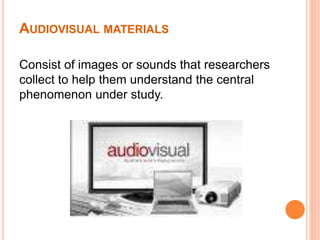
AUDIOVISUAL MATERIALS
Consist of images or sounds that researchers
collect to help them understand the central
phenomenon under study.
WHAT ARE THE ADVANTAGES AND DISADVANTAGES
OF USING VISUAL MATERIALS?
Advantages:
1- people easily relate to images because they are so
pervasive in our society.
2- Images provide an opportunity for the participant to
share directly their perceptions of reality.
3- images such as videotapes and films, for example,
provide extensive data about real life as people
visualize it.
Disadvantages:
1- they are difficult to analyze because of the rich
information.
2- you as a researcher may influence the data collected.
3- in selecting the photo album to examine or requesting
that a certain type of drawing be sketched, you may
impose your meaning of the phenomenon on participants,
rather than obtain the participants’ views.
STEPS OF COLLECTING AUDIOVISUAL
:
MATERIALS
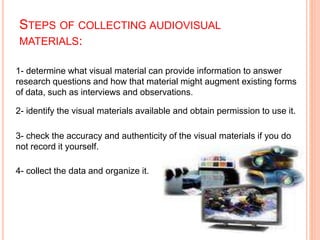
1- determine what visual material can provide information to answer
research questions and how that material might augment existing forms
of data, such as interviews and observations.
2- identify the visual materials available and obtain permission to use it.
3- check the accuracy and authenticity of the visual materials if you do
not record it yourself.
4- collect the data and organize it.
HOW DO YOU RECORD DATA?
Data recording protocols:
Are forms designed and used by qualitative research
to record information during observations and
interviews.
For observations and interviews, qualitative researchers use
specially designed protocols.
Interview protocol
Is a form designed by the researcher that contains
instructions for the process of the interview, the
questions to be asked, and space to take notes of
responses from the interviewee.
DEVELOPMENT AND DESIGN OF AN INTERVIEW
PROTOCOL
1- It contains a header to record essential information about the interview,
statements about the purpose of the study a reminder that participants need to sign
the consent form, and suggestion to make preliminary test of the recording
equipment.
2- following this header are five brief open-ended questions that allow
participants maximum flexibility for responding to the questions.
3- the core questions, 2 through 4, address major research in the study.
Observational protocol
Is a form designed by the researcher before data
collection that is used for taking fieldnotes during an
observation
THANK YOU

Lecture 2 (Qualitative Data Collection).ppt

  • 1.
  • 2.
    WHAT IS THEPROCESS OF QUALTATIVE DATA COLLECTION? 1- Identify your participants and sites. 2- Gain access. 3- Determine the type of data to collect. 4- Develop data collection forms. 5- Administer the process in an ethical manner.
  • 3.
    WHAT PARTICIPANTS ANDSITES WILL YOU STUDY?
  • 4.
    DIFFERENCE BETWEEN RANDOMSAMPLING AND PURPOSEFUL SAMPLING
  • 5.
    To develop adetailed understanding Select people or sites who can best help us understand our phenomenon Select representative individuals To generalize from sample to the population Purposeful “Qualitative” sampling Random “Quantitative” sampling To make “claims” about the population To build/test “theories” that explain the population. That might provide useful information. That might help people learn about the phenomenon. That might give voice to silenced people.
  • 6.
    PURPOSEFUL SAMPLING  Researchersintentionally select individuals and sites to learn and understand the central phenomenon.
  • 7.
    TYPES OF PURPOSEFULSAMPLING Maximal Variation Sampling Extreme Case Sampling Typical Sampling Theory or Concept Sampling Homogeneous Sampling Critical Sampling Opportunistic Sampling Snowball Sampling Confirming and Disconfirming Sampling
  • 8.
    Maximal Variation Sampling: Apurposeful sampling strategy in which the researcher samples cases or individuals that differ on some characteristic or trait. e.g. different age groups.
  • 9.
    EXTREME CASE SAMPLING Isa form of purposeful sampling in which you study an outlier case or one that displays extreme characteristics. -Choose extreme cases after knowing the typical or average case-e.g., outstanding successes, crisis events
  • 10.
    Typical Sampling A formof a purposeful sampling in which the researcher studies a person or site that is “typical” to those unfamiliar with the situation.
  • 11.
    Theory or ConceptSampling A purposeful sampling strategy in which the researcher samples individuals or sites because they can help the researcher generate or discover a theory or specific concepts within the theory.
  • 12.
    Homogeneous Sampling The researcherpurposefully samples individuals or sites based on membership in a subgroup that has defining characteristics.
  • 13.
    Critical Sampling Identify thecase that can illustrate some phenomenon dramatically.
  • 14.
    Opportunistic Sampling Purposeful samplingundertaken after the research begins, to take advantage of unfolding events that will help answer research questions.
  • 15.
    Snowball Sampling A formof purposeful sampling that typically proceeds after a study begins and occurs when the researcher asks participants to recommend other individuals to study.
  • 16.
    Confirming and DisconfirmingSampling A purposeful strategy used during a study to follow up on specific cases to test or explore further specific findings.
  • 17.
    SAMPLE SIZE ORNUMBER OF RESEARCH SITES
  • 18.
    HOW WILL YOUGAIN ACCESS TO THE PEOPLE AND SITES? Gaining access to the site or individual(s) in qualitative inquiry involves obtaining permission at different levels, such as: The organization The site The individuals The campus institutional review boards
  • 19.
    SEEK INSTITUTIONAL REVIEWBOARD APPROVAL Institutional Review Board (IRB): Insures that data reported is credible and accurate and that the participant’s right and confidentiality are protected.
  • 20.
    Several strategies mightprove useful when negotiating qualitative research through the (IRB) process: 1- Determine if individuals reviewing proposals on the review board are familiar with qualitative research. 2- Develop detailed descriptions of the procedures so that reviewers have a full disclosure of the potential risks to people and sites in the study. 3- Detail ways you will protect the anonymity participants. 4- Discuss the need to respect the research site and to disturb or disrupt it as little as possible. 5- Detail how the study will provide opportunities to “give back” and reciprocate in some way to those individuals you study. 6- Acknowledge that during your prolonged interaction with participants, you may adopt their beliefs and even become an advocate for their ideas.
  • 21.
    7- specify potentialpower imbalances that may occur between yourself and participants, and how your study will address these imbalances. 8- Detail how much time you will spend at the research site. 9- Include in the project description a list of the interview questions so reviewers on the institutional board can determine how sensitive the questions may be.
  • 22.
    GATEKEEPER A gatekeeper isan individual has an official or unofficial role at the site, provides entrance to a site, helps researchers locate people, and assists in the identification of places to study.
  • 23.
  • 24.
    A COMPENDIUM OFDATA COLLECTION APPROACHES IN QUALITATIVE RESEARCH
  • 25.
  • 26.
    OBSERVATIONS The process ofgathering open-ended, firsthand information by observing people and places at a research site. Advantages : opportunity to record information as it occurs in a setting, 1- To study actual behavior. 2- To study individuals who have difficulty verbalizing their ideas. e.g. preschool children Disadvantages: You will be limited to those sites and situations where you can gain access. You may have difficulty develop rapport with individuals there.
  • 27.
    A participant observer:is an observational role adopted by researchers when they take part in activities in the setting they observe. Observational roles A nonparticipant observer: is an observer who visit a site and records notes without becoming involved in the activities of the participants. A changing observational role: is one where researchers adapt their role to the situation. e,g, page 223
  • 28.
    The process ofobserving: 1- Select a site to be observed that can help you best understand the central phenomenon. 2- Ease into the site slowly by looking around; getting a general sense of the site; and taking limited notes, at least initially. 3- At the site, identify who or what to observe, when to observe, and how long to observe. 4- Determine, initially, your role as an observer. 5- Conduct multiple observations over time to obtain the best understanding of the site and the individuals. 6- design some means for recording notes during an observation. Fieldnotes: are text recorded by the researcher during an observation in a qualitative study.
  • 29.
    7- Consider whatinformation you will record during an observation. 8- Record descriptive and reflective fieldnotes. Descriptive fieldnotes: record a description of the events, activities, and people. Reflective fieldnotes: record personal thoughts that researchers have that relate to their insights, hunches, or board ideas or themes that emerge during the observation. 9- Make yourself known, but remain unobtrusive. 10- After observing, slowly withdraw from the site.
  • 30.
  • 31.
    INTERVIEWS Occur when researchersask one or more participants general, open-ended questions and record their answers.
  • 32.
    ADVANTAGES AND DISADVANTAGESOF THE INTERVIEW: Advantages: 1- provide useful information when you cannot directly observe participants. 2- they permit participants to describe detailed information Disadvantages : 1- it provides only information “filtered” through the views of the interviewers. 2- interview data may be deceptive and provide the perspective the interviewee wants the researcher to hear. 3- the presence of the researcher may affect how the interviewee responds. 4- interviewee responses also may not be articulate, perceptive, or clear.
  • 33.
    Types of interviewsand open-ended questions on questionnaires: 2- focus group interviews: the process of collecting data through interviews with a group of people, typically four to six. 3- telephone interviews: is the process of gathering data using the telephone and asking a small number of general questions. 4- electronic e-mail interviews: consist of collecting open-ended data through interviews with individuals using computer and the internet to do so. 1- one-on-one interviews: is a data-collection process in which the researcher asks questions to and records answers from only one participant in the study at a time.
  • 34.
    CONDUCTING INTERVIEWS: 1- Identifythe interviewees. 2- Determine the type of interview you will use. 3- During the interview, audiotape the questions and responses. 4- Take brief notes during the interview. 5- Locate a quiet, suitable place for conducting the interview. 6- Obtain the consent from the interviewee to participate in the study. 7- Have a plan, but be flexible. 8- Use probes to obtain additional information. 9- Be courteous and professional when the interview is over.
  • 35.
    DOCUMENTS Consist of publicand private records that qualitative researchers obtain about a site or participants in a study and they can include newspapers, minutes of meeting, personal journals, and letters.
  • 36.
    DOCUMENTS Advantages: 1- Being inthe language and words of the participants. 2- Ready for analysis without the necessary transcription that is required observational or interview data. Disadvantages: 1- Documents are some times difficult to locate and obtain. 2- Information may not be available to the public. 3- Information may be located in distant archives, requiring the researcher to travel, which take time and can be expensive. 4- The documents may be incomplete, inauthentic, or inaccurate. 5- In personal documents such as diaries or letters, the handwriting may be hard to read.
  • 37.
    COLLECTING DOCUMENTS: 1- Identifythe type of documents that can provide useful information to answer your qualitative research questions. 2- consider both public and private documents as sources of information of your research. 3- once the documents are located, seek permission to use them from the appropriate individuals in charge of the materials. 4- if you ask participants to keep a journal, provide specific instructions about the procedure. 5- once you have permission to use documents, examine them for accuracy, completeness, and usefulness in answering the research questions in your study. 6- record information from the documents.
  • 38.
    AUDIOVISUAL MATERIALS Consist ofimages or sounds that researchers collect to help them understand the central phenomenon under study.
  • 39.
    WHAT ARE THEADVANTAGES AND DISADVANTAGES OF USING VISUAL MATERIALS? Advantages: 1- people easily relate to images because they are so pervasive in our society. 2- Images provide an opportunity for the participant to share directly their perceptions of reality. 3- images such as videotapes and films, for example, provide extensive data about real life as people visualize it.
  • 40.
    Disadvantages: 1- they aredifficult to analyze because of the rich information. 2- you as a researcher may influence the data collected. 3- in selecting the photo album to examine or requesting that a certain type of drawing be sketched, you may impose your meaning of the phenomenon on participants, rather than obtain the participants’ views.
  • 41.
    STEPS OF COLLECTINGAUDIOVISUAL : MATERIALS 1- determine what visual material can provide information to answer research questions and how that material might augment existing forms of data, such as interviews and observations. 2- identify the visual materials available and obtain permission to use it. 3- check the accuracy and authenticity of the visual materials if you do not record it yourself. 4- collect the data and organize it.
  • 42.
    HOW DO YOURECORD DATA? Data recording protocols: Are forms designed and used by qualitative research to record information during observations and interviews. For observations and interviews, qualitative researchers use specially designed protocols.
  • 43.
    Interview protocol Is aform designed by the researcher that contains instructions for the process of the interview, the questions to be asked, and space to take notes of responses from the interviewee.
  • 44.
    DEVELOPMENT AND DESIGNOF AN INTERVIEW PROTOCOL 1- It contains a header to record essential information about the interview, statements about the purpose of the study a reminder that participants need to sign the consent form, and suggestion to make preliminary test of the recording equipment. 2- following this header are five brief open-ended questions that allow participants maximum flexibility for responding to the questions. 3- the core questions, 2 through 4, address major research in the study.
  • 45.
    Observational protocol Is aform designed by the researcher before data collection that is used for taking fieldnotes during an observation
  • 46.