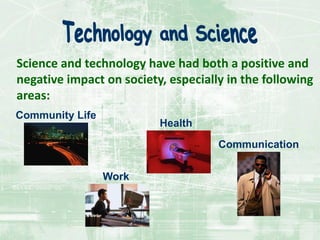
Science and technology have had both a positive and
negative impact on society, especially in the following
areas:
Community Life
Work
Communication
Health
The shift from nomadic life to farming led to the
development of the city.
• Networks of
transportation,
communication, and
trade systems
• Specialized labor
• Government and religion
• Social class
Jerusalem, one of the world’s first
cities, is still in existence today.
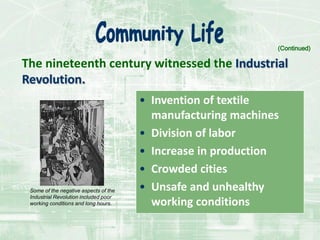
The nineteenth century witnessed the Industrial
Revolution.
• Invention of textile
manufacturing machines
• Division of labor
• Increase in production
• Crowded cities
• Unsafe and unhealthy
working conditions
(Continued)
Some of the negative aspects of the
Industrial Revolution included poor
working conditions and long hours.
The twentieth century saw the birth of suburbs.
• Invention of the trolley
car and automobile
• Status symbol
• Alternative to harsh,
crowded city conditions
(Continued)
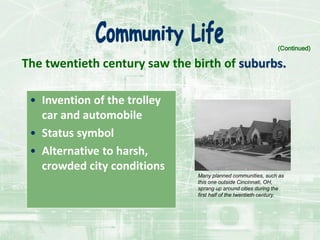
Many planned communities, such as
this one outside Cincinnati, OH,
sprang up around cities during the
first half of the twentieth century.
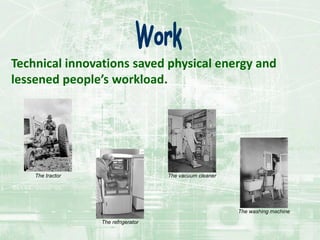
Technical innovations saved physical energy and
lessened people’s workload.
The tractor
The refrigerator
The vacuum cleaner
The washing machine
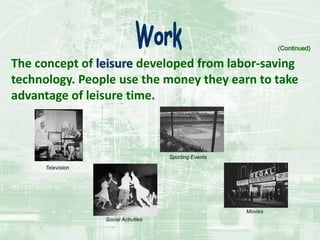
The concept of leisure developed from labor-saving
technology. People use the money they earn to take
advantage of leisure time.
(Continued)
Television
Social Activities
Sporting Events
Movies
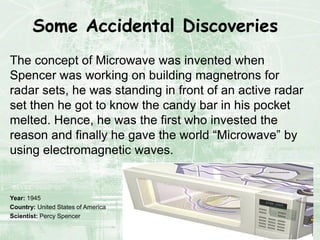
The concept of Microwave was invented when
Spencer was working on building magnetrons for
radar sets, he was standing in front of an active radar
set then he got to know the candy bar in his pocket
melted. Hence, he was the first who invested the
reason and finally he gave the world “Microwave” by
using electromagnetic waves.
Year: 1945
Country: United States of America
Scientist: Percy Spencer
Some Accidental Discoveries
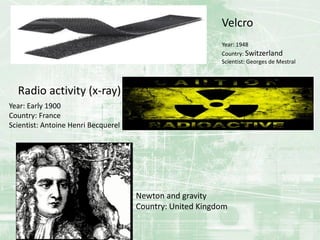
Year: 1948
Country: Switzerland
Scientist: Georges de Mestral
Velcro
Radio activity (x-ray)
Year: Early 1900
Country: France
Scientist: Antoine Henri Becquerel
Newton and gravity
Country: United Kingdom
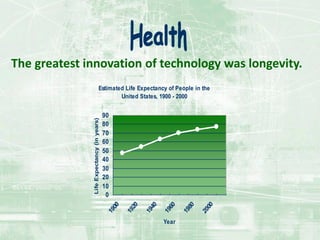
The greatest innovation of technology was longevity.
Estimated Life Expectancy of People in the
United States, 1900 - 2000
0
10
20
30
40
50
60
70
80
90
1900
1920
1940
1960
1980
2000
Year
Life
Expectancy
(in
years)
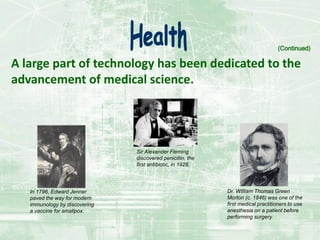
A large part of technology has been dedicated to the
advancement of medical science.
(Continued)
Sir Alexander Fleming
discovered penicillin, the
first antibiotic, in 1928.
In 1796, Edward Jenner
paved the way for modern
immunology by discovering
a vaccine for smallpox.
Dr. William Thomas Green
Morton (c. 1846) was one of the
first medical practitioners to use
anesthesia on a patient before
performing surgery.
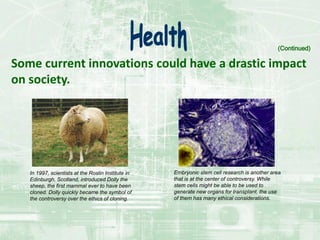
Some current innovations could have a drastic impact
on society.
(Continued)
In 1997, scientists at the Roslin Institute in
Edinburgh, Scotland, introduced Dolly the
sheep, the first mammal ever to have been
cloned. Dolly quickly became the symbol of
the controversy over the ethics of cloning.
Embryonic stem cell research is another area
that is at the center of controversy. While
stem cells might be able to be used to
generate new organs for transplant, the use
of them has many ethical considerations.
Inventions and innovations in communication have
had a major influence on society.
• Egypt: papyrus and hieroglyphics
• Ancient Babylonia: cuneiform
• Ancient Greece: public speaking, persuasive
rhetoric, drama, and philosophy
• Ancient Rome: Roman alphabet
• Modern Europe: printing press
• World today: World Wide Web
Progress is a series of improvements in human life
marked by inventions and discoveries.
• Positive attributes of
technology must be greater
than negative attributes
• Negative consequences:
destruction of environment
and loss of what it means to be
human
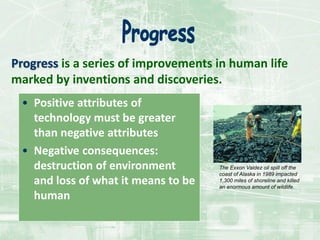
The Exxon Valdez oil spill off the
coast of Alaska in 1989 impacted
1,300 miles of shoreline and killed
an enormous amount of wildlife.

Science, Technology, and Society Industrialization

  • 2.
    Science and technologyhave had both a positive and negative impact on society, especially in the following areas: Community Life Work Communication Health
  • 3.
    The shift fromnomadic life to farming led to the development of the city. • Networks of transportation, communication, and trade systems • Specialized labor • Government and religion • Social class Jerusalem, one of the world’s first cities, is still in existence today.
  • 4.
    The nineteenth centurywitnessed the Industrial Revolution. • Invention of textile manufacturing machines • Division of labor • Increase in production • Crowded cities • Unsafe and unhealthy working conditions (Continued) Some of the negative aspects of the Industrial Revolution included poor working conditions and long hours.
  • 5.
    The twentieth centurysaw the birth of suburbs. • Invention of the trolley car and automobile • Status symbol • Alternative to harsh, crowded city conditions (Continued) Many planned communities, such as this one outside Cincinnati, OH, sprang up around cities during the first half of the twentieth century.
  • 6.
    Technical innovations savedphysical energy and lessened people’s workload. The tractor The refrigerator The vacuum cleaner The washing machine
  • 7.
    The concept ofleisure developed from labor-saving technology. People use the money they earn to take advantage of leisure time. (Continued) Television Social Activities Sporting Events Movies
  • 8.
    The concept ofMicrowave was invented when Spencer was working on building magnetrons for radar sets, he was standing in front of an active radar set then he got to know the candy bar in his pocket melted. Hence, he was the first who invested the reason and finally he gave the world “Microwave” by using electromagnetic waves. Year: 1945 Country: United States of America Scientist: Percy Spencer Some Accidental Discoveries
  • 9.
    Year: 1948 Country: Switzerland Scientist:Georges de Mestral Velcro Radio activity (x-ray) Year: Early 1900 Country: France Scientist: Antoine Henri Becquerel Newton and gravity Country: United Kingdom
  • 10.
    The greatest innovationof technology was longevity. Estimated Life Expectancy of People in the United States, 1900 - 2000 0 10 20 30 40 50 60 70 80 90 1900 1920 1940 1960 1980 2000 Year Life Expectancy (in years)
  • 11.
    A large partof technology has been dedicated to the advancement of medical science. (Continued) Sir Alexander Fleming discovered penicillin, the first antibiotic, in 1928. In 1796, Edward Jenner paved the way for modern immunology by discovering a vaccine for smallpox. Dr. William Thomas Green Morton (c. 1846) was one of the first medical practitioners to use anesthesia on a patient before performing surgery.
  • 12.
    Some current innovationscould have a drastic impact on society. (Continued) In 1997, scientists at the Roslin Institute in Edinburgh, Scotland, introduced Dolly the sheep, the first mammal ever to have been cloned. Dolly quickly became the symbol of the controversy over the ethics of cloning. Embryonic stem cell research is another area that is at the center of controversy. While stem cells might be able to be used to generate new organs for transplant, the use of them has many ethical considerations.
  • 13.
    Inventions and innovationsin communication have had a major influence on society. • Egypt: papyrus and hieroglyphics • Ancient Babylonia: cuneiform • Ancient Greece: public speaking, persuasive rhetoric, drama, and philosophy • Ancient Rome: Roman alphabet • Modern Europe: printing press • World today: World Wide Web
  • 14.
    Progress is aseries of improvements in human life marked by inventions and discoveries. • Positive attributes of technology must be greater than negative attributes • Negative consequences: destruction of environment and loss of what it means to be human The Exxon Valdez oil spill off the coast of Alaska in 1989 impacted 1,300 miles of shoreline and killed an enormous amount of wildlife.