SUMMER 1789
France Erupts
Before the Estates General

   Each Estate met separately
   One vote per Estate
     Thus  3rd could always be outvoted
     Disliked by bourgeoisie and some liberal nobles

     Argued for voting by head – double vote for 3rd Estate

   Issue dominated Paris Parlement 1788
     Essentially
                upper class body
     Supported traditional voting method

   3rd Estate outraged
Voting By Estate
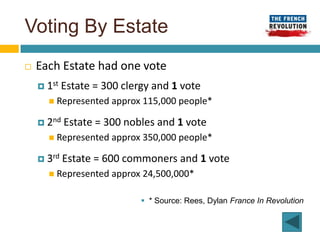
   Each Estate had one vote
     1st   Estate = 300 clergy and 1 vote
       Represented   approx 115,000 people*

     2nd   Estate = 300 nobles and 1 vote
       Represented   approx 350,000 people*

     3rd   Estate = 600 commoners and 1 vote
       Represented   approx 24,500,000*

                              * Source: Rees, Dylan France In Revolution
Voting By Head
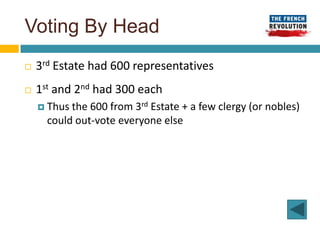
   3rd Estate had 600 representatives
   1st and 2nd had 300 each
     Thus the 600 from 3rd Estate + a few clergy (or nobles)
      could out-vote everyone else
Estates General: Build-Up 1

   3rd Estate: now against Paris Parlement
     Pamphlets attacking Paris parlement
     Debate no longer focused on King and ministers:
       Now broader   question of traditional society and leadership

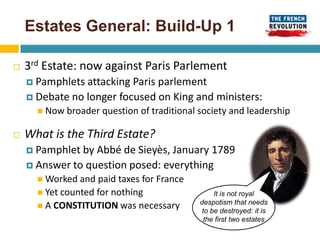
   What is the Third Estate?
     Pamphlet by Abbé de Sieyès, January 1789
     Answer to question posed: everything
       Worked and  paid taxes for France
       Yet counted for nothing                  It is not royal
                                             despotism that needs
       A CONSTITUTION was necessary
                                             to be destroyed: it is
                                              the first two estates
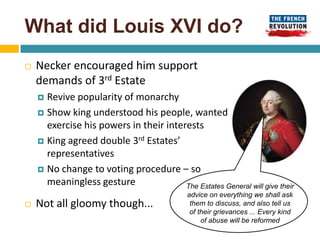
What did Louis XVI do?
   Necker encouraged him support
    demands of 3rd Estate
     Revive popularity of monarchy
     Show king understood his people, wanted
      exercise his powers in their interests
     King agreed double 3rd Estates’
      representatives
     No change to voting procedure – so
      meaningless gesture               The Estates General will give their
                                             advice on everything we shall ask
   Not all gloomy though...                  them to discuss, and also tell us
                                              of their grievances ... Every kind
                                                  of abuse will be reformed
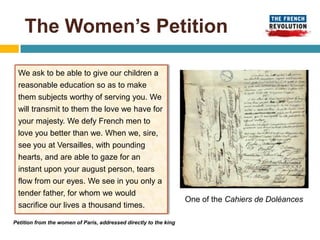
The Women’s Petition

 We ask to be able to give our children a
 reasonable education so as to make
 them subjects worthy of serving you. We
 will transmit to them the love we have for
 your majesty. We defy French men to
 love you better than we. When we, sire,
 see you at Versailles, with pounding
 hearts, and are able to gaze for an
 instant upon your august person, tears
 flow from our eyes. We see in you only a
 tender father, for whom we would
                                                                   One of the Cahiers de Doléances
 sacrifice our lives a thousand times.

Petition from the women of Paris, addressed directly to the king
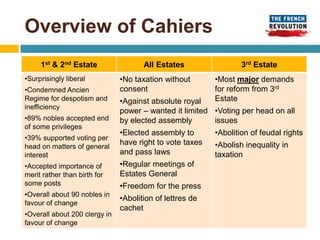
Overview of Cahiers
     1st & 2nd Estate                 All Estates                 3rd Estate
•Surprisingly liberal          •No taxation without       •Most major demands
•Condemned Ancien              consent                    for reform from 3rd
Regime for despotism and       •Against absolute royal    Estate
inefficiency
                               power – wanted it limited •Voting per head on all
•89% nobles accepted end       by elected assembly       issues
of some privileges
                               •Elected assembly to       •Abolition of feudal rights
•39% supported voting per
head on matters of general
                               have right to vote taxes   •Abolish inequality in
interest                       and pass laws              taxation
•Accepted importance of        •Regular meetings of
merit rather than birth for    Estates General
some posts                     •Freedom for the press
•Overall about 90 nobles in
                               •Abolition of lettres de
favour of change
                               cachet
•Overall about 200 clergy in
favour of change
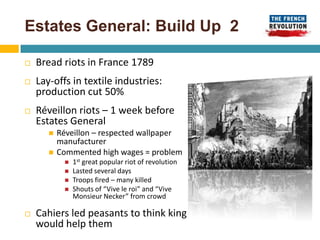
Estates General: Build Up 2

   Bread riots in France 1789
   Lay-offs in textile industries:
    production cut 50%
   Réveillon riots – 1 week before
    Estates General
          Réveillon – respected wallpaper
           manufacturer
          Commented high wages = problem
               1st great popular riot of revolution
               Lasted several days
               Troops fired – many killed
               Shouts of “Vive le roi” and “Vive
                Monsieur Necker” from crowd

   Cahiers led peasants to think king
    would help them
The Estates General
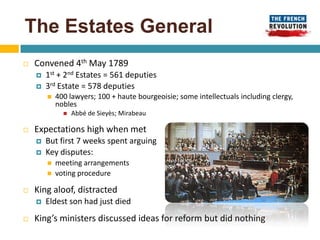
   Convened 4th May 1789
       1st + 2nd Estates = 561 deputies
       3rd Estate = 578 deputies
           400 lawyers; 100 + haute bourgeoisie; some intellectuals including clergy,
            nobles
                 Abbé de Sieyès; Mirabeau

   Expectations high when met
       But first 7 weeks spent arguing
       Key disputes:
           meeting arrangements
           voting procedure

   King aloof, distracted
       Eldest son had just died
   King’s ministers discussed ideas for reform but did nothing
The National Assembly
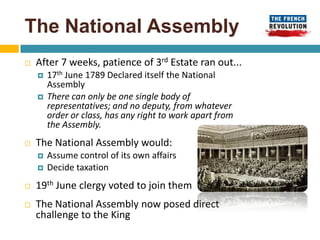
   After 7 weeks, patience of 3rd Estate ran out...
       17th June 1789 Declared itself the National
        Assembly
       There can only be one single body of
        representatives; and no deputy, from whatever
        order or class, has any right to work apart from
        the Assembly.
   The National Assembly would:
       Assume control of its own affairs
       Decide taxation
   19th June clergy voted to join them
   The National Assembly now posed direct
    challenge to the King
Video Clips
   As you watch these clips, identify all the factors
    that led to the 3rd Estate to finally rebel
     From   Estates General  National Assembly
       From 03.58    end
     Next   clip  Tennis Court Oath
The Tennis Court Oath
   Necker advised King:
     Hold royal session of all 3 Estates, offer reforms
     But events moved too fast

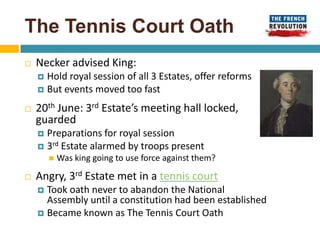
   20th June: 3rd Estate’s meeting hall locked,
    guarded
     Preparations for royal session
     3rd Estate alarmed by troops present
           Was king going to use force against them?

   Angry, 3rd Estate met in a tennis court
     Took oath never to abandon the National
      Assembly until a constitution had been established
     Became known as The Tennis Court Oath
The Royal Session
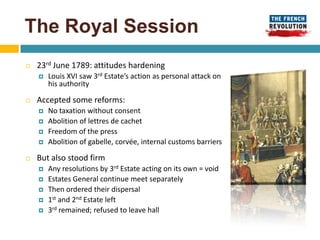
   23rd June 1789: attitudes hardening
       Louis XVI saw 3rd Estate’s action as personal attack on
        his authority

   Accepted some reforms:
       No taxation without consent
       Abolition of lettres de cachet
       Freedom of the press
       Abolition of gabelle, corvée, internal customs barriers

   But also stood firm
       Any resolutions by 3rd Estate acting on its own = void
       Estates General continue meet separately
       Then ordered their dispersal
       1st and 2nd Estate left
       3rd remained; refused to leave hall
Louis XVI Backs Down
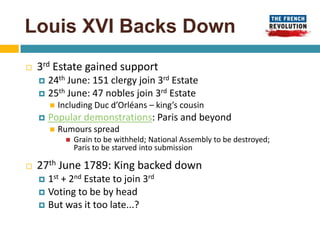
   3rd Estate gained support
     24th June: 151 clergy join 3rd Estate
     25th June: 47 nobles join 3rd Estate
           Including Duc d’Orléans – king’s cousin
       Popular demonstrations: Paris and beyond
           Rumours spread
                 Grain to be withheld; National Assembly to be destroyed;
                  Paris to be starved into submission

   27th June 1789: King backed down
     1st + 2nd Estate to join 3rd
     Voting to be by head
     But was it too late...?
Tension Escalates 1
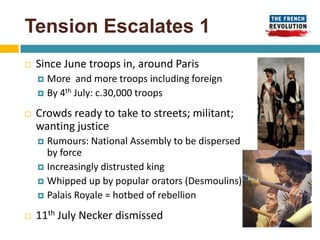
   Since June troops in, around Paris
     More and more troops including foreign
     By 4th July: c.30,000 troops

   Crowds ready to take to streets; militant;
    wanting justice
     Rumours: National Assembly to be dispersed
      by force
     Increasingly distrusted king
     Whipped up by popular orators (Desmoulins)
     Palais Royale = hotbed of rebellion

   11th July Necker dismissed
Tension Escalates 2
   12th – 13th July poor of Paris raided stores
     Including gun sellers, sword smiths, food stores
     Attack on Parisian customs posts
           40/54 destroyed
     Gardes-français (French troops): loyalty no longer
      guaranteed
     St Lazare monastery taken over

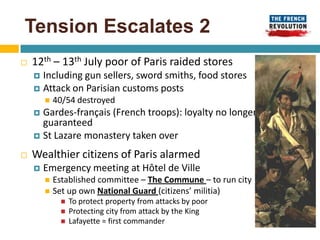
   Wealthier citizens of Paris alarmed
       Emergency meeting at Hôtel de Ville
         Established committee – The Commune – to run city
         Set up own National Guard (citizens’ militia)
                To protect property from attacks by poor
                Protecting city from attack by the King
                Lafayette = first commander
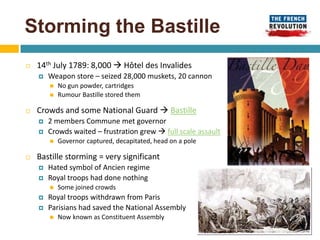
Storming the Bastille
   14th July 1789: 8,000  Hôtel des Invalides
       Weapon store – seized 28,000 muskets, 20 cannon
           No gun powder, cartridges
           Rumour Bastille stored them

   Crowds and some National Guard  Bastille
       2 members Commune met governor
       Crowds waited – frustration grew  full scale assault
           Governor captured, decapitated, head on a pole

   Bastille storming = very significant
       Hated symbol of Ancien regime
       Royal troops had done nothing
           Some joined crowds
       Royal troops withdrawn from Paris
       Parisians had saved the National Assembly
           Now known as Constituent Assembly

1789

  • 1.
  • 2.
    Before the EstatesGeneral  Each Estate met separately  One vote per Estate  Thus 3rd could always be outvoted  Disliked by bourgeoisie and some liberal nobles  Argued for voting by head – double vote for 3rd Estate  Issue dominated Paris Parlement 1788  Essentially upper class body  Supported traditional voting method  3rd Estate outraged
  • 3.
    Voting By Estate  Each Estate had one vote  1st Estate = 300 clergy and 1 vote  Represented approx 115,000 people*  2nd Estate = 300 nobles and 1 vote  Represented approx 350,000 people*  3rd Estate = 600 commoners and 1 vote  Represented approx 24,500,000*  * Source: Rees, Dylan France In Revolution
  • 4.
    Voting By Head  3rd Estate had 600 representatives  1st and 2nd had 300 each  Thus the 600 from 3rd Estate + a few clergy (or nobles) could out-vote everyone else
  • 5.
    Estates General: Build-Up1  3rd Estate: now against Paris Parlement  Pamphlets attacking Paris parlement  Debate no longer focused on King and ministers:  Now broader question of traditional society and leadership  What is the Third Estate?  Pamphlet by Abbé de Sieyès, January 1789  Answer to question posed: everything  Worked and paid taxes for France  Yet counted for nothing It is not royal despotism that needs  A CONSTITUTION was necessary to be destroyed: it is the first two estates
  • 6.
    What did LouisXVI do?  Necker encouraged him support demands of 3rd Estate  Revive popularity of monarchy  Show king understood his people, wanted exercise his powers in their interests  King agreed double 3rd Estates’ representatives  No change to voting procedure – so meaningless gesture The Estates General will give their advice on everything we shall ask  Not all gloomy though... them to discuss, and also tell us of their grievances ... Every kind of abuse will be reformed
  • 7.
    The Women’s Petition We ask to be able to give our children a reasonable education so as to make them subjects worthy of serving you. We will transmit to them the love we have for your majesty. We defy French men to love you better than we. When we, sire, see you at Versailles, with pounding hearts, and are able to gaze for an instant upon your august person, tears flow from our eyes. We see in you only a tender father, for whom we would One of the Cahiers de Doléances sacrifice our lives a thousand times. Petition from the women of Paris, addressed directly to the king
  • 8.
    Overview of Cahiers 1st & 2nd Estate All Estates 3rd Estate •Surprisingly liberal •No taxation without •Most major demands •Condemned Ancien consent for reform from 3rd Regime for despotism and •Against absolute royal Estate inefficiency power – wanted it limited •Voting per head on all •89% nobles accepted end by elected assembly issues of some privileges •Elected assembly to •Abolition of feudal rights •39% supported voting per head on matters of general have right to vote taxes •Abolish inequality in interest and pass laws taxation •Accepted importance of •Regular meetings of merit rather than birth for Estates General some posts •Freedom for the press •Overall about 90 nobles in •Abolition of lettres de favour of change cachet •Overall about 200 clergy in favour of change
  • 9.
    Estates General: BuildUp 2  Bread riots in France 1789  Lay-offs in textile industries: production cut 50%  Réveillon riots – 1 week before Estates General  Réveillon – respected wallpaper manufacturer  Commented high wages = problem  1st great popular riot of revolution  Lasted several days  Troops fired – many killed  Shouts of “Vive le roi” and “Vive Monsieur Necker” from crowd  Cahiers led peasants to think king would help them
  • 10.
    The Estates General  Convened 4th May 1789  1st + 2nd Estates = 561 deputies  3rd Estate = 578 deputies  400 lawyers; 100 + haute bourgeoisie; some intellectuals including clergy, nobles  Abbé de Sieyès; Mirabeau  Expectations high when met  But first 7 weeks spent arguing  Key disputes:  meeting arrangements  voting procedure  King aloof, distracted  Eldest son had just died  King’s ministers discussed ideas for reform but did nothing
  • 11.
    The National Assembly  After 7 weeks, patience of 3rd Estate ran out...  17th June 1789 Declared itself the National Assembly  There can only be one single body of representatives; and no deputy, from whatever order or class, has any right to work apart from the Assembly.  The National Assembly would:  Assume control of its own affairs  Decide taxation  19th June clergy voted to join them  The National Assembly now posed direct challenge to the King
  • 12.
    Video Clips  As you watch these clips, identify all the factors that led to the 3rd Estate to finally rebel  From Estates General  National Assembly  From 03.58  end  Next clip  Tennis Court Oath
  • 13.
    The Tennis CourtOath  Necker advised King:  Hold royal session of all 3 Estates, offer reforms  But events moved too fast  20th June: 3rd Estate’s meeting hall locked, guarded  Preparations for royal session  3rd Estate alarmed by troops present  Was king going to use force against them?  Angry, 3rd Estate met in a tennis court  Took oath never to abandon the National Assembly until a constitution had been established  Became known as The Tennis Court Oath
  • 14.
    The Royal Session  23rd June 1789: attitudes hardening  Louis XVI saw 3rd Estate’s action as personal attack on his authority  Accepted some reforms:  No taxation without consent  Abolition of lettres de cachet  Freedom of the press  Abolition of gabelle, corvée, internal customs barriers  But also stood firm  Any resolutions by 3rd Estate acting on its own = void  Estates General continue meet separately  Then ordered their dispersal  1st and 2nd Estate left  3rd remained; refused to leave hall
  • 15.
    Louis XVI BacksDown  3rd Estate gained support  24th June: 151 clergy join 3rd Estate  25th June: 47 nobles join 3rd Estate  Including Duc d’Orléans – king’s cousin  Popular demonstrations: Paris and beyond  Rumours spread  Grain to be withheld; National Assembly to be destroyed; Paris to be starved into submission  27th June 1789: King backed down  1st + 2nd Estate to join 3rd  Voting to be by head  But was it too late...?
  • 16.
    Tension Escalates 1  Since June troops in, around Paris  More and more troops including foreign  By 4th July: c.30,000 troops  Crowds ready to take to streets; militant; wanting justice  Rumours: National Assembly to be dispersed by force  Increasingly distrusted king  Whipped up by popular orators (Desmoulins)  Palais Royale = hotbed of rebellion  11th July Necker dismissed
  • 17.
    Tension Escalates 2  12th – 13th July poor of Paris raided stores  Including gun sellers, sword smiths, food stores  Attack on Parisian customs posts  40/54 destroyed  Gardes-français (French troops): loyalty no longer guaranteed  St Lazare monastery taken over  Wealthier citizens of Paris alarmed  Emergency meeting at Hôtel de Ville  Established committee – The Commune – to run city  Set up own National Guard (citizens’ militia)  To protect property from attacks by poor  Protecting city from attack by the King  Lafayette = first commander
  • 18.
    Storming the Bastille  14th July 1789: 8,000  Hôtel des Invalides  Weapon store – seized 28,000 muskets, 20 cannon  No gun powder, cartridges  Rumour Bastille stored them  Crowds and some National Guard  Bastille  2 members Commune met governor  Crowds waited – frustration grew  full scale assault  Governor captured, decapitated, head on a pole  Bastille storming = very significant  Hated symbol of Ancien regime  Royal troops had done nothing  Some joined crowds  Royal troops withdrawn from Paris  Parisians had saved the National Assembly  Now known as Constituent Assembly