AETCOM Module 1.4 – The
Foundation of Communication 1.
Competency Achievement
Demonstrate ability to communicate to
patients in a patient, respectful, non-
threatening, non-judgmental and
empathetic manner.
Dr. Sanjay Andrew R, Professor &
Head of Physiology - C H R I.
Essential Principles of Communication for
the Health Professional – An Overview.
 Objectives
• Understand and define the word ā€˜Communication’
in the context of healthcare.
• Outline the landmarks of the communication
process.
• Mention and summarize the types of
communication in a healthcare set-up.
• Outline the barriers of communication in a
healthcare set-up.
• Outline the facilitators of communication in a
healthcare set-up.
Dr. Sanjay Andrew R, Professor & Head of Physiology - C H R I.
Communication – Its implication to
a health professional
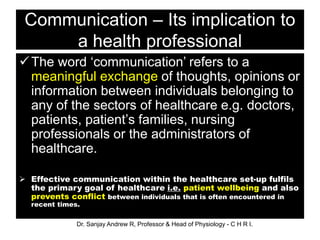
The word ā€˜communication’ refers to a
meaningful exchange of thoughts, opinions or
information between individuals belonging to
any of the sectors of healthcare e.g. doctors,
patients, patient’s families, nursing
professionals or the administrators of
healthcare.
 Effective communication within the healthcare set-up fulfils
the primary goal of healthcare i.e. patient wellbeing and also
prevents conflict between individuals that is often encountered in
recent times.
Dr. Sanjay Andrew R, Professor & Head of Physiology - C H R I.
Landmarks of the communication
process
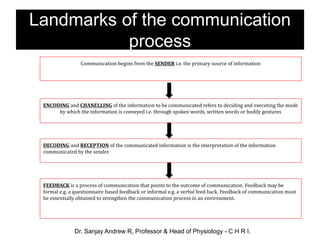
Communication begins from the SENDER i.e. the primary source of information
ENCODING and CHANELLING of the information to be communicated refers to deciding and executing the mode
by which the information is conveyed i.e. through spoken words, written words or bodily gestures
DECODING and RECEPTION of the communicated information is the interpretation of the information
communicated by the sender.
FEEDBACK is a process of communication that points to the outcome of communication. Feedback may be
formal e.g. a questionnaire based feedback or informal e.g. a verbal feed back. Feedback of communication must
be essentially obtained to strengthen the communication process in an environment.
Dr. Sanjay Andrew R, Professor & Head of Physiology - C H R I.
Types of Communication in a
Healthcare Set-up
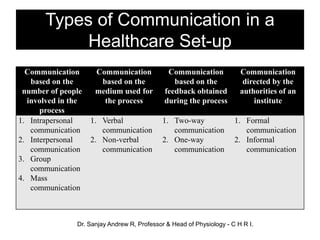
Communication
based on the
number of people
involved in the
process
Communication
based on the
medium used for
the process
Communication
based on the
feedback obtained
during the process
Communication
directed by the
authorities of an
institute
1. Intrapersonal
communication
2. Interpersonal
communication
3. Group
communication
4. Mass
communication
1. Verbal
communication
2. Non-verbal
communication
1. Two-way
communication
2. One-way
communication
1. Formal
communication
2. Informal
communication
Dr. Sanjay Andrew R, Professor & Head of Physiology - C H R I.
Barriers to Communication in the
Working Environment
1. Language Barriers.
2. Cultural Barriers.
3. Interpersonal barriers.
4. Erratic channeling of information.
5. Stereotyping.
6. Barriers due to perception of communicated information.
7. Physical barriers.
8. Emotional barriers.
Dr. Sanjay Andrew R, Professor & Head of Physiology - C H R I.
Facilitators of Effective
Communication
1. Resorting to a positive attitude while communicating.
2. Timely updating of communication skills.
3. Acceptance and correction of miscommunication.
4. Keen listening of a communicated message.
5. Stating of defined objectives during communication.
6. Using the appropriate language while communicating.
Dr. Sanjay Andrew R, Professor & Head of Physiology - C H R I.
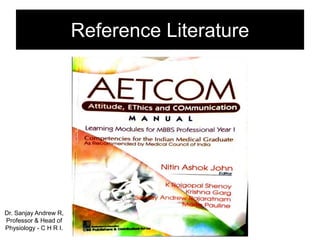
Reference Literature
Dr. Sanjay Andrew R,
Professor & Head of
Physiology - C H R I.
Character is like a tree and reputation
its shadow. The shadow is what we
think it is; the tree is the real thing.
- Abraham Lincoln
Dr. Sanjay Andrew R, Professor &
Head of Physiology - C H R I.

16944_AETCOM1.4TheFoundationsofCommunication.ppt

  • 1.
    AETCOM Module 1.4– The Foundation of Communication 1. Competency Achievement Demonstrate ability to communicate to patients in a patient, respectful, non- threatening, non-judgmental and empathetic manner. Dr. Sanjay Andrew R, Professor & Head of Physiology - C H R I.
  • 2.
    Essential Principles ofCommunication for the Health Professional – An Overview.  Objectives • Understand and define the word ā€˜Communication’ in the context of healthcare. • Outline the landmarks of the communication process. • Mention and summarize the types of communication in a healthcare set-up. • Outline the barriers of communication in a healthcare set-up. • Outline the facilitators of communication in a healthcare set-up. Dr. Sanjay Andrew R, Professor & Head of Physiology - C H R I.
  • 3.
    Communication – Itsimplication to a health professional The word ā€˜communication’ refers to a meaningful exchange of thoughts, opinions or information between individuals belonging to any of the sectors of healthcare e.g. doctors, patients, patient’s families, nursing professionals or the administrators of healthcare.  Effective communication within the healthcare set-up fulfils the primary goal of healthcare i.e. patient wellbeing and also prevents conflict between individuals that is often encountered in recent times. Dr. Sanjay Andrew R, Professor & Head of Physiology - C H R I.
  • 4.
    Landmarks of thecommunication process Communication begins from the SENDER i.e. the primary source of information ENCODING and CHANELLING of the information to be communicated refers to deciding and executing the mode by which the information is conveyed i.e. through spoken words, written words or bodily gestures DECODING and RECEPTION of the communicated information is the interpretation of the information communicated by the sender. FEEDBACK is a process of communication that points to the outcome of communication. Feedback may be formal e.g. a questionnaire based feedback or informal e.g. a verbal feed back. Feedback of communication must be essentially obtained to strengthen the communication process in an environment. Dr. Sanjay Andrew R, Professor & Head of Physiology - C H R I.
  • 5.
    Types of Communicationin a Healthcare Set-up Communication based on the number of people involved in the process Communication based on the medium used for the process Communication based on the feedback obtained during the process Communication directed by the authorities of an institute 1. Intrapersonal communication 2. Interpersonal communication 3. Group communication 4. Mass communication 1. Verbal communication 2. Non-verbal communication 1. Two-way communication 2. One-way communication 1. Formal communication 2. Informal communication Dr. Sanjay Andrew R, Professor & Head of Physiology - C H R I.
  • 6.
    Barriers to Communicationin the Working Environment 1. Language Barriers. 2. Cultural Barriers. 3. Interpersonal barriers. 4. Erratic channeling of information. 5. Stereotyping. 6. Barriers due to perception of communicated information. 7. Physical barriers. 8. Emotional barriers. Dr. Sanjay Andrew R, Professor & Head of Physiology - C H R I.
  • 7.
    Facilitators of Effective Communication 1.Resorting to a positive attitude while communicating. 2. Timely updating of communication skills. 3. Acceptance and correction of miscommunication. 4. Keen listening of a communicated message. 5. Stating of defined objectives during communication. 6. Using the appropriate language while communicating. Dr. Sanjay Andrew R, Professor & Head of Physiology - C H R I.
  • 8.
    Reference Literature Dr. SanjayAndrew R, Professor & Head of Physiology - C H R I.
  • 9.
    Character is likea tree and reputation its shadow. The shadow is what we think it is; the tree is the real thing. - Abraham Lincoln Dr. Sanjay Andrew R, Professor & Head of Physiology - C H R I.