Infrared (IR)
Promixity
Sensors
Tahereem Khan
Roll no. 15
CSE_C
Sem III
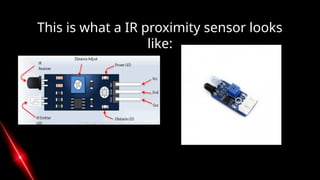
This is what a IR proximity sensor looks
like:
1. An infrared Proximity Sensor is an infrared proximity
sensor that emits infrared light and also receives reflected
infrared light and feedback on the presence of obstacles
ahead.
2. Principle: Infrared transmitter tube is composed of an
infrared light-emitting diode moment luminous body, with
infrared radiation efficiency of the material (commonly
gallium arsenide) made of PN junction, forward bias to PN
junction injection current to excite infrared light.
3. The infrared receiver tube is the infrared light signal in
electrical signal semiconductor devices, its core component
is a special material PN junction, and with the infrared light
intensity increasing the current also increases the output
analog signal.
4. Infrared proximity sensors are widely used in various
applications, from robotics and automation to security
systems and mobile devices. They detect the presence or
What are IR proimity
sensors?
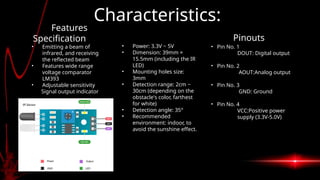
Characteristics:
Features
Specification
• Emitting a beam of
infrared, and receiving
the reflected beam
• Features wide range
voltage comparator
LM393
• Adjustable sensitivity
Signal output indicator
• Power: 3.3V ~ 5V
• Dimension: 39mm ×
15.5mm (including the IR
LED)
• Mounting holes size:
3mm
• Detection range: 2cm ~
30cm (depending on the
obstacle's color, farthest
for white)
• Detection angle: 35°
• Recommended
environment: indoor, to
avoid the sunshine effect.
• Pin No. 1
DOUT: Digital output
• Pin No. 2
AOUT:Analog output
• Pin No. 3
GND: Ground
• Pin No. 4
VCC:Positive power
supply (3.3V-5.0V)
Pinouts
Working of IR proximity
sensors:
Infrared proximity sensors work on the principle of infrared
light reflection. They consist of an infrared light emitter
(usually an infrared LED) and an infrared light detector
(photodiode or phototransistor). The emitter sends out
infrared light, which is reflected by an object in its path. The
detector then measures the intensity of the reflected light,
which is proportional to the distance between the object and
the sensor. The sensor’s output can be either an analog or
digital signal, depending on its design and application
requirements.
Types of Infrared Proximity Sensor:
1. Reflective Infrared Proximity Sensor
2. Modulated Infrared Proximity Sensor
Applications of Infrared Proximity Sensors:
Infrared proximity sensors are versatile and find application in various industries and use-cases. Some common
applications include:
● Robotics: Infrared proximity sensors are used in robotic systems for obstacle detection, collision avoidance,
and object recognition. They help robots navigate complex environments and interact with objects safely.
● Automation: In industrial automation, these sensors are used for object counting, conveyor belt control, and
product positioning. They ensure accurate and efficient operation of automated systems.
● Security: Infrared sensors can detect the presence of intruders or unauthorized access in security systems.
They are commonly used in access control, surveillance, and alarm systems.
● Mobile Devices: Smartphones and other mobile devices often use infrared proximity sensors to detect the
user’s proximity to the screen, adjusting display brightness and disabling touch input during calls.
Advantages: Disadvantages:
1.Non-contact sensing
2. Wide detection range
3. Resistance to
environmental factors
4. Fast response time
5. Compact size
1.Variation in accuracy while
sensing
2. Limited angular detection
3.Temperature dependence
Conclusion
Infrared proximity sensors are valuable tools in a wide range of industries
and applications, offering non-contact object detection and distance
measurement with high accuracy and reliability. Understanding the
working principles, types, advantages, and limitations of infrared sensors
can help engineers and designers choose the right sensor for their specific
application. From robotics and automation to security and mobile devices,
infrared proximity sensors continue to play a crucial role in making our
world smarter, safer, and more efficient.
Thank YOU!

Infrared proximity sensor. .pptx

  • 1.
  • 2.
    This is whata IR proximity sensor looks like:
  • 3.
    1. An infraredProximity Sensor is an infrared proximity sensor that emits infrared light and also receives reflected infrared light and feedback on the presence of obstacles ahead. 2. Principle: Infrared transmitter tube is composed of an infrared light-emitting diode moment luminous body, with infrared radiation efficiency of the material (commonly gallium arsenide) made of PN junction, forward bias to PN junction injection current to excite infrared light. 3. The infrared receiver tube is the infrared light signal in electrical signal semiconductor devices, its core component is a special material PN junction, and with the infrared light intensity increasing the current also increases the output analog signal. 4. Infrared proximity sensors are widely used in various applications, from robotics and automation to security systems and mobile devices. They detect the presence or What are IR proimity sensors?
  • 4.
    Characteristics: Features Specification • Emitting abeam of infrared, and receiving the reflected beam • Features wide range voltage comparator LM393 • Adjustable sensitivity Signal output indicator • Power: 3.3V ~ 5V • Dimension: 39mm × 15.5mm (including the IR LED) • Mounting holes size: 3mm • Detection range: 2cm ~ 30cm (depending on the obstacle's color, farthest for white) • Detection angle: 35° • Recommended environment: indoor, to avoid the sunshine effect. • Pin No. 1 DOUT: Digital output • Pin No. 2 AOUT:Analog output • Pin No. 3 GND: Ground • Pin No. 4 VCC:Positive power supply (3.3V-5.0V) Pinouts
  • 5.
    Working of IRproximity sensors: Infrared proximity sensors work on the principle of infrared light reflection. They consist of an infrared light emitter (usually an infrared LED) and an infrared light detector (photodiode or phototransistor). The emitter sends out infrared light, which is reflected by an object in its path. The detector then measures the intensity of the reflected light, which is proportional to the distance between the object and the sensor. The sensor’s output can be either an analog or digital signal, depending on its design and application requirements. Types of Infrared Proximity Sensor: 1. Reflective Infrared Proximity Sensor 2. Modulated Infrared Proximity Sensor
  • 6.
    Applications of InfraredProximity Sensors: Infrared proximity sensors are versatile and find application in various industries and use-cases. Some common applications include: ● Robotics: Infrared proximity sensors are used in robotic systems for obstacle detection, collision avoidance, and object recognition. They help robots navigate complex environments and interact with objects safely. ● Automation: In industrial automation, these sensors are used for object counting, conveyor belt control, and product positioning. They ensure accurate and efficient operation of automated systems. ● Security: Infrared sensors can detect the presence of intruders or unauthorized access in security systems. They are commonly used in access control, surveillance, and alarm systems. ● Mobile Devices: Smartphones and other mobile devices often use infrared proximity sensors to detect the user’s proximity to the screen, adjusting display brightness and disabling touch input during calls. Advantages: Disadvantages: 1.Non-contact sensing 2. Wide detection range 3. Resistance to environmental factors 4. Fast response time 5. Compact size 1.Variation in accuracy while sensing 2. Limited angular detection 3.Temperature dependence
  • 7.
    Conclusion Infrared proximity sensorsare valuable tools in a wide range of industries and applications, offering non-contact object detection and distance measurement with high accuracy and reliability. Understanding the working principles, types, advantages, and limitations of infrared sensors can help engineers and designers choose the right sensor for their specific application. From robotics and automation to security and mobile devices, infrared proximity sensors continue to play a crucial role in making our world smarter, safer, and more efficient. Thank YOU!