R A J E E V K U M A R
M S W ( T I S S , M U M B A I )
M . P H I L ( C I P , R A N C H I )
D O C T O R A L F E L L O W , I I T K H A R A G P U R
Special States in India
What is Article 370?
 According to the Constitution of India, Article 370 is a
law that grants special autonomous status to Jammu and
Kashmir.
 The article is drafted in Part XXI of the Constitution (in
Amendment section) which relates to Temporary,
Transitional and Special Provisions.
 The original draft explained "the Government of the
State means the person for the time being recognised by
the President as the Maharaja of Jammu and Kashmir
acting on the advice of the Council of Ministers for the
time being in office under the Maharaja's Proclamation
dated the fifth day of March, 1948."
Continued
 On November 15, 1952, it was changed to "the
Government of the State means the person for the
time being recognised by the President on the
recommendation of the Legislative Assembly of the
State as the Sadr-i-Riyasat (now Governor) of
Jammu and Kashmir, acting on the advice of the
Council of Ministers of the State for the time being in
office."
History of Article 370
 Dr BR Ambedkar, who drafted Indian Constitution,
had refused to draft Article 370.
 In 1949, the then Prime Minister Jawaharlal Nehru
had directed Kashmiri leader Sheikh Abdullah to
consult Ambedkar in preparation of suitable draft.
 Article 370 was then drafted by Gopalaswami
Ayyangar, former Diwan to Maharajah Hari Singh of
Jammu and Kashmir.
The special status to Jammu & Kashmir
 Unlike other State legislative Assemblies, J&K
legislature has a six-year term.
 Jammu & Kashmir has two flags; a separate State
flag along with the National Flag.
 Insulting of national symbols is not cognizable
offence in Jammu & Kashmir.
 Most of the laws except defence, foreign affairs,
finance and communication, passed by Indian
Parliament need to be approved by the State
Government before they are made applicable in the
State.
Continued
 The citizens of J&K are governed by State-specific laws which
come under the Constitution of Jammu and Kashmir, instead
of those for the rest of India.
 Under Article 370 the Indian Parliament cannot increase or
reduce the borders of the State.
 The Supreme Court has no jurisdiction in the State of Jammu
& Kashmir.
 The residents of J&K enjoy dual citizenship, but they could
loose the J&K citizenship if they marry residents of other
States.
 If a woman marries a man in other Indian States, she loses her
citizenship. Whereas if any woman marries a Pakistani, she
will be entitled to have a citizenship of Jammu & Kashmir.
Continued
 The Article also gives Pakistan's citizens entitlement
to Indian citizenship, if he marries a Kashmiri girl.
 Majority of Indian laws including RTE, RTI and
agencies like CBI, CAG are not applicable in J&K.
 No outsider can purchase land in the State.
 The Centre has no power to declare financial
emergency under Article 360 in the State.
 It can declare emergency in the state only in case of
war or external aggression.
Why is Article 35A in news?
 The petitioner, Dr. Charu Wali Khanna, filed the case
in Supreme Court to challenge the constitutional
validity of Article 35-A.
 Though, she remains the second petitioner after We
the Citizens (NGO),
 but her act has brought this issue in the limelight
once again and is being hotly debated across the
country and especially so, in J&K.
What is Article 35-A actually which has
created so many controversies?
 Article 35-A empowers the legislature of Jammu and Kashmir
to:
 a) Define classes of people who shall be called ‘permanent
residents’ of Jammu and Kashmir state;
 b) Confer special rights and privileges on such permanent
residents of the state like:
 Only permanent residents can be employed in state services.
 Only permanent residents can buy immovable property within
state.
 Only permanent residents can settle in the state.
 Only permanent residents can avail scholarships and other
benefits provided or offered by the state government.
What is the controversy surrounding
Article 35A?
 If the daughter of holder of state subject/permanent
resident marries a person who does not own state
subject, she would lose her permanent resident
status of J&K state.
 Consequently her children would no longer be
categorised as state subjects and their claim to
properties, education and services under the state
would stand terminated.
 Also West Pakistan refugees, who migrated to India
and settled in J&K during the wars of 1965 and 1971,
lack the status of permanent residents of the state.
Why controversy??
 This denies them various rights as otherwise
conferred by the state on permanent residents.
 In addition, the members of Valmiki Samaj are
entitled for the job of sweepers only by virtue of state
subject laws.
 The petitioners claim that this particular article of
the constitution allows discrimination not only
between people of J&K and the rest of India but also
amongst people of J&K and is in violation of Article
14 and 15 of the constitution.
Special Provisions for states (Article
371)
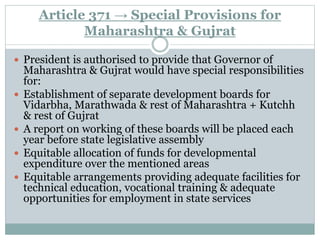
Article 371 → Special Provisions for
Maharashtra & Gujrat
 President is authorised to provide that Governor of
Maharashtra & Gujrat would have special responsibilities
for:
 Establishment of separate development boards for
Vidarbha, Marathwada & rest of Maharashtra + Kutchh
& rest of Gujrat
 A report on working of these boards will be placed each
year before state legislative assembly
 Equitable allocation of funds for developmental
expenditure over the mentioned areas
 Equitable arrangements providing adequate facilities for
technical education, vocational training & adequate
opportunities for employment in state services
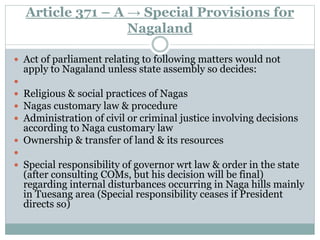
Article 371 – A → Special Provisions for
Nagaland
 Act of parliament relating to following matters would not
apply to Nagaland unless state assembly so decides:

 Religious & social practices of Nagas
 Nagas customary law & procedure
 Administration of civil or criminal justice involving decisions
according to Naga customary law
 Ownership & transfer of land & its resources

 Special responsibility of governor wrt law & order in the state
(after consulting COMs, but his decision will be final)
regarding internal disturbances occurring in Naga hills mainly
in Tuesang area (Special responsibility ceases if President
directs so)
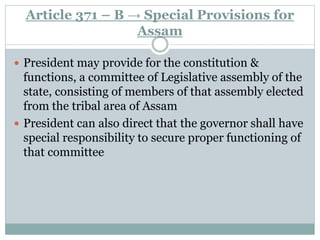
Article 371 – B → Special Provisions for
Assam
 President may provide for the constitution &
functions, a committee of Legislative assembly of the
state, consisting of members of that assembly elected
from the tribal area of Assam
 President can also direct that the governor shall have
special responsibility to secure proper functioning of
that committee
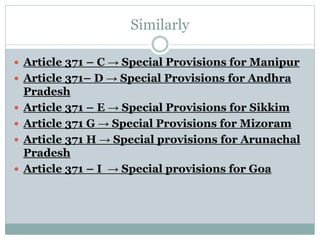
Similarly
 Article 371 – C → Special Provisions for Manipur
 Article 371– D → Special Provisions for Andhra
Pradesh
 Article 371 – E → Special Provisions for Sikkim
 Article 371 G → Special Provisions for Mizoram
 Article 371 H → Special provisions for Arunachal
Pradesh
 Article 371 – I → Special provisions for Goa
Keep learning

1.6 special states in india

  • 1.
    R A JE E V K U M A R M S W ( T I S S , M U M B A I ) M . P H I L ( C I P , R A N C H I ) D O C T O R A L F E L L O W , I I T K H A R A G P U R Special States in India
  • 2.
    What is Article370?  According to the Constitution of India, Article 370 is a law that grants special autonomous status to Jammu and Kashmir.  The article is drafted in Part XXI of the Constitution (in Amendment section) which relates to Temporary, Transitional and Special Provisions.  The original draft explained "the Government of the State means the person for the time being recognised by the President as the Maharaja of Jammu and Kashmir acting on the advice of the Council of Ministers for the time being in office under the Maharaja's Proclamation dated the fifth day of March, 1948."
  • 3.
    Continued  On November15, 1952, it was changed to "the Government of the State means the person for the time being recognised by the President on the recommendation of the Legislative Assembly of the State as the Sadr-i-Riyasat (now Governor) of Jammu and Kashmir, acting on the advice of the Council of Ministers of the State for the time being in office."
  • 4.
    History of Article370  Dr BR Ambedkar, who drafted Indian Constitution, had refused to draft Article 370.  In 1949, the then Prime Minister Jawaharlal Nehru had directed Kashmiri leader Sheikh Abdullah to consult Ambedkar in preparation of suitable draft.  Article 370 was then drafted by Gopalaswami Ayyangar, former Diwan to Maharajah Hari Singh of Jammu and Kashmir.
  • 5.
    The special statusto Jammu & Kashmir  Unlike other State legislative Assemblies, J&K legislature has a six-year term.  Jammu & Kashmir has two flags; a separate State flag along with the National Flag.  Insulting of national symbols is not cognizable offence in Jammu & Kashmir.  Most of the laws except defence, foreign affairs, finance and communication, passed by Indian Parliament need to be approved by the State Government before they are made applicable in the State.
  • 6.
    Continued  The citizensof J&K are governed by State-specific laws which come under the Constitution of Jammu and Kashmir, instead of those for the rest of India.  Under Article 370 the Indian Parliament cannot increase or reduce the borders of the State.  The Supreme Court has no jurisdiction in the State of Jammu & Kashmir.  The residents of J&K enjoy dual citizenship, but they could loose the J&K citizenship if they marry residents of other States.  If a woman marries a man in other Indian States, she loses her citizenship. Whereas if any woman marries a Pakistani, she will be entitled to have a citizenship of Jammu & Kashmir.
  • 7.
    Continued  The Articlealso gives Pakistan's citizens entitlement to Indian citizenship, if he marries a Kashmiri girl.  Majority of Indian laws including RTE, RTI and agencies like CBI, CAG are not applicable in J&K.  No outsider can purchase land in the State.  The Centre has no power to declare financial emergency under Article 360 in the State.  It can declare emergency in the state only in case of war or external aggression.
  • 8.
    Why is Article35A in news?  The petitioner, Dr. Charu Wali Khanna, filed the case in Supreme Court to challenge the constitutional validity of Article 35-A.  Though, she remains the second petitioner after We the Citizens (NGO),  but her act has brought this issue in the limelight once again and is being hotly debated across the country and especially so, in J&K.
  • 9.
    What is Article35-A actually which has created so many controversies?  Article 35-A empowers the legislature of Jammu and Kashmir to:  a) Define classes of people who shall be called ‘permanent residents’ of Jammu and Kashmir state;  b) Confer special rights and privileges on such permanent residents of the state like:  Only permanent residents can be employed in state services.  Only permanent residents can buy immovable property within state.  Only permanent residents can settle in the state.  Only permanent residents can avail scholarships and other benefits provided or offered by the state government.
  • 10.
    What is thecontroversy surrounding Article 35A?  If the daughter of holder of state subject/permanent resident marries a person who does not own state subject, she would lose her permanent resident status of J&K state.  Consequently her children would no longer be categorised as state subjects and their claim to properties, education and services under the state would stand terminated.  Also West Pakistan refugees, who migrated to India and settled in J&K during the wars of 1965 and 1971, lack the status of permanent residents of the state.
  • 11.
    Why controversy??  Thisdenies them various rights as otherwise conferred by the state on permanent residents.  In addition, the members of Valmiki Samaj are entitled for the job of sweepers only by virtue of state subject laws.  The petitioners claim that this particular article of the constitution allows discrimination not only between people of J&K and the rest of India but also amongst people of J&K and is in violation of Article 14 and 15 of the constitution.
  • 12.
    Special Provisions forstates (Article 371)
  • 13.
    Article 371 →Special Provisions for Maharashtra & Gujrat  President is authorised to provide that Governor of Maharashtra & Gujrat would have special responsibilities for:  Establishment of separate development boards for Vidarbha, Marathwada & rest of Maharashtra + Kutchh & rest of Gujrat  A report on working of these boards will be placed each year before state legislative assembly  Equitable allocation of funds for developmental expenditure over the mentioned areas  Equitable arrangements providing adequate facilities for technical education, vocational training & adequate opportunities for employment in state services
  • 14.
    Article 371 –A → Special Provisions for Nagaland  Act of parliament relating to following matters would not apply to Nagaland unless state assembly so decides:   Religious & social practices of Nagas  Nagas customary law & procedure  Administration of civil or criminal justice involving decisions according to Naga customary law  Ownership & transfer of land & its resources   Special responsibility of governor wrt law & order in the state (after consulting COMs, but his decision will be final) regarding internal disturbances occurring in Naga hills mainly in Tuesang area (Special responsibility ceases if President directs so)
  • 15.
    Article 371 –B → Special Provisions for Assam  President may provide for the constitution & functions, a committee of Legislative assembly of the state, consisting of members of that assembly elected from the tribal area of Assam  President can also direct that the governor shall have special responsibility to secure proper functioning of that committee
  • 16.
    Similarly  Article 371– C → Special Provisions for Manipur  Article 371– D → Special Provisions for Andhra Pradesh  Article 371 – E → Special Provisions for Sikkim  Article 371 G → Special Provisions for Mizoram  Article 371 H → Special provisions for Arunachal Pradesh  Article 371 – I → Special provisions for Goa
  • 17.