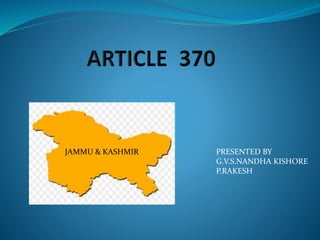
JAMMU & KASHMIR PRESENTED BY
G.V.S.NANDHA KISHORE
P.RAKESH
ARTICLE 370 – Temporary
provisions with respect to the state
of Jammu & Kashmir.
 Article -370 of the Indian constitution, which is of a
temporary nature, grants special status to Jammu &
Kashmir. Under part (21) of the constitution of India,
which deals with “temporary, Transitional and special
provisions” , the State of Jammu & Kasmir has been
accorded special status under Article 370. Even though
included in 1st schedule as 15th state, all the provisions of
the constitution which are applicable to other states are
not applicable to J&K.
Historical aspect
 When India and Pakistan gained their independence on 15
&14 August 1947, respectively; J&K with Pakistan and India
that none of them will attack J&K. while India respected the
agreement and exercised restraint, Pakistan attacked Kashmir
in a bid to annex it by force. On 6 October 1947, kashmir was
attacked by “Azad Kashmir Forces” supported by Pakistan. To
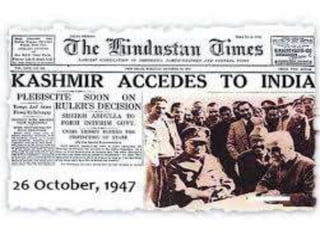
save J&K, Maharaja Hari Singh {the ruler of J&K} choose to
accede J&K to India.
 In October 1947, the accession was made by the ruler in
favour of India in consideration of certain commitmentsn
made by Pt. Jawahar Lal Nehru {PRIME MINISTER OF INDIA}. It
was in the pursuance of those commitments that Article 370
was incorporated in the Constitution.
The Ruler of Jammu & Kashmir signed the instrument of accession where by only three
Subjects were surrendered by the State to the Dominion of India.
# External Affairs
#Defense and
#Communications
The state enjoys a greater measure of autonmoy and the power of the Union of india is
Restricted, as regards other States.
Text of Article 370
 Not with standing anything in this Constitution
 The provision of article238 shall not apply in relation to the state of
Jammu & Kashmir;
 The power of parliament to make laws for the said state shall be
limited to—
{those matters in the union list and the Concurrent list which, in
consulation with the government of the state are declared by the
President to correspond the matters specified in the instrument of
Accession governing the accession of the State to the dominion of
india as the matters with respect to which the dominion of india as
the matters with respect to which the dominion legislature may
make laws for that state:} and
{such other matters in the said lists as with the concurrence of the
government of the state, the president may by order specify.
Special features
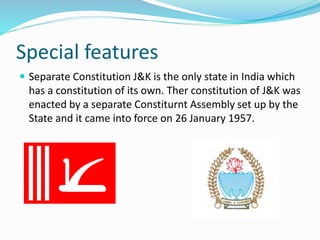
 Separate Constitution J&K is the only state in India which
has a constitution of its own. Ther constitution of J&K was
enacted by a separate Constiturnt Assembly set up by the
State and it came into force on 26 January 1957.
Emergency Provisions
 The Union of India has no power to declare financial
Emergency under Article 360 in the state . The union can
declare emergency in the stae only in case of war or External
Aggression. No proclamation of emergency made on the
grounds of internal disturbance or imminent danger there of
shall have effect in relation to the state unless (a)where it is
made at the request or with the concurrence of the
government of the state ; or(b) it has not been so made, it is
applied subsequently by the president to that stae at the
request or with the concurrence of the government of that
state. In December 1964, Articles 356 and 357 were extended
to the state.
Fundamental duties, priciples &
rights
 Part-4 (Directive Principles of the State Policy) and Part-
4A (Fundamental duties) of the Constitution are not
applicable to J&K. in addition to other fundamental
rights, Articles19(1)(f) and 31(2) of the constitution are
still applicable to J&K; hence the fundamental right to
property is still guaranteed in thios state. In the
fundamental right has been added so far and that is right
to education. This right too is not extending to J&K.
High Court of J&K
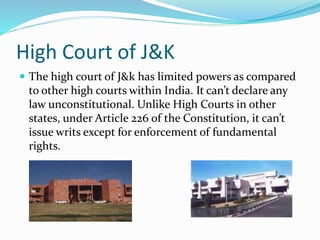
 The high court of J&k has limited powers as compared
to other high courts within India. It can’t declare any
law unconstitutional. Unlike High Courts in other
states, under Article 226 of the Constitution, it can’t
issue writs except for enforcement of fundamental
rights.
Official Languages
 URDU is the official language of the state but use of
english is permitted for official purposes unless the state
legislature provides otherwise.
Article370

Article370

  • 1.
    JAMMU & KASHMIRPRESENTED BY G.V.S.NANDHA KISHORE P.RAKESH
  • 2.
    ARTICLE 370 –Temporary provisions with respect to the state of Jammu & Kashmir.  Article -370 of the Indian constitution, which is of a temporary nature, grants special status to Jammu & Kashmir. Under part (21) of the constitution of India, which deals with “temporary, Transitional and special provisions” , the State of Jammu & Kasmir has been accorded special status under Article 370. Even though included in 1st schedule as 15th state, all the provisions of the constitution which are applicable to other states are not applicable to J&K.
  • 3.
    Historical aspect  WhenIndia and Pakistan gained their independence on 15 &14 August 1947, respectively; J&K with Pakistan and India that none of them will attack J&K. while India respected the agreement and exercised restraint, Pakistan attacked Kashmir in a bid to annex it by force. On 6 October 1947, kashmir was attacked by “Azad Kashmir Forces” supported by Pakistan. To save J&K, Maharaja Hari Singh {the ruler of J&K} choose to accede J&K to India.  In October 1947, the accession was made by the ruler in favour of India in consideration of certain commitmentsn made by Pt. Jawahar Lal Nehru {PRIME MINISTER OF INDIA}. It was in the pursuance of those commitments that Article 370 was incorporated in the Constitution.
  • 5.
    The Ruler ofJammu & Kashmir signed the instrument of accession where by only three Subjects were surrendered by the State to the Dominion of India. # External Affairs #Defense and #Communications The state enjoys a greater measure of autonmoy and the power of the Union of india is Restricted, as regards other States.
  • 6.
    Text of Article370  Not with standing anything in this Constitution  The provision of article238 shall not apply in relation to the state of Jammu & Kashmir;  The power of parliament to make laws for the said state shall be limited to— {those matters in the union list and the Concurrent list which, in consulation with the government of the state are declared by the President to correspond the matters specified in the instrument of Accession governing the accession of the State to the dominion of india as the matters with respect to which the dominion of india as the matters with respect to which the dominion legislature may make laws for that state:} and {such other matters in the said lists as with the concurrence of the government of the state, the president may by order specify.
  • 7.
    Special features  SeparateConstitution J&K is the only state in India which has a constitution of its own. Ther constitution of J&K was enacted by a separate Constiturnt Assembly set up by the State and it came into force on 26 January 1957.
  • 8.
    Emergency Provisions  TheUnion of India has no power to declare financial Emergency under Article 360 in the state . The union can declare emergency in the stae only in case of war or External Aggression. No proclamation of emergency made on the grounds of internal disturbance or imminent danger there of shall have effect in relation to the state unless (a)where it is made at the request or with the concurrence of the government of the state ; or(b) it has not been so made, it is applied subsequently by the president to that stae at the request or with the concurrence of the government of that state. In December 1964, Articles 356 and 357 were extended to the state.
  • 9.
    Fundamental duties, priciples& rights  Part-4 (Directive Principles of the State Policy) and Part- 4A (Fundamental duties) of the Constitution are not applicable to J&K. in addition to other fundamental rights, Articles19(1)(f) and 31(2) of the constitution are still applicable to J&K; hence the fundamental right to property is still guaranteed in thios state. In the fundamental right has been added so far and that is right to education. This right too is not extending to J&K.
  • 10.
    High Court ofJ&K  The high court of J&k has limited powers as compared to other high courts within India. It can’t declare any law unconstitutional. Unlike High Courts in other states, under Article 226 of the Constitution, it can’t issue writs except for enforcement of fundamental rights.
  • 11.
    Official Languages  URDUis the official language of the state but use of english is permitted for official purposes unless the state legislature provides otherwise.