Fire Inspection and Code
Enforcement
8th Edition
Chapter 10 — Hazardous Materials
‣ Explain the application of hazardous
materials regulations.
Learning Objective 1
Understand why hazardous materials
present a challenge for fire inspectors.
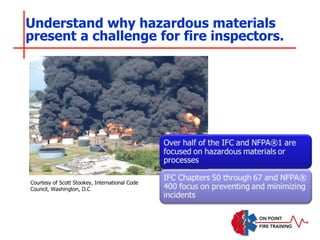
Understand why hazardous materials
present a challenge for fire inspectors.
Courtesy of Scott Stookey, International Code
Council, Washington, D.C
Understand why hazardous materials
present a challenge for fire inspectors.
Understand why hazardous materials
present a challenge for fire inspectors.
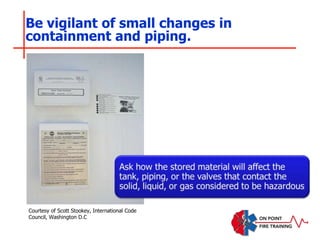
Be vigilant of small changes in
containment and piping.
Courtesy of Scott Stookey, International Code
Council, Washington D.C
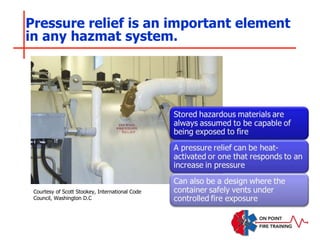
Pressure relief is an important element
in any hazmat system.
Courtesy of Scott Stookey, International Code
Council, Washington D.C
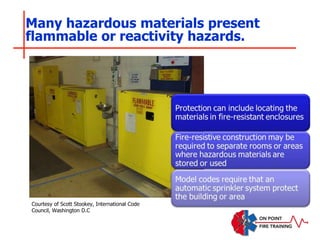
Many hazardous materials present
flammable or reactivity hazards.
Courtesy of Scott Stookey, International Code
Council, Washington D.C
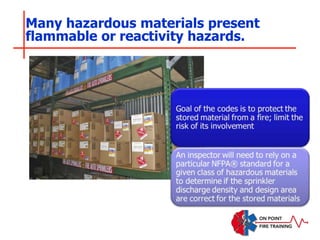
Many hazardous materials present
flammable or reactivity hazards.
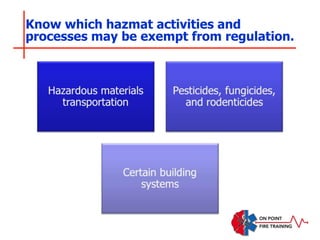
Know which hazmat activities and
processes may be exempt from regulation.
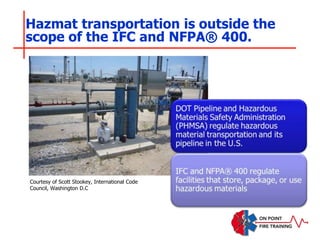
Hazmat transportation is outside the
scope of the IFC and NFPA® 400.
Courtesy of Scott Stookey, International Code
Council, Washington D.C
Another exemption is the application of
pesticides, fungicides, and rodenticides.
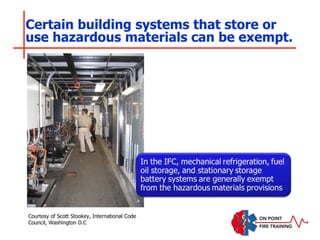
Certain building systems that store or
use hazardous materials can be exempt.
Courtesy of Scott Stookey, International Code
Council, Washington D.C
Be familiar with local codes and the standards
applicable to hazmat storage, use, and handling.
‣ Identify some of the applicable codes
and standards that apply to hazardous
materials.
Learning Objective 2
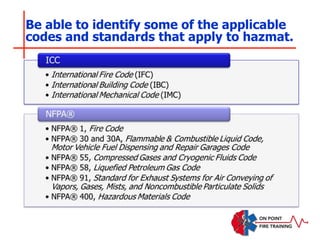
Be able to identify some of the applicable
codes and standards that apply to hazmat.
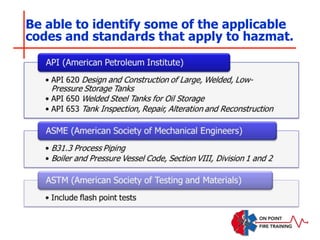
Be able to identify some of the applicable
codes and standards that apply to hazmat.
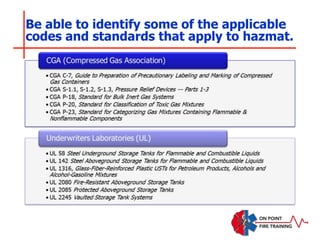
Be able to identify some of the applicable
codes and standards that apply to hazmat.
‣ Explain the classification system used for
hazardous materials.
Learning Objective 3
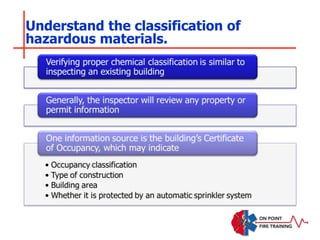
Understand the classification of
hazardous materials.
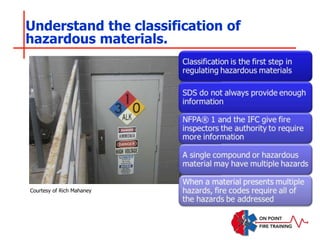
Understand the classification of
hazardous materials.
Courtesy of Rich Mahaney
NOTE
‣ Inspectors are commonly asked to
assist in classification because it may
be faster and easier than trying to
correct errors. They should exercise
caution to avoid giving incomplete or
inaccurate information.
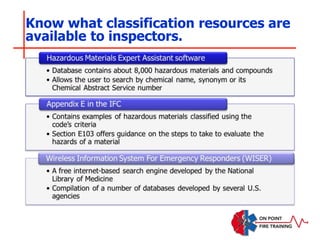
Know what classification resources are
available to inspectors.
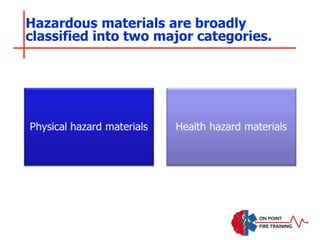
Hazardous materials are broadly
classified into two major categories.
‣ Describe the classification and properties
of physical hazard materials.
Learning Objective 4
Physical hazardous materials are those that
burn, accelerate burning, detonation, or
deflagration.
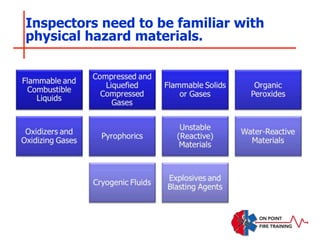
Inspectors need to be familiar with
physical hazard materials.
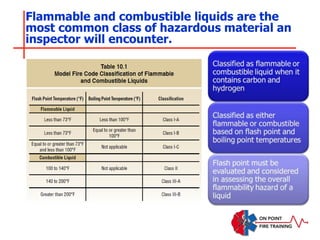
Flammable and combustible liquids are the
most common class of hazardous material an
inspector will encounter.
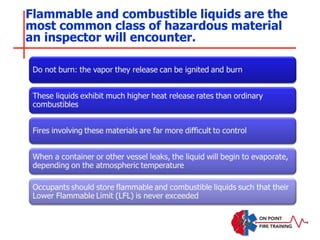
Flammable and combustible liquids are the
most common class of hazardous material
an inspector will encounter.
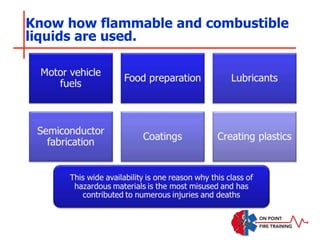
Know how flammable and combustible
liquids are used.
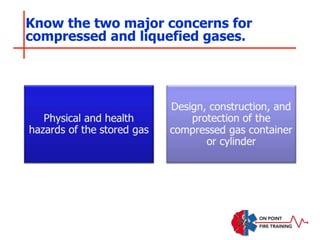
Know the two major concerns for
compressed and liquefied gases.
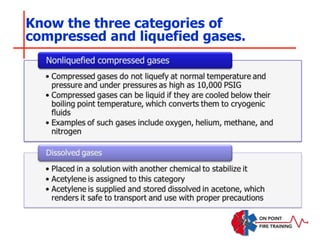
Know the three categories of
compressed and liquefied gases.
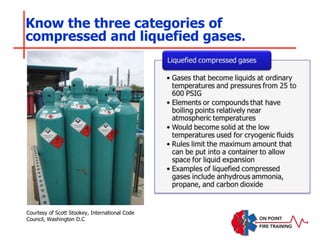
Know the three categories of
compressed and liquefied gases.
Courtesy of Scott Stookey, International Code
Council, Washington D.C
Know the characteristics of cryogenic
fluids.
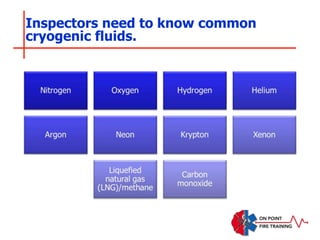
Inspectors need to know common
cryogenic fluids.
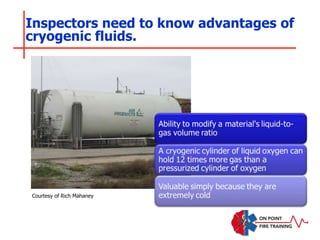
Inspectors need to know advantages of
cryogenic fluids.
Courtesy of Rich Mahaney
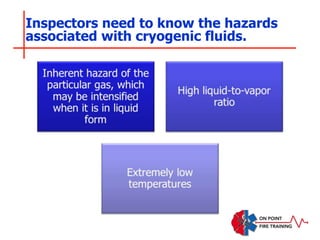
Inspectors need to know the hazards
associated with cryogenic fluids.
WARNING
‣ All cryogenic liquids (except oxygen)
are either asphyxiants or toxic.
Cryogenic liquids and gases create a
flammability hazard because they can burn or
explode.
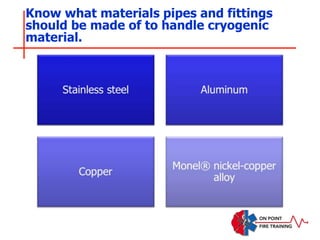
Know what materials pipes and fittings
should be made of to handle cryogenic
material.
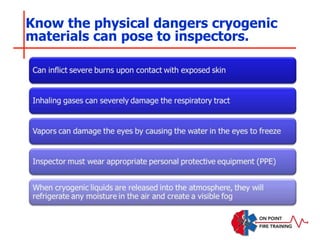
Know the physical dangers cryogenic
materials can pose to inspectors.
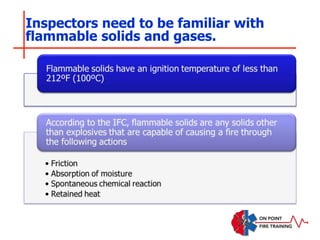
Inspectors need to be familiar with
flammable solids and gases.
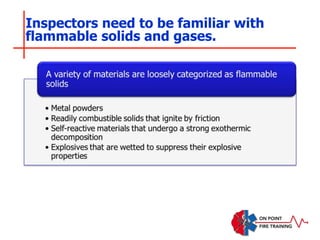
Inspectors need to be familiar with
flammable solids and gases.
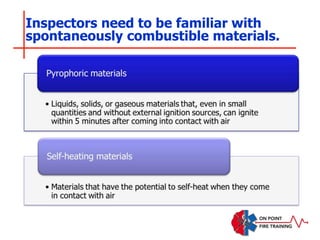
Inspectors need to be familiar with
spontaneously combustible materials.
Understand dangerous-when-wet
materials.
Flammable solids that are metals
require a Class D extinguisher nearby.
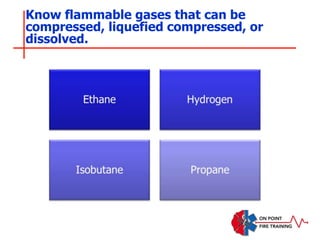
Know flammable gases that can be
compressed, liquefied compressed, or
dissolved.
Know what conditions result in gases
being classified as “flammable”.
Inspectors need to be familiar with
organic peroxides.
All organic peroxides have a limited
shelf life.
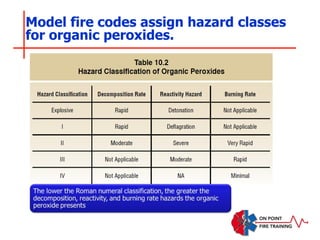
Model fire codes assign hazard classes
for organic peroxides.
Know the characteristics of oxidizers
and oxidizing gases.
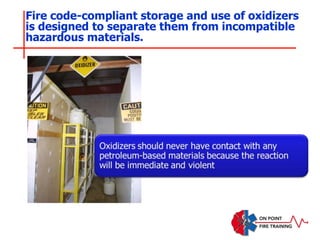
Fire code-compliant storage and use of oxidizers
is designed to separate them from incompatible
hazardous materials.
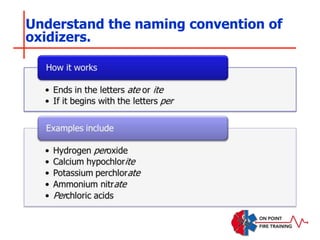
Understand the naming convention of
oxidizers.
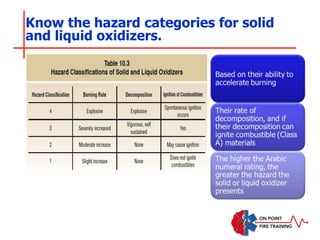
Know the hazard categories for solid
and liquid oxidizers.
Oxidizing gases can support and
accelerate combustion more than air.
Inspectors need to understand
pyrophorics.
Inspectors need to understand
pyrophorics.
Inspectors need to understand
pyrophorics.
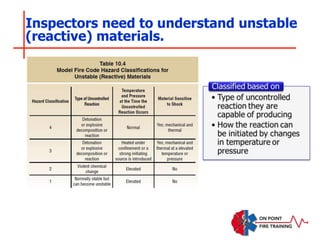
Inspectors need to understand unstable
(reactive) materials.
Inspectors need to understand unstable
(reactive) materials.
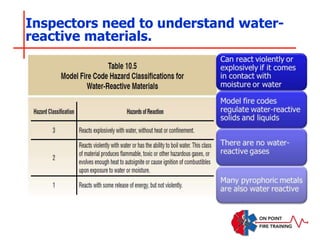
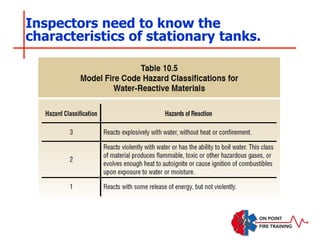
Inspectors need to understand water-
reactive materials.
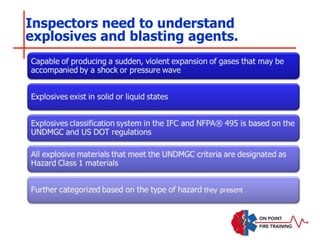
Inspectors need to understand
explosives and blasting agents.
‣ Explain the classification of health
hazard materials.
Learning Objective 5
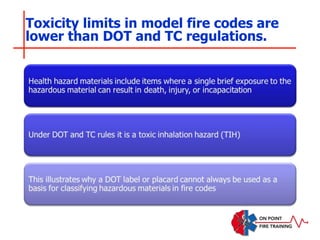
Toxicity limits in model fire codes are
lower than DOT and TC regulations.
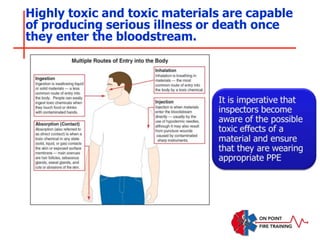
Highly toxic and toxic materials are capable
of producing serious illness or death once
they enter the bloodstream.
WARNING
‣ During inspections of facilities where
toxic materials are being manufactured,
stored, or shipped, an inspector must
have appropriate personal protective
equipment (PPE) and training in its use
when there is any possibility of being
exposed to these products.
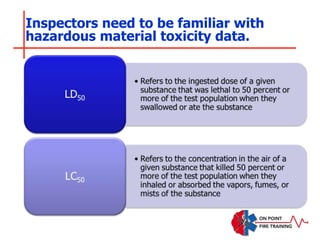
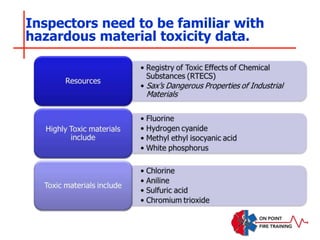
Inspectors need to be familiar with
hazardous material toxicity data.
Inspectors need to be familiar with
hazardous material toxicity data.
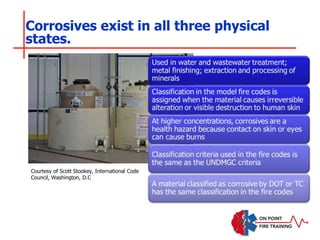
Corrosives exist in all three physical
states.
Courtesy of Scott Stookey, International Code
Council, Washington, D.C
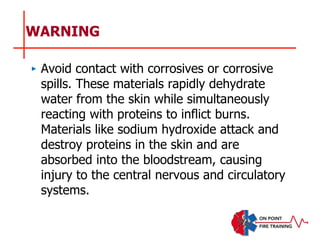
WARNING
‣ Avoid contact with corrosives or corrosive
spills. These materials rapidly dehydrate
water from the skin while simultaneously
reacting with proteins to inflict burns.
Materials like sodium hydroxide attack and
destroy proteins in the skin and are
absorbed into the bloodstream, causing
injury to the central nervous and circulatory
systems.
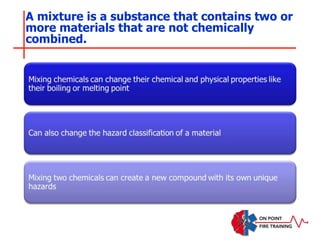
A mixture is a substance that contains two or
more materials that are not chemically
combined.
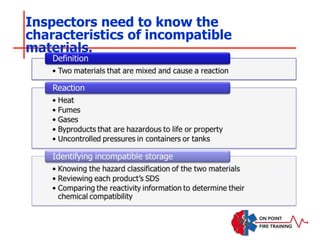
Inspectors need to know the
characteristics of incompatible
materials.
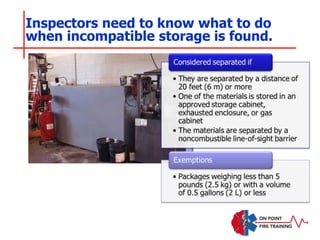
Inspectors need to know what to do
when incompatible storage is found.
‣ Describe the code requirements for the
marking of hazardous materials for
identification by emergency responders.
Learning Objective 6
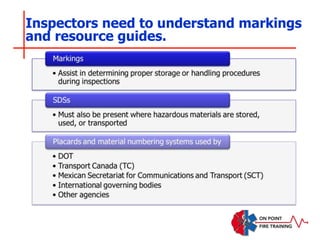
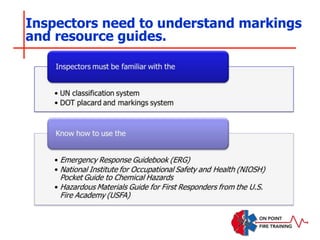
Inspectors need to understand markings
and resource guides.
Inspectors need to understand markings
and resource guides.
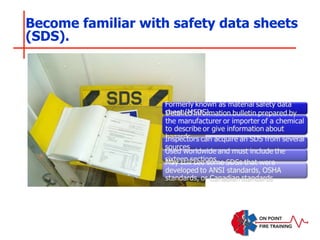
Become familiar with safety data sheets
(SDS).
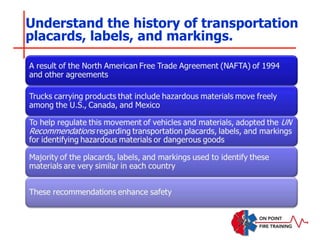
Understand the history of transportation
placards, labels, and markings.
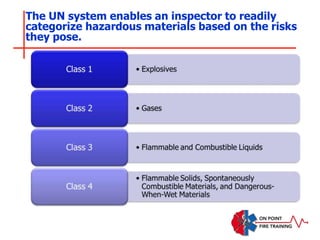
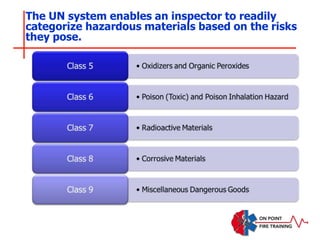
The UN system enables an inspector to readily
categorize hazardous materials based on the risks
they pose.
The UN system enables an inspector to readily
categorize hazardous materials based on the risks
they pose.
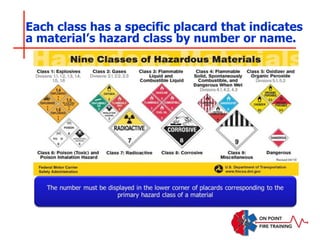
Each class has a specific placard that indicates
a material’s hazard class by number or name.
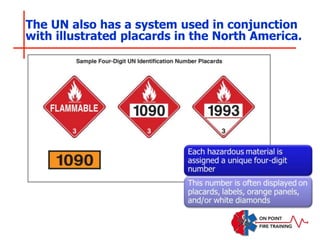
The UN also has a system used in conjunction
with illustrated placards in the North America.
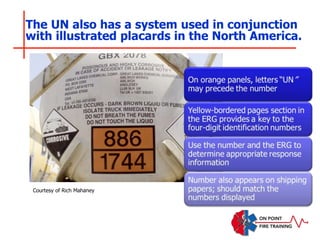
The UN also has a system used in conjunction
with illustrated placards in the North America.
Courtesy of Rich Mahaney
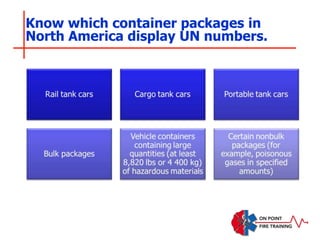
Know which container packages in
North America display UN numbers.
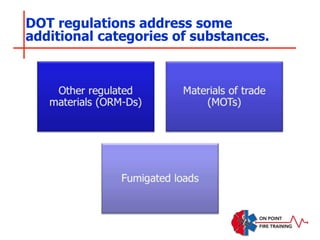
DOT regulations address some
additional categories of substances.
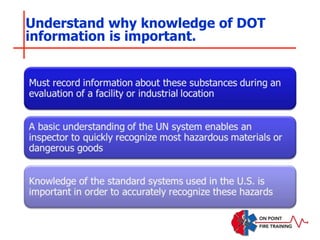
Understand why knowledge of DOT
information is important.
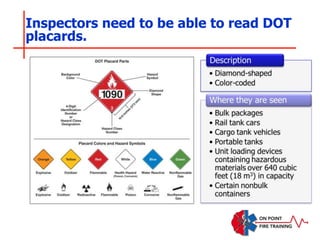
Inspectors need to be able to read DOT
placards.
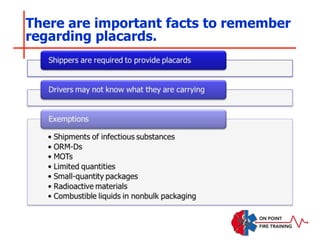
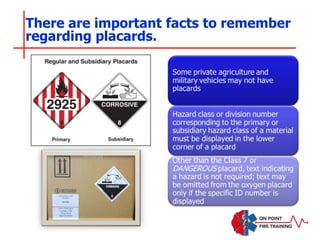
There are important facts to remember
regarding placards.
There are important facts to remember
regarding placards.
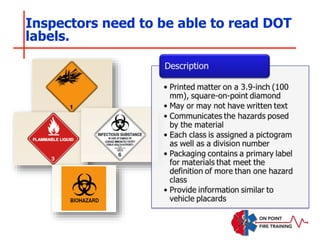
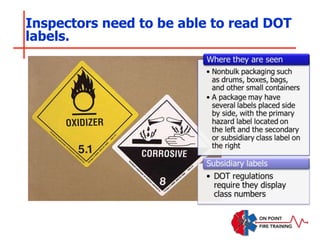
Inspectors need to be able to read DOT
labels.
Inspectors need to be able to read DOT
labels.
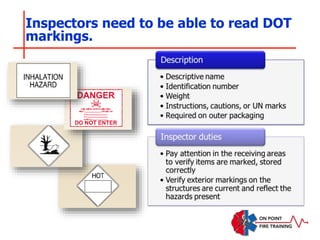
Inspectors need to be able to read DOT
markings.
Be familiar with OSHA identification
requirements for the workplace.
Be familiar with other identification
marking requirements.
Be familiar with other identification
marking requirements.
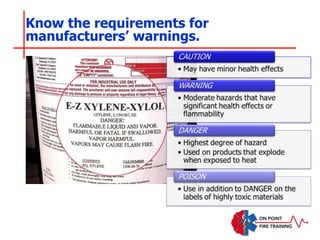
Know the requirements for
manufacturers’ warnings.
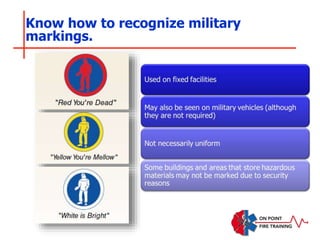
Know how to recognize military
markings.
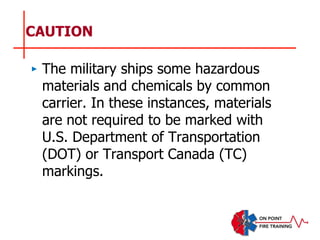
CAUTION
‣ The military ships some hazardous
materials and chemicals by common
carrier. In these instances, materials
are not required to be marked with
U.S. Department of Transportation
(DOT) or Transport Canada (TC)
markings.
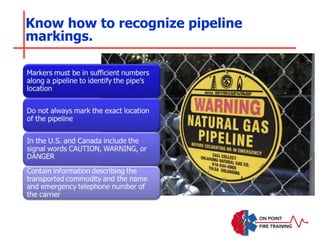
Know how to recognize pipeline
markings.
Inspectors need to understand the
NFPA® 704 system.
Know what the NFPA® 704 system does
NOT cover.
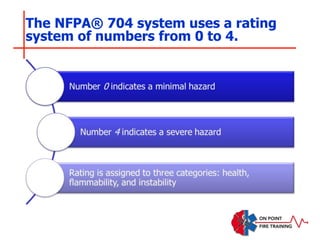
The NFPA® 704 system uses a rating
system of numbers from 0 to 4.
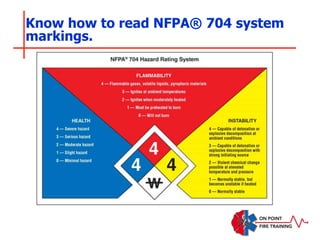
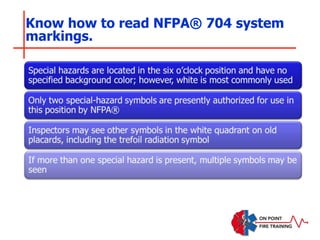
Know how to read NFPA® 704 system
markings.
Know how to read NFPA® 704 system
markings.
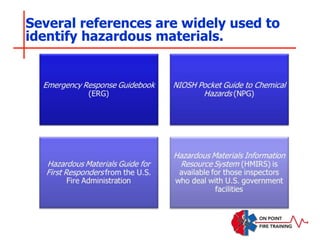
Several references are widely used to
identify hazardous materials.
The ERG is primarily a guide to aid
emergency responders.
NOTE
‣ The ERG does not address all
circumstances that may be associated
with hazardous materials/dangerous
goods. It is primarily designed for use
at hazardous materials/dangerous
goods incidents occurring on highways
or railroads.
Inspectors can use the ERG in several
ways.
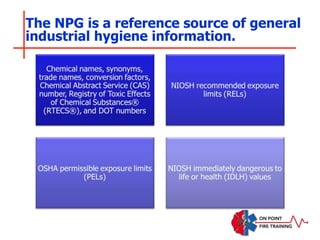
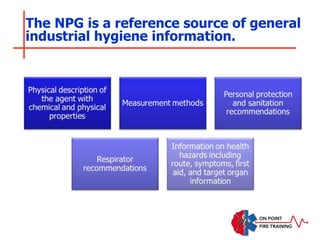
The NPG is a reference source of general
industrial hygiene information.
The NPG is a reference source of general
industrial hygiene information.
The NPG is a reference source of general
industrial hygiene information.
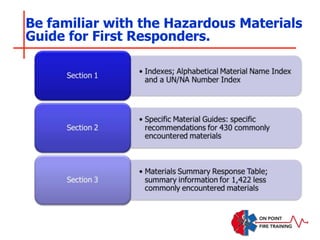
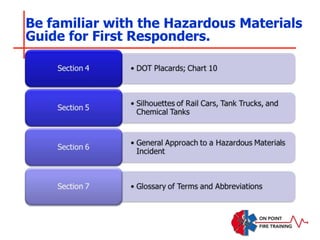
Be familiar with the Hazardous Materials
Guide for First Responders.
Be familiar with the Hazardous Materials
Guide for First Responders.
Inspectors should be familiar with the
HMIRS.
Inspectors should be familiar with the
Canadian Dangerous Goods System.
NOTE
‣ Inspectors can obtain federal and
provincial legislation from government
web sites. Federal legislation can be
found at the Department of Justice
Canada web site. The provincial
Queen’s Printer web site usually
contains provincial legislation.
Inspectors should be familiar with
WHMIS.
Inspectors should be familiar with
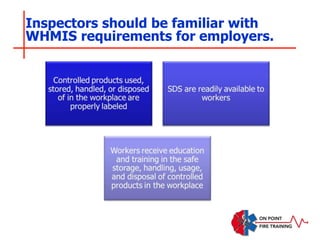
WHMIS requirements for employers.
Be familiar with what WHMIS considers a
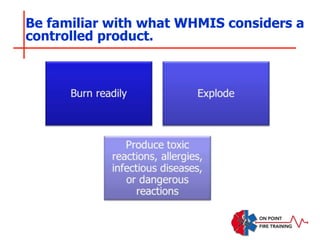
controlled product.
Inspectors need to be familiar with other
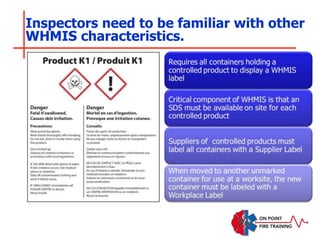
WHMIS characteristics.
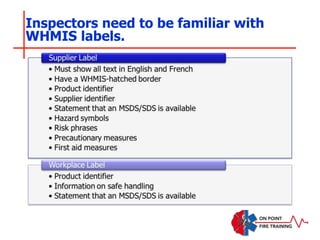
NOTE
‣ The Workplace Label does not require
the distinctive crosshatch border that
is required on the Supplier Label.
Inspectors need to be familiar with
WHMIS labels.
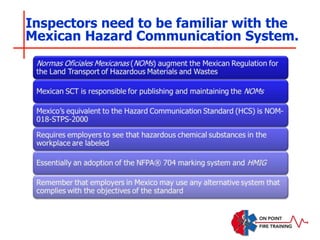
Inspectors need to be familiar with the
Mexican Hazard Communication System.
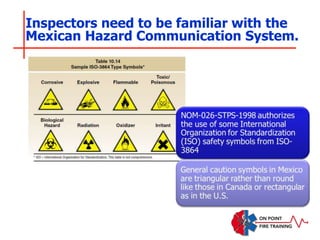
Inspectors need to be familiar with the
Mexican Hazard Communication System.
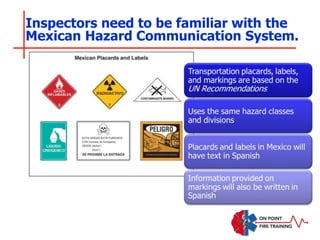
Inspectors need to be familiar with the
Mexican Hazard Communication System.
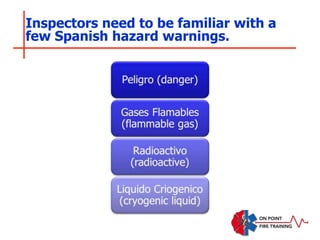
Inspectors need to be familiar with a
few Spanish hazard warnings.
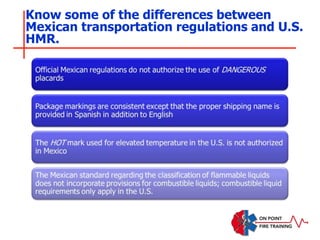
Know some of the differences between
Mexican transportation regulations and U.S.
HMR.
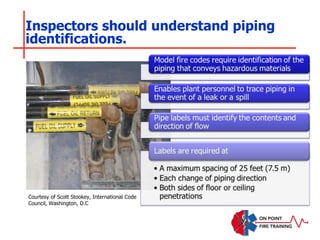
Inspectors should understand piping
identifications.
Courtesy of Scott Stookey, International Code
Council, Washington, D.C
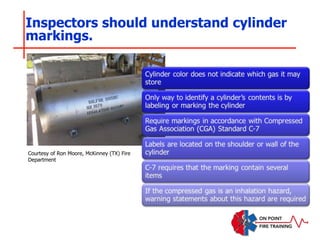
Inspectors should understand cylinder
markings.
Courtesy of Ron Moore, McKinney (TX) Fire
Department
‣ Describe code considerations for
determining the permissible amount of
hazardous materials within a building.
Learning Objective 7
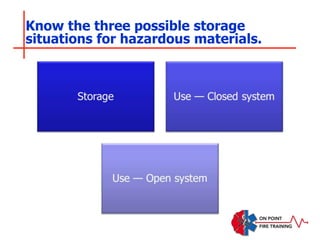
Know the three possible storage
situations for hazardous materials.
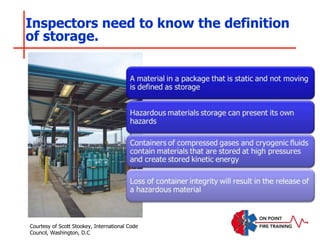
Inspectors need to know the definition
of storage.
Courtesy of Scott Stookey, International Code
Council, Washington, D.C
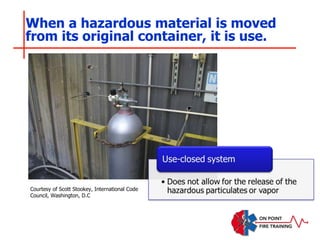
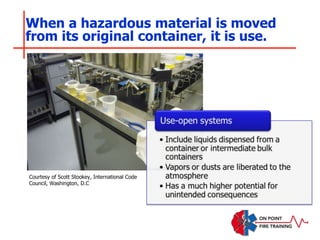
When a hazardous material is moved
from its original container, it is use.
Courtesy of Scott Stookey, International Code
Council, Washington, D.C
When a hazardous material is moved
from its original container, it is use.
Courtesy of Scott Stookey, International Code
Council, Washington, D.C
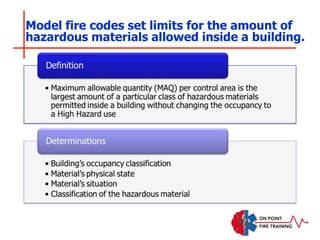
Model fire codes set limits for the amount of
hazardous materials allowed inside a building.
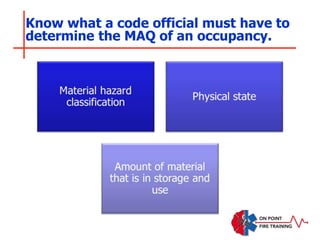
Know what a code official must have to
determine the MAQ of an occupancy.
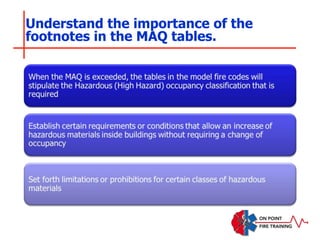
Understand the importance of the
footnotes in the MAQ tables.
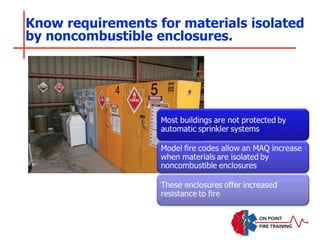
Know requirements for materials isolated
by noncombustible enclosures.
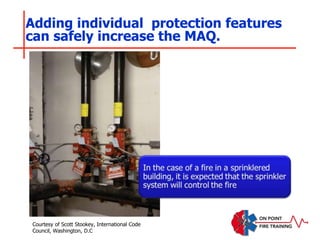
Adding individual protection features
can safely increase the MAQ.
Courtesy of Scott Stookey, International Code
Council, Washington, D.C
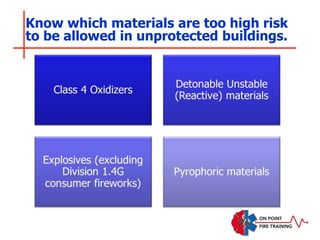
Know which materials are too high risk
to be allowed in unprotected buildings.
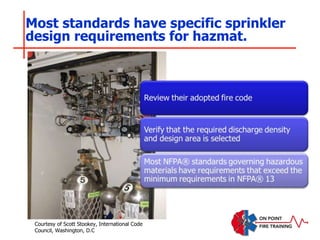
Most standards have specific sprinkler
design requirements for hazmat.
Courtesy of Scott Stookey, International Code
Council, Washington, D.C
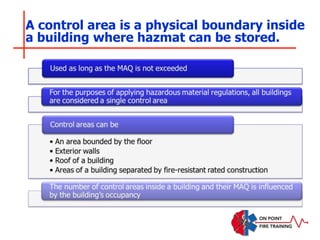
A control area is a physical boundary inside
a building where hazmat can be stored.
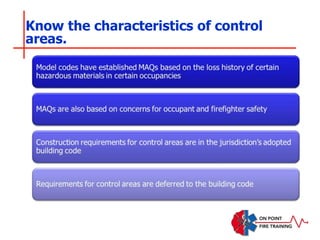
Know the characteristics of control
areas.
‣ Explain the requirements for storage
and use of nonbulk and bulk packaging.
Learning Objective 8
Inspectors need to know the two DOT and
TC categories of packaging for hazmat.
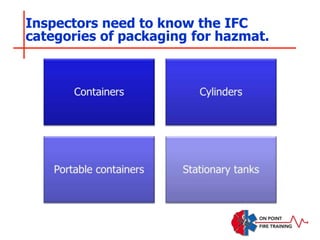
Inspectors need to know the IFC
categories of packaging for hazmat.
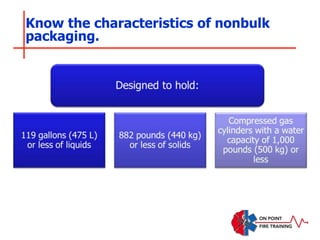
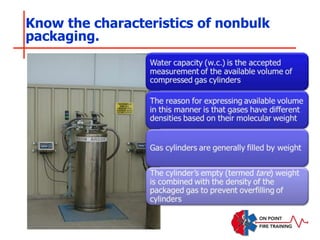
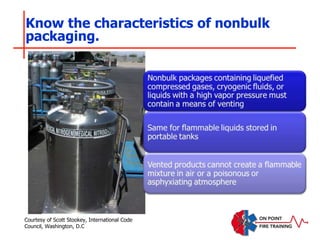
Know the characteristics of nonbulk
packaging.
Know the characteristics of nonbulk
packaging.
Know the characteristics of nonbulk
packaging.
Courtesy of Scott Stookey, International Code
Council, Washington, D.C
Code requirements for containers address
packaging of flammable and combustible
liquids.
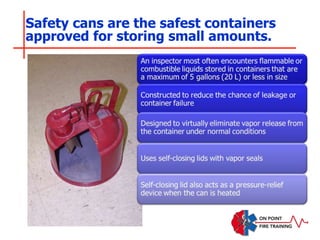
Safety cans are the safest containers
approved for storing small amounts.
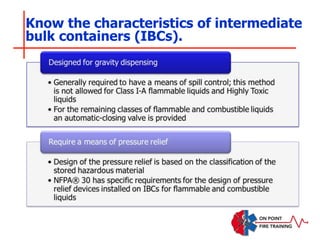
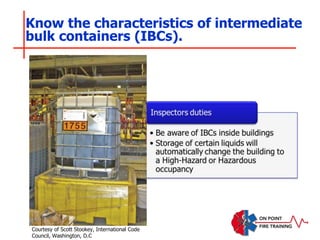
Know the characteristics of intermediate
bulk containers (IBCs).
Know the characteristics of intermediate
bulk containers (IBCs).
Know the characteristics of intermediate
bulk containers (IBCs).
Know the characteristics of intermediate
bulk containers (IBCs).
Courtesy of Scott Stookey, International Code
Council, Washington, D.C
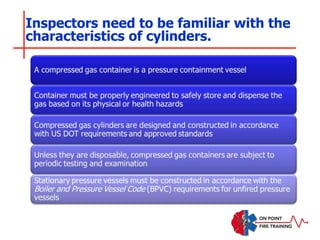
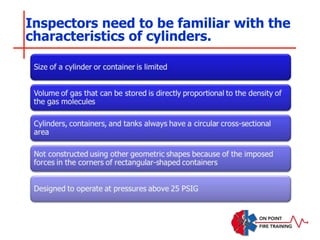
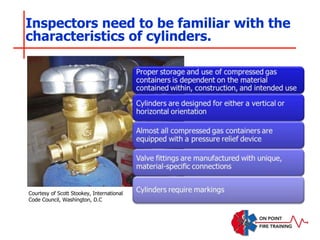
Inspectors need to be familiar with the
characteristics of cylinders.
Inspectors need to be familiar with the
characteristics of cylinders.
Inspectors need to be familiar with the
characteristics of cylinders.
Courtesy of Scott Stookey, International
Code Council, Washington, D.C
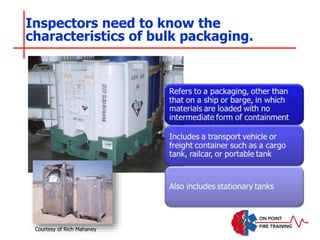
Inspectors need to know the
characteristics of bulk packaging.
Courtesy of Rich Mahaney
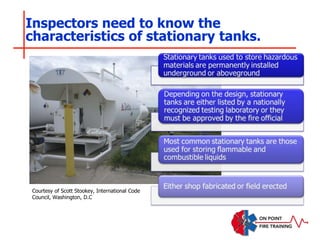
Inspectors need to know the
characteristics of stationary tanks.
Courtesy of Scott Stookey, International Code
Council, Washington, D.C
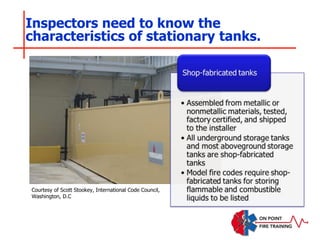
Inspectors need to know the
characteristics of stationary tanks.
Courtesy of Scott Stookey, International Code Council,
Washington, D.C
Inspectors need to know the
characteristics of stationary tanks.
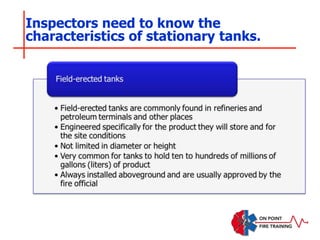
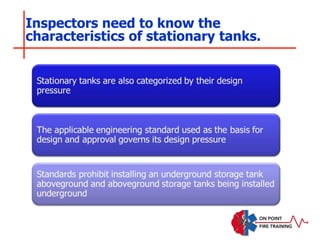
Inspectors need to know the
characteristics of stationary tanks.
Inspectors need to know the
characteristics of stationary tanks.
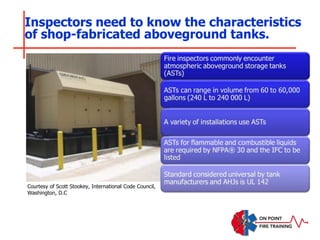
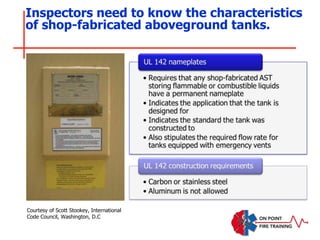
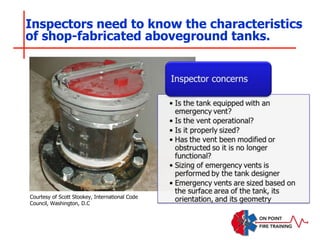
Inspectors need to know the characteristics
of shop-fabricated aboveground tanks.
Courtesy of Scott Stookey, International Code Council,
Washington, D.C
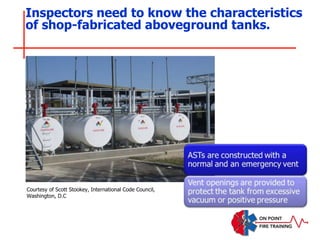
Inspectors need to know the characteristics
of shop-fabricated aboveground tanks.
Courtesy of Scott Stookey, International
Code Council, Washington, D.C
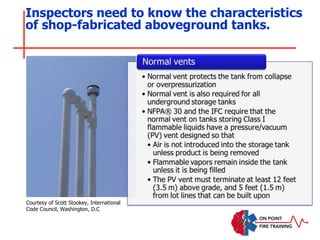
Inspectors need to know the characteristics
of shop-fabricated aboveground tanks.
Courtesy of Scott Stookey, International Code Council,
Washington, D.C
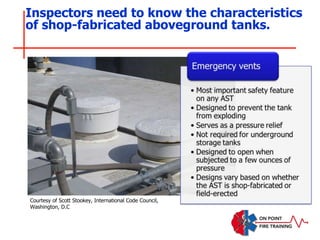
Inspectors need to know the characteristics
of shop-fabricated aboveground tanks.
Courtesy of Scott Stookey, International
Code Council, Washington, D.C
Inspectors need to know the characteristics
of shop-fabricated aboveground tanks.
Courtesy of Scott Stookey, International Code Council,
Washington, D.C
Inspectors need to know the characteristics
of shop-fabricated aboveground tanks.
Courtesy of Scott Stookey, International Code
Council, Washington, D.C
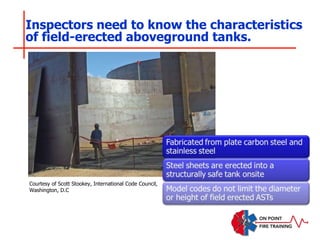
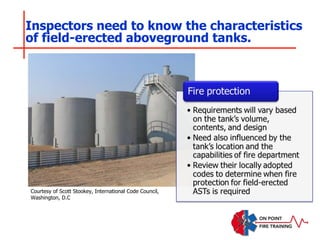
Inspectors need to know the characteristics
of field-erected aboveground tanks.
Courtesy of Scott Stookey, International Code Council,
Washington, D.C
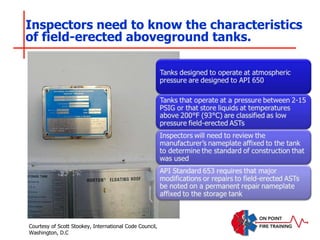
Inspectors need to know the characteristics
of field-erected aboveground tanks.
Courtesy of Scott Stookey, International Code Council,
Washington, D.C
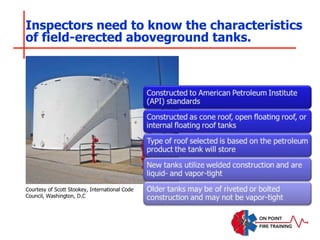
Inspectors need to know the characteristics
of field-erected aboveground tanks.
Courtesy of Scott Stookey, International Code
Council, Washington, D.C
Inspectors need to know the characteristics
of field-erected aboveground tanks.
Courtesy of Scott Stookey, International Code Council,
Washington, D.C
Inspectors need to know the characteristics
of field-erected aboveground tanks.
Inspectors need to know the characteristics
of underground storage tanks (USTs).
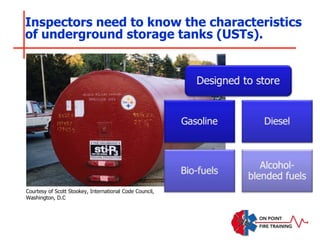
Inspectors need to know the characteristics
of underground storage tanks (USTs).
Courtesy of Scott Stookey, International Code Council,
Washington, D.C
Inspectors need to know the characteristics
of underground storage tanks (USTs).
Inspectors need to know the characteristics
of underground storage tanks (USTs).
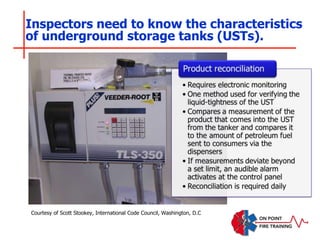
Courtesy of Scott Stookey, International Code Council, Washington, D.C
Inspectors need to know the characteristics
of underground storage tanks (USTs).
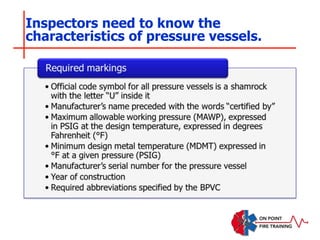
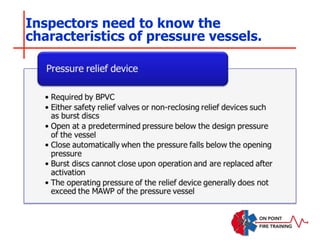
Inspectors need to know the
characteristics of pressure vessels.
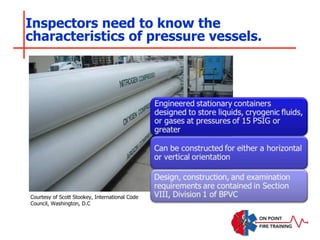
Courtesy of Scott Stookey, International Code
Council, Washington, D.C
Inspectors need to know the
characteristics of pressure vessels.
Inspectors need to know the
characteristics of pressure vessels.
‣ Describe the code requirements for
testing, maintenance and operation of
equipment, containers and tanks.
Learning Objective 9
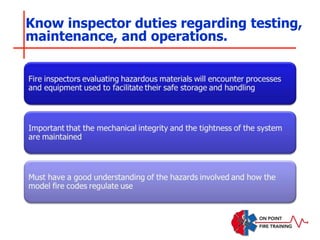
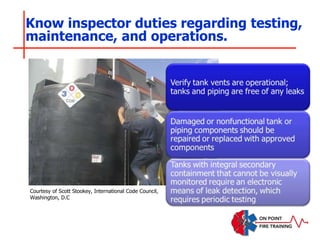
Know inspector duties regarding testing,
maintenance, and operations.
Know inspector duties regarding testing,
maintenance, and operations.
Courtesy of Scott Stookey, International Code Council,
Washington, D.C
Know inspector duties regarding testing,
maintenance, and operations.

1505 Ch 10 PowerPoint.pptx