Good afternoon..
Presented by:
DEBLINA DUTTA CHOWDHURY
CONTENTS
 Introduction(e-nose), e-sensing,

 Definition: electronic nose(e-nose),Basic design of an e-nose

 Comparison of e-nose with biological nose

 The need of an e-nose

 The e-nose---An overview

 Working principle of an e-nose

 Sensor technology in e-nose

 Performing an analysis with an e-nose

 Applications of e-nose

 Conclusion
 Introduction---electronic nose(e-nose)

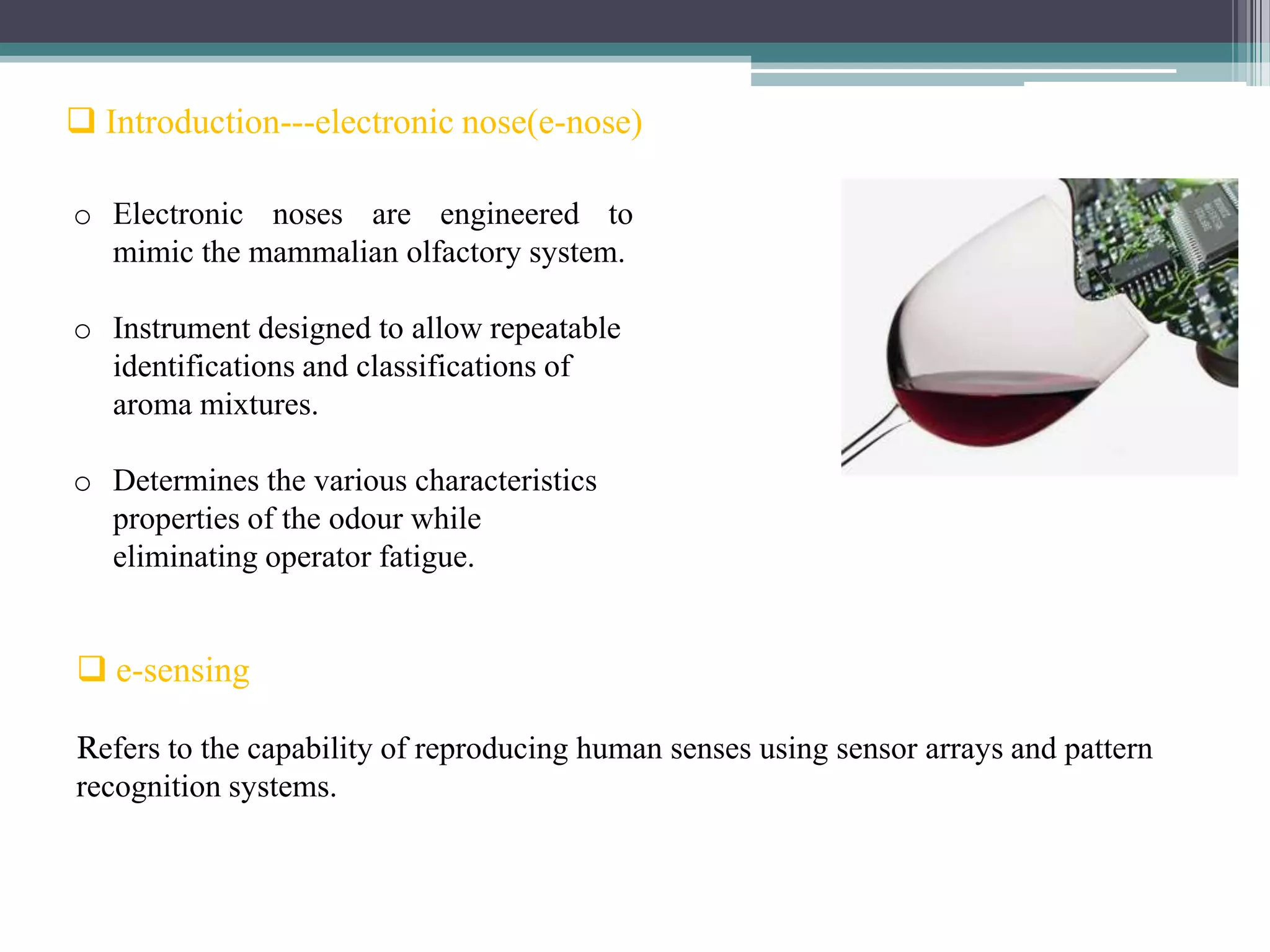
o Electronic noses are engineered to
  mimic the mammalian olfactory system.

o Instrument designed to allow repeatable
  identifications and classifications of
  aroma mixtures.

o Determines the various characteristics
  properties of the odour while
  eliminating operator fatigue.


 e-sensing

Refers to the capability of reproducing human senses using sensor arrays and pattern
recognition systems.
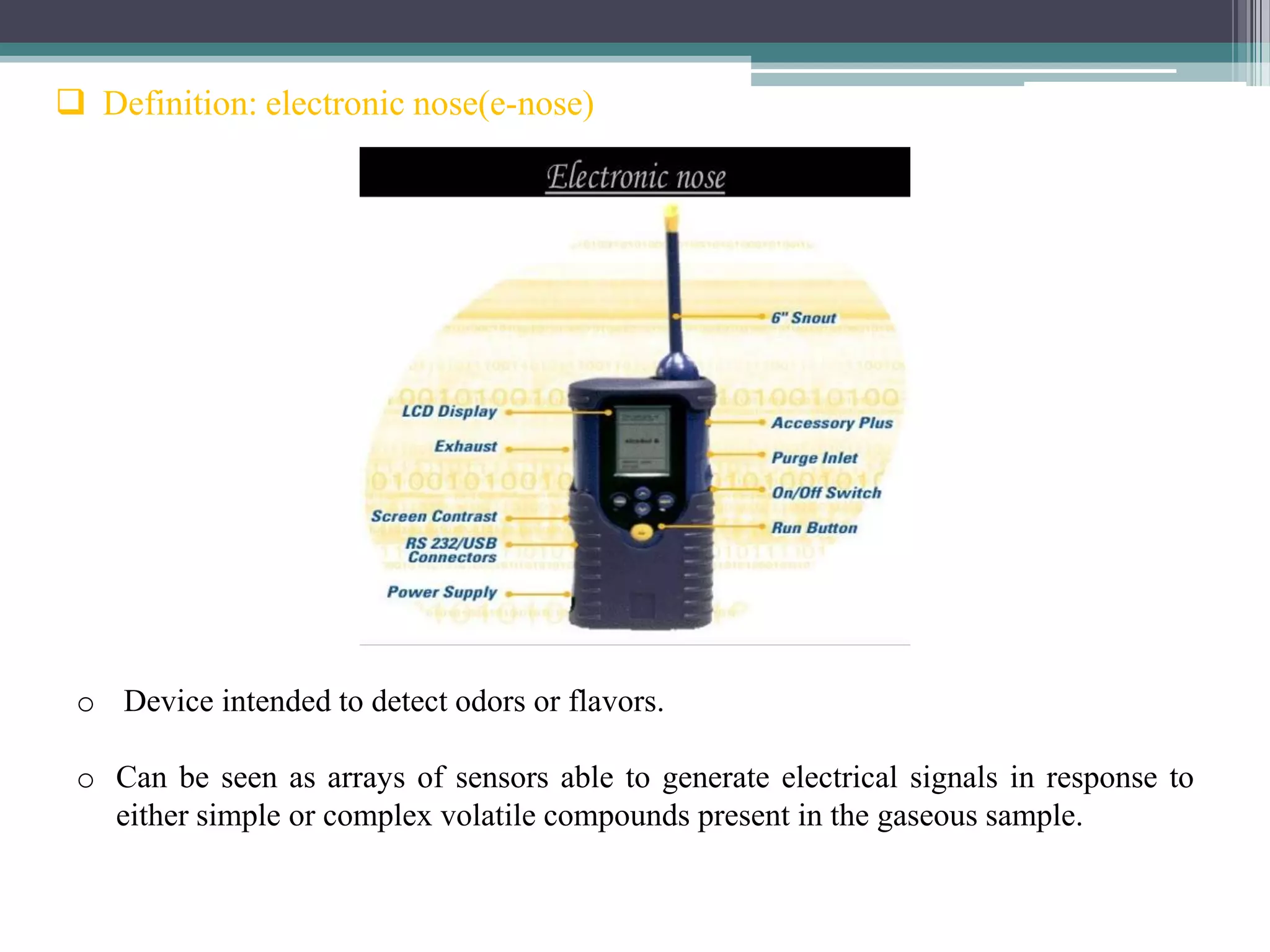
 Definition: electronic nose(e-nose)


 o Device intended to detect odors or flavors.

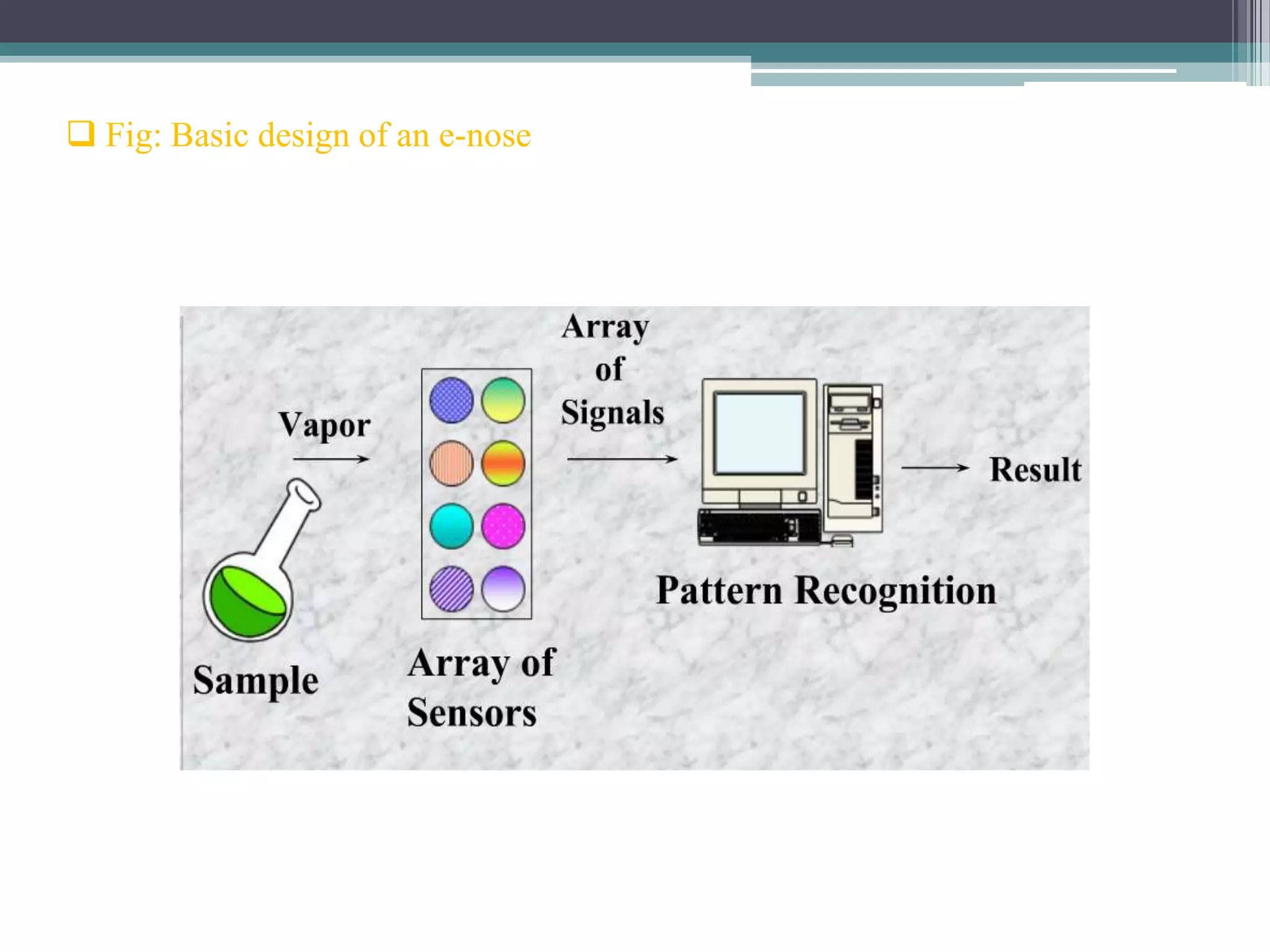
 o Can be seen as arrays of sensors able to generate electrical signals in response to
   either simple or complex volatile compounds present in the gaseous sample.
 Fig: Basic design of an e-nose
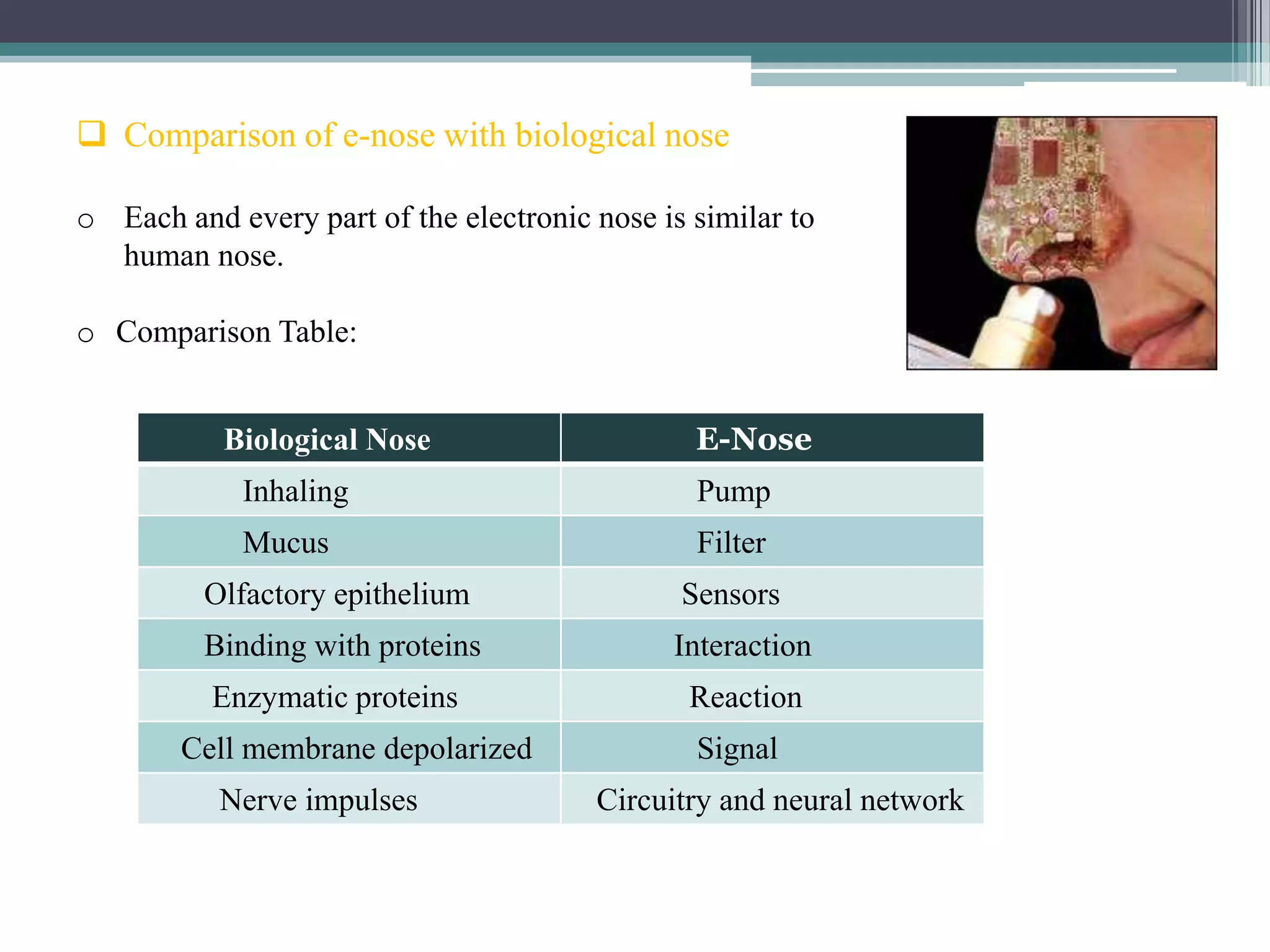
 Comparison of e-nose with biological nose

o Each and every part of the electronic nose is similar to
  human nose.

o Comparison Table:


           Biological Nose                      E-Nose
             Inhaling                           Pump
             Mucus                              Filter
          Olfactory epithelium                 Sensors
          Binding with proteins               Interaction
          Enzymatic proteins                    Reaction
        Cell membrane depolarized               Signal
           Nerve impulses               Circuitry and neural network
 The need of an e-nose

o The human sniffers are costly when compared to electronic nose.

o Speedy, reliable new technology of the gas sensors are used in the electronic
  nose.

o Detection of hazardous or poisonous gas is not possible with a human sniffer.

o An e-nose also overcomes other problems associated with the human olfactory
  system.

o For the confirmation of the values obtained from a sniffer the result obtained
  from the sniffer has to be compared with some other sniffer’s value.

o There lies a great chances of difference in the values got by each individual.
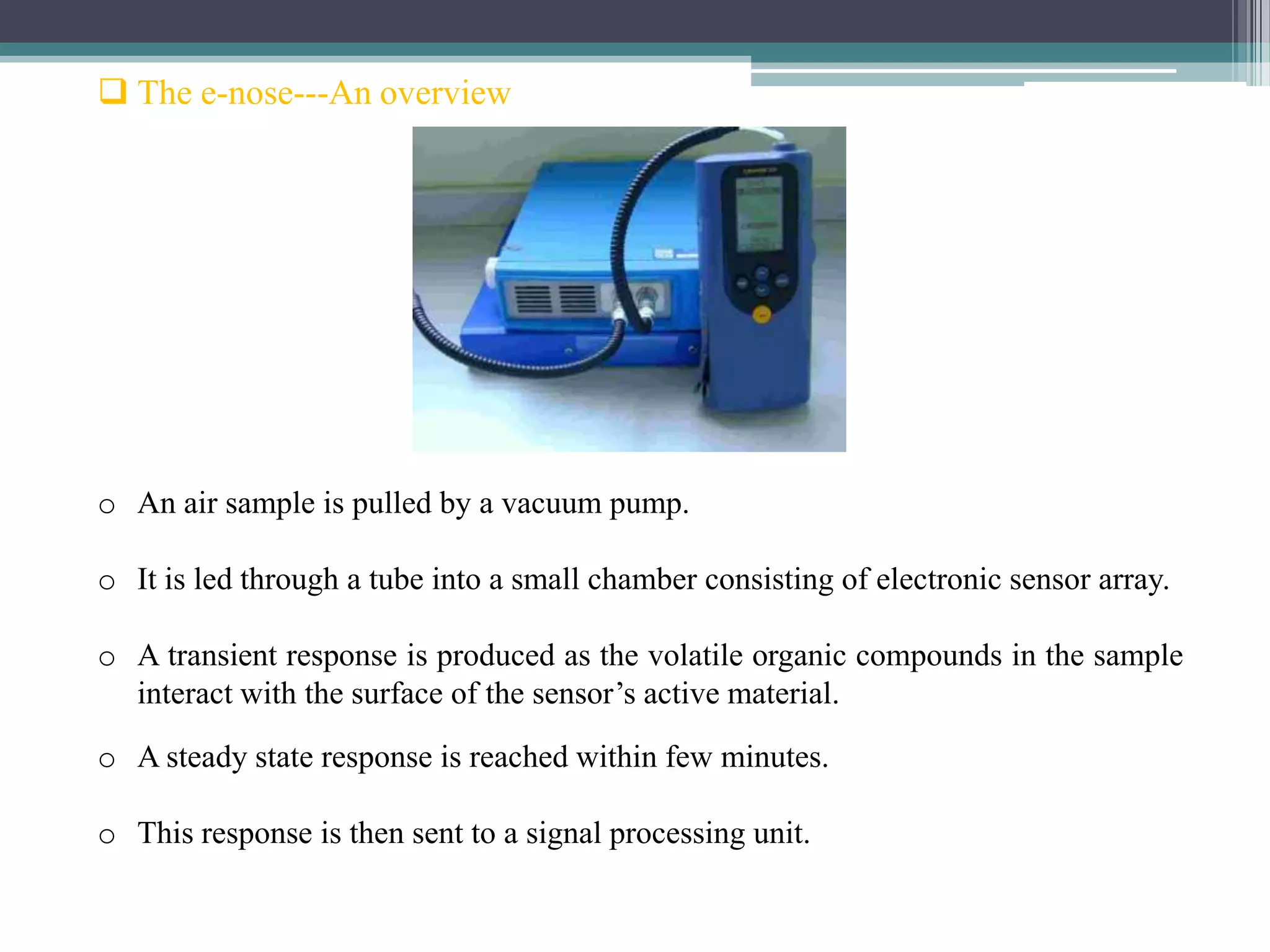
 The e-nose---An overview


o An air sample is pulled by a vacuum pump.

o It is led through a tube into a small chamber consisting of electronic sensor array.

o A transient response is produced as the volatile organic compounds in the sample
  interact with the surface of the sensor’s active material.
o A steady state response is reached within few minutes.

o This response is then sent to a signal processing unit.
Contd..

o A washing gas such as an alcohol vapour is applied to the array for a few seconds
  to a minute.

o This is done to remove the odorant mixture from the surface and bulk of the
  sensor's active material.

o Finally, the reference gas is again applied to the array, to prepare it for a new
  measurement cycle.

o A variety of basic sensors can be used according to the nose strategy chosen.

o Each sensor in the array has different characteristics.

o The pattern of response across all the sensors in the array is used to identify and/or
  characterize the odour.
 Working principle of an e-nose

Electronic noses include three major parts:
I. a sample delivery system
II. a detection system
III. a computing system


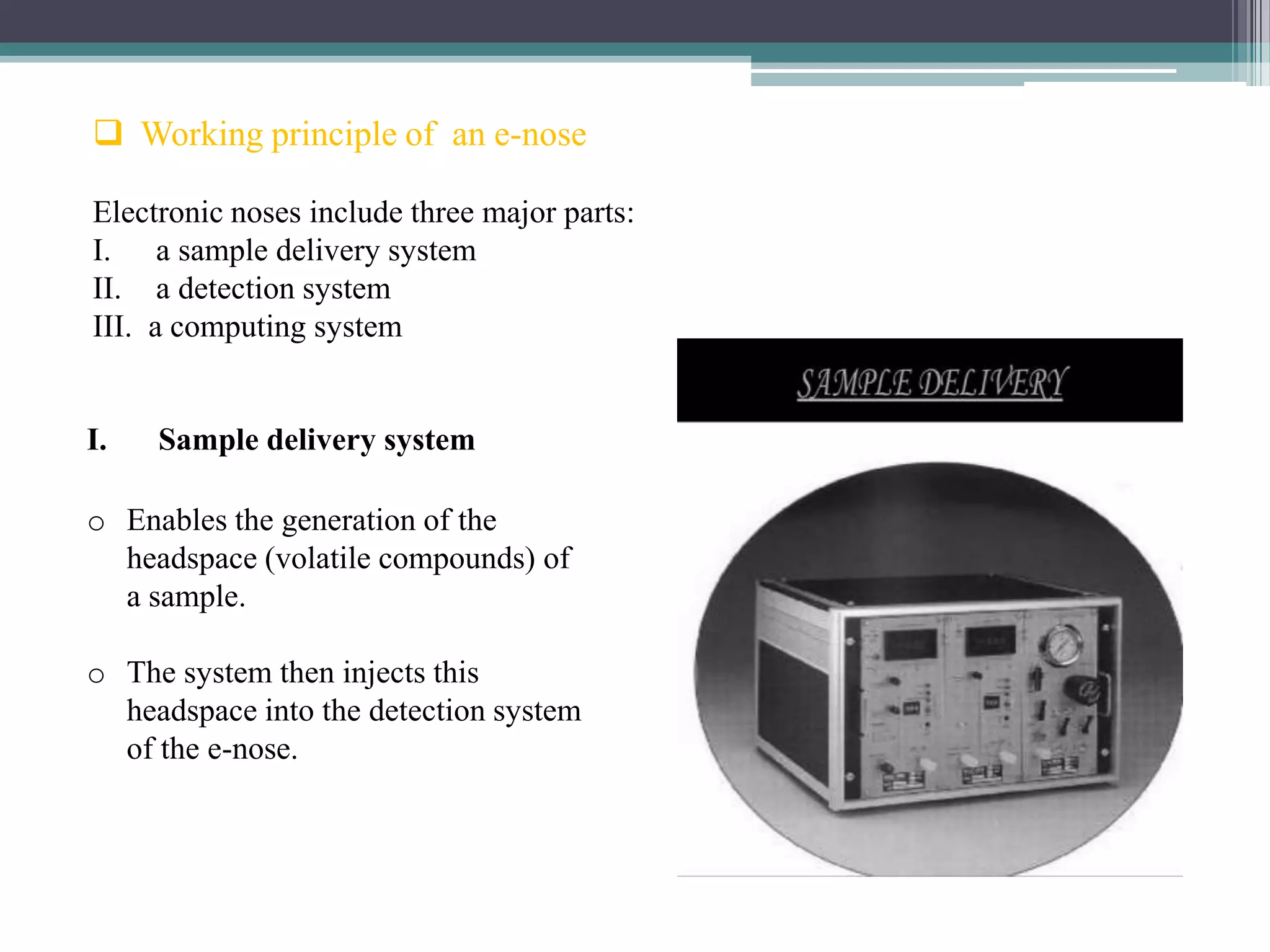
I.   Sample delivery system

o Enables the generation of the
  headspace (volatile compounds) of
  a sample.

o The system then injects this
  headspace into the detection system
  of the e-nose.
II. Detection system

o Consists of a sensor set, is the "reactive" part of the instrument.

o Adsorption of volatile compounds on the sensor surface causes a physical
  change of the sensor; they experience a change of electrical properties.

o A specific response is recorded by the electronic interface transforming the signal
  into a digital value.

o Recorded data are then computed based on statistical models.


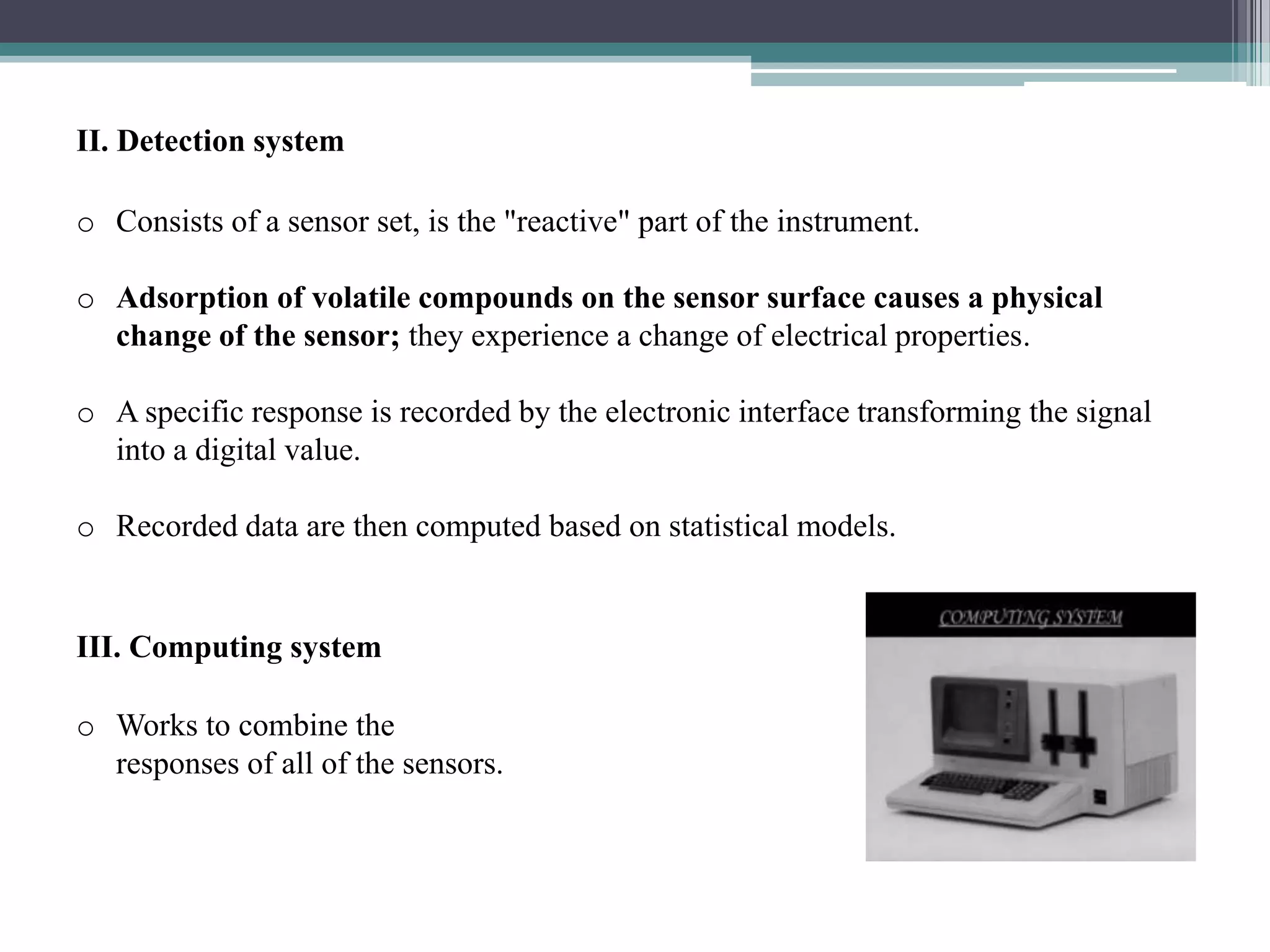
III. Computing system

o Works to combine the
  responses of all of the sensors.
 Sensor technology in e-nose

o The sensor array is clearly the key element. It forms the primary step in the detection or
  identification of an odorant.

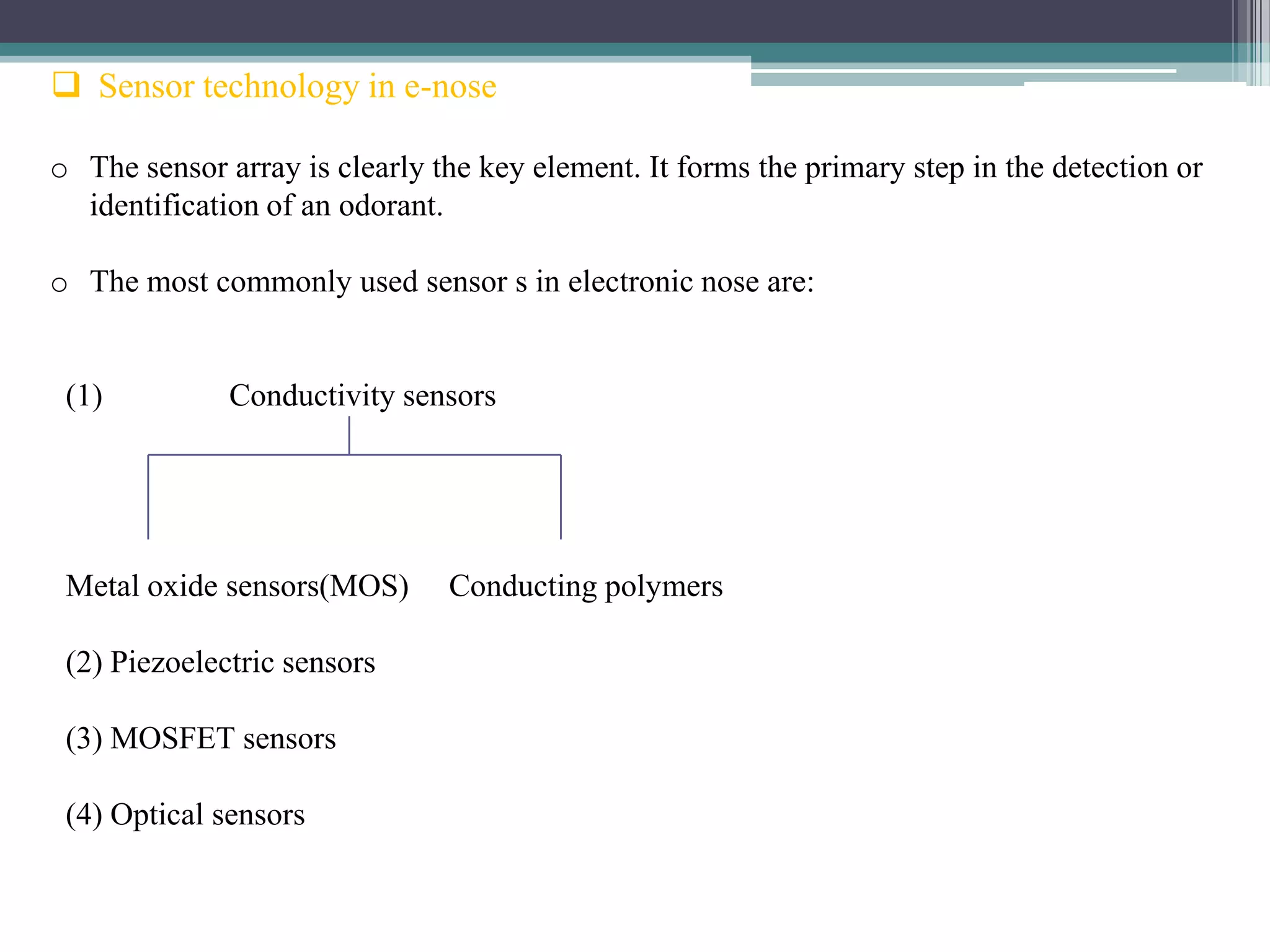
o The most commonly used sensor s in electronic nose are:


 (1)          Conductivity sensors


 Metal oxide sensors(MOS)      Conducting polymers

 (2) Piezoelectric sensors

 (3) MOSFET sensors

 (4) Optical sensors
(1a) MOS (Metal oxide sensors) -
o Adsorption of gas molecules provoke changes in conductivity .

o This conductivity change is the measure of the amount of volatile organic compounds
  adsorbed.


   (1b) Conducting polymers-
o Conducting or conductive polymer gas sensors operate based on changes in electrical
  resistance caused by adsorption of gases onto the sensor surface.


  (2) Piezoelectric sensors-
o Adsorption of gas onto the surface of the polymer leads to change in mass on the
  sensor surface.

o This in turn produces a change in the resonant frequency of the crystal.

o This change in frequency is proportional to the concentration of the test material.
(3) MOSFET (Metal Oxide Silicon Field Effect Transistor )sensors-


o A volatile organic compound produces a
  reaction in the sensing layer(gate).

o This causes the physical property of the
  gate to change.

o Thereby the threshold voltage is changed
  and thus the channel conductivity.
(4) Optical sensors-

o Optical sensor systems are somewhat more complex than typical sensor-array systems
  having transduction mechanisms based on changes in electrical resistance.

o Optical sensors work by means of light modulation measurements.


 Performing an analysis with an e-nose

o As a first step, an e-nose needs to be trained with qualified samples so as to build a
  database of reference.

o Then the instrument can recognize new samples by comparing volatile compounds
  fingerprint to those contained in its database.

o Thus they can perform the analysis.
APPLICATIONS OF ELECTRONIC NOSE
 Applications of E-nose

The applications(current) of an electronic nose
include:

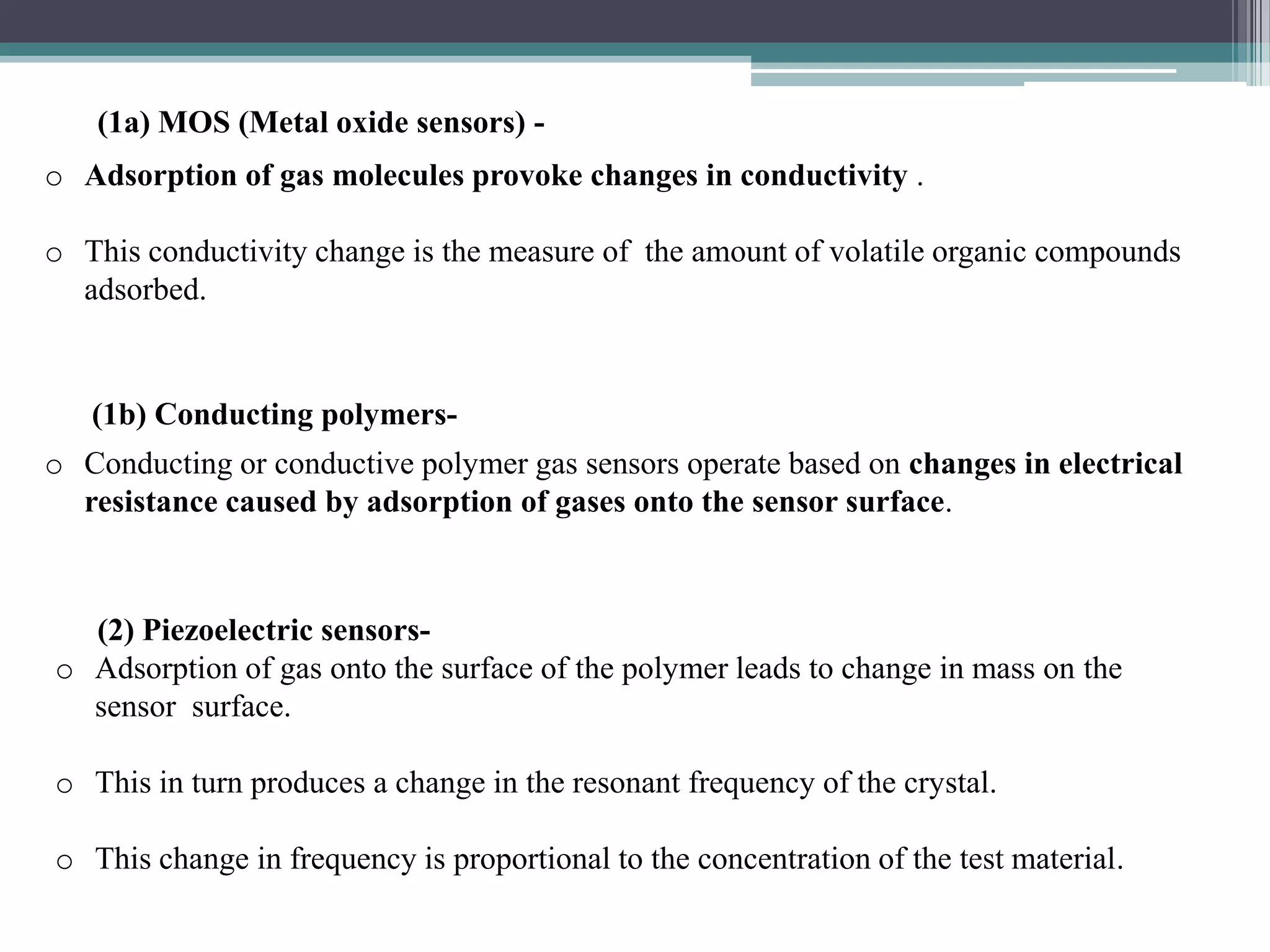
o Medical diagnosis and health monitoring

o Environmental monitoring

o Application in food industry

o Detection of explosives

o Space applications(NASA)

o In research and development industries

o In quality control laboratories

o In process and production department
The possible and future applications of an electronic nose include:

o in field of crime prevention and security

o detection of harmful bacteria

o detection of drug odours etc.
 Medical diagnosis and health monitoring by e-nose

 I. Respiratory disease diagnosis-

 o Human breath contains thousands of volatile organic compounds (VOCs) in gas
   phase.

 o E-nose can diagnose respiratory infections such as pneumonia.

 o It does so by comparing smell prints from the breath of a sick patient with those of
   patients with standardized readings.

 o It is also being studied as a diagnostic tool for lung cancer.


 II. Urinary Tract infections-

 o The e-nose as a potential diagnostic tool for patients affected with kidney diseases, by
   distinguishing traces of blood in urine samples.
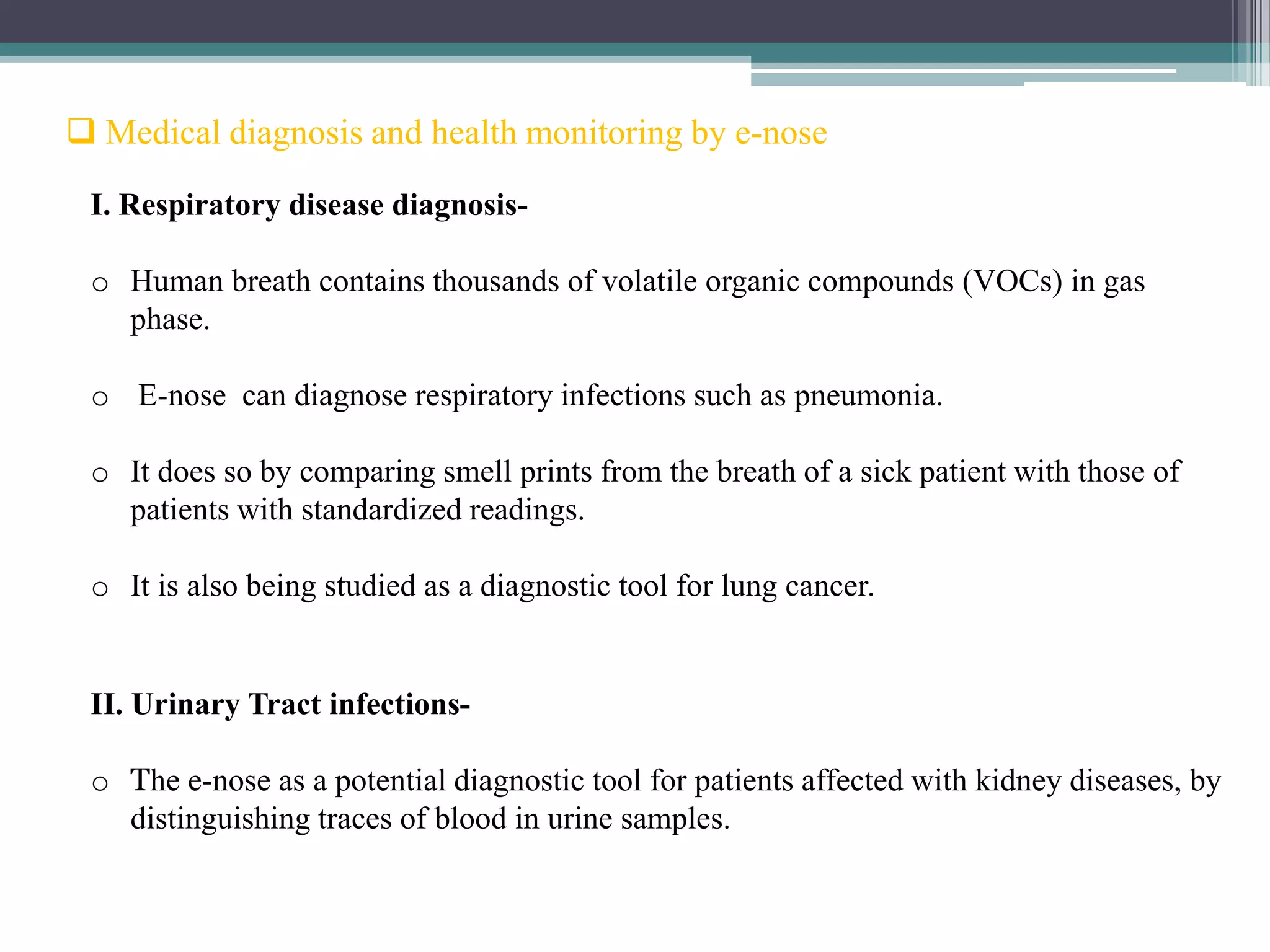
III. Cancer detection-

o E-nose is capable of distinguishing between the breath of a
  healthy person and a person with cancer.

o The device is especially promising because it is able to
  detect cancer before tumors become visible in X-rays.


 Environmental monitoring by e-nose
o Environmental applications of electronic noses include:

  (1) analysis of fuel mixtures
  (2)detection of oil leaks
  (3) testing ground water for odours
  (4)identification of household odours
  (5)identification of toxic wastes
  (6)air quality monitoring
  (7)monitoring factory emissions etc.
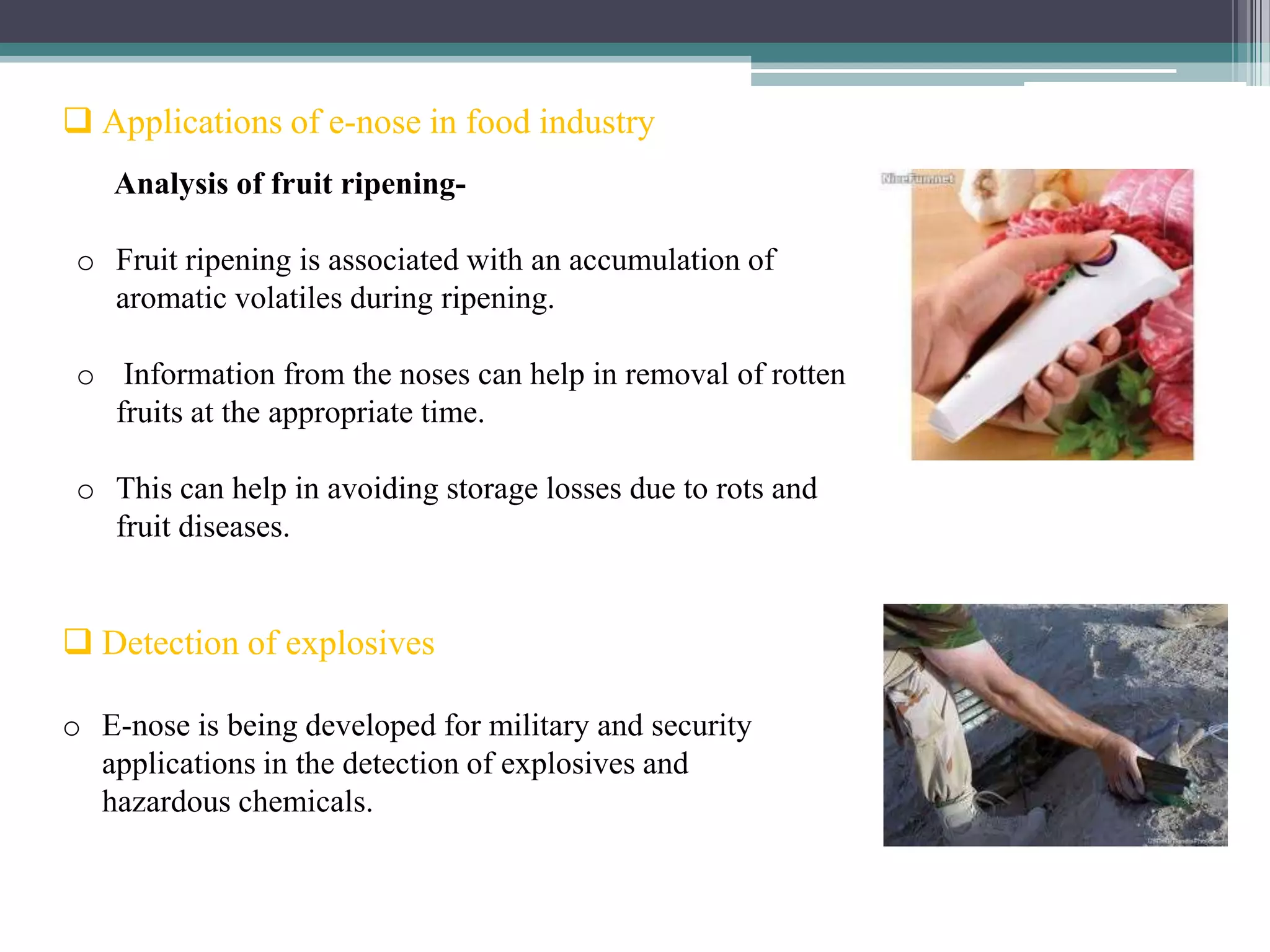
 Applications of e-nose in food industry
   Analysis of fruit ripening-

 o Fruit ripening is associated with an accumulation of
   aromatic volatiles during ripening.

 o Information from the noses can help in removal of rotten
   fruits at the appropriate time.

 o This can help in avoiding storage losses due to rots and
   fruit diseases.


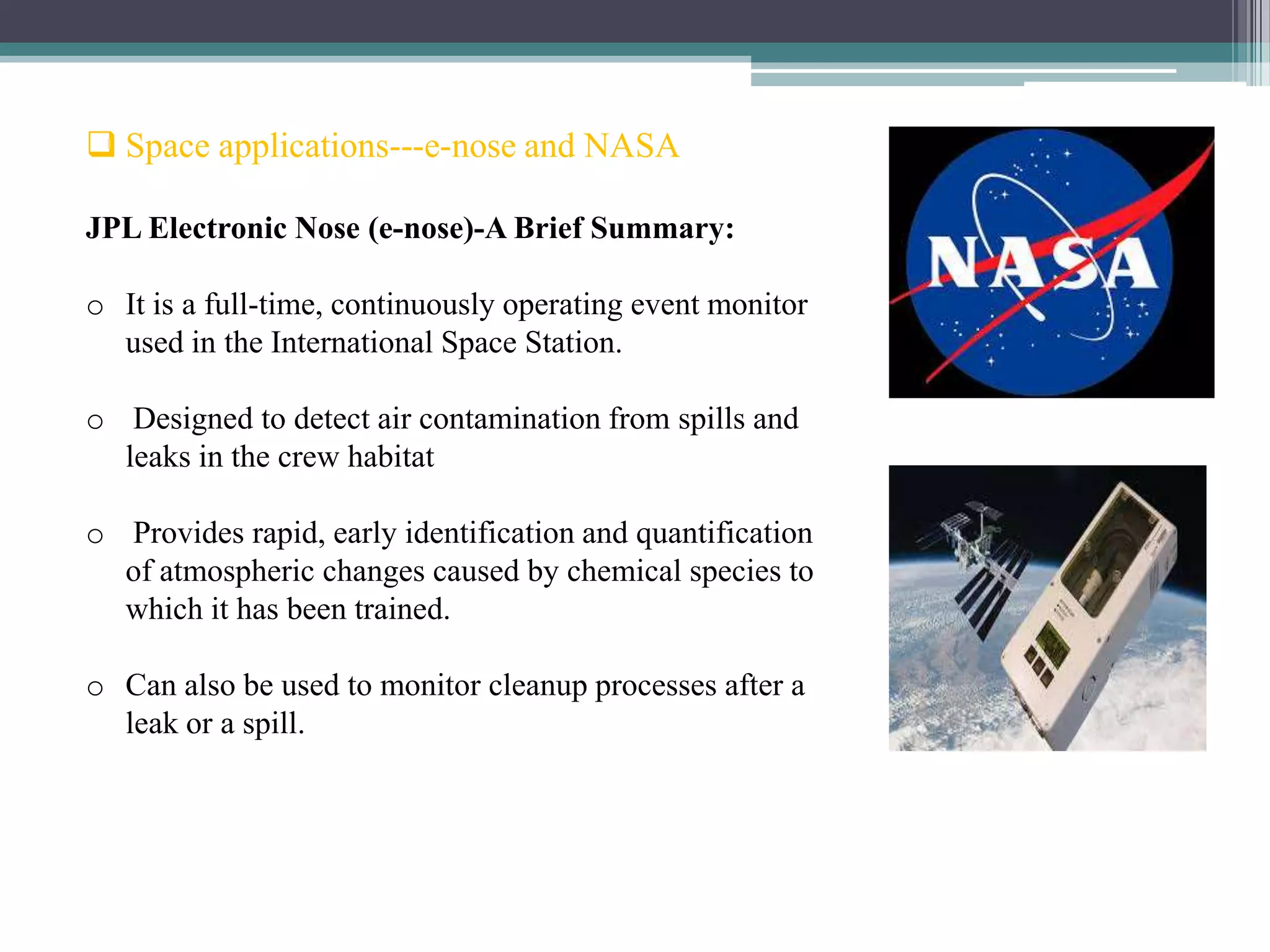
 Detection of explosives

o E-nose is being developed for military and security
  applications in the detection of explosives and
  hazardous chemicals.
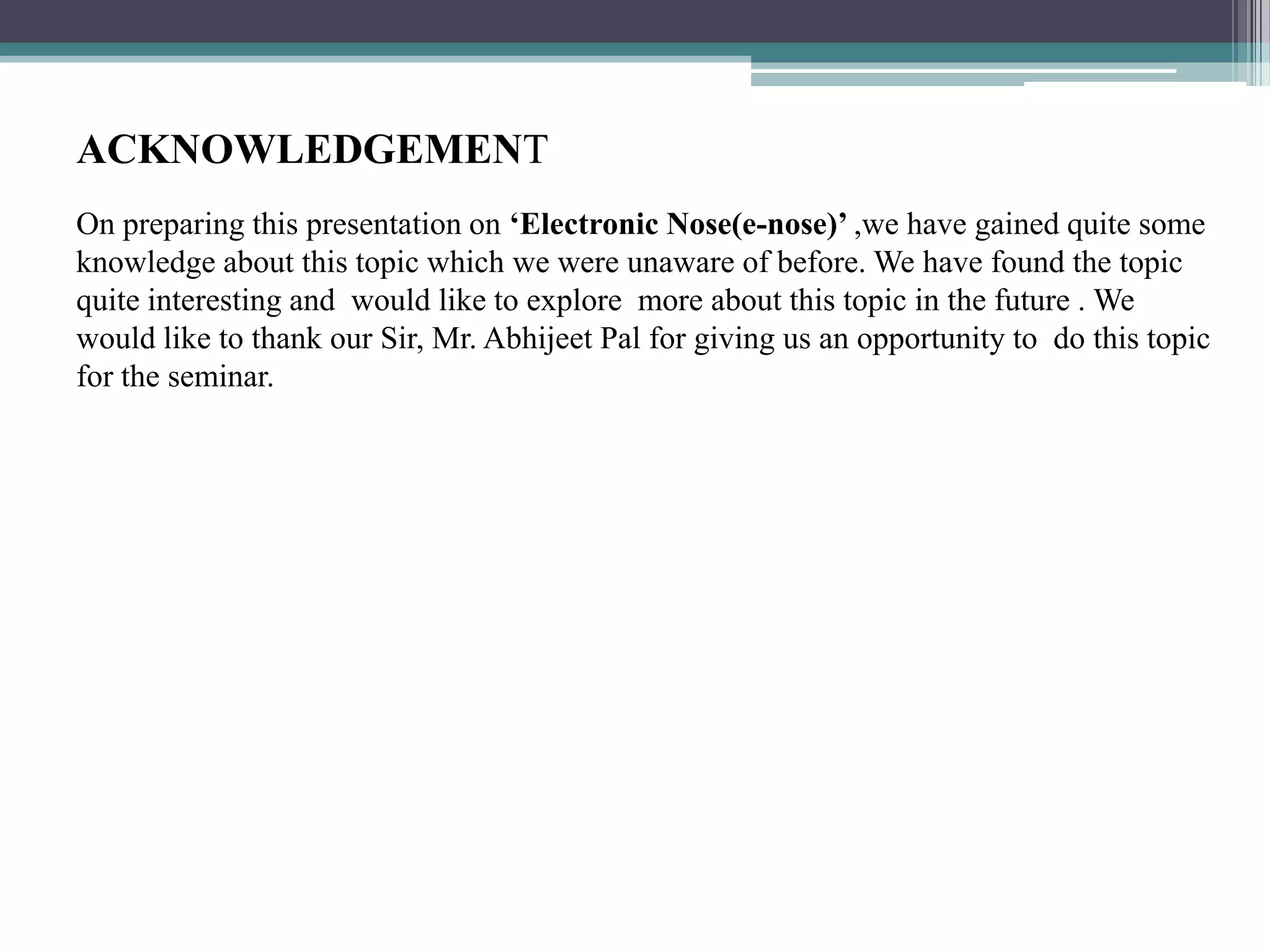
 Space applications---e-nose and NASA

JPL Electronic Nose (e-nose)-A Brief Summary:

o It is a full-time, continuously operating event monitor
  used in the International Space Station.

o Designed to detect air contamination from spills and
  leaks in the crew habitat

o Provides rapid, early identification and quantification
  of atmospheric changes caused by chemical species to
  which it has been trained.

o Can also be used to monitor cleanup processes after a
  leak or a spill.
 Conclusion
o An “electronic nose” is a system originally created to mimic the function of an
  animal nose.

o Offers a cheap and non destructive instrument that (if properly programmed and
  automated) can be operated by non specialists.

o Since the whole process is automatic, the cost of each measurement is very low.

o Finally, the measurement cycle should be faster in order to increase throughput.

o However, this analytical instrument is more a “multi-sensor array technology”
  than a real “nose”.

o Whatever the sensor technology, it is still far from the sensitivity and selectivity
  of a mammalian nose.

o Therefore, its aim is not to totally replace either the human nose or other
  analytical methods.
ACKNOWLEDGEMENT
On preparing this presentation on ‘Electronic Nose(e-nose)’ ,we have gained quite some
knowledge about this topic which we were unaware of before. We have found the topic
quite interesting and would like to explore more about this topic in the future . We
would like to thank our Sir, Mr. Abhijeet Pal for giving us an opportunity to do this topic
for the seminar.
REFERENCES

o www.wikipedia.org

o www.slideshare.com

o www.powershow.com

o www.google.com
Thank you..

Electronic nose

  • 1.
  • 2.
  • 3.
    CONTENTS  Introduction(e-nose), e-sensing, Definition: electronic nose(e-nose),Basic design of an e-nose  Comparison of e-nose with biological nose  The need of an e-nose  The e-nose---An overview  Working principle of an e-nose  Sensor technology in e-nose  Performing an analysis with an e-nose  Applications of e-nose  Conclusion
  • 4.
     Introduction---electronic nose(e-nose) oElectronic noses are engineered to mimic the mammalian olfactory system. o Instrument designed to allow repeatable identifications and classifications of aroma mixtures. o Determines the various characteristics properties of the odour while eliminating operator fatigue.  e-sensing Refers to the capability of reproducing human senses using sensor arrays and pattern recognition systems.
  • 5.
     Definition: electronicnose(e-nose) o Device intended to detect odors or flavors. o Can be seen as arrays of sensors able to generate electrical signals in response to either simple or complex volatile compounds present in the gaseous sample.
  • 6.
     Fig: Basicdesign of an e-nose
  • 7.
     Comparison ofe-nose with biological nose o Each and every part of the electronic nose is similar to human nose. o Comparison Table: Biological Nose E-Nose Inhaling Pump Mucus Filter Olfactory epithelium Sensors Binding with proteins Interaction Enzymatic proteins Reaction Cell membrane depolarized Signal Nerve impulses Circuitry and neural network
  • 8.
     The needof an e-nose o The human sniffers are costly when compared to electronic nose. o Speedy, reliable new technology of the gas sensors are used in the electronic nose. o Detection of hazardous or poisonous gas is not possible with a human sniffer. o An e-nose also overcomes other problems associated with the human olfactory system. o For the confirmation of the values obtained from a sniffer the result obtained from the sniffer has to be compared with some other sniffer’s value. o There lies a great chances of difference in the values got by each individual.
  • 9.
     The e-nose---Anoverview o An air sample is pulled by a vacuum pump. o It is led through a tube into a small chamber consisting of electronic sensor array. o A transient response is produced as the volatile organic compounds in the sample interact with the surface of the sensor’s active material. o A steady state response is reached within few minutes. o This response is then sent to a signal processing unit.
  • 10.
    Contd.. o A washinggas such as an alcohol vapour is applied to the array for a few seconds to a minute. o This is done to remove the odorant mixture from the surface and bulk of the sensor's active material. o Finally, the reference gas is again applied to the array, to prepare it for a new measurement cycle. o A variety of basic sensors can be used according to the nose strategy chosen. o Each sensor in the array has different characteristics. o The pattern of response across all the sensors in the array is used to identify and/or characterize the odour.
  • 11.
     Working principleof an e-nose Electronic noses include three major parts: I. a sample delivery system II. a detection system III. a computing system I. Sample delivery system o Enables the generation of the headspace (volatile compounds) of a sample. o The system then injects this headspace into the detection system of the e-nose.
  • 12.
    II. Detection system oConsists of a sensor set, is the "reactive" part of the instrument. o Adsorption of volatile compounds on the sensor surface causes a physical change of the sensor; they experience a change of electrical properties. o A specific response is recorded by the electronic interface transforming the signal into a digital value. o Recorded data are then computed based on statistical models. III. Computing system o Works to combine the responses of all of the sensors.
  • 13.
     Sensor technologyin e-nose o The sensor array is clearly the key element. It forms the primary step in the detection or identification of an odorant. o The most commonly used sensor s in electronic nose are: (1) Conductivity sensors Metal oxide sensors(MOS) Conducting polymers (2) Piezoelectric sensors (3) MOSFET sensors (4) Optical sensors
  • 14.
    (1a) MOS (Metaloxide sensors) - o Adsorption of gas molecules provoke changes in conductivity . o This conductivity change is the measure of the amount of volatile organic compounds adsorbed. (1b) Conducting polymers- o Conducting or conductive polymer gas sensors operate based on changes in electrical resistance caused by adsorption of gases onto the sensor surface. (2) Piezoelectric sensors- o Adsorption of gas onto the surface of the polymer leads to change in mass on the sensor surface. o This in turn produces a change in the resonant frequency of the crystal. o This change in frequency is proportional to the concentration of the test material.
  • 15.
    (3) MOSFET (MetalOxide Silicon Field Effect Transistor )sensors- o A volatile organic compound produces a reaction in the sensing layer(gate). o This causes the physical property of the gate to change. o Thereby the threshold voltage is changed and thus the channel conductivity.
  • 16.
    (4) Optical sensors- oOptical sensor systems are somewhat more complex than typical sensor-array systems having transduction mechanisms based on changes in electrical resistance. o Optical sensors work by means of light modulation measurements.  Performing an analysis with an e-nose o As a first step, an e-nose needs to be trained with qualified samples so as to build a database of reference. o Then the instrument can recognize new samples by comparing volatile compounds fingerprint to those contained in its database. o Thus they can perform the analysis.
  • 17.
  • 18.
     Applications ofE-nose The applications(current) of an electronic nose include: o Medical diagnosis and health monitoring o Environmental monitoring o Application in food industry o Detection of explosives o Space applications(NASA) o In research and development industries o In quality control laboratories o In process and production department
  • 19.
    The possible andfuture applications of an electronic nose include: o in field of crime prevention and security o detection of harmful bacteria o detection of drug odours etc.
  • 20.
     Medical diagnosisand health monitoring by e-nose I. Respiratory disease diagnosis- o Human breath contains thousands of volatile organic compounds (VOCs) in gas phase. o E-nose can diagnose respiratory infections such as pneumonia. o It does so by comparing smell prints from the breath of a sick patient with those of patients with standardized readings. o It is also being studied as a diagnostic tool for lung cancer. II. Urinary Tract infections- o The e-nose as a potential diagnostic tool for patients affected with kidney diseases, by distinguishing traces of blood in urine samples.
  • 21.
    III. Cancer detection- oE-nose is capable of distinguishing between the breath of a healthy person and a person with cancer. o The device is especially promising because it is able to detect cancer before tumors become visible in X-rays.  Environmental monitoring by e-nose o Environmental applications of electronic noses include: (1) analysis of fuel mixtures (2)detection of oil leaks (3) testing ground water for odours (4)identification of household odours (5)identification of toxic wastes (6)air quality monitoring (7)monitoring factory emissions etc.
  • 22.
     Applications ofe-nose in food industry Analysis of fruit ripening- o Fruit ripening is associated with an accumulation of aromatic volatiles during ripening. o Information from the noses can help in removal of rotten fruits at the appropriate time. o This can help in avoiding storage losses due to rots and fruit diseases.  Detection of explosives o E-nose is being developed for military and security applications in the detection of explosives and hazardous chemicals.
  • 23.
     Space applications---e-noseand NASA JPL Electronic Nose (e-nose)-A Brief Summary: o It is a full-time, continuously operating event monitor used in the International Space Station. o Designed to detect air contamination from spills and leaks in the crew habitat o Provides rapid, early identification and quantification of atmospheric changes caused by chemical species to which it has been trained. o Can also be used to monitor cleanup processes after a leak or a spill.
  • 24.
     Conclusion o An“electronic nose” is a system originally created to mimic the function of an animal nose. o Offers a cheap and non destructive instrument that (if properly programmed and automated) can be operated by non specialists. o Since the whole process is automatic, the cost of each measurement is very low. o Finally, the measurement cycle should be faster in order to increase throughput. o However, this analytical instrument is more a “multi-sensor array technology” than a real “nose”. o Whatever the sensor technology, it is still far from the sensitivity and selectivity of a mammalian nose. o Therefore, its aim is not to totally replace either the human nose or other analytical methods.
  • 25.
    ACKNOWLEDGEMENT On preparing thispresentation on ‘Electronic Nose(e-nose)’ ,we have gained quite some knowledge about this topic which we were unaware of before. We have found the topic quite interesting and would like to explore more about this topic in the future . We would like to thank our Sir, Mr. Abhijeet Pal for giving us an opportunity to do this topic for the seminar.
  • 26.
  • 27.