Integrated capabilities accumulation: A Gerschenkronian catching-up strategy Jelel Ezzine University of Tunis El-Manar (UTM), Tunisia [email_address]
Education  is a social process; education is growth; education  is not a preparation for life  but  is life itself .   John Dewey
Outline Introduction Gerschenkron and catch up – extending the framework Integrated capabilities accumulation – the fundamental role of learning Technological and capacity competitiveness – Fagerberg 2005   Social and physical technologies – Nelson 2008   Learning as the most important process – Lundvall 2007   The proposed three fundamental capabilities   Reverse engineering Gerschenkron catch up – Low Cost space technology Conclusion
Introduction (1:2) We do know that:   developing countries are in dire  need  for  applicable catch-up  strategies that will allow them to converge to the developed world, and hence secure a  better future  for their citizens (Juma and Clark, 2002), We also do know:   “ the  futility  of the search of any  ‘magic bullet’  driving industrialization. The process of accumulation of technological and organizational capabilities does  not  play a crucial role - …- but such process has to be  matched , first, by a congruent  ‘political economy’  offering incentive structures conductive to ‘learning-base’ …, and, second, by a congruent  macroeconomic management .”  Cimoli et al. (2008)
Introduction (2:2) We still propose  a “generic” catch-up strategy  called “Integrated Capabilities Accumulation”  built around triad: an  extended  version of the Gerschenkronian framework,  a  generalization  of the latest findings regarding needed capabilities,  a “ Low Cost ” pilot project, targeting a frontier technological niche.
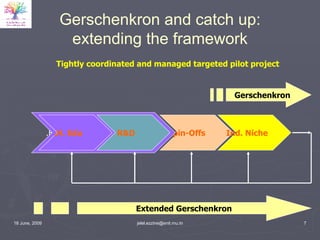
Gerschenkron and catch up: extending the framework O'Brien, 1998:  The  key insight  from Gerschenkron’s thesis is of a  systemic  nature, which is the necessity to  integrate  and simultaneously  coordinate  all  components  of the targeted  economic  activity.   “ industrialization  process begins only if the  industrialization  can proceed, as it were, along a broad front, starting simultaneously along many lines of  economic  activities.”   “ Fruits of  industrial  progress in certain lines are received as external economies by other branches of  industry  whose progress in turn accords benefit to the former.”
Gerschenkron and catch up: extending the framework Higher Edu. Spin-Offs Ind. Niche R&D H. Edu. Tightly coordinated and managed targeted pilot project Gerschenkron Extended Gerschenkron
Integrated capabilities accumulation – the fundamental role of learning Technological and capacity competitiveness – Fagerberg 2005 , Social and physical technologies – Nelson 2008 , Learning as the most important process – Lundvall 2007 , The proposed three fundamental capabilities.
Integrated capabilities accumulation – the fundamental role of learning Technological and capacity competitiveness – Fagerberg 2005 : Capacity competitiveness Technological competitiveness Social and physical technologies – Nelson 2008 , Learning as the most important process – Lundvall 2007 , The proposed three fundamental capabilities.
Integrated capabilities accumulation – the fundamental role of learning Technological and capacity competitiveness – Fagerberg 2005 , Social and physical technologies – Nelson 2008 : Social technologies   Physical technologies   Learning as the most important process – Lundvall 2007 , The proposed three fundamental capabilities.
Integrated capabilities accumulation – the fundamental role of learning Technological and capacity competitiveness – Fagerberg 2005 , Social and physical technologies – Nelson 2008 , Learning as the most important process – Lundvall 2007 : Intangible resources   Tangible resources   The proposed three fundamental capabilities.
The proposed  three fundamental capabilities Learning Capabilities (LC): Lundvall (2007): “ the  most fundamental  resource in the modern economy is  knowledge  and, accordingly, the  most important  process is  learning . ” Lundvall and Johnson  (1994): “… in an economy where the distribution of competence becomes more and more uneven and the  capability to learn  tends to become the  most important factor  behind  economic success  of  people ,  organization  and  regions .” Social Capabilities (SC), Physical Capabilities (PC),
Reverse engineering Gerschenkron catch up – Low Cost space technology Key characteristics of the niche technology  (in the making!): Strategic and dynamic “Low Cost” technology, High value added technology and large spectrum industries/services spillover, Requires highly skilled manpower, Motivating and inspiring pilot project, Bestows National and international visibility, Sufficiently available training infrastructure and know how, Largely available potential manpower, Strong and enduring political back up, Etc.
The  skill  a  student   acquires in a craft, and the habit he  attains ,  correspond  to the  quality   of instruction  and the habit of the  teacher .  A. Ibnou Khaldoun

2 B4 5 18 June 14.00 15.30 Ezzine

  • 1.
    Integrated capabilities accumulation:A Gerschenkronian catching-up strategy Jelel Ezzine University of Tunis El-Manar (UTM), Tunisia [email_address]
  • 2.
    Education isa social process; education is growth; education is not a preparation for life but is life itself . John Dewey
  • 3.
    Outline Introduction Gerschenkronand catch up – extending the framework Integrated capabilities accumulation – the fundamental role of learning Technological and capacity competitiveness – Fagerberg 2005 Social and physical technologies – Nelson 2008 Learning as the most important process – Lundvall 2007 The proposed three fundamental capabilities Reverse engineering Gerschenkron catch up – Low Cost space technology Conclusion
  • 4.
    Introduction (1:2) Wedo know that: developing countries are in dire need for applicable catch-up strategies that will allow them to converge to the developed world, and hence secure a better future for their citizens (Juma and Clark, 2002), We also do know: “ the futility of the search of any ‘magic bullet’ driving industrialization. The process of accumulation of technological and organizational capabilities does not play a crucial role - …- but such process has to be matched , first, by a congruent ‘political economy’ offering incentive structures conductive to ‘learning-base’ …, and, second, by a congruent macroeconomic management .” Cimoli et al. (2008)
  • 5.
    Introduction (2:2) Westill propose a “generic” catch-up strategy called “Integrated Capabilities Accumulation” built around triad: an extended version of the Gerschenkronian framework, a generalization of the latest findings regarding needed capabilities, a “ Low Cost ” pilot project, targeting a frontier technological niche.
  • 6.
    Gerschenkron and catchup: extending the framework O'Brien, 1998: The key insight from Gerschenkron’s thesis is of a systemic nature, which is the necessity to integrate and simultaneously coordinate all components of the targeted economic activity. “ industrialization process begins only if the industrialization can proceed, as it were, along a broad front, starting simultaneously along many lines of economic activities.” “ Fruits of industrial progress in certain lines are received as external economies by other branches of industry whose progress in turn accords benefit to the former.”
  • 7.
    Gerschenkron and catchup: extending the framework Higher Edu. Spin-Offs Ind. Niche R&D H. Edu. Tightly coordinated and managed targeted pilot project Gerschenkron Extended Gerschenkron
  • 8.
    Integrated capabilities accumulation– the fundamental role of learning Technological and capacity competitiveness – Fagerberg 2005 , Social and physical technologies – Nelson 2008 , Learning as the most important process – Lundvall 2007 , The proposed three fundamental capabilities.
  • 9.
    Integrated capabilities accumulation– the fundamental role of learning Technological and capacity competitiveness – Fagerberg 2005 : Capacity competitiveness Technological competitiveness Social and physical technologies – Nelson 2008 , Learning as the most important process – Lundvall 2007 , The proposed three fundamental capabilities.
  • 10.
    Integrated capabilities accumulation– the fundamental role of learning Technological and capacity competitiveness – Fagerberg 2005 , Social and physical technologies – Nelson 2008 : Social technologies Physical technologies Learning as the most important process – Lundvall 2007 , The proposed three fundamental capabilities.
  • 11.
    Integrated capabilities accumulation– the fundamental role of learning Technological and capacity competitiveness – Fagerberg 2005 , Social and physical technologies – Nelson 2008 , Learning as the most important process – Lundvall 2007 : Intangible resources Tangible resources The proposed three fundamental capabilities.
  • 12.
    The proposed three fundamental capabilities Learning Capabilities (LC): Lundvall (2007): “ the most fundamental resource in the modern economy is knowledge and, accordingly, the most important process is learning . ” Lundvall and Johnson (1994): “… in an economy where the distribution of competence becomes more and more uneven and the capability to learn tends to become the most important factor behind economic success of people , organization and regions .” Social Capabilities (SC), Physical Capabilities (PC),
  • 13.
    Reverse engineering Gerschenkroncatch up – Low Cost space technology Key characteristics of the niche technology (in the making!): Strategic and dynamic “Low Cost” technology, High value added technology and large spectrum industries/services spillover, Requires highly skilled manpower, Motivating and inspiring pilot project, Bestows National and international visibility, Sufficiently available training infrastructure and know how, Largely available potential manpower, Strong and enduring political back up, Etc.
  • 14.
    The skill a student acquires in a craft, and the habit he attains , correspond to the quality of instruction and the habit of the teacher . A. Ibnou Khaldoun