






Engineer in Society
EE014 3 5 3EE014-3.5-3
Engineering and Development (1)
IntroductionIntroduction
• Engineers play a crucial role in a country’s• Engineers play a crucial role in a country s
development.
• Engineers are involved in producing the goods• Engineers are involved in producing the goods
and services to raise the economy of the
country.y
• Engineers design and build the necessary
infrastructure, facilities, equipment, etc. for
achieving the desired standard of living.
• Engineers are the backbone of a country’s
EE014-3.5-3-ES Engineering and Development (1)
development.
Slide 2
What is development?What is development?
• Development:• Development:
– Growth or evolution
St f d t– Stage of advancement
• 2 definitions:
– relating to the transformation of a society
– using economics
EE014-3.5-3-ES Engineering and Development (1) Slide 3
Adapted from Hairul Azhar, “Engineers in Society’
What is development? (Cont.)What is development? (Cont.)
relating to the transformation of a..... relating to the transformation of a
society:
Th t f ti f t diti l l– The transformation of traditional, low-
productivity, subsistence societies into
modern high-productivity high-incomemodern, high-productivity, high-income
nations. Alteration of the structure of
production and employment from agriculturep p y g
to manufacturing & service industries.
EE014-3.5-3-ES Engineering and Development (1) Slide 4
Adapted from Hairul Azhar, “Engineers in Society’
What is development? (Cont.)What is development? (Cont.)
from the economics points of view:... from the economics points of view:
– Development means the capacity of a
national economy, whose initial economicnational economy, whose initial economic
condition has been more or less static for a
long time, to generate and sustain an annual
i i it l d tincrease in its gross annual product
(GNP/GDP) at rates of 5-7% or more.
Alternatively it is the ability of a nation toy y
expand its output at a rate faster than the
growth rate of its population.
EE014-3.5-3-ES Engineering and Development (1) Slide 5
Adapted from Hairul Azhar, “Engineers in Society’
Objectives of developmentObjectives of developmentObjectives of developmentObjectives of development
• The key aim of development is to enable• The key aim of development is to enable
people to lead a better life.
Th 3 k t f b tt lif• The 3 key aspects of a better life are:
– Sustenance: the ability to meet basic needs
• food, health, shelter, protection
• basic economy activity is to provide as many
people with thesepeople with these
EE014-3.5-3-ES Engineering and Development (1) Slide 6
Adapted from Hairul Azhar, “Engineers in Society’
Objectives of developmentObjectives of development
(C t )(C t )(Cont.)(Cont.)
Self esteem: to be a person– Self-esteem: to be a person
• a sense of worth and self respect
• dignity respect honor recognitiondignity, respect, honor, recognition
• not being used as a tool by others for their own
needs.
– Freedom from servitude: to be able to choose
• free from ignorance, misery, other people,
i tit tiinstitutions
• wealth increases human choice
EE014-3.5-3-ES Engineering and Development (1) Slide 7
Adapted from Hairul Azhar, “Engineers in Society’
Objectives of developmentObjectives of development
(C t )(C t )(Cont.)(Cont.)
• The objectives:• The objectives:
– To increase the availability and widen the
distribution of life sustaining goodsdistribution of life-sustaining goods.
– To raise the standard of living. This include
economic needs: higher incomes more jobseconomic needs: higher incomes, more jobs,
material needs, and non-economic needs:
better education, knowledge, spiritual, g , p
fulfillment.
– To expand the range of economic and social
EE014-3.5-3-ES Engineering and Development (1)
p g
choices.
Slide 8
Adapted from Hairul Azhar, “Engineers in Society’
Development EconomicsDevelopment Economics
• Development economics:• Development economics:
– Development economics deal with economic, social,
political, and institutional mechanisms (public and
private) to bring about rapid and large-scale
improvements in levels of living for masses.
– Social effects of change to the population need to beg p p
considered. The objective is to bring the fruits of
economic progress to broadest segment of the
population. This requires a larger government rolep p q g g
and some degree of coordinated economic decision-
making to transform economy.
• Most desirable form of economy for a
EE014-3.5-3-ES Engineering and Development (1)
• Most desirable form of economy for a
developing country.
Slide 9
Adapted from Hairul Azhar, “Engineers in Society’
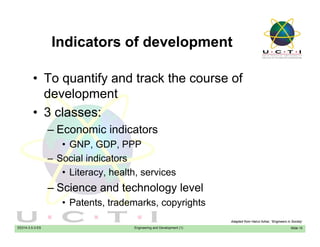
Indicators of developmentIndicators of development
• To quantify and track the course of• To quantify and track the course of
development
3 l• 3 classes:
– Economic indicators
• GNP, GDP, PPP
– Social indicators
Lit h lth i• Literacy, health, services
– Science and technology level
• Patents trademarks copyrights
EE014-3.5-3-ES Engineering and Development (1)
• Patents, trademarks, copyrights
Slide 10
Adapted from Hairul Azhar, “Engineers in Society’
Indicators of development
(C t )(Cont.)
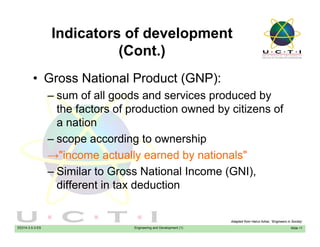
• Gross National Product (GNP):• Gross National Product (GNP):
– sum of all goods and services produced by
the factors of production owned by citizens ofthe factors of production owned by citizens of
a nation
scope according to ownership– scope according to ownership
→"income actually earned by nationals"
Similar to Gross National Income (GNI)– Similar to Gross National Income (GNI),
different in tax deduction
EE014-3.5-3-ES Engineering and Development (1) Slide 11
Adapted from Hairul Azhar, “Engineers in Society’
Indicators of development
(C t )(Cont.)
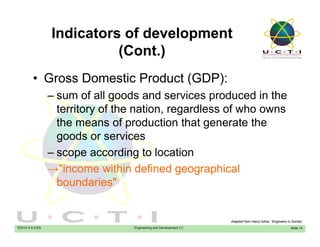
• Gross Domestic Product (GDP):• Gross Domestic Product (GDP):
– sum of all goods and services produced in the
territory of the nation regardless of who ownsterritory of the nation, regardless of who owns
the means of production that generate the
goods or servicesgoods or services
– scope according to location
→"income within defined geographical→ income within defined geographical
boundaries"
EE014-3.5-3-ES Engineering and Development (1) Slide 12
Adapted from Hairul Azhar, “Engineers in Society’
Indicators of development
(C t )(Cont.)
• Purchasing Power Parity (PPP)• Purchasing Power Parity (PPP)
– a measure of the relative purchasing power of
a country's currencya country s currency
– defined as the number of units of a foreign
country’s currency required to purchase thecountry s currency required to purchase the
identical quantity of goods/services in the
local market as $1 would buy in the United$ y
States
– quantifying the difference in standard of living
EE014-3.5-3-ES Engineering and Development (1)
q y g g
Slide 13
Adapted from Hairul Azhar, “Engineers in Society’
Indicators of development
(C t )(Cont.)
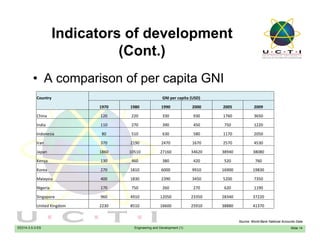
• A comparison of per capita GNI• A comparison of per capita GNI
Country GNI per capita (USD)
1970 1980 1990 2000 2005 20091970 1980 1990 2000 2005 2009
China 120 220 330 930 1760 3650
India 110 270 390 450 750 1220
Indonesia 80 510 630 580 1170 2050
Iran 370 2190 2470 1670 2570 4530
Japan 1860 10510 27160 34620 38940 38080
Kenya 130 460 380 420 520 760
Korea 270 1810 6000 9910 16900 19830Korea 270 1810 6000 9910 16900 19830
Malaysia 400 1830 2390 3450 5200 7350
Nigeria 170 750 260 270 620 1190
Singapore 960 4910 12050 23350 28340 37220
EE014-3.5-3-ES Engineering and Development (1) Slide 14
United Kingdom 2230 8510 16600 25910 38880 41370
Source: World Bank National Accounts Data
Indicators of development
(C t )(Cont.)
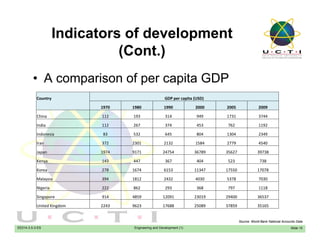
• A comparison of per capita GDP• A comparison of per capita GDP
Country GDP per capita (USD)
1970 1980 1990 2000 2005 20091970 1980 1990 2000 2005 2009
China 112 193 314 949 1731 3744
India 112 267 374 453 762 1192
Indonesia 83 532 645 804 1304 2349
Iran 372 2301 2132 1584 2779 4540
Japan 1974 9171 24754 36789 35627 39738
Kenya 143 447 367 404 523 738
Korea 278 1674 6153 11347 17550 17078Korea 278 1674 6153 11347 17550 17078
Malaysia 394 1812 2432 4030 5378 7030
Nigeria 222 862 293 368 797 1118
Singapore 914 4859 12091 23019 29400 36537
EE014-3.5-3-ES Engineering and Development (1) Slide 15
Source: World Bank National Accounts Data
United Kingdom 2243 9623 17688 25089 37859 35165
Indicators of development
(C t )(Cont.)
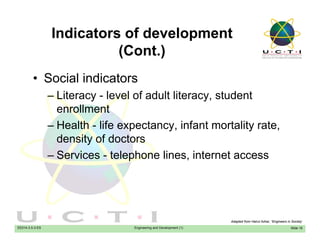
• Social indicators• Social indicators
– Literacy - level of adult literacy, student
enrollmentenrollment
– Health - life expectancy, infant mortality rate,
density of doctorsdensity of doctors
– Services - telephone lines, internet access
EE014-3.5-3-ES Engineering and Development (1) Slide 16
Adapted from Hairul Azhar, “Engineers in Society’
Indicators of development
(C t )(Cont.)
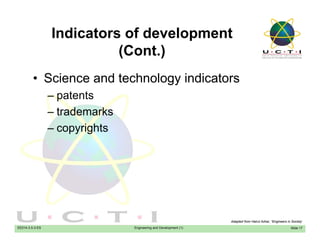
• Science and technology indicators• Science and technology indicators
– patents
t d k– trademarks
– copyrights
EE014-3.5-3-ES Engineering and Development (1) Slide 17
Adapted from Hairul Azhar, “Engineers in Society’
Common Traits Among
D l i C t iDeveloping Countries
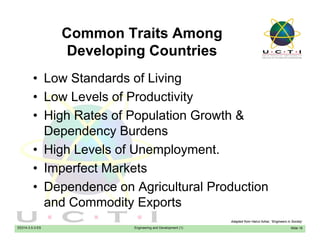
• Low Standards of Living• Low Standards of Living
• Low Levels of Productivity
• High Rates of Population Growth &
Dependency Burdens
• High Levels of Unemployment.
• Imperfect MarketsImperfect Markets
• Dependence on Agricultural Production
and Commodity Exports
EE014-3.5-3-ES Engineering and Development (1)
and Commodity Exports
Slide 18
Adapted from Hairul Azhar, “Engineers in Society’
Common Traits Among
D l i C t iDeveloping Countries
• Dependence and Vulnerability in• Dependence and Vulnerability in
International Relations
W k S i & T h l d l t• Weak Science & Technology development
EE014-3.5-3-ES Engineering and Development (1) Slide 19
Adapted from Hairul Azhar, “Engineers in Society’
Malaysia as Developing
C tCountry
• Rich in local natural resources• Rich in local natural resources.
• Skilled local labor.
• Good infrastructures and services
• Healthy climate for local and foreigny g
investments.
• Good support and incentives for businessGood support and incentives for business.
• Strategic location in the Asia Pacific rim.
P liti ll t bl
EE014-3.5-3-ES Engineering and Development (1)
• Politically stable.
Slide 20
Adapted from Hairul Azhar, “Engineers in Society’

Es l2 - engineering & development (1)

  • 1.
    Engineer in Society EE0143 5 3EE014-3.5-3 Engineering and Development (1)
  • 2.
    IntroductionIntroduction • Engineers playa crucial role in a country’s• Engineers play a crucial role in a country s development. • Engineers are involved in producing the goods• Engineers are involved in producing the goods and services to raise the economy of the country.y • Engineers design and build the necessary infrastructure, facilities, equipment, etc. for achieving the desired standard of living. • Engineers are the backbone of a country’s EE014-3.5-3-ES Engineering and Development (1) development. Slide 2
  • 3.
    What is development?Whatis development? • Development:• Development: – Growth or evolution St f d t– Stage of advancement • 2 definitions: – relating to the transformation of a society – using economics EE014-3.5-3-ES Engineering and Development (1) Slide 3 Adapted from Hairul Azhar, “Engineers in Society’
  • 4.
    What is development?(Cont.)What is development? (Cont.) relating to the transformation of a..... relating to the transformation of a society: Th t f ti f t diti l l– The transformation of traditional, low- productivity, subsistence societies into modern high-productivity high-incomemodern, high-productivity, high-income nations. Alteration of the structure of production and employment from agriculturep p y g to manufacturing & service industries. EE014-3.5-3-ES Engineering and Development (1) Slide 4 Adapted from Hairul Azhar, “Engineers in Society’
  • 5.
    What is development?(Cont.)What is development? (Cont.) from the economics points of view:... from the economics points of view: – Development means the capacity of a national economy, whose initial economicnational economy, whose initial economic condition has been more or less static for a long time, to generate and sustain an annual i i it l d tincrease in its gross annual product (GNP/GDP) at rates of 5-7% or more. Alternatively it is the ability of a nation toy y expand its output at a rate faster than the growth rate of its population. EE014-3.5-3-ES Engineering and Development (1) Slide 5 Adapted from Hairul Azhar, “Engineers in Society’
  • 6.
    Objectives of developmentObjectivesof developmentObjectives of developmentObjectives of development • The key aim of development is to enable• The key aim of development is to enable people to lead a better life. Th 3 k t f b tt lif• The 3 key aspects of a better life are: – Sustenance: the ability to meet basic needs • food, health, shelter, protection • basic economy activity is to provide as many people with thesepeople with these EE014-3.5-3-ES Engineering and Development (1) Slide 6 Adapted from Hairul Azhar, “Engineers in Society’
  • 7.
    Objectives of developmentObjectivesof development (C t )(C t )(Cont.)(Cont.) Self esteem: to be a person– Self-esteem: to be a person • a sense of worth and self respect • dignity respect honor recognitiondignity, respect, honor, recognition • not being used as a tool by others for their own needs. – Freedom from servitude: to be able to choose • free from ignorance, misery, other people, i tit tiinstitutions • wealth increases human choice EE014-3.5-3-ES Engineering and Development (1) Slide 7 Adapted from Hairul Azhar, “Engineers in Society’
  • 8.
    Objectives of developmentObjectivesof development (C t )(C t )(Cont.)(Cont.) • The objectives:• The objectives: – To increase the availability and widen the distribution of life sustaining goodsdistribution of life-sustaining goods. – To raise the standard of living. This include economic needs: higher incomes more jobseconomic needs: higher incomes, more jobs, material needs, and non-economic needs: better education, knowledge, spiritual, g , p fulfillment. – To expand the range of economic and social EE014-3.5-3-ES Engineering and Development (1) p g choices. Slide 8 Adapted from Hairul Azhar, “Engineers in Society’
  • 9.
    Development EconomicsDevelopment Economics •Development economics:• Development economics: – Development economics deal with economic, social, political, and institutional mechanisms (public and private) to bring about rapid and large-scale improvements in levels of living for masses. – Social effects of change to the population need to beg p p considered. The objective is to bring the fruits of economic progress to broadest segment of the population. This requires a larger government rolep p q g g and some degree of coordinated economic decision- making to transform economy. • Most desirable form of economy for a EE014-3.5-3-ES Engineering and Development (1) • Most desirable form of economy for a developing country. Slide 9 Adapted from Hairul Azhar, “Engineers in Society’
  • 10.
    Indicators of developmentIndicatorsof development • To quantify and track the course of• To quantify and track the course of development 3 l• 3 classes: – Economic indicators • GNP, GDP, PPP – Social indicators Lit h lth i• Literacy, health, services – Science and technology level • Patents trademarks copyrights EE014-3.5-3-ES Engineering and Development (1) • Patents, trademarks, copyrights Slide 10 Adapted from Hairul Azhar, “Engineers in Society’
  • 11.
    Indicators of development (Ct )(Cont.) • Gross National Product (GNP):• Gross National Product (GNP): – sum of all goods and services produced by the factors of production owned by citizens ofthe factors of production owned by citizens of a nation scope according to ownership– scope according to ownership →"income actually earned by nationals" Similar to Gross National Income (GNI)– Similar to Gross National Income (GNI), different in tax deduction EE014-3.5-3-ES Engineering and Development (1) Slide 11 Adapted from Hairul Azhar, “Engineers in Society’
  • 12.
    Indicators of development (Ct )(Cont.) • Gross Domestic Product (GDP):• Gross Domestic Product (GDP): – sum of all goods and services produced in the territory of the nation regardless of who ownsterritory of the nation, regardless of who owns the means of production that generate the goods or servicesgoods or services – scope according to location →"income within defined geographical→ income within defined geographical boundaries" EE014-3.5-3-ES Engineering and Development (1) Slide 12 Adapted from Hairul Azhar, “Engineers in Society’
  • 13.
    Indicators of development (Ct )(Cont.) • Purchasing Power Parity (PPP)• Purchasing Power Parity (PPP) – a measure of the relative purchasing power of a country's currencya country s currency – defined as the number of units of a foreign country’s currency required to purchase thecountry s currency required to purchase the identical quantity of goods/services in the local market as $1 would buy in the United$ y States – quantifying the difference in standard of living EE014-3.5-3-ES Engineering and Development (1) q y g g Slide 13 Adapted from Hairul Azhar, “Engineers in Society’
  • 14.
    Indicators of development (Ct )(Cont.) • A comparison of per capita GNI• A comparison of per capita GNI Country GNI per capita (USD) 1970 1980 1990 2000 2005 20091970 1980 1990 2000 2005 2009 China 120 220 330 930 1760 3650 India 110 270 390 450 750 1220 Indonesia 80 510 630 580 1170 2050 Iran 370 2190 2470 1670 2570 4530 Japan 1860 10510 27160 34620 38940 38080 Kenya 130 460 380 420 520 760 Korea 270 1810 6000 9910 16900 19830Korea 270 1810 6000 9910 16900 19830 Malaysia 400 1830 2390 3450 5200 7350 Nigeria 170 750 260 270 620 1190 Singapore 960 4910 12050 23350 28340 37220 EE014-3.5-3-ES Engineering and Development (1) Slide 14 United Kingdom 2230 8510 16600 25910 38880 41370 Source: World Bank National Accounts Data
  • 15.
    Indicators of development (Ct )(Cont.) • A comparison of per capita GDP• A comparison of per capita GDP Country GDP per capita (USD) 1970 1980 1990 2000 2005 20091970 1980 1990 2000 2005 2009 China 112 193 314 949 1731 3744 India 112 267 374 453 762 1192 Indonesia 83 532 645 804 1304 2349 Iran 372 2301 2132 1584 2779 4540 Japan 1974 9171 24754 36789 35627 39738 Kenya 143 447 367 404 523 738 Korea 278 1674 6153 11347 17550 17078Korea 278 1674 6153 11347 17550 17078 Malaysia 394 1812 2432 4030 5378 7030 Nigeria 222 862 293 368 797 1118 Singapore 914 4859 12091 23019 29400 36537 EE014-3.5-3-ES Engineering and Development (1) Slide 15 Source: World Bank National Accounts Data United Kingdom 2243 9623 17688 25089 37859 35165
  • 16.
    Indicators of development (Ct )(Cont.) • Social indicators• Social indicators – Literacy - level of adult literacy, student enrollmentenrollment – Health - life expectancy, infant mortality rate, density of doctorsdensity of doctors – Services - telephone lines, internet access EE014-3.5-3-ES Engineering and Development (1) Slide 16 Adapted from Hairul Azhar, “Engineers in Society’
  • 17.
    Indicators of development (Ct )(Cont.) • Science and technology indicators• Science and technology indicators – patents t d k– trademarks – copyrights EE014-3.5-3-ES Engineering and Development (1) Slide 17 Adapted from Hairul Azhar, “Engineers in Society’
  • 18.
    Common Traits Among Dl i C t iDeveloping Countries • Low Standards of Living• Low Standards of Living • Low Levels of Productivity • High Rates of Population Growth & Dependency Burdens • High Levels of Unemployment. • Imperfect MarketsImperfect Markets • Dependence on Agricultural Production and Commodity Exports EE014-3.5-3-ES Engineering and Development (1) and Commodity Exports Slide 18 Adapted from Hairul Azhar, “Engineers in Society’
  • 19.
    Common Traits Among Dl i C t iDeveloping Countries • Dependence and Vulnerability in• Dependence and Vulnerability in International Relations W k S i & T h l d l t• Weak Science & Technology development EE014-3.5-3-ES Engineering and Development (1) Slide 19 Adapted from Hairul Azhar, “Engineers in Society’
  • 20.
    Malaysia as Developing CtCountry • Rich in local natural resources• Rich in local natural resources. • Skilled local labor. • Good infrastructures and services • Healthy climate for local and foreigny g investments. • Good support and incentives for businessGood support and incentives for business. • Strategic location in the Asia Pacific rim. P liti ll t bl EE014-3.5-3-ES Engineering and Development (1) • Politically stable. Slide 20 Adapted from Hairul Azhar, “Engineers in Society’