Powerful Tips for Effective
Speaking
Presented by: Shadi Suhail Abo Abdo
KFUPM-2018
Outline
 Introduction.
 14 Powerful Tips.
 Conclusion.
Effective Speaking Skills
 Effective Speaking is one of interpersonal
skills
 Those are necessary for relating and working
with others
 Give the ability to understand and work
effectively with others
 Being able to work well in teams or groups
Benefits
 Personal relationships
 Professional relationships
 Employment related skill
 Learn about other perspectives
 Share work load
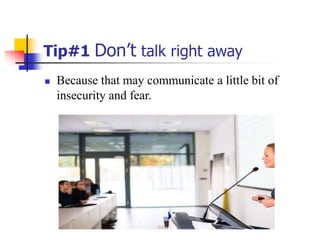
Tip#1 Don’t talk right away
 Because that may communicate a little bit of
insecurity and fear.
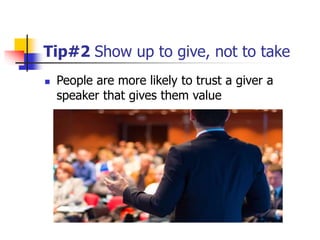
Tip#2 Show up to give, not to take
 People are more likely to trust a giver a
speaker that gives them value
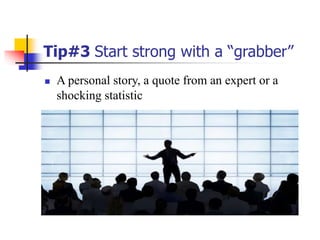
Tip#3 Start strong with a “grabber”
 A personal story, a quote from an expert or a
shocking statistic
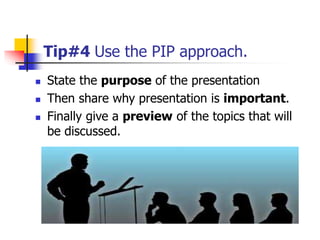
Tip#4 Use the PIP approach.
 State the purpose of the presentation
 Then share why presentation is important.
 Finally give a preview of the topics that will
be discussed.
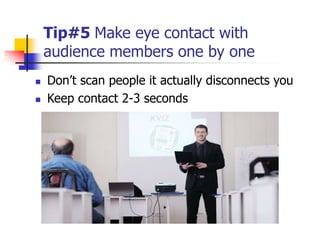
Tip#5 Make eye contact with
audience members one by one
 Don’t scan people it actually disconnects you
 Keep contact 2-3 seconds
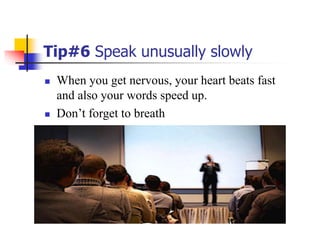
Tip#6 Speak unusually slowly
 When you get nervous, your heart beats fast
and also your words speed up.
 Don’t forget to breath
Tip#7 Use your tone to strengthen
your words
 Don’t deliver great news in a monotone
voice or serious news too relaxed.
 That will distract the audience.
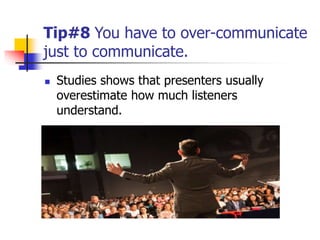
Tip#8 You have to over-communicate
just to communicate.
 Studies shows that presenters usually
overestimate how much listeners
understand.
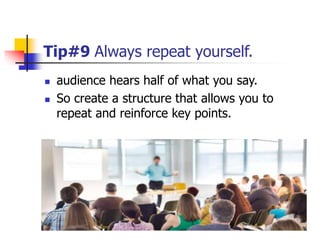
Tip#9 Always repeat yourself.
 audience hears half of what you say.
 So create a structure that allows you to
repeat and reinforce key points.
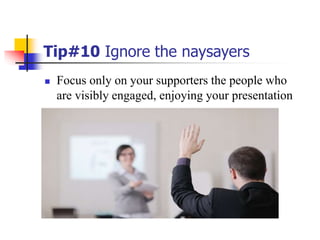
Tip#10 Ignore the naysayers
 Focus only on your supporters the people who
are visibly engaged, enjoying your presentation
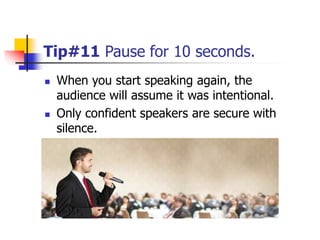
Tip#11 Pause for 10 seconds.
 When you start speaking again, the
audience will assume it was intentional.
 Only confident speakers are secure with
silence.
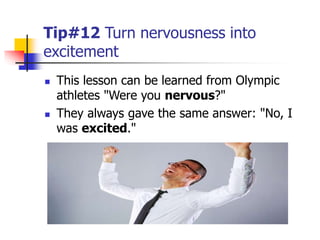
Tip#12 Turn nervousness into
excitement
 This lesson can be learned from Olympic
athletes "Were you nervous?"
 They always gave the same answer: "No, I
was excited."
Tip#13 Say thank you, Don’t
apologies
 They gave you their time. That's a gift, and
you have to be grateful
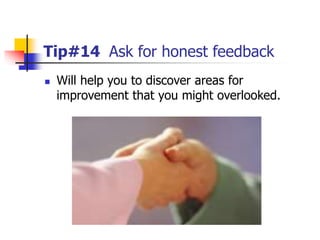
Tip#14 Ask for honest feedback
 Will help you to discover areas for
improvement that you might overlooked.
Summary
1. Don’t talk right away
2. Show to give, not to take
3. Start strong “grabber”
4. Use the PIP approach.
5. Make eye contact
6. Speak unusually slowly
7. Use your tone
8. Over-communicate.
9. Always repeat yourself.
10. Ignore the naysayers
11. Pause for 10 seconds
12. Turn nervousness
13. Say thank you
14. Ask for honest feedback
Resources
 https://blog.ted.com/a-ted-speaker-coach-shares-11-tips-for-
right-before-you-go-on-stage/
 https://www.entrepreneur.com/article/300466
 https://www.entrepreneur.com/slideshow/299610#6
 http://www.unmarketing.com/2011/11/23/30-quick-tips-for-
speakers/
 https://www.inc.com/ss/jeff-haden/20-public-speaking-tips-best-
ted-talks
THE END
THANKS FOR YOUR TIME

14 powerful tips for perfect presentation

  • 1.
    Powerful Tips forEffective Speaking Presented by: Shadi Suhail Abo Abdo KFUPM-2018
  • 2.
    Outline  Introduction.  14Powerful Tips.  Conclusion.
  • 3.
    Effective Speaking Skills Effective Speaking is one of interpersonal skills  Those are necessary for relating and working with others  Give the ability to understand and work effectively with others  Being able to work well in teams or groups
  • 4.
    Benefits  Personal relationships Professional relationships  Employment related skill  Learn about other perspectives  Share work load
  • 5.
    Tip#1 Don’t talkright away  Because that may communicate a little bit of insecurity and fear.
  • 6.
    Tip#2 Show upto give, not to take  People are more likely to trust a giver a speaker that gives them value
  • 7.
    Tip#3 Start strongwith a “grabber”  A personal story, a quote from an expert or a shocking statistic
  • 8.
    Tip#4 Use thePIP approach.  State the purpose of the presentation  Then share why presentation is important.  Finally give a preview of the topics that will be discussed.
  • 9.
    Tip#5 Make eyecontact with audience members one by one  Don’t scan people it actually disconnects you  Keep contact 2-3 seconds
  • 10.
    Tip#6 Speak unusuallyslowly  When you get nervous, your heart beats fast and also your words speed up.  Don’t forget to breath
  • 11.
    Tip#7 Use yourtone to strengthen your words  Don’t deliver great news in a monotone voice or serious news too relaxed.  That will distract the audience.
  • 12.
    Tip#8 You haveto over-communicate just to communicate.  Studies shows that presenters usually overestimate how much listeners understand.
  • 13.
    Tip#9 Always repeatyourself.  audience hears half of what you say.  So create a structure that allows you to repeat and reinforce key points.
  • 14.
    Tip#10 Ignore thenaysayers  Focus only on your supporters the people who are visibly engaged, enjoying your presentation
  • 15.
    Tip#11 Pause for10 seconds.  When you start speaking again, the audience will assume it was intentional.  Only confident speakers are secure with silence.
  • 16.
    Tip#12 Turn nervousnessinto excitement  This lesson can be learned from Olympic athletes "Were you nervous?"  They always gave the same answer: "No, I was excited."
  • 17.
    Tip#13 Say thankyou, Don’t apologies  They gave you their time. That's a gift, and you have to be grateful
  • 18.
    Tip#14 Ask forhonest feedback  Will help you to discover areas for improvement that you might overlooked.
  • 19.
    Summary 1. Don’t talkright away 2. Show to give, not to take 3. Start strong “grabber” 4. Use the PIP approach. 5. Make eye contact 6. Speak unusually slowly 7. Use your tone 8. Over-communicate. 9. Always repeat yourself. 10. Ignore the naysayers 11. Pause for 10 seconds 12. Turn nervousness 13. Say thank you 14. Ask for honest feedback
  • 20.
    Resources  https://blog.ted.com/a-ted-speaker-coach-shares-11-tips-for- right-before-you-go-on-stage/  https://www.entrepreneur.com/article/300466 https://www.entrepreneur.com/slideshow/299610#6  http://www.unmarketing.com/2011/11/23/30-quick-tips-for- speakers/  https://www.inc.com/ss/jeff-haden/20-public-speaking-tips-best- ted-talks
  • 21.

Editor's Notes

  • #3 On a personal basis - we all interact with other people, it is worth reviewing and improving our interpersonal effectiveness. In the helping professions good communication and interpersonal skills are crucial. Furthermore, many surveys of employers and graduates indicate that employers want their employees to have good social skills. The ability to communicate well with others and the ability to work well in a team are valuable skills.  These skills are also important in business and management where modern organizations increasingly use teamwork which requires being able to communicate and collaborate with others. They are also useful to develop in college where more cooperative learning is taking place, requiring interpersonal and small group skills. These are skills that can be learnt thereby improving an individual’s performance, resilience and overall emotional literacy (Goleman, 1995). Working in groups provides the opportunity to share ideas, hear other perspectives, to benefit from the experience and expertise of others and to receive help and support.
  • #4 Interpersonal skills are those necessary for relating and working with others – such as verbal and non-verbal communication, listening, giving and receiving feedback.   Howard Gardner described it as one of the multiple intelligences: interpersonal intelligence or the ability to be able to understand and work effectively with others.   Being able to understand and work with others in teams or groups is another important aspect of interpersonal skills. The focus is on facilitating teamwork, ensuring group effectiveness, decision making, running meetings and presenting work.
  • #5 On a personal basis - we all interact with other people, it is worth reviewing and improving our interpersonal effectiveness. In the helping professions good communication and interpersonal skills are crucial. Furthermore, many surveys of employers and graduates indicate that employers want their employees to have good social skills. The ability to communicate well with others and the ability to work well in a team are valuable skills.  These skills are also important in business and management where modern organizations increasingly use teamwork which requires being able to communicate and collaborate with others. They are also useful to develop in college where more cooperative learning is taking place, requiring interpersonal and small group skills. These are skills that can be learnt thereby improving an individual’s performance, resilience and overall emotional literacy (Goleman, 1995). Working in groups provides the opportunity to share ideas, hear other perspectives, to benefit from the experience and expertise of others and to receive help and support.
  • #6 Sinek says you should never talk as you walk out on stage. "A lot of people start talking right away, and it's out of nerves," Sinek says. "That communicates a little bit of insecurity and fear.“ Instead, quietly walk out on stage. Then take a deep breath, find your place, wait a few seconds and begin. "I know it sounds long and tedious and it feels excruciatingly awkward when you do it," Sinek says, "but it shows the audience you're totally confident and in charge of the situation."
  • #7 Often people give presentations to sell products or ideas, to get people to follow them on social media, buy their books or even just to like them. Sinek calls these kinds of speakers "takers," and he says audiences can see through these people right away. And, when they do, they disengage. "We are highly social animals," says Sinek. "Even at a distance on stage, we can tell if you're a giver or a taker, and people are more likely to trust a giver -- a speaker that gives them value, that teaches them something new, that inspires them -- than a taker."
  • #8 personal story, a quote from an expert or a shocking statistic – something that takes a hold of your audience and gets them hooked and opens their mind to your message. Give the audience a chance to see your personal connection to the topic.
  • #9 the speaker first states the purpose of the presentation, and then shares why presentation is important by reviewing implications and possible outcomes. Finally, the presenter gives a preview of the topics that will be discussed. This framework is a useful way to get audiences excited about the presentation, helping them to focus on your message and on key takeaways.
  • #10 Scanning and panning is your worst enemy, says Sinek. "While it looks like you're looking at everyone, it actually disconnects you from your audience.“ Related: 5 TED Talks That May Change Your View on Life It's much easier and effective, he says, if you directly look at specific audience members throughout your speech. If you can, give each person that you intently look at an entire sentence or thought, without breaking your gaze. When you finish a sentence, move on to another person and keep connecting with individual people until you're done speaking. "It's like you're having a conversation with your audience," says Sinek. "You're not speaking at them, you're speaking with them." This tactic not only creates a deeper connection with individuals but the entire audience can feel it.
  • #11 When you get nervous, it's not just your heart beat that quickens. Your words also tend to speed up. Luckily Sinek says audiences are more patient and forgiving than we know. "They want you to succeed up there, but the more you rush, the more you turn them off," he says. "If you just go quiet for a moment and take a long, deep breath, they'll wait for you. It's kind of amazing." Related: 5 Must-Read Books For Every Entrepreneur Sinek believes it's impossible to speak too slowly on stage. "It's incredible that you can stand on stage and speak so slowly that there are several seconds between each of your words and people... will... hang... on... your... every... word. It really works."
  • #12 Actually changing your tone is an important skills that will attract more people and you can practice it Merge your tone with the topic of your speech, says Barnett. Don’t deliver great news in a monotone voice or serious news too excitedly, as disjunctions like that will distract the audience. Barnett recommends going through your script and tagging what each piece of news means. By doing that, you can focus on how your tone can strengthen the message, rather than undermine what you are trying to get across.
  • #13 In 1990, a graduate student at Stanford University was able to prove that presenters overestimate how much listeners understand. In a study that become known as “the tappers and the listeners,” one set of participants was asked to tap the melody of 120 famous songs. The other participants were asked to guess what song was being tapped. Tappers estimated that 50 percent of the songs tapped would be correctly identified. In reality, only 2.5 percent of songs were correctly identified. This study shows that it is important to communicate clearly, and to over-communicate when sharing new ideas. As this study indicates, it is likely that the audience will fail to absorb as much as you expect.
  • #14 Poeple probably hears about half of what you say, and then they filter that through their own perspectives. So create a structure that allows you to repeat and reinforce key points. First explain a point, then give examples of how that point can be applied, and at the end provide the audience with action steps they can take based on that point. Since no one can remember everything you say, what you repeat has a much greater chance of being remembered--and being acted upon. So repeat away!
  • #15  Dismiss the people crossing their arms or shaking their heads "no." Instead, focus only on your supporters Dismiss the people furrowing their brows, crossing their arms or shaking their heads "no." Instead, focus only on your supporters -- the people who are visibly engaged, enjoying your presentation and nodding "yes." If you find the audience members who are positively interacting with you, you'll be much more confident and relaxed than if you try to convince the naysayers.
  • #16  Pause for two or three seconds and audiences assume you've lost your place; five seconds, they think the pause is intentional; after 10 seconds even the people texting can't help looking up. When you start speaking again, the audience naturally assumes the pause was intentional ... and that you're a confident and accomplished speaker. A poor speaker abhors a vacuum; only confident speakers are secure with silence. Take one long pause to gather your thoughts and the audience will automatically give you speaker bonus points. 
  • #17 Sinek learned this trick from watching the Olympics. A few years ago he noticed that reporters interviewing Olympic athletes before and after competing were all asking the same question. "Were you nervous?" And all of the athletes gave the same answer: "No, I was excited." These competitors were taking the body's signs of nervousness -- clammy hands, pounding heart and tense nerves -- and reinterpreting them as side effects of excitement and exhilaration. Related: 4 Motivating TED Talks to Help You Bounce Back From Failure When you're up on stage you will likely go through the same thing. That's when Sinek says you should say to yourself out loud, "I'm not nervous, I'm excited!" "When you do, it really has a miraculous impact in helping you change your attitude to what you're about to do," Sinek says.
  • #18 Applause is a gift, and when you receive a gift, it's only right to express how grateful you are for it. This is why Sinek always closes out his presentations with these two simple yet powerful words: thank you. "They gave you their time, and they're giving you their applause." Says Sinek. "That's a gift, and you have to be grateful."
  • #19 Getting honest feedback from peers, managers and members of your team is critical to becoming a better communicator As with most leadership skills, receiving honest feedback from peers, managers and members of your team is critical to becoming a better communicator. If you regularly solicit feedback, others will help you to discover areas for improvement that you might have otherwise overlooked.