IEEE SDN Initiative
Standardization Committee Meeting
Security Considerations & Concerns
Anton Kaska BTNE, LLC
June 23, 2015 Piscataway, NJ
1
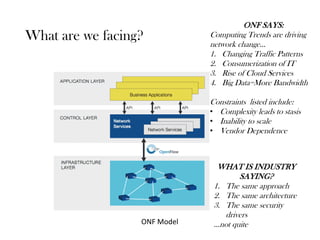
What are we facing?
ONF Model
ONF SAYS:
Computing Trends are driving
network change…
1. Changing Traffic Patterns
2. Consumerization of IT
3. Rise of Cloud Services
4. Big Data=More Bandwidth
Constraints listed include:
• Complexity leads to stasis
• Inability to scale
• Vendor Dependence
WHAT IS INDUSTRY
SAYING?
1. The same approach
2. The same architecture
3. The same security
drivers
…not quite
Not a new challenge we are facing
3
Defense in Depth with specifics for
Software Defined Networking
 Baseline Security Models
 Integrity Checks
 Brewer-Nash Model?
 Physical Security
How do we accomplish and not fail (PCI,
ETSI, IEEE, etc?
4
BSI-Standard 100-2:IT-
Grundschutz Vorgehensweise
3 GPP
TS 33.210TS Network Domain Security
TS 33.310 Authentication Framework
TS 33.401 Security Architecture
A Flexible Model
5
Remember Physical Security
Summary
• Multiple attempts at security Standards but focused on verticals,
size, business models, point technologies, etc.
• Using security as it has been practically applied, as a historical
illustration
• we will not meet the challenges sufficiently
• there are many examples to glean knowledge from.
• A flexible approach is required.
• Given the speed with which technology advances, leveraging existing
best practices and solutions that have proven themselves (Defense in
Depth Theory, Chinese Walls, etc.) will provide acceptable and
practical levels of mitigation that are implementable with tolerable
financial and political cost.
• A more complex matrixes approach leveraging industry specific
and/or business requirement based risk mitigation is likely a
requirement when viewed long term
• This is in my opinion the harder nut to crack for the industries as a whole
(and organizations such as IEEE)
6

13.Anton-Position-Security-Considerations-23June2015[1]

  • 1.
    IEEE SDN Initiative StandardizationCommittee Meeting Security Considerations & Concerns Anton Kaska BTNE, LLC June 23, 2015 Piscataway, NJ 1
  • 2.
    What are wefacing? ONF Model ONF SAYS: Computing Trends are driving network change… 1. Changing Traffic Patterns 2. Consumerization of IT 3. Rise of Cloud Services 4. Big Data=More Bandwidth Constraints listed include: • Complexity leads to stasis • Inability to scale • Vendor Dependence WHAT IS INDUSTRY SAYING? 1. The same approach 2. The same architecture 3. The same security drivers …not quite
  • 3.
    Not a newchallenge we are facing 3 Defense in Depth with specifics for Software Defined Networking  Baseline Security Models  Integrity Checks  Brewer-Nash Model?  Physical Security
  • 4.
    How do weaccomplish and not fail (PCI, ETSI, IEEE, etc? 4 BSI-Standard 100-2:IT- Grundschutz Vorgehensweise 3 GPP TS 33.210TS Network Domain Security TS 33.310 Authentication Framework TS 33.401 Security Architecture
  • 5.
    A Flexible Model 5 RememberPhysical Security
  • 6.
    Summary • Multiple attemptsat security Standards but focused on verticals, size, business models, point technologies, etc. • Using security as it has been practically applied, as a historical illustration • we will not meet the challenges sufficiently • there are many examples to glean knowledge from. • A flexible approach is required. • Given the speed with which technology advances, leveraging existing best practices and solutions that have proven themselves (Defense in Depth Theory, Chinese Walls, etc.) will provide acceptable and practical levels of mitigation that are implementable with tolerable financial and political cost. • A more complex matrixes approach leveraging industry specific and/or business requirement based risk mitigation is likely a requirement when viewed long term • This is in my opinion the harder nut to crack for the industries as a whole (and organizations such as IEEE) 6