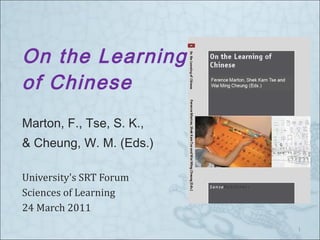




On the Learning  of Chinese Marton, F., Tse, S. K.,  & Cheung, W. M. (Eds.) University's SRT Forum  Sciences of Learning 24 March 2011
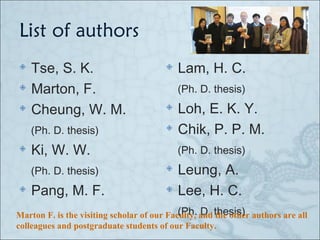
List of authors Tse, S. K. Marton, F. Cheung, W. M. (Ph. D. thesis) Ki, W. W. (Ph. D. thesis) Pang, M. F. Lam, H. C. (Ph. D. thesis) Loh, E. K. Y. Chik, P. P. M. (Ph. D. thesis) Leung, A. Lee, H. C. (Ph. D. thesis) Marton F. is the visiting scholar of our Faculty, and the other authors are all  colleagues and postgraduate students of our Faculty.
Across Universities & Institutes The University of Hong Kong University of Gothenburg Hong Kong Baptist University of Hong Kong Hong Kong Institute of Education Education Bureau, Hong Kong SAR Government
Across disciplines Chinese language I.T. Mathematics Sciences
Breakthrough The studies reported in this book crack the difficulties in learning Chinese Language in the following areas: Chinese tones Chinese characters Chinese reading Chinese writing Creative teaching of Chinese
Chik, P. P. M., & Marton, F.
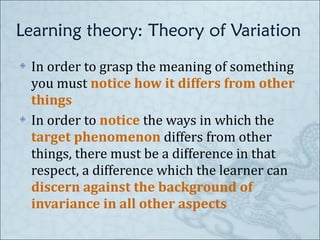
Learning theory: Theory of Variation In order to grasp the meaning of something you must  notice how it differs from other things In order to  notice  the ways in which the  target phenomenon  differs from other things, there must be a difference in that respect, a difference which the learner can  discern against the background of invariance in all other aspects
Ki, W. W., Marton, F., & Pang, M. F.
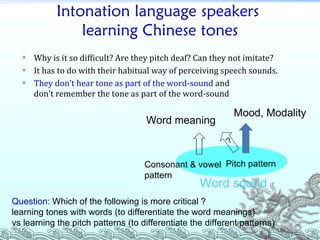
Intonation language speakers  learning Chinese tones Why is it so difficult? Are they pitch deaf? Can they not imitate? It has to do with their habitual way of perceiving speech sounds. They don’t hear tone as part of the word-sound  and  don’t remember the tone as part of the word-sound Question:  Which of the following is more critical ?  learning tones with words (to differentiate the word meanings)  vs learning the pitch patterns (to differentiate the different patterns) Word meaning Mood, Modality Pitch pattern Word sound Consonant & vowel  pattern ?
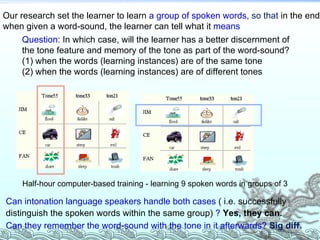
Can intonation language speakers handle both cases  ( i.e. successfully distinguish the spoken words within the same group)  ?   Yes, they can. Can they remember the word-sound with the tone in it afterwards?  Sig diff .  Question:  In which case, will the learner has a better discernment of  the tone feature and memory of the tone as part of the word-sound?  (1) when the words (learning instances) are of the same tone (2) when the words (learning instances) are of different tones  Our research set the learner to learn  a group of spoken words,  so that  in the end,  when given a word-sound, the learner can tell what it  means Half-hour computer-based training - learning 9 spoken words in groups of 3
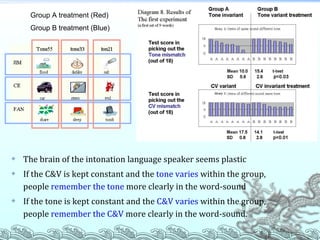
The brain of the intonation language speaker seems plastic  If the C&V is kept constant and the  tone varies  within the group,  people  remember the tone  more clearly in the word-sound If the tone is kept constant and the  C&V varies  within the group,  people  remember the C&V  more clearly in the word-sound. Group A treatment (Red) Group B treatment (Blue)
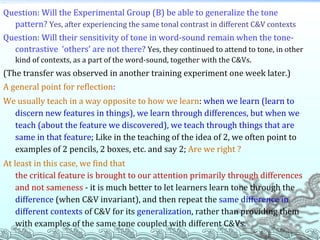
Question: Will the Experimental Group (B) be able to generalize the tone pattern?   Yes, after experiencing the same tonal contrast in different C&V contexts Question: Will their sensitivity of tone in word-sound remain when the tone-contrastive  ‘others’ are not there?   Yes, they continued to attend to tone, in other kind of contexts, as a part of the word-sound, together with the C&Vs. (The transfer was observed in another training experiment one week later.) A general point for reflection :   We usually teach in a way opposite to how we learn :  when   we learn (learn to discern new features in things), we learn through differences, but when we teach (about the feature we discovered), we teach through things that are same in that feature ; Like in the teaching of the idea of 2, we often point to examples of 2 pencils, 2 boxes, etc. and say 2;  Are we right ?  At least in this case, we find that   the critical feature is brought to our attention primarily through differences and not sameness  - it is much better to let learners learn tone through the  difference  (when C&V invariant), and then repeat the  same difference in different contexts  of C&V for its  generalization , rather than providing them with examples of the same tone coupled with different C&Vs.
Lam, H. C.
Tse, S. K., Marton, F., Ki, W. W., & Loh, E. K. Y.
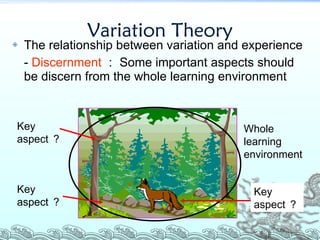
Variation Theory The relationship between variation and experience -  Discernment : Some important aspects should be discern from the whole learning environment Whole  learning  environment Key aspect ? Key aspect ? Key aspect ?
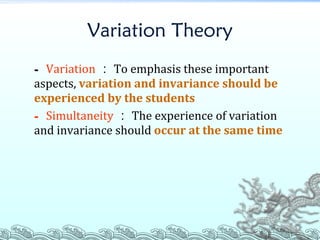
Variation Theory -  Variation : To emphasis these important aspects,  variation and invariance should be experienced by the students -  Simultaneity : The experience of variation and invariance should  occur at the same time
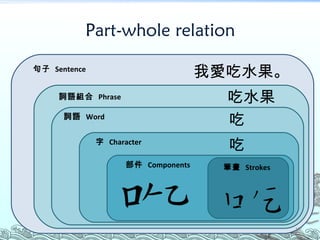
Part-whole relation 句子   Sentence 我愛吃水果。 詞語組合   Phrase 吃水果 詞語   Word 吃 字   Character 吃 部件   Components 筆畫   Str okes
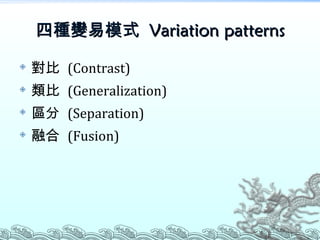
四種變易模式  Variation patterns 對比  (Contrast) 類比  (Generalization) 區分  (Separation) 融合  (Fusion)
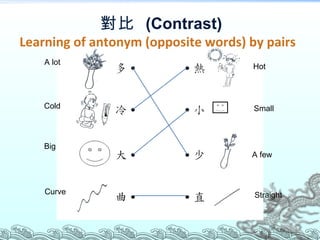
對比  (Contrast) Learning of antonym (opposite words) by pairs A lot A few Cold Big Curve Hot Small Straight
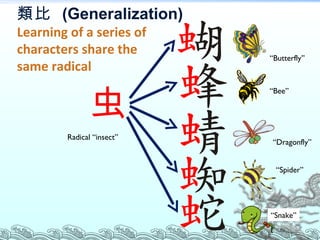
虫 類比  (Generalization) Learning of a series of  characters share the  same radical Radical “insect” “ Butterfly” “ Bee” “ Dragonfly” “ Spider” “ Snake”
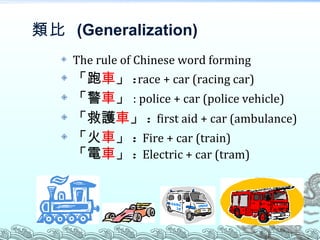
類比  (Generalization) The rule of Chinese word forming 「跑 車 」 : race + car (racing car) 「警 車 」 : police + car (police vehicle) 「救護 車 」 :  first aid + car (ambulance)   「火 車 」 :  Fire + car (train) 「電 車 」 :  Electric + car (tram)
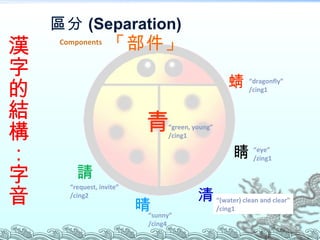
蜻 「部件」 青 晴 清 睛 漢字的結構:字音 請 Components “ green, young” /cing1 “ dragonfly” /cing1 “ eye” /zing1 “ (water) clean and clear” /cing1 “ sunny” /cing4 “ request, invite” /cing2 區分 (Separation)
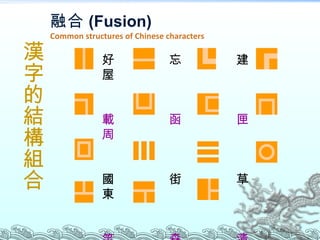
好    忘    建    屋 載    函    匣    周 國    街    草    東 笑    森    清 漢字的結構組合 融合 (Fusion) Common structures of Chinese characters
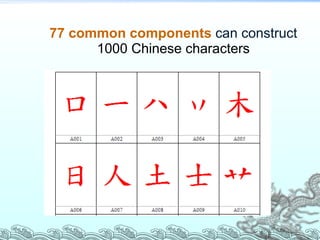
77 common components   can construct  1000 Chinese characters
Tse, S. K., Marton, F., Ki, W. W., & Loh, E. K. Y.
Chik, P. P. M., Leung, A., & Marton, F.
Tse, S. K., Marton, F., Loh, E. K. Y., & Chik, P. P. M.
Cheung, W. M., Marton, F., & Tse, S. K.
Lee, H. C., Marton, F., & Tse, S. K.

1345 sk tse_variation

  • 1.
    On the Learning of Chinese Marton, F., Tse, S. K., & Cheung, W. M. (Eds.) University's SRT Forum Sciences of Learning 24 March 2011
  • 2.
    List of authorsTse, S. K. Marton, F. Cheung, W. M. (Ph. D. thesis) Ki, W. W. (Ph. D. thesis) Pang, M. F. Lam, H. C. (Ph. D. thesis) Loh, E. K. Y. Chik, P. P. M. (Ph. D. thesis) Leung, A. Lee, H. C. (Ph. D. thesis) Marton F. is the visiting scholar of our Faculty, and the other authors are all colleagues and postgraduate students of our Faculty.
  • 3.
    Across Universities &Institutes The University of Hong Kong University of Gothenburg Hong Kong Baptist University of Hong Kong Hong Kong Institute of Education Education Bureau, Hong Kong SAR Government
  • 4.
    Across disciplines Chineselanguage I.T. Mathematics Sciences
  • 5.
    Breakthrough The studiesreported in this book crack the difficulties in learning Chinese Language in the following areas: Chinese tones Chinese characters Chinese reading Chinese writing Creative teaching of Chinese
  • 6.
    Chik, P. P.M., & Marton, F.
  • 7.
    Learning theory: Theoryof Variation In order to grasp the meaning of something you must notice how it differs from other things In order to notice the ways in which the target phenomenon differs from other things, there must be a difference in that respect, a difference which the learner can discern against the background of invariance in all other aspects
  • 8.
    Ki, W. W.,Marton, F., & Pang, M. F.
  • 9.
    Intonation language speakers learning Chinese tones Why is it so difficult? Are they pitch deaf? Can they not imitate? It has to do with their habitual way of perceiving speech sounds. They don’t hear tone as part of the word-sound and don’t remember the tone as part of the word-sound Question: Which of the following is more critical ? learning tones with words (to differentiate the word meanings) vs learning the pitch patterns (to differentiate the different patterns) Word meaning Mood, Modality Pitch pattern Word sound Consonant & vowel pattern ?
  • 10.
    Can intonation languagespeakers handle both cases ( i.e. successfully distinguish the spoken words within the same group) ? Yes, they can. Can they remember the word-sound with the tone in it afterwards? Sig diff . Question: In which case, will the learner has a better discernment of the tone feature and memory of the tone as part of the word-sound? (1) when the words (learning instances) are of the same tone (2) when the words (learning instances) are of different tones Our research set the learner to learn a group of spoken words, so that in the end, when given a word-sound, the learner can tell what it means Half-hour computer-based training - learning 9 spoken words in groups of 3
  • 11.
    The brain ofthe intonation language speaker seems plastic If the C&V is kept constant and the tone varies within the group, people remember the tone more clearly in the word-sound If the tone is kept constant and the C&V varies within the group, people remember the C&V more clearly in the word-sound. Group A treatment (Red) Group B treatment (Blue)
  • 12.
    Question: Will theExperimental Group (B) be able to generalize the tone pattern? Yes, after experiencing the same tonal contrast in different C&V contexts Question: Will their sensitivity of tone in word-sound remain when the tone-contrastive ‘others’ are not there? Yes, they continued to attend to tone, in other kind of contexts, as a part of the word-sound, together with the C&Vs. (The transfer was observed in another training experiment one week later.) A general point for reflection : We usually teach in a way opposite to how we learn : when we learn (learn to discern new features in things), we learn through differences, but when we teach (about the feature we discovered), we teach through things that are same in that feature ; Like in the teaching of the idea of 2, we often point to examples of 2 pencils, 2 boxes, etc. and say 2; Are we right ? At least in this case, we find that the critical feature is brought to our attention primarily through differences and not sameness - it is much better to let learners learn tone through the difference (when C&V invariant), and then repeat the same difference in different contexts of C&V for its generalization , rather than providing them with examples of the same tone coupled with different C&Vs.
  • 13.
  • 14.
    Tse, S. K.,Marton, F., Ki, W. W., & Loh, E. K. Y.
  • 15.
    Variation Theory Therelationship between variation and experience - Discernment : Some important aspects should be discern from the whole learning environment Whole learning environment Key aspect ? Key aspect ? Key aspect ?
  • 16.
    Variation Theory - Variation : To emphasis these important aspects, variation and invariance should be experienced by the students - Simultaneity : The experience of variation and invariance should occur at the same time
  • 17.
    Part-whole relation 句子 Sentence 我愛吃水果。 詞語組合 Phrase 吃水果 詞語 Word 吃 字 Character 吃 部件 Components 筆畫 Str okes
  • 18.
    四種變易模式 Variationpatterns 對比 (Contrast) 類比 (Generalization) 區分 (Separation) 融合 (Fusion)
  • 19.
    對比 (Contrast)Learning of antonym (opposite words) by pairs A lot A few Cold Big Curve Hot Small Straight
  • 20.
    虫 類比 (Generalization) Learning of a series of characters share the same radical Radical “insect” “ Butterfly” “ Bee” “ Dragonfly” “ Spider” “ Snake”
  • 21.
    類比 (Generalization)The rule of Chinese word forming 「跑 車 」 : race + car (racing car) 「警 車 」 : police + car (police vehicle) 「救護 車 」 : first aid + car (ambulance) 「火 車 」 : Fire + car (train) 「電 車 」 : Electric + car (tram)
  • 22.
    蜻 「部件」 青晴 清 睛 漢字的結構:字音 請 Components “ green, young” /cing1 “ dragonfly” /cing1 “ eye” /zing1 “ (water) clean and clear” /cing1 “ sunny” /cing4 “ request, invite” /cing2 區分 (Separation)
  • 23.
    好    忘    建    屋 載    函    匣    周 國    街    草    東笑    森    清 漢字的結構組合 融合 (Fusion) Common structures of Chinese characters
  • 24.
    77 common components can construct 1000 Chinese characters
  • 25.
    Tse, S. K.,Marton, F., Ki, W. W., & Loh, E. K. Y.
  • 26.
    Chik, P. P.M., Leung, A., & Marton, F.
  • 27.
    Tse, S. K.,Marton, F., Loh, E. K. Y., & Chik, P. P. M.
  • 28.
    Cheung, W. M.,Marton, F., & Tse, S. K.
  • 29.
    Lee, H. C.,Marton, F., & Tse, S. K.