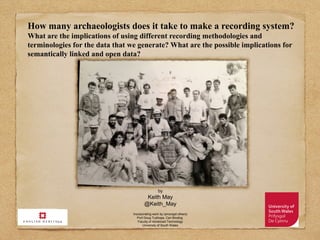
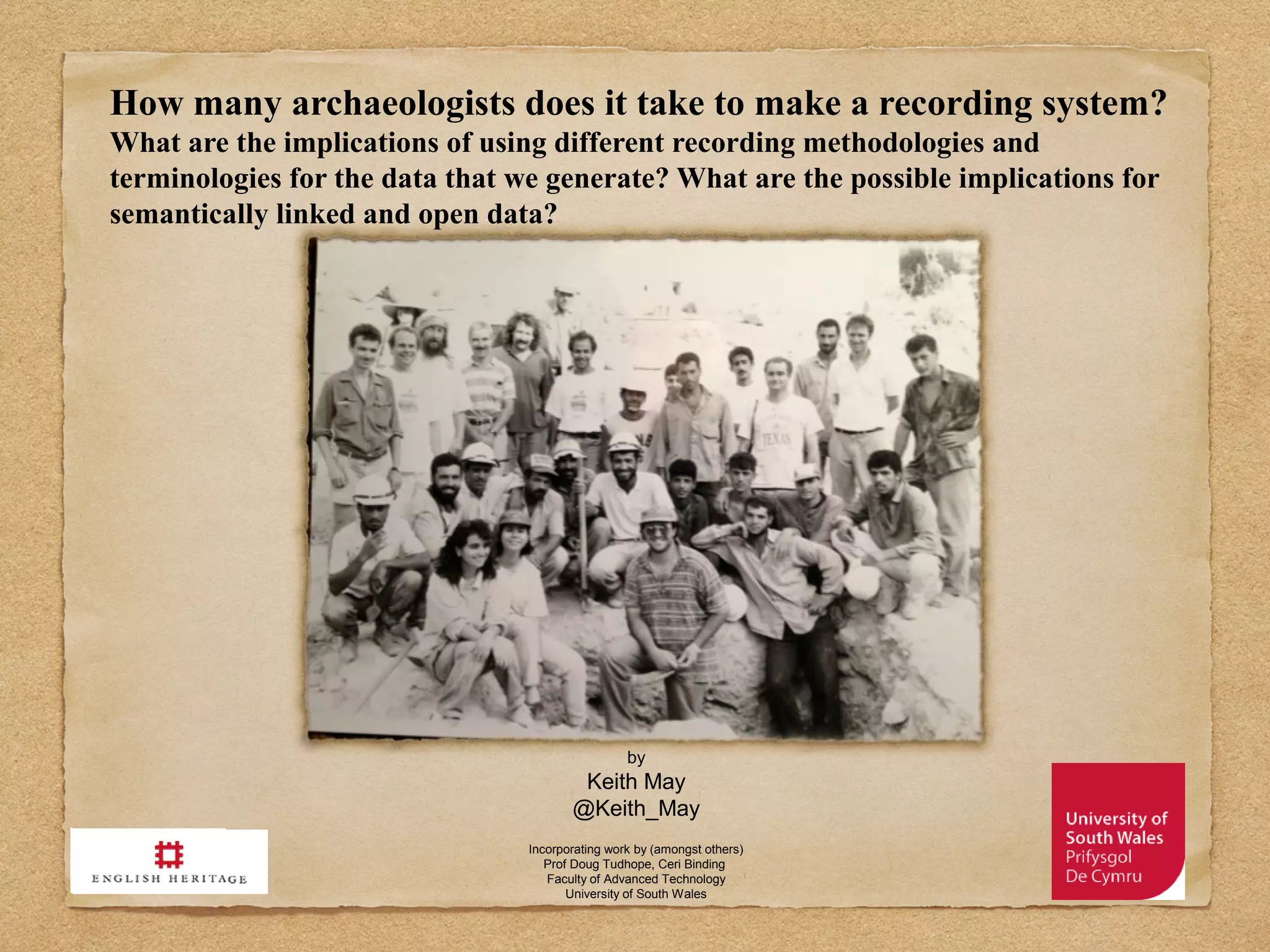
How many archaeologists does it take to make a recording system?
What are the implications of using different recording methodologies and
terminologies for the data that we generate? What are the possible implications for
semantically linked and open data?
by
Keith May
@Keith_May
Incorporating work by (amongst others)
Prof Doug Tudhope, Ceri Binding
Faculty of Advanced Technology
University of South Wales
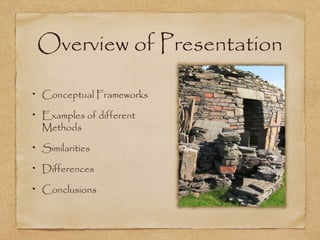
Overview of Presentation
Conceptual Frameworks
Examples of different
Methods
Similarities
Differences
Conclusions
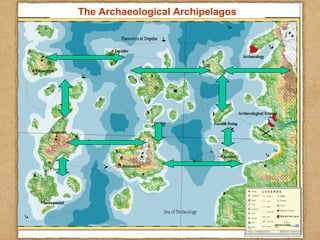
The Archaeological Archipelagos
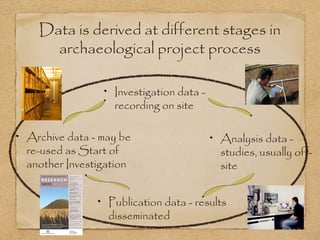
Data is derived at different stages in
archaeological project process
Archive data - may be
re-used as Start of
another Investigation
Investigation data -
recording on site
Analysis data -
studies, usually off-
site
Publication data - results
disseminated
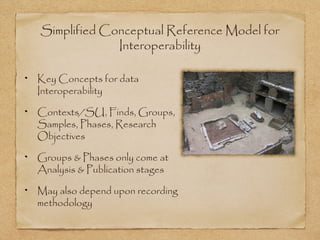
Simplified Conceptual Reference Model for
Interoperability
Key Concepts for data
Interoperability
Contexts/SU, Finds, Groups,
Samples, Phases, Research
Objectives
Groups & Phases only come at
Analysis & Publication stages
May also depend upon recording
methodology
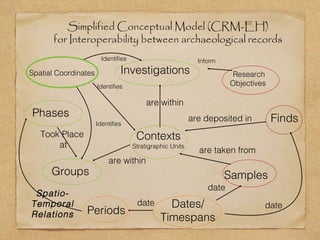
Stratigraphic Units
Spatial Coordinates
Finds
Contexts
are deposited in
Groups Samples
are taken from
Phases
Dates/
Timespans
Periods
Investigations
are within
Took Place
at
are within
Identifies
Identifies
Identifies
date
datedate
Spatio-
Temporal
Relations
Research
Objectives
Inform
Simplified Conceptual Model (CRM-EH)
for Interoperability between archaeological records
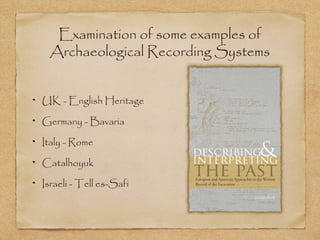
Examination of some examples of
Archaeological Recording Systems
UK - English Heritage
Germany - Bavaria
Italy - Rome
Catalhoyuk
Israeli - Tell es-Safi
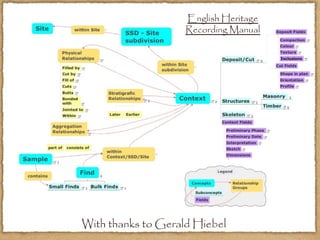
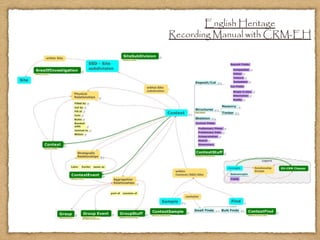
Field record based data modelling
Model common ‘core’ of Archaeological
processes
Principle archaeological concepts modelled
as CRM entities & relationships
Limited degree of minute detail
Matrix holds stratigraphic relationships
N.B. Distinguishing positive Deposits
from negative Cuts
With thanks to Gerald Hiebel
English Heritage
Recording Manual
English Heritage
Recording Manual with CRM-EH
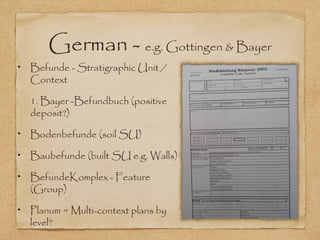
German - e.g. Gottingen & Bayer
Befunde - Stratigraphic Unit /
Context
1. Bayer -Befundbuch (positive
deposit?)
Bodenbefunde (soil SU)
Baubefunde (built SU e.g. Walls)
BefundeKomplex - Feature
(Group)
Planum = Multi-context plans by
level?
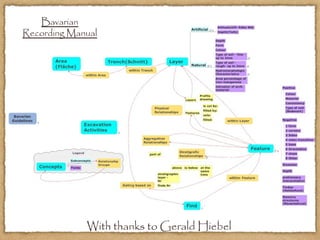
With thanks to Gerald Hiebel
Bavarian
Recording Manual
Italy
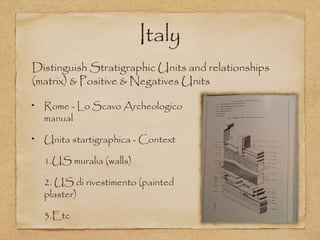
Rome - Lo Scavo Archeologico
manual
Unita startigraphica - Context
1.US muralia (walls)
2. US di rivestimento (painted
plaster)
3.Etc
Distinguish Stratigraphic Units and relationships
(matrix) & Positive & Negatives Units
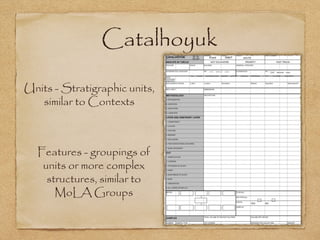
Catalhoyuk
Units - Stratigraphic units,
similar to Contexts
Features - groupings of
units or more complex
structures, similar to
MoLA Groups
Israeli - Tell es-Safi
Stratum - distinct level of human activity
(horizon)
Locus - the basic features of excavation
(e.g. a floor, a pit, a dump). Recorded with
UID on a Locus card
Basket/Bucket - Unit of excavation with
all finds from the same Locus
Stratigraphic relations recorded between
Loci
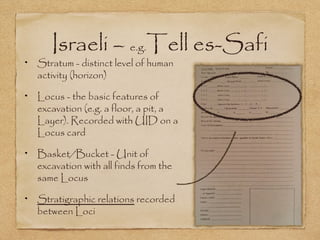
Israeli – e.g.Tell es-Safi
Stratum - distinct level of human
activity (horizon)
Locus - the basic features of
excavation (e.g. a floor, a pit, a
Layer). Recorded with UID on a
Locus card
Basket/Bucket - Unit of
excavation with all finds from the
same Locus
Stratigraphic relations recorded
between Loci
With thanks to Gerald Hiebel
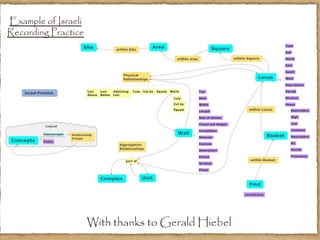
Example of Israeli
Recording Practice
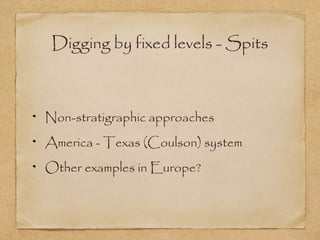
Digging by fixed levels - Spits
Non-stratigraphic approaches
America - Texas (Coulson) system
Other examples in Europe?
Conceptual Models and Knowledge ResourcesConceptual Models and Knowledge Resources
 CIDOC CRM [ http://cidoc.ics.forth.gr/ ]
 CIDOC Conceptual Reference Model
 International standard ISO 21127:2006
 CRM-EH [ http://purl.org/crmeh ]
 English Heritage Ontological Model
 Extends CIDOC CRM for EH archaeological
domain
 SKOS [ http://www.w3.org/2004/02/skos/ ]
 Simple Knowledge Organization System
 RDF representation of thesauri, glossaries,
taxonomies, classification schemes etc.
Other important mechanisms for Semantic
interoperability include syntactic alignment
Shared Vocabularies
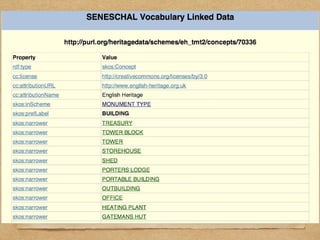
Using E55 Type and SKOS to relate
different terminologies together
see following diagram showing how
CRM E55 types & SKOS work
“cast iron”
rdf:value
crm:P105F.consists_of
CRM data instance
EHE0009.ContextFind
[http://...#..12345]
EHE0030.ContextFindMaterial
[http://......]
Linking CRM E55 Type and SKOS
Property: EHP10F.is_represented_by (represents)
Domain: crm:E55.Type
Range: skos:Concept
“cast iron”
skos:prefLabel
skos:broader
“Dating from the 15th century,
it is a hard alloy of iron and
carbon, melted and shaped
into various moulded forms”
skos:scopeNote
SKOS thesaurus concept
skos:Concept
[http://...#97992]
skos:Concept
[http://...#97805]
EHP10F.is_represented_by
skos:Concept
Castle:c789
skos:Concept
Motte:c456
skos:broader skos:narrower
skos:Concept
Bailey:c789
skos:Concept
Motte:c456
skos:related skos:related
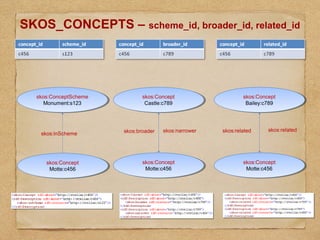
skos:ConceptScheme
Monument:s123
skos:Concept
Motte:c456
skos:inScheme
SKOS_CONCEPTS – scheme_id, broader_id, related_id
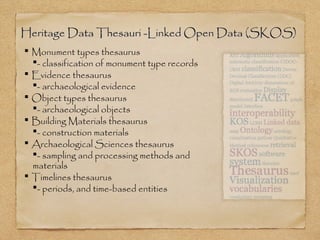
Heritage Data Thesauri -Linked Open Data (SKOS)Heritage Data Thesauri -Linked Open Data (SKOS)
 Monument types thesaurus
- classification of monument type records
 Evidence thesaurus
- archaeological evidence
 Object types thesaurus
- archaeological objects
 Building Materials thesaurus
- construction materials
 Archaeological Sciences thesaurus
- sampling and processing methods and
materials
 Timelines thesaurus
- periods, and time-based entities
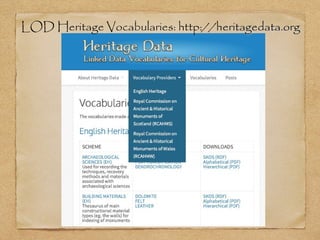
LOD Heritage Vocabularies: http://heritagedata.orgeritagedata.org
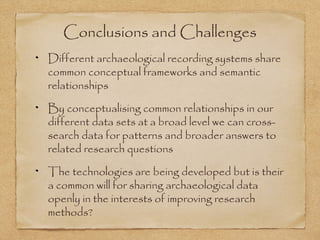
Conclusions and Challenges
Different archaeological recording systems share
common conceptual frameworks and semantic
relationships
By conceptualising common relationships in our
different data sets at a broad level we can cross-
search data for patterns and broader answers to
related research questions
The technologies are being developed but is their
a common will for sharing archaeological data
openly in the interests of improving research
methods?
References
Steve Roskams. "Excavation"
Catalin Pavel. "Describing and Interpreting the Past"
Tudhope, May, Binding, Vlachidis. "Connecting
Archaeological Data and Grey Literature via Semantic Cross
Search" - Internet Archaeology Vol 30
http://intarch.ac.uk/journal/issue30/tudhope_index.html
Contact:
Keith.May@english-heritage.org.uk
@Keith_May

EAA2013 Archaeological Recording Methods - How Many Archaeologists does it take to Make a Recording System?

  • 1.
    How many archaeologistsdoes it take to make a recording system? What are the implications of using different recording methodologies and terminologies for the data that we generate? What are the possible implications for semantically linked and open data? by Keith May @Keith_May Incorporating work by (amongst others) Prof Doug Tudhope, Ceri Binding Faculty of Advanced Technology University of South Wales
  • 2.
    Overview of Presentation ConceptualFrameworks Examples of different Methods Similarities Differences Conclusions
  • 3.
  • 4.
    Data is derivedat different stages in archaeological project process Archive data - may be re-used as Start of another Investigation Investigation data - recording on site Analysis data - studies, usually off- site Publication data - results disseminated
  • 5.
    Simplified Conceptual ReferenceModel for Interoperability Key Concepts for data Interoperability Contexts/SU, Finds, Groups, Samples, Phases, Research Objectives Groups & Phases only come at Analysis & Publication stages May also depend upon recording methodology
  • 6.
    Stratigraphic Units Spatial Coordinates Finds Contexts aredeposited in Groups Samples are taken from Phases Dates/ Timespans Periods Investigations are within Took Place at are within Identifies Identifies Identifies date datedate Spatio- Temporal Relations Research Objectives Inform Simplified Conceptual Model (CRM-EH) for Interoperability between archaeological records
  • 7.
    Examination of someexamples of Archaeological Recording Systems UK - English Heritage Germany - Bavaria Italy - Rome Catalhoyuk Israeli - Tell es-Safi
  • 8.
    Field record baseddata modelling Model common ‘core’ of Archaeological processes Principle archaeological concepts modelled as CRM entities & relationships Limited degree of minute detail Matrix holds stratigraphic relationships N.B. Distinguishing positive Deposits from negative Cuts
  • 9.
    With thanks toGerald Hiebel English Heritage Recording Manual
  • 10.
  • 11.
    German - e.g.Gottingen & Bayer Befunde - Stratigraphic Unit / Context 1. Bayer -Befundbuch (positive deposit?) Bodenbefunde (soil SU) Baubefunde (built SU e.g. Walls) BefundeKomplex - Feature (Group) Planum = Multi-context plans by level?
  • 12.
    With thanks toGerald Hiebel Bavarian Recording Manual
  • 13.
    Italy Rome - LoScavo Archeologico manual Unita startigraphica - Context 1.US muralia (walls) 2. US di rivestimento (painted plaster) 3.Etc Distinguish Stratigraphic Units and relationships (matrix) & Positive & Negatives Units
  • 14.
    Catalhoyuk Units - Stratigraphicunits, similar to Contexts Features - groupings of units or more complex structures, similar to MoLA Groups
  • 15.
    Israeli - Telles-Safi Stratum - distinct level of human activity (horizon) Locus - the basic features of excavation (e.g. a floor, a pit, a dump). Recorded with UID on a Locus card Basket/Bucket - Unit of excavation with all finds from the same Locus Stratigraphic relations recorded between Loci
  • 16.
    Israeli – e.g.Telles-Safi Stratum - distinct level of human activity (horizon) Locus - the basic features of excavation (e.g. a floor, a pit, a Layer). Recorded with UID on a Locus card Basket/Bucket - Unit of excavation with all finds from the same Locus Stratigraphic relations recorded between Loci
  • 17.
    With thanks toGerald Hiebel Example of Israeli Recording Practice
  • 18.
    Digging by fixedlevels - Spits Non-stratigraphic approaches America - Texas (Coulson) system Other examples in Europe?
  • 19.
    Conceptual Models andKnowledge ResourcesConceptual Models and Knowledge Resources  CIDOC CRM [ http://cidoc.ics.forth.gr/ ]  CIDOC Conceptual Reference Model  International standard ISO 21127:2006  CRM-EH [ http://purl.org/crmeh ]  English Heritage Ontological Model  Extends CIDOC CRM for EH archaeological domain  SKOS [ http://www.w3.org/2004/02/skos/ ]  Simple Knowledge Organization System  RDF representation of thesauri, glossaries, taxonomies, classification schemes etc.
  • 20.
    Other important mechanismsfor Semantic interoperability include syntactic alignment Shared Vocabularies Using E55 Type and SKOS to relate different terminologies together see following diagram showing how CRM E55 types & SKOS work
  • 21.
    “cast iron” rdf:value crm:P105F.consists_of CRM datainstance EHE0009.ContextFind [http://...#..12345] EHE0030.ContextFindMaterial [http://......] Linking CRM E55 Type and SKOS Property: EHP10F.is_represented_by (represents) Domain: crm:E55.Type Range: skos:Concept “cast iron” skos:prefLabel skos:broader “Dating from the 15th century, it is a hard alloy of iron and carbon, melted and shaped into various moulded forms” skos:scopeNote SKOS thesaurus concept skos:Concept [http://...#97992] skos:Concept [http://...#97805] EHP10F.is_represented_by
  • 22.
  • 23.
    Heritage Data Thesauri-Linked Open Data (SKOS)Heritage Data Thesauri -Linked Open Data (SKOS)  Monument types thesaurus - classification of monument type records  Evidence thesaurus - archaeological evidence  Object types thesaurus - archaeological objects  Building Materials thesaurus - construction materials  Archaeological Sciences thesaurus - sampling and processing methods and materials  Timelines thesaurus - periods, and time-based entities
  • 24.
    LOD Heritage Vocabularies:http://heritagedata.orgeritagedata.org
  • 26.
    Conclusions and Challenges Differentarchaeological recording systems share common conceptual frameworks and semantic relationships By conceptualising common relationships in our different data sets at a broad level we can cross- search data for patterns and broader answers to related research questions The technologies are being developed but is their a common will for sharing archaeological data openly in the interests of improving research methods?
  • 27.
    References Steve Roskams. "Excavation" CatalinPavel. "Describing and Interpreting the Past" Tudhope, May, Binding, Vlachidis. "Connecting Archaeological Data and Grey Literature via Semantic Cross Search" - Internet Archaeology Vol 30 http://intarch.ac.uk/journal/issue30/tudhope_index.html Contact: Keith.May@english-heritage.org.uk @Keith_May