


Assessment of pesticide residues in
vegetables of selected domestic
markets in Sri Lanka
K.Sendthuran (128059)
Background
• Fresh vegetable are
 Mature edible plant sources
 Rich in Nutrients
• They are an important food group in a healthy diet
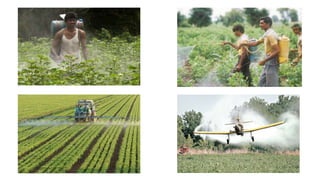
• Pesticides are the chemicals utilized by farmers to protect their crops
from pests and diseases
• Pesticides used in agriculture are
 Insecticides
 Fungicides
 Herbicides
Do we know?
• If farmers obey agrochemical usage standards?
• Are the residues of these chemicals accumulate in harvest?
• Are vegetables available in domestic market free of pesticide residues ?
Objectives
• To quantify prominent pesticide residues in selected vegetables
in domestic markets in Sri Lanka
• To compare the level of pesticide residues in vegetables
collected from different locations and compare them with
maximum residue level (MRL)
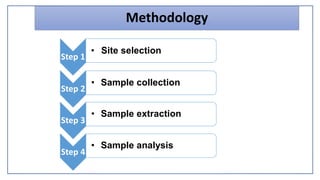
Methodology
Step 2
• Sample collection
Step 3
• Sample extraction
Step 4
• Sample analysis
Step 1
• Site selection
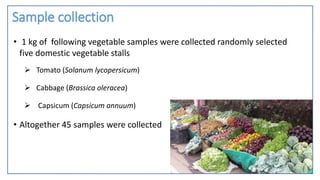
Sample collection
• 1 kg of following vegetable samples were collected randomly selected
five domestic vegetable stalls
 Tomato (Solanum lycopersicum)
 Cabbage (Brassica oleracea)
 Capsicum (Capsicum annuum)
• Altogether 45 samples were collected
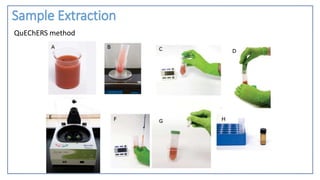
Sample Extraction
QuEChERS method
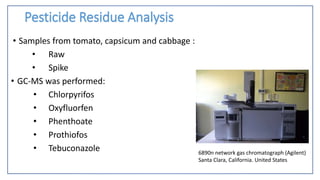
Pesticide Residue Analysis
• Samples from tomato, capsicum and cabbage :
• Raw
• Spike
• GC-MS was performed:
• Chlorpyrifos
• Oxyfluorfen
• Phenthoate
• Prothiofos
• Tebuconazole 6890n network gas chromatograph (Agilent)
Santa Clara, California. United States
Results and discussion
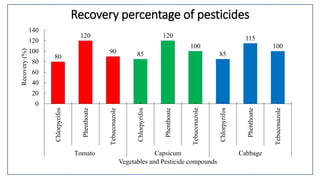
Recovery percentage of pesticides
80
120
90 85
120
100
85
115
100
0
20
40
60
80
100
120
140
Chlorpyrifos
Phenthoate
Tebuconazole
Chlorpyrifos
Phenthoate
Tebuconazole
Chlorpyrifos
Phenthoate
Tebuconazole
Tomato Capsicum Cabbage
Recovery(%)
Vegetables and Pesticide compounds
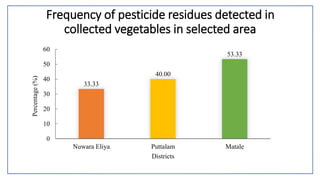
Frequency of pesticide residues detected in
collected vegetables in selected area
33.33
40.00
53.33
0
10
20
30
40
50
60
Nuwara Eliya Puttalam Matale
Districts
Percentage(%)
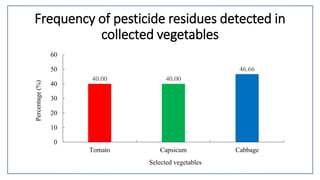
Frequency of pesticide residues detected in
collected vegetables
40.00 40.00
46.66
0
10
20
30
40
50
60
Tomato Capsicum Cabbage
Percentage(%)
Selected vegetables
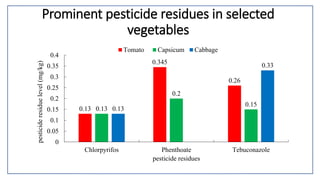
Prominent pesticide residues in selected
vegetables
0.13
0.345
0.26
0.13
0.2
0.15
0.13
0.33
0
0.05
0.1
0.15
0.2
0.25
0.3
0.35
0.4
Chlorpyrifos Phenthoate Tebuconazole
pesticideresiduelevel(mg/kg)
pesticide residues
Tomato Capsicum Cabbage
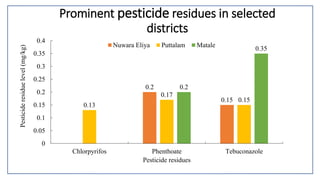
Prominent pesticide residues in selected
districts
0.2
0.15
0.13
0.17
0.15
0.2
0.35
0
0.05
0.1
0.15
0.2
0.25
0.3
0.35
0.4
Chlorpyrifos Phenthoate Tebuconazole
Pesticideresiduelevel(mg/kg)
Pesticide residues
Nuwara Eliya Puttalam Matale
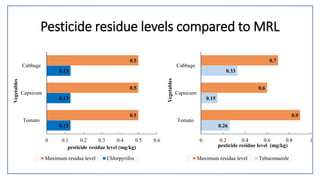
Pesticide residue levels compared to MRL
0.13
0.13
0.13
0.5
0.5
0.5
0 0.1 0.2 0.3 0.4 0.5 0.6
Tomato
Capsicum
Cabbage
pesticide residue level (mg/kg)
Vegetables
Maximum residue level Chlorpyrifos
0.26
0.15
0.33
0.9
0.6
0.7
0 0.2 0.4 0.6 0.8 1
Tomato
Capsicum
Cabbage
pesticide residue level (mg/kg)
Vegetables
Maximum residue level Tebuconazole
Conclusions
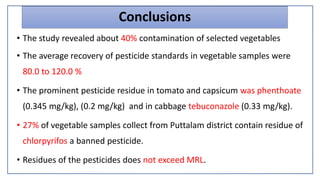
• The study revealed about 40% contamination of selected vegetables
• The average recovery of pesticide standards in vegetable samples were
80.0 to 120.0 %
• The prominent pesticide residue in tomato and capsicum was phenthoate
(0.345 mg/kg), (0.2 mg/kg) and in cabbage tebuconazole (0.33 mg/kg).
• 27% of vegetable samples collect from Puttalam district contain residue of
chlorpyrifos a banned pesticide.
• Residues of the pesticides does not exceed MRL.
Limitations
• Limited time to do the study
• Limited pesticide standards and cost of the analysis.
• Difference practices followed by middlemen.
Suggestions
• Periodical assessments are required.
• Increase the sample size and sampling locations.
• Select different vegetables and fruits.
Acknowledgement
• Prof.CVL Jayasinghe, Head , Department of Food Science &
Technology.
• Internal supervisor Dr.S.Jayathilake, Senior lecturer, Department of
Food Science & Technology.
• External supervisor Ms. P.W.Y.Lakshani ,Research officer, Office of the
Registrar of Pesticides
• All the members in the residue laboratory, Office of the Registrar of
Pesticides
• My family and friends
References
• AOAC INTERNATIONAL (2000), Official Methods of Analysis 17th edn, vol. II. Cunniff P, Arlington,
VA, AOAC Int., 49: 1-60.
• Chandra, S., Mahindrakar, A.N. & Shinde, L.P. (2014) Analysis of pesticide residue in vegetables
local market Nanded, India. International Journal of ChemTech Research, 6(5), pp.2760–2768.
• Chandra,S., Mahindrakar,A.N., Mukesh Kumar,Shinde,L.P.(2014) Determination Of Pesticide
Residues In Fruits Local Market Nanded, India. International Journal of Advanced Research, 2(7),
pp.1075–1082.
THANK YOU
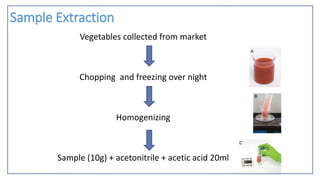
Sample Extraction
Vegetables collected from market
Chopping and freezing over night
Homogenizing
Sample (10g) + acetonitrile + acetic acid 20ml
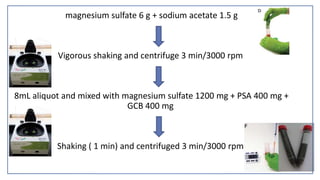
magnesium sulfate 6 g + sodium acetate 1.5 g
Vigorous shaking and centrifuge 3 min/3000 rpm
8mL aliquot and mixed with magnesium sulfate 1200 mg + PSA 400 mg +
GCB 400 mg
Shaking ( 1 min) and centrifuged 3 min/3000 rpm
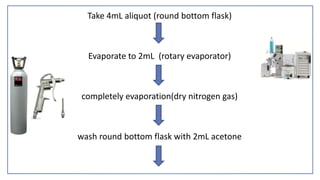
Take 4mL aliquot (round bottom flask)
Evaporate to 2mL (rotary evaporator)
completely evaporation(dry nitrogen gas)
wash round bottom flask with 2mL acetone
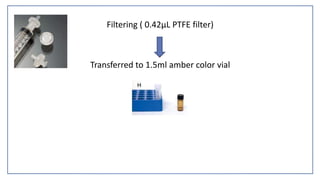
Filtering ( 0.42µL PTFE filter)
Transferred to 1.5ml amber color vial
Chlorpyrifos
• runny nose, tears, increased saliva or drooling, sweat, headache,
nausea and dizziness.
Phenthoate
• Interfere with the metabolism of acetylcholine
• Effect the CNS
• These effected clinically as feeling of headache, weakness, dizziness,
blurred vision, psychosis, respiratory difficulty, paralysis, convulsions,
and coma
Tebuconazole
• Nausea, diarrhea, abdominal cramps, shaking, sweating, dizziness, and/or
confusion
• Cancer Classification: Group C Possible Human Carcinogen

128059 final ppt30.08.2K16

  • 2.
    Assessment of pesticideresidues in vegetables of selected domestic markets in Sri Lanka K.Sendthuran (128059)
  • 3.
    Background • Fresh vegetableare  Mature edible plant sources  Rich in Nutrients • They are an important food group in a healthy diet • Pesticides are the chemicals utilized by farmers to protect their crops from pests and diseases • Pesticides used in agriculture are  Insecticides  Fungicides  Herbicides
  • 5.
    Do we know? •If farmers obey agrochemical usage standards? • Are the residues of these chemicals accumulate in harvest? • Are vegetables available in domestic market free of pesticide residues ?
  • 6.
    Objectives • To quantifyprominent pesticide residues in selected vegetables in domestic markets in Sri Lanka • To compare the level of pesticide residues in vegetables collected from different locations and compare them with maximum residue level (MRL)
  • 7.
    Methodology Step 2 • Samplecollection Step 3 • Sample extraction Step 4 • Sample analysis Step 1 • Site selection
  • 8.
    Sample collection • 1kg of following vegetable samples were collected randomly selected five domestic vegetable stalls  Tomato (Solanum lycopersicum)  Cabbage (Brassica oleracea)  Capsicum (Capsicum annuum) • Altogether 45 samples were collected
  • 9.
  • 10.
    Pesticide Residue Analysis •Samples from tomato, capsicum and cabbage : • Raw • Spike • GC-MS was performed: • Chlorpyrifos • Oxyfluorfen • Phenthoate • Prothiofos • Tebuconazole 6890n network gas chromatograph (Agilent) Santa Clara, California. United States
  • 11.
  • 12.
    Recovery percentage ofpesticides 80 120 90 85 120 100 85 115 100 0 20 40 60 80 100 120 140 Chlorpyrifos Phenthoate Tebuconazole Chlorpyrifos Phenthoate Tebuconazole Chlorpyrifos Phenthoate Tebuconazole Tomato Capsicum Cabbage Recovery(%) Vegetables and Pesticide compounds
  • 13.
    Frequency of pesticideresidues detected in collected vegetables in selected area 33.33 40.00 53.33 0 10 20 30 40 50 60 Nuwara Eliya Puttalam Matale Districts Percentage(%)
  • 14.
    Frequency of pesticideresidues detected in collected vegetables 40.00 40.00 46.66 0 10 20 30 40 50 60 Tomato Capsicum Cabbage Percentage(%) Selected vegetables
  • 15.
    Prominent pesticide residuesin selected vegetables 0.13 0.345 0.26 0.13 0.2 0.15 0.13 0.33 0 0.05 0.1 0.15 0.2 0.25 0.3 0.35 0.4 Chlorpyrifos Phenthoate Tebuconazole pesticideresiduelevel(mg/kg) pesticide residues Tomato Capsicum Cabbage
  • 16.
    Prominent pesticide residuesin selected districts 0.2 0.15 0.13 0.17 0.15 0.2 0.35 0 0.05 0.1 0.15 0.2 0.25 0.3 0.35 0.4 Chlorpyrifos Phenthoate Tebuconazole Pesticideresiduelevel(mg/kg) Pesticide residues Nuwara Eliya Puttalam Matale
  • 17.
    Pesticide residue levelscompared to MRL 0.13 0.13 0.13 0.5 0.5 0.5 0 0.1 0.2 0.3 0.4 0.5 0.6 Tomato Capsicum Cabbage pesticide residue level (mg/kg) Vegetables Maximum residue level Chlorpyrifos 0.26 0.15 0.33 0.9 0.6 0.7 0 0.2 0.4 0.6 0.8 1 Tomato Capsicum Cabbage pesticide residue level (mg/kg) Vegetables Maximum residue level Tebuconazole
  • 18.
    Conclusions • The studyrevealed about 40% contamination of selected vegetables • The average recovery of pesticide standards in vegetable samples were 80.0 to 120.0 % • The prominent pesticide residue in tomato and capsicum was phenthoate (0.345 mg/kg), (0.2 mg/kg) and in cabbage tebuconazole (0.33 mg/kg). • 27% of vegetable samples collect from Puttalam district contain residue of chlorpyrifos a banned pesticide. • Residues of the pesticides does not exceed MRL.
  • 19.
    Limitations • Limited timeto do the study • Limited pesticide standards and cost of the analysis. • Difference practices followed by middlemen.
  • 20.
    Suggestions • Periodical assessmentsare required. • Increase the sample size and sampling locations. • Select different vegetables and fruits.
  • 21.
    Acknowledgement • Prof.CVL Jayasinghe,Head , Department of Food Science & Technology. • Internal supervisor Dr.S.Jayathilake, Senior lecturer, Department of Food Science & Technology. • External supervisor Ms. P.W.Y.Lakshani ,Research officer, Office of the Registrar of Pesticides • All the members in the residue laboratory, Office of the Registrar of Pesticides • My family and friends
  • 22.
    References • AOAC INTERNATIONAL(2000), Official Methods of Analysis 17th edn, vol. II. Cunniff P, Arlington, VA, AOAC Int., 49: 1-60. • Chandra, S., Mahindrakar, A.N. & Shinde, L.P. (2014) Analysis of pesticide residue in vegetables local market Nanded, India. International Journal of ChemTech Research, 6(5), pp.2760–2768. • Chandra,S., Mahindrakar,A.N., Mukesh Kumar,Shinde,L.P.(2014) Determination Of Pesticide Residues In Fruits Local Market Nanded, India. International Journal of Advanced Research, 2(7), pp.1075–1082.
  • 24.
  • 25.
    Sample Extraction Vegetables collectedfrom market Chopping and freezing over night Homogenizing Sample (10g) + acetonitrile + acetic acid 20ml
  • 26.
    magnesium sulfate 6g + sodium acetate 1.5 g Vigorous shaking and centrifuge 3 min/3000 rpm 8mL aliquot and mixed with magnesium sulfate 1200 mg + PSA 400 mg + GCB 400 mg Shaking ( 1 min) and centrifuged 3 min/3000 rpm
  • 27.
    Take 4mL aliquot(round bottom flask) Evaporate to 2mL (rotary evaporator) completely evaporation(dry nitrogen gas) wash round bottom flask with 2mL acetone
  • 28.
    Filtering ( 0.42µLPTFE filter) Transferred to 1.5ml amber color vial
  • 29.
    Chlorpyrifos • runny nose,tears, increased saliva or drooling, sweat, headache, nausea and dizziness.
  • 30.
    Phenthoate • Interfere withthe metabolism of acetylcholine • Effect the CNS • These effected clinically as feeling of headache, weakness, dizziness, blurred vision, psychosis, respiratory difficulty, paralysis, convulsions, and coma
  • 31.
    Tebuconazole • Nausea, diarrhea,abdominal cramps, shaking, sweating, dizziness, and/or confusion • Cancer Classification: Group C Possible Human Carcinogen

Editor's Notes

  • #2 Adopting a new healthier lifestyle can involve changing diet to include more fresh fruit and vegetables TOPIC
  • #4 To make insight, vegetables are mature edible plant sources which may or may not be processed before consumption. Also they are rich in vitamins, minerals and dietary fibers. Therefore they are a important part of a healthy diet. . To improve or sustain the quality & quantity farmers apply varies Chemicals.
  • #5 Due to the type of the crops, their economic value and type of pest and weed the chemicals and the application methods can be differ.
  • #6 Can you think of answering this things. If farmers obey agrochemical usage standards? Are these chemicals residually accumulated in harvest? The vegetable we get from domestic markets are free from pesticide residues
  • #7 My research objectives stand this way To quantify prominent pesticide residues in selected vegetables in domestic markets in our country And comparing the pesticide residue level among the vegetables and the selected districts And also compare them with the maximum residue level
  • #8 Initially site selection to collect veg was done 3 district (Nuwara Eliya, Puttalam and Matale) domestic markets were assessed
  • #9 Sample collection was done by collecting 1kg of each vegetable (Tomato, Capsicum & Cabbage) collected from five different domestic market from a district Altogether 45 samples was collected.
  • #10 Vegetable samples were chopped and blended and frozen for overnight. On the following day, the pesticide residue was extracted from the vegetable matrix using “QuEChERS” method . “Quick Easy Cheap Effective Rugged Safe method”
  • #11 For the Residue analysis raw sample and spiked sample extracts was injected to preform a GC-MS. For, Chlorpyrifos, Oxyfluorfen, Phenthoate, Prothiofos, Tebuconazole
  • #12 Now I will show you the important part of my research.
  • #13 1.Moving to the results of the study, the figure illustrates the recovery % of pesticides compounds inject to the vegetable samples. 2. Recovery % of pesticides standard compounds in vegetables varies from 80% to 120%. Among the 3 pesticide standard compounds, 3.penthoate showed the highest recovery percentage where as chlorpyrifos showed the lowest recovery percentage.
  • #14 1.A variation in the presence of pesticide compounds was detected in VEG from different domestic markets. 2.Among the VEG from 3 different districts, VEGs from Matale reported to have more chance of presence of PR. 3.Level of pesticide residue presence was comparatively low in vegetables from Nuwara Eliya. 4.Further, presence of PR in VEG from Puttalam was greater than VEG from Nuwara Eliya and Lower than Matale.
  • #15 1.Having discussed the level of pesticide residue presence in vegetables from different districts, 2.let me now move on to the level of pesticide residues among different vegetables. 3.Based on the figure, highest level of pesticide residue presence was detected in cabbage. 4.Equal chance of pesticide residues was identified in tomato and capsicum.
  • #16 1.Taking a closer look at the Prominent pesticide residues in selected vegetables, 2.chlorpyrifos presence was detected at lower level in selected three types of vegetables. 3.Phenthoate was highly prominent in tomato whereas tebuconazole was commonly high in cabbage. 4.Further, phenthoate presence was not detected in cabbage.
  • #17 1.When focusing the study location, chlorpyrifos was found only in the VEG from Puttalam. 2.An equal level of phenthoate residues was identified in VEGs from Nuwara Eliya and Matale. 3.More or less equal level of pesticide residues was found in VEGs from 3 districts. 4.Tebuconazole was significantly prominent in VEGs from Matale compared to other 2 districts. 5.VEGs from Nuwara Eliya and Puttalam showed an equal level of tebuconazole pesticide residues.
  • #18 1.These figures clearly explains the comparison of pesticides residues with their respective MRL. 2.Presence of chlorpyrifos residue in selected three types of vegetables was very lower compared with its MRL. 3.Similarly, Presence of tebuconazole residue in selected three types of vegetables was also lower compared with its MRL.
  • #19 Finally lets move to the conclusion. 1.From the total 45 VEG sample 40% are contain pesticide residue 2.The avg recovery percentage for the pesticide standard is between 80% to 120% 3.Phenthoate is the prominent pesticide residue in tomato and capsicum and tebuconazole in cabbage. 4.27% of vegetable samples collect from Puttalam district contain residue of chlorpyrifos a banned pesticide. 5.But the Residues of the pesticides does not exceed MRL.
  • #20 * Limited time to assess the markets and collect samples. *8 pesticide standards are available only for this 8 compounds the analysis can be done but there are different pesticide are used in agriculture *And also for one sample extraction cost is very high.
  • #21 To get a reliable result of the residue of pesticides because there is a different in the application of pesticide to the harvest can be change due to the season. When increase the sample size and location the final out put of the study can be reliable and represent the whole country
  • #22 At the end of this study I would like to offer my gratitude to these people specially to Prof.cvl jayasinga HEAD dept. food sci & technology Internal supervisor External supervisor
  • #23 These are some of important references which I followed.
  • #24 keep this theme in your mind “Eat healthy, live longer” Thank you all