To Study the Presence of
Insecticides and Pesticides in
Various Fruits and Vegetables
By
B.KAILESH AADHITHYAA
Acknowledgement
• I would like to thank my chemistry teacher,
Mrs.Shanmugavadivu for guiding me throughout
this project work. I would also thank our lab
assistant who helped me to set up the project
and helped me in practical works. I would also
like to thank my parents for their support
whenever I needed it. I also cannot forget to
thank my friends who helped me a lot to
complete this project in the time frame.Finally, I
would like to thank everyone involved in this
project work.
Abstract
• To Study the Presence of Insecticides and
Pesticides in Various Fruits and Vegetables.
• In the past decade there has been a
tremendous increase in the yields of various
crops to meet the demand of overgrowing
population, achieved by using pesticides and
insecticides.
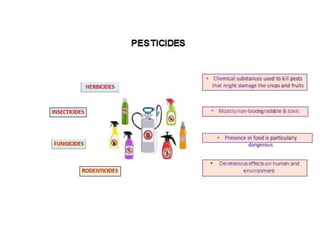
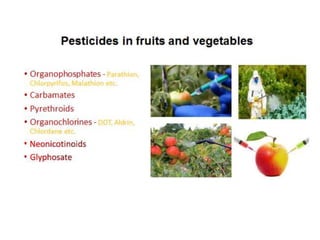
• These are chemicals that are sprayed over crop to
protect it from pests. For example: DDT, BHC, zinc
phosphide, Mercuric chloride, dinitrophenol, etc.
All pesticides are poisonous chemicals and are
used in small quantities with care. Pesticides are
proven to be effective against variety of insects,
weeds and fungi and are respectively called
insecticides, herbicides and fungicides. Most of
the pesticides are non-biodegradable and remain
penetrated as such into plants, fruits and
vegetables.
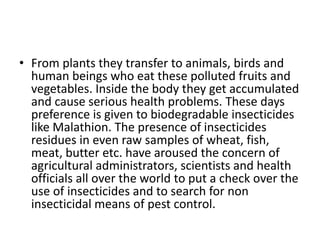
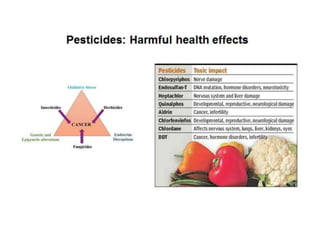
• From plants they transfer to animals, birds and
human beings who eat these polluted fruits and
vegetables. Inside the body they get accumulated
and cause serious health problems. These days
preference is given to biodegradable insecticides
like Malathion. The presence of insecticides
residues in even raw samples of wheat, fish,
meat, butter etc. have aroused the concern of
agricultural administrators, scientists and health
officials all over the world to put a check over the
use of insecticides and to search for non
insecticidal means of pest control.
Materials required
• Mortar and pestle, Beakers, Funnel, Glass rod,
Filter paper, China dish, Water bath, Tripod
stand, Fusion tube, Knife, Test tube
Requirements
• Samples of various fruits and vegetables,
Alcohol, Sodium Metal, Ferric Chloride,
Ferrous Sulphate Crystals, Distilled Water and
Dil. Sulphuric Acid
Theory
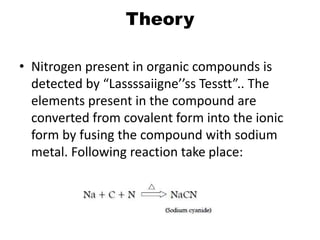
• Nitrogen present in organic compounds is
detected by “Lassssaiigne’’ss Tesstt”.. The
elements present in the compound are
converted from covalent form into the ionic
form by fusing the compound with sodium
metal. Following reaction take place:
• Cyanide of sodium so formed on sodium
fusion is extracted from the fused mass by
boiling it with distilled water. This extract is
known as sodium fusion extract.
Procedure
• 1) Take different types of fruits and vegetables
and cut them into small pieces separately.
• 2) Transfer the cut pieces of various fruits and
vegetables into it separately and crush them.
• 3) Take different kinds for each kind of fruits
and vegetables and place the crushed fruits
and vegetables in these beakers and add 100
ml of alcohol to each of these.
• 4) Stir well and filter.
• 5) Collect the filtrate in separate china dishes,
evaporate the alcohol by heating the china dishes
one by one over a water bath and let the residue
dry in the oven.
• 6) Heat a small piece of sodium in a fusion tube,
till it melts.
• 7) Then add one of the above residues from the
china dish to this fusion tube and heat it till red
hot.
• 8) Drop the hot fusion tube in a china dish
containing about 10 ml of distilled water.
• 9) Break the tube and boil the contents of the
china dish for about 5 minutes.
• 10) Cool and filter the solution.
• 11) Collect the filtrate.
• 12) To the filtrate add 1 ml of freshly prepared
ferrous sulphate solution and warm the
contents.
• 13) Then add 2-3 drops of ferric chloride
solution and acidify with dilute HCl.
• 14) If a blue or green ppt. or coloration is
obtained it indicates the presence of nitrogen
containing insecticides.
• 15) Repeat the test of nitrogen for residues
obtained from other fruits and vegetables and
record the observation.
Observations
Conclusion
• It is concluded that from the above
observations, that each fruit or vegetable
contains nitrogenous insecticide or pesticide
residues in it.
chemistry ppt.pptx

chemistry ppt.pptx

  • 1.
    To Study thePresence of Insecticides and Pesticides in Various Fruits and Vegetables By B.KAILESH AADHITHYAA
  • 2.
    Acknowledgement • I wouldlike to thank my chemistry teacher, Mrs.Shanmugavadivu for guiding me throughout this project work. I would also thank our lab assistant who helped me to set up the project and helped me in practical works. I would also like to thank my parents for their support whenever I needed it. I also cannot forget to thank my friends who helped me a lot to complete this project in the time frame.Finally, I would like to thank everyone involved in this project work.
  • 3.
    Abstract • To Studythe Presence of Insecticides and Pesticides in Various Fruits and Vegetables. • In the past decade there has been a tremendous increase in the yields of various crops to meet the demand of overgrowing population, achieved by using pesticides and insecticides.
  • 4.
    • These arechemicals that are sprayed over crop to protect it from pests. For example: DDT, BHC, zinc phosphide, Mercuric chloride, dinitrophenol, etc. All pesticides are poisonous chemicals and are used in small quantities with care. Pesticides are proven to be effective against variety of insects, weeds and fungi and are respectively called insecticides, herbicides and fungicides. Most of the pesticides are non-biodegradable and remain penetrated as such into plants, fruits and vegetables.
  • 6.
    • From plantsthey transfer to animals, birds and human beings who eat these polluted fruits and vegetables. Inside the body they get accumulated and cause serious health problems. These days preference is given to biodegradable insecticides like Malathion. The presence of insecticides residues in even raw samples of wheat, fish, meat, butter etc. have aroused the concern of agricultural administrators, scientists and health officials all over the world to put a check over the use of insecticides and to search for non insecticidal means of pest control.
  • 11.
    Materials required • Mortarand pestle, Beakers, Funnel, Glass rod, Filter paper, China dish, Water bath, Tripod stand, Fusion tube, Knife, Test tube
  • 12.
    Requirements • Samples ofvarious fruits and vegetables, Alcohol, Sodium Metal, Ferric Chloride, Ferrous Sulphate Crystals, Distilled Water and Dil. Sulphuric Acid
  • 13.
    Theory • Nitrogen presentin organic compounds is detected by “Lassssaiigne’’ss Tesstt”.. The elements present in the compound are converted from covalent form into the ionic form by fusing the compound with sodium metal. Following reaction take place:
  • 14.
    • Cyanide ofsodium so formed on sodium fusion is extracted from the fused mass by boiling it with distilled water. This extract is known as sodium fusion extract.
  • 15.
    Procedure • 1) Takedifferent types of fruits and vegetables and cut them into small pieces separately. • 2) Transfer the cut pieces of various fruits and vegetables into it separately and crush them. • 3) Take different kinds for each kind of fruits and vegetables and place the crushed fruits and vegetables in these beakers and add 100 ml of alcohol to each of these. • 4) Stir well and filter.
  • 16.
    • 5) Collectthe filtrate in separate china dishes, evaporate the alcohol by heating the china dishes one by one over a water bath and let the residue dry in the oven. • 6) Heat a small piece of sodium in a fusion tube, till it melts. • 7) Then add one of the above residues from the china dish to this fusion tube and heat it till red hot. • 8) Drop the hot fusion tube in a china dish containing about 10 ml of distilled water.
  • 17.
    • 9) Breakthe tube and boil the contents of the china dish for about 5 minutes. • 10) Cool and filter the solution. • 11) Collect the filtrate. • 12) To the filtrate add 1 ml of freshly prepared ferrous sulphate solution and warm the contents.
  • 18.
    • 13) Thenadd 2-3 drops of ferric chloride solution and acidify with dilute HCl. • 14) If a blue or green ppt. or coloration is obtained it indicates the presence of nitrogen containing insecticides. • 15) Repeat the test of nitrogen for residues obtained from other fruits and vegetables and record the observation.
  • 19.
  • 20.
    Conclusion • It isconcluded that from the above observations, that each fruit or vegetable contains nitrogenous insecticide or pesticide residues in it.