Pharma 2020
- the case to improve
innovation
14th April 2015
PwC
3 November 2014
Draft
Jo Pisani
Partner
PwC Strategy
Pharmaceuticals & Life
Sciences, London
+44 20 7804 3744,
jo.pisani@uk.pwc.com
Jo lead PwC’s UK pharmaceuticals
and life sciences consulting team
and focuses on business strategy,
valuations, portfolio management
and commercial due diligence.
The business model is broken in AMR • New funding models
PwC
14th April 2015
Pharma 2020 Series
http://www.pwc.com/pharma2020
3
Pharma 2020 – From vision to decision •
Agenda
1 The market imperative for change
2 New Commercial models in practice – a UK story
3
Generating the commercial incentive for R&D - The broken
business in AMR
PwC
3 November 2014
The market imperative for change
1
The business model is broken in AMR • New funding models
PwC
3 November 2014
Draft
United
States
$393
Canada
$29
EU-Big 5
$193
Japan
$139
Growth
markets
$489
ROW
$264United
States
$347
Canada
$25
EU-Big 5
$195
Japan
$113
Growth
markets
$232
ROW
$185
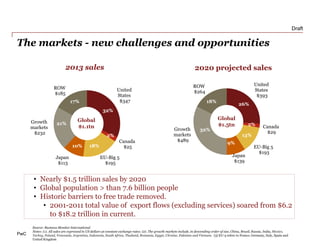
The markets - new challenges and opportunities
2013 sales
• Nearly $1.5 trillion sales by 2020
• Global population > than 7.6 billion people
• Historic barriers to free trade removed.
• 2001-2011 total value of export flows (excluding services) soared from $6.2
to $18.2 trillion in current.
2020 projected sales
Global
$1.5tn
26%
13%
9%
2%
18%
32%
17%
21%
32%
10% 18%
2%
Global
$1.1tn
The business model is broken in AMR • New funding modelsSource: Business Monitor International
Notes: (1). All sales are expressed in US dollars at constant exchange rates; (2). The growth markets include, in descending order of size, China, Brazil, Russia, India, Mexico,
Turkey, Poland, Venezuela, Argentina, Indonesia, South Africa, Thailand, Romania, Egypt, Ukraine, Pakistan and Vietnam. (3) EU-5 refers to France, Germany, Italy, Spain and
United Kingdom
PwC
14th April 2015
Greece
$7.40
Ireland
$3.00
Italy
$23.40
Portugal
$4.00
Spain
$29.70
Greece
$7.50
Ireland
$2.80
Italy
$27.60
Portugal
$4.60
Spain
$31.80
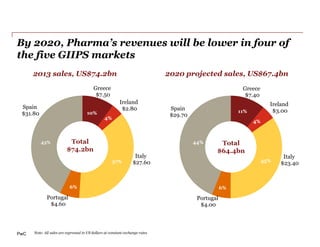
By 2020, Pharma’s revenues will be lower in four of
the five GIIPS markets
Source: Business Monitor International
Note: All sales are expressed in US dollars at constant exchange rates
2020 projected sales, US$67.4bn2013 sales, US$74.2bn
Total
$74.2bn
Total
$64.4bn
37%
43%
10%
4%
44%
35%
6%
11%
4%
6%
The business model is broken in AMR • New funding models
PwC
14th April 2015
Chronic diseases are still exerting extreme pressure
on healthcare expenditure
Older population
• >13% of the population will be 60 or older by 2020 , dementia doubles every five years >
65.
• 100 million Alzheimer sufferers by 2050.
Obesity
• By 2020 >12% of the global population will be overweight or obese. >500m people.
• 44% of the diabetes burden, 23% of the ischaemic heart disease burden and up to 41% of
certain cancer burdens are attributable to overweight and obesity.
Cardiovascular disease (CVD)
• Today 16m people die from CVD every year in developed and developing economies.
• Expect a 200% to 400% rise in developing world by 2030. Death toll could be 25 - 50m in
20 years.
Hypertension
• Globally 25% (>970m) of the population had hypertension in 2000 - 330m in developed
countries; 640m in developing countries, >1.5bn cases of hypertension by 2025
Diabetes
• Age and obesity drive diabetes increase. In the US alone some 11.3% of adults – rising to
26.9% of those aged 65-plus. Another 35% – rising to 50% of those aged 65-plus – have
prediabetes. Slide 8
More people are living longer with
chronic diseases which were
previously fatal
HONDA’s
PwC
14th April 2015
What the US Affordable Care Act means for pharma
Slide 9
Loss revenue of $155 billion in US branded
pharmaceuticals over the next decade – Medicare Part
D discounts, Medicaid rebates, industry fees and
biosimilars
Financial impact
Modest increase in sales of $15 billion from expanded
insurance coverageModest sales increase
2.3% medical device tax remains in playMedical device tax
Continue to adjust business model towards outcomes
based contracting. 80% of insurers now require
evidence of cost savings or a clear benefit to include
new products in their formularies
Outcomes based
contracting
PCORI (Patient-Centered Outcomes Research
Institute) sponsored clinical effectiveness research
raises expectations of value for drugs and medical
devices
PCORI
PwC
14th April 2015
• 2010 Bundestag passed the AMNOG health billGermany
• UK spending on drugs capped and managed through rebates
• Value based assessments continue rather than value based pricingUnited Kingdom
• The French social health insurance system offers doctors individual guidance on
rational prescribing since 2009France
• Investigating the idea of developing a pan-national body to negotiate drug prices,
• Examining the feasibility of performing real-time evaluations of medicines.Canada
• Imposed a 1.26% cut in prices in April 2012 (using total healthcare expenditure as its
base)
• The Central Social Insurance Medical Council is considering health technology
assessments by 2014-2016.
Japan
Tough talk in the EU, Canada and Japan
Slide 10
PwC
14th April 2015
• 2010 Bundestag passed the AMNOG health billGermany
• UK spending on drugs capped and managed through rebates
• Value based assessments continue rather than value based pricingUnited Kingdom
• The French social health insurance system offers doctors individual guidance on
rational prescribing since 2009France
• Investigating the idea of developing a pan-national body to negotiate drug prices,
• Examining the feasibility of performing real-time evaluations of medicines.Canada
• Imposed a 1.26% cut in prices in April 2012 (using total healthcare expenditure as its
base)
• The Central Social Insurance Medical Council is considering health technology
assessments by 2014-2016.
Japan
Tough talk in the EU, Canada and Japan
Generic spending will rise by $35-40
billion over the next five years. 60% of the
increase coming from greater utilisation of
existing generics
Healthcare payers: give us medicines
clinically and economically better than
what’s already available
8
The business model is broken in AMR • New funding models
Section 1 – The business model is broken in AMR
PwC
14th April 2015
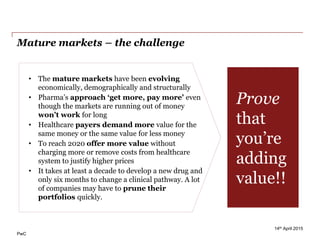
Mature markets – the challenge
Prove
that
you’re
adding
value!!
• The mature markets have been evolving
economically, demographically and structurally
• Pharma’s approach ‘get more, pay more’ even
though the markets are running out of money
won’t work for long
• Healthcare payers demand more value for the
same money or the same value for less money
• To reach 2020 offer more value without
charging more or remove costs from healthcare
system to justify higher prices
• It takes at least a decade to develop a new drug and
only six months to change a clinical pathway. A lot
of companies may have to prune their
portfolios quickly.
The business model is broken in AMR • New funding models
PwC
14th April 2015
China
$86.58
Brazil
$26.40Russia
$24.68
India
$15.43
Fast
followers
$78.41
Rising demand for medicines in the growth markets
China
$187.73
Brazil
$44.22Russia
$42.74
India
$32.66
Fast
followers
$183.98
34%
7%
11%
11%
37% 38%
7%
9% 9%
37%
2020 projected sales, US$491bn2013 sales, US$232bn
Total
$491bn
Total
$232bn
17 markets, >$491 billion a year by 2020 – up from $232 billion in 2013
The business model is broken in AMR • New funding models
Source: Business Monitor International
Notes: (1) All sales are expressed in US dollars at constant exchange rates; (2) The fast followers include Argentina, Egypt, Indonesia, Mexico, Pakistan, Poland, Romania, South Africa, Thailand,
Turkey, Ukraine, Venezuela and Vietnam.
PwC
14th April 2015
Patients in the growth markets can’t afford costly
biologics
Private share of
healthcare
expenditure (%)
Per capita health
spending, 2010,
US$
Population with
net assets of
US$10,000 or
less (%)
Brazil 53.0 990 66.6
China 46.4 221 58.4
India 70.8 54 94.4
Mexico 51.0 603 53.5
Russia 37.9 525 93.7
US 46.9 8,362 30.7
EU 5 22.3 3,799 22.0
Australia 31.5 5,187 6.9
Slide 14
Sources: World Bank Indicators and Credit Suisse, ‘Global Wealth Databook’ (October 2013)
EU5= France, Germany, Italy, Spain, United Kingdom
The business model is broken in AMR • New funding models
PwC
14th April 2015
Generic medicines will dominate, an estimated
$63.8bn expected from patented products
8.8
30
3.3
3.9
44
-26.2
15.3
60.2
24.2
10.9
42.1
11.9
-40 -20 0 20 40 60 80 100
Brazil
China
India
Russia
USA
EU-Big 5
US$ billions
Additional spending on patented products (2020) Additional spending on generics (2020)
Slide 15
Source: Business Monitor International
Note: All growth is expressed in nominal US dollars (including inflation and projected exchange rate changes).
The business model is broken in AMR • New funding models
PwC
3 November 2014
New Commercial models in practice
– a UK story
1
The business model is broken in AMR • New funding models
PwC
14th April 2015
Whole system
approach
Regulatory
and Ethics
approval
Speed of
recruitment
& patient
pools
Connected
infrastructure
Develop-
ment
funding
Talent &
scientific
rigour
Innovation
uptake
Whole systems approaches to patient centred care need to be
adopted
New models of
leadership should be:
• focussed on delivery
and outcomes – not
where in the system
the blame will lie if a
hurdle isn’t
overcome
• collaborative and
open
• skilled in science,
policy and health
care
• have a global outlook
and sees partnership
possibilities
The business model is broken in AMR • New funding models
PwC
14th April 2015
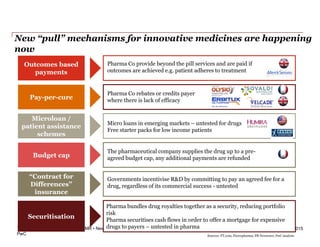
Pay-per-cure
Outcomes based
payments
Microloan /
patient assistance
schemes
“Contract for
Differences”
insurance
New “pull” mechanisms for innovative medicines are happening
now
Pharma Co rebates or credits payer
where there is lack of efficacy
Governments incentivise R&D by committing to pay an agreed fee for a
drug, regardless of its commercial success - untested
Micro loans in emerging markets – untested for drugs
Free starter packs for low income patients
Pharma Co provide beyond the pill services and are paid if
outcomes are achieved e.g. patient adheres to treatment
Sources: FT.com; Fiercepharma; PR Newswire; PwC analysis
Budget cap
The pharmaceutical company supplies the drug up to a pre-
agreed budget cap, any additional payments are refunded
The business model is broken in AMR • New funding models
Securitisation
Pharma bundles drug royalties together as a security, reducing portfolio
risk
Pharma securitises cash flows in order to offer a mortgage for expensive
drugs to payers – untested in pharma
PwC
14th April 2015
25
The business model is broken in AMR • New funding models
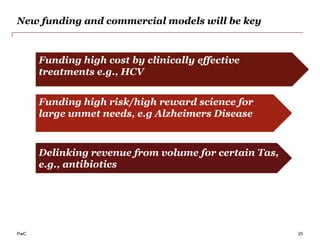
Section 4 –
Delinking revenue from volume for certain Tas,
e.g., antibiotics
Funding high cost by clinically effective
treatments e.g., HCV
Funding high risk/high reward science for
large unmet needs, e.g Alzheimers Disease
New funding and commercial models will be key
PwC
3 November 2014
Generating the commercial incentive
for R&D - The broken business in
AMR
1
The business model is broken in AMR • New funding models
PwC
3 November 2014
Draft
3
The business model is broken in AMR • New funding models
Section 1 – The business model is broken in AMR
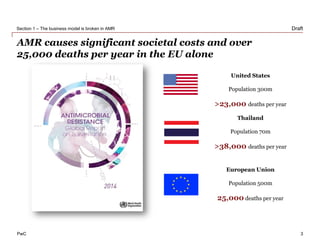
European Union
Population 500m
25,000 deaths per year
Thailand
Population 70m
>38,000 deaths per year
United States
Population 300m
>23,000 deaths per year
AMR causes significant societal costs and over
25,000 deaths per year in the EU alone
PwC
3 November 2014
Draft
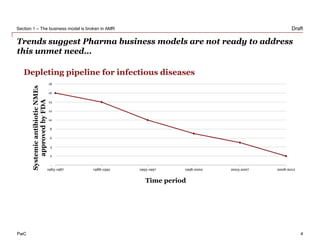
Trends suggest Pharma business models are not ready to address
this unmet need…
4
The business model is broken in AMR • New funding models
Section 1 – The business model is broken in AMR
-
2
4
6
8
10
12
14
16
18
1983-1987 1988-1992 1993-1997 1998-2002 2003-2007 2008-2012
SystemicantibioticNMEs
approvedbyFDA
Time period
Depleting pipeline for infectious diseases
PwC
3 November 2014
Draft
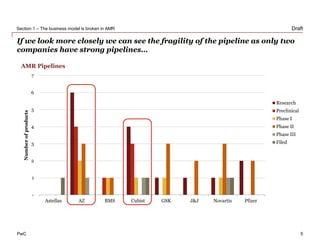
If we look more closely we can see the fragility of the pipeline as only two
companies have strong pipelines…
5
The business model is broken in AMR • New funding models
Section 1 – The business model is broken in AMR
-
1
2
3
4
5
6
7
Astellas AZ BMS Cubist GSK J&J Novartis Pfizer
Numberofproducts
AMR Pipelines
Research
Preclinical
Phase I
Phase II
Phase III
Filed
PwC
3 November 2014
Draft
8
The business model is broken in AMR • New funding models
Section 1 – The business model is broken in AMR
Leaders have emphasised the need to act now
Who carries the responsibility if no change happens?
“Unless we solve the problem of antimicrobial resistance to drugs, we will
be facing a post-antibiotic era where things as common as a strep throat
infection or a child's scratched knee could once again kill.”
Dr Margaret Chan,
Director General, WHO
“Resistance to antibiotics risks health 'catastrophe' to rank with terrorism
and climate change”
Dame Sally Davies,
Chief Medical Officer (CMO)
“If we fail to act, we are looking at an almost unthinkable scenario where
antibiotics no longer work and we are cast back into the dark ages of
medicine where treatable infections and injuries will kill once again.“
David Cameron,
Prime Minister
PwC
3 November 2014
Draft
24
The business model is broken in AMR • New funding models
Section 4 –
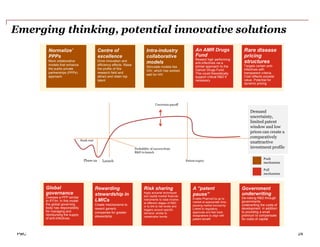
Emerging thinking, potential innovative solutions
Demand
uncertainty,
limited patent
window and low
prices can create a
comparatively
unattractive
investment profile
Global
governance
Oversee a PPP similar
to IFFIm. In this model
the global governing
body has responsibility
for managing and
reimbursing the supply
of anti-infectives.
Rewarding
stewardship in
LMICs
Create mechanisms to
reward generic
companies for greater
stewardship
Risk sharing
Apply actuarial techniques
and capital market financial
instruments to raise income
at different stages of R&D
or to link to risk levels and
triggers around specific
demand, similar to
catastrophe bonds.
A “patent
pause”
Enable PharmaCos go to
market at appropriate time,
pausing market exclusivity.
Linked to regulatory
approvals and fast track
designations to align with
patient benefit
Government
underwriting
De-risking R&D through
governments
underwriting the costs of
development in addition
to providing a small
premium to compensate
for costs of capital
Normalize’
PPPs
More collaborative
models that enhance
the public-private
partnerships (PPPs)
approach
Centre of
excellence
Drive innovation and
efficiency effects. Raise
the profile of this
research field and
attract and retain top
talent
Intra-industry
collaborative
models
Stimulate models like
ViiV, which has worked
well for HIV
An AMR Drugs
Fund
Reward high performing
anti-infectives via a
similar approach to the
Cancer Drugs Fund.
This could theoretically
support critical R&D if
necessary
Rare disease
pricing
structures
Targets certain anti-
infectives with
transparent criteria.
Cost reflects societal
value. Potential for
dynamic pricing
Push
mechanism
Pull
mechanism
PwC
3 November 2014
In summary
22
The business model is broken in AMR • New funding models
• Pricing, market access and innovative
funding will become increasingly critical
• Solutions require a long term view from
lifesciences, payers and providers
• Access to real world evidence is key for
success
• Innovation in technology, Big Data and
business models will be key
Thank you
This publication has been prepared for general guidance on matters of interest only, and does not constitute professional advice. You
should not act upon the information contained in this publication without obtaining specific professional advice. No representation or
warranty (express or implied) is given as to the accuracy or completeness of the information contained in this publication, and, to the
extent permitted by law, PricewaterhouseCoopers LLP, its members, employees and agents do not accept or assume any liability,
responsibility or duty of care for any consequences of you or anyone else acting, or refraining to act, in reliance on the information
contained in this publication or for any decision based on it.
© 2015 PricewaterhouseCoopers LLP. All rights reserved. In this document, "PwC" refers to PricewaterhouseCoopers LLP (a limited
liability partnership in the United Kingdom), which is a member firm of PricewaterhouseCoopers International Limited, each member
firm of which is a separate legal entity. Design: HB6638

Pistoia Alliance European Conference 2015 - Jo Pisani / PwC

  • 1.
    Pharma 2020 - thecase to improve innovation 14th April 2015
  • 2.
    PwC 3 November 2014 Draft JoPisani Partner PwC Strategy Pharmaceuticals & Life Sciences, London +44 20 7804 3744, jo.pisani@uk.pwc.com Jo lead PwC’s UK pharmaceuticals and life sciences consulting team and focuses on business strategy, valuations, portfolio management and commercial due diligence. The business model is broken in AMR • New funding models
  • 3.
    PwC 14th April 2015 Pharma2020 Series http://www.pwc.com/pharma2020 3 Pharma 2020 – From vision to decision •
  • 4.
    Agenda 1 The marketimperative for change 2 New Commercial models in practice – a UK story 3 Generating the commercial incentive for R&D - The broken business in AMR
  • 5.
    PwC 3 November 2014 Themarket imperative for change 1 The business model is broken in AMR • New funding models
  • 6.
    PwC 3 November 2014 Draft United States $393 Canada $29 EU-Big5 $193 Japan $139 Growth markets $489 ROW $264United States $347 Canada $25 EU-Big 5 $195 Japan $113 Growth markets $232 ROW $185 The markets - new challenges and opportunities 2013 sales • Nearly $1.5 trillion sales by 2020 • Global population > than 7.6 billion people • Historic barriers to free trade removed. • 2001-2011 total value of export flows (excluding services) soared from $6.2 to $18.2 trillion in current. 2020 projected sales Global $1.5tn 26% 13% 9% 2% 18% 32% 17% 21% 32% 10% 18% 2% Global $1.1tn The business model is broken in AMR • New funding modelsSource: Business Monitor International Notes: (1). All sales are expressed in US dollars at constant exchange rates; (2). The growth markets include, in descending order of size, China, Brazil, Russia, India, Mexico, Turkey, Poland, Venezuela, Argentina, Indonesia, South Africa, Thailand, Romania, Egypt, Ukraine, Pakistan and Vietnam. (3) EU-5 refers to France, Germany, Italy, Spain and United Kingdom
  • 7.
    PwC 14th April 2015 Greece $7.40 Ireland $3.00 Italy $23.40 Portugal $4.00 Spain $29.70 Greece $7.50 Ireland $2.80 Italy $27.60 Portugal $4.60 Spain $31.80 By2020, Pharma’s revenues will be lower in four of the five GIIPS markets Source: Business Monitor International Note: All sales are expressed in US dollars at constant exchange rates 2020 projected sales, US$67.4bn2013 sales, US$74.2bn Total $74.2bn Total $64.4bn 37% 43% 10% 4% 44% 35% 6% 11% 4% 6% The business model is broken in AMR • New funding models
  • 8.
    PwC 14th April 2015 Chronicdiseases are still exerting extreme pressure on healthcare expenditure Older population • >13% of the population will be 60 or older by 2020 , dementia doubles every five years > 65. • 100 million Alzheimer sufferers by 2050. Obesity • By 2020 >12% of the global population will be overweight or obese. >500m people. • 44% of the diabetes burden, 23% of the ischaemic heart disease burden and up to 41% of certain cancer burdens are attributable to overweight and obesity. Cardiovascular disease (CVD) • Today 16m people die from CVD every year in developed and developing economies. • Expect a 200% to 400% rise in developing world by 2030. Death toll could be 25 - 50m in 20 years. Hypertension • Globally 25% (>970m) of the population had hypertension in 2000 - 330m in developed countries; 640m in developing countries, >1.5bn cases of hypertension by 2025 Diabetes • Age and obesity drive diabetes increase. In the US alone some 11.3% of adults – rising to 26.9% of those aged 65-plus. Another 35% – rising to 50% of those aged 65-plus – have prediabetes. Slide 8 More people are living longer with chronic diseases which were previously fatal HONDA’s
  • 9.
    PwC 14th April 2015 Whatthe US Affordable Care Act means for pharma Slide 9 Loss revenue of $155 billion in US branded pharmaceuticals over the next decade – Medicare Part D discounts, Medicaid rebates, industry fees and biosimilars Financial impact Modest increase in sales of $15 billion from expanded insurance coverageModest sales increase 2.3% medical device tax remains in playMedical device tax Continue to adjust business model towards outcomes based contracting. 80% of insurers now require evidence of cost savings or a clear benefit to include new products in their formularies Outcomes based contracting PCORI (Patient-Centered Outcomes Research Institute) sponsored clinical effectiveness research raises expectations of value for drugs and medical devices PCORI
  • 10.
    PwC 14th April 2015 •2010 Bundestag passed the AMNOG health billGermany • UK spending on drugs capped and managed through rebates • Value based assessments continue rather than value based pricingUnited Kingdom • The French social health insurance system offers doctors individual guidance on rational prescribing since 2009France • Investigating the idea of developing a pan-national body to negotiate drug prices, • Examining the feasibility of performing real-time evaluations of medicines.Canada • Imposed a 1.26% cut in prices in April 2012 (using total healthcare expenditure as its base) • The Central Social Insurance Medical Council is considering health technology assessments by 2014-2016. Japan Tough talk in the EU, Canada and Japan Slide 10
  • 11.
    PwC 14th April 2015 •2010 Bundestag passed the AMNOG health billGermany • UK spending on drugs capped and managed through rebates • Value based assessments continue rather than value based pricingUnited Kingdom • The French social health insurance system offers doctors individual guidance on rational prescribing since 2009France • Investigating the idea of developing a pan-national body to negotiate drug prices, • Examining the feasibility of performing real-time evaluations of medicines.Canada • Imposed a 1.26% cut in prices in April 2012 (using total healthcare expenditure as its base) • The Central Social Insurance Medical Council is considering health technology assessments by 2014-2016. Japan Tough talk in the EU, Canada and Japan Generic spending will rise by $35-40 billion over the next five years. 60% of the increase coming from greater utilisation of existing generics Healthcare payers: give us medicines clinically and economically better than what’s already available 8 The business model is broken in AMR • New funding models Section 1 – The business model is broken in AMR
  • 12.
    PwC 14th April 2015 Maturemarkets – the challenge Prove that you’re adding value!! • The mature markets have been evolving economically, demographically and structurally • Pharma’s approach ‘get more, pay more’ even though the markets are running out of money won’t work for long • Healthcare payers demand more value for the same money or the same value for less money • To reach 2020 offer more value without charging more or remove costs from healthcare system to justify higher prices • It takes at least a decade to develop a new drug and only six months to change a clinical pathway. A lot of companies may have to prune their portfolios quickly. The business model is broken in AMR • New funding models
  • 13.
    PwC 14th April 2015 China $86.58 Brazil $26.40Russia $24.68 India $15.43 Fast followers $78.41 Risingdemand for medicines in the growth markets China $187.73 Brazil $44.22Russia $42.74 India $32.66 Fast followers $183.98 34% 7% 11% 11% 37% 38% 7% 9% 9% 37% 2020 projected sales, US$491bn2013 sales, US$232bn Total $491bn Total $232bn 17 markets, >$491 billion a year by 2020 – up from $232 billion in 2013 The business model is broken in AMR • New funding models Source: Business Monitor International Notes: (1) All sales are expressed in US dollars at constant exchange rates; (2) The fast followers include Argentina, Egypt, Indonesia, Mexico, Pakistan, Poland, Romania, South Africa, Thailand, Turkey, Ukraine, Venezuela and Vietnam.
  • 14.
    PwC 14th April 2015 Patientsin the growth markets can’t afford costly biologics Private share of healthcare expenditure (%) Per capita health spending, 2010, US$ Population with net assets of US$10,000 or less (%) Brazil 53.0 990 66.6 China 46.4 221 58.4 India 70.8 54 94.4 Mexico 51.0 603 53.5 Russia 37.9 525 93.7 US 46.9 8,362 30.7 EU 5 22.3 3,799 22.0 Australia 31.5 5,187 6.9 Slide 14 Sources: World Bank Indicators and Credit Suisse, ‘Global Wealth Databook’ (October 2013) EU5= France, Germany, Italy, Spain, United Kingdom The business model is broken in AMR • New funding models
  • 15.
    PwC 14th April 2015 Genericmedicines will dominate, an estimated $63.8bn expected from patented products 8.8 30 3.3 3.9 44 -26.2 15.3 60.2 24.2 10.9 42.1 11.9 -40 -20 0 20 40 60 80 100 Brazil China India Russia USA EU-Big 5 US$ billions Additional spending on patented products (2020) Additional spending on generics (2020) Slide 15 Source: Business Monitor International Note: All growth is expressed in nominal US dollars (including inflation and projected exchange rate changes). The business model is broken in AMR • New funding models
  • 16.
    PwC 3 November 2014 NewCommercial models in practice – a UK story 1 The business model is broken in AMR • New funding models
  • 17.
    PwC 14th April 2015 Wholesystem approach Regulatory and Ethics approval Speed of recruitment & patient pools Connected infrastructure Develop- ment funding Talent & scientific rigour Innovation uptake Whole systems approaches to patient centred care need to be adopted New models of leadership should be: • focussed on delivery and outcomes – not where in the system the blame will lie if a hurdle isn’t overcome • collaborative and open • skilled in science, policy and health care • have a global outlook and sees partnership possibilities The business model is broken in AMR • New funding models
  • 18.
    PwC 14th April 2015 Pay-per-cure Outcomesbased payments Microloan / patient assistance schemes “Contract for Differences” insurance New “pull” mechanisms for innovative medicines are happening now Pharma Co rebates or credits payer where there is lack of efficacy Governments incentivise R&D by committing to pay an agreed fee for a drug, regardless of its commercial success - untested Micro loans in emerging markets – untested for drugs Free starter packs for low income patients Pharma Co provide beyond the pill services and are paid if outcomes are achieved e.g. patient adheres to treatment Sources: FT.com; Fiercepharma; PR Newswire; PwC analysis Budget cap The pharmaceutical company supplies the drug up to a pre- agreed budget cap, any additional payments are refunded The business model is broken in AMR • New funding models Securitisation Pharma bundles drug royalties together as a security, reducing portfolio risk Pharma securitises cash flows in order to offer a mortgage for expensive drugs to payers – untested in pharma
  • 19.
    PwC 14th April 2015 25 Thebusiness model is broken in AMR • New funding models Section 4 – Delinking revenue from volume for certain Tas, e.g., antibiotics Funding high cost by clinically effective treatments e.g., HCV Funding high risk/high reward science for large unmet needs, e.g Alzheimers Disease New funding and commercial models will be key
  • 20.
    PwC 3 November 2014 Generatingthe commercial incentive for R&D - The broken business in AMR 1 The business model is broken in AMR • New funding models
  • 21.
    PwC 3 November 2014 Draft 3 Thebusiness model is broken in AMR • New funding models Section 1 – The business model is broken in AMR European Union Population 500m 25,000 deaths per year Thailand Population 70m >38,000 deaths per year United States Population 300m >23,000 deaths per year AMR causes significant societal costs and over 25,000 deaths per year in the EU alone
  • 22.
    PwC 3 November 2014 Draft Trendssuggest Pharma business models are not ready to address this unmet need… 4 The business model is broken in AMR • New funding models Section 1 – The business model is broken in AMR - 2 4 6 8 10 12 14 16 18 1983-1987 1988-1992 1993-1997 1998-2002 2003-2007 2008-2012 SystemicantibioticNMEs approvedbyFDA Time period Depleting pipeline for infectious diseases
  • 23.
    PwC 3 November 2014 Draft Ifwe look more closely we can see the fragility of the pipeline as only two companies have strong pipelines… 5 The business model is broken in AMR • New funding models Section 1 – The business model is broken in AMR - 1 2 3 4 5 6 7 Astellas AZ BMS Cubist GSK J&J Novartis Pfizer Numberofproducts AMR Pipelines Research Preclinical Phase I Phase II Phase III Filed
  • 24.
    PwC 3 November 2014 Draft 8 Thebusiness model is broken in AMR • New funding models Section 1 – The business model is broken in AMR Leaders have emphasised the need to act now Who carries the responsibility if no change happens? “Unless we solve the problem of antimicrobial resistance to drugs, we will be facing a post-antibiotic era where things as common as a strep throat infection or a child's scratched knee could once again kill.” Dr Margaret Chan, Director General, WHO “Resistance to antibiotics risks health 'catastrophe' to rank with terrorism and climate change” Dame Sally Davies, Chief Medical Officer (CMO) “If we fail to act, we are looking at an almost unthinkable scenario where antibiotics no longer work and we are cast back into the dark ages of medicine where treatable infections and injuries will kill once again.“ David Cameron, Prime Minister
  • 25.
    PwC 3 November 2014 Draft 24 Thebusiness model is broken in AMR • New funding models Section 4 – Emerging thinking, potential innovative solutions Demand uncertainty, limited patent window and low prices can create a comparatively unattractive investment profile Global governance Oversee a PPP similar to IFFIm. In this model the global governing body has responsibility for managing and reimbursing the supply of anti-infectives. Rewarding stewardship in LMICs Create mechanisms to reward generic companies for greater stewardship Risk sharing Apply actuarial techniques and capital market financial instruments to raise income at different stages of R&D or to link to risk levels and triggers around specific demand, similar to catastrophe bonds. A “patent pause” Enable PharmaCos go to market at appropriate time, pausing market exclusivity. Linked to regulatory approvals and fast track designations to align with patient benefit Government underwriting De-risking R&D through governments underwriting the costs of development in addition to providing a small premium to compensate for costs of capital Normalize’ PPPs More collaborative models that enhance the public-private partnerships (PPPs) approach Centre of excellence Drive innovation and efficiency effects. Raise the profile of this research field and attract and retain top talent Intra-industry collaborative models Stimulate models like ViiV, which has worked well for HIV An AMR Drugs Fund Reward high performing anti-infectives via a similar approach to the Cancer Drugs Fund. This could theoretically support critical R&D if necessary Rare disease pricing structures Targets certain anti- infectives with transparent criteria. Cost reflects societal value. Potential for dynamic pricing Push mechanism Pull mechanism
  • 26.
    PwC 3 November 2014 Insummary 22 The business model is broken in AMR • New funding models • Pricing, market access and innovative funding will become increasingly critical • Solutions require a long term view from lifesciences, payers and providers • Access to real world evidence is key for success • Innovation in technology, Big Data and business models will be key
  • 27.
    Thank you This publicationhas been prepared for general guidance on matters of interest only, and does not constitute professional advice. You should not act upon the information contained in this publication without obtaining specific professional advice. No representation or warranty (express or implied) is given as to the accuracy or completeness of the information contained in this publication, and, to the extent permitted by law, PricewaterhouseCoopers LLP, its members, employees and agents do not accept or assume any liability, responsibility or duty of care for any consequences of you or anyone else acting, or refraining to act, in reliance on the information contained in this publication or for any decision based on it. © 2015 PricewaterhouseCoopers LLP. All rights reserved. In this document, "PwC" refers to PricewaterhouseCoopers LLP (a limited liability partnership in the United Kingdom), which is a member firm of PricewaterhouseCoopers International Limited, each member firm of which is a separate legal entity. Design: HB6638