The CEDAR Workbench for
Metadata Management
Mark A. Musen, M.D., Ph.D.
Stanford University
musen@Stanford.EDU
A Story
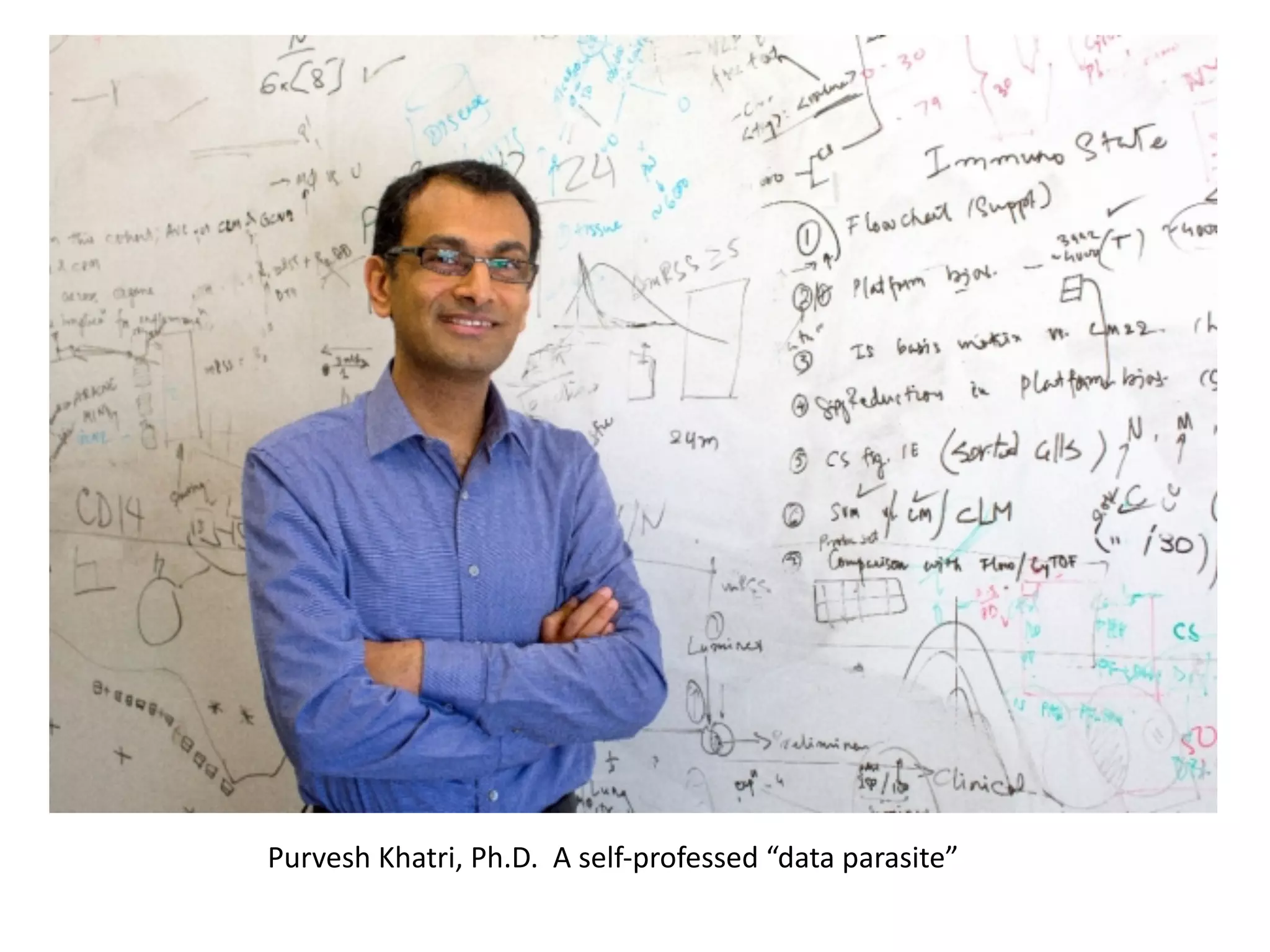
Purvesh Khatri, Ph.D. A self-professed “data parasite”
Gene Expression Omnibus (GEO)
4
Khatri has used GEO to build a career from
the analysis of “other people’s data”
Khatri has a pipeline for
• Searching for datasets in the GEO database
• Elucidating genomic signals
• Confirming those signals in “validation” data
sets
• Making discoveries without ever performing a
primary experiment
Khatri has reused public data sets to
identify genomic signatures …
• For incipient sepsis
• For active tuberculosis
• For distinguishing viral from bacterial
respiratory infection
• For rejection of organ transplants
… and he has never touched a pipette!
But you can be a data parasite only if
scientific data are …
• Available in an accessible repository
• Findable through some sort of search
facility
• Retrievable in a standard format
• Self-describing so that third parties can
make sense of the data
• Intended to be reused, and to outlive the
experiment for which they were collected
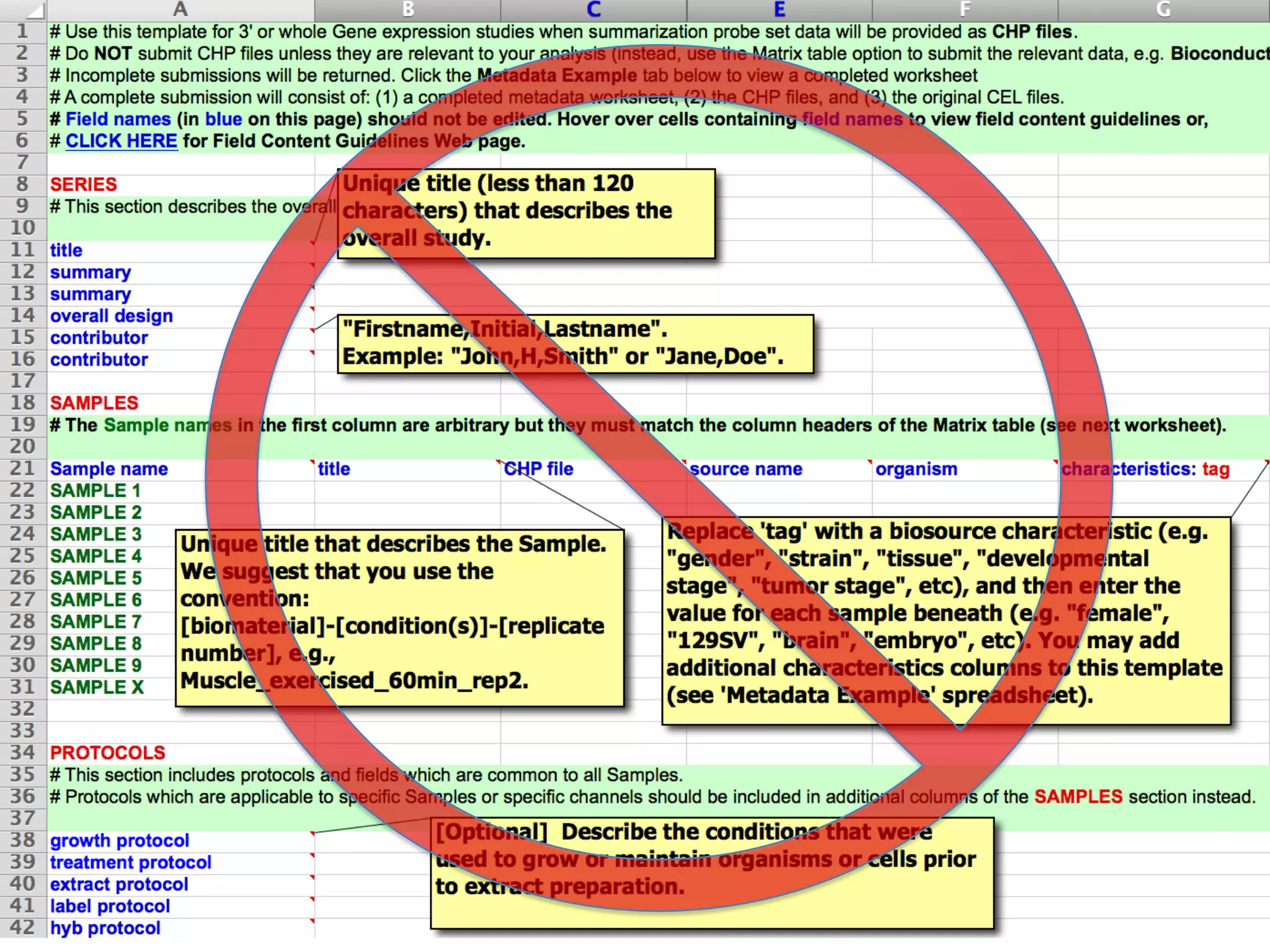
But data in most repositories are a mess!
• Investigators view their work as
publishing papers, not leaving a legacy of
reusable data
• Sponsors—both public and private—may
require data sharing, but they do not
explicitly pay for it
• Creating the metadata to describe data
sets is unbearably hard
age
Age
AGE
`Age
age (after birth)
age (in years)
age (y)
age (year)
age (years)
Age (years)
Age (Years)
age (yr)
age (yr-old)
age (yrs)
Age (yrs)
age [y]
age [year]
age [years]
age in years
age of patient
Age of patient
age of subjects
age(years)
Age(years)
Age(yrs.)
Age, year
age, years
age, yrs
age.year
age_years
Failure to use standard terms makes
datasets often impossible to search
Metadata from NCBI BioSample Stink!
• 73% of “Boolean” metadata values are not
actually true or false
– nonsmoker, former-smoker
• 26% of “integer” metadata values cannot be
parsed into integers
– JM52, UVPgt59.4, pig
• 68% of metadata entries that are supposed to
represent terms from biomedical ontologies do
not actually do so.
– presumed normal, wild_type
At a minimum, science needs
• Open, online access to experimental data sets
• Mechanisms to search for metadata to find
relevant experimental results
• Annotation of online data sets with adequate
metadata
• Use of controlled terms in metadata whenever
possible
• A culture that cares about data sharing,
secondary analyses, and the ability to make new
discoveries from legacy data
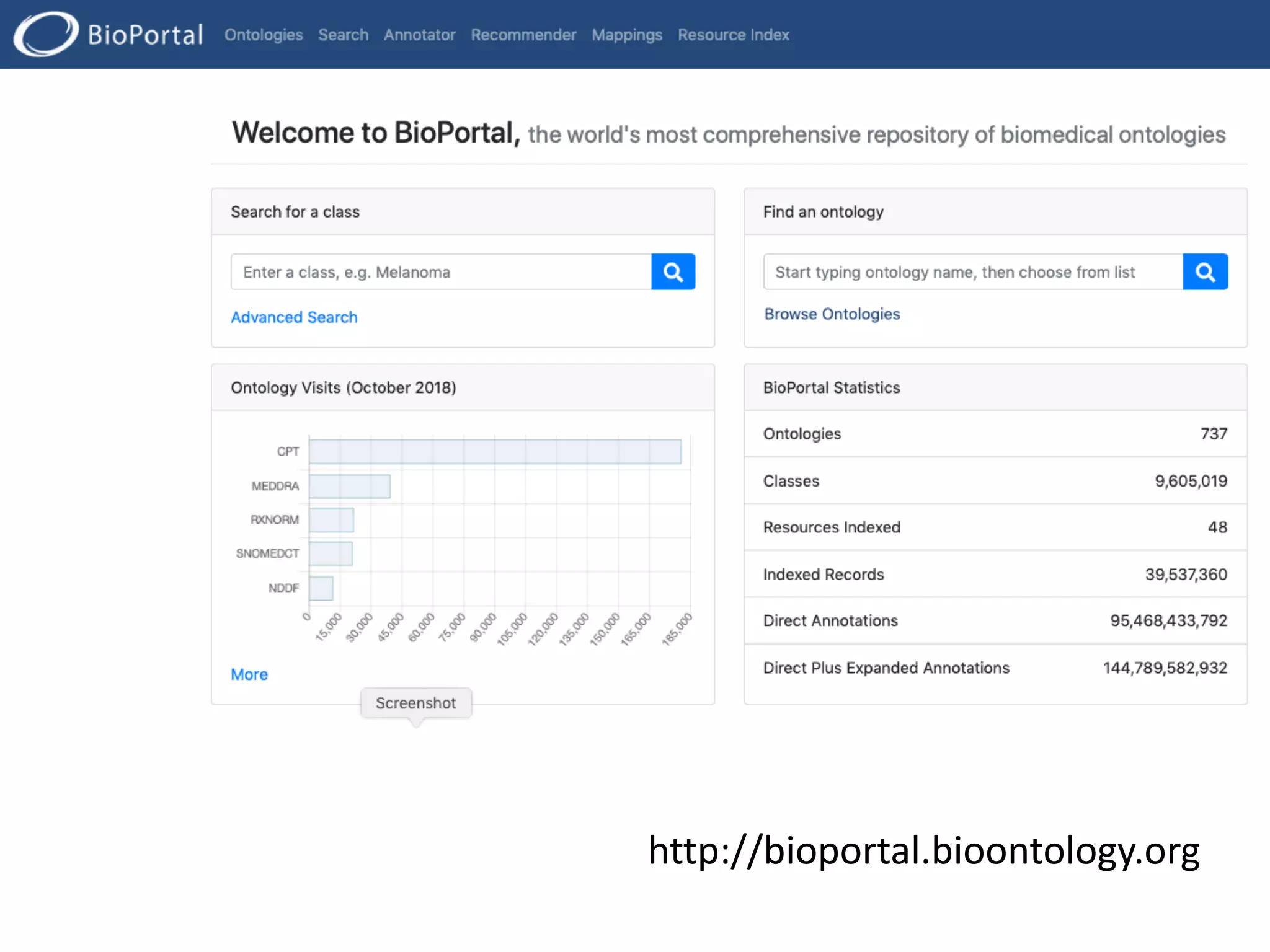
Requirement #1: Standard
ontologies to describe what
exists in a dataset completely
and consistently
http://bioportal.bioontology.org
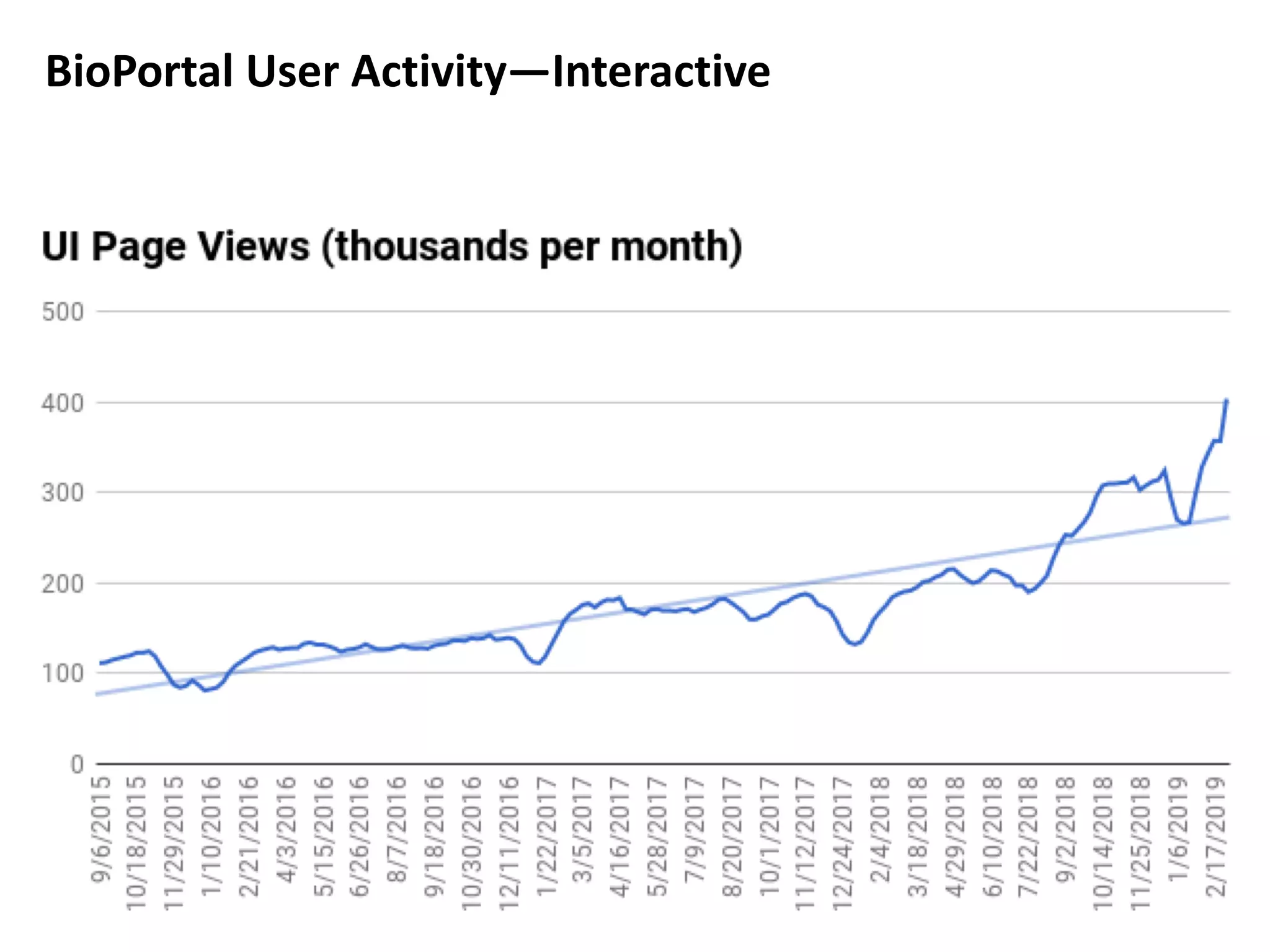
BioPortal User Activity—Interactive
BioPortal User Activity—Programmatic
Requirement #2: Describe
properties of experiments
completely and consistently
When we look at experimental data …
• How can we tell what the data are about?
• How can we search for additional data that we
might be interested in?
• How can we group data into similar
categories?
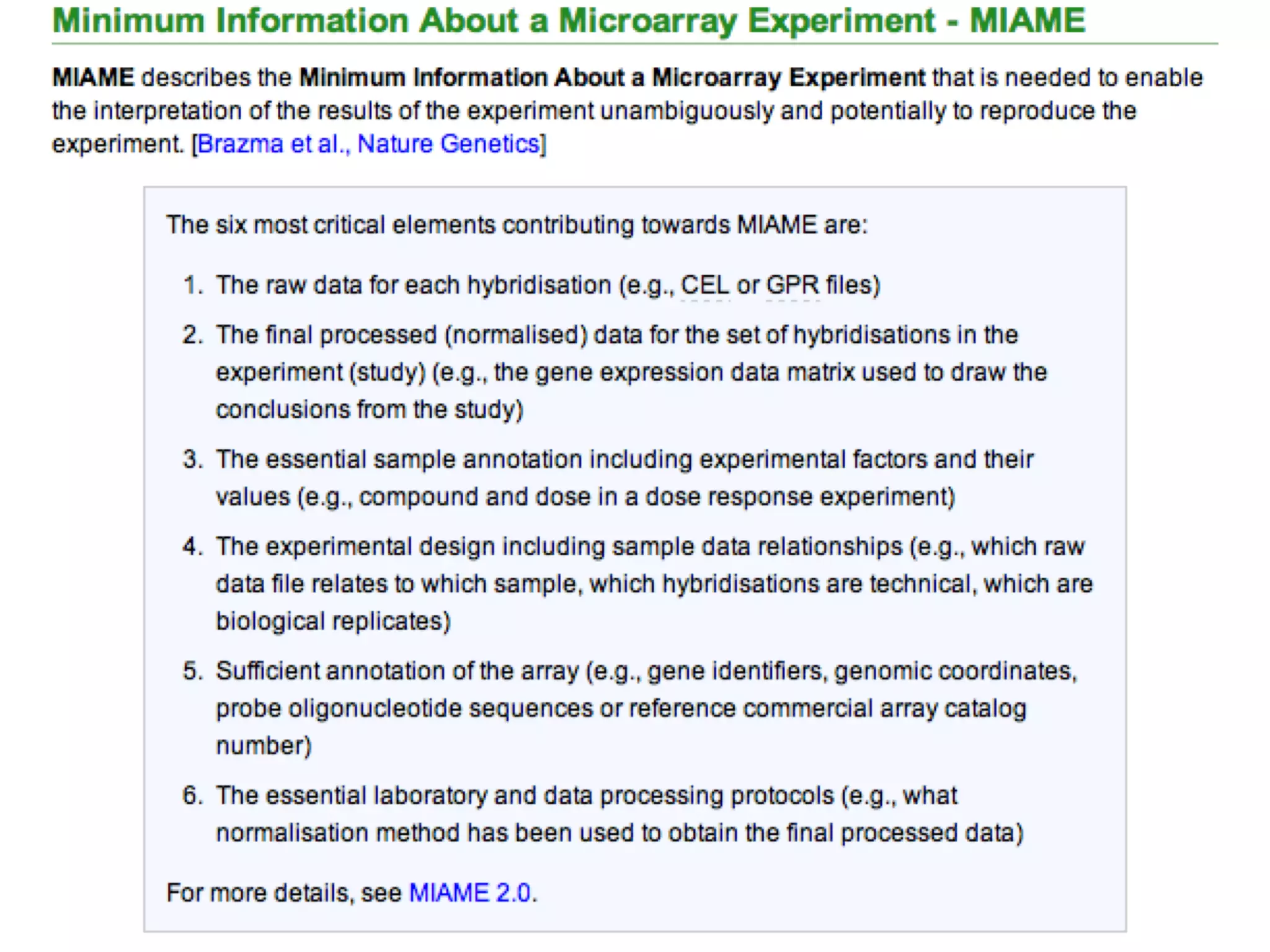
The microarray community took the lead in
standardizing biological metadata
DNA Microarray
— What was the
substrate of the
experiment?
— What array
platform was
used?
— What were the
experimental
conditions?
But it didn’t stop with MIAME!
• Minimal Information About T Cell Assays
(MIATA)
• Minimal Information Required in the
Annotation of biochemical Models (MIRIAM)
• MINImal MEtagemome Sequence analysis
Standard (MINIMESS)
• Minimal Information Specification For In Situ
Hybridization and Immunohistochemistry
Experiments (MISFISHIE)
FAIRsharing.org lists more than
100 guidelines for reporting
experimental data
Guidelines
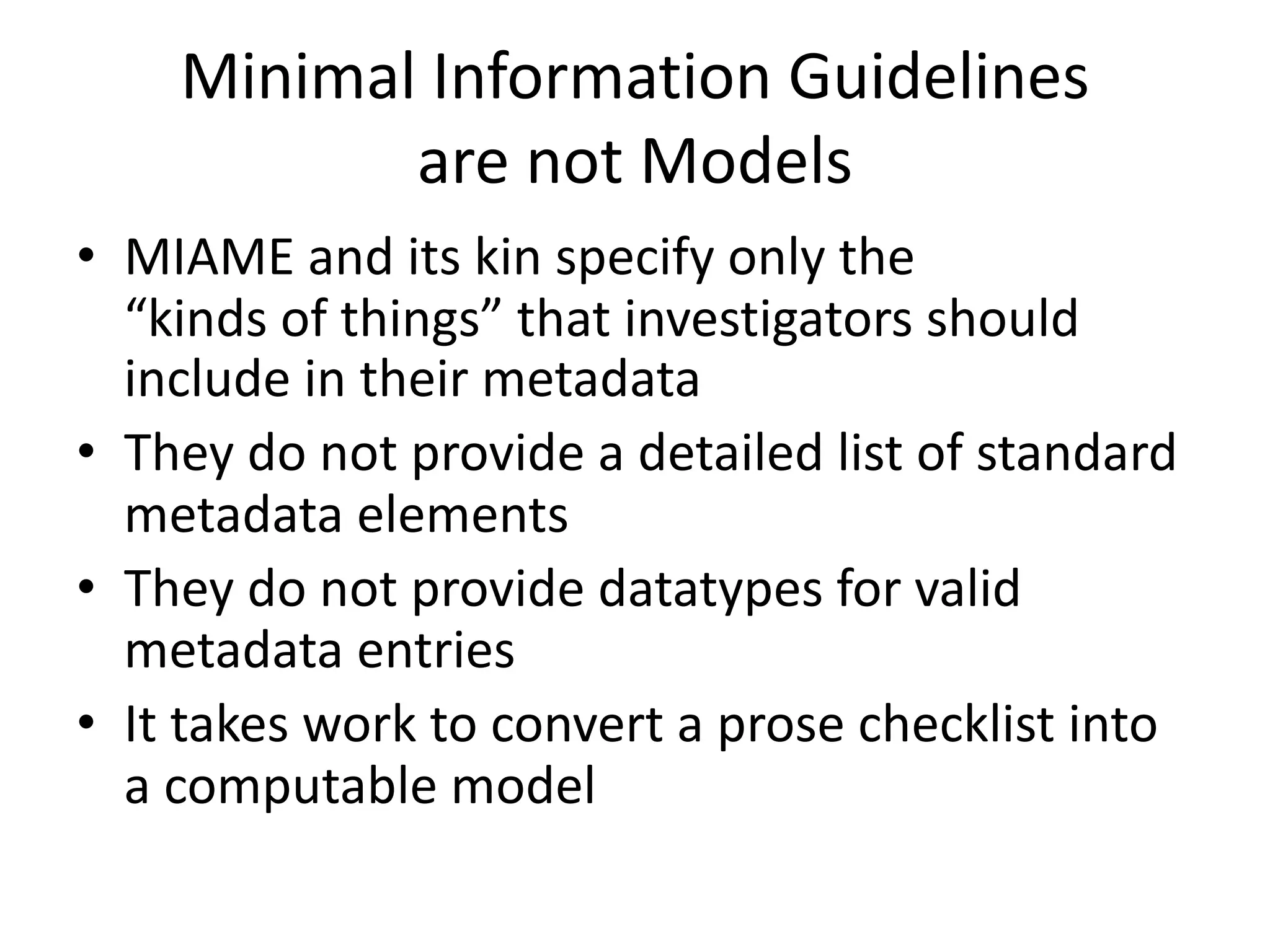
Minimal Information Guidelines
are not Models
• MIAME and its kin specify only the
“kinds of things” that investigators should
include in their metadata
• They do not provide a detailed list of standard
metadata elements
• They do not provide datatypes for valid
metadata entries
• It takes work to convert a prose checklist into
a computable model
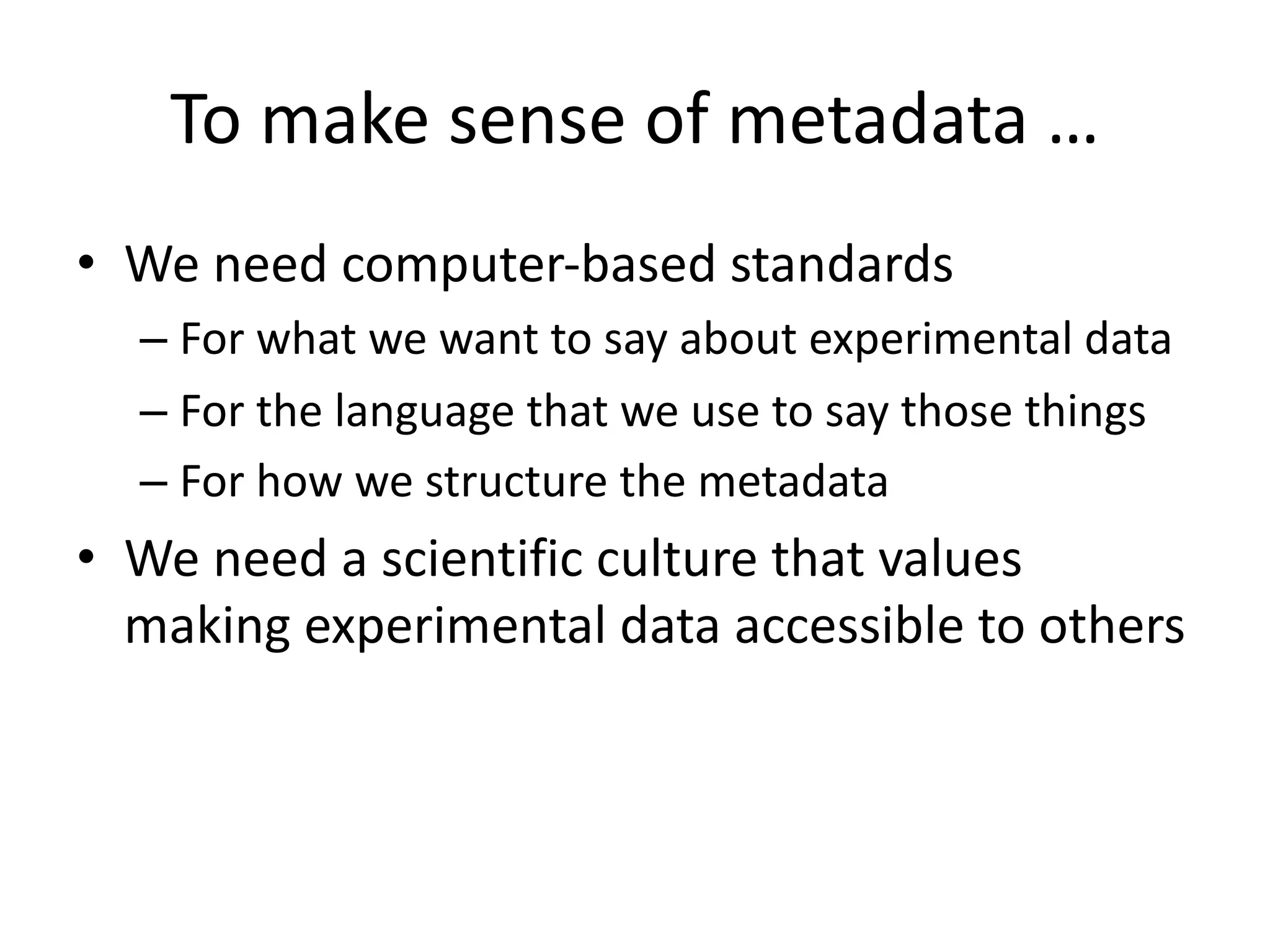
To make sense of metadata …
• We need computer-based standards
– For what we want to say about experimental data
– For the language that we use to say those things
– For how we structure the metadata
• We need a scientific culture that values
making experimental data accessible to others
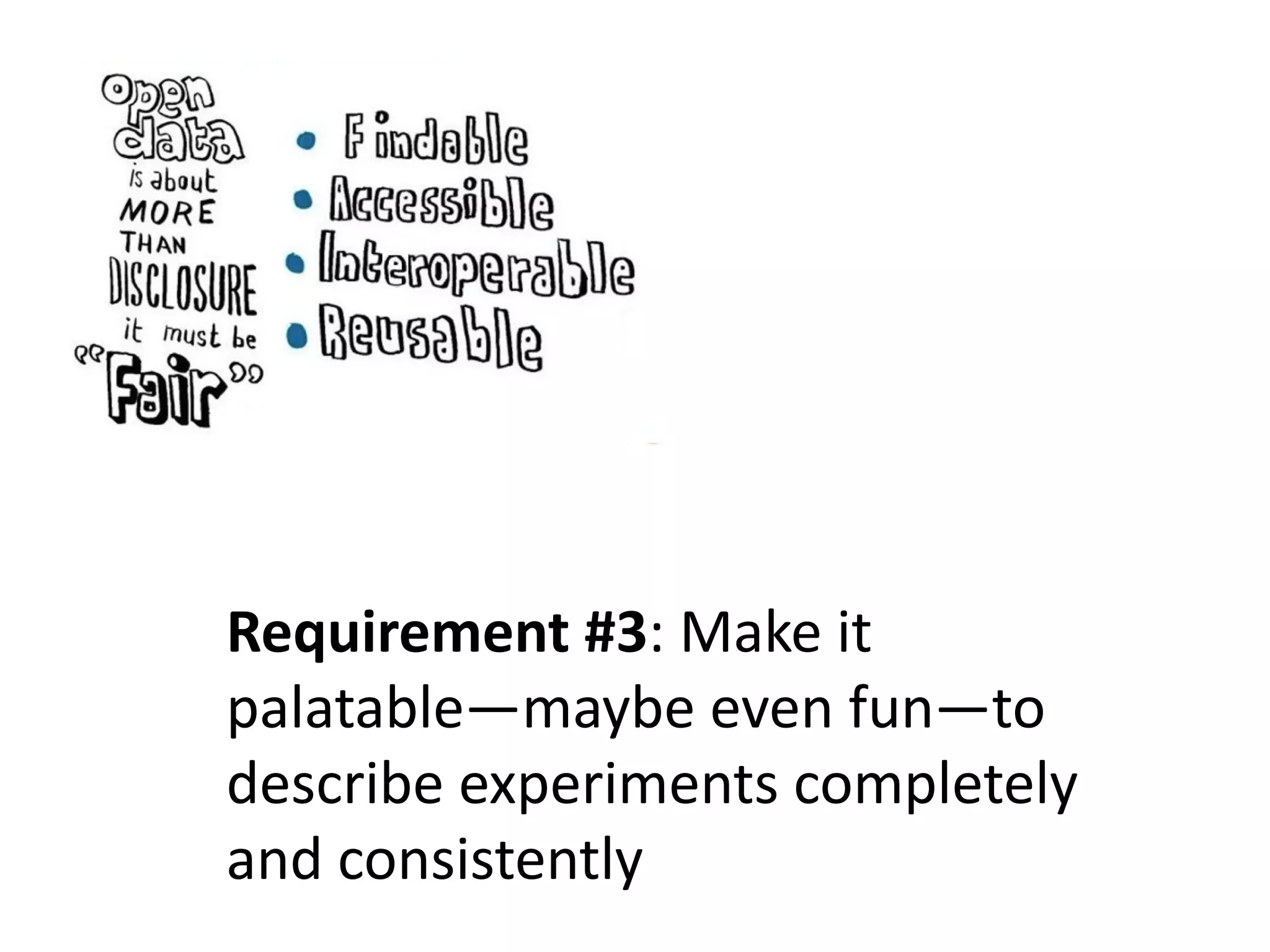
Requirement #3: Make it
palatable—maybe even fun—to
describe experiments completely
and consistently
http://metadatacenter.org
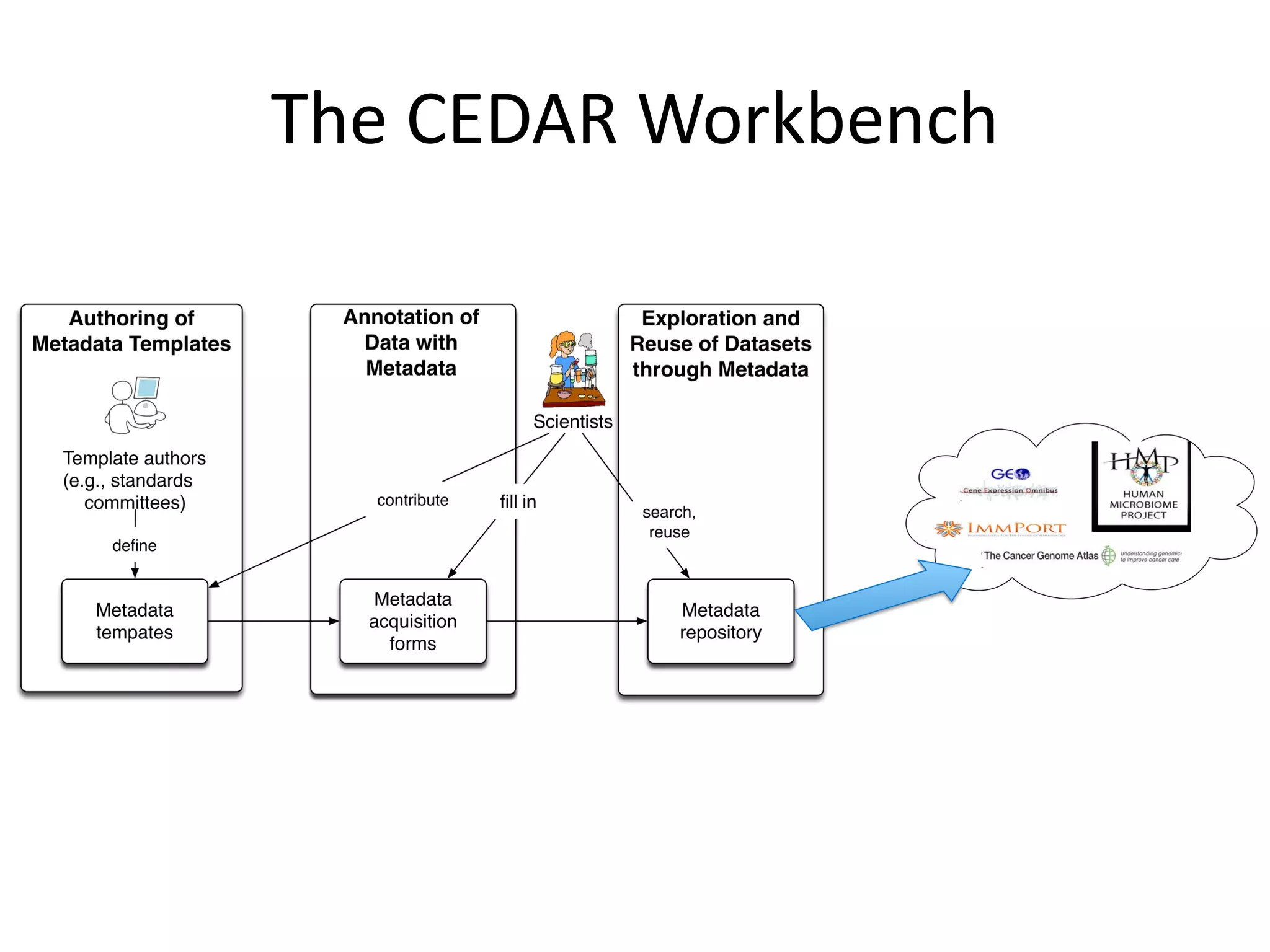
A Metadata Ecosystem
• Scientists perform experiments and generate
datasets
• Community-based standards groups create
minimal information models (like MIAME) to
define requirements for annotating particular
kinds of experimental data in a uniform manner
• CEDAR users create formal metadata templates
based on community standards
• CEDAR users fill in metadata templates to create
instances of metadata
• CEDAR stores the datasets (and the metadata
instances) in public repositories
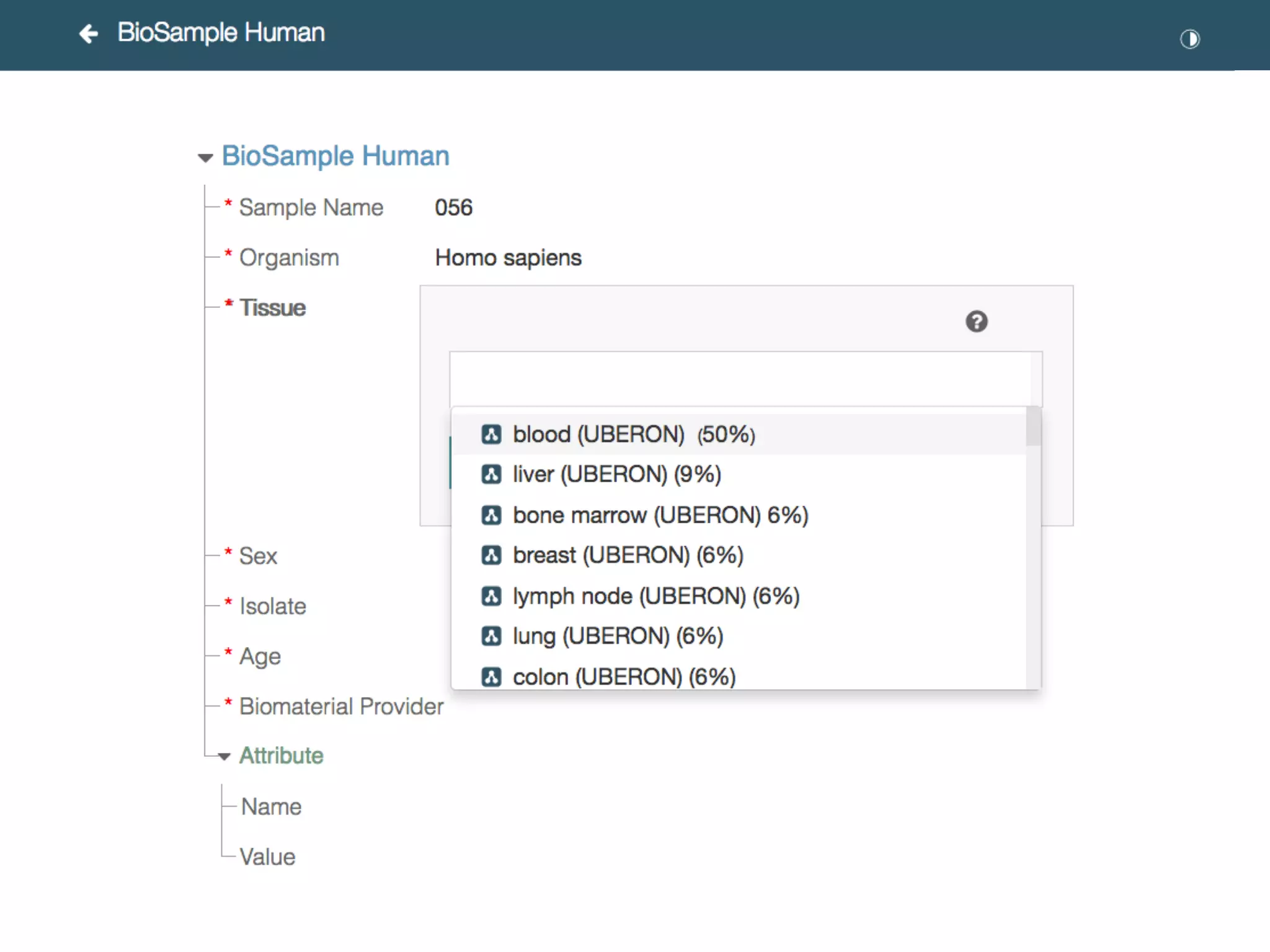
The CEDAR Approach to Metadata
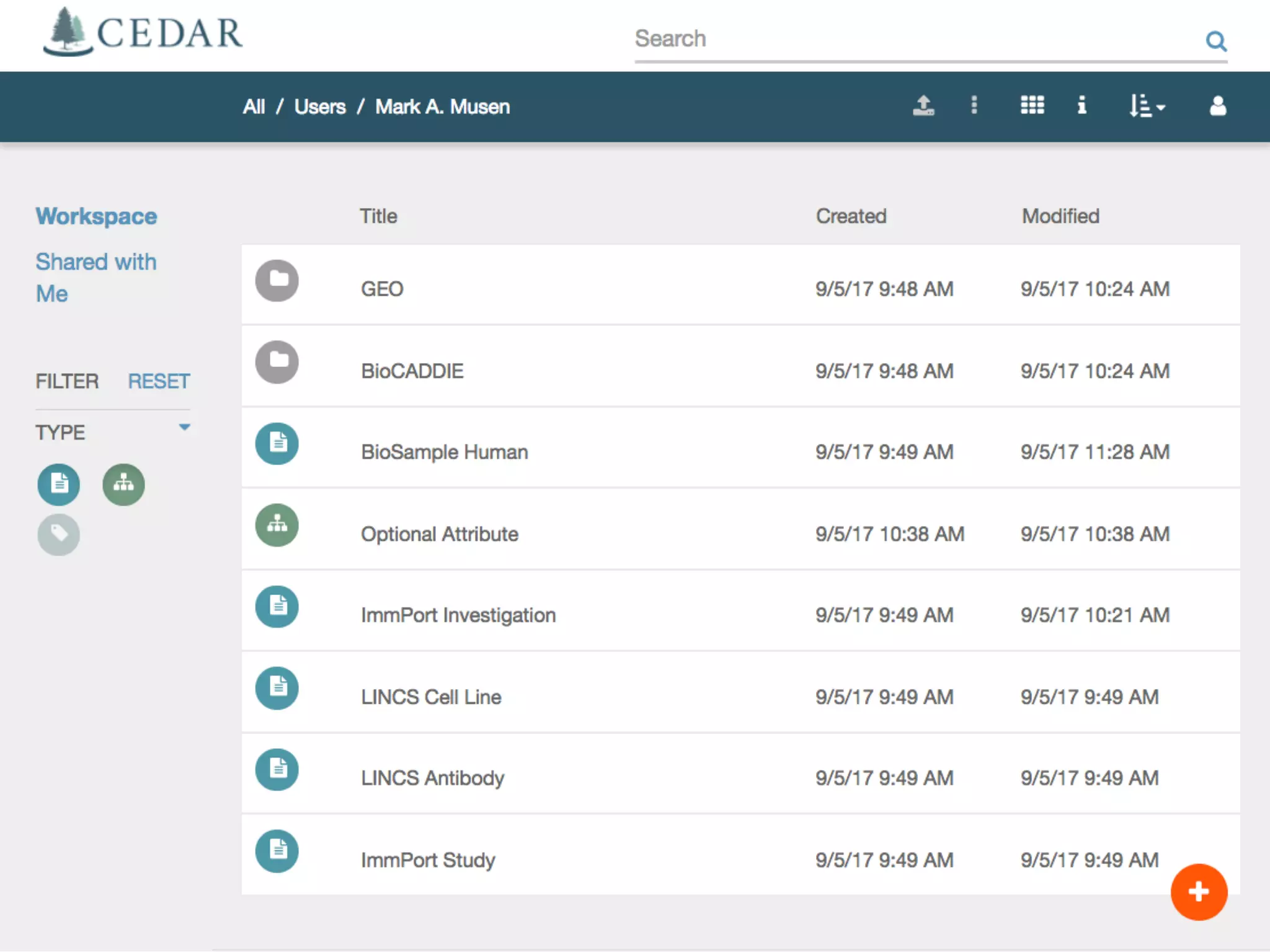
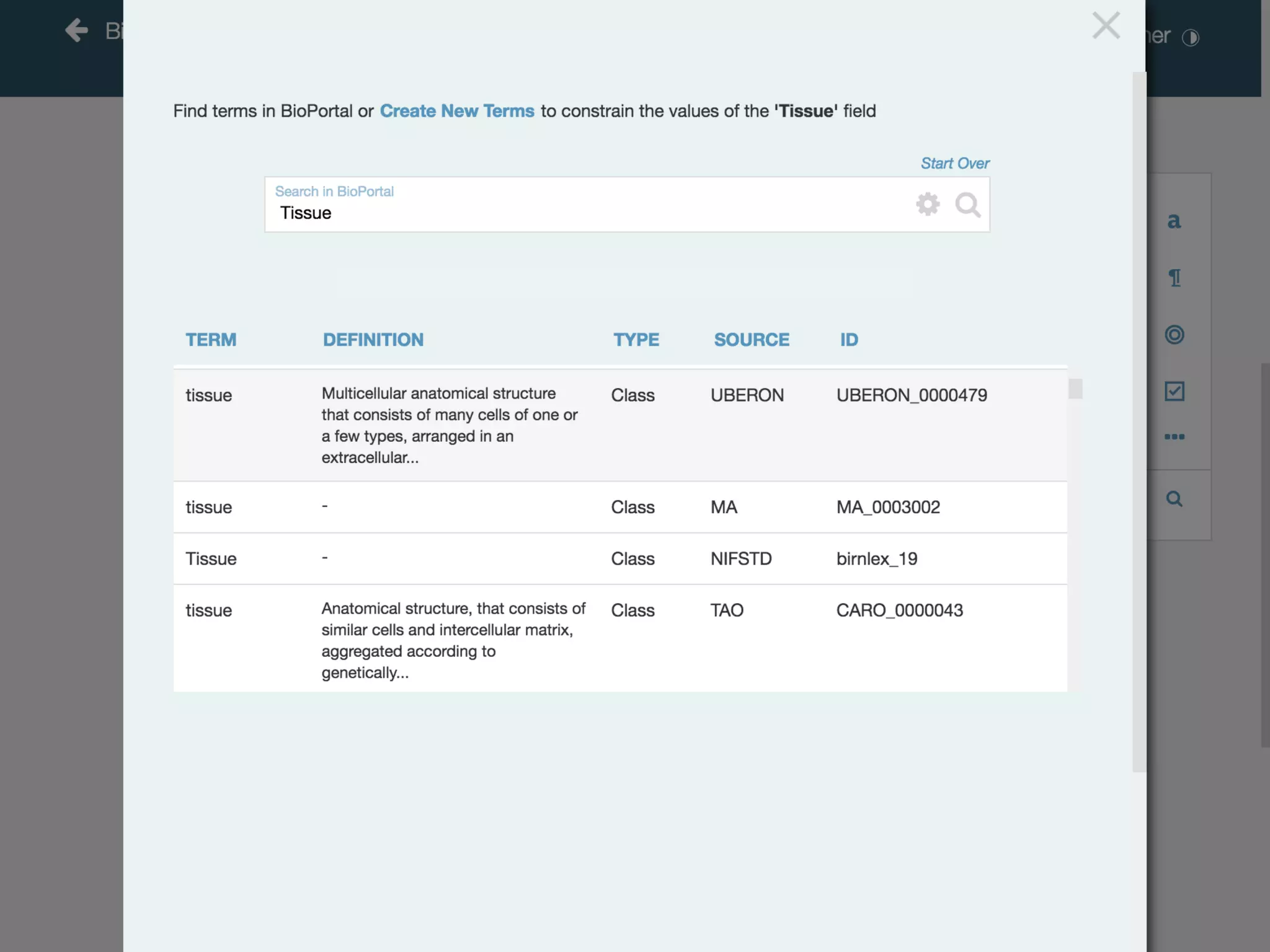
The CEDAR Workbench
The CEDAR Workbench
x
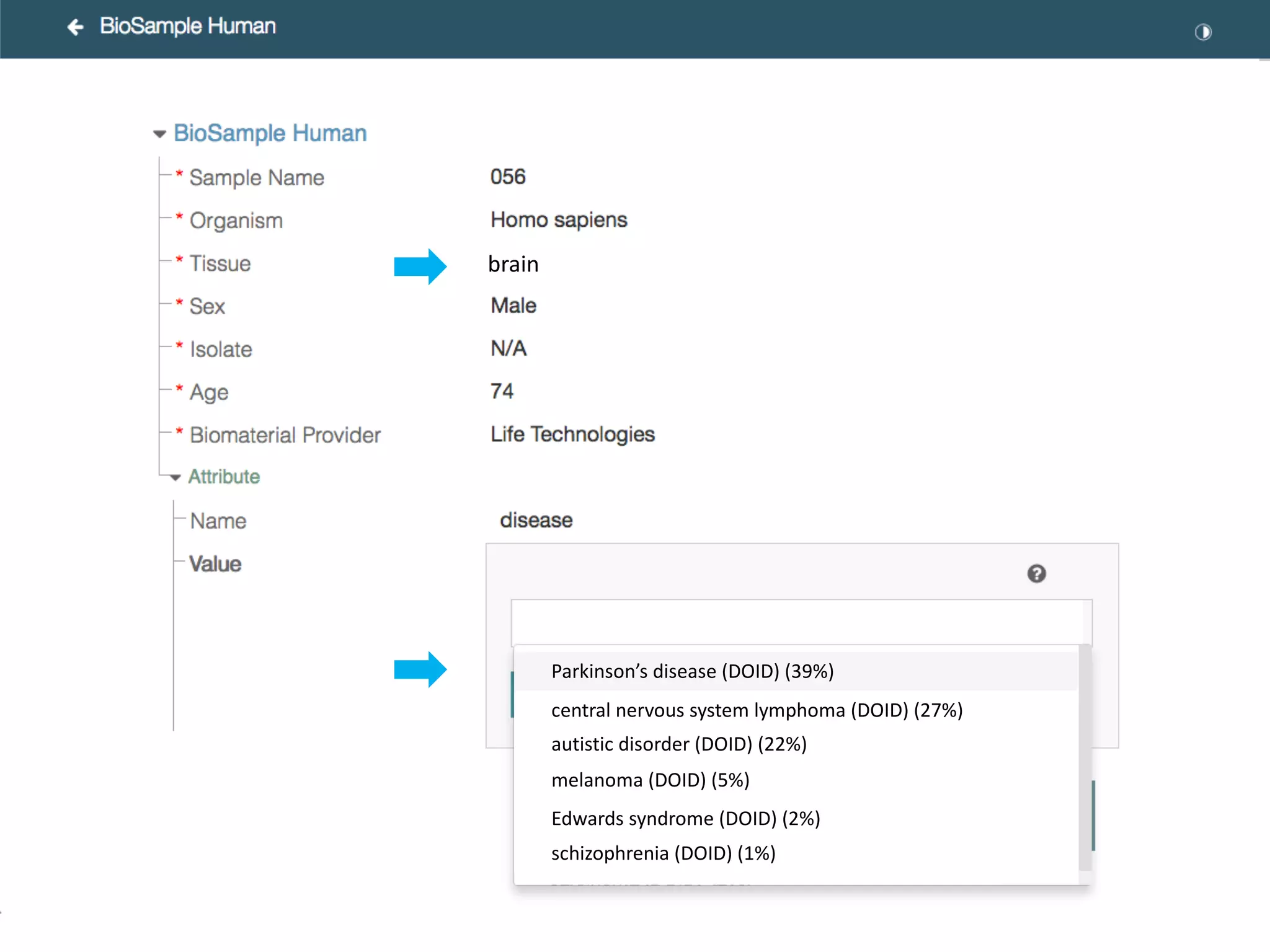
brain
Parkinson’s disease (DOID) (39%)
central nervous system lymphoma (DOID) (27%)
autistic disorder (DOID) (22%)
melanoma (DOID) (5%)
schizophrenia (DOID) (1%)
Edwards syndrome (DOID) (2%)
The CEDAR Workbench
age
Age
AGE
`Age
age (after birth)
age (in years)
age (y)
age (year)
age (years)
Age (years)
Age (Years)
age (yr)
age (yr-old)
age (yrs)
Age (yrs)
age [y]
age [year]
age [years]
age in years
age of patient
Age of patient
age of subjects
age(years)
Age(years)
Age(yrs.)
Age, year
age, years
age, yrs
age.year
age_years
AIRR is providing our first experience
uploading CEDAR-authored
metadata directly to NCBI
Scientists
Data
Curators
MiAIRR
Template
generate
experimental
data
Submission
Manager
Template
Designer
Submission Service
create
template
enter
metadata
manage
submissions
submission status
Biomedical Ontologies
1. TEMPLATE CREATION
2. METADATA EDITING
3. SUBMISSION
Submission Generator
Submission Status Monitor
Metadata
Editor
Metadata
Data
Metadata
Metadata
Data
BioProject
BioSample
SRA
NCBI Repositories
Metadata
Data
check
submission
status
MiAIRR
Standard
NCBI FTP
Server
Metadata
AIRR: CEDAR serves as a conduit to
various NCBI repositories
LINCS Repository
generate
experimental
data
1. TEMPLATE CREATION
2. METADATA EDITING
3. SUBMISSION
Metadata
Editor
Template
Designer
Biomedical OntologiesCurators
create
template
Scientists
Metadata
Data
enter
metadata
LINCS
Templates
Templat
es
Templat
es
LINCS
Templates
Data
submit
Metadata
Data
Metadata
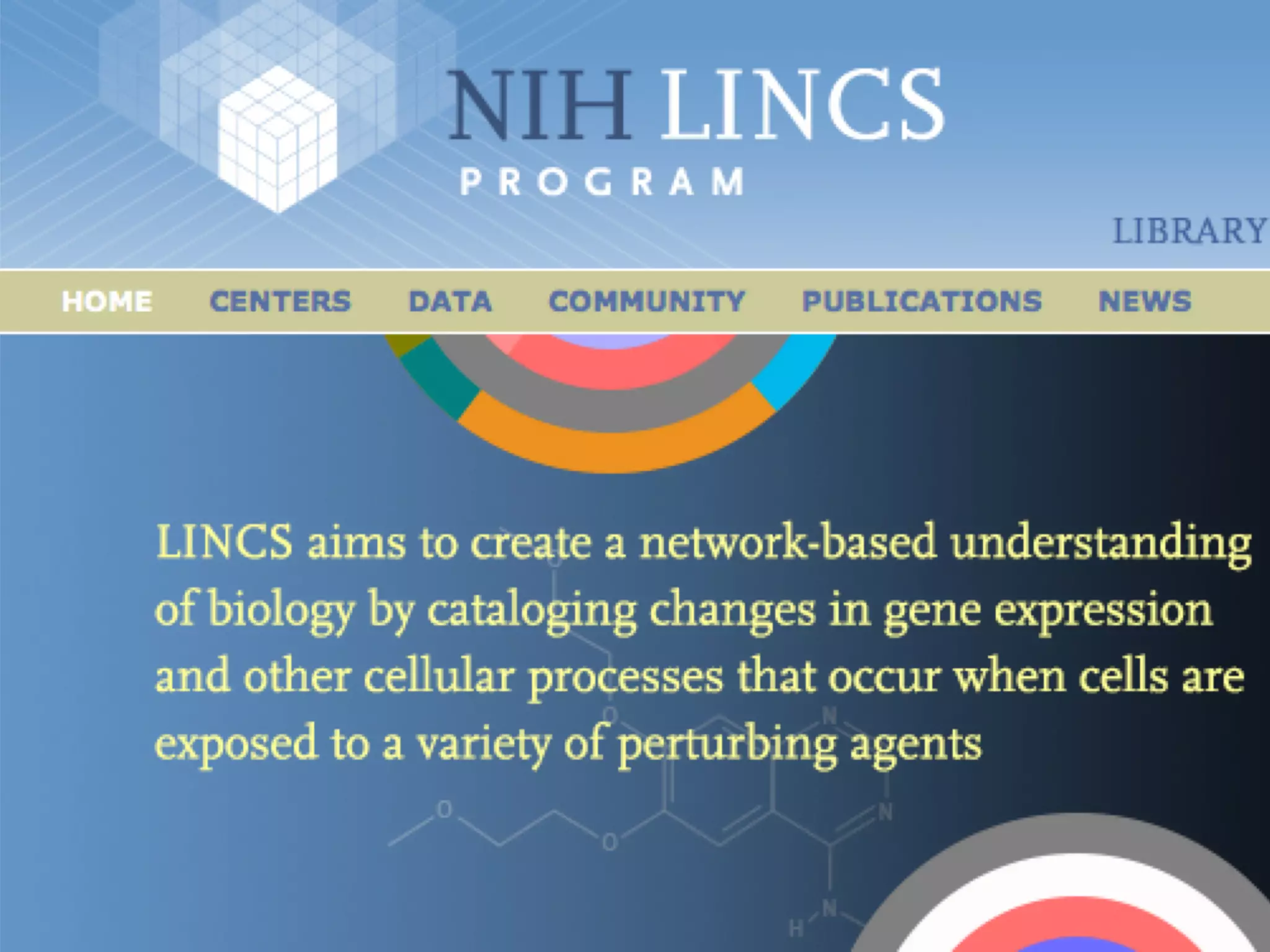
LINCS: CEDAR provides access to a
central data-coordinating center
56
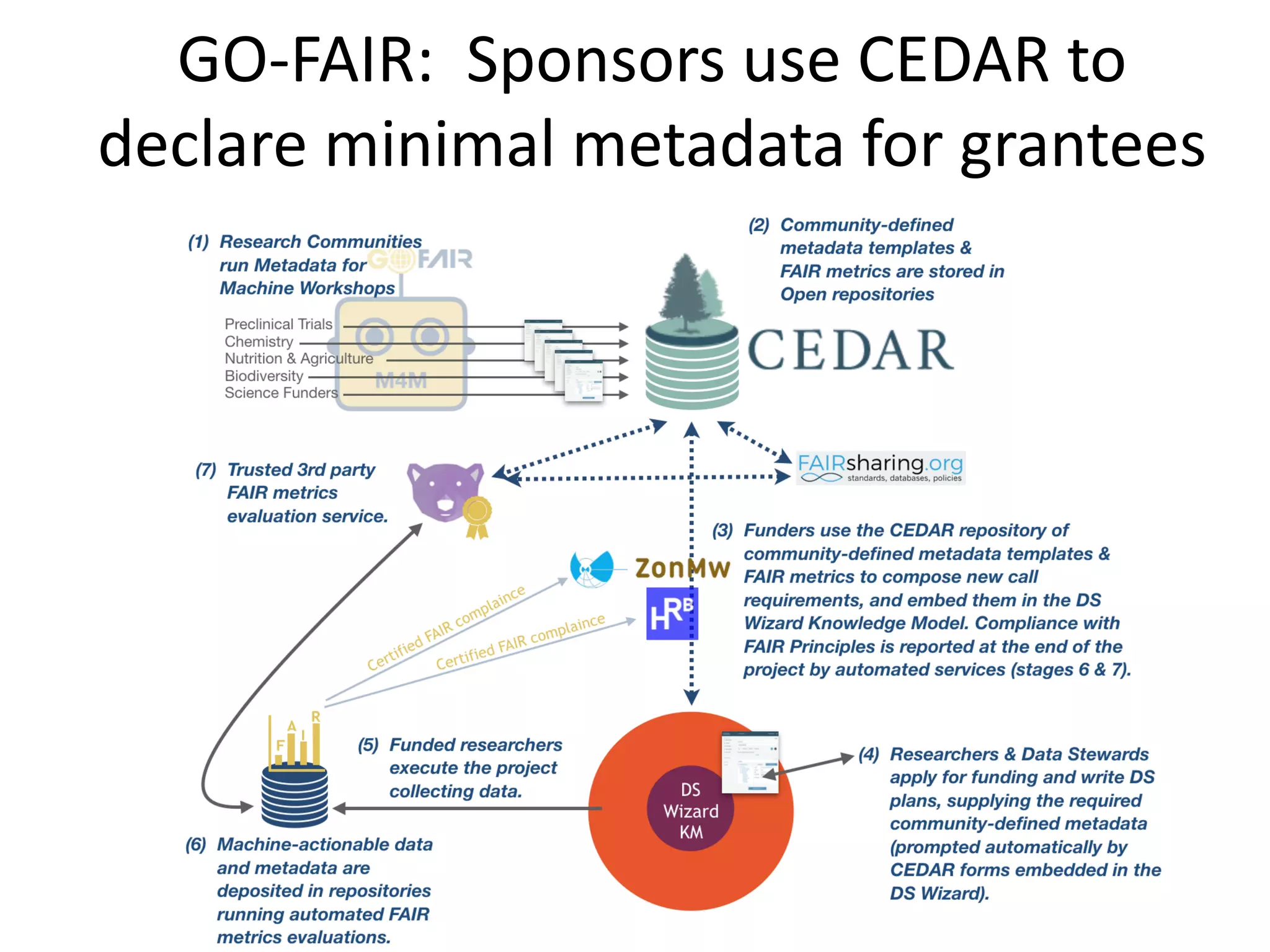
GO-FAIR: Sponsors use CEDAR to
declare minimal metadata for grantees
With CEDAR, the
data parasites of
the world will be
able to learn from
data that are
“cleaner,” better
organized, and
more searchable
Scientists will learn
when new results
become available
that are relevant to
their work, and how
those results relate
to the data that
they are already
collecting
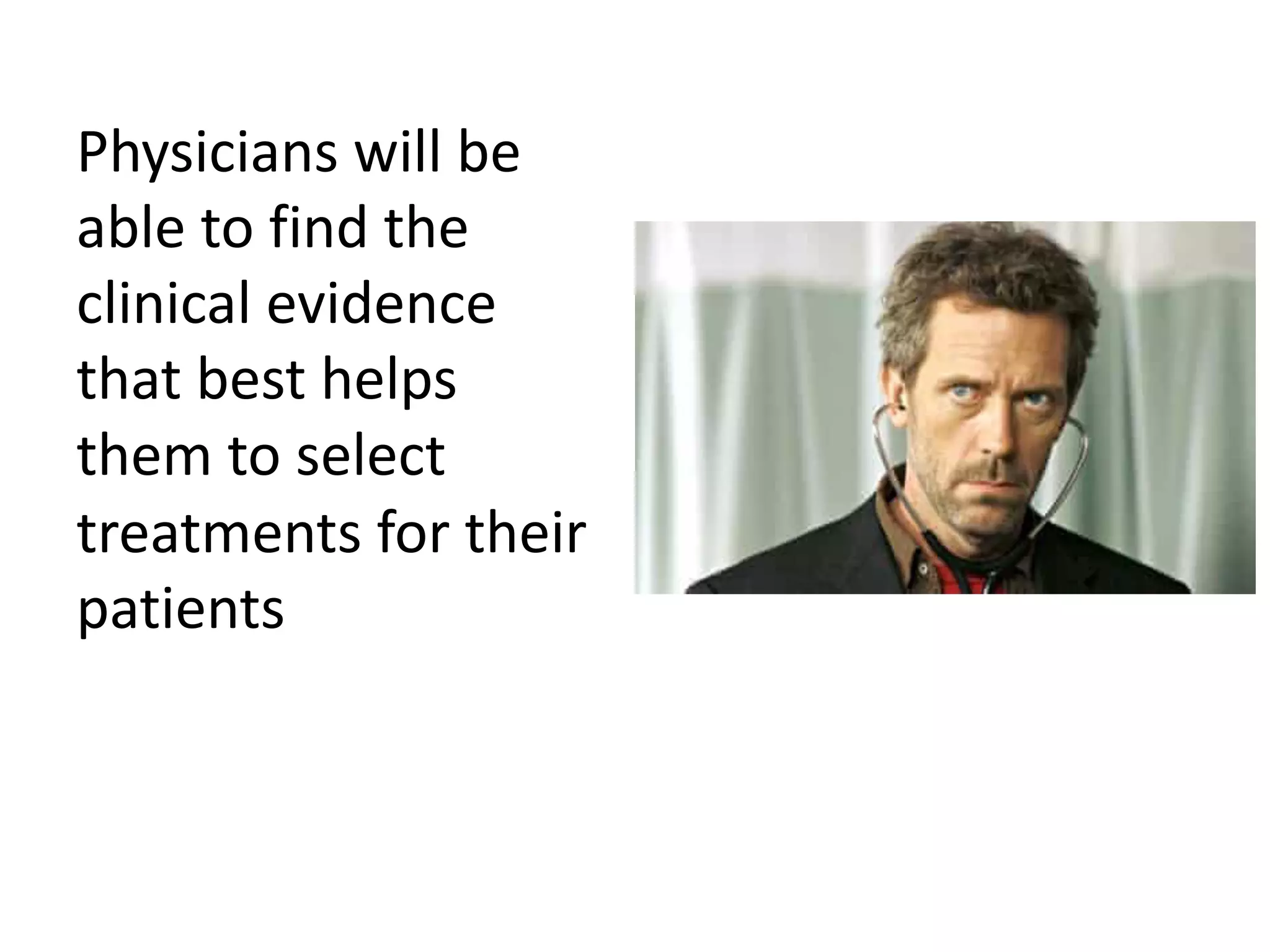
Physicians will be
able to find the
clinical evidence
that best helps
them to select
treatments for their
patients
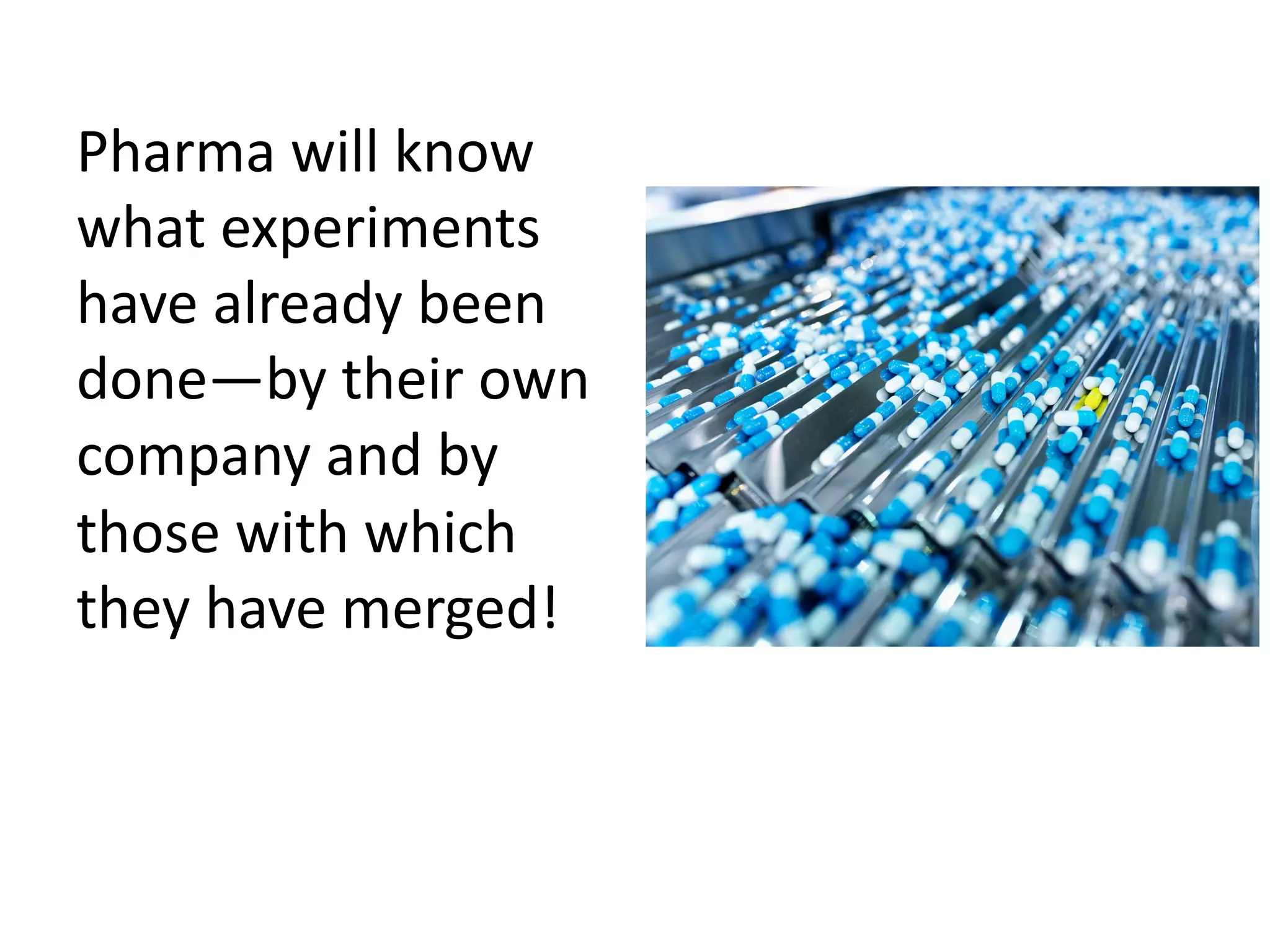
Pharma will know
what experiments
have already been
done—by their own
company and by
those with which
they have merged!
Once scientific knowledge and data are
disseminated in machine-interpretable form …
• Technology such as CEDAR will assist in the
automated “publication” of scientific results
online
• Intelligent agents will
– Search and “read” the “literature”
– Integrate information
– Track scientific advances
– Re-explore existing scientific datasets
– Suggest the next set of experiments to perform
– And maybe even do them!
http://metadatacenter.org

CEDAR work bench for metadata management

  • 1.
    The CEDAR Workbenchfor Metadata Management Mark A. Musen, M.D., Ph.D. Stanford University musen@Stanford.EDU
  • 2.
  • 3.
    Purvesh Khatri, Ph.D.A self-professed “data parasite”
  • 4.
  • 5.
    Khatri has usedGEO to build a career from the analysis of “other people’s data” Khatri has a pipeline for • Searching for datasets in the GEO database • Elucidating genomic signals • Confirming those signals in “validation” data sets • Making discoveries without ever performing a primary experiment
  • 6.
    Khatri has reusedpublic data sets to identify genomic signatures … • For incipient sepsis • For active tuberculosis • For distinguishing viral from bacterial respiratory infection • For rejection of organ transplants … and he has never touched a pipette!
  • 7.
    But you canbe a data parasite only if scientific data are … • Available in an accessible repository • Findable through some sort of search facility • Retrievable in a standard format • Self-describing so that third parties can make sense of the data • Intended to be reused, and to outlive the experiment for which they were collected
  • 8.
    But data inmost repositories are a mess! • Investigators view their work as publishing papers, not leaving a legacy of reusable data • Sponsors—both public and private—may require data sharing, but they do not explicitly pay for it • Creating the metadata to describe data sets is unbearably hard
  • 10.
    age Age AGE `Age age (after birth) age(in years) age (y) age (year) age (years) Age (years) Age (Years) age (yr) age (yr-old) age (yrs) Age (yrs) age [y] age [year] age [years] age in years age of patient Age of patient age of subjects age(years) Age(years) Age(yrs.) Age, year age, years age, yrs age.year age_years Failure to use standard terms makes datasets often impossible to search
  • 11.
    Metadata from NCBIBioSample Stink! • 73% of “Boolean” metadata values are not actually true or false – nonsmoker, former-smoker • 26% of “integer” metadata values cannot be parsed into integers – JM52, UVPgt59.4, pig • 68% of metadata entries that are supposed to represent terms from biomedical ontologies do not actually do so. – presumed normal, wild_type
  • 13.
    At a minimum,science needs • Open, online access to experimental data sets • Mechanisms to search for metadata to find relevant experimental results • Annotation of online data sets with adequate metadata • Use of controlled terms in metadata whenever possible • A culture that cares about data sharing, secondary analyses, and the ability to make new discoveries from legacy data
  • 15.
    Requirement #1: Standard ontologiesto describe what exists in a dataset completely and consistently
  • 20.
  • 22.
  • 23.
  • 24.
    Requirement #2: Describe propertiesof experiments completely and consistently
  • 25.
    When we lookat experimental data … • How can we tell what the data are about? • How can we search for additional data that we might be interested in? • How can we group data into similar categories?
  • 26.
    The microarray communitytook the lead in standardizing biological metadata DNA Microarray — What was the substrate of the experiment? — What array platform was used? — What were the experimental conditions?
  • 28.
    But it didn’tstop with MIAME! • Minimal Information About T Cell Assays (MIATA) • Minimal Information Required in the Annotation of biochemical Models (MIRIAM) • MINImal MEtagemome Sequence analysis Standard (MINIMESS) • Minimal Information Specification For In Situ Hybridization and Immunohistochemistry Experiments (MISFISHIE)
  • 29.
    FAIRsharing.org lists morethan 100 guidelines for reporting experimental data Guidelines
  • 30.
    Minimal Information Guidelines arenot Models • MIAME and its kin specify only the “kinds of things” that investigators should include in their metadata • They do not provide a detailed list of standard metadata elements • They do not provide datatypes for valid metadata entries • It takes work to convert a prose checklist into a computable model
  • 31.
    To make senseof metadata … • We need computer-based standards – For what we want to say about experimental data – For the language that we use to say those things – For how we structure the metadata • We need a scientific culture that values making experimental data accessible to others
  • 32.
    Requirement #3: Makeit palatable—maybe even fun—to describe experiments completely and consistently
  • 33.
  • 34.
    A Metadata Ecosystem •Scientists perform experiments and generate datasets • Community-based standards groups create minimal information models (like MIAME) to define requirements for annotating particular kinds of experimental data in a uniform manner • CEDAR users create formal metadata templates based on community standards • CEDAR users fill in metadata templates to create instances of metadata • CEDAR stores the datasets (and the metadata instances) in public repositories
  • 35.
    The CEDAR Approachto Metadata
  • 39.
  • 43.
  • 44.
  • 47.
    brain Parkinson’s disease (DOID)(39%) central nervous system lymphoma (DOID) (27%) autistic disorder (DOID) (22%) melanoma (DOID) (5%) schizophrenia (DOID) (1%) Edwards syndrome (DOID) (2%)
  • 48.
  • 50.
    age Age AGE `Age age (after birth) age(in years) age (y) age (year) age (years) Age (years) Age (Years) age (yr) age (yr-old) age (yrs) Age (yrs) age [y] age [year] age [years] age in years age of patient Age of patient age of subjects age(years) Age(years) Age(yrs.) Age, year age, years age, yrs age.year age_years
  • 52.
    AIRR is providingour first experience uploading CEDAR-authored metadata directly to NCBI
  • 53.
    Scientists Data Curators MiAIRR Template generate experimental data Submission Manager Template Designer Submission Service create template enter metadata manage submissions submission status BiomedicalOntologies 1. TEMPLATE CREATION 2. METADATA EDITING 3. SUBMISSION Submission Generator Submission Status Monitor Metadata Editor Metadata Data Metadata Metadata Data BioProject BioSample SRA NCBI Repositories Metadata Data check submission status MiAIRR Standard NCBI FTP Server Metadata AIRR: CEDAR serves as a conduit to various NCBI repositories
  • 55.
    LINCS Repository generate experimental data 1. TEMPLATECREATION 2. METADATA EDITING 3. SUBMISSION Metadata Editor Template Designer Biomedical OntologiesCurators create template Scientists Metadata Data enter metadata LINCS Templates Templat es Templat es LINCS Templates Data submit Metadata Data Metadata LINCS: CEDAR provides access to a central data-coordinating center
  • 56.
  • 57.
    GO-FAIR: Sponsors useCEDAR to declare minimal metadata for grantees
  • 58.
    With CEDAR, the dataparasites of the world will be able to learn from data that are “cleaner,” better organized, and more searchable
  • 59.
    Scientists will learn whennew results become available that are relevant to their work, and how those results relate to the data that they are already collecting
  • 60.
    Physicians will be ableto find the clinical evidence that best helps them to select treatments for their patients
  • 61.
    Pharma will know whatexperiments have already been done—by their own company and by those with which they have merged!
  • 62.
    Once scientific knowledgeand data are disseminated in machine-interpretable form … • Technology such as CEDAR will assist in the automated “publication” of scientific results online • Intelligent agents will – Search and “read” the “literature” – Integrate information – Track scientific advances – Re-explore existing scientific datasets – Suggest the next set of experiments to perform – And maybe even do them!
  • 63.