0
Multiple-Wavelength Holographic Interferometry
with Tunable Laser Diodes
Atsushi Wada
National Defense Academy
Japan
1. Introduction
Two-wavelength holographic interferometry is an effective technique to generate a contour
map of a diffusely reflecting surface (Friesem & Levy (1976); Heflinger & Wuerker (1969);
Hildebrand & Haines (1967); Yonemura (1985)). In this technique, two holograms are
recorded with two wavelengths. An interference fringe pattern is generated by superposing
two object images reconstructed from the holograms.
In digital holography, a hologram is recorded by an image sensor and saved into a computer.
An object image can be reconstructed by numerical calculation. Several reconstruction
methods were reported. Some of these have adjustablity of position and scale of a
reconstruction image (Yu & Kim (2006); Zhang et al. (2004)). An object phase distribution can
be obtained by the numerical reconstruction of digital holograms. Therefore, two-wavelength
digital holographic interferometry makes it possible to generate a contour map by numerical
extraction of a phase difference between two reconstructed images (Gass et al. (2003);
Parshall & Kim (2006); Wagner et al. (2000; 1999); Yamaguchi (2001); Yamaguchi et al. (2006)).
A phase difference extracted from reconstructed object images is wrapped into a half-open
interval (−π, π]. If a measured object height was large with respect to a synthetic wavelength,
2π ambiguities of the phase difference should be eliminated for retrieving the object profile.
Common phase unwrapping algorithms (Asundi & Wensen (1998); Servin et al. (1998)) which
use phase information of neighbor pixels can be applied when an object structure has no
discontinuity. However the algorithms can not work correctly for an object profile having
isolated region surrounded by discontinuous step.
An object profile with discontinuous structure can be measured by two-wavelength
interferometry with a sufficiently large synthetic wavelength. For example, two-wavelength
holographic interferometry with a ruby laser and a synthetic wavelength of ∼ 2 cm was
reported (Heflinger & Wuerker (1969); Pedrini et al. (1999)). Nevertheless the measurement
error tends to be amplified linearly with an increase in the synthetic wavelength since most
of the error sources are the product of the synthetic wavelength and an error of the extracted
phase difference (Cheng & Wyant (1984)).
A technique which eliminates 2π ambiguities by using a phase difference with a large
synthetic wavelength was reported (Cheng & Wyant (1985); de Groot (1991); Wagner et al.
(2000)). This technique makes it possible to measure a large step-height with high depth
resolution. Wagner et. al. reported multiple-wavelength holographic interferometry using
a dye laser. They combined three phase differences with synthetic wavelengths of 3.04 mm,
3
www.intechopen.com
2 Hologram / Book 2
1.53 mm and 0.76 mm, and realized the measurement with a measurable step-height of 0.6
mm and an error of 36 μm (Wagner et al. (2000)).
In this paper, multiple-wavelength digital holographic interferometry using tunablity of laser
diodes for measuremnt of a large step-height with high accuracy is presented. Using the
high-resolution wavelength tunability of laser diodes, a pair of holograms with a small
wavelength difference less than 0.01 nm can be recorded, and used to extract a phase
difference with a large synthetic wavelength of more than 120 mm. Several holograms are
recorded through the change in the wavelength of a laser diode. Phase differences with
synthetic wavelengths from 0.4637 mm to 129.1 mm are extracted from the holograms. The
synthetic wavelength of 129.1 mm allows us to measure a step-height of 32 mm. The synthetic
wavelength of 0.463 mm presents us with a measurement with an rms error of 0.01 mm. 2π
ambiguities of the phase difference with a small synthetic wavelength are eliminated by a
recursive calculations using the phase difference with a larger synthetic wavelength. The
elimination of 2π ambiguities realizes the measurement with the measurable step-height of
32 mm and the rms error of 0.01. The requirements for performing the phase unwrapping
are discussed. We found that precise knowledge of the recording wavelengths is required
for correctly performing the phase unwrapping. The required precision of the knowledge is
derived.
The Fresnel-transform based hologram reconstruction is fast and commonly used. However,
the pixel size of reconstructed image increases with the recording wavelength. If the pixel size
variation becomes large, the extraction of a phase difference cannot be performed correctly. In
order to obtain a correct phase difference, the pixel size should be adjusted. A simple and fast
algorithm for pixel size adjustment is described.
2. Hologram recording and reconstruction
Figure 1 shows a geometry of holographic interferometry. A setup for off-axis lensless Fourier
transform holography is used for hologram recording. A spherical wave from a point light
source is used as a reference wave. An object is located in the same plane as the point light
source. A distance between the object and a hologram satisfies the Fresnel approximation
(Goodman (1968)). Let the point light source be at x = 0, y = 0, z = 0 and the reference wave
ur(x, y, z) is given by
ur(x, y, z) =
1
z
exp iπ
x2 + y2
λz
, (1)
where λ is wavelength.
Let uo(x, y, z) is a complex amplitude of the object light at the hologram. By using a complex
amplitude distribution uo(x′, y′, 0) of the object light in the plane of z = 0, uo(x, y, z) is given
by
uo(x, y, z) =
1
z
exp iπ
x2 + y2
λz
dx′
dy′
uo(x′
, y′
, 0) exp i2π
x′2 + y′2
2λz
−
xx′ + yy′
λz
.
(2)
We define u′
o as the product of uo(x′, y′, 0) and a spherical wave phase factor, and U′
o as the
Fourier spectrum of u′
o:
u′
o(x′
, y′
) = uo(x′
, y′
, 0) exp iπ
x′2 + y′2
λz
, (3)
54 Advanced Holography – Metrology and Imaging
www.intechopen.com
Multiple-Wavelength Holographic Interferometry with Tunable Laser Diodes 3
z
x’
point light source
reference wave
object wave
illumination light
h
θ
3D object
image sensor
Fig. 1. Geometry of holographic interferometry.
and
U′
o( f ′
x, f ′
y) = F(u′
o) = dx′dy′u′
o(x′, y′) exp[−i2π( f ′
xx′ + f ′
yy′)]. (4)
Equation (2) can be written in terms of U′
o by substituting the spatial frequencies f ′
x = x/λz
and f ′
y = y/λz:
uo(x, y, z) =
1
z
exp iπ
x2 + y2
λz
U′
o
x
λz
,
y
λz
. (5)
An intensity distribution I(x, y, z) of an interference fringe pattern formed by the object wave
and the reference wave is given by
I(x, y, z) = |ur(x, y, z) + uo(x, y, z)|2
= |ur|2
+ |uo|2
+ u∗
r uo + uru∗
o
=
1
z2
1 + U′
o
x
λz
,
y
λz
2
+ U′
o
x
λz
,
y
λz
+ U′∗
o
x
λz
,
y
λz
=
1
z2
1 + U′
o( f ′
x, f ′
y)
2
+ U′
o( f ′
x, f ′
y) + U′∗
o ( f ′
x, f ′
y) .
(6)
In Eq. (6), the third term includes the Fourier spectrum of the object light. The object image
can be obtained by applying an inverse Fourier transform to I(x, y, z). The reconstructed wave
55Multiple-Wavelength Holographic Interferometry with Tunable Laser Diodes
www.intechopen.com
4 Hologram / Book 2
field urec obtained by the transformation is given by
urec(x′
, y′
) =F−1
{I(x, y, z)}
=F−1
{I(λz f ′
x, λz f ′
y, z)}
= d f ′
xd f ′
y I(λz f ′
x, λz f ′
y, z) exp[i2π( f ′
xx′
+ f ′
yy′
)]
=λ2 δ(x′, y′)
λ2z2
+ u′
o(x′
, y′
) ⊗ u′∗
o (−x′
, −y′
) + u′
o(x′
, y′
) + u′∗
o (−x′
, −y′
) ,
(7)
where the symbol ⊗ stands for the convolution operator. In Eq. (7), the first term is the
reference point light source. The second term is an autocorrelation of the object light. The
third term expresses the object light produced by a spherical wave phase factor. The fourth
term is the complex conjugate of the third term. Since a phase factor does not affect intensity,
the intensity distribution of the object light can be reconstructed by the third term of Eq. (7).
Let consider that I(x, y, z) is recorded by an image sensor having Nx × Ny pixels with pixel
size of Δx × Δy. Numerical reconstruction of the digital hologram is realized through the
inverse discrete Fourier transform. Let the pixel size of the numerically reconstructed object
image be Δx
′ × Δy
′. The discrete formulation of Eq. (7) is then
urec(sΔx
′
, tΔy
′
) =
Nx/2−1
∑
p=−Nx/2
Ny/2−1
∑
q=−Ny/2
I(pΔx, qΔy, z) exp i2π
pΔx
λz
sΔ′
x +
qΔy
λz
tΔ′
y , (8)
where p, q are integers, and s, t are integers and fulfill x′ = sΔx
′, y′ = tΔy
′. The right side of
Eq. (8) is arranged in the form, in which fast Fourier transform can be applied:
urec(sΔx
′
, tΔy
′
) =
Nx/2−1
∑
p=−Nx/2
Ny/2−1
∑
q=−Ny/2
I(pΔx, qΔy, z) exp i2π
ps
Nx
+
qt
Ny
, (9)
where s, t, p and q are integers, and Δ′
x, Δ′
y satisfy the following condition
Δ′
x =
λz
Δx Nx
, Δ′
y =
λz
ΔyNy
, (10)
and
−Nx/2 ≤ s < Nx/2, −Ny/2 ≤ t < Ny/2. (11)
The field of view of the reconstructed image is λz/Δx × λz/Δy.
3. Multiple-wavelength interferometry
The reference plane is assumed to be placed at z = 0. Let the illumination light irradiate to
the object at an angle θ to the reference plane, and the height of the object surface respect to
the reference plane be h(x′, y′). The phase distribution φ(x′, y′) of the reconstructed image is
given by
φ(x′
, y′
) =
2π
λ
−L +
x′2 + y′2
2z
, (12)
56 Advanced Holography – Metrology and Imaging
www.intechopen.com
Multiple-Wavelength Holographic Interferometry with Tunable Laser Diodes 5
where L is an optical path difference caused by the object surface structure, giving
L = (1 + cos θ)h(x′, y′) − x′ sin θ. (13)
The second term of Eq. (12) is the spherical wavefront introduced in Eq. (3).
Holograms are recorded with wavelengths of λn satisfying λn < λn+1 and the phase
distribution of the object wave at the plane of z = 0 is φn. The phase difference Δφn between
φn and φ0 is given by
Δφn(x′
, y′
) = φn − φ0 =
2π
Λn
L +
x′2 + y′2
2z
≃
2π
Λn
L, (14)
where Λn are synthetic wavelengths and
Λn =
λ0λn
λn − λ0
≃
¯λn
2
Δλn
, (15)
where ¯λn and Δλn are the average and difference of wavelengths given by
¯λn =
λ0 + λn
2
, Δλn = λn − λ0. (16)
In Eq. (8), the condition z ≫ (x′2 + y′2)/Λn is assumed and a quadratic phase term is
neglected.
Let Ψn be the phase difference extracted from the image reconstructed from the hologram
with wavelength of λn. The phase difference Ψn are given by
Ψn = tan−1 Im(u′
onu′
o0
∗
)
Re(u′
onu′
o0
∗
)
. (17)
Ψn is wrapped into (−π, π] and the relation between Ψn and Δφn is given by
Δφn = Ψn + 2πmn, (18)
where mn is an integer. If the conditions of Δφ1 = Ψ1 and Λn < Λn−1 are satisfied, Δφn
can be retrieved (Nadeborn et al. (1996); Paulsson et al. (2000); Wagner et al. (2000)) through
recursive calculation of
Δφn = Ψn + 2πNINT
αnΔφn−1 − Ψn
2π
, (19)
where NINT(a) denotes the function returning the nearest neighbor integer of argument a,
and αn is the sensitivity ratio between each phase difference Δφn and Δφn−1 and given by
αn =
Λn−1
Λn
. (20)
57Multiple-Wavelength Holographic Interferometry with Tunable Laser Diodes
www.intechopen.com
6 Hologram / Book 2
4. Requirements for the phase unwrapping
In this section, we discuss the requirements for correctly performing the phase unwrapping.
First, the requirements of the measurement error and the sensitivity ratio between the phase
differences are discussed based on the assumption that the error of the sensitivity ratio is
negligible small. Next, it is pointed out that the sensitivity ratio should be estimated for the
phase unwrapping. Then, the required accuracy of the sensitivity ratio is derived. Lastly,
it is explained how precise measurement of the wavelengths is required for high accuracy
estimation of the sensitivity ratio.
Let the true phase differences and the sensitivity ratio are defined as Δφ′
n, Ψ′
n and α′
n, and the
measurement errors of the phase differences and the sensitivity ratio are defined as Ψ ,n and
α ,n. The relations between these parameters and Ψ, Δφ and α are given by
Ψn = Ψ′
n + Ψ ,n, Δφ′
n = Ψ′
n + 2πmn = Δφn − Ψ ,n, αn = α′
n + α ,n. (21)
By substituting Eqs. (21) into Eq. (19), we get
Δφn = Ψ′
n + Ψ ,n + 2πNINT
(α′
n + α ,n)(Δφ′
n−1 + Ψ ,n−1) − Ψ′
n − Ψ ,n
2π
. (22)
For the true phase difference and sensitivity ratio, the condition
α′
nΔφ′
n−1 − Ψ′
n
2π
=
Δφ′
n − Ψ′
n
2π
= mn, (23)
is satisfied. Substituting Eqs. (23) into Eq. (22) gives
Δφn = Δφ′
n + Ψ ,n + 2πNINT
α ,n(Δφ′
n−1 + Ψ ,n−1) + αnΨ ,n−1 − Ψ ,n
2π
. (24)
In order to correctly perform the phase unwrapping, the third term in the right side of Eq. (24)
should be zero, and the condition
α ,nΔφ′
n−1 + αnΨ ,n−1 − Ψ ,n
2π
<
1
2
, (25)
should be satisfied. In Eq. (25), the condition Ψ ,n−1 Δφ′
n−1 is assumed. Let the maximum
of |Ψ ,n| for all n be 2π :
|Ψ ,n| ≤ 2π . (26)
Let the true synthetic wavelength be defined as Λ′
n. Substituting Δφ′
n−1, α′
n and Λ′
n into Eq.
(8) gives
Δφ′
n−1 =
2πL
α′
nΛ′
n
. (27)
Substitution of Eqs. (26) and (27) into Eq. (25) gives
<
1
α′
n + 1
1
2
−
|α ,n|
α′
n
L
Λ′
n
. (28)
If the assumption |α ,n| α′
n is introduced, we have the requirements
<
1
2(α′
n + 1)
, (29)
58 Advanced Holography – Metrology and Imaging
www.intechopen.com
Multiple-Wavelength Holographic Interferometry with Tunable Laser Diodes 7
and
α′
n <
1 − 2
2
. (30)
The requirements of and α′
n seem to be relaxed as compared with the requirements derived
in previous works (Nadeborn et al. (1996); Wagner et al. (2000)). For example, if α′
n = 2 then
the upper limit of is 1/6. In other words, if = 1/12 then the upper limit of α′
n is 5. It should
be noted that the requirements denoted in Eqs. (29) and (30) are based on the assumption of
|α ,n| α′
n. If there has been a small error of the phase difference sensitivity ratio such as
|α ,n|/α′
n = 1/40, the upper limit of and α′
n become small to 1/12 and 2 respectively with
Λ′
n = 2.5 mm and L = 25 mm.
Let us consider how accurate an estimation of the phase difference sensitivity ratio is required
for the phase unwrapping. By solving Eq. (28) for |α ,n| , we obtain the condition
|α ,n| < α′
n
Λ′
n
L
1
2
− (α′
n + 1) . (31)
This shows that the upper limit of the measurement error of the sensitivity ratio for correctly
performing the phase unwrapping become small in proportion to α′
nΛ′
n/L. This means that
αn should be precisely estimated for measuring a large object height by using a small synthetic
wavelength. For example, if α′
n = 2, Λ′
n = 2.5 mm, L = 25 mm and = 1/12 , then |α ,n|
should be less than 1/20.
Let us consider how precise the measurement of the wavelengths is required to be for the
phase unwrapping. Let the true value of wavelength be λ′
n, and the true and the measurement
error of the wavelength difference are defined as Δλ′
n and Δλ ,n. By calculating the error
propagation of Δλn in Eq. (15), we have
α ,n
α′
n
L
Λ′
n
=
Δλ ,n−1
Δλ′
n−1
−
Δλ ,n
Δλ′
n
LΔλ′
n
¯λn
2
. (32)
Let the maximum of |Δλ ,n| for all n be Δλ :
|Δλ ,n| ≤ Δλ . (33)
By substituting Eqs. (32) and (33) into Eq. (28) and solving for Δλ , we obtain the condition
Δλ <
¯λn
2
L
1
2(α′
n + 1)
− . (34)
For example, α′
n = 2, ¯λn = 800 nm, L =25 mm, and = 1/12, Δλ should be less than 0.002
nm.
5. Scale adjustment for phase calculation
In the Fresnel-transform based method (FTM), the pixel size of the reconstructed image
increases with the reconstruction distance and the recording wavenumber. The variation
of the pixel size poses problems in holographic interferometry (Yamaguchi et al. (2006)).
In contrast, the convolution method (CM) (Yamaguchi et al. (2002)) keeps the pixel size of
the reconstructed image the same as the pixel size of an image sensor used for hologram
recording. However, the CM requires huge computational time with respect to the FTM. A
59Multiple-Wavelength Holographic Interferometry with Tunable Laser Diodes
www.intechopen.com
8 Hologram / Book 2
zero padding method was proposed to control the pixel size of the image reconstructed by the
FTM (ALFIERI et al. (2006); Ferraro et al. (2004)). In this method, an increase in the total pixel
number of the hologram decreases the pixel size of the reconstructed image and can cause
an explosive increase of the computational time as a result of the impossibility of the fast
Fourier transform (FFT) application in the reconstruction. Algorithms based on an approach
of splitting the reconstruction process into two diffraction processes were reported (Yu & Kim
(2006); Zhang et al. (2004)). The methods require almost the twice computational time with
respect to the FTM.
We present a simple and fast adjustment of pixel size in the reconstructed image. We adjust
the pixel size by magnifying a recorded hologram before reconstruction of the hologram.
The total pixel number of the hologram can be maintained for the possibility of the FFT
application. Only one time calculation of the diffraction is required. Let consider that a
hologram is recorded with the wavelength of λ1, and an another hologram is recorded with
the wavelength of λ2. By application of a image magnification into the second hologram
plane, the pixel sizes of the images reconstructed from the holograms are adjusted to be the
same. Let the rescaled pixel size of the second hologram in a hologram plane be Δx2 × Δy2.
For the adjustment, Δx2 and Δy2 should satisfy
Δx2 = Δx
λ2
λ1
, Δy2 = Δy
λ2
λ1
. (35)
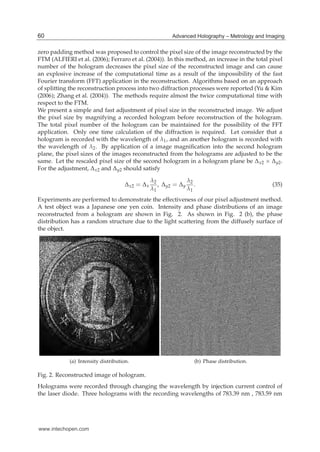
Experiments are performed to demonstrate the effectiveness of our pixel adjustment method.
A test object was a Japanese one yen coin. Intensity and phase distributions of an image
reconstructed from a hologram are shown in Fig. 2. As shown in Fig. 2 (b), the phase
distribution has a random structure due to the light scattering from the diffusely surface of
the object.
(a) Intensity distribution. (b) Phase distribution.
Fig. 2. Reconstructed image of hologram.
Holograms were recorded through changing the wavelength by injection current control of
the laser diode. Three holograms with the recording wavelengths of 783.39 nm , 783.59 nm
60 Advanced Holography – Metrology and Imaging
www.intechopen.com
Multiple-Wavelength Holographic Interferometry with Tunable Laser Diodes 9
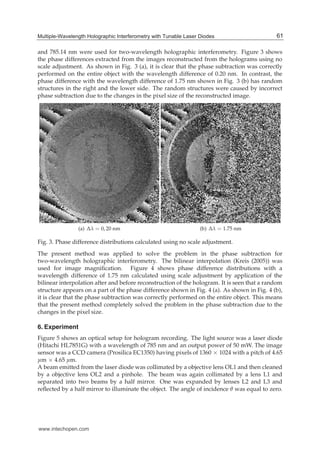
and 785.14 nm were used for two-wavelength holographic interferometry. Figure 3 shows
the phase differences extracted from the images reconstructed from the holograms using no
scale adjustment. As shown in Fig. 3 (a), it is clear that the phase subtraction was correctly
performed on the entire object with the wavelength difference of 0.20 nm. In contrast, the
phase difference with the wavelength difference of 1.75 nm shown in Fig. 3 (b) has random
structures in the right and the lower side. The random structures were caused by incorrect
phase subtraction due to the changes in the pixel size of the reconstructed image.
(a) Δλ = 0, 20 nm (b) Δλ = 1.75 nm
Fig. 3. Phase difference distributions calculated using no scale adjustment.
The present method was applied to solve the problem in the phase subtraction for
two-wavelength holographic interferometry. The bilinear interpolation (Kreis (2005)) was
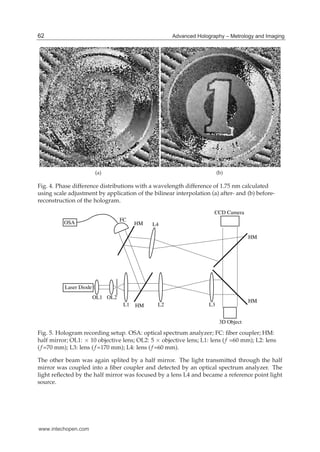
used for image magnification. Figure 4 shows phase difference distributions with a
wavelength difference of 1.75 nm calculated using scale adjustment by application of the
bilinear interpolation after and before reconstruction of the hologram. It is seen that a random
structure appears on a part of the phase difference shown in Fig. 4 (a). As shown in Fig. 4 (b),
it is clear that the phase subtraction was correctly performed on the entire object. This means
that the present method completely solved the problem in the phase subtraction due to the
changes in the pixel size.
6. Experiment
Figure 5 shows an optical setup for hologram recording. The light source was a laser diode
(Hitachi HL7851G) with a wavelength of 785 nm and an output power of 50 mW. The image
sensor was a CCD camera (Prosilica EC1350) having pixels of 1360 × 1024 with a pitch of 4.65
μm × 4.65 μm.
A beam emitted from the laser diode was collimated by a objective lens OL1 and then cleaned
by a objective lens OL2 and a pinhole. The beam was again collimated by a lens L1 and
separated into two beams by a half mirror. One was expanded by lenses L2 and L3 and
reflected by a half mirror to illuminate the object. The angle of incidence θ was equal to zero.
61Multiple-Wavelength Holographic Interferometry with Tunable Laser Diodes
www.intechopen.com
10 Hologram / Book 2
(a) (b)
Fig. 4. Phase difference distributions with a wavelength difference of 1.75 nm calculated
using scale adjustment by application of the bilinear interpolation (a) after- and (b) before-
reconstruction of the hologram.
Laser Diode
OL1 OL2
L1 L2 L3HM
HM L4
HM
HM
3D Object
FC
OSA
CCD Camera
Fig. 5. Hologram recording setup. OSA: optical spectrum analyzer; FC: fiber coupler; HM:
half mirror; OL1: × 10 objective lens; OL2: 5 × objective lens; L1: lens (f =60 mm); L2: lens
(f=70 mm); L3: lens ( f=170 mm); L4: lens (f=60 mm).
The other beam was again splited by a half mirror. The light transmitted through the half
mirror was coupled into a fiber coupler and detected by an optical spectrum analyzer. The
light reflected by the half mirror was focused by a lens L4 and became a reference point light
source.
62 Advanced Holography – Metrology and Imaging
www.intechopen.com
Multiple-Wavelength Holographic Interferometry with Tunable Laser Diodes 11
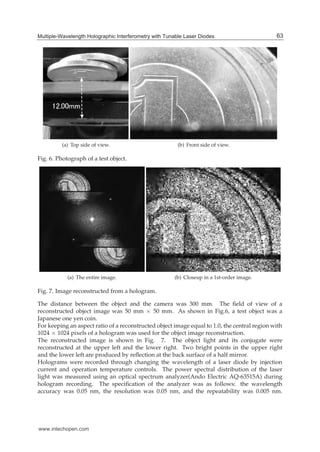
(a) Top side of view. (b) Front side of view.
Fig. 6. Photograph of a test object.
(a) The entire image. (b) Closeup in a 1st-order image.
Fig. 7. Image reconstructed from a hologram.
The distance between the object and the camera was 300 mm. The field of view of a
reconstructed object image was 50 mm × 50 mm. As shown in Fig.6, a test object was a
Japanese one yen coin.
For keeping an aspect ratio of a reconstructed object image equal to 1.0, the central region with
1024 × 1024 pixels of a hologram was used for the object image reconstruction.
The reconstructed image is shown in Fig. 7. The object light and its conjugate were
reconstructed at the upper left and the lower right. Two bright points in the upper right
and the lower left are produced by reflection at the back surface of a half mirror.
Holograms were recorded through changing the wavelength of a laser diode by injection
current and operation temperature controls. The power spectral distribution of the laser
light was measured using an optical spectrum analyzer(Ando Electric AQ-63515A) during
hologram recording. The specification of the analyzer was as follows: the wavelength
accuracy was 0.05 nm, the resolution was 0.05 nm, and the repeatability was 0.005 nm.
63Multiple-Wavelength Holographic Interferometry with Tunable Laser Diodes
www.intechopen.com
12 Hologram / Book 2
(a) Ψ1 (b) Ψ2 (c) Ψ3
(d) Ψ4 (e) Ψ5 (f) Ψ6
(g) Ψ7 (h) Ψ8 (i) Ψ9
Fig. 8. Phase differences.
The central wavelength was obtained through the calculation of the center of gravity in the
spectrum distribution measured using the optical spectrum analyzer.
Ten holograms for phase difference extraction were chosen from the holograms. The phase
differences Ψn were extracted from the object images reconstructed from the holograms with
wavelengths λn. Figure 8 shows Ψn. It can be seen in Fig. 8 that the phase differences
have a salt-and-pepper noize produced by speckle noize. As shown in later, the noize can be
suppressed by image processing method such as smoothing and median filtering (Yamaguchi
(2001); Yamaguchi et al. (2006)).
The unwrapped phase differences Δφn were retrieved by the recursive calculations of Eq. (19).
The synthetic wavelengths were calibrated (Wada et al. (2008)) by the comparison between
the phase differences and the object height measured by using a slide caliper. The calibrated
synthetic wavelengths were Λ1 = 129.1mm, Λ2 = 34.02mm, Λ3 = 11.47mm, Λ4 = 8.593mm,
Λ5 = 4.914mm, Λ6 = 2.849mm, Λ7 = 1.380mm, Λ8 = 0.9061mm, Λ9 = 0.4637mm.
The object profile was obtained using Δφn. Since the incident angle θ for the object
illumination was equal to zero, L = 2h and
h =
ΛnΔφn
4π
. (36)
Because Δφ1 = Ψ1 and a phase difference within (−π, π] corresponds to a object height within
(−Λn/4, Λn/4], a measurable step height is Λ1/4 = 32 mm. The object height distributions
64 Advanced Holography – Metrology and Imaging
www.intechopen.com
Multiple-Wavelength Holographic Interferometry with Tunable Laser Diodes 13
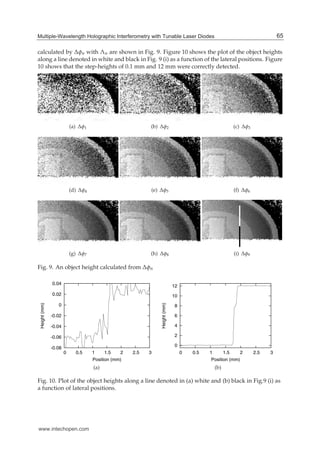
calculated by Δφn with Λn are shown in Fig. 9. Figure 10 shows the plot of the object heights
along a line denoted in white and black in Fig. 9 (i) as a function of the lateral positions. Figure
10 shows that the step-heights of 0.1 mm and 12 mm were correctly detected.
(a) Δφ1 (b) Δφ2 (c) Δφ3
(d) Δφ4 (e) Δφ5 (f) Δφ6
(g) Δφ7 (h) Δφ8 (i) Δφ9
Fig. 9. An object height calculated from Δφn
-0.08
-0.06
-0.04
-0.02
0
0.02
0.04
0 0.5 1 1.5 2 2.5 3
Height(mm)
Position (mm)
(a)
0
2
4
6
8
10
12
0 0.5 1 1.5 2 2.5 3
Height(mm)
Position (mm)
(b)
Fig. 10. Plot of the object heights along a line denoted in (a) white and (b) black in Fig.9 (i) as
a function of lateral positions.
65Multiple-Wavelength Holographic Interferometry with Tunable Laser Diodes
www.intechopen.com
14 Hologram / Book 2
7. Conclusion
Multiple-wavelength digital holographic interferometry using tunablity of laser diodes for
measuring a large step-height with high accuracy was presented. The requirements for
performing the phase unwrapping were discussed. We have found that precise knowledge
of the recording wavelengths is required for correctly performing the phase unwrapping. The
required precision of the knowledge was derived. A simple and fast algorithm for pixel size
adjustment was presented. It has been demonstrated that the problem of the phase subtraction
in two-wavelength holographic interferometry can be solved by the present method.
Several holograms were recorded through the changes in the wavelength of a laser diode
by injection current and operation temperature controls. A pair of holograms with a small
wavelength difference less than 0.01 nm was recorded and used for realizing holographic
interferometry with a large synthetic wavelength more than 120 mm. Phase differences with
synthetic wavelengths from 0.4637 mm to 129.1 mm were extracted by using the holograms.
The synthetic wavelengths were calibrated by the comparison between the phase differences
and the object heights measured by using a slide caliper. The step-heights of 0.1 mm and 12
mm were correctly detected.
8. References
Alfieri, D., Coppola, G., Denicola, S., Ferraro, P., Finizio, A., Pierattini, G. & Javidi, B.
(2006). Method for superposing reconstructed images from digital holograms of the
same object recorded at different distance and wavelength, Optics Communications
260(1): 113–116.
URL: http://dx.doi.org/10.1016/j.optcom.2005.10.055
Asundi, A. & Wensen, Z. (1998). Fast Phase-Unwrapping Algorithm Based on a Gray-Scale
Mask and Flood Fill, Applied Optics 37(23): 5416.
URL: http://ao.osa.org/abstract.cfm?URI=ao-37-23-5416
Cheng, Y.-Y. & Wyant, J. C. (1984). Two-wavelength phase shifting interferometry, Applied
Optics 23(24): 4539.
URL: http://ao.osa.org/abstract.cfm?URI=ao-23-24-4539
Cheng, Y.-Y. & Wyant, J. C. (1985). Multiple-wavelength phase-shifting interferometry, Applied
Optics 24(6): 804.
URL: http://ao.osa.org/abstract.cfm?URI=ao-24-6-804
de Groot, P. (1991). Three-color laser-diode interferometer, Applied Optics 30(25): 3612.
URL: http://ao.osa.org/abstract.cfm?URI=ao-30-25-3612
Ferraro, P., De Nicola, S., Coppola, G., Finizio, A., Alfieri, D. & Pierattini, G. (2004).
Controlling image size as a function of distance and wavelength in Fresnel-transform
reconstruction of digital holograms, Optics Letters 29(8): 854.
URL: http://ol.osa.org/abstract.cfm?URI=ol-29-8-854
Friesem, A. A. & Levy, U. (1976). Fringe formation in two-wavelength contour holography,
Applied Optics 15: 3009–3020.
URL: http://ao.osa.org/abstract.cfm?id=20668
Gass, J., Dakoff, A. & Kim, M. K. (2003). Phase imaging without 2π ambiguity by
multiwavelength digital holography, Optics Letters 28(13): 1141–1143.
URL: http://www.opticsinfobase.org/abstract.cfm?URI=ol-28-13-1141
Goodman, J. W. (1968). Introduction to Fourier Optics, McGraw-Hill, New York.
66 Advanced Holography – Metrology and Imaging
www.intechopen.com
Multiple-Wavelength Holographic Interferometry with Tunable Laser Diodes 15
Heflinger, L. O. & Wuerker, R. F. (1969). Holographic Contouring Via Multifrequency Lasers,
Applied Physics Letters 15: 28.
URL: http://scitation.aip.org/getabs/servlet/GetabsServlet?prog=normal&id=APPLAB0000
15000001000028000001&idtype=cvips&gifs=yes
Hildebrand, B. P. & Haines, K. A. (1967). Multiple-wavelength and multiple-source
holography applied to contour generation, Journal of the Optical Society of America
57: 155–162.
URL: http://www.opticsinfobase.org/abstract.cfm?id=75509
Kreis, T. (2005). Handbook of holographic interferometry: optical and digital methods, Wiley-VCH.
URL: http://books.google.com/books?id=H5nO1i7CR8cC&pgis=1
Nadeborn, W., Andrä, P. & Osten, W. (1996). A Robust Procedure for Absolute Phase
Measurement, Optics and Lasers in Engineering 24(2): 245–260.
URL: http://www.sciencedirect.com/science?_ob=GatewayURL&_origin=ScienceSearch&
_method=citationSearch&_piikey=0143816695000178&_version=1&_returnURL=&md5=
91f687b89ebc9a690103a69e85082d62
Parshall, D. & Kim, M. K. (2006). Digital holographic microscopy with dual-wavelength
phase unwrapping, Applied Optics 45(3): 451–459.
URL: http://www.ncbi.nlm.nih.gov/entrez/query.fcgi?cmd=Retrieve&db=pubmed&dopt=
Abstract&list_uids=16463728
Paulsson, L., Sjdahl, M., Kato, J. & Yamaguchi, I. (2000). Temporal Phase Unwrapping
Applied to Wavelength-Scanning Interferometry, Applied Optics 39(19): 3285–3288.
URL: http://ao.osa.org/abstract.cfm?customerkey=422ab3c3-851b-405f-9df2-adcd7de575fb
&id=62589
Pedrini, G., Fröning, P., Tiziani, H. J. & Gusev, M. E. (1999). Pulsed digital holography
for high-speed contouring that uses a two-wavelength method, Applied Optics
38: 3460–3467.
URL: http://www.opticsinfobase.org/abstract.cfm?id=44295
Servin, M., Marroquin, J. L., Malacara, D. & Cuevas, F. J. (1998). Phase Unwrapping with a
Regularized Phase-Tracking System, Applied Optics 37(10): 1917.
URL: http://ao.osa.org/abstract.cfm?URI=ao-37-10-1917
Wada, A., Kato, M. & Ishii, Y. (2008). Multiple-wavelength digital holographic interferometry
using tunable laser diodes, Applied Optics 47(12): 2053.
URL: http://ao.osa.org/abstract.cfm?URI=ao-47-12-2053
Wagner, C., Osten, W. & Seebacher, S. (2000). Direct shape measurement by digital wavefront
reconstruction and multiwavelength contouring, Optical Engineering 39: 79–85.
URL: http://spiedl.aip.org/getabs/servlet/GetabsServlet?prog=normal&id=OPEGAR000039
000001000079000001&idtype=cvips&gifs=yes
Wagner, C., Seebacher, S., Osten, W. & Jüptner, W. (1999). Digital Recording and Numerical
Reconstruction of Lensless Fourier Holograms in Optical Metrology, Applied Optics
38: 4812–4820.
URL: http://ao.osa.org/abstract.cfm?id=44347
Yamaguchi, I. (2001). Surface contouring by phase-shifting digital holography, Optics and
Lasers in Engineering 36(5): 417–428.
URL: http://dx.doi.org/10.1016/S0143-8166(01)00069-0
Yamaguchi, I., Ida, T., Yokota, M. & Yamashita, K. (2006). Surface shape measurement
by phase-shifting digital holography with a wavelength shift, Applied Optics
45(29): 7610–7616.
67Multiple-Wavelength Holographic Interferometry with Tunable Laser Diodes
www.intechopen.com
16 Hologram / Book 2
URL: http://www.ncbi.nlm.nih.gov/entrez/query.fcgi?dispmax=50&DB=pubmed&term=
Surface+shape+measurement+by+phase-shifting+digital+holography
Yamaguchi, I., Matsumura, T. & Kato, J.-i. (2002). Phase-shifting color digital holography,
Optics Letters 27(13): 1108.
URL: http://ol.osa.org/abstract.cfm?URI=ol-27-13-1108
Yonemura, M. (1985). Wavelength-change characteristics of semiconductor lasers and their
application to holographic contouring, Optics L etters 10: 1–3.
URL: http://ol.osa.org/abstract.cfm?id=8352
Yu, L. & Kim, M. K. (2006). Pixel resolution control in numerical reconstruction of digital
holography, Optics Letters 31(7): 897.
URL: http://ol.osa.org/abstract.cfm?URI=ol-31-7-897
Zhang, F., Yamaguchi, I. & Yaroslavsky, L. P. (2004). Algorithm for reconstruction of digital
holograms with adjustable magnification, Optics Letters 29(14): 1668.
URL: http://ol.osa.org/abstract.cfm?URI=ol-29-14-1668
68 Advanced Holography – Metrology and Imaging
www.intechopen.com
Advanced Holography - Metrology and Imaging
Edited by Dr Izabela Naydenova
ISBN 978-953-307-729-1
Hard cover, 374 pages
Publisher InTech
Published online 09, November, 2011
Published in print edition November, 2011
InTech Europe
University Campus STeP Ri
Slavka Krautzeka 83/A
51000 Rijeka, Croatia
Phone: +385 (51) 770 447
Fax: +385 (51) 686 166
www.intechopen.com
InTech China
Unit 405, Office Block, Hotel Equatorial Shanghai
No.65, Yan An Road (West), Shanghai, 200040, China
Phone: +86-21-62489820
Fax: +86-21-62489821
Advanced Holography - Metrology and Imaging covers digital holographic microscopy and interferometry,
including interferometry in the infra red. Other topics include synthetic imaging, the use of reflective spatial light
modulators for writing dynamic holograms and image display using holographic screens. Holography is
discussed as a vehicle for artistic expression and the use of software for the acquisition of skills in optics and
holography is also presented. Each chapter provides a comprehensive introduction to a specific topic, with a
survey of developments to date.
How to reference
In order to correctly reference this scholarly work, feel free to copy and paste the following:
Atsushi Wada (2011). Multiple-Wavelength Holographic Interferometry with Tunable Laser Diodes, Advanced
Holography - Metrology and Imaging, Dr Izabela Naydenova (Ed.), ISBN: 978-953-307-729-1, InTech,
Available from: http://www.intechopen.com/books/advanced-holography-metrology-and-imaging/multiple-
wavelength-holographic-interferometry-with-tunable-laser-diodes

In tech multiple-wavelength_holographic_interferometry_with_tunable_laser_diodes

  • 1.
    0 Multiple-Wavelength Holographic Interferometry withTunable Laser Diodes Atsushi Wada National Defense Academy Japan 1. Introduction Two-wavelength holographic interferometry is an effective technique to generate a contour map of a diffusely reflecting surface (Friesem & Levy (1976); Heflinger & Wuerker (1969); Hildebrand & Haines (1967); Yonemura (1985)). In this technique, two holograms are recorded with two wavelengths. An interference fringe pattern is generated by superposing two object images reconstructed from the holograms. In digital holography, a hologram is recorded by an image sensor and saved into a computer. An object image can be reconstructed by numerical calculation. Several reconstruction methods were reported. Some of these have adjustablity of position and scale of a reconstruction image (Yu & Kim (2006); Zhang et al. (2004)). An object phase distribution can be obtained by the numerical reconstruction of digital holograms. Therefore, two-wavelength digital holographic interferometry makes it possible to generate a contour map by numerical extraction of a phase difference between two reconstructed images (Gass et al. (2003); Parshall & Kim (2006); Wagner et al. (2000; 1999); Yamaguchi (2001); Yamaguchi et al. (2006)). A phase difference extracted from reconstructed object images is wrapped into a half-open interval (−π, π]. If a measured object height was large with respect to a synthetic wavelength, 2π ambiguities of the phase difference should be eliminated for retrieving the object profile. Common phase unwrapping algorithms (Asundi & Wensen (1998); Servin et al. (1998)) which use phase information of neighbor pixels can be applied when an object structure has no discontinuity. However the algorithms can not work correctly for an object profile having isolated region surrounded by discontinuous step. An object profile with discontinuous structure can be measured by two-wavelength interferometry with a sufficiently large synthetic wavelength. For example, two-wavelength holographic interferometry with a ruby laser and a synthetic wavelength of ∼ 2 cm was reported (Heflinger & Wuerker (1969); Pedrini et al. (1999)). Nevertheless the measurement error tends to be amplified linearly with an increase in the synthetic wavelength since most of the error sources are the product of the synthetic wavelength and an error of the extracted phase difference (Cheng & Wyant (1984)). A technique which eliminates 2π ambiguities by using a phase difference with a large synthetic wavelength was reported (Cheng & Wyant (1985); de Groot (1991); Wagner et al. (2000)). This technique makes it possible to measure a large step-height with high depth resolution. Wagner et. al. reported multiple-wavelength holographic interferometry using a dye laser. They combined three phase differences with synthetic wavelengths of 3.04 mm, 3 www.intechopen.com
  • 2.
    2 Hologram /Book 2 1.53 mm and 0.76 mm, and realized the measurement with a measurable step-height of 0.6 mm and an error of 36 μm (Wagner et al. (2000)). In this paper, multiple-wavelength digital holographic interferometry using tunablity of laser diodes for measuremnt of a large step-height with high accuracy is presented. Using the high-resolution wavelength tunability of laser diodes, a pair of holograms with a small wavelength difference less than 0.01 nm can be recorded, and used to extract a phase difference with a large synthetic wavelength of more than 120 mm. Several holograms are recorded through the change in the wavelength of a laser diode. Phase differences with synthetic wavelengths from 0.4637 mm to 129.1 mm are extracted from the holograms. The synthetic wavelength of 129.1 mm allows us to measure a step-height of 32 mm. The synthetic wavelength of 0.463 mm presents us with a measurement with an rms error of 0.01 mm. 2π ambiguities of the phase difference with a small synthetic wavelength are eliminated by a recursive calculations using the phase difference with a larger synthetic wavelength. The elimination of 2π ambiguities realizes the measurement with the measurable step-height of 32 mm and the rms error of 0.01. The requirements for performing the phase unwrapping are discussed. We found that precise knowledge of the recording wavelengths is required for correctly performing the phase unwrapping. The required precision of the knowledge is derived. The Fresnel-transform based hologram reconstruction is fast and commonly used. However, the pixel size of reconstructed image increases with the recording wavelength. If the pixel size variation becomes large, the extraction of a phase difference cannot be performed correctly. In order to obtain a correct phase difference, the pixel size should be adjusted. A simple and fast algorithm for pixel size adjustment is described. 2. Hologram recording and reconstruction Figure 1 shows a geometry of holographic interferometry. A setup for off-axis lensless Fourier transform holography is used for hologram recording. A spherical wave from a point light source is used as a reference wave. An object is located in the same plane as the point light source. A distance between the object and a hologram satisfies the Fresnel approximation (Goodman (1968)). Let the point light source be at x = 0, y = 0, z = 0 and the reference wave ur(x, y, z) is given by ur(x, y, z) = 1 z exp iπ x2 + y2 λz , (1) where λ is wavelength. Let uo(x, y, z) is a complex amplitude of the object light at the hologram. By using a complex amplitude distribution uo(x′, y′, 0) of the object light in the plane of z = 0, uo(x, y, z) is given by uo(x, y, z) = 1 z exp iπ x2 + y2 λz dx′ dy′ uo(x′ , y′ , 0) exp i2π x′2 + y′2 2λz − xx′ + yy′ λz . (2) We define u′ o as the product of uo(x′, y′, 0) and a spherical wave phase factor, and U′ o as the Fourier spectrum of u′ o: u′ o(x′ , y′ ) = uo(x′ , y′ , 0) exp iπ x′2 + y′2 λz , (3) 54 Advanced Holography – Metrology and Imaging www.intechopen.com
  • 3.
    Multiple-Wavelength Holographic Interferometrywith Tunable Laser Diodes 3 z x’ point light source reference wave object wave illumination light h θ 3D object image sensor Fig. 1. Geometry of holographic interferometry. and U′ o( f ′ x, f ′ y) = F(u′ o) = dx′dy′u′ o(x′, y′) exp[−i2π( f ′ xx′ + f ′ yy′)]. (4) Equation (2) can be written in terms of U′ o by substituting the spatial frequencies f ′ x = x/λz and f ′ y = y/λz: uo(x, y, z) = 1 z exp iπ x2 + y2 λz U′ o x λz , y λz . (5) An intensity distribution I(x, y, z) of an interference fringe pattern formed by the object wave and the reference wave is given by I(x, y, z) = |ur(x, y, z) + uo(x, y, z)|2 = |ur|2 + |uo|2 + u∗ r uo + uru∗ o = 1 z2 1 + U′ o x λz , y λz 2 + U′ o x λz , y λz + U′∗ o x λz , y λz = 1 z2 1 + U′ o( f ′ x, f ′ y) 2 + U′ o( f ′ x, f ′ y) + U′∗ o ( f ′ x, f ′ y) . (6) In Eq. (6), the third term includes the Fourier spectrum of the object light. The object image can be obtained by applying an inverse Fourier transform to I(x, y, z). The reconstructed wave 55Multiple-Wavelength Holographic Interferometry with Tunable Laser Diodes www.intechopen.com
  • 4.
    4 Hologram /Book 2 field urec obtained by the transformation is given by urec(x′ , y′ ) =F−1 {I(x, y, z)} =F−1 {I(λz f ′ x, λz f ′ y, z)} = d f ′ xd f ′ y I(λz f ′ x, λz f ′ y, z) exp[i2π( f ′ xx′ + f ′ yy′ )] =λ2 δ(x′, y′) λ2z2 + u′ o(x′ , y′ ) ⊗ u′∗ o (−x′ , −y′ ) + u′ o(x′ , y′ ) + u′∗ o (−x′ , −y′ ) , (7) where the symbol ⊗ stands for the convolution operator. In Eq. (7), the first term is the reference point light source. The second term is an autocorrelation of the object light. The third term expresses the object light produced by a spherical wave phase factor. The fourth term is the complex conjugate of the third term. Since a phase factor does not affect intensity, the intensity distribution of the object light can be reconstructed by the third term of Eq. (7). Let consider that I(x, y, z) is recorded by an image sensor having Nx × Ny pixels with pixel size of Δx × Δy. Numerical reconstruction of the digital hologram is realized through the inverse discrete Fourier transform. Let the pixel size of the numerically reconstructed object image be Δx ′ × Δy ′. The discrete formulation of Eq. (7) is then urec(sΔx ′ , tΔy ′ ) = Nx/2−1 ∑ p=−Nx/2 Ny/2−1 ∑ q=−Ny/2 I(pΔx, qΔy, z) exp i2π pΔx λz sΔ′ x + qΔy λz tΔ′ y , (8) where p, q are integers, and s, t are integers and fulfill x′ = sΔx ′, y′ = tΔy ′. The right side of Eq. (8) is arranged in the form, in which fast Fourier transform can be applied: urec(sΔx ′ , tΔy ′ ) = Nx/2−1 ∑ p=−Nx/2 Ny/2−1 ∑ q=−Ny/2 I(pΔx, qΔy, z) exp i2π ps Nx + qt Ny , (9) where s, t, p and q are integers, and Δ′ x, Δ′ y satisfy the following condition Δ′ x = λz Δx Nx , Δ′ y = λz ΔyNy , (10) and −Nx/2 ≤ s < Nx/2, −Ny/2 ≤ t < Ny/2. (11) The field of view of the reconstructed image is λz/Δx × λz/Δy. 3. Multiple-wavelength interferometry The reference plane is assumed to be placed at z = 0. Let the illumination light irradiate to the object at an angle θ to the reference plane, and the height of the object surface respect to the reference plane be h(x′, y′). The phase distribution φ(x′, y′) of the reconstructed image is given by φ(x′ , y′ ) = 2π λ −L + x′2 + y′2 2z , (12) 56 Advanced Holography – Metrology and Imaging www.intechopen.com
  • 5.
    Multiple-Wavelength Holographic Interferometrywith Tunable Laser Diodes 5 where L is an optical path difference caused by the object surface structure, giving L = (1 + cos θ)h(x′, y′) − x′ sin θ. (13) The second term of Eq. (12) is the spherical wavefront introduced in Eq. (3). Holograms are recorded with wavelengths of λn satisfying λn < λn+1 and the phase distribution of the object wave at the plane of z = 0 is φn. The phase difference Δφn between φn and φ0 is given by Δφn(x′ , y′ ) = φn − φ0 = 2π Λn L + x′2 + y′2 2z ≃ 2π Λn L, (14) where Λn are synthetic wavelengths and Λn = λ0λn λn − λ0 ≃ ¯λn 2 Δλn , (15) where ¯λn and Δλn are the average and difference of wavelengths given by ¯λn = λ0 + λn 2 , Δλn = λn − λ0. (16) In Eq. (8), the condition z ≫ (x′2 + y′2)/Λn is assumed and a quadratic phase term is neglected. Let Ψn be the phase difference extracted from the image reconstructed from the hologram with wavelength of λn. The phase difference Ψn are given by Ψn = tan−1 Im(u′ onu′ o0 ∗ ) Re(u′ onu′ o0 ∗ ) . (17) Ψn is wrapped into (−π, π] and the relation between Ψn and Δφn is given by Δφn = Ψn + 2πmn, (18) where mn is an integer. If the conditions of Δφ1 = Ψ1 and Λn < Λn−1 are satisfied, Δφn can be retrieved (Nadeborn et al. (1996); Paulsson et al. (2000); Wagner et al. (2000)) through recursive calculation of Δφn = Ψn + 2πNINT αnΔφn−1 − Ψn 2π , (19) where NINT(a) denotes the function returning the nearest neighbor integer of argument a, and αn is the sensitivity ratio between each phase difference Δφn and Δφn−1 and given by αn = Λn−1 Λn . (20) 57Multiple-Wavelength Holographic Interferometry with Tunable Laser Diodes www.intechopen.com
  • 6.
    6 Hologram /Book 2 4. Requirements for the phase unwrapping In this section, we discuss the requirements for correctly performing the phase unwrapping. First, the requirements of the measurement error and the sensitivity ratio between the phase differences are discussed based on the assumption that the error of the sensitivity ratio is negligible small. Next, it is pointed out that the sensitivity ratio should be estimated for the phase unwrapping. Then, the required accuracy of the sensitivity ratio is derived. Lastly, it is explained how precise measurement of the wavelengths is required for high accuracy estimation of the sensitivity ratio. Let the true phase differences and the sensitivity ratio are defined as Δφ′ n, Ψ′ n and α′ n, and the measurement errors of the phase differences and the sensitivity ratio are defined as Ψ ,n and α ,n. The relations between these parameters and Ψ, Δφ and α are given by Ψn = Ψ′ n + Ψ ,n, Δφ′ n = Ψ′ n + 2πmn = Δφn − Ψ ,n, αn = α′ n + α ,n. (21) By substituting Eqs. (21) into Eq. (19), we get Δφn = Ψ′ n + Ψ ,n + 2πNINT (α′ n + α ,n)(Δφ′ n−1 + Ψ ,n−1) − Ψ′ n − Ψ ,n 2π . (22) For the true phase difference and sensitivity ratio, the condition α′ nΔφ′ n−1 − Ψ′ n 2π = Δφ′ n − Ψ′ n 2π = mn, (23) is satisfied. Substituting Eqs. (23) into Eq. (22) gives Δφn = Δφ′ n + Ψ ,n + 2πNINT α ,n(Δφ′ n−1 + Ψ ,n−1) + αnΨ ,n−1 − Ψ ,n 2π . (24) In order to correctly perform the phase unwrapping, the third term in the right side of Eq. (24) should be zero, and the condition α ,nΔφ′ n−1 + αnΨ ,n−1 − Ψ ,n 2π < 1 2 , (25) should be satisfied. In Eq. (25), the condition Ψ ,n−1 Δφ′ n−1 is assumed. Let the maximum of |Ψ ,n| for all n be 2π : |Ψ ,n| ≤ 2π . (26) Let the true synthetic wavelength be defined as Λ′ n. Substituting Δφ′ n−1, α′ n and Λ′ n into Eq. (8) gives Δφ′ n−1 = 2πL α′ nΛ′ n . (27) Substitution of Eqs. (26) and (27) into Eq. (25) gives < 1 α′ n + 1 1 2 − |α ,n| α′ n L Λ′ n . (28) If the assumption |α ,n| α′ n is introduced, we have the requirements < 1 2(α′ n + 1) , (29) 58 Advanced Holography – Metrology and Imaging www.intechopen.com
  • 7.
    Multiple-Wavelength Holographic Interferometrywith Tunable Laser Diodes 7 and α′ n < 1 − 2 2 . (30) The requirements of and α′ n seem to be relaxed as compared with the requirements derived in previous works (Nadeborn et al. (1996); Wagner et al. (2000)). For example, if α′ n = 2 then the upper limit of is 1/6. In other words, if = 1/12 then the upper limit of α′ n is 5. It should be noted that the requirements denoted in Eqs. (29) and (30) are based on the assumption of |α ,n| α′ n. If there has been a small error of the phase difference sensitivity ratio such as |α ,n|/α′ n = 1/40, the upper limit of and α′ n become small to 1/12 and 2 respectively with Λ′ n = 2.5 mm and L = 25 mm. Let us consider how accurate an estimation of the phase difference sensitivity ratio is required for the phase unwrapping. By solving Eq. (28) for |α ,n| , we obtain the condition |α ,n| < α′ n Λ′ n L 1 2 − (α′ n + 1) . (31) This shows that the upper limit of the measurement error of the sensitivity ratio for correctly performing the phase unwrapping become small in proportion to α′ nΛ′ n/L. This means that αn should be precisely estimated for measuring a large object height by using a small synthetic wavelength. For example, if α′ n = 2, Λ′ n = 2.5 mm, L = 25 mm and = 1/12 , then |α ,n| should be less than 1/20. Let us consider how precise the measurement of the wavelengths is required to be for the phase unwrapping. Let the true value of wavelength be λ′ n, and the true and the measurement error of the wavelength difference are defined as Δλ′ n and Δλ ,n. By calculating the error propagation of Δλn in Eq. (15), we have α ,n α′ n L Λ′ n = Δλ ,n−1 Δλ′ n−1 − Δλ ,n Δλ′ n LΔλ′ n ¯λn 2 . (32) Let the maximum of |Δλ ,n| for all n be Δλ : |Δλ ,n| ≤ Δλ . (33) By substituting Eqs. (32) and (33) into Eq. (28) and solving for Δλ , we obtain the condition Δλ < ¯λn 2 L 1 2(α′ n + 1) − . (34) For example, α′ n = 2, ¯λn = 800 nm, L =25 mm, and = 1/12, Δλ should be less than 0.002 nm. 5. Scale adjustment for phase calculation In the Fresnel-transform based method (FTM), the pixel size of the reconstructed image increases with the reconstruction distance and the recording wavenumber. The variation of the pixel size poses problems in holographic interferometry (Yamaguchi et al. (2006)). In contrast, the convolution method (CM) (Yamaguchi et al. (2002)) keeps the pixel size of the reconstructed image the same as the pixel size of an image sensor used for hologram recording. However, the CM requires huge computational time with respect to the FTM. A 59Multiple-Wavelength Holographic Interferometry with Tunable Laser Diodes www.intechopen.com
  • 8.
    8 Hologram /Book 2 zero padding method was proposed to control the pixel size of the image reconstructed by the FTM (ALFIERI et al. (2006); Ferraro et al. (2004)). In this method, an increase in the total pixel number of the hologram decreases the pixel size of the reconstructed image and can cause an explosive increase of the computational time as a result of the impossibility of the fast Fourier transform (FFT) application in the reconstruction. Algorithms based on an approach of splitting the reconstruction process into two diffraction processes were reported (Yu & Kim (2006); Zhang et al. (2004)). The methods require almost the twice computational time with respect to the FTM. We present a simple and fast adjustment of pixel size in the reconstructed image. We adjust the pixel size by magnifying a recorded hologram before reconstruction of the hologram. The total pixel number of the hologram can be maintained for the possibility of the FFT application. Only one time calculation of the diffraction is required. Let consider that a hologram is recorded with the wavelength of λ1, and an another hologram is recorded with the wavelength of λ2. By application of a image magnification into the second hologram plane, the pixel sizes of the images reconstructed from the holograms are adjusted to be the same. Let the rescaled pixel size of the second hologram in a hologram plane be Δx2 × Δy2. For the adjustment, Δx2 and Δy2 should satisfy Δx2 = Δx λ2 λ1 , Δy2 = Δy λ2 λ1 . (35) Experiments are performed to demonstrate the effectiveness of our pixel adjustment method. A test object was a Japanese one yen coin. Intensity and phase distributions of an image reconstructed from a hologram are shown in Fig. 2. As shown in Fig. 2 (b), the phase distribution has a random structure due to the light scattering from the diffusely surface of the object. (a) Intensity distribution. (b) Phase distribution. Fig. 2. Reconstructed image of hologram. Holograms were recorded through changing the wavelength by injection current control of the laser diode. Three holograms with the recording wavelengths of 783.39 nm , 783.59 nm 60 Advanced Holography – Metrology and Imaging www.intechopen.com
  • 9.
    Multiple-Wavelength Holographic Interferometrywith Tunable Laser Diodes 9 and 785.14 nm were used for two-wavelength holographic interferometry. Figure 3 shows the phase differences extracted from the images reconstructed from the holograms using no scale adjustment. As shown in Fig. 3 (a), it is clear that the phase subtraction was correctly performed on the entire object with the wavelength difference of 0.20 nm. In contrast, the phase difference with the wavelength difference of 1.75 nm shown in Fig. 3 (b) has random structures in the right and the lower side. The random structures were caused by incorrect phase subtraction due to the changes in the pixel size of the reconstructed image. (a) Δλ = 0, 20 nm (b) Δλ = 1.75 nm Fig. 3. Phase difference distributions calculated using no scale adjustment. The present method was applied to solve the problem in the phase subtraction for two-wavelength holographic interferometry. The bilinear interpolation (Kreis (2005)) was used for image magnification. Figure 4 shows phase difference distributions with a wavelength difference of 1.75 nm calculated using scale adjustment by application of the bilinear interpolation after and before reconstruction of the hologram. It is seen that a random structure appears on a part of the phase difference shown in Fig. 4 (a). As shown in Fig. 4 (b), it is clear that the phase subtraction was correctly performed on the entire object. This means that the present method completely solved the problem in the phase subtraction due to the changes in the pixel size. 6. Experiment Figure 5 shows an optical setup for hologram recording. The light source was a laser diode (Hitachi HL7851G) with a wavelength of 785 nm and an output power of 50 mW. The image sensor was a CCD camera (Prosilica EC1350) having pixels of 1360 × 1024 with a pitch of 4.65 μm × 4.65 μm. A beam emitted from the laser diode was collimated by a objective lens OL1 and then cleaned by a objective lens OL2 and a pinhole. The beam was again collimated by a lens L1 and separated into two beams by a half mirror. One was expanded by lenses L2 and L3 and reflected by a half mirror to illuminate the object. The angle of incidence θ was equal to zero. 61Multiple-Wavelength Holographic Interferometry with Tunable Laser Diodes www.intechopen.com
  • 10.
    10 Hologram /Book 2 (a) (b) Fig. 4. Phase difference distributions with a wavelength difference of 1.75 nm calculated using scale adjustment by application of the bilinear interpolation (a) after- and (b) before- reconstruction of the hologram. Laser Diode OL1 OL2 L1 L2 L3HM HM L4 HM HM 3D Object FC OSA CCD Camera Fig. 5. Hologram recording setup. OSA: optical spectrum analyzer; FC: fiber coupler; HM: half mirror; OL1: × 10 objective lens; OL2: 5 × objective lens; L1: lens (f =60 mm); L2: lens (f=70 mm); L3: lens ( f=170 mm); L4: lens (f=60 mm). The other beam was again splited by a half mirror. The light transmitted through the half mirror was coupled into a fiber coupler and detected by an optical spectrum analyzer. The light reflected by the half mirror was focused by a lens L4 and became a reference point light source. 62 Advanced Holography – Metrology and Imaging www.intechopen.com
  • 11.
    Multiple-Wavelength Holographic Interferometrywith Tunable Laser Diodes 11 (a) Top side of view. (b) Front side of view. Fig. 6. Photograph of a test object. (a) The entire image. (b) Closeup in a 1st-order image. Fig. 7. Image reconstructed from a hologram. The distance between the object and the camera was 300 mm. The field of view of a reconstructed object image was 50 mm × 50 mm. As shown in Fig.6, a test object was a Japanese one yen coin. For keeping an aspect ratio of a reconstructed object image equal to 1.0, the central region with 1024 × 1024 pixels of a hologram was used for the object image reconstruction. The reconstructed image is shown in Fig. 7. The object light and its conjugate were reconstructed at the upper left and the lower right. Two bright points in the upper right and the lower left are produced by reflection at the back surface of a half mirror. Holograms were recorded through changing the wavelength of a laser diode by injection current and operation temperature controls. The power spectral distribution of the laser light was measured using an optical spectrum analyzer(Ando Electric AQ-63515A) during hologram recording. The specification of the analyzer was as follows: the wavelength accuracy was 0.05 nm, the resolution was 0.05 nm, and the repeatability was 0.005 nm. 63Multiple-Wavelength Holographic Interferometry with Tunable Laser Diodes www.intechopen.com
  • 12.
    12 Hologram /Book 2 (a) Ψ1 (b) Ψ2 (c) Ψ3 (d) Ψ4 (e) Ψ5 (f) Ψ6 (g) Ψ7 (h) Ψ8 (i) Ψ9 Fig. 8. Phase differences. The central wavelength was obtained through the calculation of the center of gravity in the spectrum distribution measured using the optical spectrum analyzer. Ten holograms for phase difference extraction were chosen from the holograms. The phase differences Ψn were extracted from the object images reconstructed from the holograms with wavelengths λn. Figure 8 shows Ψn. It can be seen in Fig. 8 that the phase differences have a salt-and-pepper noize produced by speckle noize. As shown in later, the noize can be suppressed by image processing method such as smoothing and median filtering (Yamaguchi (2001); Yamaguchi et al. (2006)). The unwrapped phase differences Δφn were retrieved by the recursive calculations of Eq. (19). The synthetic wavelengths were calibrated (Wada et al. (2008)) by the comparison between the phase differences and the object height measured by using a slide caliper. The calibrated synthetic wavelengths were Λ1 = 129.1mm, Λ2 = 34.02mm, Λ3 = 11.47mm, Λ4 = 8.593mm, Λ5 = 4.914mm, Λ6 = 2.849mm, Λ7 = 1.380mm, Λ8 = 0.9061mm, Λ9 = 0.4637mm. The object profile was obtained using Δφn. Since the incident angle θ for the object illumination was equal to zero, L = 2h and h = ΛnΔφn 4π . (36) Because Δφ1 = Ψ1 and a phase difference within (−π, π] corresponds to a object height within (−Λn/4, Λn/4], a measurable step height is Λ1/4 = 32 mm. The object height distributions 64 Advanced Holography – Metrology and Imaging www.intechopen.com
  • 13.
    Multiple-Wavelength Holographic Interferometrywith Tunable Laser Diodes 13 calculated by Δφn with Λn are shown in Fig. 9. Figure 10 shows the plot of the object heights along a line denoted in white and black in Fig. 9 (i) as a function of the lateral positions. Figure 10 shows that the step-heights of 0.1 mm and 12 mm were correctly detected. (a) Δφ1 (b) Δφ2 (c) Δφ3 (d) Δφ4 (e) Δφ5 (f) Δφ6 (g) Δφ7 (h) Δφ8 (i) Δφ9 Fig. 9. An object height calculated from Δφn -0.08 -0.06 -0.04 -0.02 0 0.02 0.04 0 0.5 1 1.5 2 2.5 3 Height(mm) Position (mm) (a) 0 2 4 6 8 10 12 0 0.5 1 1.5 2 2.5 3 Height(mm) Position (mm) (b) Fig. 10. Plot of the object heights along a line denoted in (a) white and (b) black in Fig.9 (i) as a function of lateral positions. 65Multiple-Wavelength Holographic Interferometry with Tunable Laser Diodes www.intechopen.com
  • 14.
    14 Hologram /Book 2 7. Conclusion Multiple-wavelength digital holographic interferometry using tunablity of laser diodes for measuring a large step-height with high accuracy was presented. The requirements for performing the phase unwrapping were discussed. We have found that precise knowledge of the recording wavelengths is required for correctly performing the phase unwrapping. The required precision of the knowledge was derived. A simple and fast algorithm for pixel size adjustment was presented. It has been demonstrated that the problem of the phase subtraction in two-wavelength holographic interferometry can be solved by the present method. Several holograms were recorded through the changes in the wavelength of a laser diode by injection current and operation temperature controls. A pair of holograms with a small wavelength difference less than 0.01 nm was recorded and used for realizing holographic interferometry with a large synthetic wavelength more than 120 mm. Phase differences with synthetic wavelengths from 0.4637 mm to 129.1 mm were extracted by using the holograms. The synthetic wavelengths were calibrated by the comparison between the phase differences and the object heights measured by using a slide caliper. The step-heights of 0.1 mm and 12 mm were correctly detected. 8. References Alfieri, D., Coppola, G., Denicola, S., Ferraro, P., Finizio, A., Pierattini, G. & Javidi, B. (2006). Method for superposing reconstructed images from digital holograms of the same object recorded at different distance and wavelength, Optics Communications 260(1): 113–116. URL: http://dx.doi.org/10.1016/j.optcom.2005.10.055 Asundi, A. & Wensen, Z. (1998). Fast Phase-Unwrapping Algorithm Based on a Gray-Scale Mask and Flood Fill, Applied Optics 37(23): 5416. URL: http://ao.osa.org/abstract.cfm?URI=ao-37-23-5416 Cheng, Y.-Y. & Wyant, J. C. (1984). Two-wavelength phase shifting interferometry, Applied Optics 23(24): 4539. URL: http://ao.osa.org/abstract.cfm?URI=ao-23-24-4539 Cheng, Y.-Y. & Wyant, J. C. (1985). Multiple-wavelength phase-shifting interferometry, Applied Optics 24(6): 804. URL: http://ao.osa.org/abstract.cfm?URI=ao-24-6-804 de Groot, P. (1991). Three-color laser-diode interferometer, Applied Optics 30(25): 3612. URL: http://ao.osa.org/abstract.cfm?URI=ao-30-25-3612 Ferraro, P., De Nicola, S., Coppola, G., Finizio, A., Alfieri, D. & Pierattini, G. (2004). Controlling image size as a function of distance and wavelength in Fresnel-transform reconstruction of digital holograms, Optics Letters 29(8): 854. URL: http://ol.osa.org/abstract.cfm?URI=ol-29-8-854 Friesem, A. A. & Levy, U. (1976). Fringe formation in two-wavelength contour holography, Applied Optics 15: 3009–3020. URL: http://ao.osa.org/abstract.cfm?id=20668 Gass, J., Dakoff, A. & Kim, M. K. (2003). Phase imaging without 2π ambiguity by multiwavelength digital holography, Optics Letters 28(13): 1141–1143. URL: http://www.opticsinfobase.org/abstract.cfm?URI=ol-28-13-1141 Goodman, J. W. (1968). Introduction to Fourier Optics, McGraw-Hill, New York. 66 Advanced Holography – Metrology and Imaging www.intechopen.com
  • 15.
    Multiple-Wavelength Holographic Interferometrywith Tunable Laser Diodes 15 Heflinger, L. O. & Wuerker, R. F. (1969). Holographic Contouring Via Multifrequency Lasers, Applied Physics Letters 15: 28. URL: http://scitation.aip.org/getabs/servlet/GetabsServlet?prog=normal&id=APPLAB0000 15000001000028000001&idtype=cvips&gifs=yes Hildebrand, B. P. & Haines, K. A. (1967). Multiple-wavelength and multiple-source holography applied to contour generation, Journal of the Optical Society of America 57: 155–162. URL: http://www.opticsinfobase.org/abstract.cfm?id=75509 Kreis, T. (2005). Handbook of holographic interferometry: optical and digital methods, Wiley-VCH. URL: http://books.google.com/books?id=H5nO1i7CR8cC&pgis=1 Nadeborn, W., Andrä, P. & Osten, W. (1996). A Robust Procedure for Absolute Phase Measurement, Optics and Lasers in Engineering 24(2): 245–260. URL: http://www.sciencedirect.com/science?_ob=GatewayURL&_origin=ScienceSearch& _method=citationSearch&_piikey=0143816695000178&_version=1&_returnURL=&md5= 91f687b89ebc9a690103a69e85082d62 Parshall, D. & Kim, M. K. (2006). Digital holographic microscopy with dual-wavelength phase unwrapping, Applied Optics 45(3): 451–459. URL: http://www.ncbi.nlm.nih.gov/entrez/query.fcgi?cmd=Retrieve&db=pubmed&dopt= Abstract&list_uids=16463728 Paulsson, L., Sjdahl, M., Kato, J. & Yamaguchi, I. (2000). Temporal Phase Unwrapping Applied to Wavelength-Scanning Interferometry, Applied Optics 39(19): 3285–3288. URL: http://ao.osa.org/abstract.cfm?customerkey=422ab3c3-851b-405f-9df2-adcd7de575fb &id=62589 Pedrini, G., Fröning, P., Tiziani, H. J. & Gusev, M. E. (1999). Pulsed digital holography for high-speed contouring that uses a two-wavelength method, Applied Optics 38: 3460–3467. URL: http://www.opticsinfobase.org/abstract.cfm?id=44295 Servin, M., Marroquin, J. L., Malacara, D. & Cuevas, F. J. (1998). Phase Unwrapping with a Regularized Phase-Tracking System, Applied Optics 37(10): 1917. URL: http://ao.osa.org/abstract.cfm?URI=ao-37-10-1917 Wada, A., Kato, M. & Ishii, Y. (2008). Multiple-wavelength digital holographic interferometry using tunable laser diodes, Applied Optics 47(12): 2053. URL: http://ao.osa.org/abstract.cfm?URI=ao-47-12-2053 Wagner, C., Osten, W. & Seebacher, S. (2000). Direct shape measurement by digital wavefront reconstruction and multiwavelength contouring, Optical Engineering 39: 79–85. URL: http://spiedl.aip.org/getabs/servlet/GetabsServlet?prog=normal&id=OPEGAR000039 000001000079000001&idtype=cvips&gifs=yes Wagner, C., Seebacher, S., Osten, W. & Jüptner, W. (1999). Digital Recording and Numerical Reconstruction of Lensless Fourier Holograms in Optical Metrology, Applied Optics 38: 4812–4820. URL: http://ao.osa.org/abstract.cfm?id=44347 Yamaguchi, I. (2001). Surface contouring by phase-shifting digital holography, Optics and Lasers in Engineering 36(5): 417–428. URL: http://dx.doi.org/10.1016/S0143-8166(01)00069-0 Yamaguchi, I., Ida, T., Yokota, M. & Yamashita, K. (2006). Surface shape measurement by phase-shifting digital holography with a wavelength shift, Applied Optics 45(29): 7610–7616. 67Multiple-Wavelength Holographic Interferometry with Tunable Laser Diodes www.intechopen.com
  • 16.
    16 Hologram /Book 2 URL: http://www.ncbi.nlm.nih.gov/entrez/query.fcgi?dispmax=50&DB=pubmed&term= Surface+shape+measurement+by+phase-shifting+digital+holography Yamaguchi, I., Matsumura, T. & Kato, J.-i. (2002). Phase-shifting color digital holography, Optics Letters 27(13): 1108. URL: http://ol.osa.org/abstract.cfm?URI=ol-27-13-1108 Yonemura, M. (1985). Wavelength-change characteristics of semiconductor lasers and their application to holographic contouring, Optics L etters 10: 1–3. URL: http://ol.osa.org/abstract.cfm?id=8352 Yu, L. & Kim, M. K. (2006). Pixel resolution control in numerical reconstruction of digital holography, Optics Letters 31(7): 897. URL: http://ol.osa.org/abstract.cfm?URI=ol-31-7-897 Zhang, F., Yamaguchi, I. & Yaroslavsky, L. P. (2004). Algorithm for reconstruction of digital holograms with adjustable magnification, Optics Letters 29(14): 1668. URL: http://ol.osa.org/abstract.cfm?URI=ol-29-14-1668 68 Advanced Holography – Metrology and Imaging www.intechopen.com
  • 17.
    Advanced Holography -Metrology and Imaging Edited by Dr Izabela Naydenova ISBN 978-953-307-729-1 Hard cover, 374 pages Publisher InTech Published online 09, November, 2011 Published in print edition November, 2011 InTech Europe University Campus STeP Ri Slavka Krautzeka 83/A 51000 Rijeka, Croatia Phone: +385 (51) 770 447 Fax: +385 (51) 686 166 www.intechopen.com InTech China Unit 405, Office Block, Hotel Equatorial Shanghai No.65, Yan An Road (West), Shanghai, 200040, China Phone: +86-21-62489820 Fax: +86-21-62489821 Advanced Holography - Metrology and Imaging covers digital holographic microscopy and interferometry, including interferometry in the infra red. Other topics include synthetic imaging, the use of reflective spatial light modulators for writing dynamic holograms and image display using holographic screens. Holography is discussed as a vehicle for artistic expression and the use of software for the acquisition of skills in optics and holography is also presented. Each chapter provides a comprehensive introduction to a specific topic, with a survey of developments to date. How to reference In order to correctly reference this scholarly work, feel free to copy and paste the following: Atsushi Wada (2011). Multiple-Wavelength Holographic Interferometry with Tunable Laser Diodes, Advanced Holography - Metrology and Imaging, Dr Izabela Naydenova (Ed.), ISBN: 978-953-307-729-1, InTech, Available from: http://www.intechopen.com/books/advanced-holography-metrology-and-imaging/multiple- wavelength-holographic-interferometry-with-tunable-laser-diodes