Wealth Management
Impact of Taxes and Trading Costs
Tax-Aware Wealth Management
• Understanding that maximizing pre-tax return is not
the same as maximizing after-tax wealth.
• How taxes influence decisions related to asset
allocation, asset location, and portfolio construction.
• Don’t let the tail wag the dog. It is important to be
aware of taxes but they should not control your
investment decisions
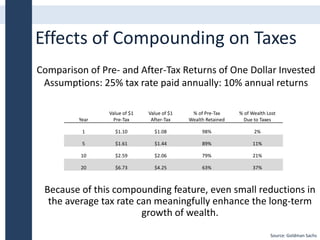
Effects of Compounding on Taxes
Year
Value of $1
Pre-Tax
Value of $1
After-Tax
% of Pre-Tax
Wealth Retained
% of Wealth Lost
Due to Taxes
1 $1.10 $1.08 98% 2%
5 $1.61 $1.44 89% 11%
10 $2.59 $2.06 79% 21%
20 $6.73 $4.25 63% 37%
Comparison of Pre- and After-Tax Returns of One Dollar Invested
Assumptions: 25% tax rate paid annually: 10% annual returns
Because of this compounding feature, even small reductions in
the average tax rate can meaningfully enhance the long-term
growth of wealth.
Source: Goldman Sachs
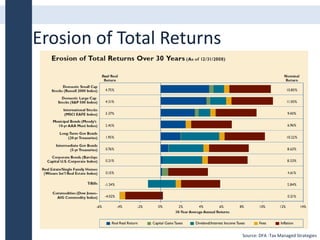
Source: DFA -Tax Managed Strategies
Erosion of Total Returns
Asset Location
Deciding where to place the carious components of the
asset allocation plan among the individuals and entities
that make up the investor or family.
What is it?
Why it matters:
• Different types of accounts have different types of tax treatment, ie.
IRA’s are taxed differently than trust accounts and individual accounts.
• Determining the most appropriate location for an asset can help
maximize your after-tax wealth
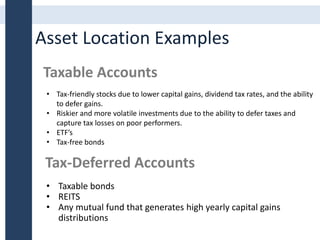
Asset Location Examples
Taxable Accounts
Tax-Deferred Accounts
• Taxable bonds
• REITS
• Any mutual fund that generates high yearly capital gains
distributions
• Tax-friendly stocks due to lower capital gains, dividend tax rates, and the ability
to defer gains.
• Riskier and more volatile investments due to the ability to defer taxes and
capture tax losses on poor performers.
• ETF’s
• Tax-free bonds
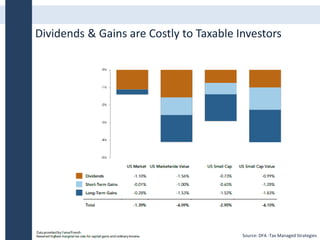
Dividends & Gains are Costly to Taxable Investors
Source: DFA -Tax Managed Strategies
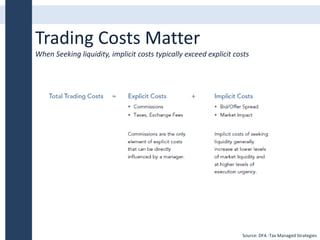
Trading Costs Matter
When Seeking liquidity, implicit costs typically exceed explicit costs
Source: DFA -Tax Managed Strategies
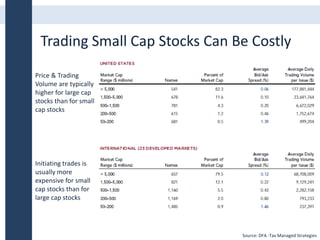
Trading Small Cap Stocks Can Be Costly
Price & Trading
Volume are typically
higher for large cap
stocks than for small
cap stocks
Initiating trades is
usually more
expensive for small
cap stocks than for
large cap stocks
Source: DFA -Tax Managed Strategies

Taxes & trading costs

  • 1.
    Wealth Management Impact ofTaxes and Trading Costs
  • 2.
    Tax-Aware Wealth Management •Understanding that maximizing pre-tax return is not the same as maximizing after-tax wealth. • How taxes influence decisions related to asset allocation, asset location, and portfolio construction. • Don’t let the tail wag the dog. It is important to be aware of taxes but they should not control your investment decisions
  • 3.
    Effects of Compoundingon Taxes Year Value of $1 Pre-Tax Value of $1 After-Tax % of Pre-Tax Wealth Retained % of Wealth Lost Due to Taxes 1 $1.10 $1.08 98% 2% 5 $1.61 $1.44 89% 11% 10 $2.59 $2.06 79% 21% 20 $6.73 $4.25 63% 37% Comparison of Pre- and After-Tax Returns of One Dollar Invested Assumptions: 25% tax rate paid annually: 10% annual returns Because of this compounding feature, even small reductions in the average tax rate can meaningfully enhance the long-term growth of wealth. Source: Goldman Sachs
  • 4.
    Source: DFA -TaxManaged Strategies Erosion of Total Returns
  • 5.
    Asset Location Deciding whereto place the carious components of the asset allocation plan among the individuals and entities that make up the investor or family. What is it? Why it matters: • Different types of accounts have different types of tax treatment, ie. IRA’s are taxed differently than trust accounts and individual accounts. • Determining the most appropriate location for an asset can help maximize your after-tax wealth
  • 6.
    Asset Location Examples TaxableAccounts Tax-Deferred Accounts • Taxable bonds • REITS • Any mutual fund that generates high yearly capital gains distributions • Tax-friendly stocks due to lower capital gains, dividend tax rates, and the ability to defer gains. • Riskier and more volatile investments due to the ability to defer taxes and capture tax losses on poor performers. • ETF’s • Tax-free bonds
  • 7.
    Dividends & Gainsare Costly to Taxable Investors Source: DFA -Tax Managed Strategies
  • 8.
    Trading Costs Matter WhenSeeking liquidity, implicit costs typically exceed explicit costs Source: DFA -Tax Managed Strategies
  • 9.
    Trading Small CapStocks Can Be Costly Price & Trading Volume are typically higher for large cap stocks than for small cap stocks Initiating trades is usually more expensive for small cap stocks than for large cap stocks Source: DFA -Tax Managed Strategies