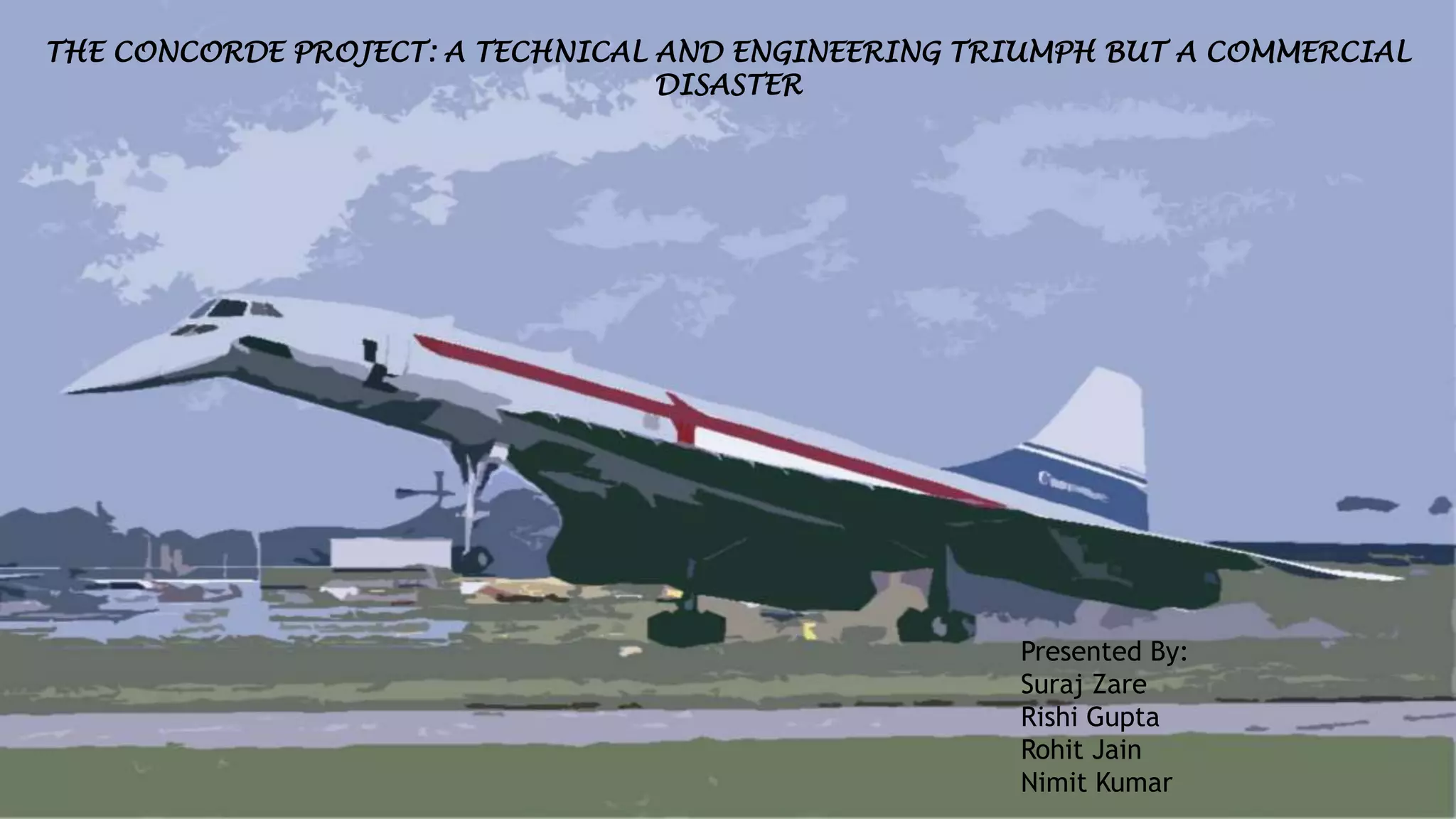
THE CONCORDE PROJECT: A TECHNICAL AND ENGINEERING TRIUMPH BUT A COMMERCIAL
DISASTER
Presented By:
Suraj Zare
Rishi Gupta
Rohit Jain
Nimit Kumar
The Concorde Project
 The idea of a supersonic aircraft had started as early as 1943 and steps were
taken to develop one in 1946.
 Concorde was a product of manufacturing efforts of Aerospatiale and British
Aircraft Corporation(BAC) & SUD Aviation(France), produced under a joint
France-British treaty.
 It was meant for high speed transportation for long distances.
Engineering Triumph
 Double delta shaped wings
 Mach 2.04 cruising speed
 Digital air intake system
 Fly-by-wire and brake by wire system
 Drop-nose section for better landing visibility
 High fuel storage
A Commercial Disaster
 Delay in completion leading to increase in cost significantly.
 No clearly identified owner.
 Over looked the project management aspects.
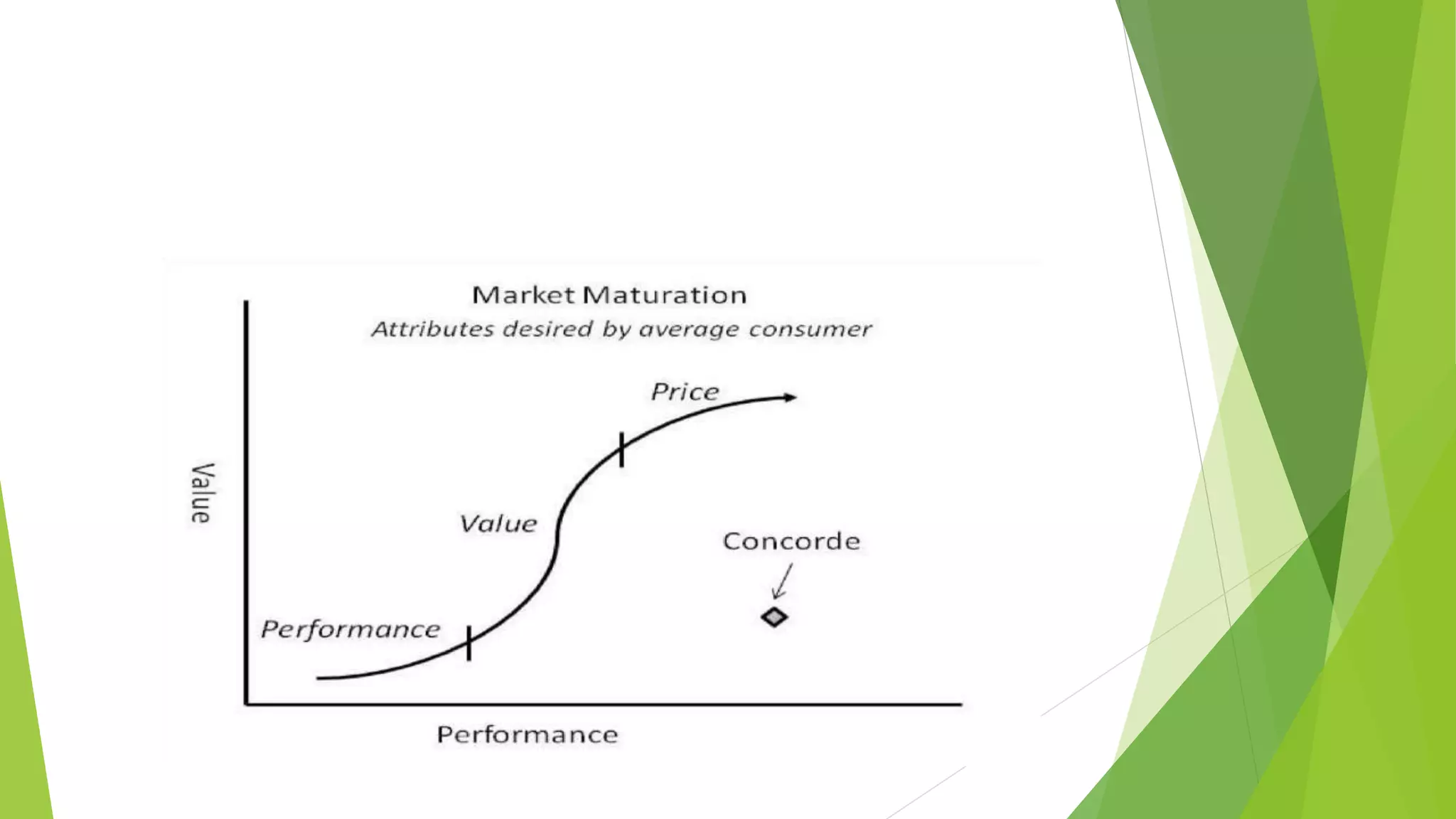
 Thought high speed would itself attract buyers .
 Due to high cost only a niche segment of population travelled through it.
 Sonic blast during take-off and landing.
 High fuel consumption.
Conclusion
 In terms of both cost and time the project was a disaster, but it met its main
objective.
 Concorde throughout its 35 year career, despite its leading edge in aeronautical
technology, faced a mountain of financial problems.
 As observed, the engineering/technology of the product alone cannot foretell if
the product is going to be successful.
 Accounting/finance criteria have to be met in order for it to be profitable. Market
research, initial cost assessment, financing requirements, budgetary planning and
control, all of these have to be carried out before the project even reaches the
development phase.
 Concorde had the latest technology in engineering and design yet it did not
manage to provide a profitable outcome. Hence engineering/technology is greatly
dependable upon accounting and finance.

The concorde project

  • 1.
    THE CONCORDE PROJECT:A TECHNICAL AND ENGINEERING TRIUMPH BUT A COMMERCIAL DISASTER Presented By: Suraj Zare Rishi Gupta Rohit Jain Nimit Kumar
  • 2.
    The Concorde Project The idea of a supersonic aircraft had started as early as 1943 and steps were taken to develop one in 1946.  Concorde was a product of manufacturing efforts of Aerospatiale and British Aircraft Corporation(BAC) & SUD Aviation(France), produced under a joint France-British treaty.  It was meant for high speed transportation for long distances.
  • 3.
    Engineering Triumph  Doubledelta shaped wings  Mach 2.04 cruising speed  Digital air intake system  Fly-by-wire and brake by wire system  Drop-nose section for better landing visibility  High fuel storage
  • 4.
    A Commercial Disaster Delay in completion leading to increase in cost significantly.  No clearly identified owner.  Over looked the project management aspects.  Thought high speed would itself attract buyers .  Due to high cost only a niche segment of population travelled through it.  Sonic blast during take-off and landing.  High fuel consumption.
  • 6.
    Conclusion  In termsof both cost and time the project was a disaster, but it met its main objective.  Concorde throughout its 35 year career, despite its leading edge in aeronautical technology, faced a mountain of financial problems.  As observed, the engineering/technology of the product alone cannot foretell if the product is going to be successful.  Accounting/finance criteria have to be met in order for it to be profitable. Market research, initial cost assessment, financing requirements, budgetary planning and control, all of these have to be carried out before the project even reaches the development phase.  Concorde had the latest technology in engineering and design yet it did not manage to provide a profitable outcome. Hence engineering/technology is greatly dependable upon accounting and finance.