ListViews, GridViews, Adapters,
Dialogs and Toasts
ListViews, GridViews, Adapters, Dialogs and Toasts
A ListView or a GridView shows data in an array, a Collection or a
Cursor resulting from a DB query.
Contrary to what happens with the other View, the data entry is
done at runtime using an Adapter that tells the system how to
insert the data specifying the graphical interface of each element.
To simplify this management it provides lists of specialized
classes like ListActivity and ListFragment that add methods to
handle the ListView without recovering its reference from the
layout.
ListViews and GridViews
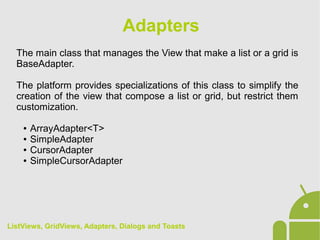
The main class that manages the View that make a list or a grid is
BaseAdapter.
The platform provides specializations of this class to simplify the
creation of the view that compose a list or grid, but restrict them
customization.
● ArrayAdapter<T>
● SimpleAdapter
● CursorAdapter
● SimpleCursorAdapter
Adapters
ListViews, GridViews, Adapters, Dialogs and Toasts
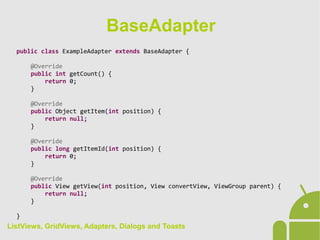
public class ExampleAdapter extends BaseAdapter {
@Override
public int getCount() {
return 0;
}
@Override
public Object getItem(int position) {
return null;
}
@Override
public long getItemId(int position) {
return 0;
}
@Override
public View getView(int position, View convertView, ViewGroup parent) {
return null;
}
}
BaseAdapter
ListViews, GridViews, Adapters, Dialogs and Toasts
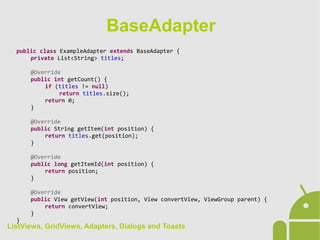
public class ExampleAdapter extends BaseAdapter {
private List<String> titles;
@Override
public int getCount() {
if (titles != null)
return titles.size();
return 0;
}
@Override
public String getItem(int position) {
return titles.get(position);
}
@Override
public long getItemId(int position) {
return position;
}
@Override
public View getView(int position, View convertView, ViewGroup parent) {
return convertView;
}
}
BaseAdapter
ListViews, GridViews, Adapters, Dialogs and Toasts
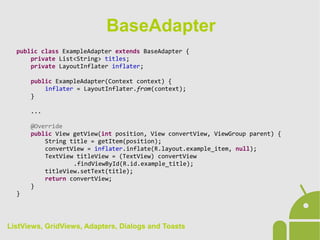
public class ExampleAdapter extends BaseAdapter {
private List<String> titles;
private LayoutInflater inflater;
public ExampleAdapter(Context context) {
inflater = LayoutInflater.from(context);
}
...
@Override
public View getView(int position, View convertView, ViewGroup parent) {
String title = getItem(position);
convertView = inflater.inflate(R.layout.example_item, null);
TextView titleView = (TextView) convertView
.findViewById(R.id.example_title);
titleView.setText(title);
return convertView;
}
}
BaseAdapter
ListViews, GridViews, Adapters, Dialogs and Toasts
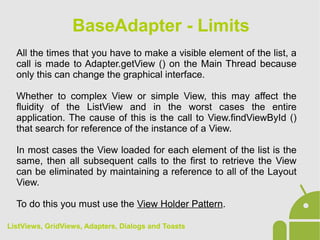
All the times that you have to make a visible element of the list, a
call is made to Adapter.getView () on the Main Thread because
only this can change the graphical interface.
Whether to complex View or simple View, this may affect the
fluidity of the ListView and in the worst cases the entire
application. The cause of this is the call to View.findViewById ()
that search for reference of the instance of a View.
In most cases the View loaded for each element of the list is the
same, then all subsequent calls to the first to retrieve the View
can be eliminated by maintaining a reference to all of the Layout
View.
To do this you must use the View Holder Pattern.
BaseAdapter - Limits
ListViews, GridViews, Adapters, Dialogs and Toasts
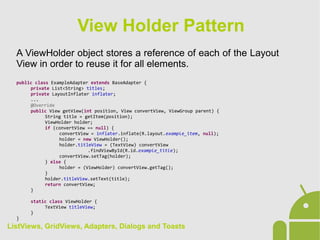
A ViewHolder object stores a reference of each of the Layout
View in order to reuse it for all elements.
public class ExampleAdapter extends BaseAdapter {
private List<String> titles;
private LayoutInflater inflater;
...
@Override
public View getView(int position, View convertView, ViewGroup parent) {
String title = getItem(position);
ViewHolder holder;
if (convertView == null) {
convertView = inflater.inflate(R.layout.example_item, null);
holder = new ViewHolder();
holder.titleView = (TextView) convertView
.findViewById(R.id.example_title);
convertView.setTag(holder);
} else {
holder = (ViewHolder) convertView.getTag();
}
holder.titleView.setText(title);
return convertView;
}
static class ViewHolder {
TextView titleView;
}
}
View Holder Pattern
ListViews, GridViews, Adapters, Dialogs and Toasts
ArrayAdapter is a concrete class that allows the insertion of a
simple list in a ListView.
ArrayAdapter<String> itemsAdapter =
new ArrayAdapter<String>(this, android.R.layout.simple_list_item_1, items);
By default, the text entered in the one TextView in the list is the
string returned by toString().
ArrayAdapter<T>
ListViews, GridViews, Adapters, Dialogs and Toasts
SimpleAdapter (as the ArrayAdapter) is a concrete class that
allows the insertion of a simple list in a ListView, but allows a
greater level of customization.
List<Map<String, String>> data = new ArrayList<Map<String, String>>();
data.add(new HashMap<String, String>() {
{
put("description", "10100");
put("title", "Torino");
}
});
...
ListAdapter adapter = new SimpleAdapter(this, data,
android.R.layout.simple_list_item_2, new String[] { "title",
"description" }, new int[] { android.R.id.text1,
android.R.id.text2 });
SimpleAdapter
ListViews, GridViews, Adapters, Dialogs and Toasts
CursorAdapter is an abstract class that simplifies the
management of data from a DataBase to show them in a
ListView.
It is not necessary to implement the ViewHolderPattern, because
the class manages the reuse of View.
public class ExampleCursorAdapter extends CursorAdapter {
private LayoutInflater inflater;
public ExampleCursorAdapter(Context context, Cursor c, boolean autoRequery) {
super(context, c, autoRequery);
inflater = LayoutInflater.from(context);
}
@Override
public void bindView(View view, Context context, Cursor cursor) {
TextView titleText = (TextView) view.findViewById(R.id.example_title);
String title = cursor.getString(cursor.getColumnIndex("title"));
titleText.setText(title);
}
@Override
public View newView(Context context, Cursor cursor, ViewGroup parent) {
return inflater.inflate(R.layout.example_item, null);
}
}
CursorAdapter
ListViews, GridViews, Adapters, Dialogs and Toasts
Once you have created the adapter, it should be assigned to the
ListView or GridView with the method:
listView.setAdapter(adapter);
After you've assigned all'AdapterView, you no longer need to
instantiate a new one: if and when the data passed to the adapter
undergo a change, it is necessary and sufficient to invoke the
method Adapter.notifyDataSetChanged () to apply your changes
and force the update of the list.
adapter.notifyDataSetChanged();
N.B.: If you change the data, but the method
Adapter.notifyDataSetChanged() is not called, the system will
throw an IllegalStateException.
Data management
ListViews, GridViews, Adapters, Dialogs and Toasts
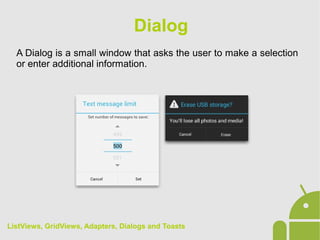
A Dialog is a small window that asks the user to make a selection
or enter additional information.
Dialog
ListViews, GridViews, Adapters, Dialogs and Toasts
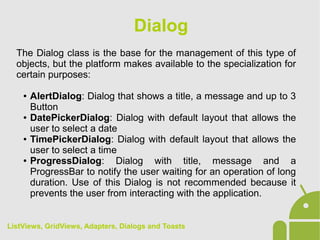
The Dialog class is the base for the management of this type of
objects, but the platform makes available to the specialization for
certain purposes:
● AlertDialog: Dialog that shows a title, a message and up to 3
Button
● DatePickerDialog: Dialog with default layout that allows the
user to select a date
● TimePickerDialog: Dialog with default layout that allows the
user to select a time
● ProgressDialog: Dialog with title, message and a
ProgressBar to notify the user waiting for an operation of long
duration. Use of this Dialog is not recommended because it
prevents the user from interacting with the application.
Dialog
ListViews, GridViews, Adapters, Dialogs and Toasts
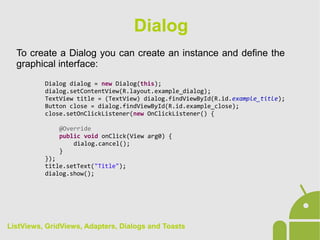
To create a Dialog you can create an instance and define the
graphical interface:
Dialog dialog = new Dialog(this);
dialog.setContentView(R.layout.example_dialog);
TextView title = (TextView) dialog.findViewById(R.id.example_title);
Button close = dialog.findViewById(R.id.example_close);
close.setOnClickListener(new OnClickListener() {
@Override
public void onClick(View arg0) {
dialog.cancel();
}
});
title.setText("Title");
dialog.show();
Dialog
ListViews, GridViews, Adapters, Dialogs and Toasts
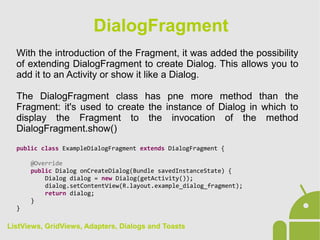
With the introduction of the Fragment, it was added the possibility
of extending DialogFragment to create Dialog. This allows you to
add it to an Activity or show it like a Dialog.
The DialogFragment class has pne more method than the
Fragment: it's used to create the instance of Dialog in which to
display the Fragment to the invocation of the method
DialogFragment.show()
public class ExampleDialogFragment extends DialogFragment {
@Override
public Dialog onCreateDialog(Bundle savedInstanceState) {
Dialog dialog = new Dialog(getActivity());
dialog.setContentView(R.layout.example_dialog_fragment);
return dialog;
}
}
DialogFragment
ListViews, GridViews, Adapters, Dialogs and Toasts
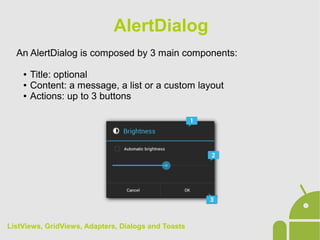
An AlertDialog is composed by 3 main components:
● Title: optional
● Content: a message, a list or a custom layout
● Actions: up to 3 buttons
AlertDialog
ListViews, GridViews, Adapters, Dialogs and Toasts
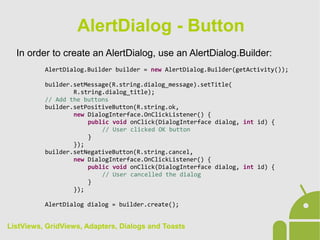
In order to create an AlertDialog, use an AlertDialog.Builder:
AlertDialog.Builder builder = new AlertDialog.Builder(getActivity());
builder.setMessage(R.string.dialog_message).setTitle(
R.string.dialog_title);
// Add the buttons
builder.setPositiveButton(R.string.ok,
new DialogInterface.OnClickListener() {
public void onClick(DialogInterface dialog, int id) {
// User clicked OK button
}
});
builder.setNegativeButton(R.string.cancel,
new DialogInterface.OnClickListener() {
public void onClick(DialogInterface dialog, int id) {
// User cancelled the dialog
}
});
AlertDialog dialog = builder.create();
AlertDialog - Button
ListViews, GridViews, Adapters, Dialogs and Toasts
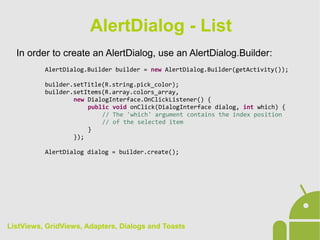
In order to create an AlertDialog, use an AlertDialog.Builder:
AlertDialog.Builder builder = new AlertDialog.Builder(getActivity());
builder.setTitle(R.string.pick_color);
builder.setItems(R.array.colors_array,
new DialogInterface.OnClickListener() {
public void onClick(DialogInterface dialog, int which) {
// The 'which' argument contains the index position
// of the selected item
}
});
AlertDialog dialog = builder.create();
AlertDialog - List
ListViews, GridViews, Adapters, Dialogs and Toasts
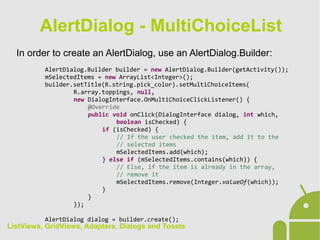
In order to create an AlertDialog, use an AlertDialog.Builder:
AlertDialog.Builder builder = new AlertDialog.Builder(getActivity());
mSelectedItems = new ArrayList<Integer>();
builder.setTitle(R.string.pick_color).setMultiChoiceItems(
R.array.toppings, null,
new DialogInterface.OnMultiChoiceClickListener() {
@Override
public void onClick(DialogInterface dialog, int which,
boolean isChecked) {
if (isChecked) {
// If the user checked the item, add it to the
// selected items
mSelectedItems.add(which);
} else if (mSelectedItems.contains(which)) {
// Else, if the item is already in the array,
// remove it
mSelectedItems.remove(Integer.valueOf(which));
}
}
});
AlertDialog dialog = builder.create();
AlertDialog - MultiChoiceList
ListViews, GridViews, Adapters, Dialogs and Toasts
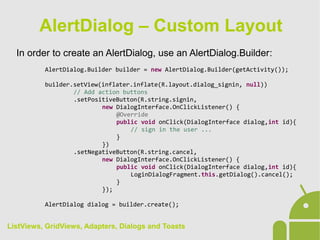
In order to create an AlertDialog, use an AlertDialog.Builder:
AlertDialog.Builder builder = new AlertDialog.Builder(getActivity());
builder.setView(inflater.inflate(R.layout.dialog_signin, null))
// Add action buttons
.setPositiveButton(R.string.signin,
new DialogInterface.OnClickListener() {
@Override
public void onClick(DialogInterface dialog,int id){
// sign in the user ...
}
})
.setNegativeButton(R.string.cancel,
new DialogInterface.OnClickListener() {
public void onClick(DialogInterface dialog,int id){
LoginDialogFragment.this.getDialog().cancel();
}
});
AlertDialog dialog = builder.create();
AlertDialog – Custom Layout
ListViews, GridViews, Adapters, Dialogs and Toasts
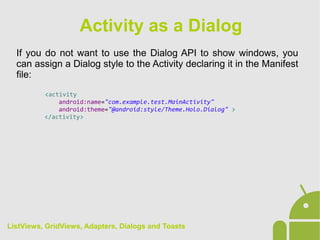
If you do not want to use the Dialog API to show windows, you
can assign a Dialog style to the Activity declaring it in the Manifest
file:
<activity
android:name="com.example.test.MainActivity"
android:theme="@android:style/Theme.Holo.Dialog" >
</activity>
Activity as a Dialog
ListViews, GridViews, Adapters, Dialogs and Toasts
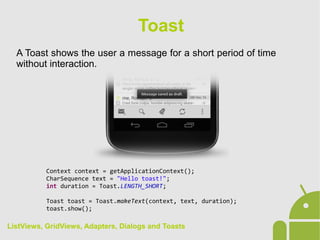
A Toast shows the user a message for a short period of time
without interaction.
Toast
Context context = getApplicationContext();
CharSequence text = "Hello toast!";
int duration = Toast.LENGTH_SHORT;
Toast toast = Toast.makeText(context, text, duration);
toast.show();
ListViews, GridViews, Adapters, Dialogs and Toasts

Android App Development - 11 Lists, grids, adapters, dialogs and toasts

  • 1.
  • 2.
    ListViews, GridViews, Adapters,Dialogs and Toasts A ListView or a GridView shows data in an array, a Collection or a Cursor resulting from a DB query. Contrary to what happens with the other View, the data entry is done at runtime using an Adapter that tells the system how to insert the data specifying the graphical interface of each element. To simplify this management it provides lists of specialized classes like ListActivity and ListFragment that add methods to handle the ListView without recovering its reference from the layout. ListViews and GridViews
  • 3.
    The main classthat manages the View that make a list or a grid is BaseAdapter. The platform provides specializations of this class to simplify the creation of the view that compose a list or grid, but restrict them customization. ● ArrayAdapter<T> ● SimpleAdapter ● CursorAdapter ● SimpleCursorAdapter Adapters ListViews, GridViews, Adapters, Dialogs and Toasts
  • 4.
    public class ExampleAdapterextends BaseAdapter { @Override public int getCount() { return 0; } @Override public Object getItem(int position) { return null; } @Override public long getItemId(int position) { return 0; } @Override public View getView(int position, View convertView, ViewGroup parent) { return null; } } BaseAdapter ListViews, GridViews, Adapters, Dialogs and Toasts
  • 5.
    public class ExampleAdapterextends BaseAdapter { private List<String> titles; @Override public int getCount() { if (titles != null) return titles.size(); return 0; } @Override public String getItem(int position) { return titles.get(position); } @Override public long getItemId(int position) { return position; } @Override public View getView(int position, View convertView, ViewGroup parent) { return convertView; } } BaseAdapter ListViews, GridViews, Adapters, Dialogs and Toasts
  • 6.
    public class ExampleAdapterextends BaseAdapter { private List<String> titles; private LayoutInflater inflater; public ExampleAdapter(Context context) { inflater = LayoutInflater.from(context); } ... @Override public View getView(int position, View convertView, ViewGroup parent) { String title = getItem(position); convertView = inflater.inflate(R.layout.example_item, null); TextView titleView = (TextView) convertView .findViewById(R.id.example_title); titleView.setText(title); return convertView; } } BaseAdapter ListViews, GridViews, Adapters, Dialogs and Toasts
  • 7.
    All the timesthat you have to make a visible element of the list, a call is made to Adapter.getView () on the Main Thread because only this can change the graphical interface. Whether to complex View or simple View, this may affect the fluidity of the ListView and in the worst cases the entire application. The cause of this is the call to View.findViewById () that search for reference of the instance of a View. In most cases the View loaded for each element of the list is the same, then all subsequent calls to the first to retrieve the View can be eliminated by maintaining a reference to all of the Layout View. To do this you must use the View Holder Pattern. BaseAdapter - Limits ListViews, GridViews, Adapters, Dialogs and Toasts
  • 8.
    A ViewHolder objectstores a reference of each of the Layout View in order to reuse it for all elements. public class ExampleAdapter extends BaseAdapter { private List<String> titles; private LayoutInflater inflater; ... @Override public View getView(int position, View convertView, ViewGroup parent) { String title = getItem(position); ViewHolder holder; if (convertView == null) { convertView = inflater.inflate(R.layout.example_item, null); holder = new ViewHolder(); holder.titleView = (TextView) convertView .findViewById(R.id.example_title); convertView.setTag(holder); } else { holder = (ViewHolder) convertView.getTag(); } holder.titleView.setText(title); return convertView; } static class ViewHolder { TextView titleView; } } View Holder Pattern ListViews, GridViews, Adapters, Dialogs and Toasts
  • 9.
    ArrayAdapter is aconcrete class that allows the insertion of a simple list in a ListView. ArrayAdapter<String> itemsAdapter = new ArrayAdapter<String>(this, android.R.layout.simple_list_item_1, items); By default, the text entered in the one TextView in the list is the string returned by toString(). ArrayAdapter<T> ListViews, GridViews, Adapters, Dialogs and Toasts
  • 10.
    SimpleAdapter (as theArrayAdapter) is a concrete class that allows the insertion of a simple list in a ListView, but allows a greater level of customization. List<Map<String, String>> data = new ArrayList<Map<String, String>>(); data.add(new HashMap<String, String>() { { put("description", "10100"); put("title", "Torino"); } }); ... ListAdapter adapter = new SimpleAdapter(this, data, android.R.layout.simple_list_item_2, new String[] { "title", "description" }, new int[] { android.R.id.text1, android.R.id.text2 }); SimpleAdapter ListViews, GridViews, Adapters, Dialogs and Toasts
  • 11.
    CursorAdapter is anabstract class that simplifies the management of data from a DataBase to show them in a ListView. It is not necessary to implement the ViewHolderPattern, because the class manages the reuse of View. public class ExampleCursorAdapter extends CursorAdapter { private LayoutInflater inflater; public ExampleCursorAdapter(Context context, Cursor c, boolean autoRequery) { super(context, c, autoRequery); inflater = LayoutInflater.from(context); } @Override public void bindView(View view, Context context, Cursor cursor) { TextView titleText = (TextView) view.findViewById(R.id.example_title); String title = cursor.getString(cursor.getColumnIndex("title")); titleText.setText(title); } @Override public View newView(Context context, Cursor cursor, ViewGroup parent) { return inflater.inflate(R.layout.example_item, null); } } CursorAdapter ListViews, GridViews, Adapters, Dialogs and Toasts
  • 12.
    Once you havecreated the adapter, it should be assigned to the ListView or GridView with the method: listView.setAdapter(adapter); After you've assigned all'AdapterView, you no longer need to instantiate a new one: if and when the data passed to the adapter undergo a change, it is necessary and sufficient to invoke the method Adapter.notifyDataSetChanged () to apply your changes and force the update of the list. adapter.notifyDataSetChanged(); N.B.: If you change the data, but the method Adapter.notifyDataSetChanged() is not called, the system will throw an IllegalStateException. Data management ListViews, GridViews, Adapters, Dialogs and Toasts
  • 13.
    A Dialog isa small window that asks the user to make a selection or enter additional information. Dialog ListViews, GridViews, Adapters, Dialogs and Toasts
  • 14.
    The Dialog classis the base for the management of this type of objects, but the platform makes available to the specialization for certain purposes: ● AlertDialog: Dialog that shows a title, a message and up to 3 Button ● DatePickerDialog: Dialog with default layout that allows the user to select a date ● TimePickerDialog: Dialog with default layout that allows the user to select a time ● ProgressDialog: Dialog with title, message and a ProgressBar to notify the user waiting for an operation of long duration. Use of this Dialog is not recommended because it prevents the user from interacting with the application. Dialog ListViews, GridViews, Adapters, Dialogs and Toasts
  • 15.
    To create aDialog you can create an instance and define the graphical interface: Dialog dialog = new Dialog(this); dialog.setContentView(R.layout.example_dialog); TextView title = (TextView) dialog.findViewById(R.id.example_title); Button close = dialog.findViewById(R.id.example_close); close.setOnClickListener(new OnClickListener() { @Override public void onClick(View arg0) { dialog.cancel(); } }); title.setText("Title"); dialog.show(); Dialog ListViews, GridViews, Adapters, Dialogs and Toasts
  • 16.
    With the introductionof the Fragment, it was added the possibility of extending DialogFragment to create Dialog. This allows you to add it to an Activity or show it like a Dialog. The DialogFragment class has pne more method than the Fragment: it's used to create the instance of Dialog in which to display the Fragment to the invocation of the method DialogFragment.show() public class ExampleDialogFragment extends DialogFragment { @Override public Dialog onCreateDialog(Bundle savedInstanceState) { Dialog dialog = new Dialog(getActivity()); dialog.setContentView(R.layout.example_dialog_fragment); return dialog; } } DialogFragment ListViews, GridViews, Adapters, Dialogs and Toasts
  • 17.
    An AlertDialog iscomposed by 3 main components: ● Title: optional ● Content: a message, a list or a custom layout ● Actions: up to 3 buttons AlertDialog ListViews, GridViews, Adapters, Dialogs and Toasts
  • 18.
    In order tocreate an AlertDialog, use an AlertDialog.Builder: AlertDialog.Builder builder = new AlertDialog.Builder(getActivity()); builder.setMessage(R.string.dialog_message).setTitle( R.string.dialog_title); // Add the buttons builder.setPositiveButton(R.string.ok, new DialogInterface.OnClickListener() { public void onClick(DialogInterface dialog, int id) { // User clicked OK button } }); builder.setNegativeButton(R.string.cancel, new DialogInterface.OnClickListener() { public void onClick(DialogInterface dialog, int id) { // User cancelled the dialog } }); AlertDialog dialog = builder.create(); AlertDialog - Button ListViews, GridViews, Adapters, Dialogs and Toasts
  • 19.
    In order tocreate an AlertDialog, use an AlertDialog.Builder: AlertDialog.Builder builder = new AlertDialog.Builder(getActivity()); builder.setTitle(R.string.pick_color); builder.setItems(R.array.colors_array, new DialogInterface.OnClickListener() { public void onClick(DialogInterface dialog, int which) { // The 'which' argument contains the index position // of the selected item } }); AlertDialog dialog = builder.create(); AlertDialog - List ListViews, GridViews, Adapters, Dialogs and Toasts
  • 20.
    In order tocreate an AlertDialog, use an AlertDialog.Builder: AlertDialog.Builder builder = new AlertDialog.Builder(getActivity()); mSelectedItems = new ArrayList<Integer>(); builder.setTitle(R.string.pick_color).setMultiChoiceItems( R.array.toppings, null, new DialogInterface.OnMultiChoiceClickListener() { @Override public void onClick(DialogInterface dialog, int which, boolean isChecked) { if (isChecked) { // If the user checked the item, add it to the // selected items mSelectedItems.add(which); } else if (mSelectedItems.contains(which)) { // Else, if the item is already in the array, // remove it mSelectedItems.remove(Integer.valueOf(which)); } } }); AlertDialog dialog = builder.create(); AlertDialog - MultiChoiceList ListViews, GridViews, Adapters, Dialogs and Toasts
  • 21.
    In order tocreate an AlertDialog, use an AlertDialog.Builder: AlertDialog.Builder builder = new AlertDialog.Builder(getActivity()); builder.setView(inflater.inflate(R.layout.dialog_signin, null)) // Add action buttons .setPositiveButton(R.string.signin, new DialogInterface.OnClickListener() { @Override public void onClick(DialogInterface dialog,int id){ // sign in the user ... } }) .setNegativeButton(R.string.cancel, new DialogInterface.OnClickListener() { public void onClick(DialogInterface dialog,int id){ LoginDialogFragment.this.getDialog().cancel(); } }); AlertDialog dialog = builder.create(); AlertDialog – Custom Layout ListViews, GridViews, Adapters, Dialogs and Toasts
  • 22.
    If you donot want to use the Dialog API to show windows, you can assign a Dialog style to the Activity declaring it in the Manifest file: <activity android:name="com.example.test.MainActivity" android:theme="@android:style/Theme.Holo.Dialog" > </activity> Activity as a Dialog ListViews, GridViews, Adapters, Dialogs and Toasts
  • 23.
    A Toast showsthe user a message for a short period of time without interaction. Toast Context context = getApplicationContext(); CharSequence text = "Hello toast!"; int duration = Toast.LENGTH_SHORT; Toast toast = Toast.makeText(context, text, duration); toast.show(); ListViews, GridViews, Adapters, Dialogs and Toasts