BREAKING DOWN “DATA
SILOS”•WITH THE OPEN
DATA PROTOCOL
(ODATA)
Chris Woodruff
WHO AM I?
CHRIS WOODRUFF
MVP, Data Platform Development
Chris.Woodruff@rcmt.com
http://chriswoodruff.com
http://deepfriedbytes.com
http://nplus1.org
twitter @cwoodruff
Today, the tools for capturing
data both at the mega-scale
and at the milli-scale are just
dreadful. After you have
captured the data, you need
to curate it before you can
start doing any kind of data
analysis, and we lack good
tools for both data curation
and data analysis.
Jim Gray
QUOTE
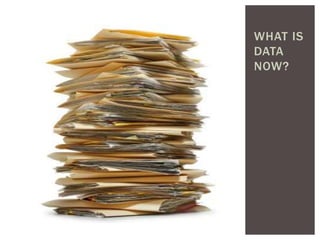
WHAT IS
DATA
NOW?
WHAT COULD DATA BE
TOMORROW?
 An architectural style for building loosely coupled
systems
 defined by a set of very general constraints (principles)
 the Web (URI/HTTP/HTML/XML) is an instance of this style
 The Web used correctly (i.e., not using the Web as
transport)
 HTTP is built according to RESTful principles
 services are built on top of Web standards without misusing them
 most importantly, HTTP is an application protocol (not a transport
protocol)
 Anything that uses HTTP and XML (XML without
SOAP)
 XML-RPC was the first approach for this
 violates REST because there is no uniform interface
REST: 3 DEFINITIONS
The name Atom applies to a pair of
related standards. The Atom Syndication
Format is an XML language used for web
feeds, while the Atom Publishing Protocol
(AtomPub) is a simple HTTP-based
protocol for creating and updating web
resources.
ATOMPUB
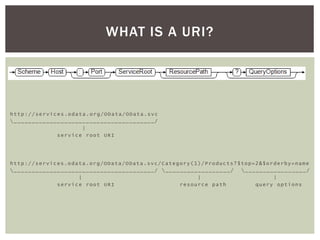
http://services.odata.org/OData/OData.svc
_______________________________________/
|
service root URI
http://services.odata.org/OData/OData.svc/Category(1)/Products?$top=2&$orderby=name
_______________________________________/ __________________/ _________________/
| | |
service root URI resource path query options
WHAT IS A URI?
Creation of standard Web
API’s
Allow internal Information
Workers to be more
productive
Give IT staff more time to
work on meaningful
projects
Monetize/Open Data for
others to use and benefit
from
WHAT ARE
THE
BENEFITS OF
ODATA?
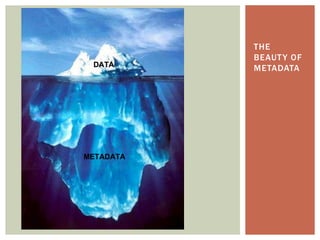
THE
BEAUTY OF
METADATA
THE BASICS
• Feeds, which are Collections of typed
Entries
• OData services can expose Service
Operations
• OData services expose all these
constructs via URIs
• OData service may also expose a
Service Metadata Document
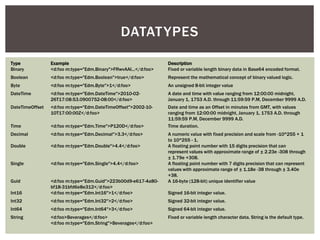
Type Example Description
Binary <d:foo m:type="Edm.Binary">FRwvAAI...</d:foo> Fixed or variable length binary data in Base64 encoded format.
Boolean <d:foo m:type="Edm.Boolean">true</d:foo> Represent the mathematical concept of binary valued logic.
Byte <d:foo m:type="Edm.Byte">1</d:foo> An unsigned 8-bit integer value
DateTime <d:foo m:type="Edm.DateTime">2010-02-
26T17:08:53.0900752-08:00</d:foo>
A date and time with value ranging from 12:00:00 midnight,
January 1, 1753 A.D. through 11:59:59 P.M, December 9999 A.D.
DateTimeOffset <d:foo m:type="Edm.DateTimeOffset">2002-10-
10T17:00:00Z</d:foo>
Date and time as an Offset in minutes from GMT, with values
ranging from 12:00:00 midnight, January 1, 1753 A.D. through
11:59:59 P.M, December 9999 A.D.
Time <d:foo m:type="Edm.Time">P120D</d:foo> Time duration.
Decimal <d:foo m:type="Edm.Decimal">3.3</d:foo> A numeric value with fixed precision and scale from -10^255 + 1
to 10^255 - 1.
Double <d:foo m:type="Edm.Double">4.4</d:foo> A floating point number with 15 digits precision that can
represent values with approximate range of ± 2.23e -308 through
± 1.79e +308.
Single <d:foo m:type="Edm.Single">4.4</d:foo> A floating point number with 7 digits precision that can represent
values with approximate range of ± 1.18e -38 through ± 3.40e
+38.
Guid <d:foo m:type="Edm.Guid">223b00d9-e617-4a80-
bf18-31bfd6e8e312</d:foo>
A 16-byte (128-bit) unique identifier value
Int16 <d:foo m:type="Edm.Int16">1</d:foo> Signed 16-bit integer value.
Int32 <d:foo m:type="Edm.Int32">2</d:foo> Signed 32-bit integer value.
Int64 <d:foo m:type="Edm.Int64">3</d:foo> Signed 64-bit integer value.
String <d:foo>Beverages</d:foo>
<d:foo m:type="Edm.String">Beverages</d:foo>
Fixed or variable length character data. String is the default type.
DATATYPES
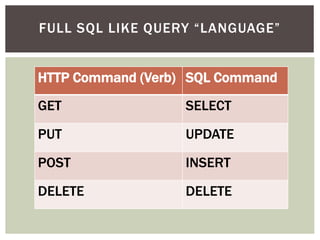
FULL SQL LIKE QUERY “LANGUAGE”
HTTP Command (Verb) SQL Command
GET SELECT
PUT UPDATE
POST INSERT
DELETE DELETE
How we get
around OData
QUERY
NAVIGATION
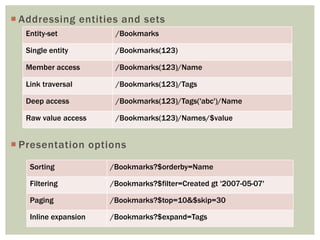
 Addressing entities and sets
 Presentation options
Entity-set /Bookmarks
Single entity /Bookmarks(123)
Member access /Bookmarks(123)/Name
Link traversal /Bookmarks(123)/Tags
Deep access /Bookmarks(123)/Tags('abc')/Name
Raw value access /Bookmarks(123)/Names/$value
Sorting /Bookmarks?$orderby=Name
Filtering /Bookmarks?$filter=Created gt '2007-05-07'
Paging /Bookmarks?$top=10&$skip=30
Inline expansion /Bookmarks?$expand=Tags
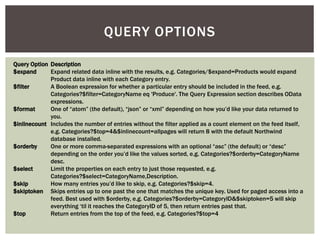
Query Option Description
$expand Expand related data inline with the results, e.g. Categories/$expand=Products would expand
Product data inline with each Category entry.
$filter A Boolean expression for whether a particular entry should be included in the feed, e.g.
Categories?$filter=CategoryName eq 'Produce'. The Query Expression section describes OData
expressions.
$format One of “atom” (the default), “json” or “xml” depending on how you’d like your data returned to
you.
$inlinecount Includes the number of entries without the filter applied as a count element on the feed itself,
e.g. Categories?$top=4&$inlinecount=allpages will return 8 with the default Northwind
database installed.
$orderby One or more comma-separated expressions with an optional “asc” (the default) or “desc”
depending on the order you’d like the values sorted, e.g. Categories?$orderby=CategoryName
desc.
$select Limit the properties on each entry to just those requested, e.g.
Categories?$select=CategoryName,Description.
$skip How many entries you’d like to skip, e.g. Categories?$skip=4.
$skiptoken Skips entries up to one past the one that matches the unique key. Used for paged access into a
feed. Best used with $orderby, e.g. Categories?$orderby=CategoryID&$skiptoken=5 will skip
everything ‘til it reaches the CategoryID of 5, then return entries past that.
$top Return entries from the top of the feed, e.g. Categories?$top=4
QUERY OPTIONS
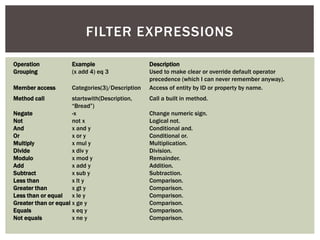
Operation Example Description
Grouping (x add 4) eq 3 Used to make clear or override default operator
precedence (which I can never remember anyway).
Member access Categories(3)/Description Access of entity by ID or property by name.
Method call startswith(Description,
“Bread”)
Call a built in method.
Negate -x Change numeric sign.
Not not x Logical not.
And x and y Conditional and.
Or x or y Conditional or.
Multiply x mul y Multiplication.
Divide x div y Division.
Modulo x mod y Remainder.
Add x add y Addition.
Subtract x sub y Subtraction.
Less than x lt y Comparison.
Greater than x gt y Comparison.
Less than or equal x le y Comparison.
Greater than or equal x ge y Comparison.
Equals x eq y Comparison.
Not equals x ne y Comparison.
FILTER EXPRESSIONS
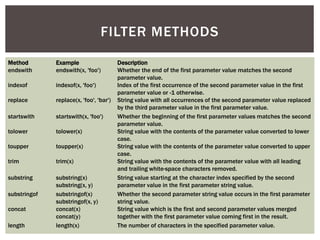
Method Example Description
endswith endswith(x, 'foo') Whether the end of the first parameter value matches the second
parameter value.
indexof indexof(x, 'foo') Index of the first occurrence of the second parameter value in the first
parameter value or -1 otherwise.
replace replace(x, 'foo', 'bar') String value with all occurrences of the second parameter value replaced
by the third parameter value in the first parameter value.
startswith startswith(x, 'foo') Whether the beginning of the first parameter values matches the second
parameter value.
tolower tolower(x) String value with the contents of the parameter value converted to lower
case.
toupper toupper(x) String value with the contents of the parameter value converted to upper
case.
trim trim(x) String value with the contents of the parameter value with all leading
and trailing white-space characters removed.
substring substring(x)
substring(x, y)
String value starting at the character index specified by the second
parameter value in the first parameter string value.
substringof substringof(x)
substringof(x, y)
Whether the second parameter string value occurs in the first parameter
string value.
concat concat(x)
concat(y)
String value which is the first and second parameter values merged
together with the first parameter value coming first in the result.
length length(x) The number of characters in the specified parameter value.
FILTER METHODS
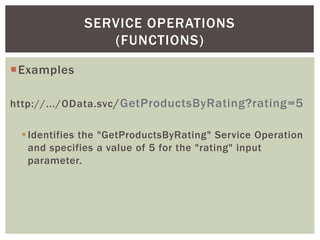
Examples
http://.../OData.svc/GetProductsByRating?rating=5
Identifies the "GetProductsByRating" Service Operation
and specifies a value of 5 for the "rating" input
parameter.
SERVICE OPERATIONS
(FUNCTIONS)
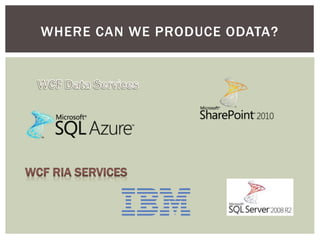
WHERE CAN WE PRODUCE ODATA?
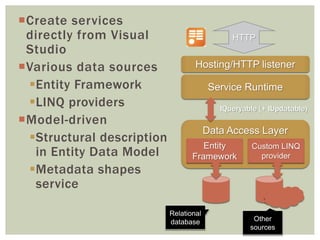
Data Access Layer
Entity
Framework
Custom LINQ
provider
Relational
database Other
sources
Service Runtime
Hosting/HTTP listener
HTTP
IQueryable (+ IUpdatable)
Create services
directly from Visual
Studio
Various data sources
Entity Framework
LINQ providers
Model-driven
Structural description
in Entity Data Model
Metadata shapes
service
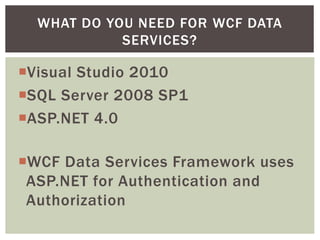
Visual Studio 2010
SQL Server 2008 SP1
ASP.NET 4.0
WCF Data Services Framework uses
ASP.NET for Authentication and
Authorization
WHAT DO YOU NEED FOR WCF DATA
SERVICES?
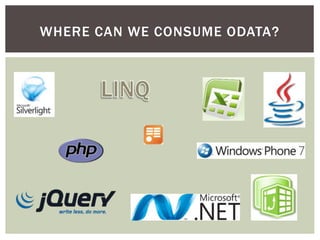
WHERE CAN WE CONSUME ODATA?
CONSUMING FROM .NET APPLICATIONS
Demo
OPEN YOUR DATA FOR OTHERS
MORE INFORMATION
WCF Data Services Framework Home --
http://tinyurl.com/wcfdataservices
WCF Data Services Framework Team Blog --
http://blogs.msdn.com/astoriateam
ODataPrimer.com – http://odataprimer.com
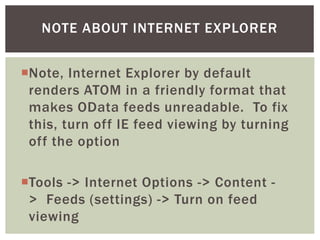
NOTE ABOUT INTERNET EXPLORER
Note, Internet Explorer by default
renders ATOM in a friendly format that
makes OData feeds unreadable. To fix
this, turn off IE feed viewing by turning
off the option
Tools -> Internet Options -> Content -
> Feeds (settings) -> Turn on feed
viewing
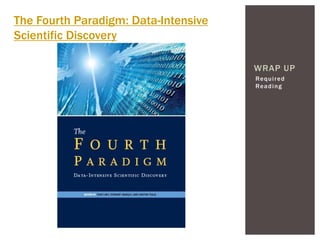
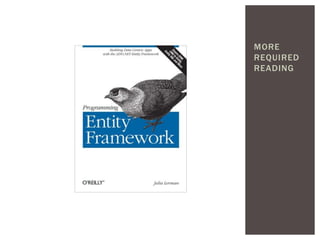
Required
Reading
WRAP UP
The Fourth Paradigm: Data-Intensive
Scientific Discovery
MORE
REQUIRED
READING
CONTACT ME!!
cwoodruff@live.com
Twitter @cwoodruff
MSN IM
cwoodruff@live.com

Breaking down data silos with the open data protocol

  • 1.
    BREAKING DOWN “DATA SILOS”•WITHTHE OPEN DATA PROTOCOL (ODATA) Chris Woodruff
  • 2.
    WHO AM I? CHRISWOODRUFF MVP, Data Platform Development Chris.Woodruff@rcmt.com http://chriswoodruff.com http://deepfriedbytes.com http://nplus1.org twitter @cwoodruff
  • 3.
    Today, the toolsfor capturing data both at the mega-scale and at the milli-scale are just dreadful. After you have captured the data, you need to curate it before you can start doing any kind of data analysis, and we lack good tools for both data curation and data analysis. Jim Gray QUOTE
  • 4.
  • 5.
    WHAT COULD DATABE TOMORROW?
  • 6.
     An architecturalstyle for building loosely coupled systems  defined by a set of very general constraints (principles)  the Web (URI/HTTP/HTML/XML) is an instance of this style  The Web used correctly (i.e., not using the Web as transport)  HTTP is built according to RESTful principles  services are built on top of Web standards without misusing them  most importantly, HTTP is an application protocol (not a transport protocol)  Anything that uses HTTP and XML (XML without SOAP)  XML-RPC was the first approach for this  violates REST because there is no uniform interface REST: 3 DEFINITIONS
  • 7.
    The name Atomapplies to a pair of related standards. The Atom Syndication Format is an XML language used for web feeds, while the Atom Publishing Protocol (AtomPub) is a simple HTTP-based protocol for creating and updating web resources. ATOMPUB
  • 8.
  • 9.
    Creation of standardWeb API’s Allow internal Information Workers to be more productive Give IT staff more time to work on meaningful projects Monetize/Open Data for others to use and benefit from WHAT ARE THE BENEFITS OF ODATA?
  • 10.
  • 11.
    THE BASICS • Feeds,which are Collections of typed Entries • OData services can expose Service Operations • OData services expose all these constructs via URIs • OData service may also expose a Service Metadata Document
  • 12.
    Type Example Description Binary<d:foo m:type="Edm.Binary">FRwvAAI...</d:foo> Fixed or variable length binary data in Base64 encoded format. Boolean <d:foo m:type="Edm.Boolean">true</d:foo> Represent the mathematical concept of binary valued logic. Byte <d:foo m:type="Edm.Byte">1</d:foo> An unsigned 8-bit integer value DateTime <d:foo m:type="Edm.DateTime">2010-02- 26T17:08:53.0900752-08:00</d:foo> A date and time with value ranging from 12:00:00 midnight, January 1, 1753 A.D. through 11:59:59 P.M, December 9999 A.D. DateTimeOffset <d:foo m:type="Edm.DateTimeOffset">2002-10- 10T17:00:00Z</d:foo> Date and time as an Offset in minutes from GMT, with values ranging from 12:00:00 midnight, January 1, 1753 A.D. through 11:59:59 P.M, December 9999 A.D. Time <d:foo m:type="Edm.Time">P120D</d:foo> Time duration. Decimal <d:foo m:type="Edm.Decimal">3.3</d:foo> A numeric value with fixed precision and scale from -10^255 + 1 to 10^255 - 1. Double <d:foo m:type="Edm.Double">4.4</d:foo> A floating point number with 15 digits precision that can represent values with approximate range of ± 2.23e -308 through ± 1.79e +308. Single <d:foo m:type="Edm.Single">4.4</d:foo> A floating point number with 7 digits precision that can represent values with approximate range of ± 1.18e -38 through ± 3.40e +38. Guid <d:foo m:type="Edm.Guid">223b00d9-e617-4a80- bf18-31bfd6e8e312</d:foo> A 16-byte (128-bit) unique identifier value Int16 <d:foo m:type="Edm.Int16">1</d:foo> Signed 16-bit integer value. Int32 <d:foo m:type="Edm.Int32">2</d:foo> Signed 32-bit integer value. Int64 <d:foo m:type="Edm.Int64">3</d:foo> Signed 64-bit integer value. String <d:foo>Beverages</d:foo> <d:foo m:type="Edm.String">Beverages</d:foo> Fixed or variable length character data. String is the default type. DATATYPES
  • 13.
    FULL SQL LIKEQUERY “LANGUAGE” HTTP Command (Verb) SQL Command GET SELECT PUT UPDATE POST INSERT DELETE DELETE
  • 14.
    How we get aroundOData QUERY NAVIGATION
  • 15.
     Addressing entitiesand sets  Presentation options Entity-set /Bookmarks Single entity /Bookmarks(123) Member access /Bookmarks(123)/Name Link traversal /Bookmarks(123)/Tags Deep access /Bookmarks(123)/Tags('abc')/Name Raw value access /Bookmarks(123)/Names/$value Sorting /Bookmarks?$orderby=Name Filtering /Bookmarks?$filter=Created gt '2007-05-07' Paging /Bookmarks?$top=10&$skip=30 Inline expansion /Bookmarks?$expand=Tags
  • 16.
    Query Option Description $expandExpand related data inline with the results, e.g. Categories/$expand=Products would expand Product data inline with each Category entry. $filter A Boolean expression for whether a particular entry should be included in the feed, e.g. Categories?$filter=CategoryName eq 'Produce'. The Query Expression section describes OData expressions. $format One of “atom” (the default), “json” or “xml” depending on how you’d like your data returned to you. $inlinecount Includes the number of entries without the filter applied as a count element on the feed itself, e.g. Categories?$top=4&$inlinecount=allpages will return 8 with the default Northwind database installed. $orderby One or more comma-separated expressions with an optional “asc” (the default) or “desc” depending on the order you’d like the values sorted, e.g. Categories?$orderby=CategoryName desc. $select Limit the properties on each entry to just those requested, e.g. Categories?$select=CategoryName,Description. $skip How many entries you’d like to skip, e.g. Categories?$skip=4. $skiptoken Skips entries up to one past the one that matches the unique key. Used for paged access into a feed. Best used with $orderby, e.g. Categories?$orderby=CategoryID&$skiptoken=5 will skip everything ‘til it reaches the CategoryID of 5, then return entries past that. $top Return entries from the top of the feed, e.g. Categories?$top=4 QUERY OPTIONS
  • 17.
    Operation Example Description Grouping(x add 4) eq 3 Used to make clear or override default operator precedence (which I can never remember anyway). Member access Categories(3)/Description Access of entity by ID or property by name. Method call startswith(Description, “Bread”) Call a built in method. Negate -x Change numeric sign. Not not x Logical not. And x and y Conditional and. Or x or y Conditional or. Multiply x mul y Multiplication. Divide x div y Division. Modulo x mod y Remainder. Add x add y Addition. Subtract x sub y Subtraction. Less than x lt y Comparison. Greater than x gt y Comparison. Less than or equal x le y Comparison. Greater than or equal x ge y Comparison. Equals x eq y Comparison. Not equals x ne y Comparison. FILTER EXPRESSIONS
  • 18.
    Method Example Description endswithendswith(x, 'foo') Whether the end of the first parameter value matches the second parameter value. indexof indexof(x, 'foo') Index of the first occurrence of the second parameter value in the first parameter value or -1 otherwise. replace replace(x, 'foo', 'bar') String value with all occurrences of the second parameter value replaced by the third parameter value in the first parameter value. startswith startswith(x, 'foo') Whether the beginning of the first parameter values matches the second parameter value. tolower tolower(x) String value with the contents of the parameter value converted to lower case. toupper toupper(x) String value with the contents of the parameter value converted to upper case. trim trim(x) String value with the contents of the parameter value with all leading and trailing white-space characters removed. substring substring(x) substring(x, y) String value starting at the character index specified by the second parameter value in the first parameter string value. substringof substringof(x) substringof(x, y) Whether the second parameter string value occurs in the first parameter string value. concat concat(x) concat(y) String value which is the first and second parameter values merged together with the first parameter value coming first in the result. length length(x) The number of characters in the specified parameter value. FILTER METHODS
  • 19.
    Examples http://.../OData.svc/GetProductsByRating?rating=5 Identifies the "GetProductsByRating"Service Operation and specifies a value of 5 for the "rating" input parameter. SERVICE OPERATIONS (FUNCTIONS)
  • 20.
    WHERE CAN WEPRODUCE ODATA?
  • 21.
    Data Access Layer Entity Framework CustomLINQ provider Relational database Other sources Service Runtime Hosting/HTTP listener HTTP IQueryable (+ IUpdatable) Create services directly from Visual Studio Various data sources Entity Framework LINQ providers Model-driven Structural description in Entity Data Model Metadata shapes service
  • 22.
    Visual Studio 2010 SQLServer 2008 SP1 ASP.NET 4.0 WCF Data Services Framework uses ASP.NET for Authentication and Authorization WHAT DO YOU NEED FOR WCF DATA SERVICES?
  • 23.
    WHERE CAN WECONSUME ODATA?
  • 24.
    CONSUMING FROM .NETAPPLICATIONS Demo
  • 25.
    OPEN YOUR DATAFOR OTHERS
  • 26.
    MORE INFORMATION WCF DataServices Framework Home -- http://tinyurl.com/wcfdataservices WCF Data Services Framework Team Blog -- http://blogs.msdn.com/astoriateam ODataPrimer.com – http://odataprimer.com
  • 27.
    NOTE ABOUT INTERNETEXPLORER Note, Internet Explorer by default renders ATOM in a friendly format that makes OData feeds unreadable. To fix this, turn off IE feed viewing by turning off the option Tools -> Internet Options -> Content - > Feeds (settings) -> Turn on feed viewing
  • 28.
    Required Reading WRAP UP The FourthParadigm: Data-Intensive Scientific Discovery
  • 29.
  • 30.

Editor's Notes

  • #7 Representational State Transfer (REST) is defined as an architectural style, which means that it is not a concrete systems architecture, but instead a set of constraints that are applied when designing a systems architecture. We briefly discuss these constraints, but then focus on explaining how the Web is one such systems architecture that implements REST. In particular, the mechanisms of the Uniform Resource Identifiers (URIs), the Hypertext Transfer Protocol (HTTP), media types, and markup languages such as the Hypertext Markup Language (HTML) and the Extensible Markup Language (XML). We also introduce Atom and the Atom Publishing Protocol (AtomPub) as two established ways on how RESTful services are already provided and used on today's Web.
  • #18 http://localhost:53211/owind.svc/Categories?$filter=(CategoryID add 4) eq 8