

10.23 GLOSSARY
B A A C A D E M Y 1
WHAT IS THIS GLOSSARY?
 Glossary is a place where key business terms with their
definitions are documented. Much of information that goes
into a glossary will be results of the business , stakeholder,
solution and transition requirements development efforts.
Simple example :
Bob and Jenny burst out laughing after reading out a user story of a project they
were working on which didn’t have a proper glossary.
“As a team member of OMG, I need a single window to access all pending records
and assigned list”.
What's OMG here?
For Bob and Jenny it was OH MY GOD! But actually its ‘Order Management Group’
B A A C A D E M Y 2
GLOSSARY ?
 The purpose of Glossary is to get stakeholder consensus
about the terminology within a particular domain
 Having a glossary with established definitions provides a
common language that can be used to communicate and
exchange ideas between the stakeholders.
Bob says “ Glossary is a place where I can read and
understand meaning of the terms which are outside the
common use, be it a business or a process it works like a
dictionary for me”.
B A A C A D E M Y 3
WHAT ARE ELEMENTS OF A GLOSSARY?
 Glossary contains a list of terms with unique, formal definitions
within a particular domain with any synonyms or aliases
 A term is included if it is unique to a domain, multiple
definitions, implied outside of the term’s common use, or
chance of misunderstanding
 A glossary should be created early in a project to facilitate
knowledge transfer and understanding. A person should be
identified who is responsible for the maintenance and
distribution of a glossary through out the initiative.
 Definition should be clear , concise and brief
 Should be accessible to all stakeholders
B A A C A D E M Y 4
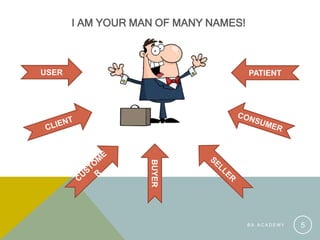
I AM YOUR MAN OF MANY NAMES!
B A A C A D E M Y 5
USER PATIENT
BUYER
BABOK 3.0 DEFINITION
 Glossaries are used to provide a common understanding of
terms that are used by stakeholders. A term may have
different meanings for any two people. A list of terms and
established definitions provides a common language that can
be used to communicate and exchange ideas.
 A glossary is organized and continuously accessible to all
stakeholders.
B A A C A D E M Y 6
B A A C A D E M Y 7
USAGE CONSIDERATIONS
Strengths
 A glossary promotes common understanding of the business domain and better
communication among all stakeholders..
 Capturing the definitions as part of an enterprise's documentation provides a
single reference and encourages consistency.
 Simplifies the writing and maintenance of other business analysis information
including but not limited to requirements, business rules, and change strategy.
Limitations
 A glossary requires an owner to perform timely maintenance, otherwise it
becomes outdated and may be ignored.
 It may be challenging for different stakeholders to agree on a single definition
for a term.
KNOWLEDGE TEST
 Bob is eliciting data requirements and discussing systems
communication and how the two systems currently
exchange data and services with his stakeholders. What
principle is Bob discussing??
A) Interoperability
B) Portability
C) Data Migration
D) Trans-System Exchange
B A A C A D E M Y 8
KNOWLEDGE TEST
 Bob is eliciting data requirements and discussing systems
communication and how the two systems currently
exchange data and services with his stakeholders. What
principle is Bob discussing??
A) Interoperability
B) Portability
C) Data Migration
D) Trans-System Exchange
B A A C A D E M Y 9
KNOWLEDGE TEST
 What is performed to assess or evaluate the effect of a change?
A) Traceability
B) Manage requirements approval
C) Base lining
D) Impact analysis
B A A C A D E M Y 10
KNOWLEDGE TEST
 What is performed to assess or evaluate the effect of a change?
A) Traceability
B) Manage requirements approval
C) Base lining
D) Impact analysis
B A A C A D E M Y 11
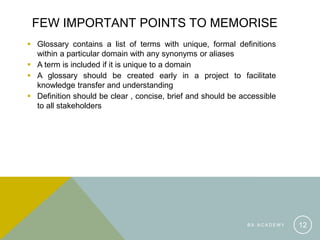
FEW IMPORTANT POINTS TO MEMORISE
 Glossary contains a list of terms with unique, formal definitions
within a particular domain with any synonyms or aliases
 A term is included if it is unique to a domain
 A glossary should be created early in a project to facilitate
knowledge transfer and understanding
 Definition should be clear , concise, brief and should be accessible
to all stakeholders
B A A C A D E M Y 12
THANK YOU
B A A C A D E M Y 13
Durga Prasad CBAP® CSM®

10.23 Glossary

  • 1.
    10.23 GLOSSARY B AA C A D E M Y 1
  • 2.
    WHAT IS THISGLOSSARY?  Glossary is a place where key business terms with their definitions are documented. Much of information that goes into a glossary will be results of the business , stakeholder, solution and transition requirements development efforts. Simple example : Bob and Jenny burst out laughing after reading out a user story of a project they were working on which didn’t have a proper glossary. “As a team member of OMG, I need a single window to access all pending records and assigned list”. What's OMG here? For Bob and Jenny it was OH MY GOD! But actually its ‘Order Management Group’ B A A C A D E M Y 2
  • 3.
    GLOSSARY ?  Thepurpose of Glossary is to get stakeholder consensus about the terminology within a particular domain  Having a glossary with established definitions provides a common language that can be used to communicate and exchange ideas between the stakeholders. Bob says “ Glossary is a place where I can read and understand meaning of the terms which are outside the common use, be it a business or a process it works like a dictionary for me”. B A A C A D E M Y 3
  • 4.
    WHAT ARE ELEMENTSOF A GLOSSARY?  Glossary contains a list of terms with unique, formal definitions within a particular domain with any synonyms or aliases  A term is included if it is unique to a domain, multiple definitions, implied outside of the term’s common use, or chance of misunderstanding  A glossary should be created early in a project to facilitate knowledge transfer and understanding. A person should be identified who is responsible for the maintenance and distribution of a glossary through out the initiative.  Definition should be clear , concise and brief  Should be accessible to all stakeholders B A A C A D E M Y 4
  • 5.
    I AM YOURMAN OF MANY NAMES! B A A C A D E M Y 5 USER PATIENT BUYER
  • 6.
    BABOK 3.0 DEFINITION Glossaries are used to provide a common understanding of terms that are used by stakeholders. A term may have different meanings for any two people. A list of terms and established definitions provides a common language that can be used to communicate and exchange ideas.  A glossary is organized and continuously accessible to all stakeholders. B A A C A D E M Y 6
  • 7.
    B A AC A D E M Y 7 USAGE CONSIDERATIONS Strengths  A glossary promotes common understanding of the business domain and better communication among all stakeholders..  Capturing the definitions as part of an enterprise's documentation provides a single reference and encourages consistency.  Simplifies the writing and maintenance of other business analysis information including but not limited to requirements, business rules, and change strategy. Limitations  A glossary requires an owner to perform timely maintenance, otherwise it becomes outdated and may be ignored.  It may be challenging for different stakeholders to agree on a single definition for a term.
  • 8.
    KNOWLEDGE TEST  Bobis eliciting data requirements and discussing systems communication and how the two systems currently exchange data and services with his stakeholders. What principle is Bob discussing?? A) Interoperability B) Portability C) Data Migration D) Trans-System Exchange B A A C A D E M Y 8
  • 9.
    KNOWLEDGE TEST  Bobis eliciting data requirements and discussing systems communication and how the two systems currently exchange data and services with his stakeholders. What principle is Bob discussing?? A) Interoperability B) Portability C) Data Migration D) Trans-System Exchange B A A C A D E M Y 9
  • 10.
    KNOWLEDGE TEST  Whatis performed to assess or evaluate the effect of a change? A) Traceability B) Manage requirements approval C) Base lining D) Impact analysis B A A C A D E M Y 10
  • 11.
    KNOWLEDGE TEST  Whatis performed to assess or evaluate the effect of a change? A) Traceability B) Manage requirements approval C) Base lining D) Impact analysis B A A C A D E M Y 11
  • 12.
    FEW IMPORTANT POINTSTO MEMORISE  Glossary contains a list of terms with unique, formal definitions within a particular domain with any synonyms or aliases  A term is included if it is unique to a domain  A glossary should be created early in a project to facilitate knowledge transfer and understanding  Definition should be clear , concise, brief and should be accessible to all stakeholders B A A C A D E M Y 12
  • 13.
    THANK YOU B AA C A D E M Y 13 Durga Prasad CBAP® CSM®