International INTERNATIONAL Journal of Advanced JOURNAL Research in Management OF ADVANCED (IJARM), ISSN RESEARCH 
0976 – 6324 (Print), 
ISSN 0976 – 6332 (Online), Volume 5, Issue 4, July- August (2014), pp. 01-10 © IAEME 
IN MANAGEMENT (IJARM) 
ISSN 0976 - 6324 (Print) 
ISSN 0976 - 6332 (Online) 
Volume 5, Issue 4, July-August (2014), pp. 01-10 
© IAEME: www.iaeme.com/ijarm.asp 
Journal Impact Factor (2014): 5.4271 (Calculated by GISI) 
www.jifactor.com 
1 
 
IJARM 
© I A E M E 
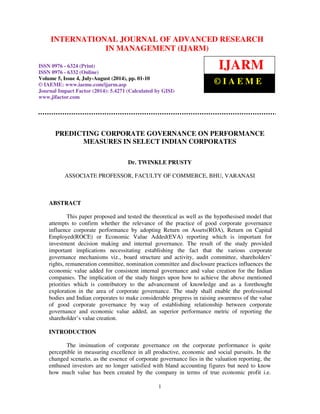
PREDICTING CORPORATE GOVERNANCE ON PERFORMANCE 
MEASURES IN SELECT INDIAN CORPORATES 
Dr. TWINKLE PRUSTY 
ASSOCIATE PROFESSOR, FACULTY OF COMMERCE, BHU, VARANASI 
ABSTRACT 
This paper proposed and tested the theoretical as well as the hypothesised model that 
attempts to confirm whether the relevance of the practice of good corporate governance 
influence corporate performance by adopting Return on Assets(ROA), Return on Capital 
Employed(ROCE) or Economic Value Added(EVA) reporting which is important for 
investment decision making and internal governance. The result of the study provided 
important implications necessitating establishing the fact that the various corporate 
governance mechanisms viz., board structure and activity, audit committee, shareholders’ 
rights, remuneration committee, nomination committee and disclosure practices influences the 
economic value added for consistent internal governance and value creation for the Indian 
companies. The implication of the study hinges upon how to achieve the above mentioned 
priorities which is contributory to the advancement of knowledge and as a forethought 
exploration in the area of corporate governance. The study shall enable the professional 
bodies and Indian corporates to make considerable progress in raising awareness of the value 
of good corporate governance by way of establishing relationship between corporate 
governance and economic value added, an superior performance metric of reporting the 
shareholder’s value creation. 
INTRODUCTION 
The insinuation of corporate governance on the corporate performance is quite 
perceptible in measuring excellence in all productive, economic and social pursuits. In the 
changed scenario, as the essence of corporate governance lies in the valuation reporting, the 
enthused investors are no longer satisfied with bland accounting figures but need to know 
how much value has been created by the company in terms of true economic profit i.e.
International Journal of Advanced Research in Management (IJARM), ISSN 0976 – 6324 (Print), 
ISSN 0976 – 6332 (Online), Volume 5, Issue 4, July- August (2014), pp. 01-10 © IAEME 
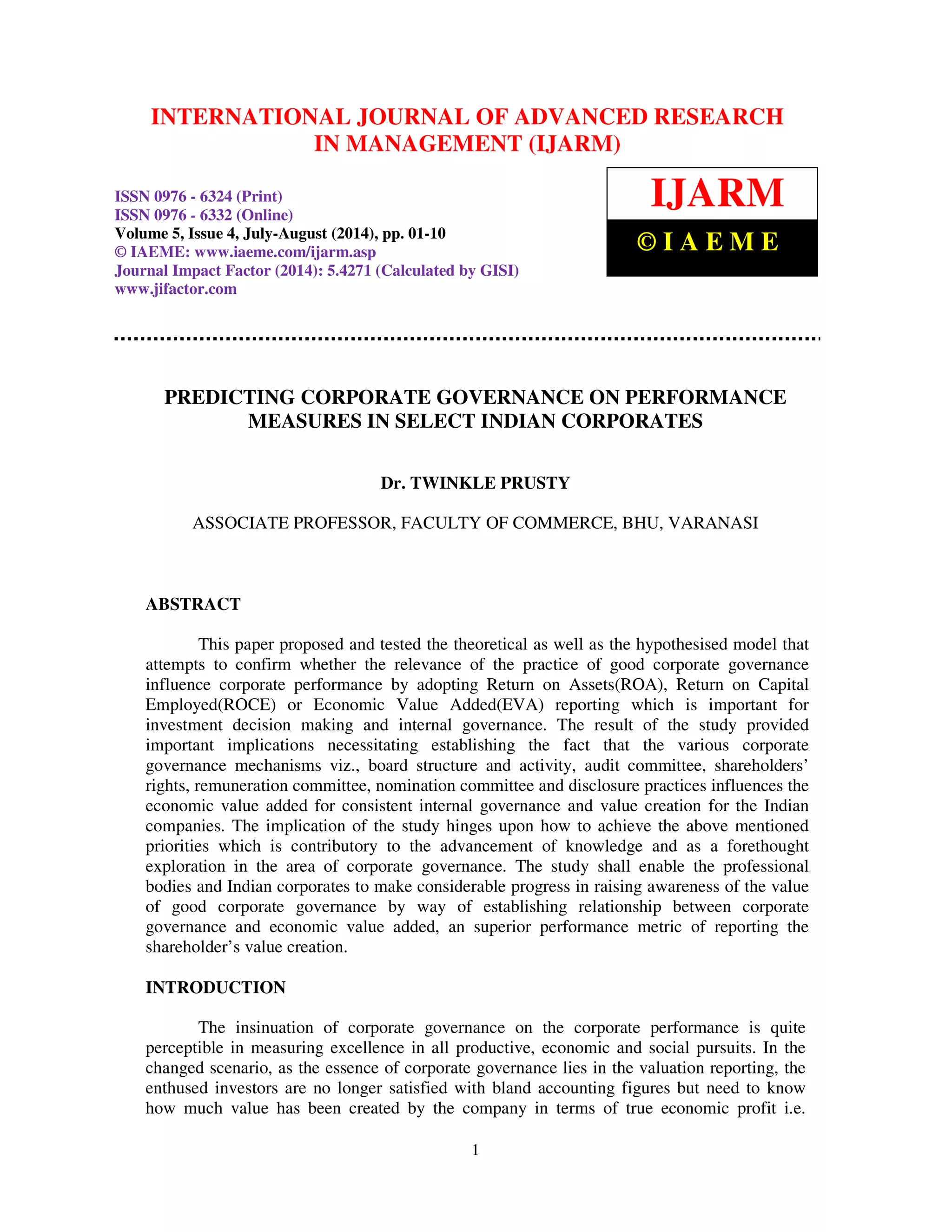
through the path of revolutionary EVA (Economic Value Added). Although the traditional 
measures of corporate performance, ROA  ROCE are still in vogue (linking directors’ 
compensation and management), it has led to value destroying actions with the false notion of 
creating shareholders’ wealth without considering the concept of cost of capital. In the era of 
globalisation, to achieve the best corporate performance, the corporates in their commitment 
to all stakeholders and shareholders’ relationship, has focussed on EVA, a superior 
performance measure for corporate reporting and internal governance that has the cohesive 
management values in harmony with the companies and engrossed by the quantum of 
economic value generated by them in excess of its cost of capital. In other words, a company 
creates value only if it is able to generate returns higher than its cost of capital. Performance 
measurement using EVA causes the objective of management suitable with the shareholders’ 
interest. 
2 
REVIEW OF LITERATURE 
 
Literature survey has suggested that EVA is being considered as the most accurate 
driver of corporate performance in terms of shareholders’ wealth creation as well as 
management of a higher stock price. Teen (2006) explained that corporate governance is not 
only about compliance to law, order, standard, and code, but also the performance 
improvement and assess stockholder. The opinion succeed has also been proved by Klapper 
and Love, 2002; DurnevAnd Kim, 2003; Black, Jang, and Kim (2005). They found positive 
relation between CG index and company value that measured by Tobin's Q. Utama and 
Afriani ( 2005) succeeding to prove the positive relation between CGPI and spread of EVA, 
and the positive relation between CLSA index with market value divided by investment 
capital. Corporate governance represent serious effort of companies in giving commitment to 
achieve the objective of company which have been specified ( Syakhroza, 2003). CG will 
improve value of company because main objective of corporate governance is to assure 
whether companies operate efficiently and achieve the ultimate goal to maximize stockholder 
value (Zheka, 2006). Brown and Caylor (2004) explain that effective CG will lessen control 
rights that are given by stockholders to creditors and manager. CG will improve manager 
possibility to make investments in projects with rate of return which are positive. Company 
will be managed better so that the performance will be increased. Company with good growth 
opportunity need fund from external for expansion. Good corporate governance reflects the 
ability of companies to manage all activities well. It gives positive signal about the credibility 
and commitment of management to protect the creditor rights. Corporate governance tends to 
decrease the cost of debt (Klapperdan Love, 2004). According to Durnev and Kim (2003), 
company with opportunity of growth need large external fund so they will adopt better CG to 
attract the owner of capital. Company with high potential growth in the future will have better 
EVA. One of the important components in EVA is net operating after tax (NOPAT). High 
sales will create high NOPAT and EVA. Increasing of NOPAT can be happened through 
improvement of earnings growth (Febrianti, 2006). Salmi and Virtanen (2001) find that 
profitability (or earnings growth) representing primary factor influences EVA. 
SIGNIFICANCE OF THE STUDY 
The appraisal of the effect of Corporate Governance (CG) to the performance of the 
firm measured by ROA, ROCE and EVA, the performance measurements, is the need of the 
study from the gaining importance of motivating managers’ i.e enabling good governance, to
International Journal of Advanced Research in Management (IJARM), ISSN 0976 – 6324 (Print), 
ISSN 0976 – 6332 (Online), Volume 5, Issue 4, July- August (2014), pp. 01-10 © IAEME 
get rid of destructive activities and to invest in those projects that are expected to enhance 
shareholder value. This research will investigate the relationship between corporate 
governance and the performance measures of the listed companies in India. The study shall 
be based on the formulation of the hypothesis and find out the statistical modelling 
relationships between the corporate governance (CG) and ROA, ROCE  EVA. It is 
imperative to find out whether the practice of corporate governance shall bring in efficiency 
and improve company performance thereby enhancing the value of the company. It shall also 
focus on the importance of corporate governance in the economic framework for 
shareholder’s wealth creation and whether the route to achieve excellence by the corporates 
have been tailored in the best practices of corporate governance of which EVA is the perfect 
measurement tool and an integrated management philosophy. 
3 
OBJECTIVE OF THE STUDY 
 
The main objective of the study is to explore the implications of practices of corporate 
governance on the various performance measures of the Indian corporates. It shall also find 
out the corporate governance score of the sample companies based on the BT-SS Survey of 
the India’s biggest wealth creators and assess whether conformance of the various aspects of 
corporate governance could bring about direct impact on the shareholder’s value creation by 
way of EVA reporting. 
RESEARCH METHODOLOGY OF THE STUDY 
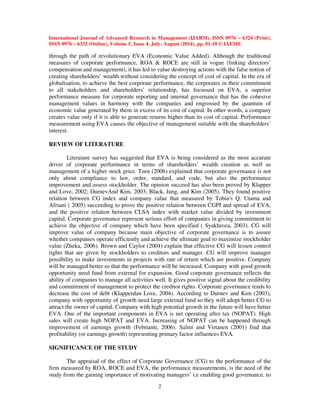
To enable the study’s objective, the strictures of the corporate governance are 
explored in light of the recent developments and amendments in the Indian legal context. 
Sample of companies ensuring ROA,  ROCE and EVA reporting as surveyed by the BT-SS( 
Business Times-Stern Stewart) biggest wealth creators, were retrieved for the last 5 years. 
The annual reports with disclosures of corporate governance reports as per Clause 49 of SEBI 
and values of EVA have been collected from 50 listed companies(top wealth creators) in 
India from the CMIE(Centre for Monitoring Indian Economy) database to qualify the study 
of impact of various facets of corporate governance by constructing a CG Score on the 
internal performance measures and shareholder’s value creation. Based on this objective 
framework, the research entails the hypothesis to be: Corporate Governance has no 
significant and positive relationship with corporate performance measures, EVA, ROA  
ROCE. 
Corporate Governance is measured by way of developing the corporate governance 
score(CGS) by considering six important governance mechanisms, viz., (a) Board structure 
and activity, (b) Disclosure practices, (c) Audit committee, (d) Shareholders’ rights, (e) 
Remuneration committee, and (f) Nomination committee, covering a total of 85 attributes 
affecting the governance of the companies. 
Hence, using the information in regard to the six internal governance mechanisms, 
corporate governance score (CGS) is being constructed covering a total of 85 attributes 
affecting governance of the Indian companies, with help of the corporate governance reports 
stated in the annual reports of the companies. This is being compiled by Credit Rating 
Information Services of India-CRISIL(Governance and Value Creation-GVC) and 
Governance Metrics International(GMI), which produces governance ratings of more than 
6000 global companies by gathering information on individual governance attributes 
requiring the minimum level of implementation as per Clause 49 of the Listing agreement,
International Journal of Advanced Research in Management (IJARM), ISSN 0976 – 6324 (Print), 
ISSN 0976 – 6332 (Online), Volume 5, Issue 4, July- August (2014), pp. 01-10 © IAEME 
Securities Exchange Board of India). The corporate governance scoring methodology 
facilitate the regulators in assessing the efficacy of the corporate governance system of the 
company practised as an approach and helps to evaluate the impact of it on various 
performance measures as an rating tool. 
EMPIRICAL ANALYSIS: MODEL SPECIFICATION 
4 
 
The data is analysed with help of Pearson’s correlation technique and Structural 
Equation Modelling techniques to establish the association between corporate governance 
and the three corporate performance measures considered for the study that supervises, 
controls and measures the internal performance. 
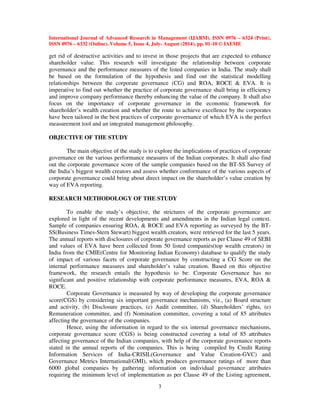
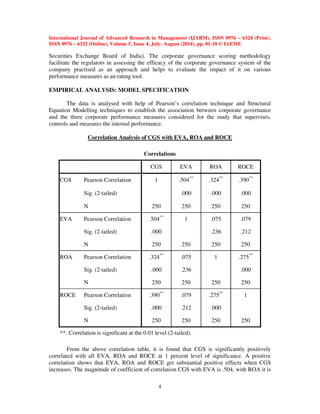
Correlation Analysis of CGS with EVA, ROA and ROCE 
Correlations 
CGS EVA ROA ROCE 
CGS Pearson Correlation 1 .504** .324** .390** 
Sig. (2-tailed) .000 .000 .000 
N 250 250 250 250 
EVA Pearson Correlation .504** 1 .075 .079 
Sig. (2-tailed) .000 .236 .212 
N 250 250 250 250 
ROA Pearson Correlation .324** .075 1 .275** 
Sig. (2-tailed) .000 .236 .000 
N 250 250 250 250 
ROCE Pearson Correlation .390** .079 .275** 1 
Sig. (2-tailed) .000 .212 .000 
N 250 250 250 250 
**. Correlation is significant at the 0.01 level (2-tailed). 
From the above correlation table, it is found that CGS is significantly positively 
correlated with all EVA, ROA and ROCE at 1 percent level of significance. A positive 
correlation shows that EVA, ROA and ROCE get substantial positive effects when CGS 
increases. The magnitude of coefficient of correlation CGS with EVA is .504, with ROA it is
International Journal of Advanced Research in Management (IJARM), ISSN 0976 – 6324 (Print), 
ISSN 0976 – 6332 (Online), Volume 5, Issue 4, July- August (2014), pp. 01-10 © IAEME 
.324 and with ROCE it is .390. The magnitude of coefficient of correlation of EVA with CGS 
is the highest among ROA and ROCE each with CGS. It means whenever, CGS changes, 
EVA will be affected much compared to ROA and ROCE. That is, EVA changes in direct 
proportion to CGS rather in a faster rate than ROA  ROCE. 
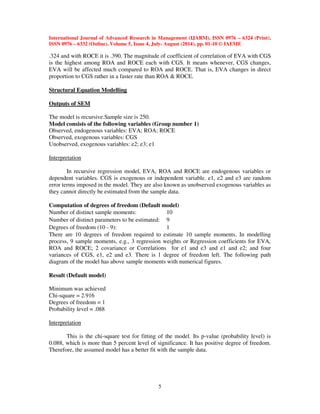
The model is recursive.Sample size is 250. 
Model consists of the following variables (Group number 1) 
Observed, endogenous variables: EVA; ROA; ROCE 
Observed, exogenous variables: CGS 
Unobserved, exogenous variables: e2; e3; e1 
5 
Structural Equation Modelling 
Outputs of SEM 
Interpretation 
 
In recursive regression model, EVA, ROA and ROCE are endogenous variables or 
dependent variables. CGS is exogenous or independent variable. e1, e2 and e3 are random 
error terms imposed in the model. They are also known as unobserved exogenous variables as 
they cannot directly be estimated from the sample data. 
Computation of degrees of freedom (Default model) 
Number of distinct sample moments: 10 
Number of distinct parameters to be estimated: 9 
Degrees of freedom (10 - 9): 1 
There are 10 degrees of freedom required to estimate 10 sample moments. In modelling 
process, 9 sample moments, e.g., 3 regression weights or Regression coefficients for EVA, 
ROA and ROCE; 2 covariance or Correlations for e1 and e3 and e1 and e2; and four 
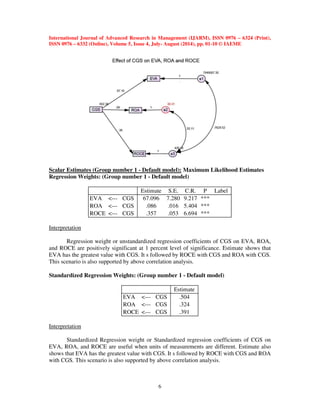
variances of CGS, e1, e2 and e3. There is 1 degree of freedom left. The following path 
diagram of the model has above sample moments with numerical figures. 
Result (Default model) 
Minimum was achieved 
Chi-square = 2.916 
Degrees of freedom = 1 
Probability level = .088 
Interpretation 
This is the chi-square test for fitting of the model. Its p-value (probability level) is 
0.088, which is more than 5 percent level of significance. It has positive degree of freedom. 
Therefore, the assumed model has a better fit with the sample data.
International Journal of Advanced Research in Management (IJARM), ISSN 0976 – 6324 (Print), 
ISSN 0976 – 6332 (Online), Volume 5, Issue 4, July- August (2014), pp. 01-10 © IAEME 
Scalar Estimates (Group number 1 - Default model): Maximum Likelihood Estimates 
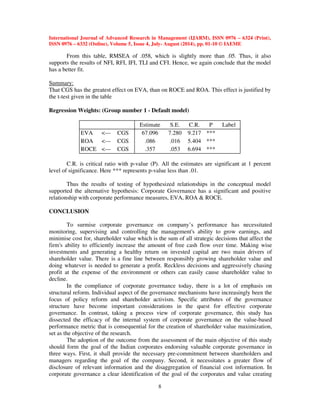
Regression Weights: (Group number 1 - Default model) 
6 
 
Estimate S.E. C.R. P Label 
EVA --- CGS 67.096 7.280 9.217 *** 
ROA --- CGS .086 .016 5.404 *** 
ROCE --- CGS .357 .053 6.694 *** 
Interpretation 
Regression weight or unstandardized regression coefficients of CGS on EVA, ROA, 
and ROCE are positively significant at 1 percent level of significance. Estimate shows that 
EVA has the greatest value with CGS. It s followed by ROCE with CGS and ROA with CGS. 
This scenario is also supported by above correlation analysis. 
Standardized Regression Weights: (Group number 1 - Default model) 
Estimate 
EVA --- CGS .504 
ROA --- CGS .324 
ROCE --- CGS .391 
Interpretation 
Standardized Regression weight or Standardized regression coefficients of CGS on 
EVA, ROA, and ROCE are useful when units of measurements are different. Estimate also 
shows that EVA has the greatest value with CGS. It s followed by ROCE with CGS and ROA 
with CGS. This scenario is also supported by above correlation analysis.
International Journal of Advanced Research in Management (IJARM), ISSN 0976 – 6324 (Print), 
ISSN 0976 – 6332 (Online), Volume 5, Issue 4, July- August (2014), pp. 01-10 © IAEME 
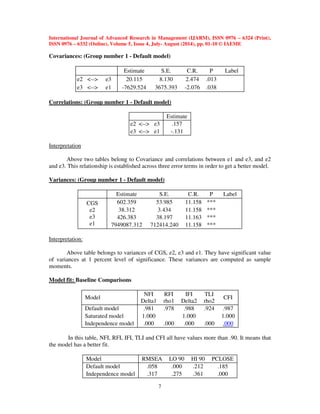
Covariances: (Group number 1 - Default model) 
7 
 
Estimate S.E. C.R. P Label 
e2 -- e3 20.115 8.130 2.474 .013 
e3 -- e1 -7629.524 3675.393 -2.076 .038 
Correlations: (Group number 1 - Default model) 
Estimate 
e2 -- e3 .157 
e3 -- e1 -.131 
Interpretation 
Above two tables belong to Covariance and correlations between e1 and e3, and e2 
and e3. This relationship is established across three error terms in order to get a better model. 
Variances: (Group number 1 - Default model) 
Estimate S.E. C.R. P Label 
CGS 
e2 
e3 
e1 
602.359 53.985 11.158 *** 
38.312 3.434 11.158 *** 
426.383 38.197 11.163 *** 
7949087.312 712414.240 11.158 *** 
Interpretation: 
Above table belongs to variances of CGS, e2, e3 and e1. They have significant value 
of variances at 1 percent level of significance. These variances are computed as sample 
moments. 
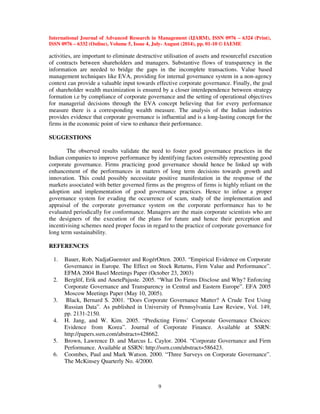
Model fit: Baseline Comparisons 
Model 
NFI 
Delta1 
RFI 
rho1 
IFI 
Delta2 
TLI 
rho2 
CFI 
Default model .981 .978 .988 .924 .987 
Saturated model 1.000 
1.000 
1.000 
Independence model .000 .000 .000 .000 .000 
In this table, NFI, RFI, IFI, TLI and CFI all have values more than .90. It means that 
the model has a better fit. 
Model RMSEA LO 90 HI 90 PCLOSE 
Default model .058 .000 .212 .185 
Independence model .317 .275 .361 .000
International Journal of Advanced Research in Management (IJARM), ISSN 0976 – 6324 (Print), 
ISSN 0976 – 6332 (Online), Volume 5, Issue 4, July- August (2014), pp. 01-10 © IAEME 
8 
 
From this table, RMSEA of .058, which is slightly more than .05. Thus, it also 
supports the results of NFI, RFI, IFI, TLI and CFI. Hence, we again conclude that the model 
has a better fit. 
Summary: 
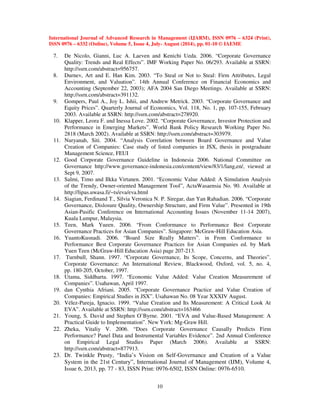
That CGS has the greatest effect on EVA, than on ROCE and ROA. This effect is justified by 
the t-test given in the table 
Regression Weights: (Group number 1 - Default model) 
Estimate S.E. C.R. P Label 
EVA --- CGS 67.096 7.280 9.217 *** 
ROA --- CGS .086 .016 5.404 *** 
ROCE --- CGS .357 .053 6.694 *** 
C.R. is critical ratio with p-value (P). All the estimates are significant at 1 percent 
level of significance. Here *** represents p-value less than .01. 
Thus the results of testing of hypothesized relationships in the conceptual model 
supported the alternative hypothesis: Corporate Governance has a significant and positive 
relationship with corporate performance measures, EVA, ROA  ROCE. 
CONCLUSION 
To surmise corporate governance on company’s performance has necessitated 
monitoring, supervising and controlling the management's ability to grow earnings, and 
minimise cost for, shareholder value which is the sum of all strategic decisions that affect the 
firm's ability to efficiently increase the amount of free cash flow over time. Making wise 
investments and generating a healthy return on invested capital are two main drivers of 
shareholder value. There is a fine line between responsibly growing shareholder value and 
doing whatever is needed to generate a profit. Reckless decisions and aggressively chasing 
profit at the expense of the environment or others can easily cause shareholder value to 
decline. 
In the compliance of corporate governance today, there is a lot of emphasis on 
structural reform. Individual aspect of the governance mechanisms have increasingly been the 
focus of policy reform and shareholder activism. Specific attributes of the governance 
structure have become important considerations in the quest for effective corporate 
governance. In contrast, taking a process view of corporate governance, this study has 
dissected the efficacy of the internal system of corporate governance on the value-based 
performance metric that is consequential for the creation of shareholder value maximization, 
set as the objective of the research. 
The adoption of the outcome from the assessment of the main objective of this study 
should form the goal of the Indian corporates endorsing valuable corporate governance in 
three ways. First, it shall provide the necessary pre-commitment between shareholders and 
managers regarding the goal of the company. Second, it necessitates a greater flow of 
disclosure of relevant information and the disaggregation of financial cost information. In 
corporate governance a clear identification of the goal of the corporates and value creating
International Journal of Advanced Research in Management (IJARM), ISSN 0976 – 6324 (Print), 
ISSN 0976 – 6332 (Online), Volume 5, Issue 4, July- August (2014), pp. 01-10 © IAEME 
activities, are important to eliminate destructive utilisation of assets and resourceful execution 
of contracts between shareholders and managers. Substantive flows of transparency in the 
information are needed to bridge the gaps in the incomplete transactions. Value based 
management techniques like EVA, providing for internal governance system in a non-agency 
context can provide a valuable input towards effective corporate governance. Finally, the goal 
of shareholder wealth maximization is ensured by a closer interdependence between strategy 
formation i.e by compliance of corporate governance and the setting of operational objectives 
for managerial decisions through the EVA concept believing that for every performance 
measure there is a corresponding wealth measure. The analysis of the Indian industries 
provides evidence that corporate governance is influential and is a long-lasting concept for the 
firms in the economic point of view to enhance their performance. 
9 
SUGGESTIONS 
 
The observed results validate the need to foster good governance practices in the 
Indian companies to improve performance by identifying factors ostensibly representing good 
corporate governance. Firms practicing good governance should hence be linked up with 
enhancement of the performances in matters of long term decisions towards growth and 
innovation. This could possibly necessitate positive manifestation in the response of the 
markets associated with better governed firms as the progress of firms is highly reliant on the 
adoption and implementation of good governance practices. Hence to infuse a proper 
governance system for evading the occurrence of scam, study of the implementation and 
appraisal of the corporate governance system on the corporate performance has to be 
evaluated periodically for conformance. Managers are the main corporate scientists who are 
the designers of the execution of the plans for future and hence their perception and 
incentivising schemes need proper focus in regard to the practice of corporate governance for 
long term sustainability. 
REFERENCES 
1. Bauer, Rob, NadjaGuenster and RogérOtten. 2003. “Empirical Evidence on Corporate 
Governance in Europe. The Effect on Stock Returns, Firm Value and Performance”. 
EFMA 2004 Basel Meetings Paper (October 23, 2003) 
2. Berglöf, Erik and AnetePajuste. 2005. “What Do Firms Disclose and Why? Enforcing 
Corporate Governance and Transparency in Central and Eastern Europe”. EFA 2005 
Moscow Meetings Paper (May 10, 2005). 
3. Black, Bernard S. 2001. “Does Corporate Governance Matter? A Crude Test Using 
Russian Data”. As published in University of Pennsylvania Law Review, Vol. 149, 
pp. 2131-2150. 
4. H. Jang, and W. Kim. 2005. “Predicting Firms’ Corporate Governance Choices: 
Evidence from Korea”. Journal of Corporate Finance. Available at SSRN: 
http://papers.ssrn.com/abstract=428662. 
5. Brown, Lawrence D. and Marcus L. Caylor. 2004. “Corporate Governance and Firm 
Performance. Available at SSRN: http://ssrn.com/abstract=586423. 
6. Coombes, Paul and Mark Watson. 2000. “Three Surveys on Corporate Governance”. 
The McKinsey Quarterly No. 4/2000.
International Journal of Advanced Research in Management (IJARM), ISSN 0976 – 6324 (Print), 
ISSN 0976 – 6332 (Online), Volume 5, Issue 4, July- August (2014), pp. 01-10 © IAEME 
10 
 
7. De Nicolo, Gianni, Luc A. Laeven and Kenichi Ueda. 2006. “Corporate Governance 
Quality: Trends and Real Effects”. IMF Working Paper No. 06/293. Available at SSRN: 
http://ssrn.com/abstract=956757. 
8. Durnev, Art and E. Han Kim. 2003. “To Steal or Not to Steal: Firm Attributes, Legal 
Environment, and Valuation”. 14th Annual Conference on Financial Economics and 
Accounting (September 22, 2003); AFA 2004 San Diego Meetings. Available at SSRN: 
http://ssrn.com/abstract=391132. 
9. Gompers, Paul A., Joy L. Ishii, and Andrew Metrick. 2003. “Corporate Governance and 
Equity Prices”. Quarterly Journal of Economics, Vol. 118, No. 1, pp. 107-155, February 
2003. Available at SSRN: http://ssrn.com/abstract=278920. 
10. Klapper, Leora F. and Inessa Love. 2002. “Corporate Governance, Investor Protection and 
Performance in Emerging Markets”. World Bank Policy Research Working Paper No. 
2818 (March 2002). Available at SSRN: http://ssrn.com/abstract=303979. 
11. Nuryanah, Siti. 2004. “Analysis Correlation between Board Governance and Value 
Creation of Companies: Case study of listed companies in JSX, thesis in postgraduate 
Management Science, FEUI 
12. Good Corporate Governance Guideline in Indonesia 2006. National Committee on 
Governance http://www.governance-indonesia.con/content/view/83/1/lang,en/, viewed at 
Sept 9, 2007. 
13. Salmi, Timo and Ilkka Virtanen. 2001. “Economic Value Added: A Simulation Analysis 
of the Trendy, Owner-oriented Management Tool”, ActaWasaensia No. 90. Available at 
http://lipas.uwasa.fi/~ts/eva/eva.html 
14. Siagian, Ferdinand T., Silvia Veronica N. P. Siregar, dan Yan Rahadian. 2006. “Corporate 
Governance, Dislosure Quality, Ownership Structure, and Firm Value”. Presented in 19th 
Asian-Pasific Conference on International Accounting Issues (November 11-14 2007), 
Kuala Lumpur, Malaysia. 
15. Teen, Mark Yueen. 2006. “From Conformance to Performance Best Corporate 
Governance Practices for Asian Companies”. Singapore: McGraw-Hill Education Asia. 
16. YuantoKusnadi. 2006. “Board Size Really Matters”. in From Conformance to 
Performance Best Corporate Governance Practices for Asian Companies ed. by Mark 
Yuen Teen (McGraw-Hill Education Asia) page 207-213. 
17. Turnbull, Shann. 1997. “Corporate Governance, Its Scope, Concerns, and Theories”. 
Corporate Governance: An International Review, Blackwood, Oxford, vol. 5, no. 4, 
pp. 180-205, October, 1997. 
18. Utama, Siddharta. 1997. “Economic Value Added: Value Creation Measurement of 
Companies”. Usahawan, April 1997. 
19. dan Cynthia Afriani. 2005. “Corporate Governance Practice and Value Creation of 
Companies: Empirical Studies in JSX”. Usahawan No. 08 Year XXXIV August. 
20. Vélez-Pareja, Ignacio. 1999. “Value Creation and Its Measurement: A Critical Look At 
EVA”. Available at SSRN: http://ssrn.com/abstract=163466 
21. Young, S. David and Stephen O’Byrne. 2001. “EVA and Value-Based Management: A 
Practical Guide to Implementation”. New York: Mg-Graw Hill. 
22. Zheka, Vitaliy V. 2006. “Does Corporate Governance Causally Predicts Firm 
Performance? Panel Data and Instrumental Variables Evidence”. 2nd Annual Conference 
on Empirical Legal Studies Paper (March 2006). Available at SSRN: 
http://ssrn.com/abstract=877913. 
23. Dr. Twinkle Prusty, “India’s Vision on Self-Governance and Creation of a Value 
System in the 21st Century”, International Journal of Management (IJM), Volume 4, 
Issue 6, 2013, pp. 77 - 83, ISSN Print: 0976-6502, ISSN Online: 0976-6510.

10220140504001

  • 1.
    International INTERNATIONAL Journalof Advanced JOURNAL Research in Management OF ADVANCED (IJARM), ISSN RESEARCH 0976 – 6324 (Print), ISSN 0976 – 6332 (Online), Volume 5, Issue 4, July- August (2014), pp. 01-10 © IAEME IN MANAGEMENT (IJARM) ISSN 0976 - 6324 (Print) ISSN 0976 - 6332 (Online) Volume 5, Issue 4, July-August (2014), pp. 01-10 © IAEME: www.iaeme.com/ijarm.asp Journal Impact Factor (2014): 5.4271 (Calculated by GISI) www.jifactor.com 1 IJARM © I A E M E PREDICTING CORPORATE GOVERNANCE ON PERFORMANCE MEASURES IN SELECT INDIAN CORPORATES Dr. TWINKLE PRUSTY ASSOCIATE PROFESSOR, FACULTY OF COMMERCE, BHU, VARANASI ABSTRACT This paper proposed and tested the theoretical as well as the hypothesised model that attempts to confirm whether the relevance of the practice of good corporate governance influence corporate performance by adopting Return on Assets(ROA), Return on Capital Employed(ROCE) or Economic Value Added(EVA) reporting which is important for investment decision making and internal governance. The result of the study provided important implications necessitating establishing the fact that the various corporate governance mechanisms viz., board structure and activity, audit committee, shareholders’ rights, remuneration committee, nomination committee and disclosure practices influences the economic value added for consistent internal governance and value creation for the Indian companies. The implication of the study hinges upon how to achieve the above mentioned priorities which is contributory to the advancement of knowledge and as a forethought exploration in the area of corporate governance. The study shall enable the professional bodies and Indian corporates to make considerable progress in raising awareness of the value of good corporate governance by way of establishing relationship between corporate governance and economic value added, an superior performance metric of reporting the shareholder’s value creation. INTRODUCTION The insinuation of corporate governance on the corporate performance is quite perceptible in measuring excellence in all productive, economic and social pursuits. In the changed scenario, as the essence of corporate governance lies in the valuation reporting, the enthused investors are no longer satisfied with bland accounting figures but need to know how much value has been created by the company in terms of true economic profit i.e.
  • 2.
    International Journal ofAdvanced Research in Management (IJARM), ISSN 0976 – 6324 (Print), ISSN 0976 – 6332 (Online), Volume 5, Issue 4, July- August (2014), pp. 01-10 © IAEME through the path of revolutionary EVA (Economic Value Added). Although the traditional measures of corporate performance, ROA ROCE are still in vogue (linking directors’ compensation and management), it has led to value destroying actions with the false notion of creating shareholders’ wealth without considering the concept of cost of capital. In the era of globalisation, to achieve the best corporate performance, the corporates in their commitment to all stakeholders and shareholders’ relationship, has focussed on EVA, a superior performance measure for corporate reporting and internal governance that has the cohesive management values in harmony with the companies and engrossed by the quantum of economic value generated by them in excess of its cost of capital. In other words, a company creates value only if it is able to generate returns higher than its cost of capital. Performance measurement using EVA causes the objective of management suitable with the shareholders’ interest. 2 REVIEW OF LITERATURE Literature survey has suggested that EVA is being considered as the most accurate driver of corporate performance in terms of shareholders’ wealth creation as well as management of a higher stock price. Teen (2006) explained that corporate governance is not only about compliance to law, order, standard, and code, but also the performance improvement and assess stockholder. The opinion succeed has also been proved by Klapper and Love, 2002; DurnevAnd Kim, 2003; Black, Jang, and Kim (2005). They found positive relation between CG index and company value that measured by Tobin's Q. Utama and Afriani ( 2005) succeeding to prove the positive relation between CGPI and spread of EVA, and the positive relation between CLSA index with market value divided by investment capital. Corporate governance represent serious effort of companies in giving commitment to achieve the objective of company which have been specified ( Syakhroza, 2003). CG will improve value of company because main objective of corporate governance is to assure whether companies operate efficiently and achieve the ultimate goal to maximize stockholder value (Zheka, 2006). Brown and Caylor (2004) explain that effective CG will lessen control rights that are given by stockholders to creditors and manager. CG will improve manager possibility to make investments in projects with rate of return which are positive. Company will be managed better so that the performance will be increased. Company with good growth opportunity need fund from external for expansion. Good corporate governance reflects the ability of companies to manage all activities well. It gives positive signal about the credibility and commitment of management to protect the creditor rights. Corporate governance tends to decrease the cost of debt (Klapperdan Love, 2004). According to Durnev and Kim (2003), company with opportunity of growth need large external fund so they will adopt better CG to attract the owner of capital. Company with high potential growth in the future will have better EVA. One of the important components in EVA is net operating after tax (NOPAT). High sales will create high NOPAT and EVA. Increasing of NOPAT can be happened through improvement of earnings growth (Febrianti, 2006). Salmi and Virtanen (2001) find that profitability (or earnings growth) representing primary factor influences EVA. SIGNIFICANCE OF THE STUDY The appraisal of the effect of Corporate Governance (CG) to the performance of the firm measured by ROA, ROCE and EVA, the performance measurements, is the need of the study from the gaining importance of motivating managers’ i.e enabling good governance, to
  • 3.
    International Journal ofAdvanced Research in Management (IJARM), ISSN 0976 – 6324 (Print), ISSN 0976 – 6332 (Online), Volume 5, Issue 4, July- August (2014), pp. 01-10 © IAEME get rid of destructive activities and to invest in those projects that are expected to enhance shareholder value. This research will investigate the relationship between corporate governance and the performance measures of the listed companies in India. The study shall be based on the formulation of the hypothesis and find out the statistical modelling relationships between the corporate governance (CG) and ROA, ROCE EVA. It is imperative to find out whether the practice of corporate governance shall bring in efficiency and improve company performance thereby enhancing the value of the company. It shall also focus on the importance of corporate governance in the economic framework for shareholder’s wealth creation and whether the route to achieve excellence by the corporates have been tailored in the best practices of corporate governance of which EVA is the perfect measurement tool and an integrated management philosophy. 3 OBJECTIVE OF THE STUDY The main objective of the study is to explore the implications of practices of corporate governance on the various performance measures of the Indian corporates. It shall also find out the corporate governance score of the sample companies based on the BT-SS Survey of the India’s biggest wealth creators and assess whether conformance of the various aspects of corporate governance could bring about direct impact on the shareholder’s value creation by way of EVA reporting. RESEARCH METHODOLOGY OF THE STUDY To enable the study’s objective, the strictures of the corporate governance are explored in light of the recent developments and amendments in the Indian legal context. Sample of companies ensuring ROA, ROCE and EVA reporting as surveyed by the BT-SS( Business Times-Stern Stewart) biggest wealth creators, were retrieved for the last 5 years. The annual reports with disclosures of corporate governance reports as per Clause 49 of SEBI and values of EVA have been collected from 50 listed companies(top wealth creators) in India from the CMIE(Centre for Monitoring Indian Economy) database to qualify the study of impact of various facets of corporate governance by constructing a CG Score on the internal performance measures and shareholder’s value creation. Based on this objective framework, the research entails the hypothesis to be: Corporate Governance has no significant and positive relationship with corporate performance measures, EVA, ROA ROCE. Corporate Governance is measured by way of developing the corporate governance score(CGS) by considering six important governance mechanisms, viz., (a) Board structure and activity, (b) Disclosure practices, (c) Audit committee, (d) Shareholders’ rights, (e) Remuneration committee, and (f) Nomination committee, covering a total of 85 attributes affecting the governance of the companies. Hence, using the information in regard to the six internal governance mechanisms, corporate governance score (CGS) is being constructed covering a total of 85 attributes affecting governance of the Indian companies, with help of the corporate governance reports stated in the annual reports of the companies. This is being compiled by Credit Rating Information Services of India-CRISIL(Governance and Value Creation-GVC) and Governance Metrics International(GMI), which produces governance ratings of more than 6000 global companies by gathering information on individual governance attributes requiring the minimum level of implementation as per Clause 49 of the Listing agreement,
  • 4.
    International Journal ofAdvanced Research in Management (IJARM), ISSN 0976 – 6324 (Print), ISSN 0976 – 6332 (Online), Volume 5, Issue 4, July- August (2014), pp. 01-10 © IAEME Securities Exchange Board of India). The corporate governance scoring methodology facilitate the regulators in assessing the efficacy of the corporate governance system of the company practised as an approach and helps to evaluate the impact of it on various performance measures as an rating tool. EMPIRICAL ANALYSIS: MODEL SPECIFICATION 4 The data is analysed with help of Pearson’s correlation technique and Structural Equation Modelling techniques to establish the association between corporate governance and the three corporate performance measures considered for the study that supervises, controls and measures the internal performance. Correlation Analysis of CGS with EVA, ROA and ROCE Correlations CGS EVA ROA ROCE CGS Pearson Correlation 1 .504** .324** .390** Sig. (2-tailed) .000 .000 .000 N 250 250 250 250 EVA Pearson Correlation .504** 1 .075 .079 Sig. (2-tailed) .000 .236 .212 N 250 250 250 250 ROA Pearson Correlation .324** .075 1 .275** Sig. (2-tailed) .000 .236 .000 N 250 250 250 250 ROCE Pearson Correlation .390** .079 .275** 1 Sig. (2-tailed) .000 .212 .000 N 250 250 250 250 **. Correlation is significant at the 0.01 level (2-tailed). From the above correlation table, it is found that CGS is significantly positively correlated with all EVA, ROA and ROCE at 1 percent level of significance. A positive correlation shows that EVA, ROA and ROCE get substantial positive effects when CGS increases. The magnitude of coefficient of correlation CGS with EVA is .504, with ROA it is
  • 5.
    International Journal ofAdvanced Research in Management (IJARM), ISSN 0976 – 6324 (Print), ISSN 0976 – 6332 (Online), Volume 5, Issue 4, July- August (2014), pp. 01-10 © IAEME .324 and with ROCE it is .390. The magnitude of coefficient of correlation of EVA with CGS is the highest among ROA and ROCE each with CGS. It means whenever, CGS changes, EVA will be affected much compared to ROA and ROCE. That is, EVA changes in direct proportion to CGS rather in a faster rate than ROA ROCE. The model is recursive.Sample size is 250. Model consists of the following variables (Group number 1) Observed, endogenous variables: EVA; ROA; ROCE Observed, exogenous variables: CGS Unobserved, exogenous variables: e2; e3; e1 5 Structural Equation Modelling Outputs of SEM Interpretation In recursive regression model, EVA, ROA and ROCE are endogenous variables or dependent variables. CGS is exogenous or independent variable. e1, e2 and e3 are random error terms imposed in the model. They are also known as unobserved exogenous variables as they cannot directly be estimated from the sample data. Computation of degrees of freedom (Default model) Number of distinct sample moments: 10 Number of distinct parameters to be estimated: 9 Degrees of freedom (10 - 9): 1 There are 10 degrees of freedom required to estimate 10 sample moments. In modelling process, 9 sample moments, e.g., 3 regression weights or Regression coefficients for EVA, ROA and ROCE; 2 covariance or Correlations for e1 and e3 and e1 and e2; and four variances of CGS, e1, e2 and e3. There is 1 degree of freedom left. The following path diagram of the model has above sample moments with numerical figures. Result (Default model) Minimum was achieved Chi-square = 2.916 Degrees of freedom = 1 Probability level = .088 Interpretation This is the chi-square test for fitting of the model. Its p-value (probability level) is 0.088, which is more than 5 percent level of significance. It has positive degree of freedom. Therefore, the assumed model has a better fit with the sample data.
  • 6.
    International Journal ofAdvanced Research in Management (IJARM), ISSN 0976 – 6324 (Print), ISSN 0976 – 6332 (Online), Volume 5, Issue 4, July- August (2014), pp. 01-10 © IAEME Scalar Estimates (Group number 1 - Default model): Maximum Likelihood Estimates Regression Weights: (Group number 1 - Default model) 6 Estimate S.E. C.R. P Label EVA --- CGS 67.096 7.280 9.217 *** ROA --- CGS .086 .016 5.404 *** ROCE --- CGS .357 .053 6.694 *** Interpretation Regression weight or unstandardized regression coefficients of CGS on EVA, ROA, and ROCE are positively significant at 1 percent level of significance. Estimate shows that EVA has the greatest value with CGS. It s followed by ROCE with CGS and ROA with CGS. This scenario is also supported by above correlation analysis. Standardized Regression Weights: (Group number 1 - Default model) Estimate EVA --- CGS .504 ROA --- CGS .324 ROCE --- CGS .391 Interpretation Standardized Regression weight or Standardized regression coefficients of CGS on EVA, ROA, and ROCE are useful when units of measurements are different. Estimate also shows that EVA has the greatest value with CGS. It s followed by ROCE with CGS and ROA with CGS. This scenario is also supported by above correlation analysis.
  • 7.
    International Journal ofAdvanced Research in Management (IJARM), ISSN 0976 – 6324 (Print), ISSN 0976 – 6332 (Online), Volume 5, Issue 4, July- August (2014), pp. 01-10 © IAEME Covariances: (Group number 1 - Default model) 7 Estimate S.E. C.R. P Label e2 -- e3 20.115 8.130 2.474 .013 e3 -- e1 -7629.524 3675.393 -2.076 .038 Correlations: (Group number 1 - Default model) Estimate e2 -- e3 .157 e3 -- e1 -.131 Interpretation Above two tables belong to Covariance and correlations between e1 and e3, and e2 and e3. This relationship is established across three error terms in order to get a better model. Variances: (Group number 1 - Default model) Estimate S.E. C.R. P Label CGS e2 e3 e1 602.359 53.985 11.158 *** 38.312 3.434 11.158 *** 426.383 38.197 11.163 *** 7949087.312 712414.240 11.158 *** Interpretation: Above table belongs to variances of CGS, e2, e3 and e1. They have significant value of variances at 1 percent level of significance. These variances are computed as sample moments. Model fit: Baseline Comparisons Model NFI Delta1 RFI rho1 IFI Delta2 TLI rho2 CFI Default model .981 .978 .988 .924 .987 Saturated model 1.000 1.000 1.000 Independence model .000 .000 .000 .000 .000 In this table, NFI, RFI, IFI, TLI and CFI all have values more than .90. It means that the model has a better fit. Model RMSEA LO 90 HI 90 PCLOSE Default model .058 .000 .212 .185 Independence model .317 .275 .361 .000
  • 8.
    International Journal ofAdvanced Research in Management (IJARM), ISSN 0976 – 6324 (Print), ISSN 0976 – 6332 (Online), Volume 5, Issue 4, July- August (2014), pp. 01-10 © IAEME 8 From this table, RMSEA of .058, which is slightly more than .05. Thus, it also supports the results of NFI, RFI, IFI, TLI and CFI. Hence, we again conclude that the model has a better fit. Summary: That CGS has the greatest effect on EVA, than on ROCE and ROA. This effect is justified by the t-test given in the table Regression Weights: (Group number 1 - Default model) Estimate S.E. C.R. P Label EVA --- CGS 67.096 7.280 9.217 *** ROA --- CGS .086 .016 5.404 *** ROCE --- CGS .357 .053 6.694 *** C.R. is critical ratio with p-value (P). All the estimates are significant at 1 percent level of significance. Here *** represents p-value less than .01. Thus the results of testing of hypothesized relationships in the conceptual model supported the alternative hypothesis: Corporate Governance has a significant and positive relationship with corporate performance measures, EVA, ROA ROCE. CONCLUSION To surmise corporate governance on company’s performance has necessitated monitoring, supervising and controlling the management's ability to grow earnings, and minimise cost for, shareholder value which is the sum of all strategic decisions that affect the firm's ability to efficiently increase the amount of free cash flow over time. Making wise investments and generating a healthy return on invested capital are two main drivers of shareholder value. There is a fine line between responsibly growing shareholder value and doing whatever is needed to generate a profit. Reckless decisions and aggressively chasing profit at the expense of the environment or others can easily cause shareholder value to decline. In the compliance of corporate governance today, there is a lot of emphasis on structural reform. Individual aspect of the governance mechanisms have increasingly been the focus of policy reform and shareholder activism. Specific attributes of the governance structure have become important considerations in the quest for effective corporate governance. In contrast, taking a process view of corporate governance, this study has dissected the efficacy of the internal system of corporate governance on the value-based performance metric that is consequential for the creation of shareholder value maximization, set as the objective of the research. The adoption of the outcome from the assessment of the main objective of this study should form the goal of the Indian corporates endorsing valuable corporate governance in three ways. First, it shall provide the necessary pre-commitment between shareholders and managers regarding the goal of the company. Second, it necessitates a greater flow of disclosure of relevant information and the disaggregation of financial cost information. In corporate governance a clear identification of the goal of the corporates and value creating
  • 9.
    International Journal ofAdvanced Research in Management (IJARM), ISSN 0976 – 6324 (Print), ISSN 0976 – 6332 (Online), Volume 5, Issue 4, July- August (2014), pp. 01-10 © IAEME activities, are important to eliminate destructive utilisation of assets and resourceful execution of contracts between shareholders and managers. Substantive flows of transparency in the information are needed to bridge the gaps in the incomplete transactions. Value based management techniques like EVA, providing for internal governance system in a non-agency context can provide a valuable input towards effective corporate governance. Finally, the goal of shareholder wealth maximization is ensured by a closer interdependence between strategy formation i.e by compliance of corporate governance and the setting of operational objectives for managerial decisions through the EVA concept believing that for every performance measure there is a corresponding wealth measure. The analysis of the Indian industries provides evidence that corporate governance is influential and is a long-lasting concept for the firms in the economic point of view to enhance their performance. 9 SUGGESTIONS The observed results validate the need to foster good governance practices in the Indian companies to improve performance by identifying factors ostensibly representing good corporate governance. Firms practicing good governance should hence be linked up with enhancement of the performances in matters of long term decisions towards growth and innovation. This could possibly necessitate positive manifestation in the response of the markets associated with better governed firms as the progress of firms is highly reliant on the adoption and implementation of good governance practices. Hence to infuse a proper governance system for evading the occurrence of scam, study of the implementation and appraisal of the corporate governance system on the corporate performance has to be evaluated periodically for conformance. Managers are the main corporate scientists who are the designers of the execution of the plans for future and hence their perception and incentivising schemes need proper focus in regard to the practice of corporate governance for long term sustainability. REFERENCES 1. Bauer, Rob, NadjaGuenster and RogérOtten. 2003. “Empirical Evidence on Corporate Governance in Europe. The Effect on Stock Returns, Firm Value and Performance”. EFMA 2004 Basel Meetings Paper (October 23, 2003) 2. Berglöf, Erik and AnetePajuste. 2005. “What Do Firms Disclose and Why? Enforcing Corporate Governance and Transparency in Central and Eastern Europe”. EFA 2005 Moscow Meetings Paper (May 10, 2005). 3. Black, Bernard S. 2001. “Does Corporate Governance Matter? A Crude Test Using Russian Data”. As published in University of Pennsylvania Law Review, Vol. 149, pp. 2131-2150. 4. H. Jang, and W. Kim. 2005. “Predicting Firms’ Corporate Governance Choices: Evidence from Korea”. Journal of Corporate Finance. Available at SSRN: http://papers.ssrn.com/abstract=428662. 5. Brown, Lawrence D. and Marcus L. Caylor. 2004. “Corporate Governance and Firm Performance. Available at SSRN: http://ssrn.com/abstract=586423. 6. Coombes, Paul and Mark Watson. 2000. “Three Surveys on Corporate Governance”. The McKinsey Quarterly No. 4/2000.
  • 10.
    International Journal ofAdvanced Research in Management (IJARM), ISSN 0976 – 6324 (Print), ISSN 0976 – 6332 (Online), Volume 5, Issue 4, July- August (2014), pp. 01-10 © IAEME 10 7. De Nicolo, Gianni, Luc A. Laeven and Kenichi Ueda. 2006. “Corporate Governance Quality: Trends and Real Effects”. IMF Working Paper No. 06/293. Available at SSRN: http://ssrn.com/abstract=956757. 8. Durnev, Art and E. Han Kim. 2003. “To Steal or Not to Steal: Firm Attributes, Legal Environment, and Valuation”. 14th Annual Conference on Financial Economics and Accounting (September 22, 2003); AFA 2004 San Diego Meetings. Available at SSRN: http://ssrn.com/abstract=391132. 9. Gompers, Paul A., Joy L. Ishii, and Andrew Metrick. 2003. “Corporate Governance and Equity Prices”. Quarterly Journal of Economics, Vol. 118, No. 1, pp. 107-155, February 2003. Available at SSRN: http://ssrn.com/abstract=278920. 10. Klapper, Leora F. and Inessa Love. 2002. “Corporate Governance, Investor Protection and Performance in Emerging Markets”. World Bank Policy Research Working Paper No. 2818 (March 2002). Available at SSRN: http://ssrn.com/abstract=303979. 11. Nuryanah, Siti. 2004. “Analysis Correlation between Board Governance and Value Creation of Companies: Case study of listed companies in JSX, thesis in postgraduate Management Science, FEUI 12. Good Corporate Governance Guideline in Indonesia 2006. National Committee on Governance http://www.governance-indonesia.con/content/view/83/1/lang,en/, viewed at Sept 9, 2007. 13. Salmi, Timo and Ilkka Virtanen. 2001. “Economic Value Added: A Simulation Analysis of the Trendy, Owner-oriented Management Tool”, ActaWasaensia No. 90. Available at http://lipas.uwasa.fi/~ts/eva/eva.html 14. Siagian, Ferdinand T., Silvia Veronica N. P. Siregar, dan Yan Rahadian. 2006. “Corporate Governance, Dislosure Quality, Ownership Structure, and Firm Value”. Presented in 19th Asian-Pasific Conference on International Accounting Issues (November 11-14 2007), Kuala Lumpur, Malaysia. 15. Teen, Mark Yueen. 2006. “From Conformance to Performance Best Corporate Governance Practices for Asian Companies”. Singapore: McGraw-Hill Education Asia. 16. YuantoKusnadi. 2006. “Board Size Really Matters”. in From Conformance to Performance Best Corporate Governance Practices for Asian Companies ed. by Mark Yuen Teen (McGraw-Hill Education Asia) page 207-213. 17. Turnbull, Shann. 1997. “Corporate Governance, Its Scope, Concerns, and Theories”. Corporate Governance: An International Review, Blackwood, Oxford, vol. 5, no. 4, pp. 180-205, October, 1997. 18. Utama, Siddharta. 1997. “Economic Value Added: Value Creation Measurement of Companies”. Usahawan, April 1997. 19. dan Cynthia Afriani. 2005. “Corporate Governance Practice and Value Creation of Companies: Empirical Studies in JSX”. Usahawan No. 08 Year XXXIV August. 20. Vélez-Pareja, Ignacio. 1999. “Value Creation and Its Measurement: A Critical Look At EVA”. Available at SSRN: http://ssrn.com/abstract=163466 21. Young, S. David and Stephen O’Byrne. 2001. “EVA and Value-Based Management: A Practical Guide to Implementation”. New York: Mg-Graw Hill. 22. Zheka, Vitaliy V. 2006. “Does Corporate Governance Causally Predicts Firm Performance? Panel Data and Instrumental Variables Evidence”. 2nd Annual Conference on Empirical Legal Studies Paper (March 2006). Available at SSRN: http://ssrn.com/abstract=877913. 23. Dr. Twinkle Prusty, “India’s Vision on Self-Governance and Creation of a Value System in the 21st Century”, International Journal of Management (IJM), Volume 4, Issue 6, 2013, pp. 77 - 83, ISSN Print: 0976-6502, ISSN Online: 0976-6510.