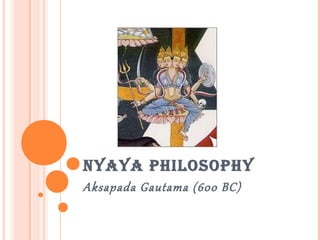
NYAYA PHILOSOPHY
Aksapada Gautama (600 BC)
INTRODUCTION
 Founded by the sage Gotama, also known as Aksapada.
 Primarily concerned with the conditions of correct
knowledge and the means of receiving this knowledge
(Epestemology).
 The science of logic or reasoning – the science of critical
study (Anviksiki).
 Discovers the validity or invalidity of knowledge.
 Through the process of obtaining valid knowledge of things
one could secure release from material bondage.
 Obtaining valid knowledge is the only way to obtain
release from suffering.
NYAYA EPISTEMOLOGY
SIXTEEN DIVISIONS(PADARTHAS) OF
EXTERNAL REALITY
Nyaya divides perceivable and unperceivable reality into sixteen divisions (padarthas) that are
1. Pramana, the sources of knowledge
2. Prameya, the object of knowledge
3. Samsaya, doubt or the state of uncertainty
4. Prayojana, the aim
5. Drstanta, example
6. Siddhanta, doctrine
7. Ayayava, the constituents of inference
8. Tarka, hypothetical argument 
9. Nirnaya, conclusion
10. Badha, discussion
11. Jalpa, wrangling
12. Vitanda, irrational argument
13. Hetvabhasa,specious reasoning
14. Chala, unfair reply
15. Jati, generality based on a false analogy
16. Nigrahsthana, the grounds for defeat
16PadarthofNyayaPhilosophy
1.PRAMAN: SOURCESOF KNOWLEDGE
 Prama = valid knowledge
 Pramana is that through which valid knowledge
is received.
Knowledge itself is of two types:
1. Anubhava (experiential) and
2. Smriti (memory).
Both categories can be divided into valid and
invalid knowledge.
 Valid experiential knowledge is called prama and
 Invalid experiential knowledge is aprama.
16PadarthofNyayaPhilosophy
2. PRAMEYA: THE OBJECT OF
KNOWLEDGE
2.01 Atma - the individual conscious unit
2.02 Sarira - the material body
2.03 Indriyas - the sense organs
2.04 Artha - the objects of the senses
2.05 Buddhi - cognition
2.06 Manas - the mind
2.07 Pravrti - activity
2.08 Dosa - mental defects
2.09 Pretyabhava - life and death
2.10 Phala - the results of pleasure and pain
2.11 Duhkha - suffering
2.12 Apavarga - permanent relief from all suffering
16PadarthofNyayaPhilosophy
3. SAMSAY - DOUBT
 A state in which the mind wavers between
conflicting views regarding a single object.
 Is that a plant or a human being in the darkness?
Is that a rope or a serpent?
 Samsaya is not certain knowledge, nor is it a
mere reflection of knowledge, nor is it invalid
knowledge.
 It is a positive state of cognition but the cognition
is split in two and does not provide any definite
conclusion.
 Doubt is the product of a confused state of mind.
16PadarthofNyayaPhilosophy
4.PRAYOJANA - AIM
 No action can be performed without an objective,
a target or an aim.
 It does not matter if the aim is only presumed or
is fully understood.
 One acts either to achieve desirable objects or to
get rid of undesirable ones; these desirable or
undesirable objects are known as prayojana.
16PadarthofNyayaPhilosophy
5. DRSTANTA: EXAMPLE
 This refers to using an example or an illustration
to highlight a common fact and establish an
argument.
 Useful examples can be accepted by both parties
in a dispute.
 For instance, one can say that there must be fire
because one sees smoke and one can refer to the
fire and smoke in a kitchen to establish common
ground.
16PadarthofNyayaPhilosophy
6. SIDDHANTA: DOCTRINE
 An axiomatic postulate accepted as undisputed
truth and serves as the foundation for the entire
theory of a particular system of philosophy.
 For instance, it is a Nyaya siddhanta that there
is a Nimitta Karana (efficient cause) of the
universe
16PadarthofNyayaPhilosophy
7. AVAYAVA: CONSTITUENTSOF
INFERENCE
 Parts or components.
 Nyaya uses inference to establish reasons and
come to conclusions in arguments.
 If an inference has five necessary parts, it is
assumed that it can give correct knowledge.
 These components are:
1. pratijna (statements),
2. hetu (reason),
3. udaharana (example),
4. upanaya (universal proposition) and
5. nigamana (conclusion).
16PadarthofNyayaPhilosophy
8.TARKA HYPOTHETICAL ARGUMENT
 The mind's jabbering that creates confusion and
misunderstanding within and without
 Because the mind is clouded by its own
modifications, it is very important to wash out
these confusions before attempting to understand
something solely through the mind
 Tark is the process of clarifying the confusion
 It is the process of questioning and cross-
questioning with the mind that leads to a
particular conclusion.
 Tarka can be useful in differentiating between
invalid and valid knowledge
16PadarthofNyayaPhilosophy
9.NIRNAYA: CONCLUSION
 Is certain knowledge that is attained by using
legitimate means.
 It is the ascertaining of the truth about
something, perhaps using Tarka or other ways of
perception like direct perception, inference,
testimony or intuition
16PadarthofNyayaPhilosophy
10. BADHA: DISCUSSION
 A debate between two parties – exponent and
opponent – on a subject.
 But both are agreed on using the methods of
reasoning and logic and valid knowledge can be
reached if both parties are honest and free from
prejudices
16PadarthofNyayaPhilosophy
11. JALPA: WRANGLING
 When the two parties try to defeat each other
through dishonest means.
 There is an involvement of ego instead of a true
search for knowledge.
 Jalpa contains all the characteristics of a valid
debate except that of aiming to discover truth.
 It is that type of discussion in which each party
has a prejudice for his own view and thus tries to
gather all possible arguments in his own favor
 Lawyers sometimes apply this method to win
their cases in court
16PadarthofNyayaPhilosophy
12. VITANDA: IRRATIONAL REASONING
 An argumentation aimed at refuting or
destroying an antagonist’s position without
seeking to establish one’s own position – it is
mere destructive criticism.
 In irrational reasoning either or both tries to
refute the other's position instead of establishing
his own.
 This usually happens when one of the parties
realizes that his position is weak and that he
cannot defend his point of view
 Consequently, he irrationally attacks the other's
case with destructive intent
16PadarthofNyayaPhilosophy
13. HETVABHASA : SPECIOUS
REASONING
 An irrational argument which is reasoning that
appears to be valid but is really unfounded
16PadarthofNyayaPhilosophy
14.CHALA: UNFAIR REPLY
 A statement meant to cheat or to fool someone in
an argument.
 A person pretends to understand a word or
phrase used in a particular sense as other than
what was intended and then denies the truth of
this deliberate misinterpretation of the speaker’s
words.
 For example, suppose someone's name is Bizarre,
and in referring to this person, someone says,
"He is Bizarre." If the listener knowingly
misconstrues this statement and replies, "He is
not bizarre; he is just a common ordinary man,"
then that person is using chala.
16PadarthofNyayaPhilosophy
15 JATI : GENERALITY BASED ON FALSE
ANALOGY –
 A debate in which an unfair reply or conclusion is
based on a false analogy.
 Example of sound – is it non-eternal or eternal?
 A. Sound is noneternal because it is an effect of a
certain cause, just as a pot is produced from clay.
 One can argue that it is eternal by comparing it with
the sky.
 But it is a false analogy because there is no universal
relationship between the non-material and the
eternal
In the nyaya system itself, sound is considered
to he a noneternal quality because it is
produced and can be destroyed.
16PadarthofNyayaPhilosophy
16. NIGRAHASTHANA: GROUNDSFOR
DEFEAT
 The grounds on which a person is defeated in his
argument.
 Happens when a person misunderstands his own
or his opponent’s premises and becomes helpless
and eventually accepts defeat in the debate
 The point at which he accepts his defeat is
called nigrahasthana
16PadarthofNyayaPhilosophy
1. PRAMAN: SOURCES OFOBTAINING
KNOWLEDGE
Praman (Valid)
1. Pratyaksa (direct perception):.
2. Anumana (inference): .
3. Upamana (comparison): .
4. Sabda (testimony): 
Aprama (Invalid)
1. Doubt (samsaya), faulty cognition
(bhrama or viparyaya) and
2. Hypothetical argument (tarka).
NyayaEpistemology
THENYAYA THEORY OF
CAUSATION
THE NYAYA THEORY OF CAUSATION
 A cause is defined as an unconditional and
invariable antecedent of an effect and an effect as
an unconditional and invariable consequent of a
cause.
 The same cause produces the same effect; and
the same effect is produced by the same cause.
The cause is not present in any hidden form
whatsoever in its effect.
 The following conditions should be met:
 The cause must be antencedent [Purvavrtti]
 Invariability [Niyatapurvavrtti]
 Unconditionality [Ananyathasiddha]
CausationinNyayaPhilosophy
NYAYA RECOGNIZESTHREE KINDSOF
CAUSE:
1. Samavayi, material cause. E.g. Thread of a
cloth.
2. Asamavayi, colour of the thread which gives the
colour of the cloth.
3. Nimitta', efficient cause, e.g. the weaver of the
cloth.
CausationinNyayaPhilosophy
CAUSE OF SUFFERING
 A misunderstanding of these twelve aspects of
reality.
 Once these twelve are percieved correctly, one
attains freedom from suffering.
CausationinNyayaPhilosophy
LAW OF KARMA
 Nyaya inquires why some people are happy
and others are unhappy
 To claim that each individual suffers or
attains happiness randomly is not logical
 Gautama postulates that this must be due to
the law of cause and effect (karma).
 Such a law is not of itself and by itself – it
lacks intelligence and therefore must be
guided by a higher principle, an intelligent
agent who directs karma through the proper
channels to produce proper consequences.
CausationinNyayaPhilosophy
FIVE KINDSOFACCIDENTAL ANTECEDENTS
[ANYATHASIDDHA]
1. Mere accidental antecedent. E.g., The colour of
the potter's cloth.
2. Remote cause is not a cause because it is not
unconditional. E.g., The father of the potter.
3. The co-effects of a cause are not causally
related.
4. Eternal substances, or eternal conditions are
not unconditional antecedents. e.g. space.
5. Unnecessary things, e.g. the donkey of the
potter.
CausationinNyayaPhilosophy
NYAYA METAPHYSICS
ATMAN
 The atma is eternal in nature because it is not
limited by space or time.
 It also accepts that there are an infinite number
of atmas.
 One’s own atma can be known through mental
perception, whereas someone elses atma can only
be inferred.
29
NyayaMetaphysics
BRAHMAN
 Brahman is the efficient cause of creation,
maintenance and dissolution
 Brahman creates all substances from eternal
atoms of space, time, mind and consciousness.
 Brahman causes these atoms to hold together
and continue their existence in a particular order
to maintain the physical universe.
30
NyayaMetaphysics
SIGNIFICANCE
 Nyaya's most important contribution to Hindu thought is
its elucidation of the pramanas (tools of epistemology).
 It developed a system of logic adopted by other Indian
schools of philosophy.
 Nyaya differs from Aristotelian logic in that it is more
than logic in its own right.
 Obtaining valid knowledge was the only way to obtain
release from suffering.
 To identify valid sources of knowledge and to distinguish
these from mere false opinions.
31
NyayaMetaphysics
THE END

nyaya philosophy

  • 1.
  • 2.
    INTRODUCTION  Founded bythe sage Gotama, also known as Aksapada.  Primarily concerned with the conditions of correct knowledge and the means of receiving this knowledge (Epestemology).  The science of logic or reasoning – the science of critical study (Anviksiki).  Discovers the validity or invalidity of knowledge.  Through the process of obtaining valid knowledge of things one could secure release from material bondage.  Obtaining valid knowledge is the only way to obtain release from suffering.
  • 3.
  • 4.
    SIXTEEN DIVISIONS(PADARTHAS) OF EXTERNALREALITY Nyaya divides perceivable and unperceivable reality into sixteen divisions (padarthas) that are 1. Pramana, the sources of knowledge 2. Prameya, the object of knowledge 3. Samsaya, doubt or the state of uncertainty 4. Prayojana, the aim 5. Drstanta, example 6. Siddhanta, doctrine 7. Ayayava, the constituents of inference 8. Tarka, hypothetical argument  9. Nirnaya, conclusion 10. Badha, discussion 11. Jalpa, wrangling 12. Vitanda, irrational argument 13. Hetvabhasa,specious reasoning 14. Chala, unfair reply 15. Jati, generality based on a false analogy 16. Nigrahsthana, the grounds for defeat 16PadarthofNyayaPhilosophy
  • 5.
    1.PRAMAN: SOURCESOF KNOWLEDGE Prama = valid knowledge  Pramana is that through which valid knowledge is received. Knowledge itself is of two types: 1. Anubhava (experiential) and 2. Smriti (memory). Both categories can be divided into valid and invalid knowledge.  Valid experiential knowledge is called prama and  Invalid experiential knowledge is aprama. 16PadarthofNyayaPhilosophy
  • 6.
    2. PRAMEYA: THEOBJECT OF KNOWLEDGE 2.01 Atma - the individual conscious unit 2.02 Sarira - the material body 2.03 Indriyas - the sense organs 2.04 Artha - the objects of the senses 2.05 Buddhi - cognition 2.06 Manas - the mind 2.07 Pravrti - activity 2.08 Dosa - mental defects 2.09 Pretyabhava - life and death 2.10 Phala - the results of pleasure and pain 2.11 Duhkha - suffering 2.12 Apavarga - permanent relief from all suffering 16PadarthofNyayaPhilosophy
  • 7.
    3. SAMSAY -DOUBT  A state in which the mind wavers between conflicting views regarding a single object.  Is that a plant or a human being in the darkness? Is that a rope or a serpent?  Samsaya is not certain knowledge, nor is it a mere reflection of knowledge, nor is it invalid knowledge.  It is a positive state of cognition but the cognition is split in two and does not provide any definite conclusion.  Doubt is the product of a confused state of mind. 16PadarthofNyayaPhilosophy
  • 8.
    4.PRAYOJANA - AIM No action can be performed without an objective, a target or an aim.  It does not matter if the aim is only presumed or is fully understood.  One acts either to achieve desirable objects or to get rid of undesirable ones; these desirable or undesirable objects are known as prayojana. 16PadarthofNyayaPhilosophy
  • 9.
    5. DRSTANTA: EXAMPLE This refers to using an example or an illustration to highlight a common fact and establish an argument.  Useful examples can be accepted by both parties in a dispute.  For instance, one can say that there must be fire because one sees smoke and one can refer to the fire and smoke in a kitchen to establish common ground. 16PadarthofNyayaPhilosophy
  • 10.
    6. SIDDHANTA: DOCTRINE An axiomatic postulate accepted as undisputed truth and serves as the foundation for the entire theory of a particular system of philosophy.  For instance, it is a Nyaya siddhanta that there is a Nimitta Karana (efficient cause) of the universe 16PadarthofNyayaPhilosophy
  • 11.
    7. AVAYAVA: CONSTITUENTSOF INFERENCE Parts or components.  Nyaya uses inference to establish reasons and come to conclusions in arguments.  If an inference has five necessary parts, it is assumed that it can give correct knowledge.  These components are: 1. pratijna (statements), 2. hetu (reason), 3. udaharana (example), 4. upanaya (universal proposition) and 5. nigamana (conclusion). 16PadarthofNyayaPhilosophy
  • 12.
    8.TARKA HYPOTHETICAL ARGUMENT The mind's jabbering that creates confusion and misunderstanding within and without  Because the mind is clouded by its own modifications, it is very important to wash out these confusions before attempting to understand something solely through the mind  Tark is the process of clarifying the confusion  It is the process of questioning and cross- questioning with the mind that leads to a particular conclusion.  Tarka can be useful in differentiating between invalid and valid knowledge 16PadarthofNyayaPhilosophy
  • 13.
    9.NIRNAYA: CONCLUSION  Iscertain knowledge that is attained by using legitimate means.  It is the ascertaining of the truth about something, perhaps using Tarka or other ways of perception like direct perception, inference, testimony or intuition 16PadarthofNyayaPhilosophy
  • 14.
    10. BADHA: DISCUSSION A debate between two parties – exponent and opponent – on a subject.  But both are agreed on using the methods of reasoning and logic and valid knowledge can be reached if both parties are honest and free from prejudices 16PadarthofNyayaPhilosophy
  • 15.
    11. JALPA: WRANGLING When the two parties try to defeat each other through dishonest means.  There is an involvement of ego instead of a true search for knowledge.  Jalpa contains all the characteristics of a valid debate except that of aiming to discover truth.  It is that type of discussion in which each party has a prejudice for his own view and thus tries to gather all possible arguments in his own favor  Lawyers sometimes apply this method to win their cases in court 16PadarthofNyayaPhilosophy
  • 16.
    12. VITANDA: IRRATIONALREASONING  An argumentation aimed at refuting or destroying an antagonist’s position without seeking to establish one’s own position – it is mere destructive criticism.  In irrational reasoning either or both tries to refute the other's position instead of establishing his own.  This usually happens when one of the parties realizes that his position is weak and that he cannot defend his point of view  Consequently, he irrationally attacks the other's case with destructive intent 16PadarthofNyayaPhilosophy
  • 17.
    13. HETVABHASA :SPECIOUS REASONING  An irrational argument which is reasoning that appears to be valid but is really unfounded 16PadarthofNyayaPhilosophy
  • 18.
    14.CHALA: UNFAIR REPLY A statement meant to cheat or to fool someone in an argument.  A person pretends to understand a word or phrase used in a particular sense as other than what was intended and then denies the truth of this deliberate misinterpretation of the speaker’s words.  For example, suppose someone's name is Bizarre, and in referring to this person, someone says, "He is Bizarre." If the listener knowingly misconstrues this statement and replies, "He is not bizarre; he is just a common ordinary man," then that person is using chala. 16PadarthofNyayaPhilosophy
  • 19.
    15 JATI :GENERALITY BASED ON FALSE ANALOGY –  A debate in which an unfair reply or conclusion is based on a false analogy.  Example of sound – is it non-eternal or eternal?  A. Sound is noneternal because it is an effect of a certain cause, just as a pot is produced from clay.  One can argue that it is eternal by comparing it with the sky.  But it is a false analogy because there is no universal relationship between the non-material and the eternal In the nyaya system itself, sound is considered to he a noneternal quality because it is produced and can be destroyed. 16PadarthofNyayaPhilosophy
  • 20.
    16. NIGRAHASTHANA: GROUNDSFOR DEFEAT The grounds on which a person is defeated in his argument.  Happens when a person misunderstands his own or his opponent’s premises and becomes helpless and eventually accepts defeat in the debate  The point at which he accepts his defeat is called nigrahasthana 16PadarthofNyayaPhilosophy
  • 21.
    1. PRAMAN: SOURCESOFOBTAINING KNOWLEDGE Praman (Valid) 1. Pratyaksa (direct perception):. 2. Anumana (inference): . 3. Upamana (comparison): . 4. Sabda (testimony):  Aprama (Invalid) 1. Doubt (samsaya), faulty cognition (bhrama or viparyaya) and 2. Hypothetical argument (tarka). NyayaEpistemology
  • 22.
  • 23.
    THE NYAYA THEORYOF CAUSATION  A cause is defined as an unconditional and invariable antecedent of an effect and an effect as an unconditional and invariable consequent of a cause.  The same cause produces the same effect; and the same effect is produced by the same cause. The cause is not present in any hidden form whatsoever in its effect.  The following conditions should be met:  The cause must be antencedent [Purvavrtti]  Invariability [Niyatapurvavrtti]  Unconditionality [Ananyathasiddha] CausationinNyayaPhilosophy
  • 24.
    NYAYA RECOGNIZESTHREE KINDSOF CAUSE: 1.Samavayi, material cause. E.g. Thread of a cloth. 2. Asamavayi, colour of the thread which gives the colour of the cloth. 3. Nimitta', efficient cause, e.g. the weaver of the cloth. CausationinNyayaPhilosophy
  • 25.
    CAUSE OF SUFFERING A misunderstanding of these twelve aspects of reality.  Once these twelve are percieved correctly, one attains freedom from suffering. CausationinNyayaPhilosophy
  • 26.
    LAW OF KARMA Nyaya inquires why some people are happy and others are unhappy  To claim that each individual suffers or attains happiness randomly is not logical  Gautama postulates that this must be due to the law of cause and effect (karma).  Such a law is not of itself and by itself – it lacks intelligence and therefore must be guided by a higher principle, an intelligent agent who directs karma through the proper channels to produce proper consequences. CausationinNyayaPhilosophy
  • 27.
    FIVE KINDSOFACCIDENTAL ANTECEDENTS [ANYATHASIDDHA] 1.Mere accidental antecedent. E.g., The colour of the potter's cloth. 2. Remote cause is not a cause because it is not unconditional. E.g., The father of the potter. 3. The co-effects of a cause are not causally related. 4. Eternal substances, or eternal conditions are not unconditional antecedents. e.g. space. 5. Unnecessary things, e.g. the donkey of the potter. CausationinNyayaPhilosophy
  • 28.
  • 29.
    ATMAN  The atma is eternalin nature because it is not limited by space or time.  It also accepts that there are an infinite number of atmas.  One’s own atma can be known through mental perception, whereas someone elses atma can only be inferred. 29 NyayaMetaphysics
  • 30.
    BRAHMAN  Brahman isthe efficient cause of creation, maintenance and dissolution  Brahman creates all substances from eternal atoms of space, time, mind and consciousness.  Brahman causes these atoms to hold together and continue their existence in a particular order to maintain the physical universe. 30 NyayaMetaphysics
  • 31.
    SIGNIFICANCE  Nyaya's mostimportant contribution to Hindu thought is its elucidation of the pramanas (tools of epistemology).  It developed a system of logic adopted by other Indian schools of philosophy.  Nyaya differs from Aristotelian logic in that it is more than logic in its own right.  Obtaining valid knowledge was the only way to obtain release from suffering.  To identify valid sources of knowledge and to distinguish these from mere false opinions. 31 NyayaMetaphysics
  • 32.

Editor's Notes

  • #2 Origins The beginning of Nyaya can be traced back to the writings of Aksapada Gautama (ca. sixth century B.C.E.) who wrote the Nyaya Sutras.  Gautama founded the Nyaya school, which was closely affiliated to the Vaisheshika (atomism) school of Hindu philosophy. While Nyaya centered around logic and epistemology, Vaisesika was primarily a metaphysical system of thought that classifies all beings into seven categories, and postulated that all objects in the physical universe are reducible to a finite number of atoms. The exact periods of the origin of Vaisesika have not been established; it is thought to be more ancient than Nyāya, and may have preceded, but was at least contemporary with, Buddhism and Jainism. The founder of Vaisesika is considered to be Kanāda, author of the  Vaishesika Sutra , written sometime after 300 B.C.E.. Gautama has sometimes been equated with the Greek philosopher Aristotle. However, Gautama’s system of logic differs from Aristotelian logic as it is much more than logic in its own right. Followers of  Nyaya ( Nyayanikas ) believe that through the process of obtaining valid knowledge of things one could secure release from material bondage. Gautama and his followers therefore took great pains in identifying valid sources of knowledge and distinguishing them from invalid sources. Nyaya's most important contribution to Hindu thought is its elucidation of the  pramanas  (tools of epistemology). Its followers believe that obtaining valid knowledge is the only way to obtain release from suffering. They therefore took great pains to identify valid sources of knowledge and to distinguish these from mere false opinions. They argued that there are exactly four sources of knowledge: perception, inference, comparison and testimony. However, knowledge obtained through each of these sources can still be either valid or invalid. As a result, Nyaya scholars again went to great pains to identify, in each case, what it took to make knowledge valid—in the process creating a number of explanatory schemes. In this sense, Nyaya is probably the closest Indian equivalent to contemporary analytic philosophy. 07/24/13
  • #3 The  nyaya  system of philosophy was established by the sage Gautama. As he was also known as Aksapada, this system is also sometimes referred to as the  aksapada  system.  Nyaya  philosophy is primarily concerned with the conditions of correct knowledge and the means of receiving this knowledge.  Nyaya  is predominantly based on reasoning and logic and therefore is also known as  Nyaya Vidya  or  Tarka Sastra  -- "the science of logic and reasoning", Because this system analyzes the nature and source of knowledge and its validity and nonvalidity, it is also referred to as  anviksiki , which means "the science of critical study." Using systematic reasoning, this school of philosophy attempts to discriminate valid knowledge from invalid knowledge. This philosophy asserts that obtaining valid knowledge of the external world and its relationship with the mind and self is the only way to attain liberation. If one masters the logical techniques of reasoning and assiduously applies these in his daily life, he will rid himself of all suffering. Thus, the methods and conditions of determining true knowledge are not the final goal of  nyaya  philosophy; logical criticism is viewed only as an instrument that enables one to discriminate valid from invalid knowledge. The ultimate goal of  nyaya  philosophy, like that of the other systems of Indian philosophy, is liberation -- the absolute cessation of pain and suffering.  Nyaya  is a philosophy of life, even though it is mainly concerned with the study of logic and epistemology 07/24/13
  • #4 The subjects discussed under  pramana , the source of knowledge, are the most important and the most thoroughly and profoundly expounded of all the divisions. For this reason, pramana will be explained in detail after the other fifteen divisions of studying reality have been described.  07/24/13
  • #5 All six schools of Vedic philosophy aim to describe the nature of the external world and its relationship to the individual, to go beyond the world of appearances to ultimate Reality, and to describe the goal of life and the means for attaining this goal. In this attempt, the six philosophies divide their course of study into two major categories: the study of unmanifested reality, and the study of manifest reality. In nyaya  philosophy, both aspects of reality are divided into sixteen major divisions, called  padarthas  (see chart below). These sixteen philosophical divisions are:  pramana , the sources of knowledge;  prameya , the object of knowledge;  samsaya , doubt or the state of uncertainty;  prayojana , the aim;  drstanta , example;  siddhanta , doctrine;  ayayava , the constituents of inference;  tarka , hypothetical argument;  nirnaya , conclusion;  badha , discussion;  jalpa , wrangling;  vitanda , irrational argument;  hetvabhasa , specious reasoning;  chala , unfair reply;  jati , generality based on a false analogy; and  nigrahsthana , the grounds for defeat. For example,  Nyaya  divides perceivable and imperceivable reality into sixteen divisions ( padarthas ) that are: 1)  pramana , the sources of knowledge 2)  prameya , the object of knowledge 3)  samsaya , doubt or the state of uncertainty 4)  prayojana , the aim 5)  drstanta , example 6)  siddhanta , doctrine 7)  ayayava , the constituents of inference 8)  tarka , hypothetical argument 9)  nirnaya , conclusion 10)  badha , discussion 11)  jalpa , wrangling 12)  vitanda , irrational argument 13)  hetvabhasa , specious reasoning 14)  chala , unfair reply 15)  jati , generality based on a false analogy 16)  nigrahsthana , the grounds for defeat 07/24/13
  • #6 The most important contribution made by the Nyaya school to modern Hindu thought is its methodology. This methodology is based on a system of logic that, subsequently, has been adopted by the majority of the other Indian schools, orthodox or not. This is comparable to how Western science and philosophy can be said to be largely based on Aristotelian logic. However, Nyaya differs from Aristotelian logic in that it is more than logic in its own right. Its followers believed that obtaining valid knowledge was the only way to obtain release from suffering. They therefore took great pains to identify valid sources of knowledge and to distinguish these from mere false opinions. Nyaya is thus a form of epistemology in addition to logic. According to the Nyaya school, there are exactly four sources of knowledge (pramanas): perception, inference, comparison, and testimony. Knowledge obtained through each of these can, of course, still be either valid or invalid. As a result, Nyaya scholars again went to great pains to identify, in each case, what it took to make knowledge valid, in the process creating a number of explanatory schemes. In this sense, Nyaya is probably the closest Indian equivalent to contemporary analytic philosophy. 07/24/13
  • #7 PRAMEYA – 12 OBJECTS OF KNOWLEDGE Not all these objects are found in the physical world which is composed of the four gross elements – air, fire, water, earth. Soul and mind are involved in the physical world but are not physical elements. Time and space are nonmaterial but belong to the physical world. Akasa (space or ether) is also a physical substance but not a productive cause. SOUL: The soul is a unique substance of which all desires, aversions, pleasures, pains and cognitions are qualities. Indestructible. Eternal. Its attribute is consciousness. Infinite. All-pervading. There are many souls – as one person’s experience is completely distinct from any other’s. Body is not soul because immaterial consciousness cannot be an attribute of a material body. Neither can the functioning of the senses explain the processes of imagination, memory and ideation. Soul experiences the external world through the mind and senses. All cognitions and conscious states arise in the soul when the soul is related to the mind, the mind to the senses and the senses to external objects. The soul is not known by sensory perception but rather by inference (anumana) and testimony (sabda). Memory must depend on a permanent entity – the soul. One’s own soul can be known through mental perception but another’s soul in another body can only be inferred. The Object of Knowledge.   Prameya  may be translated as "that which is knowable," or "the object of true knowledge." That which is the object of cognition is  prameya , and whatever is comprehended or cognized by  buddhi  is categorized into the twelve objects of cognition known as the  prameyas . These twelve divisions are:  atman , the self;  sarira , the body -- the abode of the experience of pain and pleasure that is the seat of all organic activities;  indriyas , the five senses -- smell, taste, sight, touch and hearing -- which contact external objects and transmit the experience to the mind;  artha , the objects of the senses;  buddhi , cognition;  manas , the mind -- the internal sense that is concerned with the perception of pleasure, pain, and all other internal experiences and that, according to  nyaya , limits cognition to time and space. The mind is compared to an atom (not the atom of modern physics; see vaisesika philosophy) because it is minute, everlasting, individual, and all-pervading;  pravrtti , activity -- vocal, mental, and physical;  dosa , mental defects that include attachment ( raga ), hatred ( dvesa ), and infatuation or delusion ( moha );  pretyabhava , rebirth or life after death;  phala , the fruits or results of actions experienced as pain or pleasure;  dukha , suffering -- the bitter or undesired experiences of mind; and  apavarga , liberation or complete cessation of all suffering without any possibility of its reappearance. According to  nyaya  philosophy the goal of life is to understand these twelve aspects of reality, the  prameyas , as they actually are. Bondage is born of the misunderstanding of these twelve knowable objects, and one obtains freedom from bondage when he attains the correct know ledge of these twelve aspects of reality. Most of the time, however, this knowledge remains incomplete, and the means for attaining an integral comprehension of reality is not learned, so defective or invalid knowledge is maintained. In order to cast off this invalid knowledge, nyaya  provides a profound method for determining valid knowledge. This is studies under the category of  pramana , which will be discussed following brief descriptions of the other fourteen components in the  nyaya  process for attaining valid knowledge. 07/24/13
  • #8 Doubt .  Samsaya  means "doubt." It is the state in which the mind wavers between conflicting views regarding a single object. In a state of doubt, there are at least two alternative views, neither of which can be determined to lead to a state of certainty.  Samsaya  is not certain knowledge; neither is it a mere reflection of knowledge; nor is it invalid knowledge. It is a positive state of cognition, but the cognition is split in two and does not provide any definite conclusions. For example, in the dark of the night a person may be looking at a plant, but because he cannot see clearly he does not recognize the plant for what it is and falsely perceives it as a man. However, if it would be logically impossible for a man to be present at that place, then the mind does not accept that the figure is a man. The mind becomes confused at that moment, questions whether it is a man or a plant, and cannot come to a decision about what it actually is. Thus, doubt is a product of a confused state of mind that is not able to perceive with clarity. 07/24/13
  • #9 Aim – Prayojana – No action can be performed without an objective, a target or an aim. It does not matter if the aim is only presumed or is fully understood. One acts either to achieve desirable objects or to get rid of undesirable ones; these desirable or undesirable objects are known as prayojana. 07/24/13
  • #10 Example .  Drstanta  is the use of an example to illustrate a common fact and establish an argument. This is a very important aspect of reasoning, for frequently a useful example can be accepted by both parties involved in a discussion without any disputation or difference of opinion. For instance, when one argues that there must be fire because there is smoke, he may use the example of smoke in the kitchen to confirm the permanent relationship between fire and smoke. The relationship between fire and smoke in the kitchen is a common occurrence and may be readily accepted by both parties. Therefore, the example of the kitchen for confirming the existence of fire inferred from the presence of smoke is potentially very helpful. 07/24/13
  • #11 6. Doctrine .  Siddhanta  means "doctrine." It is an axiomatic postulate that is accepted as the undisputed truth and that serves as the foundation for the entire theory of a particular system of philosophy. This accepted truth might be derived either from direct experience or from reasoning and logic. For example, it is the doctrine of  nyaya  philosophy that there is a God ( nimitta karana ) who is the operative cause of the universe and who organizes and regulates the atoms. 07/24/13
  • #12 7. Constituents of inference . The term  avayaya  literally means "constituents" or "parts," and in this context it refers to the constituents of inference. This is an important topic in  nyaya  philosophy because  nyaya  strongly emphasizes describing the minute complexities of the pramanas , the sources or methods of receiving correct knowledge. Among these methods, inference is the most important source of correct knowledge, and  nyaya  therefore provides a technical method to test the validity of inference. If an inference contains five necessary constituents, then it can give correct know ledge. These five requisite components of inference are  pratijna  (statements);  hetu  (reason); udaharana  (example);  upanaya  (universal proposition); and  nigamana  (conclusion). These are discussed later in this chapter in the section on inference. 07/24/13
  • #13 8. Hypothetical argument .  Tarka  may be translated as "hypothetical argument." All the systems of Indian philosophy agree that it is simply the mind's jabbering that creates confusion and misunderstanding within and without. Because the mind is clouded by its own modifications, it is very important to wash out these confusions before attempting to understand something solely through the mind. For this purpose, nyaya  philosophy discusses the possible problems of the mind and clarifies its confusions, using such processes as  tarka. Tarka  is the process of questioning and cross-questioning that leads to a particular conclusion. It is a form of supposition that can be used as an aid to the attainment of valid knowledge.  Tarka  can become a great instrument for analyzing a common statement and for discriminating valid knowledge from invalid knowledge. 07/24/13
  • #14 9. Conclusion .  NirРѓnaya , conclusion, is certain knowledge that is attained by using legitimate means. If the mind has doubts concerning the correctness or validity of a conclusion it has drawn, then employing the process of tarka (hypothetical argument) can help to resolve those doubts. But it is not always necessary for a conclusion to pass through a doubtful state. It may be indubitably perceived, either through direct perception, inference, testimony, or intuition.  Nirnaya  is this ascertainment of assured truth about something that is attained by means of recognized and legitimate sources of knowledge. 07/24/13
  • #15 10. Discussion .  Badha , discussion, is a kind of debate between two parties -- the exponent and the opponent -- on a particular subject. Each party tries to establish its own position and to refute that of the other, arguing against any theory propounded by the other. Both, however, are trying to arrive at the truth by applying the methods of reasoning and logic. This is an effective and efficient way to reach valid knowledge if both parties are honest and free from prejudices. 07/24/13
  • #16 11. Wrangling .  Jalpa , or wrangling, is the process by which the exponent and opponent both try to attain victory over the other without making an honest attempt to come to the truth; there is an involvement of ego instead of a search for knowledge.  Jalpa  contains all the characteristics of a valid debate except that of aiming to discover truth. It is that type of discussion in which each party has a prejudice for his own view and thus tries to gather all possible arguments in his own favor. Lawyers sometimes apply this method to win their cases in court. 07/24/13
  • #17 12. Irrational reasoning .  Vitanda  is irrational reasoning. Specifically, it is argumentation that is aimed exclusively at refuting or destroying an antagonist's position and that is not at all concerned with establishing or defending one's own position. It is mere destructive criticism of the views of one's opponent. Whereas in wrangling both the exponent and opponent try to establish their own position, in irrational reasoning either or both tries to refute the other's position instead of establishing his own. This usually occurs when one or both parties realize that his own case is weak and that he cannot defend his point of view. Consequently, he irrationally attacks the other's case with destructive intent. 07/24/13
  • #18 13. Specious reasoning – Hetvabhasa – is irrational argument which is reasoning that appears to be valid but is really unfounded. This specious reasoning is a fallacy of inference, and it is therefore discussed later in this chapter in the section on inference. 07/24/13
  • #19 14. Unfair reply .  Chala  means "unfair reply." Here it is used to designate a statement that is meant to cheat or to fool someone. In unfair reply one takes a word or phrase that has been used in a particular sense, pretends to understand it in a sense other than that which was intended, and then denies the truth of this deliberate misinterpretation of the original speaker's words. For example, suppose someone's name is Bizarre, and in referring to this person, someone says, "He is Bizarre." If the listener knowingly misconstrues this statement and replies, "He is not bizarre; he is just a common ordinary man," then that person is using  chala . 07/24/13
  • #20 15. Generality based on a false analogy .  Jati  means generality, but as used here,it is a technical term used to describe a debate in which an unfair reply or conclusion is based on a false analogy. Suppose, for example, that someone is arguing that sound is noneternal because it is an effect of a certain cause, just as a pot is produced from clay. But another argues that sound must be eternal because it is nonmaterial, like the sky. This counter argument of trying to prove the eternity of sound by comparing it with the nonmaterial sky is fallacious, because there is not necessarily a universal relationship between the nonmaterial and the eternal. (In the  nyaya  system itself, sound is considered to he a noneternal quality because it is produced and can be destroyed. Some other systems, however, do not agree with this view.) 07/24/13
  • #21 16. Grounds for defeat .  Nigrahasthana  may be translated as "the grounds on which a person is defeated in his argument." When a proponent misunderstands his own or his opponent's premises and their implications, then he becomes helpless and must eventually admit his defeat in the debate. The point at which he accepts his defeat is called  nigrahasthana .  07/24/13
  • #22 07/24/13
  • #23 07/24/13
  • #24 The Nyaya theory of causation A  cause  is defined as an unconditional and invariable antecedent of an  effect  and an effect as an unconditional and invariable consequent of a cause. The same cause produces the same effect; and the same effect is produced by the same cause. The cause is  not  present in any hidden form whatsoever in its effect. The following conditions should be met: The cause must be antencedent [Purvavrtti] Invariability [Niyatapurvavrtti] Unconditionality [Ananyathasiddha] 07/24/13
  • #26 Nyaya  maintains that material suffering is caused by a misunderstanding of these twelve aspects of reality. Once these twelve are percieved correctly, one attains freedom from suffering. 07/24/13
  • #27 Furthermore,  Nyaya  inquires why some people are happy and others are unhappy. To claim that each individual suffers or attains happiness randomly is not logical. Gautama postulates that this must be due to the law of cause and effect ( karma ). Such a law is not of itself and by itself – it lacks intelligence and therefore must be guided by a higher principle, an intelligent agent who directs  karma  through the proper channels to produce proper consequences. 07/24/13
  • #28 Nyaya recognizes five kinds of accidental antecedents [Anyathasiddha] Mere accidental antecedent. E.g., The colour of the potter's cloth. Remote cause is not a cause because it is not unconditional. E.g., The father of the potter. The co-effects of a cause are not causally related. Eternal substances, or eternal conditions are not unconditional antecedents. e.g. space. Unnecessary things, e.g. the donkey of the potter. Nyaya recognizes three kinds of cause: Samavayi , material cause. E.g. Thread of a cloth. Asamavayi , colour of the thread which gives the colour of the cloth. Nimitta', efficient cause, e.g. the weaver of the cloth. 07/24/13
  • #29 The Nature of the Physical World  As mentioned previously, the  nyaya  system groups all the objects of the world into twelve major categories: soul, body, senses, objects of the senses, cognition ( buddhi ), mind ( manas ), activity, mental modifications, rebirth, feelings, suffering, and absolute freedom from all sufferings. Not all these objects of knowledge are found in the physical world because the physical world is composed only of the four gross elements -- earth, water, fire, and air. Although the soul and the mind are involved in the physical world, they are not physical elements. Likewise, time and space are completely nonmaterial, but they nonetheless belong to the physical world.  Akasa  (space or ether) is considered to be a physical substance, but it is not considered to be a productive cause of anything In fact, the ultimate constituents of earth, air, fire, and water are eternal and unchanging atoms. Ether and time and space are also eternal and infinite substances, each being one single whole. All in all, the  nyaya  theory of the physical world is very similar to that of the  vaisesika  school, and a more detailed discussion of this world view will be provided in the next chapter.  07/24/13
  • #30 The Concept of the Individual Soul  There are many apparently different concepts of the soul among the various schools of Indian philosophy. The  carvaka  system states that the soul consists of the living physical body and its attributes. According to Buddhist philosophy, there is no soul. Buddhism teaches that the stream of ever-changing thoughts and feelings is the ultimate reality. This may be termed soul, but it is not considered to be a permanent entity, as is maintained by other philosophies. According to the concept of soul held by the  nyaya  and  vaisesika  systems, the soul is a unique substance, of which all desires, aversions, pleasures, pains, and cognition are qualities. There are different souls in different bodies. The soul is indestructible and eternal, and its attribute is consciousness. Because it is not limited by time and space, the soul is also seen as infinite or all-pervading. There are many souls, because one person's experiences do not overlap those of another person; one's, experience is completely distinct from any other's. Nyaya  gives numerous arguments to prove the existence of the soul. It first argues that the body is not the soul because immaterial consciousness cannot be said to be an attribute of the material body, which in itself is unconscious and unintelligent. Neither can the functioning of the senses explain the process of imagination, memory, and ideation -- none of these functions depends on any external sense. The mind can also not be the soul because the mind is considered to be an imperceptible substance. Nor can the soul, as the Buddhists maintain, be identified as the ever- changing series of cognition. The soul cannot be said to be an eternal and self-effulgent consciousness because consciousness cannot subsist without a certain locus. At the same time, the soul is not mere consciousness or knowledge but is the knower of knowledge and the enjoyed of objects. In sum, the soul is not consciousness but is a substance having consciousness as its attribute. The soul experiences the external world through the mind and senses. All the cognition and conscious states arise in the soul when the soul is related to the mind, the mind to the senses, and the senses to external objects. It is because of this sequential contact or relationship that the whole process actuates; otherwise there would be no consciousness in the soul. In its disembodied or disintegrated state, the soul has no knowledge or consciousness. How then can one know whether there is such a thing as an individual soul? The  nyaya  system answers that the soul is not known by sensory perception but rather by inference or testimony. The existence of the soul is inferred from the functions of desire, aversion, and volition, from the sensations of pain and pleasure, and from memories of these. These memories cannot be explained unless one admits a permanent soul that has experienced pain and pleasure in relation to certain objects in the past. The process of knowledge based on memory requires to}e existence of a permanent self that desires to know something and then desires to attain certain knowledge about it. Desire, volition, pain, and pleasure cannot be explained by the body, senses, or mind. Just as the experiences of one person cannot be remembered by another person, the present states of the body or the senses or the mind cannot remember their past states. The phenomenon of memory must depend upon a permanent entity -- the soul. One's own soul can be known through mental perception, but someone else's soul in another body can only be inferred.  07/24/13
  • #31 07/24/13
  • #32 07/24/13
  • #33 07/24/13