SAMPLE OUTCOMES-BASED CURRICULUM FOR THE
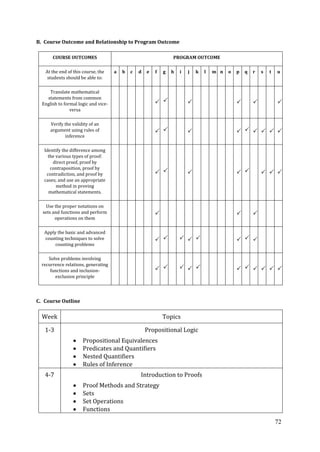
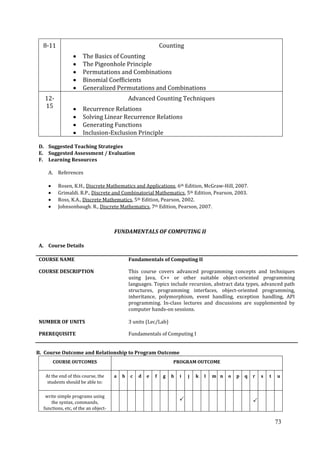
BACHELOR OF SCIENCE IN MATHEMATICS
PROGRAM SPECIFICATIONS
Section 1 Program Description
1.1 Degree Name
The degree name shall be Bachelor of Science in Mathematics (BS Math)
or Bachelor of Science in Applied Mathematics (BS Applied Math).
1.2 Nature of the Field of Study
Mathematics is often described as the science of patterns.
Mathematicians seek to discover, analyze and classify patterns in both
abstract objects and natural phenomena. The traditional domains of
study are quantity (arithmetic), structure (algebra), space (geometry)
and change (analysis). Mathematics offers distinctive and powerful
modes of thought such as abstraction, generalization, deduction,
inference, use of symbols and the axiomatic method. Mathematical truth
is established through logical analysis and proof. As a universal
discipline it is rich in both theory and applications.
Mathematics is used as an essential tool in many fields, including the
natural sciences, engineering, medicine, finance and the social sciences.
Apart from being the language of the physical sciences, mathematics
shares much in common with the former, notably in the exploration of
logical consequences of assumptions. Mathematics is also regarded as an
art, having an aesthetic and creative side. The special role of
mathematics in education (being part of the curricula from primary
school to college) is a consequence of its foundational nature and
universal applicability.
Mathematicians engage in pure mathematics or mathematics for its own
sake, without having, at least initially or intentionally, application or
utility in mind. Applied mathematics, on the other hand, is the branch of
mathematics concerned with application of mathematical theories and
methods to other fields. Applied mathematicians are academics,
researchers, or professionals who work on practical problems, often
involving the formulation, analysis, and use of mathematical models. In
turn, their work inspires and motivates new mathematical discoveries
that may lead to the development of new mathematical disciplines, as in
the case of operations research or game theory, or mathematics-based
disciplines, such as statistics and finance. There is no clear line
separating pure and applied mathematics.
5.3 Trends and Developments in Mathematics in the 21st Century
The legacy of classical mathematical theory, discovery of modern
mathematical theories and techniques, and emergence of efficient
computing methods, robust symbolic mathematical software and
2
powerful computers, have broadened the landscape of mathematics and
have led to many advancements in mathematics and science in general.
Experimental and computational mathematics continue to grow in
importance within mathematics. Computation, simulation and
visualization are playing increasing roles in both science and
mathematics. Mathematical theories and techniques have become
essential in many areas, notably finance and the life sciences. The
overlap between applied mathematics and statistics and other decision
sciences has become more significant, especially with the recognition of
the stochastic nature of varied phenomena. Mathematical models and
quantitative methods are increasingly being used in many fields, and
new and powerful models are needed to address global problems and
issues like climate change, disaster mitigation, risk management, food,
water, and population.
5.4 Program Goals
The BS Math/ Applied Math graduates shall be equipped with enhanced
mathematical and critical thinking skills. Graduates are expected to have
developed deeper appreciation and understanding of the importance of
mathematics in history and the modern world. They will be able do
research or perform jobs that require analytical thinking and
quantitative skills.
The program provides students with substantial exposure to the breadth
and depth of mathematics, from classical to contemporary, and from
theoretical to applied. The curriculum covers foundational courses in
core areas of mathematics/applied mathematics as well as advanced
courses that will help prepares graduates to pursue higher studies or
work in a variety of fields.
5.5 Professions/careers/occupations for BS Math/ Applied Math
graduates
Graduates of BS Math/ Applied Math often obtain jobs in education
(teaching high school math courses or tertiary level elementary/service
courses), statistics, actuarial science, operations research, risk
management, business and economics, banking and finance, and
computing and information technology.
5.6 Allied Fields
Mathematics/ applied mathematics is closely related to the fields of
statistics, physics, computer science, and engineering.
3
Section 6 Program Outcomes
The minimum standards for the Bachelor of Science in Mathematics/ Bachelor of
Science in Applied Mathematics program are expressed in the following
minimum set of learning outcomes:
6.1 Common to all baccalaureate programs in all types of institutions
The graduates have the ability to:
a) Articulate the latest developments in their specific field of practice.
(PQF level 6 descriptor)
b) Effectively communicate orally and in writing using both English and
Filipino languages.
c) Work effectively and independently in multi-disciplinary and multi-
cultural teams. (PQF level 6 descriptor)
d) Demonstrate professional, social, and ethical responsibility,
especially in practicing intellectual property rights and sustainable
development.
e) Preserve and promote “Filipino historical and cultural
heritage”(based on RA 7722).
6.2 Common to the Science and Mathematics Discipline
f) Demonstrate broad and coherent knowledge and understanding in
the core areas of physical and natural sciences.
g) Apply critical and problem solving skills using the scientific method.
h) Interpret relevant scientific data and make judgments that include
reflection on relevant scientific and ethical issues.
i) Carry out basic mathematical and statistical computations and use
appropriate technologies in the analysis of data.
j) Communicate information, ideas problems and solutions, both, orally
and in writing, to other scientists, decision makers and the public.
k) Relate science and mathematics to the other disciplines.
l) Design and perform safe and responsible techniques and procedures
in laboratory or field practices.
m) Critically evaluate input from others.
n) Appreciate the limitations and implications of science in everyday
life.
o) Commit to the integrity of data.
6.3 Specific to BS Math/ BS Applied Math
p) Gain mastery in the core areas of mathematics: algebra, analysis,
and geometry.
q) Demonstrate skills in pattern recognition, generalization,
abstraction, critical analysis, synthesis, problem-solving and
rigorous argument.
r) Develop an enhanced perception of the vitality and importance of
mathematics in the modern world including inter-relationships
within math and its connection to other disciplines.
s) Appreciate the concept and role of proof and reasoning and
demonstrate knowledge in reading and writing mathematical
proofs.
4
t) Make and evaluate mathematical conjectures and arguments and
validate their own mathematical thinking.
u) Communicate mathematical ideas orally and in writing using clear
and precise language.
6.4 Common to a horizontal type as defined in CMO 46 s 2012
For professional institutions: a service orientation in one’s
profession
For colleges: an ability to participate in various types of
employment, development activities, and public discourses
particularly in response to the needs of the communities one serves
For universities: an ability to participate in the generation of new
knowledge or in research and development projects
Graduates of state universities and colleges must, in addition, have the
competencies to support “national, regional and local development plans” (RA
7722).
The HEIs, at its option, may adopt mission-related program outcomes that are
not included in the minimum set.
Section 7 Sample Performance Indicators
Performance indicators (PIs) assist in the evaluation of student learning or the
achievement of the program outcomes. These are demonstrable traits developed
not only through the core or discipline-specific courses but also more
importantly through their collective experiences.
To achieve the program outcomes, graduates of the BS Mathematics/ BS Applied
Mathematics program are expected to possess a wide range of knowledge,
values and skills. The performance indicators presented even for the
baccalaureate and science and mathematics graduates are evaluated in the
context of a BS Mathematics/ BS Applied Mathematics graduate.
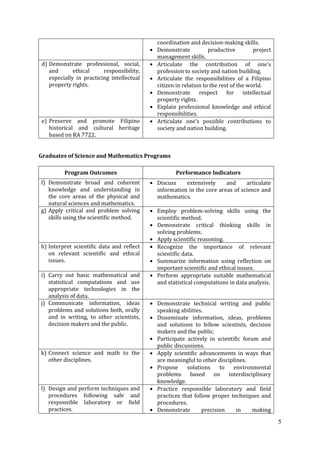
Graduates of all Baccalaureate Programs
Program Outcomes Performance Indicators
a) Articulate the latest developments
in their specific field of practice.
Participate in continuing education and
professional development in the specific
field of practice.
b) Effectively communicate orally and
in writing using both the
English/Filipino language.
Demonstrate effective oral and written
communication using both English and
Filipino languages.
Exhibit adequate technical writing and oral
communication abilities.
c) Work effectively in multi-
disciplinary and multi-cultural
teams.
Work effectively as a member of multi-
disciplinary and multi-cultural teams.
Display good judgment of people, actions
and ideas and communicate them efficiently.
Demonstrate effective leadership,
5
coordination and decision-making skills.
Demonstrate productive project
management skills.
d) Demonstrate professional, social,
and ethical responsibility,
especially in practicing intellectual
property rights.
Articulate the contribution of one’s
profession to society and nation building.
Articulate the responsibilities of a Filipino
citizen in relation to the rest of the world.
Demonstrate respect for intellectual
property rights.
Explain professional knowledge and ethical
responsibilities.
e) Preserve and promote Filipino
historical and cultural heritage
based on RA 7722.
Articulate one’s possible contributions to
society and nation building.
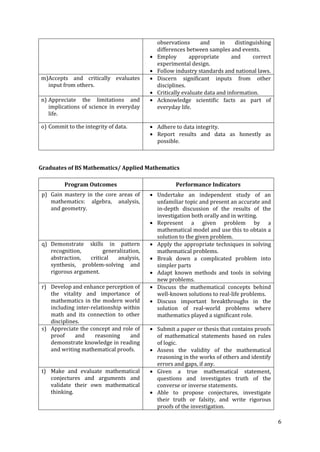
Graduates of Science and Mathematics Programs
Program Outcomes Performance Indicators
f) Demonstrate broad and coherent
knowledge and understanding in
the core areas of the physical and
natural sciences and mathematics.
Discuss extensively and articulate
information in the core areas of science and
mathematics.
g) Apply critical and problem solving
skills using the scientific method.
Employ problem-solving skills using the
scientific method.
Demonstrate critical thinking skills in
solving problems.
Apply scientific reasoning.
h) Interpret scientific data and reflect
on relevant scientific and ethical
issues.
Recognize the importance of relevant
scientific data.
Summarize information using reflection on
important scientific and ethical issues.
i) Carry out basic mathematical and
statistical computations and use
appropriate technologies in the
analysis of data.
Perform appropriate suitable mathematical
and statistical computations in data analysis.
j) Communicate information, ideas
problems and solutions both, orally
and in writing, to other scientists,
decision makers and the public.
Demonstrate technical writing and public
speaking abilities.
Disseminate information, ideas, problems
and solutions to fellow scientists, decision
makers and the public.
Participate actively in scientific forum and
public discussions.
k) Connect science and math to the
other disciplines.
Apply scientific advancements in ways that
are meaningful to other disciplines.
Propose solutions to environmental
problems based on interdisciplinary
knowledge.
l) Design and perform techniques and
procedures following safe and
responsible laboratory or field
practices.
Practice responsible laboratory and field
practices that follow proper techniques and
procedures.
Demonstrate precision in making
6
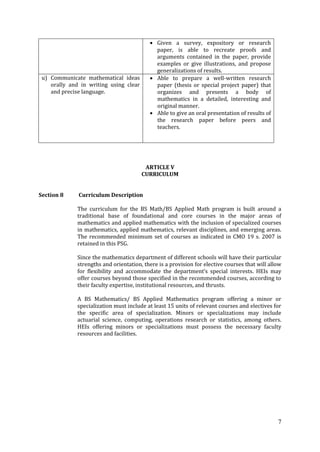
observations and in distinguishing
differences between samples and events.
Employ appropriate and correct
experimental design.
Follow industry standards and national laws.
m)Accepts and critically evaluates
input from others.
Discern significant inputs from other
disciplines.
Critically evaluate data and information.
n) Appreciate the limitations and
implications of science in everyday
life.
Acknowledge scientific facts as part of
everyday life.
o) Commit to the integrity of data. Adhere to data integrity.
Report results and data as honestly as
possible.
Graduates of BS Mathematics/ Applied Mathematics
Program Outcomes Performance Indicators
p) Gain mastery in the core areas of
mathematics: algebra, analysis,
and geometry.
Undertake an independent study of an
unfamiliar topic and present an accurate and
in-depth discussion of the results of the
investigation both orally and in writing.
Represent a given problem by a
mathematical model and use this to obtain a
solution to the given problem.
q) Demonstrate skills in pattern
recognition, generalization,
abstraction, critical analysis,
synthesis, problem-solving and
rigorous argument.
Apply the appropriate techniques in solving
mathematical problems.
Break down a complicated problem into
simpler parts
Adapt known methods and tools in solving
new problems.
r) Develop and enhance perception of
the vitality and importance of
mathematics in the modern world
including inter-relationship within
math and its connection to other
disciplines.
Discuss the mathematical concepts behind
well-known solutions to real-life problems.
Discuss important breakthroughs in the
solution of real-world problems where
mathematics played a significant role.
s) Appreciate the concept and role of
proof and reasoning and
demonstrate knowledge in reading
and writing mathematical proofs.
Submit a paper or thesis that contains proofs
of mathematical statements based on rules
of logic.
Assess the validity of the mathematical
reasoning in the works of others and identify
errors and gaps, if any.
t) Make and evaluate mathematical
conjectures and arguments and
validate their own mathematical
thinking.
Given a true mathematical statement,
questions and investigates truth of the
converse or inverse statements.
Able to propose conjectures, investigate
their truth or falsity, and write rigorous
proofs of the investigation.
7
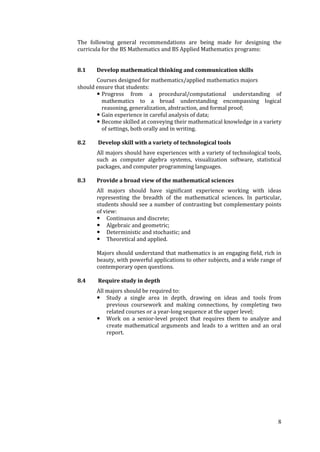
Given a survey, expository or research
paper, is able to recreate proofs and
arguments contained in the paper, provide
examples or give illustrations, and propose
generalizations of results.
u) Communicate mathematical ideas
orally and in writing using clear
and precise language.
Able to prepare a well-written research
paper (thesis or special project paper) that
organizes and presents a body of
mathematics in a detailed, interesting and
original manner.
Able to give an oral presentation of results of
the research paper before peers and
teachers.
ARTICLE V
CURRICULUM
Section 8 Curriculum Description
The curriculum for the BS Math/BS Applied Math program is built around a
traditional base of foundational and core courses in the major areas of
mathematics and applied mathematics with the inclusion of specialized courses
in mathematics, applied mathematics, relevant disciplines, and emerging areas.
The recommended minimum set of courses as indicated in CMO 19 s. 2007 is
retained in this PSG.
Since the mathematics department of different schools will have their particular
strengths and orientation, there is a provision for elective courses that will allow
for flexibility and accommodate the department’s special interests. HEIs may
offer courses beyond those specified in the recommended courses, according to
their faculty expertise, institutional resources, and thrusts.
A BS Mathematics/ BS Applied Mathematics program offering a minor or
specialization must include at least 15 units of relevant courses and electives for
the specific area of specialization. Minors or specializations may include
actuarial science, computing, operations research or statistics, among others.
HEIs offering minors or specializations must possess the necessary faculty
resources and facilities.
8
The following general recommendations are being made for designing the
curricula for the BS Mathematics and BS Applied Mathematics programs:
8.1 Develop mathematical thinking and communication skills
Courses designed for mathematics/applied mathematics majors
should ensure that students:
 Progress from a procedural/computational understanding of
mathematics to a broad understanding encompassing logical
reasoning, generalization, abstraction, and formal proof;
 Gain experience in careful analysis of data;
 Become skilled at conveying their mathematical knowledge in a variety
of settings, both orally and in writing.
8.2 Develop skill with a variety of technological tools
All majors should have experiences with a variety of technological tools,
such as computer algebra systems, visualization software, statistical
packages, and computer programming languages.
8.3 Provide a broad view of the mathematical sciences
All majors should have significant experience working with ideas
representing the breadth of the mathematical sciences. In particular,
students should see a number of contrasting but complementary points
of view:
 Continuous and discrete;
 Algebraic and geometric;
 Deterministic and stochastic; and
 Theoretical and applied.
Majors should understand that mathematics is an engaging field, rich in
beauty, with powerful applications to other subjects, and a wide range of
contemporary open questions.
8.4 Require study in depth
All majors should be required to:
 Study a single area in depth, drawing on ideas and tools from
previous coursework and making connections, by completing two
related courses or a year-long sequence at the upper level;
 Work on a senior-level project that requires them to analyze and
create mathematical arguments and leads to a written and an oral
report.
9
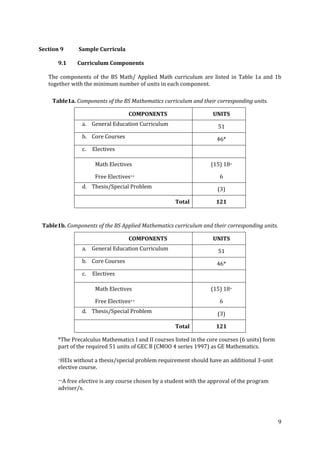
Section 9 Sample Curricula
9.1 Curriculum Components
The components of the BS Math/ Applied Math curriculum are listed in Table 1a and 1b
together with the minimum number of units in each component.
Table1a. Components of the BS Mathematics curriculum and their corresponding units.
COMPONENTS UNITS
a. General Education Curriculum 51
b. Core Courses 46*
c. Electives
Math Electives
Free Electives++
(15) 18+
6
d. Thesis/Special Problem (3)
Total 121
Table1b. Components of the BS Applied Mathematics curriculum and their corresponding units.
COMPONENTS UNITS
a. General Education Curriculum 51
b. Core Courses 46*
c. Electives
Math Electives
Free Electives++
(15) 18+
6
d. Thesis/Special Problem (3)
Total 121
*The Precalculus Mathematics I and II courses listed in the core courses (6 units) form
part of the required 51 units of GEC B (CMOO 4 series 1997) as GE Mathematics.
+HEIs without a thesis/special problem requirement should have an additional 3-unit
elective course.
++A free elective is any course chosen by a student with the approval of the program
adviser/s.
10
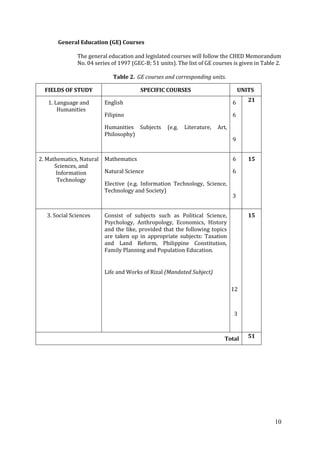
General Education (GE) Courses
The general education and legislated courses will follow the CHED Memorandum
No. 04 series of 1997 (GEC-B; 51 units). The list of GE courses is given in Table 2.
Table 2. GE courses and corresponding units.
FIELDS OF STUDY SPECIFIC COURSES UNITS
1. Language and
Humanities
English
Filipino
Humanities Subjects (e.g. Literature, Art,
Philosophy)
6
6
9
21
2. Mathematics, Natural
Sciences, and
Information
Technology
Mathematics
Natural Science
Elective (e.g. Information Technology, Science,
Technology and Society)
6
6
3
15
3. Social Sciences Consist of subjects such as Political Science,
Psychology, Anthropology, Economics, History
and the like, provided that the following topics
are taken up in appropriate subjects: Taxation
and Land Reform, Philippine Constitution,
Family Planning and Population Education.
Life and Works of Rizal (Mandated Subject)
12
3
15
Total 51
11
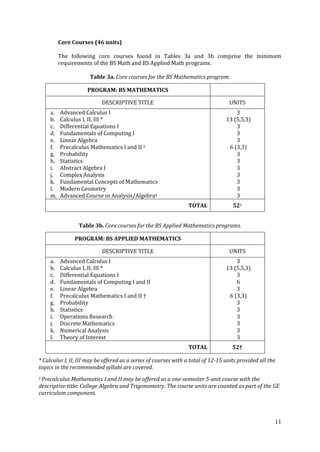
Core Courses (46 units)
The following core courses found in Tables 3a and 3b comprise the minimum
requirements of the BS Math and BS Applied Math programs.
Table 3a. Core courses for the BS Mathematics program.
PROGRAM: BS MATHEMATICS
DESCRIPTIVE TITLE UNITS
a. Advanced Calculus I
b. Calculus I, II, III *
c. Differential Equations I
d. Fundamentals of Computing I
e. Linear Algebra
f. Precalculus Mathematics I and II †
g. Probability
h. Statistics
i. Abstract Algebra I
j. Complex Analysis
k. Fundamental Concepts of Mathematics
l. Modern Geometry
m. Advanced Course in Analysis/Algebra‡
3
13 (5,5,3)
3
3
3
6 (3,3)
3
3
3
3
3
3
3
TOTAL 52†
Table 3b. Core courses for the BS Applied Mathematics programs.
PROGRAM: BS APPLIED MATHEMATICS
DESCRIPTIVE TITLE UNITS
a. Advanced Calculus I
b. Calculus I, II, III *
c. Differential Equations I
d. Fundamentals of Computing I and II
e. Linear Algebra
f. Precalculus Mathematics I and II †
g. Probability
h. Statistics
i. Operations Research
j. Discrete Mathematics
k. Numerical Analysis
l. Theory of Interest
3
13 (5,5,3)
3
6
3
6 (3,3)
3
3
3
3
3
3
TOTAL 52†
* Calculus I, II, III may be offered as a series of courses with a total of 12-15 units provided all the
topics in the recommended syllabi are covered.
† Precalculus Mathematics I and II may be offered as a one-semester 5-unit course with the
descriptive title: College Algebra and Trigonometry. The course units are counted as part of the GE
curriculum component.
12
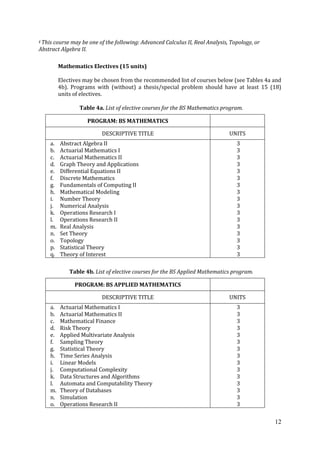
‡ This course may be one of the following: Advanced Calculus II, Real Analysis, Topology, or
Abstract Algebra II.
Mathematics Electives (15 units)
Electives may be chosen from the recommended list of courses below (see Tables 4a and
4b). Programs with (without) a thesis/special problem should have at least 15 (18)
units of electives.
Table 4a. List of elective courses for the BS Mathematics program.
PROGRAM: BS MATHEMATICS
DESCRIPTIVE TITLE UNITS
a. Abstract Algebra II
b. Actuarial Mathematics I
c. Actuarial Mathematics II
d. Graph Theory and Applications
e. Differential Equations II
f. Discrete Mathematics
g. Fundamentals of Computing II
h. Mathematical Modeling
i. Number Theory
j. Numerical Analysis
k. Operations Research I
l. Operations Research II
m. Real Analysis
n. Set Theory
o. Topology
p. Statistical Theory
q. Theory of Interest
3
3
3
3
3
3
3
3
3
3
3
3
3
3
3
3
3
Table 4b. List of elective courses for the BS Applied Mathematics program.
PROGRAM: BS APPLIED MATHEMATICS
DESCRIPTIVE TITLE UNITS
a. Actuarial Mathematics I
b. Actuarial Mathematics II
c. Mathematical Finance
d. Risk Theory
e. Applied Multivariate Analysis
f. Sampling Theory
g. Statistical Theory
h. Time Series Analysis
i. Linear Models
j. Computational Complexity
k. Data Structures and Algorithms
l. Automata and Computability Theory
m. Theory of Databases
n. Simulation
o. Operations Research II
3
3
3
3
3
3
3
3
3
3
3
3
3
3
3
13
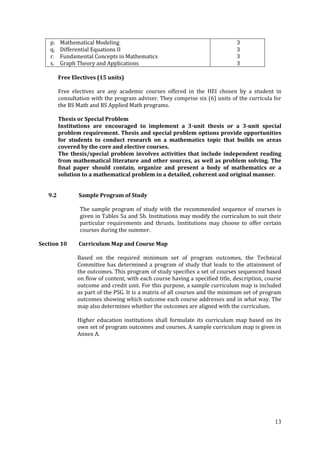
p. Mathematical Modeling
q. Differential Equations II
r. Fundamental Concepts in Mathematics
s. Graph Theory and Applications
3
3
3
3
Free Electives (15 units)
Free electives are any academic courses offered in the HEI chosen by a student in
consultation with the program adviser. They comprise six (6) units of the curricula for
the BS Math and BS Applied Math programs.
Thesis or Special Problem
Institutions are encouraged to implement a 3-unit thesis or a 3-unit special
problem requirement. Thesis and special problem options provide opportunities
for students to conduct research on a mathematics topic that builds on areas
covered by the core and elective courses.
The thesis/special problem involves activities that include independent reading
from mathematical literature and other sources, as well as problem solving. The
final paper should contain, organize and present a body of mathematics or a
solution to a mathematical problem in a detailed, coherent and original manner.
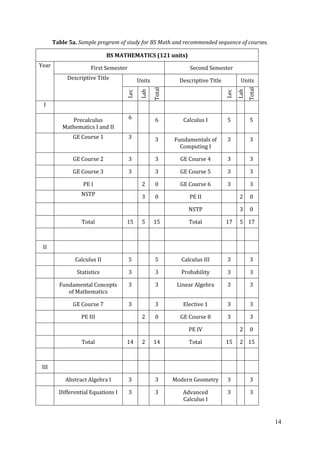
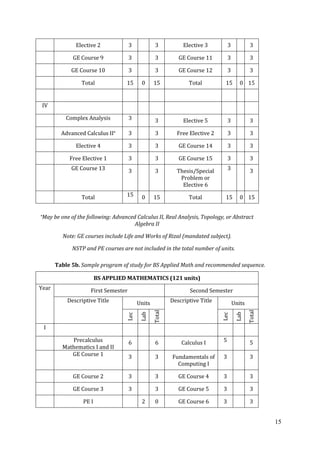
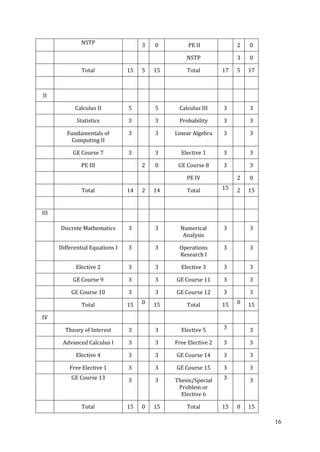
9.2 Sample Program of Study
The sample program of study with the recommended sequence of courses is
given in Tables 5a and 5b. Institutions may modify the curriculum to suit their
particular requirements and thrusts. Institutions may choose to offer certain
courses during the summer.
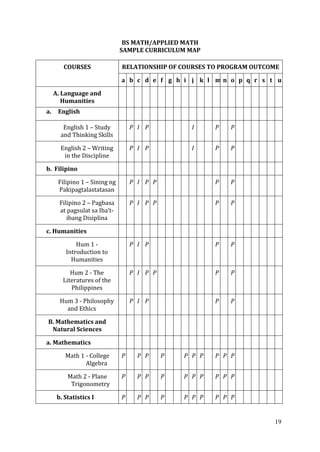
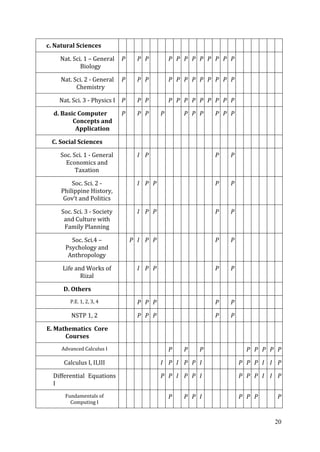
Section 10 Curriculum Map and Course Map
Based on the required minimum set of program outcomes, the Technical
Committee has determined a program of study that leads to the attainment of
the outcomes. This program of study specifies a set of courses sequenced based
on flow of content, with each course having a specified title, description, course
outcome and credit unit. For this purpose, a sample curriculum map is included
as part of the PSG. It is a matrix of all courses and the minimum set of program
outcomes showing which outcome each course addresses and in what way. The
map also determines whether the outcomes are aligned with the curriculum.
Higher education institutions shall formulate its curriculum map based on its
own set of program outcomes and courses. A sample curriculum map is given in
Annex A.
14
Table 5a. Sample program of study for BS Math and recommended sequence of courses.
BS MATHEMATICS (121 units)
Year First Semester Second Semester
Descriptive Title Units Descriptive Title Units
Lec
Lab
Total
Lec
Lab
Total
I
Precalculus
Mathematics I and II
6 6 Calculus I 5 5
GE Course 1 3 3 Fundamentals of
Computing I
3 3
GE Course 2 3 3 GE Course 4 3 3
GE Course 3 3 3 GE Course 5 3 3
PE I 2 0 GE Course 6 3 3
NSTP 3 0 PE II 2 0
NSTP 3 0
Total 15 5 15 Total 17 5 17
II
Calculus II 5 5 Calculus III 3 3
Statistics 3 3 Probability 3 3
Fundamental Concepts
of Mathematics
3 3 Linear Algebra 3 3
GE Course 7 3 3 Elective 1 3 3
PE III 2 0 GE Course 8 3 3
PE IV 2 0
Total 14 2 14 Total 15 2 15
III
Abstract Algebra I 3 3 Modern Geometry 3 3
Differential Equations I 3 3 Advanced
Calculus I
3 3
15
Elective 2 3 3 Elective 3 3 3
GE Course 9 3 3 GE Course 11 3 3
GE Course 10 3 3 GE Course 12 3 3
Total 15 0 15 Total 15 0 15
IV
Complex Analysis 3 3 Elective 5 3 3
Advanced Calculus II* 3 3 Free Elective 2 3 3
Elective 4 3 3 GE Course 14 3 3
Free Elective 1 3 3 GE Course 15 3 3
GE Course 13 3 3 Thesis/Special
Problem or
Elective 6
3 3
Total 15 0 15 Total 15 0 15
*May be one of the following: Advanced Calculus II, Real Analysis, Topology, or Abstract
Algebra II
Note: GE courses include Life and Works of Rizal (mandated subject).
NSTP and PE courses are not included in the total number of units.
Table 5b. Sample program of study for BS Applied Math and recommended sequence.
BS APPLIED MATHEMATICS (121 units)
Year First Semester Second Semester
Descriptive Title Units Descriptive Title Units
Lec
Lab
Total
Lec
Lab
Total
I
Precalculus
Mathematics I and II
6 6 Calculus I 5 5
GE Course 1 3 3 Fundamentals of
Computing I
3 3
GE Course 2 3 3 GE Course 4 3 3
GE Course 3 3 3 GE Course 5 3 3
PE I 2 0 GE Course 6 3 3
16
NSTP 3 0 PE II 2 0
NSTP 3 0
Total 15 5 15 Total 17 5 17
II
Calculus II 5 5 Calculus III 3 3
Statistics 3 3 Probability 3 3
Fundamentals of
Computing II
3 3 Linear Algebra 3 3
GE Course 7 3 3 Elective 1 3 3
PE III 2 0 GE Course 8 3 3
PE IV 2 0
Total 14 2 14 Total 15 2 15
III
Discrete Mathematics 3 3 Numerical
Analysis
3 3
Differential Equations I 3 3 Operations
Research I
3 3
Elective 2 3 3 Elective 3 3 3
GE Course 9 3 3 GE Course 11 3 3
GE Course 10 3 3 GE Course 12 3 3
Total 15 0 15 Total 15 0 15
IV
Theory of Interest 3 3 Elective 5 3 3
Advanced Calculus I 3 3 Free Elective 2 3 3
Elective 4 3 3 GE Course 14 3 3
Free Elective 1 3 3 GE Course 15 3 3
GE Course 13 3 3 Thesis/Special
Problem or
Elective 6
3 3
Total 15 0 15 Total 15 0 15
17
Note: GE courses include Life and Works of Rizal (mandated subject).
NSTP and PE courses are not included in the total number of units.
Section 11 Sample Means of Curriculum Delivery
A range of instructional methods can be employed that can also become means
of assessing outcomes. These include lecture and discussion, problem-solving,
individual or group reports, problem-sets, computing and programming
exercises, computer simulations and visualization. Suggested teaching strategies
and assessment activities are indicated in the course syllabus of each course.
Section 12 Sample Syllabi for Core Mathematics Courses
The course specifications provided in this CMO in Annex B apply only to the core
courses and indicate the minimum topics to be covered in each area. The HEIs
shall formulate the syllabus for all the courses in their respective BS Math/
Applied Math program.
HEIs may follow their own course specification s in the implementation of the program but must
not be less than those specified for major courses.
18
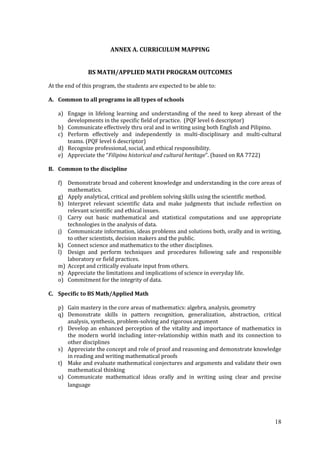
ANNEX A. CURRICULUM MAPPING
BS MATH/APPLIED MATH PROGRAM OUTCOMES
At the end of this program, the students are expected to be able to:
A. Common to all programs in all types of schools
a) Engage in lifelong learning and understanding of the need to keep abreast of the
developments in the specific field of practice. (PQF level 6 descriptor)
b) Communicate effectively thru oral and in writing using both English and Pilipino.
c) Perform effectively and independently in multi-disciplinary and multi-cultural
teams. (PQF level 6 descriptor)
d) Recognize professional, social, and ethical responsibility.
e) Appreciate the “Filipino historical and cultural heritage”. (based on RA 7722)
B. Common to the discipline
f) Demonstrate broad and coherent knowledge and understanding in the core areas of
mathematics.
g) Apply analytical, critical and problem solving skills using the scientific method.
h) Interpret relevant scientific data and make judgments that include reflection on
relevant scientific and ethical issues.
i) Carry out basic mathematical and statistical computations and use appropriate
technologies in the analysis of data.
j) Communicate information, ideas problems and solutions both, orally and in writing,
to other scientists, decision makers and the public.
k) Connect science and mathematics to the other disciplines.
l) Design and perform techniques and procedures following safe and responsible
laboratory or field practices.
m) Accept and critically evaluate input from others.
n) Appreciate the limitations and implications of science in everyday life.
o) Commitment for the integrity of data.
C. Specific to BS Math/Applied Math
p) Gain mastery in the core areas of mathematics: algebra, analysis, geometry
q) Demonstrate skills in pattern recognition, generalization, abstraction, critical
analysis, synthesis, problem-solving and rigorous argument
r) Develop an enhanced perception of the vitality and importance of mathematics in
the modern world including inter-relationship within math and its connection to
other disciplines
s) Appreciate the concept and role of proof and reasoning and demonstrate knowledge
in reading and writing mathematical proofs
t) Make and evaluate mathematical conjectures and arguments and validate their own
mathematical thinking
u) Communicate mathematical ideas orally and in writing using clear and precise
language
19
BS MATH/APPLIED MATH
SAMPLE CURRICULUM MAP
COURSES RELATIONSHIP OF COURSES TO PROGRAM OUTCOME
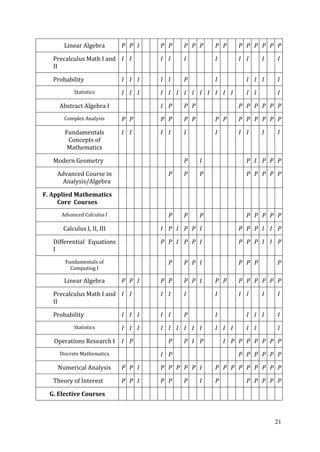
a b c d e f g h i j k l m n o p q r s t u
A. Language and
Humanities
a. English
English 1 – Study
and Thinking Skills
P I P I P P
English 2 – Writing
in the Discipline
P I P I P P
b. Filipino
Filipino 1 – Sining ng
Pakipagtalastatasan
P I P P P P
Filipino 2 – Pagbasa
at pagsulat sa Iba’t-
ibang Disiplina
P I P P P P
c. Humanities
Hum 1 -
Introduction to
Humanities
P I P P P
Hum 2 - The
Literatures of the
Philippines
P I P P P P
Hum 3 - Philosophy
and Ethics
P I P P P
B. Mathematics and
Natural Sciences
a. Mathematics
Math 1 - College
Algebra
P P P P P P P P P P
Math 2 - Plane
Trigonometry
P P P P P P P P P P
b. Statistics I P P P P P P P P P P
20
c. Natural Sciences
Nat. Sci. 1 – General
Biology
P P P P P P P P P P P P
Nat. Sci. 2 - General
Chemistry
P P P P P P P P P P P P
Nat. Sci. 3 - Physics I P P P P P P P P P P P P
d. Basic Computer
Concepts and
Application
P P P P P P P P P P
C. Social Sciences
Soc. Sci. 1 - General
Economics and
Taxation
I P P P
Soc. Sci. 2 -
Philippine History,
Gov’t and Politics
I P P P P
Soc. Sci. 3 - Society
and Culture with
Family Planning
I P P P P
Soc. Sci.4 –
Psychology and
Anthropology
P I P P P P
Life and Works of
Rizal
I P P P P
D. Others
P.E. 1, 2, 3, 4 P P P P P
NSTP 1, 2 P P P P P
E. Mathematics Core
Courses
Advanced Calculus I P P P P P P P P
Calculus I, II,III I P I P P I P P P I I P
Differential Equations
I
P P I P P I P P P I I P
Fundamentals of
Computing I
P P P I P P P P
21
Linear Algebra P P I P P P P P P P P P P P P P
Precalculus Math I and
II
I I I I I I I I I I
Probability I I I I I P I I I I I
Statistics I I I I I I I I I I I I I I I I
Abstract Algebra I I P P P P P P P P P
Complex Analysis P P P P P P P P P P P P P P
Fundamentals
Concepts of
Mathematics
I I I I I I I I I I
Modern Geometry P I P I P P P
Advanced Course in
Analysis/Algebra
P P P P P P P P
F. Applied Mathematics
Core Courses
Advanced Calculus I P P P P P P P P
Calculus I, II, III I P I P P I P P P I I P
Differential Equations
I
P P I P P I P P P I I P
Fundamentals of
Computing I
P P P I P P P P
Linear Algebra P P I P P P P I P P P P P P P P
Precalculus Math I and
II
I I I I I I I I I I
Probability I I I I I P I I I I I
Statistics I I I I I I I I I I I I I I I
Operations Research I I P P P I P I P P P P P P P
Discrete Mathematics I P P P P P P P
Numerical Analysis P P I P P P P P I P P P P P P P P P
Theory of Interest P P I P P P I P P P P P P
G. Elective Courses
22
H. Free Electives
I. Thesis or Special
Problem
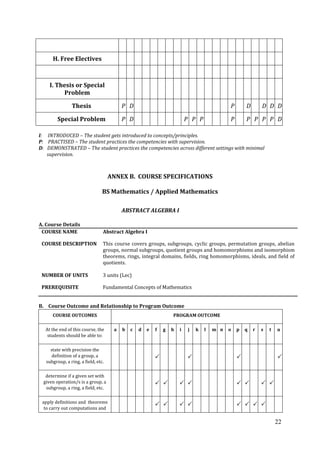
Thesis P D P D D D D
Special Problem P D P P P P P P P P D
I: INTRODUCED – The student gets introduced to concepts/principles.
P: PRACTISED – The student practices the competencies with supervision.
D: DEMONSTRATED – The student practices the competencies across different settings with minimal
supervision.
ANNEX B. COURSE SPECIFICATIONS
BS Mathematics / Applied Mathematics
ABSTRACT ALGEBRA I
A. Course Details
COURSE NAME Abstract Algebra I
COURSE DESCRIPTION This course covers groups, subgroups, cyclic groups, permutation groups, abelian
groups, normal subgroups, quotient groups and homomorphisms and isomorphism
theorems, rings, integral domains, fields, ring homomorphisms, ideals, and field of
quotients.
NUMBER OF UNITS 3 units (Lec)
PREREQUISITE Fundamental Concepts of Mathematics
B. Course Outcome and Relationship to Program Outcome
COURSE OUTCOMES PROGRAM OUTCOME
At the end of this course, the
students should be able to:
a b c d e f g h i j k l m n o p q r s t u
state with precision the
definition of a group, a
subgroup, a ring, a field, etc.
   
determine if a given set with
given operation/s is a group, a
subgroup, a ring, a field, etc.
       
apply definitions and theorems
to carry out computations and
       
23
constructions involving
different algebraic structures
apply definitions and theorems
to prove properties that are
satisfied by all groups,
subgroups, rings, etc
        
recall the definitions and the
basic properties of certain
examples of groups, e.g.
dihedral, symmetric, alternating
    
recall the definition and basic
properties of other objects such
as homomorphism,
isomorphism, kernel, direct
product of groups, quotient
groups, etc.
    
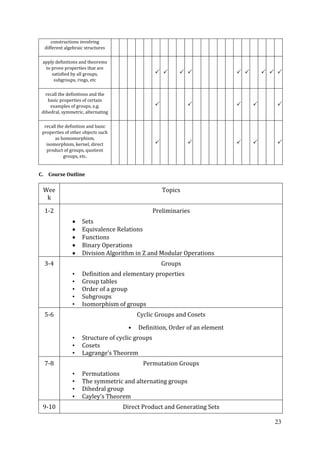
C. Course Outline
Wee
k
Topics
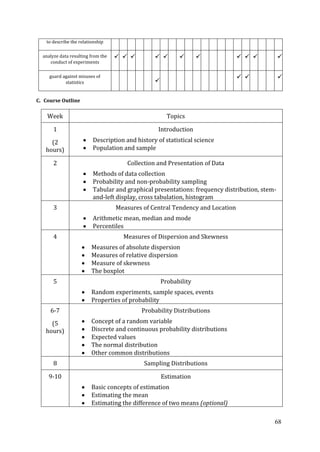
1-2 Preliminaries
Sets
Equivalence Relations
Functions
Binary Operations
Division Algorithm in Z and Modular Operations
3-4 Groups
• Definition and elementary properties
• Group tables
• Order of a group
• Subgroups
• Isomorphism of groups
5-6 Cyclic Groups and Cosets
• Definition, Order of an element
• Structure of cyclic groups
• Cosets
• Lagrange’s Theorem
7-8 Permutation Groups
• Permutations
• The symmetric and alternating groups
• Dihedral group
• Cayley’s Theorem
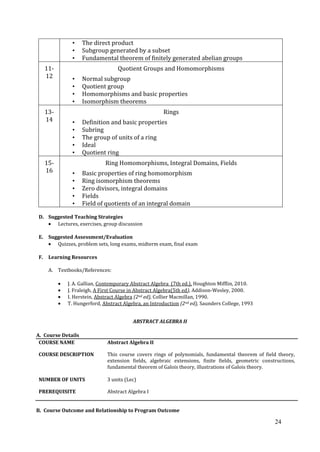
9-10 Direct Product and Generating Sets
24
• The direct product
• Subgroup generated by a subset
• Fundamental theorem of finitely generated abelian groups
11-
12
Quotient Groups and Homomorphisms
• Normal subgroup
• Quotient group
• Homomorphisms and basic properties
• Isomorphism theorems
13-
14
Rings
• Definition and basic properties
• Subring
• The group of units of a ring
• Ideal
• Quotient ring
15-
16
Ring Homomorphisms, Integral Domains, Fields
• Basic properties of ring homomorphism
• Ring isomorphism theorems
• Zero divisors, integral domains
• Fields
• Field of quotients of an integral domain
D. Suggested Teaching Strategies
Lectures, exercises, group discussion
E. Suggested Assessment/Evaluation
Quizzes, problem sets, long exams, midterm exam, final exam
F. Learning Resources
A. Textbooks/References:
J. A. Gallian, Contemporary Abstract Algebra (7th ed.), Houghton Mifflin, 2010.
J. Fraleigh, A First Course in Abstract Algebra(5th ed), Addison-Wesley, 2000.
I. Herstein, Abstract Algebra (2nd ed), Collier Macmillan, 1990.
T. Hungerford, Abstract Algebra, an Introduction (2nd ed), Saunders College, 1993
ABSTRACT ALGEBRA II
A. Course Details
COURSE NAME Abstract Algebra II
COURSE DESCRIPTION This course covers rings of polynomials, fundamental theorem of field theory,
extension fields, algebraic extensions, finite fields, geometric constructions,
fundamental theorem of Galois theory, illustrations of Galois theory.
NUMBER OF UNITS 3 units (Lec)
PREREQUISITE Abstract Algebra I
B. Course Outcome and Relationship to Program Outcome
25
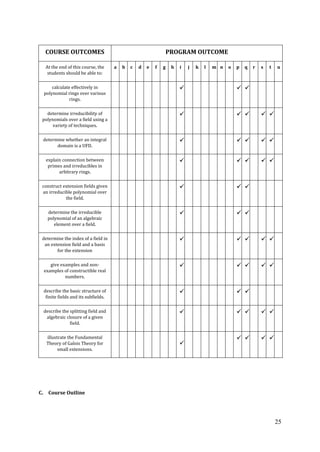
COURSE OUTCOMES PROGRAM OUTCOME
At the end of this course, the
students should be able to:
a b c d e f g h i j k l m n o p q r s t u
calculate effectively in
polynomial rings over various
rings.
  
determine irreducibility of
polynomials over a field using a
variety of techniques.
    
determine whether an integral
domain is a UFD.
    
explain connection between
primes and irreducibles in
arbitrary rings.
    
construct extension fields given
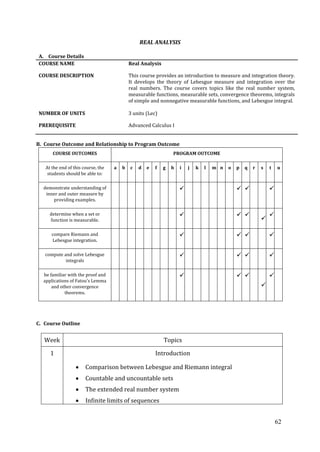
an irreducible polynomial over
the field.
  
determine the irreducible
polynomial of an algebraic
element over a field.
  
determine the index of a field in
an extension field and a basis
for the extension
    
give examples and non-
examples of constructible real
numbers.
    
describe the basic structure of
finite fields and its subfields.
  
describe the splitting field and
algebraic closure of a given
field.
    
illustrate the Fundamental
Theory of Galois Theory for
small extensions.

   
C. Course Outline
26
Week Topics
1 Introduction
Historical background
Solution of quadratic, cubic, quartic equations
2 Rings
Review of basic concepts on rings
Characteristic of a ring
Prime subfield
Prime ideal, maximal Ideal, principal ideal
3-4 Rings of Polynomials
Division algorithm in F[x] (F a field)
Ideal structure in F[x]
Divisibility conditions in ideal form
Irreducible polynomials
Tests for irreducibility
5-6 Factorization in Commutative Rings*
Unique factorization domains
Euclidean domains
Gaussian integers
Multiplicative norms
7-8 Extension Fields
Fundamental theorem of field theory (Kronecker)
Algebraic and transcendental elements
Irreducible polynomial of an algebraic element
Extension fields as vector spaces
9 Finite Fields
Cyclic structure of group of units
Subfield structure
Frobenius automorphism
10-
12
Special Extension Fields
Finite extensions
Algebraic extensions
Splitting fields
Algebraically closed fields, algebraic closure
27
13 Geometric Constructions
Constructible numbers
Trisecting an angle, doubling the cube
14 Some Important Theorems
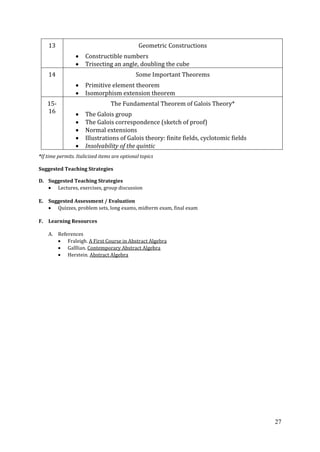
Primitive element theorem
Isomorphism extension theorem
15-
16
The Fundamental Theorem of Galois Theory*
The Galois group
The Galois correspondence (sketch of proof)
Normal extensions
Illustrations of Galois theory: finite fields, cyclotomic fields
Insolvability of the quintic
*If time permits. Italicized items are optional topics
Suggested Teaching Strategies
D. Suggested Teaching Strategies
Lectures, exercises, group discussion
E. Suggested Assessment / Evaluation
Quizzes, problem sets, long exams, midterm exam, final exam
F. Learning Resources
A. References
Fraleigh. A First Course in Abstract Algebra
Galllian. Contemporary Abstract Algebra
Herstein. Abstract Algebra
28
ADVANCED CALCULUS I
A. Course Details
COURSE NAME Advanced Calculus I
COURSE DESCRIPTION Advanced Calculus I is the first of two courses that provides an introduction to
mathematical analysis beyond the calculus series. Topics include the real number
system, point set topology, limits and continuity, the derivatives, multivariable
differential calculus, implicit functions and extremum problems.
NUMBER OF UNITS 3 units (Lec)
PREREQUISITE Calculus III
B. Course Outcome and Relationship to Program Outcome
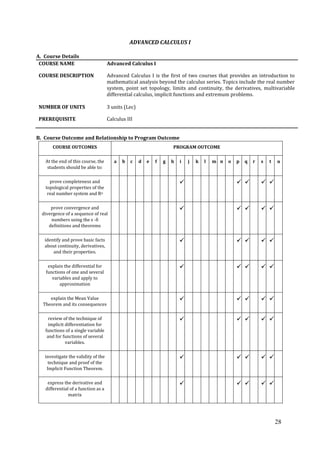
COURSE OUTCOMES PROGRAM OUTCOME
At the end of this course, the
students should be able to:
a b c d e f g h i j k l m n o p q r s t u
prove completeness and
topological properties of the
real number system and Rn
    
prove convergence and
divergence of a sequence of real
numbers using the ϵ -δ
definitions and theorems
    
identify and prove basic facts
about continuity, derivatives,
and their properties.
    
explain the differential for
functions of one and several
variables and apply to
approximation
    
explain the Mean Value
Theorem and its consequences
    
review of the technique of
implicit differentiation for
functions of a single variable
and for functions of several
variables.
    
investigate the validity of the
technique and proof of the
Implicit Function Theorem.
    
express the derivative and
differential of a function as a
matrix
    
29
C. Course Outline
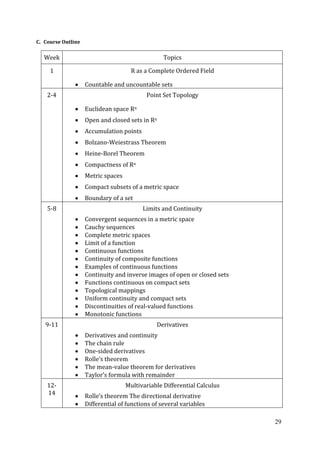
Week Topics
1 R as a Complete Ordered Field
Countable and uncountable sets
2-4 Point Set Topology
Euclidean space Rn
Open and closed sets in Rn
Accumulation points
Bolzano-Weiestrass Theorem
Heine-Borel Theorem
Compactness of Rn
Metric spaces
Compact subsets of a metric space
Boundary of a set
5-8 Limits and Continuity
Convergent sequences in a metric space
Cauchy sequences
Complete metric spaces
Limit of a function
Continuous functions
Continuity of composite functions
Examples of continuous functions
Continuity and inverse images of open or closed sets
Functions continuous on compact sets
Topological mappings
Uniform continuity and compact sets
Discontinuities of real-valued functions
Monotonic functions
9-11 Derivatives
Derivatives and continuity
The chain rule
One-sided derivatives
Rolle’s theorem
The mean-value theorem for derivatives
Taylor’s formula with remainder
12-
14
Multivariable Differential Calculus
Rolle’s theorem The directional derivative
Differential of functions of several variables
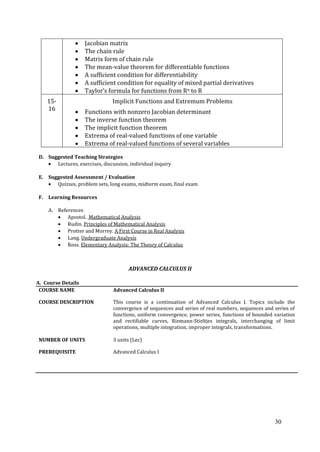
30
Jacobian matrix
The chain rule
Matrix form of chain rule
The mean-value theorem for differentiable functions
A sufficient condition for differentiability
A sufficient condition for equality of mixed partial derivatives
Taylor’s formula for functions from Rn to R
15-
16
Implicit Functions and Extremum Problems
Functions with nonzero Jacobian determinant
The inverse function theorem
The implicit function theorem
Extrema of real-valued functions of one variable
Extrema of real-valued functions of several variables
D. Suggested Teaching Strategies
Lectures, exercises, discussion, individual inquiry
E. Suggested Assessment / Evaluation
Quizzes, problem sets, long exams, midterm exam, final exam
F. Learning Resources
A. References
Apostol. Mathematical Analysis
Rudin. Principles of Mathematical Analysis
Protter and Morrey. A First Course in Real Analysis
Lang. Undergraduate Analysis
Ross. Elementary Analysis: The Theory of Calculus
ADVANCED CALCULUS II
A. Course Details
COURSE NAME Advanced Calculus II
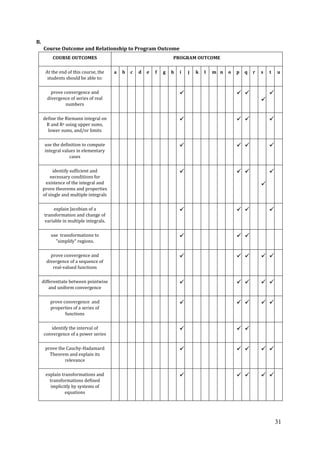
COURSE DESCRIPTION This course is a continuation of Advanced Calculus I. Topics include the
convergence of sequences and series of real numbers, sequences and series of
functions, uniform convergence, power series, functions of bounded variation
and rectifiable curves, Riemann-Stieltjes integrals, interchanging of limit
operations, multiple integration, improper integrals, transformations.
NUMBER OF UNITS 3 units (Lec)
PREREQUISITE Advanced Calculus I
31
B.
Course Outcome and Relationship to Program Outcome
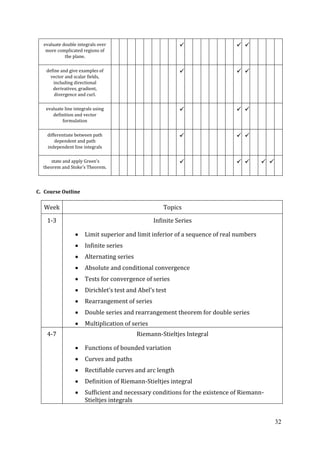
COURSE OUTCOMES PROGRAM OUTCOME
At the end of this course, the
students should be able to:
a b c d e f g h i j k l m n o p q r s t u
prove convergence and
divergence of series of real
numbers
  


define the Riemann integral on
R and Rn using upper sums,
lower sums, and/or limits
   
use the definition to compute
integral values in elementary
cases
   
identify sufficient and
necessary conditions for
existence of the integral and
prove theorems and properties
of single and multiple integrals
  


explain Jacobian of a
transformation and change of
variable in multiple integrals.
   
use transformations to
"simplify" regions.
  
prove convergence and
divergence of a sequence of
real-valued functions
    
differentiate between pointwise
and uniform convergence
    
prove convergence and
properties of a series of
functions
    
identify the interval of
convergence of a power series
  
prove the Cauchy-Hadamard
Theorem and explain its
relevance
    
explain transformations and
transformations defined
implicitly by systems of
equations
    
32
evaluate double integrals over
more complicated regions of
the plane.
  
define and give examples of
vector and scalar fields,
including directional
derivatives, gradient,
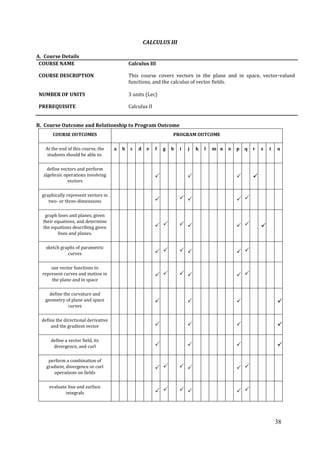
divergence and curl.
  
evaluate line integrals using
definition and vector
formulation
  
differentiate between path
dependent and path
independent line integrals
  
state and apply Green's
theorem and Stoke's Theorem.
    
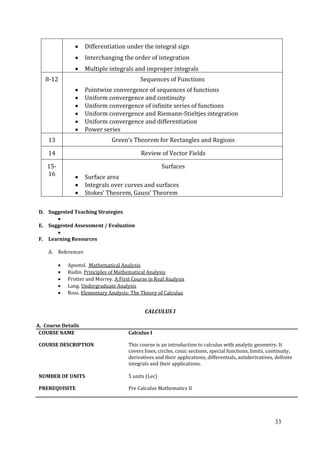
C. Course Outline
Week Topics
1-3 Infinite Series
Limit superior and limit inferior of a sequence of real numbers
Infinite series
Alternating series
Absolute and conditional convergence
Tests for convergence of series
Dirichlet’s test and Abel’s test
Rearrangement of series
Double series and rearrangement theorem for double series
Multiplication of series
4-7 Riemann-Stieltjes Integral
Functions of bounded variation
Curves and paths
Rectifiable curves and arc length
Definition of Riemann-Stieltjes integral
Sufficient and necessary conditions for the existence of Riemann-
Stieltjes integrals
33
Differentiation under the integral sign
Interchanging the order of integration
Multiple integrals and improper integrals
8-12 Sequences of Functions
Pointwise convergence of sequences of functions
Uniform convergence and continuity
Uniform convergence of infinite series of functions
Uniform convergence and Riemann-Stieltjes integration
Uniform convergence and differentiation
Power series
13 Green’s Theorem for Rectangles and Regions
14 Review of Vector Fields
15-
16
Surfaces
Surface area
Integrals over curves and surfaces
Stokes’ Theorem, Gauss’ Theorem
D. Suggested Teaching Strategies
E. Suggested Assessment / Evaluation
F. Learning Resources
A. References
Apostol. Mathematical Analysis
Rudin. Principles of Mathematical Analysis
Protter and Morrey. A First Course in Real Analysis
Lang. Undergraduate Analysis
Ross. Elementary Analysis: The Theory of Calculus
CALCULUS I
A. Course Details
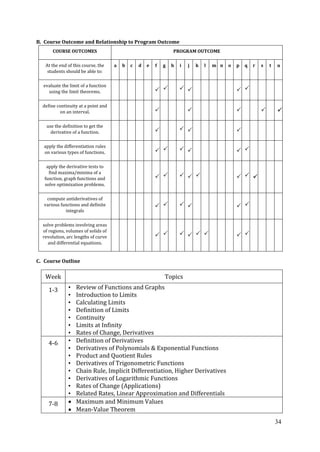
COURSE NAME Calculus I
COURSE DESCRIPTION This course is an introduction to calculus with analytic geometry. It
covers lines, circles, conic sections, special functions, limits, continuity,
derivatives and their applications, differentials, antiderivatives, definite
integrals and their applications.
NUMBER OF UNITS 5 units (Lec)
PREREQUISITE Pre Calculus Mathematics II
34
B. Course Outcome and Relationship to Program Outcome
COURSE OUTCOMES PROGRAM OUTCOME
At the end of this course, the
students should be able to:
a b c d e f g h i j k l m n o p q r s t u
evaluate the limit of a function
using the limit theorems.      
define continuity at a point and
on an interval.     
use the definition to get the
derivative of a function.    
apply the differentiation rules
on various types of functions.      
apply the derivative tests to
find maxima/minima of a
function, graph functions and
solve optimization problems.
       
compute antiderivatives of
various functions and definite
integrals
     
solve problems involving areas
of regions, volumes of solids of
revolution, arc lengths of curve
and differential equations.
       
C. Course Outline
Week Topics
1-3 • Review of Functions and Graphs
• Introduction to Limits
• Calculating Limits
• Definition of Limits
• Continuity
• Limits at Infinity
• Rates of Change, Derivatives
4-6 • Definition of Derivatives
• Derivatives of Polynomials & Exponential Functions
• Product and Quotient Rules
• Derivatives of Trigonometric Functions
• Chain Rule, Implicit Differentiation, Higher Derivatives
• Derivatives of Logarithmic Functions
• Rates of Change (Applications)
• Related Rates, Linear Approximation and Differentials
7-8 Maximum and Minimum Values
Mean-Value Theorem
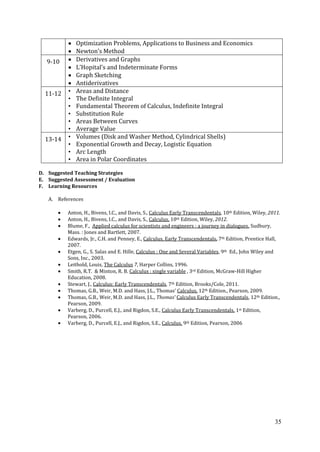
35
Optimization Problems, Applications to Business and Economics
Newton’s Method
9-10 Derivatives and Graphs
L’Hopital’s and Indeterminate Forms
Graph Sketching
Antiderivatives
11-12 • Areas and Distance
• The Definite Integral
• Fundamental Theorem of Calculus, Indefinite Integral
• Substitution Rule
• Areas Between Curves
• Average Value
13-14 • Volumes (Disk and Washer Method, Cylindrical Shells)
• Exponential Growth and Decay, Logistic Equation
• Arc Length
• Area in Polar Coordinates
D. Suggested Teaching Strategies
E. Suggested Assessment / Evaluation
F. Learning Resources
A. References
Anton, H., Bivens, I.C., and Davis, S., Calculus Early Transcendentals, 10th Edition, Wiley, 2011.
Anton, H., Bivens, I.C., and Davis, S., Calculus, 10th Edition, Wiley, 2012.
Blume, F., Applied calculus for scientists and engineers : a journey in dialogues. Sudbury,
Mass. : Jones and Bartlett, 2007.
Edwards, Jr., C.H. and Penney, E., Calculus, Early Transcendentals, 7th Edition, Prentice Hall,
2007.
Etgen, G., S. Salas and E. Hille, Calculus : One and Several Variables, 9th Ed., John Wiley and
Sons, Inc., 2003.
Leithold, Louis, The Calculus 7, Harper Collins, 1996.
Smith, R.T. & Minton, R. B. Calculus : single variable , 3rd Edition, McGraw-Hill Higher
Education, 2008.
Stewart, J., Calculus: Early Transcendentals, 7th Edition, Brooks/Cole, 2011.
Thomas, G.B., Weir, M.D. and Hass, J.L., Thomas’ Calculus, 12th Edition., Pearson, 2009.
Thomas, G.B., Weir, M.D. and Hass, J.L., Thomas’ Calculus Early Transcendentals, 12th Edition.,
Pearson, 2009.
Varberg, D., Purcell, E.J., and Rigdon, S.E., Calculus Early Transcendentals, 1st Edition,
Pearson, 2006.
Varberg, D., Purcell, E.J., and Rigdon, S.E., Calculus, 9th Edition, Pearson, 2006
36
CALCULUS II
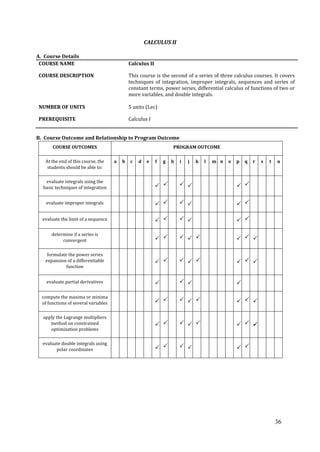
A. Course Details
COURSE NAME Calculus II
COURSE DESCRIPTION This course is the second of a series of three calculus courses. It covers
techniques of integration, improper integrals, sequences and series of
constant terms, power series, differential calculus of functions of two or
more variables, and double integrals.
NUMBER OF UNITS 5 units (Lec)
PREREQUISITE Calculus I
B. Course Outcome and Relationship to Program Outcome
COURSE OUTCOMES PROGRAM OUTCOME
At the end of this course, the
students should be able to:
a b c d e f g h i j k l m n o p q r s t u
evaluate integrals using the
basic techniques of integration      
evaluate improper integrals      
evaluate the limit of a sequence      
determine if a series is
convergent        
formulate the power series
expansion of a differentiable
function
       
evaluate partial derivatives    
compute the maxima or minima
of functions of several variables        
apply the Lagrange multipliers
method on constrained
optimization problems
       
evaluate double integrals using
polar coordinates      
37
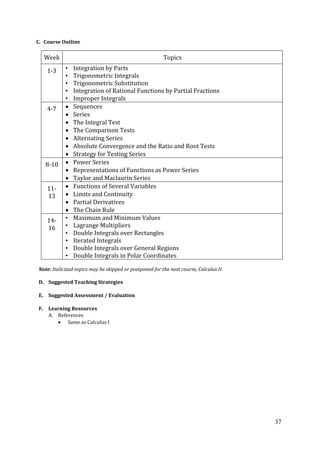
C. Course Outline
Week Topics
1-3 • Integration by Parts
• Trigonometric Integrals
• Trigonometric Substitution
• Integration of Rational Functions by Partial Fractions
• Improper Integrals
4-7 Sequences
Series
The Integral Test
The Comparison Tests
Alternating Series
Absolute Convergence and the Ratio and Root Tests
Strategy for Testing Series
8-10 Power Series
Representations of Functions as Power Series
Taylor and Maclaurin Series
11-
13
Functions of Several Variables
Limits and Continuity
Partial Derivatives
The Chain Rule
14-
16
• Maximum and Minimum Values
• Lagrange Multipliers
• Double Integrals over Rectangles
• Iterated Integrals
• Double Integrals over General Regions
• Double Integrals in Polar Coordinates
Note: Italicized topics may be skipped or postponed for the next course, Calculus II.
D. Suggested Teaching Strategies
E. Suggested Assessment / Evaluation
F. Learning Resources
A. References
Same as Calculus I
38
CALCULUS III
A. Course Details
COURSE NAME Calculus III
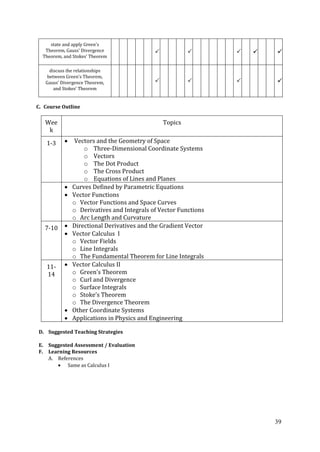
COURSE DESCRIPTION This course covers vectors in the plane and in space, vector-valued
functions, and the calculus of vector fields.
NUMBER OF UNITS 3 units (Lec)
PREREQUISITE Calculus II
B. Course Outcome and Relationship to Program Outcome
COURSE OUTCOMES PROGRAM OUTCOME
At the end of this course, the
students should be able to:
a b c d e f g h i j k l m n o p q r s t u
define vectors and perform
algebraic operations involving
vectors
   
graphically represent vectors in
two- or three-dimensions     
graph lines and planes, given
their equations, and determine
the equations describing given
lines and planes.
      
sketch graphs of parametric
curves      
use vector functions to
represent curves and motion in
the plane and in space
     
define the curvature and
geometry of plane and space
curves
   
define the directional derivative
and the gradient vector    
define a vector field, its
divergence, and curl    
perform a combination of
gradient, divergence or curl
operations on fields
     
evaluate line and surface
integrals      
39
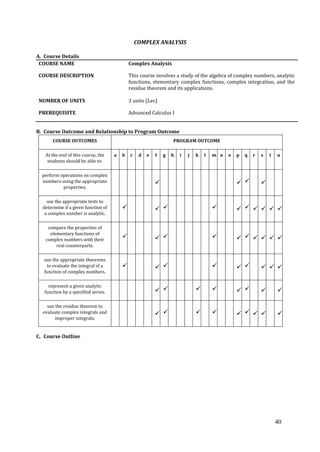
state and apply Green's
Theorem, Gauss' Divergence
Theorem, and Stokes' Theorem
    
discuss the relationships
between Green's Theorem,
Gauss' Divergence Theorem,
and Stokes' Theorem
   
C. Course Outline
Wee
k
Topics
1-3 Vectors and the Geometry of Space
o Three-Dimensional Coordinate Systems
o Vectors
o The Dot Product
o The Cross Product
o Equations of Lines and Planes
Curves Defined by Parametric Equations
Vector Functions
o Vector Functions and Space Curves
o Derivatives and Integrals of Vector Functions
o Arc Length and Curvature
7-10 Directional Derivatives and the Gradient Vector
Vector Calculus I
o Vector Fields
o Line Integrals
o The Fundamental Theorem for Line Integrals
11-
14
Vector Calculus II
o Green’s Theorem
o Curl and Divergence
o Surface Integrals
o Stoke’s Theorem
o The Divergence Theorem
Other Coordinate Systems
Applications in Physics and Engineering
D. Suggested Teaching Strategies
E. Suggested Assessment / Evaluation
F. Learning Resources
A. References
Same as Calculus I
40
COMPLEX ANALYSIS
A. Course Details
COURSE NAME Complex Analysis
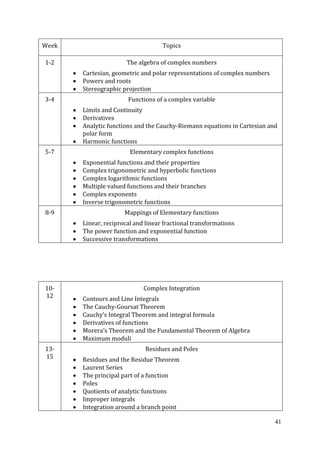
COURSE DESCRIPTION This course involves a study of the algebra of complex numbers, analytic
functions, elementary complex functions, complex integration, and the
residue theorem and its applications.
NUMBER OF UNITS 3 units (Lec)
PREREQUISITE Advanced Calculus I
B. Course Outcome and Relationship to Program Outcome
COURSE OUTCOMES PROGRAM OUTCOME
At the end of this course, the
students should be able to:
a b c d e f g h i j k l m n o p q r s t u
perform operations on complex
numbers using the appropriate
properties.
   
use the appropriate tests to
determine if a given function of
a complex number is analytic.
         
compare the properties of
elementary functions of
complex numbers with their
real counterparts.
         
use the appropriate theorems
to evaluate the integral of a
function of complex numbers.
        
represent a given analytic
function by a specified series.        
use the residue theorem to
evaluate complex integrals and
improper integrals.
        
C. Course Outline
41
Week Topics
1-2 The algebra of complex numbers
Cartesian, geometric and polar representations of complex numbers
Powers and roots
Stereographic projection
3-4 Functions of a complex variable
Limits and Continuity
Derivatives
Analytic functions and the Cauchy-Riemann equations in Cartesian and
polar form
Harmonic functions
5-7 Elementary complex functions
Exponential functions and their properties
Complex trigonometric and hyperbolic functions
Complex logarithmic functions
Multiple valued functions and their branches
Complex exponents
Inverse trigonometric functions
8-9 Mappings of Elementary functions
Linear, reciprocal and linear fractional transformations
The power function and exponential function
Successive transformations
10-
12
Complex Integration
Contours and Line Integrals
The Cauchy-Goursat Theorem
Cauchy’s Integral Theorem and integral formula
Derivatives of functions
Morera’s Theorem and the Fundamental Theorem of Algebra
Maximum moduli
13-
15
Residues and Poles
Residues and the Residue Theorem
Laurent Series
The principal part of a function
Poles
Quotients of analytic functions
Improper integrals
Integration around a branch point
42
D. Suggested Teaching Strategies
E. Suggested Assessment / Evaluation
F. Learning Resources
A. References
Pennisi. Elements of Complex Variables
Churchill, Brown, and Verhey. Complex Variables and Applications
Lang. Complex Analysis
Spiegel. Theory and Problems of Complex Variables
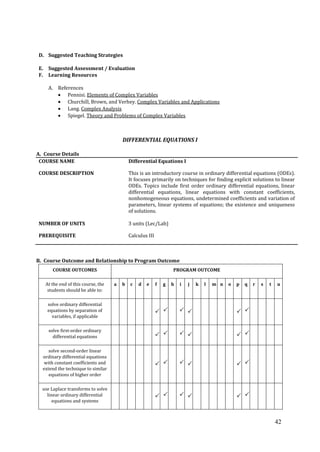
DIFFERENTIAL EQUATIONS I
A. Course Details
COURSE NAME Differential Equations I
COURSE DESCRIPTION This is an introductory course in ordinary differential equations (ODEs).
It focuses primarily on techniques for finding explicit solutions to linear
ODEs. Topics include first order ordinary differential equations, linear
differential equations, linear equations with constant coefficients,
nonhomogeneous equations, undetermined coefficients and variation of
parameters, linear systems of equations; the existence and uniqueness
of solutions.
NUMBER OF UNITS 3 units (Lec/Lab)
PREREQUISITE Calculus III
B. Course Outcome and Relationship to Program Outcome
COURSE OUTCOMES PROGRAM OUTCOME
At the end of this course, the
students should be able to:
a b c d e f g h i j k l m n o p q r s t u
solve ordinary differential
equations by separation of
variables, if applicable
     
solve first-order ordinary
differential equations      
solve second-order linear
ordinary differential equations
with constant coefficients and
extend the technique to similar
equations of higher order
     
use Laplace transforms to solve
linear ordinary differential
equations and systems
     
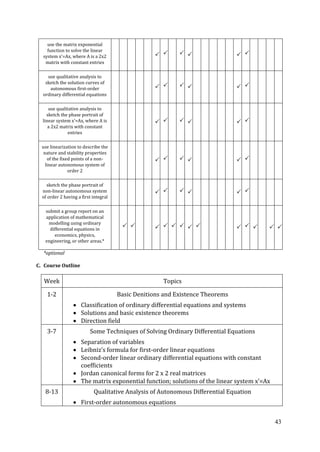
43
use the matrix exponential
function to solve the linear
system x'=Ax, where A is a 2x2
matrix with constant entries
     
use qualitative analysis to
sketch the solution curves of
autonomous first-order
ordinary differential equations
     
use qualitative analysis to
sketch the phase portrait of
linear system x'=Ax, where A is
a 2x2 matrix with constant
entries
     
use linearization to describe the
nature and stability properties
of the fixed points of a non-
linear autonomous system of
order 2
     
sketch the phase portrait of
non-linear autonomous system
of order 2 having a first integral
     
submit a group report on an
application of mathematical
modelling using ordinary
differential equations in
economics, physics,
engineering, or other areas.*
            
*optional
C. Course Outline
Week Topics
1-2 Basic Denitions and Existence Theorems
Classification of ordinary differential equations and systems
Solutions and basic existence theorems
Direction field
3-7 Some Techniques of Solving Ordinary Differential Equations
Separation of variables
Leibniz’s formula for first-order linear equations
Second-order linear ordinary differential equations with constant
coefficients
Jordan canonical forms for 2 x 2 real matrices
The matrix exponential function; solutions of the linear system x’=Ax
8-13 Qualitative Analysis of Autonomous Differential Equation
First-order autonomous equations
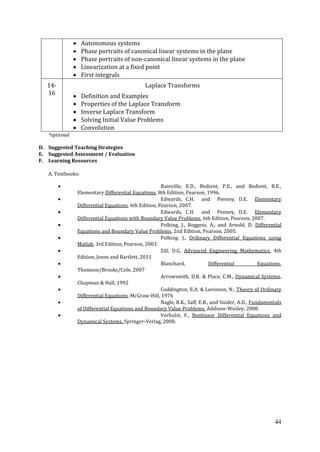
44
Autonomous systems
Phase portraits of canonical linear systems in the plane
Phase portraits of non-canonical linear systems in the plane
Linearization at a fixed point
First integrals
14-
16
Laplace Transforms
Definition and Examples
Properties of the Laplace Transform
Inverse Laplace Transform
Solving Initial Value Problems
Convolution
*optional
D. Suggested Teaching Strategies
E. Suggested Assessment / Evaluation
F. Learning Resources
A. Textbooks:
Rainville, E.D., Bedient, P.E., and Bedient, R.E.,
Elementary Differential Equations, 8th Edition, Pearson, 1996.
Edwards, C.H. and Penney, D.E. Elementary
Differential Equations, 6th Edition, Pearson, 2007.
Edwards, C.H. and Penney, D.E. Elementary
Differential Equations with Boundary Value Problems, 6th Edition, Pearson, 2007.
Polking, J., Boggess, A., and Arnold, D. Differential
Equations and Boundary Value Problems, 2nd Edition, Pearson, 2005.
Polking. J., Ordinary Differential Equations using
Matlab, 3rd Edition, Pearson, 2003.
Zill, D.G, Advanced Engineering Mathematics, 4th
Edition, Jones and Bartlett, 2011
Blanchard, Differential Equations,
Thomson/Brooks/Cole, 2007
Arrowsmith, D.K. & Place, C.M., Dynamical Systems,
Chapman & Hall, 1992
Coddington, E.A. & Levinson, N., Theory of Ordinary
Differential Equations, McGraw-Hill, 1976
Nagle, R.K., Saff, E.B., and Snider, A.D., Fundamentals
of Differential Equations and Boundary Value Problems, Addison-Wesley, 2000
Verhulst, F., Nonlinear Differential Equations and
Dynamical Systems, Springer-Verlag, 2000.
45
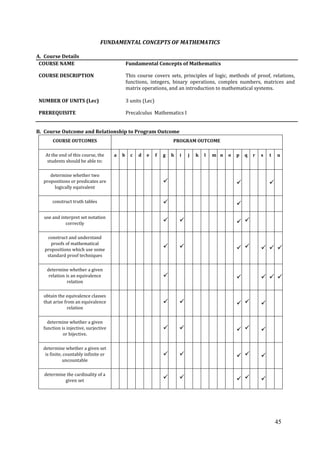
FUNDAMENTAL CONCEPTS OF MATHEMATICS
A. Course Details
COURSE NAME Fundamental Concepts of Mathematics
COURSE DESCRIPTION This course covers sets, principles of logic, methods of proof, relations,
functions, integers, binary operations, complex numbers, matrices and
matrix operations, and an introduction to mathematical systems.
NUMBER OF UNITS (Lec) 3 units (Lec)
PREREQUISITE Precalculus Mathematics I
B. Course Outcome and Relationship to Program Outcome
COURSE OUTCOMES PROGRAM OUTCOME
At the end of this course, the
students should be able to:
a b c d e f g h i j k l m n o p q r s t u
determine whether two
propositions or predicates are
logically equivalent
  
construct truth tables  
use and interpret set notation
correctly
   
construct and understand
proofs of mathematical
propositions which use some
standard proof techniques
      
determine whether a given
relation is an equivalence
relation
    
obtain the equivalence classes
that arise from an equivalence
relation
    
determine whether a given
function is injective, surjective
or bijective.
    
determine whether a given set
is finite, countably infinite or
uncountable
    
determine the cardinality of a
given set
    
46
C. Course Outline
Week Topics
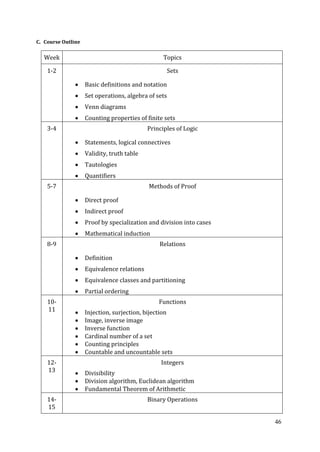
1-2 Sets
Basic definitions and notation
Set operations, algebra of sets
Venn diagrams
Counting properties of finite sets
3-4 Principles of Logic
Statements, logical connectives
Validity, truth table
Tautologies
Quantifiers
5-7 Methods of Proof
Direct proof
Indirect proof
Proof by specialization and division into cases
Mathematical induction
8-9 Relations
Definition
Equivalence relations
Equivalence classes and partitioning
Partial ordering
10-
11
Functions
Injection, surjection, bijection
Image, inverse image
Inverse function
Cardinal number of a set
Counting principles
Countable and uncountable sets
12-
13
Integers
Divisibility
Division algorithm, Euclidean algorithm
Fundamental Theorem of Arithmetic
14-
15
Binary Operations
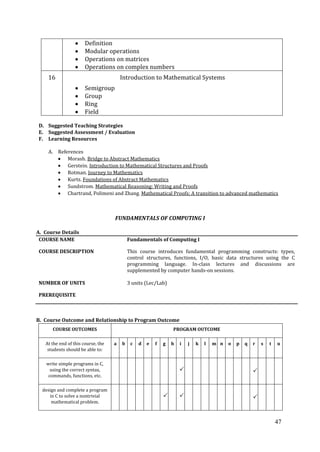
47
Definition
Modular operations
Operations on matrices
Operations on complex numbers
16 Introduction to Mathematical Systems
Semigroup
Group
Ring
Field
D. Suggested Teaching Strategies
E. Suggested Assessment / Evaluation
F. Learning Resources
A. References
Morash. Bridge to Abstract Mathematics
Gerstein. Introduction to Mathematical Structures and Proofs
Rotman. Journey to Mathematics
Kurtz. Foundations of Abstract Mathematics
Sundstrom. Mathematical Reasoning: Writing and Proofs
Chartrand, Polimeni and Zhang. Mathematical Proofs: A transition to advanced mathematics
FUNDAMENTALS OF COMPUTING I
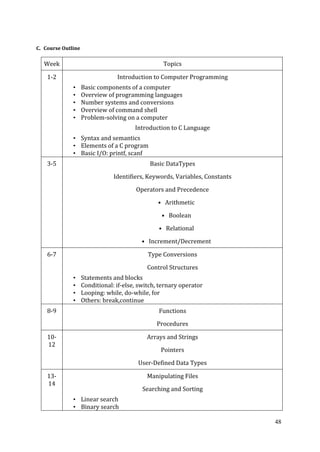
A. Course Details
COURSE NAME Fundamentals of Computing I
COURSE DESCRIPTION This course introduces fundamental programming constructs: types,
control structures, functions, I/O, basic data structures using the C
programming language. In-class lectures and discussions are
supplemented by computer hands-on sessions.
NUMBER OF UNITS 3 units (Lec/Lab)
PREREQUISITE
B. Course Outcome and Relationship to Program Outcome
COURSE OUTCOMES PROGRAM OUTCOME
At the end of this course, the
students should be able to:
a b c d e f g h i j k l m n o p q r s t u
write simple programs in C,
using the correct syntax,
commands, functions, etc.
 
design and complete a program
in C to solve a nontrivial
mathematical problem.
  
48
C. Course Outline
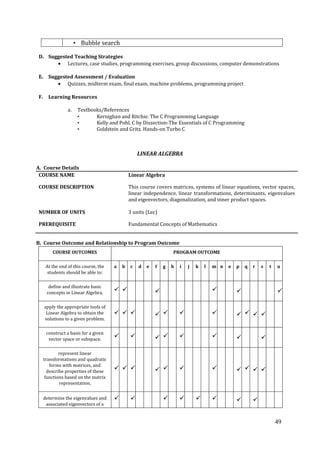
Week Topics
1-2 Introduction to Computer Programming
• Basic components of a computer
• Overview of programming languages
• Number systems and conversions
• Overview of command shell
• Problem-solving on a computer
Introduction to C Language
• Syntax and semantics
• Elements of a C program
• Basic I/O: printf, scanf
3-5 Basic DataTypes
Identifiers, Keywords, Variables, Constants
Operators and Precedence
• Arithmetic
• Boolean
• Relational
• Increment/Decrement
6-7 Type Conversions
Control Structures
• Statements and blocks
• Conditional: if-else, switch, ternary operator
• Looping: while, do-while, for
• Others: break,continue
8-9 Functions
Procedures
10-
12
Arrays and Strings
Pointers
User-Defined Data Types
13-
14
Manipulating Files
Searching and Sorting
• Linear search
• Binary search
49
• Bubble search
D. Suggested Teaching Strategies
Lectures, case studies, programming exercises, group discussions, computer demonstrations
E. Suggested Assessment / Evaluation
Quizzes, midterm exam, final exam, machine problems, programming project
F. Learning Resources
a. Textbooks/References
• Kernighan and Ritchie. The C Programming Language
• Kelly and Pohl. C by Dissection-The Essentials of C Programming
• Goldstein and Gritz. Hands-on Turbo C
LINEAR ALGEBRA
A. Course Details
COURSE NAME Linear Algebra
COURSE DESCRIPTION This course covers matrices, systems of linear equations, vector spaces,
linear independence, linear transformations, determinants, eigenvalues
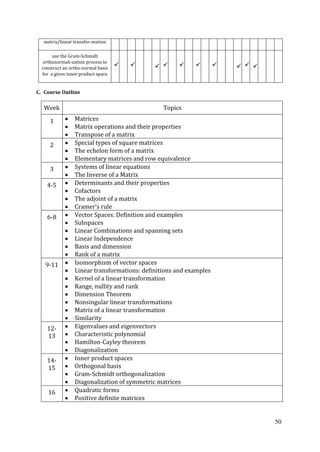
and eigenvectors, diagonalization, and inner product spaces.
NUMBER OF UNITS 3 units (Lec)
PREREQUISITE Fundamental Concepts of Mathematics
B. Course Outcome and Relationship to Program Outcome
COURSE OUTCOMES PROGRAM OUTCOME
At the end of this course, the
students should be able to:
a b c d e f g h i j k l m n o p q r s t u
define and illustrate basic
concepts in Linear Algebra.
     
apply the appropriate tools of
Linear Algebra to obtain the
solutions to a given problem.
          
construct a basis for a given
vector space or subspace.
       
represent linear
transformations and quadratic
forms with matrices, and
describe properties of these
functions based on the matrix
representation.
          
determine the eigenvalues and
associated eigenvectors of a
       
50
matrix/linear transfor-mation
use the Gram-Schmidt
orthonormali-zation process to
construct an ortho-normal basis
for a given inner product space
         
C. Course Outline
Week Topics
1 Matrices
Matrix operations and their properties
Transpose of a matrix
2 Special types of square matrices
The echelon form of a matrix
Elementary matrices and row equivalence
3 Systems of linear equations
The Inverse of a Matrix
4-5 Determinants and their properties
Cofactors
The adjoint of a matrix
Cramer’s rule
6-8 Vector Spaces: Definition and examples
Subspaces
Linear Combinations and spanning sets
Linear Independence
Basis and dimension
Rank of a matrix
9-11 Isomorphism of vector spaces
Linear transformations: definitions and examples
Kernel of a linear transformation
Range, nullity and rank
Dimension Theorem
Nonsingular linear transformations
Matrix of a linear transformation
Similarity
12-
13
Eigenvalues and eigenvectors
Characteristic polynomial
Hamilton-Cayley theorem
Diagonalization
14-
15
Inner product spaces
Orthogonal basis
Gram-Schmidt orthogonalization
Diagonalization of symmetric matrices
16 Quadratic forms
Positive definite matrices
51
D. Suggested Teaching Strategies
Lectures, exercises, group discussion, individual inquiry
E. Suggested Assessment / Evaluation
Quizzes, long exams, midterm, final exam, exploration (real-life application of linear algebra)
F. Learning Resources
A. References
Kolman. Elementary Linear Algebra
Finkbeiner. Introduction to Matrices and Linear Transformations
Herstein. Topics in Algebra
Lang. Linear Algebra
MODERN GEOMETRY (EUCLIDEAN AND NON-EUCLIDEAN GEOMETRY)
A. Course Details
COURSE NAME Modern Geometry (Euclidean and Non-Euclidean Geometry)
COURSE DESCRIPTION The first part of the course focuses on Euclidean and affine geometry on
the plane. The second half may continue with Euclidean geometry on the
sphere; alternatively, an introduction to finite geometries and to the non-
Euclidean hyperbolic and elliptic geometries may be given. This course
interrelates and makes use of tools from Geometry, Linear Algebra and
Abstract Algebra.
NUMBER OF UNITS 3 units (Lec)
PREREQUISITE Linear Algebra and Abstract Algebra I
B. Course Outcome and Relationship to Program Outcome
COURSE OUTCOMES PROGRAM OUTCOME
At the end of this course, the
students should be able to:
a b c d e f g h i j k l m n o p q r s t u
prove geometric statements
using a variety of methods (e.g.
synthetic, analytic) with
appropriate logical arguments
and mathematical rigor.
     
identify desirable features of
axiomatic and deductive
systems such as consistency
and completeness.
     
describe the basic
transformations (e.g. Euclidean,
affine, orthogonal)
     
explain the significance of
Euclid’s Fifth Postulate and
     
52
construct equivalent statements
describe some models of non-
euclidean geometries and finite
geometries
     
identify properties of small
finite geometries
     
evaluate the role and
contributions of geometry to
mathematics, culture and
society
       
C. Course Outline
Week Topics
1-5 A. Plane Euclidean Geometry
Review
o Coordinate Plane
o The Vector Space R2
o The Inner-Product Space R2
o The Euclidean Plane E2
Lines
Orthonormal pairs
Equation of a line
Perpendicular lines
Parallel and intersecting lines
Reflections
Congruence and isometries
Symmetry groups
Translations, Rotations, Glide reflections
Structure of the isometry group
Fixed points and fixed lines of isometries
6-8 B. Affine Transformations in the Euclidean Plane*
Affine transformations
Fixed lines
The 2-dimensional affine group
53
Fundamental theorem of affine geometry
Affine reflections
Shears
Dilatations
Similarities
Affine symmetries
9-11 C. Geometry on the Sphere*
Preliminaries from 3-dimensional Euclidean space
The cross-product
Orthogonal bases
Planes
Incidence geometry of the sphere
The triangle inequality
Parametric representation of lines
Perpendicular lines
Motions of the sphere
Orthogonal transformations of Euler’s theorem
Isometries
Fixed points and fixed lines of isometries
9-11 D. Finite Geometries*
Introduction to finite geometries
o Axiomatic systems
o Four-line and four point geometries
Finite geometries of Fano and Young
Finite geometries of Pappus and Desargues
Finite geometries as linear spaces
a. Near-linear and linear spaces
b. Incidence matrices
c. Numerical properties
Finite projective planes and projective spaces
Finite affine spaces
12-16 E. Non-euclidean geometries
54
Euclid’s Fifth Postulate
Introduction to hyperbolic geometry
o Fundamental postulate of hyperbolic geometry
o Ideal points and omega triangles
o Quadrilaterals and triangles
Introduction to elliptic geometry
o Characteristic postulate of elliptic geometry
o Quadrilaterals and triangles
Note: Two of the three main topics in weeks 6 to 11 may be chosen. Italicized items are optional.
D. Suggested Teaching Strategies
E. Suggested Assessment / Evaluation
Group project
F. Learning Resources
A. References
Ryan. Euclidean and Non-Euclidean Geometry (for weeks 1, 2 and 3)
Wald. Geometry: An Introduction
Greenberg. Euclidean and Non–Euclidean Geometries: Development & History
Batten, Combinatorics of Finite Geometries (for week 4)
Smart, Modern Geometries (for week 5)
MODERN GEOMETRY (PROJECTIVE GEOMETRY)
A. Course Details
COURSE NAME Modern Geometry (Projective Geometry)
COURSE DESCRIPTION This course covers projective planes, projectivities, analytic projective
geometry, cross ratio and harmonic sequences, geometric
transformations, and isometries.
NUMBER OF UNITS 3 units (Lec)
PREREQUISITE Linear Algebra
B. Course Outcome and Relationship to Program Outcome
COURSE OUTCOMES PROGRAM OUTCOME
At the end of this course, the
students should be able to:
a b c d e f g h i j k l m n o p q r s t u
show how projective geometry
relates to Euclidean geometry
    
describe the properties of
projective geometry and
projective planes
    
illustrate the principle of     
55
duality
define the terms “point at
infinity (or ideal point)” and
“line at infinity.”
    
outline the proofs and
consequences of the theorems
of Pappus and Desargues
    
illustrate the concepts of
“perspective from a line” and
“perspective from a point”
    
compute the cross ratio and
illustrate its projective
invariance
  
illustrate harmonic sets,
harmonic conjugates and
complete quadrangles
  
work effectively with
homogeneous coordinates
  
C. Course Outline
Week Topics
1 Introduction and Historical Background
From Euclidean geometry to non-Euclidean geometry
Some geometries: hyperbolic, elliptic, inversive and projective
2-3 The Projective Plane
Axioms of the projective plane
Principle of duality
Number of points/lines n a finite projective plane
Applications
4-5 Triangles and Quadrangles
Definitions
Desarguesian plane
Harmonic sequence of points/lines
6-7 Projectivities
Central perspectivity
Projectivity
56
Fundamental theorem of projective geometry
Theorem of Pappus
8-9 Analytic Projective Geometry
Projective plane determined by a three-dimensional vector space over
a field
Homogeneous coordinates of points/lines
Line determined by two points
Point determined by two lines
Collinearity, concurrency
10-
11
Linear Independence of Points/Lines
Definition
Analytic proof of some theorems like Desargues’ Theorem
12 The Real Projective Plane
Ideal points
Ideal line
13 Matrix Representation of Projectivities
Derivation of matrix representation
Fundamental theorem of projective geometry (analytic approach)
14 Geometric Transformations*
Affine transformations and the affine plane
Similarity transformation
Homothetic transformation
15-
16
Isometries*
Types of isometries
Products of isometries
Application of isometries to the solution of some geometric problems
*If time permits
D. Suggested Teaching Strategies
E. Suggested Assessment / Evaluation
F. Learning Resources
A. References
Coxeter and Greitzer. Geometry Revisited
Smart. Modern Geometry
Hughes and Piper. Projective Planes
57
PRECALCULUS MATHEMATICS I (COLLEGE ALGEBRA)
A. Course Details
COURSE NAME Precalculus Mathematics I (College Algebra)
COURSE DESCRIPTION This course covers the real number system, algebraic expressions, the
one- and two-dimensional coordinate systems, functions, equations and
inequalities, word problems and variations.
NUMBER OF UNITS (Lec) 3 units (Lec)
PREREQUISITE None
B. Course Outcome and Relationship to Program Outcome
COURSE OUTCOMES PROGRAM OUTCOME
At the end of this course, the
students should be able to:
a b c d e f g h i j k l m n o p q r s t u
define, give examples and
perform the fundamental
operations on sets and real
numbers.
    
add, subtract, multiply, divide
and factor algebraic
expressions.
   
solve linear and quadratic
equations and inequalities.
   
solve word problems involving
on equations and inequalities.
          
identify relations which are
functions.
     
determine the domain, range,
inverse and graph of a given
function.
   
solve exponential and
logarithmic equations.
    
recognize arithmetic
progressions and geometric
progressions.
   
58
C. Course Outline
Week Topics
1 Sets
Definitions and basic notations
Subsets and counting
Operations on sets
2 Number Systems
Counting Numbers
Integers
Rational and irrational numbers
Real numbers and their properties
3-4 Algebraic Expressions
Definitions of terms
Addition and subtraction of algebraic expressions
Multiplication and division of algebraic expressions
Special products
Factors and factoring
5-6
(4
hours)
Rational Expressions
Simplication of rational expressions
Addition and subtraction of rational expressions
Multiplication and division of rational expressions
Complex fractions
6-7
(4
hours)
Radicals
Integral and zero exponents
Rational exponents
Simplication of radicals
Addition and subtraction of radicals
Multiplication and division of radicals
8 The Coordinate Systems
Order axioms for the real numbers
1-dimensional coordinate system
2-dimensional coordinate system
The distance formula
Definition and formula for the slope
9
(4
hours)
Functions and Relations
Basic definitions
Domain and range
Graphical representations of functions and relations
Definition and graph of linear functions
10-12 Solutions of Equations and Associated Word Problems
Solutions of linear equations
59
Solutions of quadratic equations
Relations between the zeros and the coefficients of quadratic
equations
Equations containing radicals
Equations in quadratic form
Theorems on roots of equations (Factor Theorem, Rational Root
Theorem, etc.)
Polynomial equations
Systems of two and three linear equations
Systems of one linear and one quadratic equations
13 Inequalities
Solving linear inequalities
Solving nonlinear inequalities
Inequalities with absolute values
Graphical solution of inequalities in two variables
14 The Exponential and Logarithmic Functions
Exponential functions
Logarithmic functions
15 Variations and Progressions
Variation
Arithmetic progression
Geometric progression
D. Suggested Teaching Strategies
E. Suggested Assessment / Evaluation
F. Learning Resources
A. References
Leithold. College Algebra and Trigonometry
Vance. Modern College Algebra and Trigonometry
Reyes and Marasigan. College Algebra
Rees, Spark and Rees. College Algebra
PRECALCULUS MATHEMATICS II (TRIGONOMETRY)
A. Course Details
COURSE NAME Precalculus Mathematics II (Trigonometry)
COURSE DESCRIPTION This course covers circular functions, circular functions identities,
solutions of equations involving circular functions, inverse circular
functions, circular functions of angles, and applications of circular
functions.
NUMBER OF UNITS 3 units (Lec)
PREREQUISITE Precalculus Mathematics I
60
B. Course Outcome and Relationship to Program Outcome
COURSE OUTCOMES PROGRAM OUTCOME
At the end of this course, the
students should be able to:
a b c d e f g h i j k l m n o p q r s t u
perform trigonometric
computations with angles
measured in degrees and
radians.
 
recognize and verify the
trigonometric identities.       
prove the validity of
trigonometric equations by
means of the trigonometric
identities.
      
solve oblique triangles using
the laws of sine and cosine.        
model trigonometric functions
graphically.    
solve for an unknown angle
using inverse trigonometric
functions.
     
model exponential and
logarithmic functions
graphically.
    
solve exponential and
logarithmic applications.        
express complex numbers in
trigonometric form. 
perform mathematical
operations using complex
numbers.
  
C. Course Outline
Week Topics
1 Review of functions
Polynomial function
Exponential functions
Logarithmic functions
2 Angles and Circular Functions
61
Angles
The unit circle and arc length
The terminal point associated with an angle
Circular functions: the sine and cosine functions
Behavior of the sine and cosine functions
3 The Other Four Circular Functions
Definitions
The fundamental circular function identities
The values of the circular functions of special real numbers
4 Formulas Involving Circular Functions
Circular functions of sums and differences of real numbers
Double-angle and half-angle formulas
Conversions of sums and products
General reduction formulas
5 Graphs of the Circular Functions
6 Solving Equations Involving Circular Functions
7 Inverse Circular Functions
Review of inverse functions
Inverse circular functions
Operations involving inverse circular functions
8 The Law of Sines and the Law of Cosines
9 Applications
Solutions of right triangles
Solutions of oblique triangles
Complex numbers and the geometric use of numbers in complex
numbers
Powers and roots of complex numbers (De Moivre’s theorem)
Note: Precalculus Mathematics I and II may be offered as a one-semester 5-unit course with the descriptive
title: College Algebra and Trigonometry.
D. Suggested Teaching Strategies
E. Suggested Assessment / Evaluation
F. Learning Resources
A. References
Leithold. College Algebra and Trigonometry
Vance. Modern College Algebra and Trigonometry
62
REAL ANALYSIS
A. Course Details
COURSE NAME Real Analysis
COURSE DESCRIPTION This course provides an introduction to measure and integration theory.
It develops the theory of Lebesgue measure and integration over the
real numbers. The course covers topics like the real number system,
measurable functions, measurable sets, convergence theorems, integrals
of simple and nonnegative measurable functions, and Lebesgue integral.
NUMBER OF UNITS 3 units (Lec)
PREREQUISITE Advanced Calculus I
B. Course Outcome and Relationship to Program Outcome
COURSE OUTCOMES PROGRAM OUTCOME
At the end of this course, the
students should be able to:
a b c d e f g h i j k l m n o p q r s t u
demonstrate understanding of
inner and outer measure by
providing examples.
   
determine when a set or
function is measurable.
  


compare Riemann and
Lebesgue integration.
   
compute and solve Lebesgue
integrals
   
be familiar with the proof and
applications of Fatou’s Lemma
and other convergence
theorems.
  


C. Course Outline
Week Topics
1 Introduction
Comparison between Lebesgue and Riemann integral
Countable and uncountable sets
The extended real number system
Infinite limits of sequences
63
2 Measurable functions Integral
Measurable sets
Measurable functions
3 Measures
Lebesgue measure
Measure spaces
4 Integrals
Simple functions and their integrals
The integral of a non-negative extended real-valued measurable
function
The monotone convergence theorem
Fatou’s lemma and properties of integrals
5 Integrable functions
Integrable real-valued functions
The positivity and linearity of the integral
The Lebesgue dominated convergence theorem
6 Modes of convergence
Relations between convergence in mean
Uniform convergence
Almost everywhere convergence
Convergence in measure
Almost uniform convergence
Egoroff’s Theorem
Vitali Convergence Theorem
7 The Lebesgue spaces Lp
Normed linear spaces
The Lp spaces
Holder’s inequality
The completeness theorem
The Riesz’s representation theorem for Lp
Note: Italicized items are optional topics.
D. Suggested Teaching Strategies
E. Suggested Assessment / Evaluation
F. Learning Resources
A. References
Bartle. Elements of Integration and Lebesque Measure
Chae and Soo Bong . Lebesgue Integration
Royden. Real Analysis
64
PROBABILITY
A. Course Details
COURSE NAME Probability
COURSE DESCRIPTION This is an introductory course in probability covering axiomatic
probability space, discrete and continuous random variables, special
distributions, mathematical expectation, conditional probability and
independence, multivariate distributions, Laws of Large Numbers, and
the Central Limit Theorem.
NUMBER OF UNITS 3 units (Lec)
PREREQUISITE Differential and Integral Calculus, Set Theory
COREQUISITE Calculus III (Multivariate Calculus)
B. Course Outcome and Relationship to Program Outcome
COURSE OUTCOMES PROGRAM OUTCOME
At the end of this course, the
students should be able to:
a b c d e f g h i j k l m n o p q r s t u
define basic terms in
probability 
perform and compute
probabilities from experiments
 
define and give examples of
mutually exclusive events and
independent events
 
define a random variable and
explain its usefulness in
computing probabilities of
events

enumerate the properties of a
cumulative distribution
function and probability
distribution function
 
derive the probability
distribution function from the
cumulative distribution
function and vice versa

name some commonly used
special discrete and continuous
distributions and their
properties
 
give examples of experiments
yielding special distributions

65
compute probabilities, means,
and variances of special
probability distributions

derive the distribution of a
function of random variables
using different techniques
  
explain the notion of a random
vector
 
explain and give the properties
of a joint cumulative
distribution function and joint
probability distribution
 
derive conditional distributions
and marginal distributions
 
explain and show independence
of random variables
   
compute mathematical and
conditional expectations
involving functions of a random
vector
 
construct sampling
distributions and compute their
means and variances
 
explain the law of large
numbers and the Central Limit
Theorem
  
discuss the importance of the
Central Limit Theorem
 
C. Course Outline
Week Topics
1-2 Probability
Sample spaces and events
Methods of assigning probabilities
Axiomatic approach to probability
Calculating probabilities
Conditional probability and independence
Bayes’ rule
3-5 Random Variables, Distribution Functions and Expectation
Random variables
Distribution functions- definition and properties
66
Discrete and continuous random variables
Mathematical Expectation
6-8 Some Special Distributions
Discrete probability distributions-uniform, Bernoulli/binomial,
Poisson, hypergeometric, and negative binomial/geometric
distributions
Continuous probability distributions: uniform, normal/standard
normal, gamma/exponential, Beta, Weibull, Cauchy
9-10 Functions Of Random Variables
Mathematical formulation
Distribution of a function of random variables-CGF technique, MGF
technique, method of transformations
Expectation of functions of random variables
11-12 Joint and Marginal Distributions
The notion of a random vector
Joint distribution functions
Marginal distributions
Mathematical expectations
13-14 Conditional Distribution and Stochastic Independence
Conditional distributions
Stochastic independence
Mathematical expectation
15-16
4
hours
Sampling and Sampling Distributions
16-17
4
hours
Laws of Large Numbers and the Central Limit Theorem
D. Suggested Teaching Strategies
Lecture, discussion, exercises (seatwork, boardwork, assignments, recitation, group work)
E. Suggested Assessment / Evaluation
Class participation (recitations/ boarwork), Assignment, problem sets, quizzes, final exam
F. Learning Resources
A. References
Hogg, Craig and Mckean. Introduction to Mathematical Statistics
Larsen and Marx. Introduction toMathematical Statistics and Its Applications
Mood, Graybill and Boes. Introduction to the Theory of Statistics
Ross. A First Course in Probability
67
STATISTICS
A. Course Details
COURSE NAME Statistics
COURSE DESCRIPTION This course is an introduction to statistics and data analysis. It covers the
following: reasons for doing Statistics, collection, summarization and
presentation of data, basic concepts in probability, point and interval
estimation, and hypothesis testing.
NUMBER OF UNITS 3 units (Lec/Lab)
PREREQUISITE PREREQUISITE
B. Course Outcome and Relationship to Program Outcome
COURSE OUTCOMES PROGRAM OUTCOME
At the end of this course, the
students should be able to:
a b c d e f g h i j k l m n o p q r s t u
demonstrate knowledge of the
basic terms, concepts and
procedures in statistics;


use appropriate methods of
data collection and
presentation;
 
     
summarize data using different
numerical measures
          
demonstrate knowledge of the
basic terms, concepts and
procedures in statistics;


use appropriate methods of
data collection and
presentation;
       
apply rules of probability in
handling probability sampling
distributions;
       
make inferences about the
mean and proportion of one
and two populations using
sample information through
estimation and hypothesis
testing;
      

  
investigate the linear
relationship between two
variables by measuring the
strength of association and
obtaining a regression equation
          
68
to describe the relationship
analyze data resulting from the
conduct of experiments
          
guard against misuses of
statistics 
  
C. Course Outline
Week Topics
1
(2
hours)
Introduction
Description and history of statistical science
Population and sample
2 Collection and Presentation of Data
Methods of data collection
Probability and non-probability sampling
Tabular and graphical presentations: frequency distribution, stem-
and-left display, cross tabulation, histogram
3 Measures of Central Tendency and Location
Arithmetic mean, median and mode
Percentiles
4 Measures of Dispersion and Skewness
Measures of absolute dispersion
Measures of relative dispersion
Measure of skewness
The boxplot
5 Probability
Random experiments, sample spaces, events
Properties of probability
6-7
(5
hours)
Probability Distributions
Concept of a random variable
Discrete and continuous probability distributions
Expected values
The normal distribution
Other common distributions
8 Sampling Distributions
9-10 Estimation
Basic concepts of estimation
Estimating the mean
Estimating the difference of two means (optional)
69
Estimating proportions
Estimating the difference of two proportions (optional)
Sample size determination
11-13
(8
hours)
Tests of Hypothesis
Basic concepts of statistical hypothesis testing
Testing a hypothesis on the population mean
Testing a hypothesis on the population proportion
Testing the difference of two means
Testing the difference of two proportions
Test of independence
13-15
(8
hours)
Regression and Correlation
The correlation coefficient
Testing a hypothesis on the correlation coefficient
Simple linear regression
16 Analysis of Variance
D. Suggested Teaching Strategies
Lecture, discussion, exercises, computer laboratory sessions, individual inquiry
E. Suggested Assessment / Evaluation
Quizzes, final exam, individual/group reports, problem sets
F. Learning Resources
A. References
Hayter, A. (2002). Probability and Statistics for Engineers and Scientists (2nd edition).
CA: Duxbury.
Levine, Berenson & Stephan (2002). Statistics for Managers Using Microsoft Excel (3rd
edition). Upper Saddle River, NJ: Prentice Hall
Mann, P. (2010). Introductory Statistics (7th edition). Hoboken, NJ: Wiley.
Mendenhall, Beaver & Beaver (2009). Introduction to Probability and Statistics (13th edition).
Belmont, CA: Thomson/Brooke/Cole.
Walpole, Myers, Myers & Ye (2005). Probability and Statistics for Engineers and Scientists
(7th edition). Singapore: Pearson Education (Asia).
TOPOLOGY
A. Course Details
COURSE NAME Topology
COURSE DESCRIPTION This course is an introduction to topology. It includes topics
fundamental to modern analysis and geometry like topological spaces
and continuous functions, connectedness, compactness, countability
axioms, and separation axioms.
NUMBER OF UNITS 3 units (Lec)
PREREQUISITE Advanced Calculus I
B. Course Outcome and Relationship to Program Outcome
70
COURSE OUTCOMES PROGRAM OUTCOME
At the end of this course, the
students should be able to:
a b c d e f g h i j k l m n o p q r s t u
Determine whether a collection
of subsets of a set determines a
topology.
   
Prove that certain subsets of
Euclidean space are
topologically equivalent.
    
Understand notion of
connectedness and be familiar
with some standard
applications
    
Use the definitions of the
subspace, product, and
quotient topologies to prove
their properties and be familiar
with standard examples.
    
Recognize when a topological
space is compact and be
familiar with basic properties of
compact spaces.
    
Develop the concept of metric
spaces.
    
Recognize when a topological
space is connected and be
familiar with basic properties of
connected sets.
    
Demonstrate understanding of
countability and separation
axioms and illustrate their uses.
    
C. Course Outline
Week Topics
1 Review of Fundamental Concepts of Set Theory and Logic
2 Topological Spaces and Continuous Functions
Topological spaces
Basis for a topology
Continuous functions and homeomorphisms
71
Construction of subspace, product, quotient, and sum topologies
Closed sets and limit points
The metric topology and the metrization problem
3 Connectedness and Compactness
Connected spaces
Connected sets in the real line
Compact spaces
Tychonoff’s Theorem
Compact sets in the real line
Limit point compactness
4 Countability and Separation Axioms
The countability axioms
The separation of axioms and characterization of various spaces
The Urysohn Lemma: Tietze Extension Theorem
The Urysohn Metrization Theorem
Note: Italicized items are optional topics.
D. Suggested Teaching Strategies
E. Suggested Assessment / Evaluation
F. Learning Resources
A. References
Munkres. Topology: A First Course
Simmons. Topology and Modern Analysis
Engelking and Sieklucki. Introduction to Topology
Jänich. Topology
Kahn. Topology, An Introduction to the Point-Set and Algebraic Areas
Dixmier. General Topology
DISCRETE MATHEMATICS
A. Course Details
COURSE NAME Discrete Mathematics
COURSE DESCRIPTION This is a course that covers the fundamentals of logic, proving, functions
and sets, basic counting techniques, and advanced counting techniques.
NUMBER OF UNITS 3 units (Lec)
PREREQUISITE Precalculus Mathematics I
72
B. Course Outcome and Relationship to Program Outcome
COURSE OUTCOMES PROGRAM OUTCOME
At the end of this course, the
students should be able to:
a b c d e f g h i j k l m n o p q r s t u
Translate mathematical
statements from common
English to formal logic and vice-
versa
     
Verify the validity of an
argument using rules of
inference
        
Identify the difference among
the various types of proof:
direct proof, proof by
contraposition, proof by
contradiction, and proof by
cases; and use an appropriate
method in proving
mathematical statements.
       
Use the proper notations on
sets and functions and perform
operations on them
  
Apply the basic and advanced
counting techniques to solve
counting problems
       
Solve problems involving
recurrence relations, generating
functions and inclusion-
exclusion principle
          
C. Course Outline
Week Topics
1-3 Propositional Logic
Propositional Equivalences
Predicates and Quantifiers
Nested Quantifiers
Rules of Inference
4-7 Introduction to Proofs
Proof Methods and Strategy
Sets
Set Operations
Functions
73
8-11 Counting
The Basics of Counting
The Pigeonhole Principle
Permutations and Combinations
Binomial Coefficients
Generalized Permutations and Combinations
12-
15
Advanced Counting Techniques
Recurrence Relations
Solving Linear Recurrence Relations
Generating Functions
Inclusion-Exclusion Principle
D. Suggested Teaching Strategies
E. Suggested Assessment / Evaluation
F. Learning Resources
A. References
Rosen, K.H., Discrete Mathematics and Applications, 6th Edition, McGraw-Hill, 2007.
Grimaldi. R.P., Discrete and Combinatorial Mathematics, 5th Edition, Pearson, 2003.
Ross, K.A., Discrete Mathematics, 5th Edition, Pearson, 2002.
Johnsonbaugh. R., Discrete Mathematics, 7th Edition, Pearson, 2007.
FUNDAMENTALS OF COMPUTING II
A. Course Details
COURSE NAME Fundamentals of Computing II
COURSE DESCRIPTION This course covers advanced programming concepts and techniques
using Java, C++ or other suitable object-oriented programming
languages. Topics include recursion, abstract data types, advanced path
structures, programming interfaces, object-oriented programming,
inheritance, polymorphism, event handling, exception handling, API
programming. In-class lectures and discussions are supplemented by
computer hands-on sessions.
NUMBER OF UNITS 3 units (Lec/Lab)
PREREQUISITE Fundamentals of Computing I
B. Course Outcome and Relationship to Program Outcome
COURSE OUTCOMES PROGRAM OUTCOME
At the end of this course, the
students should be able to:
a b c d e f g h i j k l m n o p q r s t u
write simple programs using
the syntax, commands,
functions, etc, of the an object-
 
74
oriented programming
language.
design and complete a
programming project to
implement algorithms in
solving a nontrivial
mathematical problem.
  
C. Course Outline
Week Topics
1-2 The way of the program
• The Python programming language
• What is a program?
• What is debugging?
• Formal and natural language
Variables, expressions and statements
• Values and types
• Variables
• Variable names and keywords
• Statements
• Operators and operands
• Expressions
• Order of operations
• String operations
Functions
• Function calls
• Type conversion functions
• Math functions
• Composition
• Adding new functions
• Definitions and uses
• Flow of execution
• Parameters and argument
3-5 Conditionals and recursion
Modulus operator
Boolean expressions
Logical operators
Conditional execution
Alternative execution
Chained conditionals
Nested conditionals
Recursion
Stack diagrams for recursive functions
Infinite recursion
75
Keyboard input
Fruitful functions
Return values
Incremental development
Composition
Boolean functions
More recursion
Iteration
Multiple assignment
Updating variables
The while statement
Break
Strings
A string is a sequence
Traversal with a for loop
String slices
Strings are immutable
Searching
Looping and counting
String methods
The in operator
String comparison
6-8 Lists
A list is a sequence
Lists are mutable
Traversing a list
List operations
List slices
List methods
Map, filter and reduce
Deleting elements
Lists and strings
Objects and values
Aliasing
List arguments
Dictionaries
Dictionary as a set of counters
Looping and dictionaries
Reverse lookup
Dictionaries and lists
Memos
Global variables
Tuples
76
Tuples are immutable
Tuple assignment
Tuples as return values
Variable-length argument tuples
Lists and tuples
Dictionaries and tuples
Comparing tuples
Sequences of sequence
9-12 Files
Persistence
Reading and writing
Format operator
Filenames and paths
Catching exceptions
Databases
Pickling
Pipes
Writing modules
Classes and objects
User-defined types
Attributes
Rectangles
Instances as return values
Objects are mutable
Copying
Classes and functions
Time
Pure functions
Modifiers
Prototyping versus planning
Classes and methods
Object-oriented features
Printing objects
The init method
The str method
Operator overloading Type-based dispatch
Polymorphis
Inheritance
Card objects
Class attributes
Comparing cards
Decks
Printing the deck
Add, remove, shuffle and sort
77
Inheritance
Class diagrams
D. Suggested Teaching Strategies
E. Suggested Assessment / Evaluation
F. Learning Resources
A. References
Downey, Allen. Think Python. O’Reilly Media. 2012. Also accessible at
http://faculty.stedwards.edu/mikek/python/thinkpython.pdf
Zelle, John. Python Programming: An Introduction to Computer Science, 2nd Edition. Franklin,
Beedle and Associates Inc. 2010.
“The Python Tutorial”. Docs.Python.Org. October, 2013.
<docs.python.org/3/tutorial/index.html>
“Non-Programmer's Tutorial for Python 3”. Wikibooks. October, 2013 <
http://en.wikibooks.org/wiki/Non-Programmer%27s_Tutorial_for_Python_3>
NUMERICAL ANALYSIS
A. Course Details
COURSE NAME Numerical Analysis
COURSE DESCRIPTION This is an introductory course that covers error analysis, solutions of
linear and nonlinear equations and linear systems, interpolating
polynomials, numerical differentiation and integration, numerical
approximations of eigenvalues, and numerical solutions of ordinary
differential equations.
NUMBER OF UNITS 3 units (Lec/Lab)
PREREQUISITE Differential Equations I and Linear Algebra
B. Course Outcome and Relationship to Program Outcome
COURSE OUTCOMES PROGRAM OUTCOME
At the end of this course, the
students should be able to:
a b c d e f g h i j k l m n o p q r s t u
choose and use the appropriate
method to obtain a numerical
solution to a given
mathematical problem.
       
implement a specified
numerical method using
available software.
   
compute the error of the
estimate provided by a given
numerical method.

compare the accuracy of the
estimates provided by different
numerical methods for solving a
         
78
given problem.
discuss a real-life application of
a numerical method.
          
C. Course Outline
Time
Allotme
nt
Topics
2 hours Mathematical Preliminaries
Intermediate Value Theorem
Extreme Value Theorem
Rolle’s Theorem and the Mean Value Theorem
Taylor’s Theorem
4 hours Error Analysis and Computer Arithmetic
Floating point arithmetic
Error
Accuracy
Convergence of solutions
7 hours Solutions of Nonlinear Equations
Bracketing methods
Fixed Point methods
Newton’s method
Secant method
6 hours Solutions of Linear Systems
Gaussian elimination
LU-Decomposition
Gauss-Seidel method
Gauss-Jacobi method
8 hours Numerical Interpolation
Lagrange Interpolation
Divided differences
Interpolation at equally spaced points: Newton’s and Gauss’
formulas
Cubic splines
8 hours Numerical Differentiation and integration
Newton’s formulas
Finite differences
Trapezoidal rule
Simpson’s rules
Romberg integration
Gaussian integrals
79
8 hours Numerical Solutions of Ordinary Differential Equations
One-step methods
o Euler’s method
o Taylor series method
o Runge-Kutta methods
Multi-step methods
o Adams’ corrector-predictor formulas
o Milne’s method
5 hours Numerical Approximation of Eigenvalues and Eigenvectors
Power method
Inverse power and shifted power method
Rayleigh quotients
QR-Algorithm
D. Suggested Teaching Strategies
E. Suggested Assessment / Evaluation
F. Learning Resources
A. References
Atkinson. Elementary Numerical Analysis
Gerald and Wheatley. Applied Numerical Analysis
Kreysig. Advanced Engineering Mathematics
Sastry. Introductory Methods of Numerical Analysis
Scheid. Theory and Problems of Numerical Analysis
OPERATIONS RESEARCH I
A. Course Detail
COURSE NAME Operations Research I
COURSE DESCRIPTION This course is an introduction to linear programming. It covers basic
concepts, problem formulation, graphical solution for two-variable
problems, simplex algorithm and other algorithms for special LP
problems, duality and sensitivity analysis. In-class lectures and
discussions are supplemented by computer hands-on sessions.
NUMBER OF UNITS 3 units (Lec/Lab)
PREREQUISITE Linear Algebra
B. Course Outcome and Relationship to Program Outcome
COURSE OUTCOMES PROGRAM OUTCOME
At the end of this course, the
students should be able to:
a b c d e f g h i j k l m n o p q r s t u
determine appropriateness of
linear programming (LP)
modeling as framework to
     
80
investigate real-world problems
develop LP models that
consider key elements of real
world problems
     
solve the models for their
optimal solutions
    
interpret the models' solutions
and infer solutions to the real-
world problems
     
illustrate proficiency in the use
of the simplex method and its
variants and extensions
    
apply the principle of duality in
solving LP problems
    
demonstrate proficiency in
using appropriate mathematical
software in solving problems.
    
apply parametric and integer
programming whenever
appropriate.
     
develop a report that describes
the formulation of a model, its
solution, and analysis, with
recommendations in language
understandable to decision-
makers
        
C. Course Outline
Week Topics
1 Overview of Operations Research
Definition of OR
The general optimization problem
o Survey of applications and introduction to some classical LP
models
o The product mix problem
o The diet problem
o The transportation problem
o The fluid bending problem
o The caterer’s problem
81
2 Linear Programming (LP)
Definition of linear programming
Formulation of verbal problems into LPs
Assumptions/Limitations:
o Proportionality
o Additivity
o Divisibility
o Nonnegativity
o Certainty
o Single objective
3 Geometry of LP in Two Variables
Graphing of linear inequalities
The feasible region as a convex polyhedral area
Geometric interpretation of convex combination
The extreme points
The objective function as a family of parallel lines
4 Review of Linear Algebra
Systems of linear equations
Canonical forms
Basic solutions
Basic feasible solution
Degenerate solutions
Inconsistent systems
Pivoting as a sequence of elementary row operations or a sequence of
algebraic substitutions
5 Equivalent Formulations of an LP
The use of slacks and surpluses
How to handle variables with no sign restrictions
The symmetric forms
The standard form of an LP
The adjoined form
The canonical forms
The feasible canonical forms
Tableau conventions and notation
Conversion from maximization to minimization
6-7 The Simplex Algorithm
A simple illustration
The Fundamental Theorem of LP and its proof
Details of the algorithm
Possible entrance rules
82
The exit rule (minimum ratio test)
Test of optimality
Questions of uniqueness
The need for the nondegeneracy assumption
8 The Two-Phase Simplex Method
Artificial variables
Phase I as a test of feasibility
Phase I and algebraic redundancy
The Big M method
9 Revised Simplex Method
10 Duality in LP
The concept of duality
Dual linear programs in symmetric form
Duality theorems
Solving an LP problem from its dual
11 Sensitivity Analysis
12 Parametric Programming
13-14 Integer Programming
15 Special Purpose Algorithm
Transportation problem
Assignment problem
Maximal flow problem
Traveling salesman problem
16 Computer Applications
Note: Italicized items are optional topics.
D. Suggested Teaching Strategies
E. Suggested Assessment / Evaluation
F. Learning Resources
A. References
Taha. Operations Research: An Introduction
Gass. Linear Programming (Methods and Applications)
Gillet. Introduction to Operations Research
83
THEORY OF INTEREST
A. Course Details
COURSE NAME Theory of Interest
COURSE DESCRIPTION This course covers measures of interest, present and future values,
equations of value, annuity certains, general annuity certains, yield
rates, extinction of debts, and bonds and securities.
NUMBER OF UNITS 3 units (Lec/Lab)
PREREQUISITE Calculus III
B. Course Outcome and Relationship to Program Outcome
COURSE OUTCOMES PROGRAM OUTCOME
At the end of this course, the
students should be able to:
a b c d e f g h i j k l m n o p q r s t u
apply appropriate formulas,
concepts and procedures to
solve various investment
problems.
    
distinguish different types of
interest rates and how to use
these in finding the present
value or future value of an
investment. Moreover, learn
how to compare these rates to
make sound judgment as to
which rate gives the best
return.
      
recognize different types of
annuities and learn how to find
its value at the start, at the end
and on any date within or
outside its term.
     
learn to track the
growth/diminution of an
investment/a loan.
      
determine the value/price, as
well as the yield rate of
different types of financial
instruments like stocks and
bonds at different dates during
its term.
       
84
C. Course Outline
Time
Allotme
nt
Topics
6 hours Measures of Interest
Accumulation and amount functions
Simple and compound interest
Effective rate of interest
Present and future values
Nominal rates of interest and discount
Force of interest
4 hours Equations of Value
Present and future values
Current value equation
Unknown time and unknown interest rate
6 hours Annuity Certain
Annuity immediate
Annuity Due
6 hours General Annuities
Annuities payable less frequently than interest is convertible
Annuities payable more frequently than interest is convertible
Continuous annuities
Basic varying identities
More general varying identities
8 hours Yield Rates
Discounted cash flow analysis
Definition of yield rates
Uniqueness of the yield rate
Reinvestment rates
Interest measurement of a fund
Dollar-weighted rate of interest for a single period
Time-weighted rates of interest
Portfolio methods
Investment year methods
6 hours Extinction of debts
Loan extinction
Computation of the outstanding balance
Amortization method
Sinking fund method
85
10
hours
Bonds and Securities
Basic financial securities
Bonds and stocks
Price of a bond (FRANK formula)
Other formulas for the bond
Premium and discount
Valuation between coupon payment dates
Yield rates and the Bond Salesman’s Formula
Callable bonds
Serial bonds and stocks
D. Suggested Teaching Strategies
E. Suggested Assessment / Evaluation
Skills check (boardwork, quizzes, long exam), individual/group report, individual/group
project, final exam
F. Learning Resources
A. References
William Hart. Mathematics of Investment
Stephen Kellison. The Theory of Interest
Shao and Shao. Mathematics for Management and Finance

Sample-Curricula-Bachelor-of-Science-in-Mathematics.pdf

  • 1.
    SAMPLE OUTCOMES-BASED CURRICULUMFOR THE BACHELOR OF SCIENCE IN MATHEMATICS PROGRAM SPECIFICATIONS Section 1 Program Description 1.1 Degree Name The degree name shall be Bachelor of Science in Mathematics (BS Math) or Bachelor of Science in Applied Mathematics (BS Applied Math). 1.2 Nature of the Field of Study Mathematics is often described as the science of patterns. Mathematicians seek to discover, analyze and classify patterns in both abstract objects and natural phenomena. The traditional domains of study are quantity (arithmetic), structure (algebra), space (geometry) and change (analysis). Mathematics offers distinctive and powerful modes of thought such as abstraction, generalization, deduction, inference, use of symbols and the axiomatic method. Mathematical truth is established through logical analysis and proof. As a universal discipline it is rich in both theory and applications. Mathematics is used as an essential tool in many fields, including the natural sciences, engineering, medicine, finance and the social sciences. Apart from being the language of the physical sciences, mathematics shares much in common with the former, notably in the exploration of logical consequences of assumptions. Mathematics is also regarded as an art, having an aesthetic and creative side. The special role of mathematics in education (being part of the curricula from primary school to college) is a consequence of its foundational nature and universal applicability. Mathematicians engage in pure mathematics or mathematics for its own sake, without having, at least initially or intentionally, application or utility in mind. Applied mathematics, on the other hand, is the branch of mathematics concerned with application of mathematical theories and methods to other fields. Applied mathematicians are academics, researchers, or professionals who work on practical problems, often involving the formulation, analysis, and use of mathematical models. In turn, their work inspires and motivates new mathematical discoveries that may lead to the development of new mathematical disciplines, as in the case of operations research or game theory, or mathematics-based disciplines, such as statistics and finance. There is no clear line separating pure and applied mathematics. 5.3 Trends and Developments in Mathematics in the 21st Century The legacy of classical mathematical theory, discovery of modern mathematical theories and techniques, and emergence of efficient computing methods, robust symbolic mathematical software and
  • 2.
    2 powerful computers, havebroadened the landscape of mathematics and have led to many advancements in mathematics and science in general. Experimental and computational mathematics continue to grow in importance within mathematics. Computation, simulation and visualization are playing increasing roles in both science and mathematics. Mathematical theories and techniques have become essential in many areas, notably finance and the life sciences. The overlap between applied mathematics and statistics and other decision sciences has become more significant, especially with the recognition of the stochastic nature of varied phenomena. Mathematical models and quantitative methods are increasingly being used in many fields, and new and powerful models are needed to address global problems and issues like climate change, disaster mitigation, risk management, food, water, and population. 5.4 Program Goals The BS Math/ Applied Math graduates shall be equipped with enhanced mathematical and critical thinking skills. Graduates are expected to have developed deeper appreciation and understanding of the importance of mathematics in history and the modern world. They will be able do research or perform jobs that require analytical thinking and quantitative skills. The program provides students with substantial exposure to the breadth and depth of mathematics, from classical to contemporary, and from theoretical to applied. The curriculum covers foundational courses in core areas of mathematics/applied mathematics as well as advanced courses that will help prepares graduates to pursue higher studies or work in a variety of fields. 5.5 Professions/careers/occupations for BS Math/ Applied Math graduates Graduates of BS Math/ Applied Math often obtain jobs in education (teaching high school math courses or tertiary level elementary/service courses), statistics, actuarial science, operations research, risk management, business and economics, banking and finance, and computing and information technology. 5.6 Allied Fields Mathematics/ applied mathematics is closely related to the fields of statistics, physics, computer science, and engineering.
  • 3.
    3 Section 6 ProgramOutcomes The minimum standards for the Bachelor of Science in Mathematics/ Bachelor of Science in Applied Mathematics program are expressed in the following minimum set of learning outcomes: 6.1 Common to all baccalaureate programs in all types of institutions The graduates have the ability to: a) Articulate the latest developments in their specific field of practice. (PQF level 6 descriptor) b) Effectively communicate orally and in writing using both English and Filipino languages. c) Work effectively and independently in multi-disciplinary and multi- cultural teams. (PQF level 6 descriptor) d) Demonstrate professional, social, and ethical responsibility, especially in practicing intellectual property rights and sustainable development. e) Preserve and promote “Filipino historical and cultural heritage”(based on RA 7722). 6.2 Common to the Science and Mathematics Discipline f) Demonstrate broad and coherent knowledge and understanding in the core areas of physical and natural sciences. g) Apply critical and problem solving skills using the scientific method. h) Interpret relevant scientific data and make judgments that include reflection on relevant scientific and ethical issues. i) Carry out basic mathematical and statistical computations and use appropriate technologies in the analysis of data. j) Communicate information, ideas problems and solutions, both, orally and in writing, to other scientists, decision makers and the public. k) Relate science and mathematics to the other disciplines. l) Design and perform safe and responsible techniques and procedures in laboratory or field practices. m) Critically evaluate input from others. n) Appreciate the limitations and implications of science in everyday life. o) Commit to the integrity of data. 6.3 Specific to BS Math/ BS Applied Math p) Gain mastery in the core areas of mathematics: algebra, analysis, and geometry. q) Demonstrate skills in pattern recognition, generalization, abstraction, critical analysis, synthesis, problem-solving and rigorous argument. r) Develop an enhanced perception of the vitality and importance of mathematics in the modern world including inter-relationships within math and its connection to other disciplines. s) Appreciate the concept and role of proof and reasoning and demonstrate knowledge in reading and writing mathematical proofs.
  • 4.
    4 t) Make andevaluate mathematical conjectures and arguments and validate their own mathematical thinking. u) Communicate mathematical ideas orally and in writing using clear and precise language. 6.4 Common to a horizontal type as defined in CMO 46 s 2012 For professional institutions: a service orientation in one’s profession For colleges: an ability to participate in various types of employment, development activities, and public discourses particularly in response to the needs of the communities one serves For universities: an ability to participate in the generation of new knowledge or in research and development projects Graduates of state universities and colleges must, in addition, have the competencies to support “national, regional and local development plans” (RA 7722). The HEIs, at its option, may adopt mission-related program outcomes that are not included in the minimum set. Section 7 Sample Performance Indicators Performance indicators (PIs) assist in the evaluation of student learning or the achievement of the program outcomes. These are demonstrable traits developed not only through the core or discipline-specific courses but also more importantly through their collective experiences. To achieve the program outcomes, graduates of the BS Mathematics/ BS Applied Mathematics program are expected to possess a wide range of knowledge, values and skills. The performance indicators presented even for the baccalaureate and science and mathematics graduates are evaluated in the context of a BS Mathematics/ BS Applied Mathematics graduate. Graduates of all Baccalaureate Programs Program Outcomes Performance Indicators a) Articulate the latest developments in their specific field of practice. Participate in continuing education and professional development in the specific field of practice. b) Effectively communicate orally and in writing using both the English/Filipino language. Demonstrate effective oral and written communication using both English and Filipino languages. Exhibit adequate technical writing and oral communication abilities. c) Work effectively in multi- disciplinary and multi-cultural teams. Work effectively as a member of multi- disciplinary and multi-cultural teams. Display good judgment of people, actions and ideas and communicate them efficiently. Demonstrate effective leadership,
  • 5.
    5 coordination and decision-makingskills. Demonstrate productive project management skills. d) Demonstrate professional, social, and ethical responsibility, especially in practicing intellectual property rights. Articulate the contribution of one’s profession to society and nation building. Articulate the responsibilities of a Filipino citizen in relation to the rest of the world. Demonstrate respect for intellectual property rights. Explain professional knowledge and ethical responsibilities. e) Preserve and promote Filipino historical and cultural heritage based on RA 7722. Articulate one’s possible contributions to society and nation building. Graduates of Science and Mathematics Programs Program Outcomes Performance Indicators f) Demonstrate broad and coherent knowledge and understanding in the core areas of the physical and natural sciences and mathematics. Discuss extensively and articulate information in the core areas of science and mathematics. g) Apply critical and problem solving skills using the scientific method. Employ problem-solving skills using the scientific method. Demonstrate critical thinking skills in solving problems. Apply scientific reasoning. h) Interpret scientific data and reflect on relevant scientific and ethical issues. Recognize the importance of relevant scientific data. Summarize information using reflection on important scientific and ethical issues. i) Carry out basic mathematical and statistical computations and use appropriate technologies in the analysis of data. Perform appropriate suitable mathematical and statistical computations in data analysis. j) Communicate information, ideas problems and solutions both, orally and in writing, to other scientists, decision makers and the public. Demonstrate technical writing and public speaking abilities. Disseminate information, ideas, problems and solutions to fellow scientists, decision makers and the public. Participate actively in scientific forum and public discussions. k) Connect science and math to the other disciplines. Apply scientific advancements in ways that are meaningful to other disciplines. Propose solutions to environmental problems based on interdisciplinary knowledge. l) Design and perform techniques and procedures following safe and responsible laboratory or field practices. Practice responsible laboratory and field practices that follow proper techniques and procedures. Demonstrate precision in making
  • 6.
    6 observations and indistinguishing differences between samples and events. Employ appropriate and correct experimental design. Follow industry standards and national laws. m)Accepts and critically evaluates input from others. Discern significant inputs from other disciplines. Critically evaluate data and information. n) Appreciate the limitations and implications of science in everyday life. Acknowledge scientific facts as part of everyday life. o) Commit to the integrity of data. Adhere to data integrity. Report results and data as honestly as possible. Graduates of BS Mathematics/ Applied Mathematics Program Outcomes Performance Indicators p) Gain mastery in the core areas of mathematics: algebra, analysis, and geometry. Undertake an independent study of an unfamiliar topic and present an accurate and in-depth discussion of the results of the investigation both orally and in writing. Represent a given problem by a mathematical model and use this to obtain a solution to the given problem. q) Demonstrate skills in pattern recognition, generalization, abstraction, critical analysis, synthesis, problem-solving and rigorous argument. Apply the appropriate techniques in solving mathematical problems. Break down a complicated problem into simpler parts Adapt known methods and tools in solving new problems. r) Develop and enhance perception of the vitality and importance of mathematics in the modern world including inter-relationship within math and its connection to other disciplines. Discuss the mathematical concepts behind well-known solutions to real-life problems. Discuss important breakthroughs in the solution of real-world problems where mathematics played a significant role. s) Appreciate the concept and role of proof and reasoning and demonstrate knowledge in reading and writing mathematical proofs. Submit a paper or thesis that contains proofs of mathematical statements based on rules of logic. Assess the validity of the mathematical reasoning in the works of others and identify errors and gaps, if any. t) Make and evaluate mathematical conjectures and arguments and validate their own mathematical thinking. Given a true mathematical statement, questions and investigates truth of the converse or inverse statements. Able to propose conjectures, investigate their truth or falsity, and write rigorous proofs of the investigation.
  • 7.
    7 Given a survey,expository or research paper, is able to recreate proofs and arguments contained in the paper, provide examples or give illustrations, and propose generalizations of results. u) Communicate mathematical ideas orally and in writing using clear and precise language. Able to prepare a well-written research paper (thesis or special project paper) that organizes and presents a body of mathematics in a detailed, interesting and original manner. Able to give an oral presentation of results of the research paper before peers and teachers. ARTICLE V CURRICULUM Section 8 Curriculum Description The curriculum for the BS Math/BS Applied Math program is built around a traditional base of foundational and core courses in the major areas of mathematics and applied mathematics with the inclusion of specialized courses in mathematics, applied mathematics, relevant disciplines, and emerging areas. The recommended minimum set of courses as indicated in CMO 19 s. 2007 is retained in this PSG. Since the mathematics department of different schools will have their particular strengths and orientation, there is a provision for elective courses that will allow for flexibility and accommodate the department’s special interests. HEIs may offer courses beyond those specified in the recommended courses, according to their faculty expertise, institutional resources, and thrusts. A BS Mathematics/ BS Applied Mathematics program offering a minor or specialization must include at least 15 units of relevant courses and electives for the specific area of specialization. Minors or specializations may include actuarial science, computing, operations research or statistics, among others. HEIs offering minors or specializations must possess the necessary faculty resources and facilities.
  • 8.
    8 The following generalrecommendations are being made for designing the curricula for the BS Mathematics and BS Applied Mathematics programs: 8.1 Develop mathematical thinking and communication skills Courses designed for mathematics/applied mathematics majors should ensure that students:  Progress from a procedural/computational understanding of mathematics to a broad understanding encompassing logical reasoning, generalization, abstraction, and formal proof;  Gain experience in careful analysis of data;  Become skilled at conveying their mathematical knowledge in a variety of settings, both orally and in writing. 8.2 Develop skill with a variety of technological tools All majors should have experiences with a variety of technological tools, such as computer algebra systems, visualization software, statistical packages, and computer programming languages. 8.3 Provide a broad view of the mathematical sciences All majors should have significant experience working with ideas representing the breadth of the mathematical sciences. In particular, students should see a number of contrasting but complementary points of view:  Continuous and discrete;  Algebraic and geometric;  Deterministic and stochastic; and  Theoretical and applied. Majors should understand that mathematics is an engaging field, rich in beauty, with powerful applications to other subjects, and a wide range of contemporary open questions. 8.4 Require study in depth All majors should be required to:  Study a single area in depth, drawing on ideas and tools from previous coursework and making connections, by completing two related courses or a year-long sequence at the upper level;  Work on a senior-level project that requires them to analyze and create mathematical arguments and leads to a written and an oral report.
  • 9.
    9 Section 9 SampleCurricula 9.1 Curriculum Components The components of the BS Math/ Applied Math curriculum are listed in Table 1a and 1b together with the minimum number of units in each component. Table1a. Components of the BS Mathematics curriculum and their corresponding units. COMPONENTS UNITS a. General Education Curriculum 51 b. Core Courses 46* c. Electives Math Electives Free Electives++ (15) 18+ 6 d. Thesis/Special Problem (3) Total 121 Table1b. Components of the BS Applied Mathematics curriculum and their corresponding units. COMPONENTS UNITS a. General Education Curriculum 51 b. Core Courses 46* c. Electives Math Electives Free Electives++ (15) 18+ 6 d. Thesis/Special Problem (3) Total 121 *The Precalculus Mathematics I and II courses listed in the core courses (6 units) form part of the required 51 units of GEC B (CMOO 4 series 1997) as GE Mathematics. +HEIs without a thesis/special problem requirement should have an additional 3-unit elective course. ++A free elective is any course chosen by a student with the approval of the program adviser/s.
  • 10.
    10 General Education (GE)Courses The general education and legislated courses will follow the CHED Memorandum No. 04 series of 1997 (GEC-B; 51 units). The list of GE courses is given in Table 2. Table 2. GE courses and corresponding units. FIELDS OF STUDY SPECIFIC COURSES UNITS 1. Language and Humanities English Filipino Humanities Subjects (e.g. Literature, Art, Philosophy) 6 6 9 21 2. Mathematics, Natural Sciences, and Information Technology Mathematics Natural Science Elective (e.g. Information Technology, Science, Technology and Society) 6 6 3 15 3. Social Sciences Consist of subjects such as Political Science, Psychology, Anthropology, Economics, History and the like, provided that the following topics are taken up in appropriate subjects: Taxation and Land Reform, Philippine Constitution, Family Planning and Population Education. Life and Works of Rizal (Mandated Subject) 12 3 15 Total 51
  • 11.
    11 Core Courses (46units) The following core courses found in Tables 3a and 3b comprise the minimum requirements of the BS Math and BS Applied Math programs. Table 3a. Core courses for the BS Mathematics program. PROGRAM: BS MATHEMATICS DESCRIPTIVE TITLE UNITS a. Advanced Calculus I b. Calculus I, II, III * c. Differential Equations I d. Fundamentals of Computing I e. Linear Algebra f. Precalculus Mathematics I and II † g. Probability h. Statistics i. Abstract Algebra I j. Complex Analysis k. Fundamental Concepts of Mathematics l. Modern Geometry m. Advanced Course in Analysis/Algebra‡ 3 13 (5,5,3) 3 3 3 6 (3,3) 3 3 3 3 3 3 3 TOTAL 52† Table 3b. Core courses for the BS Applied Mathematics programs. PROGRAM: BS APPLIED MATHEMATICS DESCRIPTIVE TITLE UNITS a. Advanced Calculus I b. Calculus I, II, III * c. Differential Equations I d. Fundamentals of Computing I and II e. Linear Algebra f. Precalculus Mathematics I and II † g. Probability h. Statistics i. Operations Research j. Discrete Mathematics k. Numerical Analysis l. Theory of Interest 3 13 (5,5,3) 3 6 3 6 (3,3) 3 3 3 3 3 3 TOTAL 52† * Calculus I, II, III may be offered as a series of courses with a total of 12-15 units provided all the topics in the recommended syllabi are covered. † Precalculus Mathematics I and II may be offered as a one-semester 5-unit course with the descriptive title: College Algebra and Trigonometry. The course units are counted as part of the GE curriculum component.
  • 12.
    12 ‡ This coursemay be one of the following: Advanced Calculus II, Real Analysis, Topology, or Abstract Algebra II. Mathematics Electives (15 units) Electives may be chosen from the recommended list of courses below (see Tables 4a and 4b). Programs with (without) a thesis/special problem should have at least 15 (18) units of electives. Table 4a. List of elective courses for the BS Mathematics program. PROGRAM: BS MATHEMATICS DESCRIPTIVE TITLE UNITS a. Abstract Algebra II b. Actuarial Mathematics I c. Actuarial Mathematics II d. Graph Theory and Applications e. Differential Equations II f. Discrete Mathematics g. Fundamentals of Computing II h. Mathematical Modeling i. Number Theory j. Numerical Analysis k. Operations Research I l. Operations Research II m. Real Analysis n. Set Theory o. Topology p. Statistical Theory q. Theory of Interest 3 3 3 3 3 3 3 3 3 3 3 3 3 3 3 3 3 Table 4b. List of elective courses for the BS Applied Mathematics program. PROGRAM: BS APPLIED MATHEMATICS DESCRIPTIVE TITLE UNITS a. Actuarial Mathematics I b. Actuarial Mathematics II c. Mathematical Finance d. Risk Theory e. Applied Multivariate Analysis f. Sampling Theory g. Statistical Theory h. Time Series Analysis i. Linear Models j. Computational Complexity k. Data Structures and Algorithms l. Automata and Computability Theory m. Theory of Databases n. Simulation o. Operations Research II 3 3 3 3 3 3 3 3 3 3 3 3 3 3 3
  • 13.
    13 p. Mathematical Modeling q.Differential Equations II r. Fundamental Concepts in Mathematics s. Graph Theory and Applications 3 3 3 3 Free Electives (15 units) Free electives are any academic courses offered in the HEI chosen by a student in consultation with the program adviser. They comprise six (6) units of the curricula for the BS Math and BS Applied Math programs. Thesis or Special Problem Institutions are encouraged to implement a 3-unit thesis or a 3-unit special problem requirement. Thesis and special problem options provide opportunities for students to conduct research on a mathematics topic that builds on areas covered by the core and elective courses. The thesis/special problem involves activities that include independent reading from mathematical literature and other sources, as well as problem solving. The final paper should contain, organize and present a body of mathematics or a solution to a mathematical problem in a detailed, coherent and original manner. 9.2 Sample Program of Study The sample program of study with the recommended sequence of courses is given in Tables 5a and 5b. Institutions may modify the curriculum to suit their particular requirements and thrusts. Institutions may choose to offer certain courses during the summer. Section 10 Curriculum Map and Course Map Based on the required minimum set of program outcomes, the Technical Committee has determined a program of study that leads to the attainment of the outcomes. This program of study specifies a set of courses sequenced based on flow of content, with each course having a specified title, description, course outcome and credit unit. For this purpose, a sample curriculum map is included as part of the PSG. It is a matrix of all courses and the minimum set of program outcomes showing which outcome each course addresses and in what way. The map also determines whether the outcomes are aligned with the curriculum. Higher education institutions shall formulate its curriculum map based on its own set of program outcomes and courses. A sample curriculum map is given in Annex A.
  • 14.
    14 Table 5a. Sampleprogram of study for BS Math and recommended sequence of courses. BS MATHEMATICS (121 units) Year First Semester Second Semester Descriptive Title Units Descriptive Title Units Lec Lab Total Lec Lab Total I Precalculus Mathematics I and II 6 6 Calculus I 5 5 GE Course 1 3 3 Fundamentals of Computing I 3 3 GE Course 2 3 3 GE Course 4 3 3 GE Course 3 3 3 GE Course 5 3 3 PE I 2 0 GE Course 6 3 3 NSTP 3 0 PE II 2 0 NSTP 3 0 Total 15 5 15 Total 17 5 17 II Calculus II 5 5 Calculus III 3 3 Statistics 3 3 Probability 3 3 Fundamental Concepts of Mathematics 3 3 Linear Algebra 3 3 GE Course 7 3 3 Elective 1 3 3 PE III 2 0 GE Course 8 3 3 PE IV 2 0 Total 14 2 14 Total 15 2 15 III Abstract Algebra I 3 3 Modern Geometry 3 3 Differential Equations I 3 3 Advanced Calculus I 3 3
  • 15.
    15 Elective 2 33 Elective 3 3 3 GE Course 9 3 3 GE Course 11 3 3 GE Course 10 3 3 GE Course 12 3 3 Total 15 0 15 Total 15 0 15 IV Complex Analysis 3 3 Elective 5 3 3 Advanced Calculus II* 3 3 Free Elective 2 3 3 Elective 4 3 3 GE Course 14 3 3 Free Elective 1 3 3 GE Course 15 3 3 GE Course 13 3 3 Thesis/Special Problem or Elective 6 3 3 Total 15 0 15 Total 15 0 15 *May be one of the following: Advanced Calculus II, Real Analysis, Topology, or Abstract Algebra II Note: GE courses include Life and Works of Rizal (mandated subject). NSTP and PE courses are not included in the total number of units. Table 5b. Sample program of study for BS Applied Math and recommended sequence. BS APPLIED MATHEMATICS (121 units) Year First Semester Second Semester Descriptive Title Units Descriptive Title Units Lec Lab Total Lec Lab Total I Precalculus Mathematics I and II 6 6 Calculus I 5 5 GE Course 1 3 3 Fundamentals of Computing I 3 3 GE Course 2 3 3 GE Course 4 3 3 GE Course 3 3 3 GE Course 5 3 3 PE I 2 0 GE Course 6 3 3
  • 16.
    16 NSTP 3 0PE II 2 0 NSTP 3 0 Total 15 5 15 Total 17 5 17 II Calculus II 5 5 Calculus III 3 3 Statistics 3 3 Probability 3 3 Fundamentals of Computing II 3 3 Linear Algebra 3 3 GE Course 7 3 3 Elective 1 3 3 PE III 2 0 GE Course 8 3 3 PE IV 2 0 Total 14 2 14 Total 15 2 15 III Discrete Mathematics 3 3 Numerical Analysis 3 3 Differential Equations I 3 3 Operations Research I 3 3 Elective 2 3 3 Elective 3 3 3 GE Course 9 3 3 GE Course 11 3 3 GE Course 10 3 3 GE Course 12 3 3 Total 15 0 15 Total 15 0 15 IV Theory of Interest 3 3 Elective 5 3 3 Advanced Calculus I 3 3 Free Elective 2 3 3 Elective 4 3 3 GE Course 14 3 3 Free Elective 1 3 3 GE Course 15 3 3 GE Course 13 3 3 Thesis/Special Problem or Elective 6 3 3 Total 15 0 15 Total 15 0 15
  • 17.
    17 Note: GE coursesinclude Life and Works of Rizal (mandated subject). NSTP and PE courses are not included in the total number of units. Section 11 Sample Means of Curriculum Delivery A range of instructional methods can be employed that can also become means of assessing outcomes. These include lecture and discussion, problem-solving, individual or group reports, problem-sets, computing and programming exercises, computer simulations and visualization. Suggested teaching strategies and assessment activities are indicated in the course syllabus of each course. Section 12 Sample Syllabi for Core Mathematics Courses The course specifications provided in this CMO in Annex B apply only to the core courses and indicate the minimum topics to be covered in each area. The HEIs shall formulate the syllabus for all the courses in their respective BS Math/ Applied Math program. HEIs may follow their own course specification s in the implementation of the program but must not be less than those specified for major courses.
  • 18.
    18 ANNEX A. CURRICULUMMAPPING BS MATH/APPLIED MATH PROGRAM OUTCOMES At the end of this program, the students are expected to be able to: A. Common to all programs in all types of schools a) Engage in lifelong learning and understanding of the need to keep abreast of the developments in the specific field of practice. (PQF level 6 descriptor) b) Communicate effectively thru oral and in writing using both English and Pilipino. c) Perform effectively and independently in multi-disciplinary and multi-cultural teams. (PQF level 6 descriptor) d) Recognize professional, social, and ethical responsibility. e) Appreciate the “Filipino historical and cultural heritage”. (based on RA 7722) B. Common to the discipline f) Demonstrate broad and coherent knowledge and understanding in the core areas of mathematics. g) Apply analytical, critical and problem solving skills using the scientific method. h) Interpret relevant scientific data and make judgments that include reflection on relevant scientific and ethical issues. i) Carry out basic mathematical and statistical computations and use appropriate technologies in the analysis of data. j) Communicate information, ideas problems and solutions both, orally and in writing, to other scientists, decision makers and the public. k) Connect science and mathematics to the other disciplines. l) Design and perform techniques and procedures following safe and responsible laboratory or field practices. m) Accept and critically evaluate input from others. n) Appreciate the limitations and implications of science in everyday life. o) Commitment for the integrity of data. C. Specific to BS Math/Applied Math p) Gain mastery in the core areas of mathematics: algebra, analysis, geometry q) Demonstrate skills in pattern recognition, generalization, abstraction, critical analysis, synthesis, problem-solving and rigorous argument r) Develop an enhanced perception of the vitality and importance of mathematics in the modern world including inter-relationship within math and its connection to other disciplines s) Appreciate the concept and role of proof and reasoning and demonstrate knowledge in reading and writing mathematical proofs t) Make and evaluate mathematical conjectures and arguments and validate their own mathematical thinking u) Communicate mathematical ideas orally and in writing using clear and precise language
  • 19.
    19 BS MATH/APPLIED MATH SAMPLECURRICULUM MAP COURSES RELATIONSHIP OF COURSES TO PROGRAM OUTCOME a b c d e f g h i j k l m n o p q r s t u A. Language and Humanities a. English English 1 – Study and Thinking Skills P I P I P P English 2 – Writing in the Discipline P I P I P P b. Filipino Filipino 1 – Sining ng Pakipagtalastatasan P I P P P P Filipino 2 – Pagbasa at pagsulat sa Iba’t- ibang Disiplina P I P P P P c. Humanities Hum 1 - Introduction to Humanities P I P P P Hum 2 - The Literatures of the Philippines P I P P P P Hum 3 - Philosophy and Ethics P I P P P B. Mathematics and Natural Sciences a. Mathematics Math 1 - College Algebra P P P P P P P P P P Math 2 - Plane Trigonometry P P P P P P P P P P b. Statistics I P P P P P P P P P P
  • 20.
    20 c. Natural Sciences Nat.Sci. 1 – General Biology P P P P P P P P P P P P Nat. Sci. 2 - General Chemistry P P P P P P P P P P P P Nat. Sci. 3 - Physics I P P P P P P P P P P P P d. Basic Computer Concepts and Application P P P P P P P P P P C. Social Sciences Soc. Sci. 1 - General Economics and Taxation I P P P Soc. Sci. 2 - Philippine History, Gov’t and Politics I P P P P Soc. Sci. 3 - Society and Culture with Family Planning I P P P P Soc. Sci.4 – Psychology and Anthropology P I P P P P Life and Works of Rizal I P P P P D. Others P.E. 1, 2, 3, 4 P P P P P NSTP 1, 2 P P P P P E. Mathematics Core Courses Advanced Calculus I P P P P P P P P Calculus I, II,III I P I P P I P P P I I P Differential Equations I P P I P P I P P P I I P Fundamentals of Computing I P P P I P P P P
  • 21.
    21 Linear Algebra PP I P P P P P P P P P P P P P Precalculus Math I and II I I I I I I I I I I Probability I I I I I P I I I I I Statistics I I I I I I I I I I I I I I I I Abstract Algebra I I P P P P P P P P P Complex Analysis P P P P P P P P P P P P P P Fundamentals Concepts of Mathematics I I I I I I I I I I Modern Geometry P I P I P P P Advanced Course in Analysis/Algebra P P P P P P P P F. Applied Mathematics Core Courses Advanced Calculus I P P P P P P P P Calculus I, II, III I P I P P I P P P I I P Differential Equations I P P I P P I P P P I I P Fundamentals of Computing I P P P I P P P P Linear Algebra P P I P P P P I P P P P P P P P Precalculus Math I and II I I I I I I I I I I Probability I I I I I P I I I I I Statistics I I I I I I I I I I I I I I I Operations Research I I P P P I P I P P P P P P P Discrete Mathematics I P P P P P P P Numerical Analysis P P I P P P P P I P P P P P P P P P Theory of Interest P P I P P P I P P P P P P G. Elective Courses
  • 22.
    22 H. Free Electives I.Thesis or Special Problem Thesis P D P D D D D Special Problem P D P P P P P P P P D I: INTRODUCED – The student gets introduced to concepts/principles. P: PRACTISED – The student practices the competencies with supervision. D: DEMONSTRATED – The student practices the competencies across different settings with minimal supervision. ANNEX B. COURSE SPECIFICATIONS BS Mathematics / Applied Mathematics ABSTRACT ALGEBRA I A. Course Details COURSE NAME Abstract Algebra I COURSE DESCRIPTION This course covers groups, subgroups, cyclic groups, permutation groups, abelian groups, normal subgroups, quotient groups and homomorphisms and isomorphism theorems, rings, integral domains, fields, ring homomorphisms, ideals, and field of quotients. NUMBER OF UNITS 3 units (Lec) PREREQUISITE Fundamental Concepts of Mathematics B. Course Outcome and Relationship to Program Outcome COURSE OUTCOMES PROGRAM OUTCOME At the end of this course, the students should be able to: a b c d e f g h i j k l m n o p q r s t u state with precision the definition of a group, a subgroup, a ring, a field, etc.     determine if a given set with given operation/s is a group, a subgroup, a ring, a field, etc.         apply definitions and theorems to carry out computations and        
  • 23.
    23 constructions involving different algebraicstructures apply definitions and theorems to prove properties that are satisfied by all groups, subgroups, rings, etc          recall the definitions and the basic properties of certain examples of groups, e.g. dihedral, symmetric, alternating      recall the definition and basic properties of other objects such as homomorphism, isomorphism, kernel, direct product of groups, quotient groups, etc.      C. Course Outline Wee k Topics 1-2 Preliminaries Sets Equivalence Relations Functions Binary Operations Division Algorithm in Z and Modular Operations 3-4 Groups • Definition and elementary properties • Group tables • Order of a group • Subgroups • Isomorphism of groups 5-6 Cyclic Groups and Cosets • Definition, Order of an element • Structure of cyclic groups • Cosets • Lagrange’s Theorem 7-8 Permutation Groups • Permutations • The symmetric and alternating groups • Dihedral group • Cayley’s Theorem 9-10 Direct Product and Generating Sets
  • 24.
    24 • The directproduct • Subgroup generated by a subset • Fundamental theorem of finitely generated abelian groups 11- 12 Quotient Groups and Homomorphisms • Normal subgroup • Quotient group • Homomorphisms and basic properties • Isomorphism theorems 13- 14 Rings • Definition and basic properties • Subring • The group of units of a ring • Ideal • Quotient ring 15- 16 Ring Homomorphisms, Integral Domains, Fields • Basic properties of ring homomorphism • Ring isomorphism theorems • Zero divisors, integral domains • Fields • Field of quotients of an integral domain D. Suggested Teaching Strategies Lectures, exercises, group discussion E. Suggested Assessment/Evaluation Quizzes, problem sets, long exams, midterm exam, final exam F. Learning Resources A. Textbooks/References: J. A. Gallian, Contemporary Abstract Algebra (7th ed.), Houghton Mifflin, 2010. J. Fraleigh, A First Course in Abstract Algebra(5th ed), Addison-Wesley, 2000. I. Herstein, Abstract Algebra (2nd ed), Collier Macmillan, 1990. T. Hungerford, Abstract Algebra, an Introduction (2nd ed), Saunders College, 1993 ABSTRACT ALGEBRA II A. Course Details COURSE NAME Abstract Algebra II COURSE DESCRIPTION This course covers rings of polynomials, fundamental theorem of field theory, extension fields, algebraic extensions, finite fields, geometric constructions, fundamental theorem of Galois theory, illustrations of Galois theory. NUMBER OF UNITS 3 units (Lec) PREREQUISITE Abstract Algebra I B. Course Outcome and Relationship to Program Outcome
  • 25.
    25 COURSE OUTCOMES PROGRAMOUTCOME At the end of this course, the students should be able to: a b c d e f g h i j k l m n o p q r s t u calculate effectively in polynomial rings over various rings.    determine irreducibility of polynomials over a field using a variety of techniques.      determine whether an integral domain is a UFD.      explain connection between primes and irreducibles in arbitrary rings.      construct extension fields given an irreducible polynomial over the field.    determine the irreducible polynomial of an algebraic element over a field.    determine the index of a field in an extension field and a basis for the extension      give examples and non- examples of constructible real numbers.      describe the basic structure of finite fields and its subfields.    describe the splitting field and algebraic closure of a given field.      illustrate the Fundamental Theory of Galois Theory for small extensions.      C. Course Outline
  • 26.
    26 Week Topics 1 Introduction Historicalbackground Solution of quadratic, cubic, quartic equations 2 Rings Review of basic concepts on rings Characteristic of a ring Prime subfield Prime ideal, maximal Ideal, principal ideal 3-4 Rings of Polynomials Division algorithm in F[x] (F a field) Ideal structure in F[x] Divisibility conditions in ideal form Irreducible polynomials Tests for irreducibility 5-6 Factorization in Commutative Rings* Unique factorization domains Euclidean domains Gaussian integers Multiplicative norms 7-8 Extension Fields Fundamental theorem of field theory (Kronecker) Algebraic and transcendental elements Irreducible polynomial of an algebraic element Extension fields as vector spaces 9 Finite Fields Cyclic structure of group of units Subfield structure Frobenius automorphism 10- 12 Special Extension Fields Finite extensions Algebraic extensions Splitting fields Algebraically closed fields, algebraic closure
  • 27.
    27 13 Geometric Constructions Constructiblenumbers Trisecting an angle, doubling the cube 14 Some Important Theorems Primitive element theorem Isomorphism extension theorem 15- 16 The Fundamental Theorem of Galois Theory* The Galois group The Galois correspondence (sketch of proof) Normal extensions Illustrations of Galois theory: finite fields, cyclotomic fields Insolvability of the quintic *If time permits. Italicized items are optional topics Suggested Teaching Strategies D. Suggested Teaching Strategies Lectures, exercises, group discussion E. Suggested Assessment / Evaluation Quizzes, problem sets, long exams, midterm exam, final exam F. Learning Resources A. References Fraleigh. A First Course in Abstract Algebra Galllian. Contemporary Abstract Algebra Herstein. Abstract Algebra
  • 28.
    28 ADVANCED CALCULUS I A.Course Details COURSE NAME Advanced Calculus I COURSE DESCRIPTION Advanced Calculus I is the first of two courses that provides an introduction to mathematical analysis beyond the calculus series. Topics include the real number system, point set topology, limits and continuity, the derivatives, multivariable differential calculus, implicit functions and extremum problems. NUMBER OF UNITS 3 units (Lec) PREREQUISITE Calculus III B. Course Outcome and Relationship to Program Outcome COURSE OUTCOMES PROGRAM OUTCOME At the end of this course, the students should be able to: a b c d e f g h i j k l m n o p q r s t u prove completeness and topological properties of the real number system and Rn      prove convergence and divergence of a sequence of real numbers using the ϵ -δ definitions and theorems      identify and prove basic facts about continuity, derivatives, and their properties.      explain the differential for functions of one and several variables and apply to approximation      explain the Mean Value Theorem and its consequences      review of the technique of implicit differentiation for functions of a single variable and for functions of several variables.      investigate the validity of the technique and proof of the Implicit Function Theorem.      express the derivative and differential of a function as a matrix     
  • 29.
    29 C. Course Outline WeekTopics 1 R as a Complete Ordered Field Countable and uncountable sets 2-4 Point Set Topology Euclidean space Rn Open and closed sets in Rn Accumulation points Bolzano-Weiestrass Theorem Heine-Borel Theorem Compactness of Rn Metric spaces Compact subsets of a metric space Boundary of a set 5-8 Limits and Continuity Convergent sequences in a metric space Cauchy sequences Complete metric spaces Limit of a function Continuous functions Continuity of composite functions Examples of continuous functions Continuity and inverse images of open or closed sets Functions continuous on compact sets Topological mappings Uniform continuity and compact sets Discontinuities of real-valued functions Monotonic functions 9-11 Derivatives Derivatives and continuity The chain rule One-sided derivatives Rolle’s theorem The mean-value theorem for derivatives Taylor’s formula with remainder 12- 14 Multivariable Differential Calculus Rolle’s theorem The directional derivative Differential of functions of several variables
  • 30.
    30 Jacobian matrix The chainrule Matrix form of chain rule The mean-value theorem for differentiable functions A sufficient condition for differentiability A sufficient condition for equality of mixed partial derivatives Taylor’s formula for functions from Rn to R 15- 16 Implicit Functions and Extremum Problems Functions with nonzero Jacobian determinant The inverse function theorem The implicit function theorem Extrema of real-valued functions of one variable Extrema of real-valued functions of several variables D. Suggested Teaching Strategies Lectures, exercises, discussion, individual inquiry E. Suggested Assessment / Evaluation Quizzes, problem sets, long exams, midterm exam, final exam F. Learning Resources A. References Apostol. Mathematical Analysis Rudin. Principles of Mathematical Analysis Protter and Morrey. A First Course in Real Analysis Lang. Undergraduate Analysis Ross. Elementary Analysis: The Theory of Calculus ADVANCED CALCULUS II A. Course Details COURSE NAME Advanced Calculus II COURSE DESCRIPTION This course is a continuation of Advanced Calculus I. Topics include the convergence of sequences and series of real numbers, sequences and series of functions, uniform convergence, power series, functions of bounded variation and rectifiable curves, Riemann-Stieltjes integrals, interchanging of limit operations, multiple integration, improper integrals, transformations. NUMBER OF UNITS 3 units (Lec) PREREQUISITE Advanced Calculus I
  • 31.
    31 B. Course Outcome andRelationship to Program Outcome COURSE OUTCOMES PROGRAM OUTCOME At the end of this course, the students should be able to: a b c d e f g h i j k l m n o p q r s t u prove convergence and divergence of series of real numbers      define the Riemann integral on R and Rn using upper sums, lower sums, and/or limits     use the definition to compute integral values in elementary cases     identify sufficient and necessary conditions for existence of the integral and prove theorems and properties of single and multiple integrals      explain Jacobian of a transformation and change of variable in multiple integrals.     use transformations to "simplify" regions.    prove convergence and divergence of a sequence of real-valued functions      differentiate between pointwise and uniform convergence      prove convergence and properties of a series of functions      identify the interval of convergence of a power series    prove the Cauchy-Hadamard Theorem and explain its relevance      explain transformations and transformations defined implicitly by systems of equations     
  • 32.
    32 evaluate double integralsover more complicated regions of the plane.    define and give examples of vector and scalar fields, including directional derivatives, gradient, divergence and curl.    evaluate line integrals using definition and vector formulation    differentiate between path dependent and path independent line integrals    state and apply Green's theorem and Stoke's Theorem.      C. Course Outline Week Topics 1-3 Infinite Series Limit superior and limit inferior of a sequence of real numbers Infinite series Alternating series Absolute and conditional convergence Tests for convergence of series Dirichlet’s test and Abel’s test Rearrangement of series Double series and rearrangement theorem for double series Multiplication of series 4-7 Riemann-Stieltjes Integral Functions of bounded variation Curves and paths Rectifiable curves and arc length Definition of Riemann-Stieltjes integral Sufficient and necessary conditions for the existence of Riemann- Stieltjes integrals
  • 33.
    33 Differentiation under theintegral sign Interchanging the order of integration Multiple integrals and improper integrals 8-12 Sequences of Functions Pointwise convergence of sequences of functions Uniform convergence and continuity Uniform convergence of infinite series of functions Uniform convergence and Riemann-Stieltjes integration Uniform convergence and differentiation Power series 13 Green’s Theorem for Rectangles and Regions 14 Review of Vector Fields 15- 16 Surfaces Surface area Integrals over curves and surfaces Stokes’ Theorem, Gauss’ Theorem D. Suggested Teaching Strategies E. Suggested Assessment / Evaluation F. Learning Resources A. References Apostol. Mathematical Analysis Rudin. Principles of Mathematical Analysis Protter and Morrey. A First Course in Real Analysis Lang. Undergraduate Analysis Ross. Elementary Analysis: The Theory of Calculus CALCULUS I A. Course Details COURSE NAME Calculus I COURSE DESCRIPTION This course is an introduction to calculus with analytic geometry. It covers lines, circles, conic sections, special functions, limits, continuity, derivatives and their applications, differentials, antiderivatives, definite integrals and their applications. NUMBER OF UNITS 5 units (Lec) PREREQUISITE Pre Calculus Mathematics II
  • 34.
    34 B. Course Outcomeand Relationship to Program Outcome COURSE OUTCOMES PROGRAM OUTCOME At the end of this course, the students should be able to: a b c d e f g h i j k l m n o p q r s t u evaluate the limit of a function using the limit theorems.       define continuity at a point and on an interval.      use the definition to get the derivative of a function.     apply the differentiation rules on various types of functions.       apply the derivative tests to find maxima/minima of a function, graph functions and solve optimization problems.         compute antiderivatives of various functions and definite integrals       solve problems involving areas of regions, volumes of solids of revolution, arc lengths of curve and differential equations.         C. Course Outline Week Topics 1-3 • Review of Functions and Graphs • Introduction to Limits • Calculating Limits • Definition of Limits • Continuity • Limits at Infinity • Rates of Change, Derivatives 4-6 • Definition of Derivatives • Derivatives of Polynomials & Exponential Functions • Product and Quotient Rules • Derivatives of Trigonometric Functions • Chain Rule, Implicit Differentiation, Higher Derivatives • Derivatives of Logarithmic Functions • Rates of Change (Applications) • Related Rates, Linear Approximation and Differentials 7-8 Maximum and Minimum Values Mean-Value Theorem
  • 35.
    35 Optimization Problems, Applicationsto Business and Economics Newton’s Method 9-10 Derivatives and Graphs L’Hopital’s and Indeterminate Forms Graph Sketching Antiderivatives 11-12 • Areas and Distance • The Definite Integral • Fundamental Theorem of Calculus, Indefinite Integral • Substitution Rule • Areas Between Curves • Average Value 13-14 • Volumes (Disk and Washer Method, Cylindrical Shells) • Exponential Growth and Decay, Logistic Equation • Arc Length • Area in Polar Coordinates D. Suggested Teaching Strategies E. Suggested Assessment / Evaluation F. Learning Resources A. References Anton, H., Bivens, I.C., and Davis, S., Calculus Early Transcendentals, 10th Edition, Wiley, 2011. Anton, H., Bivens, I.C., and Davis, S., Calculus, 10th Edition, Wiley, 2012. Blume, F., Applied calculus for scientists and engineers : a journey in dialogues. Sudbury, Mass. : Jones and Bartlett, 2007. Edwards, Jr., C.H. and Penney, E., Calculus, Early Transcendentals, 7th Edition, Prentice Hall, 2007. Etgen, G., S. Salas and E. Hille, Calculus : One and Several Variables, 9th Ed., John Wiley and Sons, Inc., 2003. Leithold, Louis, The Calculus 7, Harper Collins, 1996. Smith, R.T. & Minton, R. B. Calculus : single variable , 3rd Edition, McGraw-Hill Higher Education, 2008. Stewart, J., Calculus: Early Transcendentals, 7th Edition, Brooks/Cole, 2011. Thomas, G.B., Weir, M.D. and Hass, J.L., Thomas’ Calculus, 12th Edition., Pearson, 2009. Thomas, G.B., Weir, M.D. and Hass, J.L., Thomas’ Calculus Early Transcendentals, 12th Edition., Pearson, 2009. Varberg, D., Purcell, E.J., and Rigdon, S.E., Calculus Early Transcendentals, 1st Edition, Pearson, 2006. Varberg, D., Purcell, E.J., and Rigdon, S.E., Calculus, 9th Edition, Pearson, 2006
  • 36.
    36 CALCULUS II A. CourseDetails COURSE NAME Calculus II COURSE DESCRIPTION This course is the second of a series of three calculus courses. It covers techniques of integration, improper integrals, sequences and series of constant terms, power series, differential calculus of functions of two or more variables, and double integrals. NUMBER OF UNITS 5 units (Lec) PREREQUISITE Calculus I B. Course Outcome and Relationship to Program Outcome COURSE OUTCOMES PROGRAM OUTCOME At the end of this course, the students should be able to: a b c d e f g h i j k l m n o p q r s t u evaluate integrals using the basic techniques of integration       evaluate improper integrals       evaluate the limit of a sequence       determine if a series is convergent         formulate the power series expansion of a differentiable function         evaluate partial derivatives     compute the maxima or minima of functions of several variables         apply the Lagrange multipliers method on constrained optimization problems         evaluate double integrals using polar coordinates      
  • 37.
    37 C. Course Outline WeekTopics 1-3 • Integration by Parts • Trigonometric Integrals • Trigonometric Substitution • Integration of Rational Functions by Partial Fractions • Improper Integrals 4-7 Sequences Series The Integral Test The Comparison Tests Alternating Series Absolute Convergence and the Ratio and Root Tests Strategy for Testing Series 8-10 Power Series Representations of Functions as Power Series Taylor and Maclaurin Series 11- 13 Functions of Several Variables Limits and Continuity Partial Derivatives The Chain Rule 14- 16 • Maximum and Minimum Values • Lagrange Multipliers • Double Integrals over Rectangles • Iterated Integrals • Double Integrals over General Regions • Double Integrals in Polar Coordinates Note: Italicized topics may be skipped or postponed for the next course, Calculus II. D. Suggested Teaching Strategies E. Suggested Assessment / Evaluation F. Learning Resources A. References Same as Calculus I
  • 38.
    38 CALCULUS III A. CourseDetails COURSE NAME Calculus III COURSE DESCRIPTION This course covers vectors in the plane and in space, vector-valued functions, and the calculus of vector fields. NUMBER OF UNITS 3 units (Lec) PREREQUISITE Calculus II B. Course Outcome and Relationship to Program Outcome COURSE OUTCOMES PROGRAM OUTCOME At the end of this course, the students should be able to: a b c d e f g h i j k l m n o p q r s t u define vectors and perform algebraic operations involving vectors     graphically represent vectors in two- or three-dimensions      graph lines and planes, given their equations, and determine the equations describing given lines and planes.        sketch graphs of parametric curves       use vector functions to represent curves and motion in the plane and in space       define the curvature and geometry of plane and space curves     define the directional derivative and the gradient vector     define a vector field, its divergence, and curl     perform a combination of gradient, divergence or curl operations on fields       evaluate line and surface integrals      
  • 39.
    39 state and applyGreen's Theorem, Gauss' Divergence Theorem, and Stokes' Theorem      discuss the relationships between Green's Theorem, Gauss' Divergence Theorem, and Stokes' Theorem     C. Course Outline Wee k Topics 1-3 Vectors and the Geometry of Space o Three-Dimensional Coordinate Systems o Vectors o The Dot Product o The Cross Product o Equations of Lines and Planes Curves Defined by Parametric Equations Vector Functions o Vector Functions and Space Curves o Derivatives and Integrals of Vector Functions o Arc Length and Curvature 7-10 Directional Derivatives and the Gradient Vector Vector Calculus I o Vector Fields o Line Integrals o The Fundamental Theorem for Line Integrals 11- 14 Vector Calculus II o Green’s Theorem o Curl and Divergence o Surface Integrals o Stoke’s Theorem o The Divergence Theorem Other Coordinate Systems Applications in Physics and Engineering D. Suggested Teaching Strategies E. Suggested Assessment / Evaluation F. Learning Resources A. References Same as Calculus I
  • 40.
    40 COMPLEX ANALYSIS A. CourseDetails COURSE NAME Complex Analysis COURSE DESCRIPTION This course involves a study of the algebra of complex numbers, analytic functions, elementary complex functions, complex integration, and the residue theorem and its applications. NUMBER OF UNITS 3 units (Lec) PREREQUISITE Advanced Calculus I B. Course Outcome and Relationship to Program Outcome COURSE OUTCOMES PROGRAM OUTCOME At the end of this course, the students should be able to: a b c d e f g h i j k l m n o p q r s t u perform operations on complex numbers using the appropriate properties.     use the appropriate tests to determine if a given function of a complex number is analytic.           compare the properties of elementary functions of complex numbers with their real counterparts.           use the appropriate theorems to evaluate the integral of a function of complex numbers.          represent a given analytic function by a specified series.         use the residue theorem to evaluate complex integrals and improper integrals.          C. Course Outline
  • 41.
    41 Week Topics 1-2 Thealgebra of complex numbers Cartesian, geometric and polar representations of complex numbers Powers and roots Stereographic projection 3-4 Functions of a complex variable Limits and Continuity Derivatives Analytic functions and the Cauchy-Riemann equations in Cartesian and polar form Harmonic functions 5-7 Elementary complex functions Exponential functions and their properties Complex trigonometric and hyperbolic functions Complex logarithmic functions Multiple valued functions and their branches Complex exponents Inverse trigonometric functions 8-9 Mappings of Elementary functions Linear, reciprocal and linear fractional transformations The power function and exponential function Successive transformations 10- 12 Complex Integration Contours and Line Integrals The Cauchy-Goursat Theorem Cauchy’s Integral Theorem and integral formula Derivatives of functions Morera’s Theorem and the Fundamental Theorem of Algebra Maximum moduli 13- 15 Residues and Poles Residues and the Residue Theorem Laurent Series The principal part of a function Poles Quotients of analytic functions Improper integrals Integration around a branch point
  • 42.
    42 D. Suggested TeachingStrategies E. Suggested Assessment / Evaluation F. Learning Resources A. References Pennisi. Elements of Complex Variables Churchill, Brown, and Verhey. Complex Variables and Applications Lang. Complex Analysis Spiegel. Theory and Problems of Complex Variables DIFFERENTIAL EQUATIONS I A. Course Details COURSE NAME Differential Equations I COURSE DESCRIPTION This is an introductory course in ordinary differential equations (ODEs). It focuses primarily on techniques for finding explicit solutions to linear ODEs. Topics include first order ordinary differential equations, linear differential equations, linear equations with constant coefficients, nonhomogeneous equations, undetermined coefficients and variation of parameters, linear systems of equations; the existence and uniqueness of solutions. NUMBER OF UNITS 3 units (Lec/Lab) PREREQUISITE Calculus III B. Course Outcome and Relationship to Program Outcome COURSE OUTCOMES PROGRAM OUTCOME At the end of this course, the students should be able to: a b c d e f g h i j k l m n o p q r s t u solve ordinary differential equations by separation of variables, if applicable       solve first-order ordinary differential equations       solve second-order linear ordinary differential equations with constant coefficients and extend the technique to similar equations of higher order       use Laplace transforms to solve linear ordinary differential equations and systems      
  • 43.
    43 use the matrixexponential function to solve the linear system x'=Ax, where A is a 2x2 matrix with constant entries       use qualitative analysis to sketch the solution curves of autonomous first-order ordinary differential equations       use qualitative analysis to sketch the phase portrait of linear system x'=Ax, where A is a 2x2 matrix with constant entries       use linearization to describe the nature and stability properties of the fixed points of a non- linear autonomous system of order 2       sketch the phase portrait of non-linear autonomous system of order 2 having a first integral       submit a group report on an application of mathematical modelling using ordinary differential equations in economics, physics, engineering, or other areas.*              *optional C. Course Outline Week Topics 1-2 Basic Denitions and Existence Theorems Classification of ordinary differential equations and systems Solutions and basic existence theorems Direction field 3-7 Some Techniques of Solving Ordinary Differential Equations Separation of variables Leibniz’s formula for first-order linear equations Second-order linear ordinary differential equations with constant coefficients Jordan canonical forms for 2 x 2 real matrices The matrix exponential function; solutions of the linear system x’=Ax 8-13 Qualitative Analysis of Autonomous Differential Equation First-order autonomous equations
  • 44.
    44 Autonomous systems Phase portraitsof canonical linear systems in the plane Phase portraits of non-canonical linear systems in the plane Linearization at a fixed point First integrals 14- 16 Laplace Transforms Definition and Examples Properties of the Laplace Transform Inverse Laplace Transform Solving Initial Value Problems Convolution *optional D. Suggested Teaching Strategies E. Suggested Assessment / Evaluation F. Learning Resources A. Textbooks: Rainville, E.D., Bedient, P.E., and Bedient, R.E., Elementary Differential Equations, 8th Edition, Pearson, 1996. Edwards, C.H. and Penney, D.E. Elementary Differential Equations, 6th Edition, Pearson, 2007. Edwards, C.H. and Penney, D.E. Elementary Differential Equations with Boundary Value Problems, 6th Edition, Pearson, 2007. Polking, J., Boggess, A., and Arnold, D. Differential Equations and Boundary Value Problems, 2nd Edition, Pearson, 2005. Polking. J., Ordinary Differential Equations using Matlab, 3rd Edition, Pearson, 2003. Zill, D.G, Advanced Engineering Mathematics, 4th Edition, Jones and Bartlett, 2011 Blanchard, Differential Equations, Thomson/Brooks/Cole, 2007 Arrowsmith, D.K. & Place, C.M., Dynamical Systems, Chapman & Hall, 1992 Coddington, E.A. & Levinson, N., Theory of Ordinary Differential Equations, McGraw-Hill, 1976 Nagle, R.K., Saff, E.B., and Snider, A.D., Fundamentals of Differential Equations and Boundary Value Problems, Addison-Wesley, 2000 Verhulst, F., Nonlinear Differential Equations and Dynamical Systems, Springer-Verlag, 2000.
  • 45.
    45 FUNDAMENTAL CONCEPTS OFMATHEMATICS A. Course Details COURSE NAME Fundamental Concepts of Mathematics COURSE DESCRIPTION This course covers sets, principles of logic, methods of proof, relations, functions, integers, binary operations, complex numbers, matrices and matrix operations, and an introduction to mathematical systems. NUMBER OF UNITS (Lec) 3 units (Lec) PREREQUISITE Precalculus Mathematics I B. Course Outcome and Relationship to Program Outcome COURSE OUTCOMES PROGRAM OUTCOME At the end of this course, the students should be able to: a b c d e f g h i j k l m n o p q r s t u determine whether two propositions or predicates are logically equivalent    construct truth tables   use and interpret set notation correctly     construct and understand proofs of mathematical propositions which use some standard proof techniques        determine whether a given relation is an equivalence relation      obtain the equivalence classes that arise from an equivalence relation      determine whether a given function is injective, surjective or bijective.      determine whether a given set is finite, countably infinite or uncountable      determine the cardinality of a given set     
  • 46.
    46 C. Course Outline WeekTopics 1-2 Sets Basic definitions and notation Set operations, algebra of sets Venn diagrams Counting properties of finite sets 3-4 Principles of Logic Statements, logical connectives Validity, truth table Tautologies Quantifiers 5-7 Methods of Proof Direct proof Indirect proof Proof by specialization and division into cases Mathematical induction 8-9 Relations Definition Equivalence relations Equivalence classes and partitioning Partial ordering 10- 11 Functions Injection, surjection, bijection Image, inverse image Inverse function Cardinal number of a set Counting principles Countable and uncountable sets 12- 13 Integers Divisibility Division algorithm, Euclidean algorithm Fundamental Theorem of Arithmetic 14- 15 Binary Operations
  • 47.
    47 Definition Modular operations Operations onmatrices Operations on complex numbers 16 Introduction to Mathematical Systems Semigroup Group Ring Field D. Suggested Teaching Strategies E. Suggested Assessment / Evaluation F. Learning Resources A. References Morash. Bridge to Abstract Mathematics Gerstein. Introduction to Mathematical Structures and Proofs Rotman. Journey to Mathematics Kurtz. Foundations of Abstract Mathematics Sundstrom. Mathematical Reasoning: Writing and Proofs Chartrand, Polimeni and Zhang. Mathematical Proofs: A transition to advanced mathematics FUNDAMENTALS OF COMPUTING I A. Course Details COURSE NAME Fundamentals of Computing I COURSE DESCRIPTION This course introduces fundamental programming constructs: types, control structures, functions, I/O, basic data structures using the C programming language. In-class lectures and discussions are supplemented by computer hands-on sessions. NUMBER OF UNITS 3 units (Lec/Lab) PREREQUISITE B. Course Outcome and Relationship to Program Outcome COURSE OUTCOMES PROGRAM OUTCOME At the end of this course, the students should be able to: a b c d e f g h i j k l m n o p q r s t u write simple programs in C, using the correct syntax, commands, functions, etc.   design and complete a program in C to solve a nontrivial mathematical problem.   
  • 48.
    48 C. Course Outline WeekTopics 1-2 Introduction to Computer Programming • Basic components of a computer • Overview of programming languages • Number systems and conversions • Overview of command shell • Problem-solving on a computer Introduction to C Language • Syntax and semantics • Elements of a C program • Basic I/O: printf, scanf 3-5 Basic DataTypes Identifiers, Keywords, Variables, Constants Operators and Precedence • Arithmetic • Boolean • Relational • Increment/Decrement 6-7 Type Conversions Control Structures • Statements and blocks • Conditional: if-else, switch, ternary operator • Looping: while, do-while, for • Others: break,continue 8-9 Functions Procedures 10- 12 Arrays and Strings Pointers User-Defined Data Types 13- 14 Manipulating Files Searching and Sorting • Linear search • Binary search
  • 49.
    49 • Bubble search D.Suggested Teaching Strategies Lectures, case studies, programming exercises, group discussions, computer demonstrations E. Suggested Assessment / Evaluation Quizzes, midterm exam, final exam, machine problems, programming project F. Learning Resources a. Textbooks/References • Kernighan and Ritchie. The C Programming Language • Kelly and Pohl. C by Dissection-The Essentials of C Programming • Goldstein and Gritz. Hands-on Turbo C LINEAR ALGEBRA A. Course Details COURSE NAME Linear Algebra COURSE DESCRIPTION This course covers matrices, systems of linear equations, vector spaces, linear independence, linear transformations, determinants, eigenvalues and eigenvectors, diagonalization, and inner product spaces. NUMBER OF UNITS 3 units (Lec) PREREQUISITE Fundamental Concepts of Mathematics B. Course Outcome and Relationship to Program Outcome COURSE OUTCOMES PROGRAM OUTCOME At the end of this course, the students should be able to: a b c d e f g h i j k l m n o p q r s t u define and illustrate basic concepts in Linear Algebra.       apply the appropriate tools of Linear Algebra to obtain the solutions to a given problem.            construct a basis for a given vector space or subspace.         represent linear transformations and quadratic forms with matrices, and describe properties of these functions based on the matrix representation.            determine the eigenvalues and associated eigenvectors of a        
  • 50.
    50 matrix/linear transfor-mation use theGram-Schmidt orthonormali-zation process to construct an ortho-normal basis for a given inner product space           C. Course Outline Week Topics 1 Matrices Matrix operations and their properties Transpose of a matrix 2 Special types of square matrices The echelon form of a matrix Elementary matrices and row equivalence 3 Systems of linear equations The Inverse of a Matrix 4-5 Determinants and their properties Cofactors The adjoint of a matrix Cramer’s rule 6-8 Vector Spaces: Definition and examples Subspaces Linear Combinations and spanning sets Linear Independence Basis and dimension Rank of a matrix 9-11 Isomorphism of vector spaces Linear transformations: definitions and examples Kernel of a linear transformation Range, nullity and rank Dimension Theorem Nonsingular linear transformations Matrix of a linear transformation Similarity 12- 13 Eigenvalues and eigenvectors Characteristic polynomial Hamilton-Cayley theorem Diagonalization 14- 15 Inner product spaces Orthogonal basis Gram-Schmidt orthogonalization Diagonalization of symmetric matrices 16 Quadratic forms Positive definite matrices
  • 51.
    51 D. Suggested TeachingStrategies Lectures, exercises, group discussion, individual inquiry E. Suggested Assessment / Evaluation Quizzes, long exams, midterm, final exam, exploration (real-life application of linear algebra) F. Learning Resources A. References Kolman. Elementary Linear Algebra Finkbeiner. Introduction to Matrices and Linear Transformations Herstein. Topics in Algebra Lang. Linear Algebra MODERN GEOMETRY (EUCLIDEAN AND NON-EUCLIDEAN GEOMETRY) A. Course Details COURSE NAME Modern Geometry (Euclidean and Non-Euclidean Geometry) COURSE DESCRIPTION The first part of the course focuses on Euclidean and affine geometry on the plane. The second half may continue with Euclidean geometry on the sphere; alternatively, an introduction to finite geometries and to the non- Euclidean hyperbolic and elliptic geometries may be given. This course interrelates and makes use of tools from Geometry, Linear Algebra and Abstract Algebra. NUMBER OF UNITS 3 units (Lec) PREREQUISITE Linear Algebra and Abstract Algebra I B. Course Outcome and Relationship to Program Outcome COURSE OUTCOMES PROGRAM OUTCOME At the end of this course, the students should be able to: a b c d e f g h i j k l m n o p q r s t u prove geometric statements using a variety of methods (e.g. synthetic, analytic) with appropriate logical arguments and mathematical rigor.       identify desirable features of axiomatic and deductive systems such as consistency and completeness.       describe the basic transformations (e.g. Euclidean, affine, orthogonal)       explain the significance of Euclid’s Fifth Postulate and      
  • 52.
    52 construct equivalent statements describesome models of non- euclidean geometries and finite geometries       identify properties of small finite geometries       evaluate the role and contributions of geometry to mathematics, culture and society         C. Course Outline Week Topics 1-5 A. Plane Euclidean Geometry Review o Coordinate Plane o The Vector Space R2 o The Inner-Product Space R2 o The Euclidean Plane E2 Lines Orthonormal pairs Equation of a line Perpendicular lines Parallel and intersecting lines Reflections Congruence and isometries Symmetry groups Translations, Rotations, Glide reflections Structure of the isometry group Fixed points and fixed lines of isometries 6-8 B. Affine Transformations in the Euclidean Plane* Affine transformations Fixed lines The 2-dimensional affine group
  • 53.
    53 Fundamental theorem ofaffine geometry Affine reflections Shears Dilatations Similarities Affine symmetries 9-11 C. Geometry on the Sphere* Preliminaries from 3-dimensional Euclidean space The cross-product Orthogonal bases Planes Incidence geometry of the sphere The triangle inequality Parametric representation of lines Perpendicular lines Motions of the sphere Orthogonal transformations of Euler’s theorem Isometries Fixed points and fixed lines of isometries 9-11 D. Finite Geometries* Introduction to finite geometries o Axiomatic systems o Four-line and four point geometries Finite geometries of Fano and Young Finite geometries of Pappus and Desargues Finite geometries as linear spaces a. Near-linear and linear spaces b. Incidence matrices c. Numerical properties Finite projective planes and projective spaces Finite affine spaces 12-16 E. Non-euclidean geometries
  • 54.
    54 Euclid’s Fifth Postulate Introductionto hyperbolic geometry o Fundamental postulate of hyperbolic geometry o Ideal points and omega triangles o Quadrilaterals and triangles Introduction to elliptic geometry o Characteristic postulate of elliptic geometry o Quadrilaterals and triangles Note: Two of the three main topics in weeks 6 to 11 may be chosen. Italicized items are optional. D. Suggested Teaching Strategies E. Suggested Assessment / Evaluation Group project F. Learning Resources A. References Ryan. Euclidean and Non-Euclidean Geometry (for weeks 1, 2 and 3) Wald. Geometry: An Introduction Greenberg. Euclidean and Non–Euclidean Geometries: Development & History Batten, Combinatorics of Finite Geometries (for week 4) Smart, Modern Geometries (for week 5) MODERN GEOMETRY (PROJECTIVE GEOMETRY) A. Course Details COURSE NAME Modern Geometry (Projective Geometry) COURSE DESCRIPTION This course covers projective planes, projectivities, analytic projective geometry, cross ratio and harmonic sequences, geometric transformations, and isometries. NUMBER OF UNITS 3 units (Lec) PREREQUISITE Linear Algebra B. Course Outcome and Relationship to Program Outcome COURSE OUTCOMES PROGRAM OUTCOME At the end of this course, the students should be able to: a b c d e f g h i j k l m n o p q r s t u show how projective geometry relates to Euclidean geometry      describe the properties of projective geometry and projective planes      illustrate the principle of     
  • 55.
    55 duality define the terms“point at infinity (or ideal point)” and “line at infinity.”      outline the proofs and consequences of the theorems of Pappus and Desargues      illustrate the concepts of “perspective from a line” and “perspective from a point”      compute the cross ratio and illustrate its projective invariance    illustrate harmonic sets, harmonic conjugates and complete quadrangles    work effectively with homogeneous coordinates    C. Course Outline Week Topics 1 Introduction and Historical Background From Euclidean geometry to non-Euclidean geometry Some geometries: hyperbolic, elliptic, inversive and projective 2-3 The Projective Plane Axioms of the projective plane Principle of duality Number of points/lines n a finite projective plane Applications 4-5 Triangles and Quadrangles Definitions Desarguesian plane Harmonic sequence of points/lines 6-7 Projectivities Central perspectivity Projectivity
  • 56.
    56 Fundamental theorem ofprojective geometry Theorem of Pappus 8-9 Analytic Projective Geometry Projective plane determined by a three-dimensional vector space over a field Homogeneous coordinates of points/lines Line determined by two points Point determined by two lines Collinearity, concurrency 10- 11 Linear Independence of Points/Lines Definition Analytic proof of some theorems like Desargues’ Theorem 12 The Real Projective Plane Ideal points Ideal line 13 Matrix Representation of Projectivities Derivation of matrix representation Fundamental theorem of projective geometry (analytic approach) 14 Geometric Transformations* Affine transformations and the affine plane Similarity transformation Homothetic transformation 15- 16 Isometries* Types of isometries Products of isometries Application of isometries to the solution of some geometric problems *If time permits D. Suggested Teaching Strategies E. Suggested Assessment / Evaluation F. Learning Resources A. References Coxeter and Greitzer. Geometry Revisited Smart. Modern Geometry Hughes and Piper. Projective Planes
  • 57.
    57 PRECALCULUS MATHEMATICS I(COLLEGE ALGEBRA) A. Course Details COURSE NAME Precalculus Mathematics I (College Algebra) COURSE DESCRIPTION This course covers the real number system, algebraic expressions, the one- and two-dimensional coordinate systems, functions, equations and inequalities, word problems and variations. NUMBER OF UNITS (Lec) 3 units (Lec) PREREQUISITE None B. Course Outcome and Relationship to Program Outcome COURSE OUTCOMES PROGRAM OUTCOME At the end of this course, the students should be able to: a b c d e f g h i j k l m n o p q r s t u define, give examples and perform the fundamental operations on sets and real numbers.      add, subtract, multiply, divide and factor algebraic expressions.     solve linear and quadratic equations and inequalities.     solve word problems involving on equations and inequalities.            identify relations which are functions.       determine the domain, range, inverse and graph of a given function.     solve exponential and logarithmic equations.      recognize arithmetic progressions and geometric progressions.    
  • 58.
    58 C. Course Outline WeekTopics 1 Sets Definitions and basic notations Subsets and counting Operations on sets 2 Number Systems Counting Numbers Integers Rational and irrational numbers Real numbers and their properties 3-4 Algebraic Expressions Definitions of terms Addition and subtraction of algebraic expressions Multiplication and division of algebraic expressions Special products Factors and factoring 5-6 (4 hours) Rational Expressions Simplication of rational expressions Addition and subtraction of rational expressions Multiplication and division of rational expressions Complex fractions 6-7 (4 hours) Radicals Integral and zero exponents Rational exponents Simplication of radicals Addition and subtraction of radicals Multiplication and division of radicals 8 The Coordinate Systems Order axioms for the real numbers 1-dimensional coordinate system 2-dimensional coordinate system The distance formula Definition and formula for the slope 9 (4 hours) Functions and Relations Basic definitions Domain and range Graphical representations of functions and relations Definition and graph of linear functions 10-12 Solutions of Equations and Associated Word Problems Solutions of linear equations
  • 59.
    59 Solutions of quadraticequations Relations between the zeros and the coefficients of quadratic equations Equations containing radicals Equations in quadratic form Theorems on roots of equations (Factor Theorem, Rational Root Theorem, etc.) Polynomial equations Systems of two and three linear equations Systems of one linear and one quadratic equations 13 Inequalities Solving linear inequalities Solving nonlinear inequalities Inequalities with absolute values Graphical solution of inequalities in two variables 14 The Exponential and Logarithmic Functions Exponential functions Logarithmic functions 15 Variations and Progressions Variation Arithmetic progression Geometric progression D. Suggested Teaching Strategies E. Suggested Assessment / Evaluation F. Learning Resources A. References Leithold. College Algebra and Trigonometry Vance. Modern College Algebra and Trigonometry Reyes and Marasigan. College Algebra Rees, Spark and Rees. College Algebra PRECALCULUS MATHEMATICS II (TRIGONOMETRY) A. Course Details COURSE NAME Precalculus Mathematics II (Trigonometry) COURSE DESCRIPTION This course covers circular functions, circular functions identities, solutions of equations involving circular functions, inverse circular functions, circular functions of angles, and applications of circular functions. NUMBER OF UNITS 3 units (Lec) PREREQUISITE Precalculus Mathematics I
  • 60.
    60 B. Course Outcomeand Relationship to Program Outcome COURSE OUTCOMES PROGRAM OUTCOME At the end of this course, the students should be able to: a b c d e f g h i j k l m n o p q r s t u perform trigonometric computations with angles measured in degrees and radians.   recognize and verify the trigonometric identities.        prove the validity of trigonometric equations by means of the trigonometric identities.        solve oblique triangles using the laws of sine and cosine.         model trigonometric functions graphically.     solve for an unknown angle using inverse trigonometric functions.       model exponential and logarithmic functions graphically.      solve exponential and logarithmic applications.         express complex numbers in trigonometric form.  perform mathematical operations using complex numbers.    C. Course Outline Week Topics 1 Review of functions Polynomial function Exponential functions Logarithmic functions 2 Angles and Circular Functions
  • 61.
    61 Angles The unit circleand arc length The terminal point associated with an angle Circular functions: the sine and cosine functions Behavior of the sine and cosine functions 3 The Other Four Circular Functions Definitions The fundamental circular function identities The values of the circular functions of special real numbers 4 Formulas Involving Circular Functions Circular functions of sums and differences of real numbers Double-angle and half-angle formulas Conversions of sums and products General reduction formulas 5 Graphs of the Circular Functions 6 Solving Equations Involving Circular Functions 7 Inverse Circular Functions Review of inverse functions Inverse circular functions Operations involving inverse circular functions 8 The Law of Sines and the Law of Cosines 9 Applications Solutions of right triangles Solutions of oblique triangles Complex numbers and the geometric use of numbers in complex numbers Powers and roots of complex numbers (De Moivre’s theorem) Note: Precalculus Mathematics I and II may be offered as a one-semester 5-unit course with the descriptive title: College Algebra and Trigonometry. D. Suggested Teaching Strategies E. Suggested Assessment / Evaluation F. Learning Resources A. References Leithold. College Algebra and Trigonometry Vance. Modern College Algebra and Trigonometry
  • 62.
    62 REAL ANALYSIS A. CourseDetails COURSE NAME Real Analysis COURSE DESCRIPTION This course provides an introduction to measure and integration theory. It develops the theory of Lebesgue measure and integration over the real numbers. The course covers topics like the real number system, measurable functions, measurable sets, convergence theorems, integrals of simple and nonnegative measurable functions, and Lebesgue integral. NUMBER OF UNITS 3 units (Lec) PREREQUISITE Advanced Calculus I B. Course Outcome and Relationship to Program Outcome COURSE OUTCOMES PROGRAM OUTCOME At the end of this course, the students should be able to: a b c d e f g h i j k l m n o p q r s t u demonstrate understanding of inner and outer measure by providing examples.     determine when a set or function is measurable.      compare Riemann and Lebesgue integration.     compute and solve Lebesgue integrals     be familiar with the proof and applications of Fatou’s Lemma and other convergence theorems.      C. Course Outline Week Topics 1 Introduction Comparison between Lebesgue and Riemann integral Countable and uncountable sets The extended real number system Infinite limits of sequences
  • 63.
    63 2 Measurable functionsIntegral Measurable sets Measurable functions 3 Measures Lebesgue measure Measure spaces 4 Integrals Simple functions and their integrals The integral of a non-negative extended real-valued measurable function The monotone convergence theorem Fatou’s lemma and properties of integrals 5 Integrable functions Integrable real-valued functions The positivity and linearity of the integral The Lebesgue dominated convergence theorem 6 Modes of convergence Relations between convergence in mean Uniform convergence Almost everywhere convergence Convergence in measure Almost uniform convergence Egoroff’s Theorem Vitali Convergence Theorem 7 The Lebesgue spaces Lp Normed linear spaces The Lp spaces Holder’s inequality The completeness theorem The Riesz’s representation theorem for Lp Note: Italicized items are optional topics. D. Suggested Teaching Strategies E. Suggested Assessment / Evaluation F. Learning Resources A. References Bartle. Elements of Integration and Lebesque Measure Chae and Soo Bong . Lebesgue Integration Royden. Real Analysis
  • 64.
    64 PROBABILITY A. Course Details COURSENAME Probability COURSE DESCRIPTION This is an introductory course in probability covering axiomatic probability space, discrete and continuous random variables, special distributions, mathematical expectation, conditional probability and independence, multivariate distributions, Laws of Large Numbers, and the Central Limit Theorem. NUMBER OF UNITS 3 units (Lec) PREREQUISITE Differential and Integral Calculus, Set Theory COREQUISITE Calculus III (Multivariate Calculus) B. Course Outcome and Relationship to Program Outcome COURSE OUTCOMES PROGRAM OUTCOME At the end of this course, the students should be able to: a b c d e f g h i j k l m n o p q r s t u define basic terms in probability  perform and compute probabilities from experiments   define and give examples of mutually exclusive events and independent events   define a random variable and explain its usefulness in computing probabilities of events  enumerate the properties of a cumulative distribution function and probability distribution function   derive the probability distribution function from the cumulative distribution function and vice versa  name some commonly used special discrete and continuous distributions and their properties   give examples of experiments yielding special distributions 
  • 65.
    65 compute probabilities, means, andvariances of special probability distributions  derive the distribution of a function of random variables using different techniques    explain the notion of a random vector   explain and give the properties of a joint cumulative distribution function and joint probability distribution   derive conditional distributions and marginal distributions   explain and show independence of random variables     compute mathematical and conditional expectations involving functions of a random vector   construct sampling distributions and compute their means and variances   explain the law of large numbers and the Central Limit Theorem    discuss the importance of the Central Limit Theorem   C. Course Outline Week Topics 1-2 Probability Sample spaces and events Methods of assigning probabilities Axiomatic approach to probability Calculating probabilities Conditional probability and independence Bayes’ rule 3-5 Random Variables, Distribution Functions and Expectation Random variables Distribution functions- definition and properties
  • 66.
    66 Discrete and continuousrandom variables Mathematical Expectation 6-8 Some Special Distributions Discrete probability distributions-uniform, Bernoulli/binomial, Poisson, hypergeometric, and negative binomial/geometric distributions Continuous probability distributions: uniform, normal/standard normal, gamma/exponential, Beta, Weibull, Cauchy 9-10 Functions Of Random Variables Mathematical formulation Distribution of a function of random variables-CGF technique, MGF technique, method of transformations Expectation of functions of random variables 11-12 Joint and Marginal Distributions The notion of a random vector Joint distribution functions Marginal distributions Mathematical expectations 13-14 Conditional Distribution and Stochastic Independence Conditional distributions Stochastic independence Mathematical expectation 15-16 4 hours Sampling and Sampling Distributions 16-17 4 hours Laws of Large Numbers and the Central Limit Theorem D. Suggested Teaching Strategies Lecture, discussion, exercises (seatwork, boardwork, assignments, recitation, group work) E. Suggested Assessment / Evaluation Class participation (recitations/ boarwork), Assignment, problem sets, quizzes, final exam F. Learning Resources A. References Hogg, Craig and Mckean. Introduction to Mathematical Statistics Larsen and Marx. Introduction toMathematical Statistics and Its Applications Mood, Graybill and Boes. Introduction to the Theory of Statistics Ross. A First Course in Probability
  • 67.
    67 STATISTICS A. Course Details COURSENAME Statistics COURSE DESCRIPTION This course is an introduction to statistics and data analysis. It covers the following: reasons for doing Statistics, collection, summarization and presentation of data, basic concepts in probability, point and interval estimation, and hypothesis testing. NUMBER OF UNITS 3 units (Lec/Lab) PREREQUISITE PREREQUISITE B. Course Outcome and Relationship to Program Outcome COURSE OUTCOMES PROGRAM OUTCOME At the end of this course, the students should be able to: a b c d e f g h i j k l m n o p q r s t u demonstrate knowledge of the basic terms, concepts and procedures in statistics;   use appropriate methods of data collection and presentation;         summarize data using different numerical measures            demonstrate knowledge of the basic terms, concepts and procedures in statistics;   use appropriate methods of data collection and presentation;         apply rules of probability in handling probability sampling distributions;         make inferences about the mean and proportion of one and two populations using sample information through estimation and hypothesis testing;            investigate the linear relationship between two variables by measuring the strength of association and obtaining a regression equation           
  • 68.
    68 to describe therelationship analyze data resulting from the conduct of experiments            guard against misuses of statistics     C. Course Outline Week Topics 1 (2 hours) Introduction Description and history of statistical science Population and sample 2 Collection and Presentation of Data Methods of data collection Probability and non-probability sampling Tabular and graphical presentations: frequency distribution, stem- and-left display, cross tabulation, histogram 3 Measures of Central Tendency and Location Arithmetic mean, median and mode Percentiles 4 Measures of Dispersion and Skewness Measures of absolute dispersion Measures of relative dispersion Measure of skewness The boxplot 5 Probability Random experiments, sample spaces, events Properties of probability 6-7 (5 hours) Probability Distributions Concept of a random variable Discrete and continuous probability distributions Expected values The normal distribution Other common distributions 8 Sampling Distributions 9-10 Estimation Basic concepts of estimation Estimating the mean Estimating the difference of two means (optional)
  • 69.
    69 Estimating proportions Estimating thedifference of two proportions (optional) Sample size determination 11-13 (8 hours) Tests of Hypothesis Basic concepts of statistical hypothesis testing Testing a hypothesis on the population mean Testing a hypothesis on the population proportion Testing the difference of two means Testing the difference of two proportions Test of independence 13-15 (8 hours) Regression and Correlation The correlation coefficient Testing a hypothesis on the correlation coefficient Simple linear regression 16 Analysis of Variance D. Suggested Teaching Strategies Lecture, discussion, exercises, computer laboratory sessions, individual inquiry E. Suggested Assessment / Evaluation Quizzes, final exam, individual/group reports, problem sets F. Learning Resources A. References Hayter, A. (2002). Probability and Statistics for Engineers and Scientists (2nd edition). CA: Duxbury. Levine, Berenson & Stephan (2002). Statistics for Managers Using Microsoft Excel (3rd edition). Upper Saddle River, NJ: Prentice Hall Mann, P. (2010). Introductory Statistics (7th edition). Hoboken, NJ: Wiley. Mendenhall, Beaver & Beaver (2009). Introduction to Probability and Statistics (13th edition). Belmont, CA: Thomson/Brooke/Cole. Walpole, Myers, Myers & Ye (2005). Probability and Statistics for Engineers and Scientists (7th edition). Singapore: Pearson Education (Asia). TOPOLOGY A. Course Details COURSE NAME Topology COURSE DESCRIPTION This course is an introduction to topology. It includes topics fundamental to modern analysis and geometry like topological spaces and continuous functions, connectedness, compactness, countability axioms, and separation axioms. NUMBER OF UNITS 3 units (Lec) PREREQUISITE Advanced Calculus I B. Course Outcome and Relationship to Program Outcome
  • 70.
    70 COURSE OUTCOMES PROGRAMOUTCOME At the end of this course, the students should be able to: a b c d e f g h i j k l m n o p q r s t u Determine whether a collection of subsets of a set determines a topology.     Prove that certain subsets of Euclidean space are topologically equivalent.      Understand notion of connectedness and be familiar with some standard applications      Use the definitions of the subspace, product, and quotient topologies to prove their properties and be familiar with standard examples.      Recognize when a topological space is compact and be familiar with basic properties of compact spaces.      Develop the concept of metric spaces.      Recognize when a topological space is connected and be familiar with basic properties of connected sets.      Demonstrate understanding of countability and separation axioms and illustrate their uses.      C. Course Outline Week Topics 1 Review of Fundamental Concepts of Set Theory and Logic 2 Topological Spaces and Continuous Functions Topological spaces Basis for a topology Continuous functions and homeomorphisms
  • 71.
    71 Construction of subspace,product, quotient, and sum topologies Closed sets and limit points The metric topology and the metrization problem 3 Connectedness and Compactness Connected spaces Connected sets in the real line Compact spaces Tychonoff’s Theorem Compact sets in the real line Limit point compactness 4 Countability and Separation Axioms The countability axioms The separation of axioms and characterization of various spaces The Urysohn Lemma: Tietze Extension Theorem The Urysohn Metrization Theorem Note: Italicized items are optional topics. D. Suggested Teaching Strategies E. Suggested Assessment / Evaluation F. Learning Resources A. References Munkres. Topology: A First Course Simmons. Topology and Modern Analysis Engelking and Sieklucki. Introduction to Topology Jänich. Topology Kahn. Topology, An Introduction to the Point-Set and Algebraic Areas Dixmier. General Topology DISCRETE MATHEMATICS A. Course Details COURSE NAME Discrete Mathematics COURSE DESCRIPTION This is a course that covers the fundamentals of logic, proving, functions and sets, basic counting techniques, and advanced counting techniques. NUMBER OF UNITS 3 units (Lec) PREREQUISITE Precalculus Mathematics I
  • 72.
    72 B. Course Outcomeand Relationship to Program Outcome COURSE OUTCOMES PROGRAM OUTCOME At the end of this course, the students should be able to: a b c d e f g h i j k l m n o p q r s t u Translate mathematical statements from common English to formal logic and vice- versa       Verify the validity of an argument using rules of inference          Identify the difference among the various types of proof: direct proof, proof by contraposition, proof by contradiction, and proof by cases; and use an appropriate method in proving mathematical statements.         Use the proper notations on sets and functions and perform operations on them    Apply the basic and advanced counting techniques to solve counting problems         Solve problems involving recurrence relations, generating functions and inclusion- exclusion principle            C. Course Outline Week Topics 1-3 Propositional Logic Propositional Equivalences Predicates and Quantifiers Nested Quantifiers Rules of Inference 4-7 Introduction to Proofs Proof Methods and Strategy Sets Set Operations Functions
  • 73.
    73 8-11 Counting The Basicsof Counting The Pigeonhole Principle Permutations and Combinations Binomial Coefficients Generalized Permutations and Combinations 12- 15 Advanced Counting Techniques Recurrence Relations Solving Linear Recurrence Relations Generating Functions Inclusion-Exclusion Principle D. Suggested Teaching Strategies E. Suggested Assessment / Evaluation F. Learning Resources A. References Rosen, K.H., Discrete Mathematics and Applications, 6th Edition, McGraw-Hill, 2007. Grimaldi. R.P., Discrete and Combinatorial Mathematics, 5th Edition, Pearson, 2003. Ross, K.A., Discrete Mathematics, 5th Edition, Pearson, 2002. Johnsonbaugh. R., Discrete Mathematics, 7th Edition, Pearson, 2007. FUNDAMENTALS OF COMPUTING II A. Course Details COURSE NAME Fundamentals of Computing II COURSE DESCRIPTION This course covers advanced programming concepts and techniques using Java, C++ or other suitable object-oriented programming languages. Topics include recursion, abstract data types, advanced path structures, programming interfaces, object-oriented programming, inheritance, polymorphism, event handling, exception handling, API programming. In-class lectures and discussions are supplemented by computer hands-on sessions. NUMBER OF UNITS 3 units (Lec/Lab) PREREQUISITE Fundamentals of Computing I B. Course Outcome and Relationship to Program Outcome COURSE OUTCOMES PROGRAM OUTCOME At the end of this course, the students should be able to: a b c d e f g h i j k l m n o p q r s t u write simple programs using the syntax, commands, functions, etc, of the an object-  
  • 74.
    74 oriented programming language. design andcomplete a programming project to implement algorithms in solving a nontrivial mathematical problem.    C. Course Outline Week Topics 1-2 The way of the program • The Python programming language • What is a program? • What is debugging? • Formal and natural language Variables, expressions and statements • Values and types • Variables • Variable names and keywords • Statements • Operators and operands • Expressions • Order of operations • String operations Functions • Function calls • Type conversion functions • Math functions • Composition • Adding new functions • Definitions and uses • Flow of execution • Parameters and argument 3-5 Conditionals and recursion Modulus operator Boolean expressions Logical operators Conditional execution Alternative execution Chained conditionals Nested conditionals Recursion Stack diagrams for recursive functions Infinite recursion
  • 75.
    75 Keyboard input Fruitful functions Returnvalues Incremental development Composition Boolean functions More recursion Iteration Multiple assignment Updating variables The while statement Break Strings A string is a sequence Traversal with a for loop String slices Strings are immutable Searching Looping and counting String methods The in operator String comparison 6-8 Lists A list is a sequence Lists are mutable Traversing a list List operations List slices List methods Map, filter and reduce Deleting elements Lists and strings Objects and values Aliasing List arguments Dictionaries Dictionary as a set of counters Looping and dictionaries Reverse lookup Dictionaries and lists Memos Global variables Tuples
  • 76.
    76 Tuples are immutable Tupleassignment Tuples as return values Variable-length argument tuples Lists and tuples Dictionaries and tuples Comparing tuples Sequences of sequence 9-12 Files Persistence Reading and writing Format operator Filenames and paths Catching exceptions Databases Pickling Pipes Writing modules Classes and objects User-defined types Attributes Rectangles Instances as return values Objects are mutable Copying Classes and functions Time Pure functions Modifiers Prototyping versus planning Classes and methods Object-oriented features Printing objects The init method The str method Operator overloading Type-based dispatch Polymorphis Inheritance Card objects Class attributes Comparing cards Decks Printing the deck Add, remove, shuffle and sort
  • 77.
    77 Inheritance Class diagrams D. SuggestedTeaching Strategies E. Suggested Assessment / Evaluation F. Learning Resources A. References Downey, Allen. Think Python. O’Reilly Media. 2012. Also accessible at http://faculty.stedwards.edu/mikek/python/thinkpython.pdf Zelle, John. Python Programming: An Introduction to Computer Science, 2nd Edition. Franklin, Beedle and Associates Inc. 2010. “The Python Tutorial”. Docs.Python.Org. October, 2013. <docs.python.org/3/tutorial/index.html> “Non-Programmer's Tutorial for Python 3”. Wikibooks. October, 2013 < http://en.wikibooks.org/wiki/Non-Programmer%27s_Tutorial_for_Python_3> NUMERICAL ANALYSIS A. Course Details COURSE NAME Numerical Analysis COURSE DESCRIPTION This is an introductory course that covers error analysis, solutions of linear and nonlinear equations and linear systems, interpolating polynomials, numerical differentiation and integration, numerical approximations of eigenvalues, and numerical solutions of ordinary differential equations. NUMBER OF UNITS 3 units (Lec/Lab) PREREQUISITE Differential Equations I and Linear Algebra B. Course Outcome and Relationship to Program Outcome COURSE OUTCOMES PROGRAM OUTCOME At the end of this course, the students should be able to: a b c d e f g h i j k l m n o p q r s t u choose and use the appropriate method to obtain a numerical solution to a given mathematical problem.         implement a specified numerical method using available software.     compute the error of the estimate provided by a given numerical method.  compare the accuracy of the estimates provided by different numerical methods for solving a          
  • 78.
    78 given problem. discuss areal-life application of a numerical method.            C. Course Outline Time Allotme nt Topics 2 hours Mathematical Preliminaries Intermediate Value Theorem Extreme Value Theorem Rolle’s Theorem and the Mean Value Theorem Taylor’s Theorem 4 hours Error Analysis and Computer Arithmetic Floating point arithmetic Error Accuracy Convergence of solutions 7 hours Solutions of Nonlinear Equations Bracketing methods Fixed Point methods Newton’s method Secant method 6 hours Solutions of Linear Systems Gaussian elimination LU-Decomposition Gauss-Seidel method Gauss-Jacobi method 8 hours Numerical Interpolation Lagrange Interpolation Divided differences Interpolation at equally spaced points: Newton’s and Gauss’ formulas Cubic splines 8 hours Numerical Differentiation and integration Newton’s formulas Finite differences Trapezoidal rule Simpson’s rules Romberg integration Gaussian integrals
  • 79.
    79 8 hours NumericalSolutions of Ordinary Differential Equations One-step methods o Euler’s method o Taylor series method o Runge-Kutta methods Multi-step methods o Adams’ corrector-predictor formulas o Milne’s method 5 hours Numerical Approximation of Eigenvalues and Eigenvectors Power method Inverse power and shifted power method Rayleigh quotients QR-Algorithm D. Suggested Teaching Strategies E. Suggested Assessment / Evaluation F. Learning Resources A. References Atkinson. Elementary Numerical Analysis Gerald and Wheatley. Applied Numerical Analysis Kreysig. Advanced Engineering Mathematics Sastry. Introductory Methods of Numerical Analysis Scheid. Theory and Problems of Numerical Analysis OPERATIONS RESEARCH I A. Course Detail COURSE NAME Operations Research I COURSE DESCRIPTION This course is an introduction to linear programming. It covers basic concepts, problem formulation, graphical solution for two-variable problems, simplex algorithm and other algorithms for special LP problems, duality and sensitivity analysis. In-class lectures and discussions are supplemented by computer hands-on sessions. NUMBER OF UNITS 3 units (Lec/Lab) PREREQUISITE Linear Algebra B. Course Outcome and Relationship to Program Outcome COURSE OUTCOMES PROGRAM OUTCOME At the end of this course, the students should be able to: a b c d e f g h i j k l m n o p q r s t u determine appropriateness of linear programming (LP) modeling as framework to      
  • 80.
    80 investigate real-world problems developLP models that consider key elements of real world problems       solve the models for their optimal solutions      interpret the models' solutions and infer solutions to the real- world problems       illustrate proficiency in the use of the simplex method and its variants and extensions      apply the principle of duality in solving LP problems      demonstrate proficiency in using appropriate mathematical software in solving problems.      apply parametric and integer programming whenever appropriate.       develop a report that describes the formulation of a model, its solution, and analysis, with recommendations in language understandable to decision- makers          C. Course Outline Week Topics 1 Overview of Operations Research Definition of OR The general optimization problem o Survey of applications and introduction to some classical LP models o The product mix problem o The diet problem o The transportation problem o The fluid bending problem o The caterer’s problem
  • 81.
    81 2 Linear Programming(LP) Definition of linear programming Formulation of verbal problems into LPs Assumptions/Limitations: o Proportionality o Additivity o Divisibility o Nonnegativity o Certainty o Single objective 3 Geometry of LP in Two Variables Graphing of linear inequalities The feasible region as a convex polyhedral area Geometric interpretation of convex combination The extreme points The objective function as a family of parallel lines 4 Review of Linear Algebra Systems of linear equations Canonical forms Basic solutions Basic feasible solution Degenerate solutions Inconsistent systems Pivoting as a sequence of elementary row operations or a sequence of algebraic substitutions 5 Equivalent Formulations of an LP The use of slacks and surpluses How to handle variables with no sign restrictions The symmetric forms The standard form of an LP The adjoined form The canonical forms The feasible canonical forms Tableau conventions and notation Conversion from maximization to minimization 6-7 The Simplex Algorithm A simple illustration The Fundamental Theorem of LP and its proof Details of the algorithm Possible entrance rules
  • 82.
    82 The exit rule(minimum ratio test) Test of optimality Questions of uniqueness The need for the nondegeneracy assumption 8 The Two-Phase Simplex Method Artificial variables Phase I as a test of feasibility Phase I and algebraic redundancy The Big M method 9 Revised Simplex Method 10 Duality in LP The concept of duality Dual linear programs in symmetric form Duality theorems Solving an LP problem from its dual 11 Sensitivity Analysis 12 Parametric Programming 13-14 Integer Programming 15 Special Purpose Algorithm Transportation problem Assignment problem Maximal flow problem Traveling salesman problem 16 Computer Applications Note: Italicized items are optional topics. D. Suggested Teaching Strategies E. Suggested Assessment / Evaluation F. Learning Resources A. References Taha. Operations Research: An Introduction Gass. Linear Programming (Methods and Applications) Gillet. Introduction to Operations Research
  • 83.
    83 THEORY OF INTEREST A.Course Details COURSE NAME Theory of Interest COURSE DESCRIPTION This course covers measures of interest, present and future values, equations of value, annuity certains, general annuity certains, yield rates, extinction of debts, and bonds and securities. NUMBER OF UNITS 3 units (Lec/Lab) PREREQUISITE Calculus III B. Course Outcome and Relationship to Program Outcome COURSE OUTCOMES PROGRAM OUTCOME At the end of this course, the students should be able to: a b c d e f g h i j k l m n o p q r s t u apply appropriate formulas, concepts and procedures to solve various investment problems.      distinguish different types of interest rates and how to use these in finding the present value or future value of an investment. Moreover, learn how to compare these rates to make sound judgment as to which rate gives the best return.        recognize different types of annuities and learn how to find its value at the start, at the end and on any date within or outside its term.       learn to track the growth/diminution of an investment/a loan.        determine the value/price, as well as the yield rate of different types of financial instruments like stocks and bonds at different dates during its term.        
  • 84.
    84 C. Course Outline Time Allotme nt Topics 6hours Measures of Interest Accumulation and amount functions Simple and compound interest Effective rate of interest Present and future values Nominal rates of interest and discount Force of interest 4 hours Equations of Value Present and future values Current value equation Unknown time and unknown interest rate 6 hours Annuity Certain Annuity immediate Annuity Due 6 hours General Annuities Annuities payable less frequently than interest is convertible Annuities payable more frequently than interest is convertible Continuous annuities Basic varying identities More general varying identities 8 hours Yield Rates Discounted cash flow analysis Definition of yield rates Uniqueness of the yield rate Reinvestment rates Interest measurement of a fund Dollar-weighted rate of interest for a single period Time-weighted rates of interest Portfolio methods Investment year methods 6 hours Extinction of debts Loan extinction Computation of the outstanding balance Amortization method Sinking fund method
  • 85.
    85 10 hours Bonds and Securities Basicfinancial securities Bonds and stocks Price of a bond (FRANK formula) Other formulas for the bond Premium and discount Valuation between coupon payment dates Yield rates and the Bond Salesman’s Formula Callable bonds Serial bonds and stocks D. Suggested Teaching Strategies E. Suggested Assessment / Evaluation Skills check (boardwork, quizzes, long exam), individual/group report, individual/group project, final exam F. Learning Resources A. References William Hart. Mathematics of Investment Stephen Kellison. The Theory of Interest Shao and Shao. Mathematics for Management and Finance