Making ISTQB
Certification
Work for You
As a test manager
or an aspiring test
manager
Where are you now?
• You’ve invested in your team
• You have a well-educated group
– Common knowledge
– Common goals
– Common language
• They are eager to apply their knowledge
• You are eager to get a return on your
investment and leverage the training into high
quality products
But….
• But your company doesn’t appreciate testing
• Your schedules are too tight
• Your budgets are too strict
• The code you’re testing is somewhat less than
functional
• You must be in the real world!
• So, how do you get that return on your
investment?
Bridging Ideal and Reality
• There are 12 main steps that we need to take
to leverage good practices and knowledge
• These steps will provide a return where we
need it – improved quality and value
• It’s important to set a realistic schedule
– “Realistic” depends on your environment and
needs
– Remember those pesky projects in progress
How do you make it work?
1. Identify the perceived
value
2. Meet the schedules
and budgets
3. Improve quality
4. Spread the knowledge
5. Push testing upstream
6. Do the static testing
7. Expand into white box
testing
8. Pick, use and improve
tools
9. Manage
10. Build satisfaction
11. Count the numbers
12. Show the actual value
1. Identify the Perceived Value
• What is the perceived value of your team?
– Do you get told to just work faster, add more people
from the street, work weekends….
– Does development get told that?
• The less valued team will get the
schedule/budget/manpower cuts
• Look around, ask around, how is your team
perceived?
• Understanding the perception tells you what you
need to change/fix
Fixing Perceived Value
• Use the test plan to get the stakeholders to
understand testing scope and goals
• Engage in the risk analysis and help people
understand that there is risk
• Track and publish your metrics
– Entry/exit criteria (don’t bend the rules)
– Cost of Quality
– Defect Detection Percentage
– Real numbers from real projects get attention
2. Meet the Schedules and Budgets
• Who’s holding the software when the end
dates are missed?
• Who’s charging to the budget when it
overruns?
• Who really caused the slip and the overrun?
Fixing Schedules and Budgets
• Track the testing schedule in days allotted, not
start/end
• Track the testing budget in money allotted
• Let the PM manage the overall project
• Track the test coverage (risk / requirements /
code) and map coverage to schedule
• Be ready to answer “what could you do if you
had two more weeks to test”
3. Improve Quality
• Goal: Highest quality possible
– Obstacles - define “possible”
– Time, training, manpower…
• Incoming quality often defines limits of
outgoing quality
• “Just do the best you can….” so we can blame
you later…
• Time, Time, Time, Time, Time
Fixing Quality
• Incoming quality issues should be dealt with
via the entry criteria (test plan)
– Unit testing and static analysis are not optional
– Objective metrics are used to determine
“testability”
• Employ those test strategies your team knows
– If time is an issue, use risk-based
– Track the residual risk as the time runs out
Fixing Quality
• Break into the arsenal of testing techniques
– Reduce tests via equivalence partitioning
– Test the combinatorials with your advanced team
– Verify code coverage; better code = shorter
testing time
– Apply the right techniques to the right situation
– Use experience-based to leverage the team’s
experience and knowledge and find gaps
4. Spread the Knowledge
• Time-constrained teams tend to silo
• Cross-training isn’t done because there isn’t
time
• Faster to use the experts in the area
• If someone leaves…. Uh-oh
• No time to develop and advance skills
Fixing Knowledge Spreading
• ISTQB training builds a base level of
knowledge
• Growing from that common base is easier
than starting new
• Find and create opportunities to leverage
known techniques
• Build an environment of learning
5. Push Testing Upstream
• Bad code makes for long testing schedules
• “Throw it over the fence” is too common
• Regardless of lifecycle model, testing has to
start with the requirements
• Continuous testing = continuously improved
products
• Testing is not “owned” by the test team
• The test team may feel like salmon
Fixing Upstream Testing
• Talk to development
• Implement code coverage tools to verify unit
testing
• Create a plan for real integration testing
• Check your entrance/exit criteria
– Are they measurable?
– Can you make them stick?
6. Do the Static Testing
• Not enough time for reviews
• Reviews are not valued
• The test team’s input is not valued
• Not enough time for reviews
• The documents to be reviewed don’t exist…
• The test team is busy on other projects
• Not enough time for reviews
Fixing Static Testing
• Your team knows how to do high quality
reviews
• Pick the review type that makes sense
• Review the requirements and designs first
– Start with a small group if needed
– Document the results
• Move into code reviews and static analysis
• Be sure to make reviews a standard part of
test documentation as well
7. Expand into White Box Testing
• Does your DDP indicate that you are missing
things?
• Do you think your black box coverage is great?
• Can’t do white box testing
– Not enough time
– Not enough skill on the team
– Not enough access to the code
Fixing White Box Testing
• Check the defects you are missing – could you
have caught them?
• Don’t estimate, use code coverage tools to
determine your black box coverage
• Start with targeted white box to address risky
areas not covered by black box
• Use your Technical Test Analysts for this
8. Pick, Use and Improve Tools
• Using sub-optimal tools is often a time waster
• People get frustrated with poor or awkward
tools
• Data can be lost when tools don’t interface
• Time spent creating reports could be better
spent
• Data dissemination is difficult with some tools
Fixing Tools
• Make sure you have the best tools available using
the info you learned on picking tools
• Make sure you are using the tool optimally
• Get rid of fields you don’t need and quit annoying
people
• Add the critical fields needed for COQ and DDP
• Get your TTA’s to code “glueware” to make the
tools work smoothly together
• Create and publish reports that prove your value
9. Manage
• Seems obvious, right?
• A lot of test managers forget to manage
• Managing a team should not be fire fighting
• If you are swamped, you need to get your
processes under control
• People need to have some of your time
• Finding and creating metrics should not be a
significant part of your job
Managing
• Use the test plan to plan projects
• Implement the proper control metrics to
monitor and report
• Follow up on the escapes and fix the issues
• Automate metrics publishing (save time!)
• Train your people and create opportunities
• Build relationships though risk analysis and
reporting
10. Build Satisfaction
• Is your test team the recipient of comments:
– “How did you miss this?”
– “Why does testing take so long?”
– “The developers should just do the testing”
• Test teams that cannot produce quality
products are frustrated and updating resumes
• Hiring and training is a significant investment
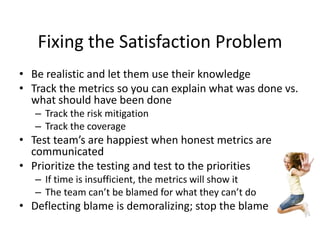
Fixing the Satisfaction Problem
• Be realistic and let them use their knowledge
• Track the metrics so you can explain what was done vs.
what should have been done
– Track the risk mitigation
– Track the coverage
• Test team’s are happiest when honest metrics are
communicated
• Prioritize the testing and test to the priorities
– If time is insufficient, the metrics will show it
– The team can’t be blamed for what they can’t do
• Deflecting blame is demoralizing; stop the blame
11. Count the Numbers
• Do you have the metrics you need to explain
the status of a project?
• Check the defect tracking system – is it getting
accurate data?
• Reports and graphs that are too complicated
will not be read
• No one will dig for the real numbers – it’s
easier to assume they don’t exist
Fixing the Metrics
• Plan to track and use the tracking to plan
• Pre-emptive metrics stop the blame game
• Your people know why metrics are important
– Make sure your tools are tracking the important
data
• For DDP, need to know what was found after release as
well as what was found in all testing
• For COQ, need to know phase introduced and phase
found
– Make reports/dashboards available and readable
12. Show the ACTUAL Value
• The value of testing has to be shown in time
and cost savings
– Return on investment is required
– It’s easy for others to see testing as an expense
with little return
• Quality doesn’t just happen, it has to be
planned, implemented and maintained
Fixing the Visible Value
• Use those metrics – Real numbers for real
projects show actual value
– Risk mitigation
– Coverage
– Defects found (DDP)
– Cost of quality (COQ)
• People should feel good about testing, but
should also understand residual risk
• Quality must be embraced by all stakeholders
Long Term
• Continuing education keeps testers current,
interested and is a job benefit
• Good testers always want to improve – look to
Advanced and Expert levels
• Leverage your team knowledge
• Keep your good practices in place – always!
– Make sure your processes and tools work for you
– Make sure your reporting is consistent and
automated
Goals for the Certified Team
• Improving
• Learning
• Building
• Producing Quality
• Performing Consistently
• Finding Satisfaction
• Maintaining Pride

Istqb implementation

  • 1.
    Making ISTQB Certification Work forYou As a test manager or an aspiring test manager
  • 2.
    Where are younow? • You’ve invested in your team • You have a well-educated group – Common knowledge – Common goals – Common language • They are eager to apply their knowledge • You are eager to get a return on your investment and leverage the training into high quality products
  • 3.
    But…. • But yourcompany doesn’t appreciate testing • Your schedules are too tight • Your budgets are too strict • The code you’re testing is somewhat less than functional • You must be in the real world! • So, how do you get that return on your investment?
  • 4.
    Bridging Ideal andReality • There are 12 main steps that we need to take to leverage good practices and knowledge • These steps will provide a return where we need it – improved quality and value • It’s important to set a realistic schedule – “Realistic” depends on your environment and needs – Remember those pesky projects in progress
  • 5.
    How do youmake it work? 1. Identify the perceived value 2. Meet the schedules and budgets 3. Improve quality 4. Spread the knowledge 5. Push testing upstream 6. Do the static testing 7. Expand into white box testing 8. Pick, use and improve tools 9. Manage 10. Build satisfaction 11. Count the numbers 12. Show the actual value
  • 6.
    1. Identify thePerceived Value • What is the perceived value of your team? – Do you get told to just work faster, add more people from the street, work weekends…. – Does development get told that? • The less valued team will get the schedule/budget/manpower cuts • Look around, ask around, how is your team perceived? • Understanding the perception tells you what you need to change/fix
  • 7.
    Fixing Perceived Value •Use the test plan to get the stakeholders to understand testing scope and goals • Engage in the risk analysis and help people understand that there is risk • Track and publish your metrics – Entry/exit criteria (don’t bend the rules) – Cost of Quality – Defect Detection Percentage – Real numbers from real projects get attention
  • 8.
    2. Meet theSchedules and Budgets • Who’s holding the software when the end dates are missed? • Who’s charging to the budget when it overruns? • Who really caused the slip and the overrun?
  • 9.
    Fixing Schedules andBudgets • Track the testing schedule in days allotted, not start/end • Track the testing budget in money allotted • Let the PM manage the overall project • Track the test coverage (risk / requirements / code) and map coverage to schedule • Be ready to answer “what could you do if you had two more weeks to test”
  • 10.
    3. Improve Quality •Goal: Highest quality possible – Obstacles - define “possible” – Time, training, manpower… • Incoming quality often defines limits of outgoing quality • “Just do the best you can….” so we can blame you later… • Time, Time, Time, Time, Time
  • 11.
    Fixing Quality • Incomingquality issues should be dealt with via the entry criteria (test plan) – Unit testing and static analysis are not optional – Objective metrics are used to determine “testability” • Employ those test strategies your team knows – If time is an issue, use risk-based – Track the residual risk as the time runs out
  • 12.
    Fixing Quality • Breakinto the arsenal of testing techniques – Reduce tests via equivalence partitioning – Test the combinatorials with your advanced team – Verify code coverage; better code = shorter testing time – Apply the right techniques to the right situation – Use experience-based to leverage the team’s experience and knowledge and find gaps
  • 13.
    4. Spread theKnowledge • Time-constrained teams tend to silo • Cross-training isn’t done because there isn’t time • Faster to use the experts in the area • If someone leaves…. Uh-oh • No time to develop and advance skills
  • 14.
    Fixing Knowledge Spreading •ISTQB training builds a base level of knowledge • Growing from that common base is easier than starting new • Find and create opportunities to leverage known techniques • Build an environment of learning
  • 15.
    5. Push TestingUpstream • Bad code makes for long testing schedules • “Throw it over the fence” is too common • Regardless of lifecycle model, testing has to start with the requirements • Continuous testing = continuously improved products • Testing is not “owned” by the test team • The test team may feel like salmon
  • 16.
    Fixing Upstream Testing •Talk to development • Implement code coverage tools to verify unit testing • Create a plan for real integration testing • Check your entrance/exit criteria – Are they measurable? – Can you make them stick?
  • 17.
    6. Do theStatic Testing • Not enough time for reviews • Reviews are not valued • The test team’s input is not valued • Not enough time for reviews • The documents to be reviewed don’t exist… • The test team is busy on other projects • Not enough time for reviews
  • 18.
    Fixing Static Testing •Your team knows how to do high quality reviews • Pick the review type that makes sense • Review the requirements and designs first – Start with a small group if needed – Document the results • Move into code reviews and static analysis • Be sure to make reviews a standard part of test documentation as well
  • 19.
    7. Expand intoWhite Box Testing • Does your DDP indicate that you are missing things? • Do you think your black box coverage is great? • Can’t do white box testing – Not enough time – Not enough skill on the team – Not enough access to the code
  • 20.
    Fixing White BoxTesting • Check the defects you are missing – could you have caught them? • Don’t estimate, use code coverage tools to determine your black box coverage • Start with targeted white box to address risky areas not covered by black box • Use your Technical Test Analysts for this
  • 21.
    8. Pick, Useand Improve Tools • Using sub-optimal tools is often a time waster • People get frustrated with poor or awkward tools • Data can be lost when tools don’t interface • Time spent creating reports could be better spent • Data dissemination is difficult with some tools
  • 22.
    Fixing Tools • Makesure you have the best tools available using the info you learned on picking tools • Make sure you are using the tool optimally • Get rid of fields you don’t need and quit annoying people • Add the critical fields needed for COQ and DDP • Get your TTA’s to code “glueware” to make the tools work smoothly together • Create and publish reports that prove your value
  • 23.
    9. Manage • Seemsobvious, right? • A lot of test managers forget to manage • Managing a team should not be fire fighting • If you are swamped, you need to get your processes under control • People need to have some of your time • Finding and creating metrics should not be a significant part of your job
  • 24.
    Managing • Use thetest plan to plan projects • Implement the proper control metrics to monitor and report • Follow up on the escapes and fix the issues • Automate metrics publishing (save time!) • Train your people and create opportunities • Build relationships though risk analysis and reporting
  • 25.
    10. Build Satisfaction •Is your test team the recipient of comments: – “How did you miss this?” – “Why does testing take so long?” – “The developers should just do the testing” • Test teams that cannot produce quality products are frustrated and updating resumes • Hiring and training is a significant investment
  • 26.
    Fixing the SatisfactionProblem • Be realistic and let them use their knowledge • Track the metrics so you can explain what was done vs. what should have been done – Track the risk mitigation – Track the coverage • Test team’s are happiest when honest metrics are communicated • Prioritize the testing and test to the priorities – If time is insufficient, the metrics will show it – The team can’t be blamed for what they can’t do • Deflecting blame is demoralizing; stop the blame
  • 27.
    11. Count theNumbers • Do you have the metrics you need to explain the status of a project? • Check the defect tracking system – is it getting accurate data? • Reports and graphs that are too complicated will not be read • No one will dig for the real numbers – it’s easier to assume they don’t exist
  • 28.
    Fixing the Metrics •Plan to track and use the tracking to plan • Pre-emptive metrics stop the blame game • Your people know why metrics are important – Make sure your tools are tracking the important data • For DDP, need to know what was found after release as well as what was found in all testing • For COQ, need to know phase introduced and phase found – Make reports/dashboards available and readable
  • 29.
    12. Show theACTUAL Value • The value of testing has to be shown in time and cost savings – Return on investment is required – It’s easy for others to see testing as an expense with little return • Quality doesn’t just happen, it has to be planned, implemented and maintained
  • 30.
    Fixing the VisibleValue • Use those metrics – Real numbers for real projects show actual value – Risk mitigation – Coverage – Defects found (DDP) – Cost of quality (COQ) • People should feel good about testing, but should also understand residual risk • Quality must be embraced by all stakeholders
  • 31.
    Long Term • Continuingeducation keeps testers current, interested and is a job benefit • Good testers always want to improve – look to Advanced and Expert levels • Leverage your team knowledge • Keep your good practices in place – always! – Make sure your processes and tools work for you – Make sure your reporting is consistent and automated
  • 32.
    Goals for theCertified Team • Improving • Learning • Building • Producing Quality • Performing Consistently • Finding Satisfaction • Maintaining Pride