Strengthening Organizations
through Team Effectiveness
GSI and Simulations
1
Brian Stout
John Van Etten
Human Synergistics, Inc.
2
Bushfire Survival Situation
• Step 1: Individual Rank
• Step 2: Team Rank
• Step 3: Expert’s Rank
• Step 4: Individual Score
• Step 5: Team Score
3
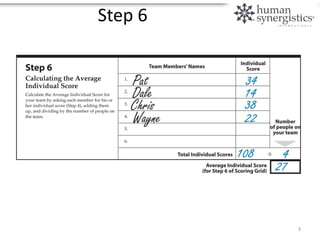
Step 6Average Individual Score
4
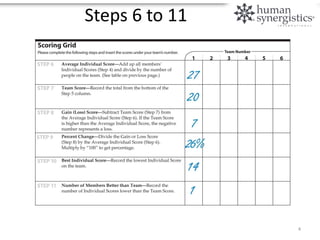
Steps 6 to 11Team Performance Scores
5
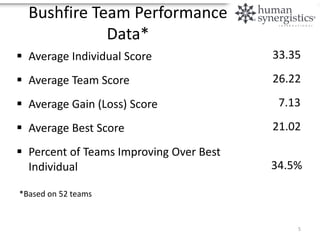
Bushfire Team Performance
Data*
 Average Individual Score
 Average Team Score
 Average Gain (Loss) Score
 Average Best Score
 Percent of Teams Improving Over Best
Individual
33.35
26.22
7.13
21.02
34.5%
*Based on 52 teams
6
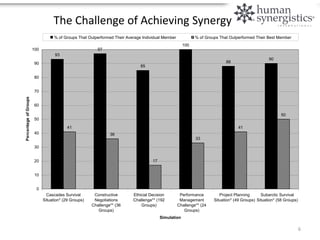
The Challenge of Achieving Synergy
93
97
85
100
88
90
41
36
17
33
41
50
0
10
20
30
40
50
60
70
80
90
100
Cascades Survival
Situation* (29 Groups)
Constructive
Negotiations
Challenge** (36
Groups)
Ethicial Decision
Challenge** (192
Groups)
Performance
Management
Challenge** (24
Groups)
Project Planning
Situation* (49 Groups)
Subarctic Survival
Situation* (58 Groups)
Simulation
PercentageofGroups
% of Groups That Outperformed Their Average Individual Member % of Groups That Outperformed Their Best Member
7
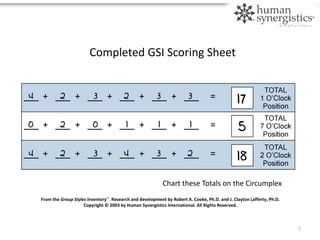
Completed GSI Scoring Sheet
Chart these Totals on the Circumplex
From the Group Styles Inventory. Research and development by Robert A. Cooke, Ph.D. and J. Clayton Lafferty, Ph.D.
Copyright © 2003 by Human Synergistics International. All Rights Reserved.
8
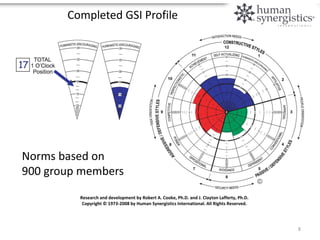
Completed GSI Profile

Norms based on
900 group members
Research and development by Robert A. Cooke, Ph.D. and J. Clayton Lafferty, Ph.D.
Copyright © 1973-2008 by Human Synergistics International. All Rights Reserved.
9
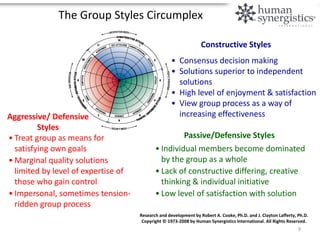
The Group Styles Circumplex
• Consensus decision making
• Solutions superior to independent
solutions
• High level of enjoyment & satisfaction
• View group process as a way of
increasing effectiveness
• Treat group as means for
satisfying own goals
• Marginal quality solutions
limited by level of expertise of
those who gain control
• Impersonal, sometimes tension-
ridden group process
• Individual members become dominated
by the group as a whole
• Lack of constructive differing, creative
thinking & individual initiative
• Low level of satisfaction with solution
Passive/Defensive Styles
Constructive Styles
Aggressive/ Defensive
Styles
Research and development by Robert A. Cooke, Ph.D. and J. Clayton Lafferty, Ph.D.
Copyright © 1973-2008 by Human Synergistics International. All Rights Reserved.
10
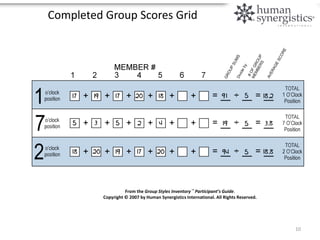
Completed Group Scores Grid
From the Group Styles Inventory  Participant’s Guide.
Copyright © 2007 by Human Synergistics International. All Rights Reserved.
11
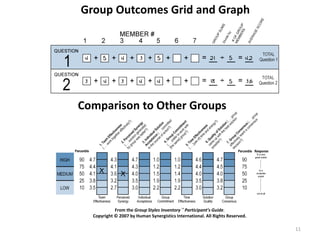
Group Outcomes Grid and Graph
Comparison to Other Groups
From the Group Styles Inventory  Participant’s Guide.
Copyright © 2007 by Human Synergistics International. All Rights Reserved.
12
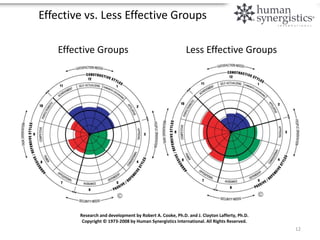
Effective vs. Less Effective Groups
Less Effective Groups

Effective Groups

Research and development by Robert A. Cooke, Ph.D. and J. Clayton Lafferty, Ph.D.
Copyright © 1973-2008 by Human Synergistics International. All Rights Reserved.
13
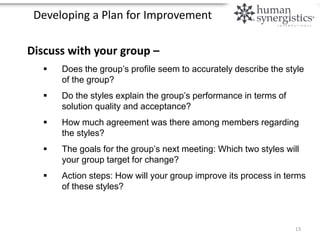
Developing a Plan for Improvement
Discuss with your group –
 Does the group’s profile seem to accurately describe the style
of the group?
 Do the styles explain the group’s performance in terms of
solution quality and acceptance?
 How much agreement was there among members regarding
the styles?
 The goals for the group’s next meeting: Which two styles will
your group target for change?
 Action steps: How will your group improve its process in terms
of these styles?
14
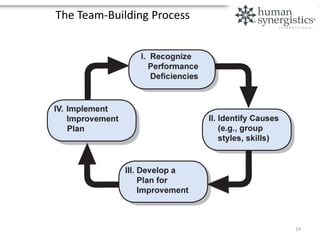
The Team-Building Process
15
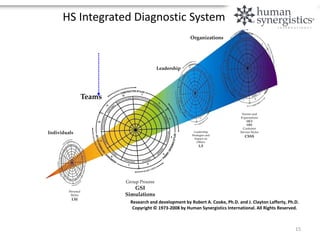
HS Integrated Diagnostic System
Research and development by Robert A. Cooke, Ph.D. and J. Clayton Lafferty, Ph.D.
Copyright © 1973-2008 by Human Synergistics International. All Rights Reserved.