EPF10a. Examine basic economic concepts and their
       relation to product prices and consumer spending
EPF10c. Describe the steps in making a purchase decision
    EPF10d. Determine the consequences of conspicuous
                                           consumption
  EPF10h. Examine the impact of advertising & marketing
 on consumer demand and decision-making in the global
                                            marketplace
Basic economic concepts can be used to understand pricing of
products.

Basic economic concepts can be used to understand consumer
spending.
What economic concepts impact
consumers?
 Profit is an incentive for producers.
 Businesses produce what consumers demand, a
  concept known as consumer sovereignty.
 If the cost of production goes up, supply will decrease
  and prices will rise; if the cost of production goes
  down, supply will increase and prices will fall.
 An increase in productivity lowers the cost of
  production and thus increases supply, leading to a
  decrease in price.
 Competition among businesses affects consumer
  prices.
What economic concepts can be used
to understand consumer spending?
   Changes in income affect the demand for goods and
    services; an increase in income increases demand for
    most products, and vice versa.
   Interest income is an incentive to save money.
   Supply and demand for a product or service determine
    price.
Purchase decisions are made more easily when marginal benefit
and marginal cost are considered.

The use of decision models can improve purchase decision-
making.
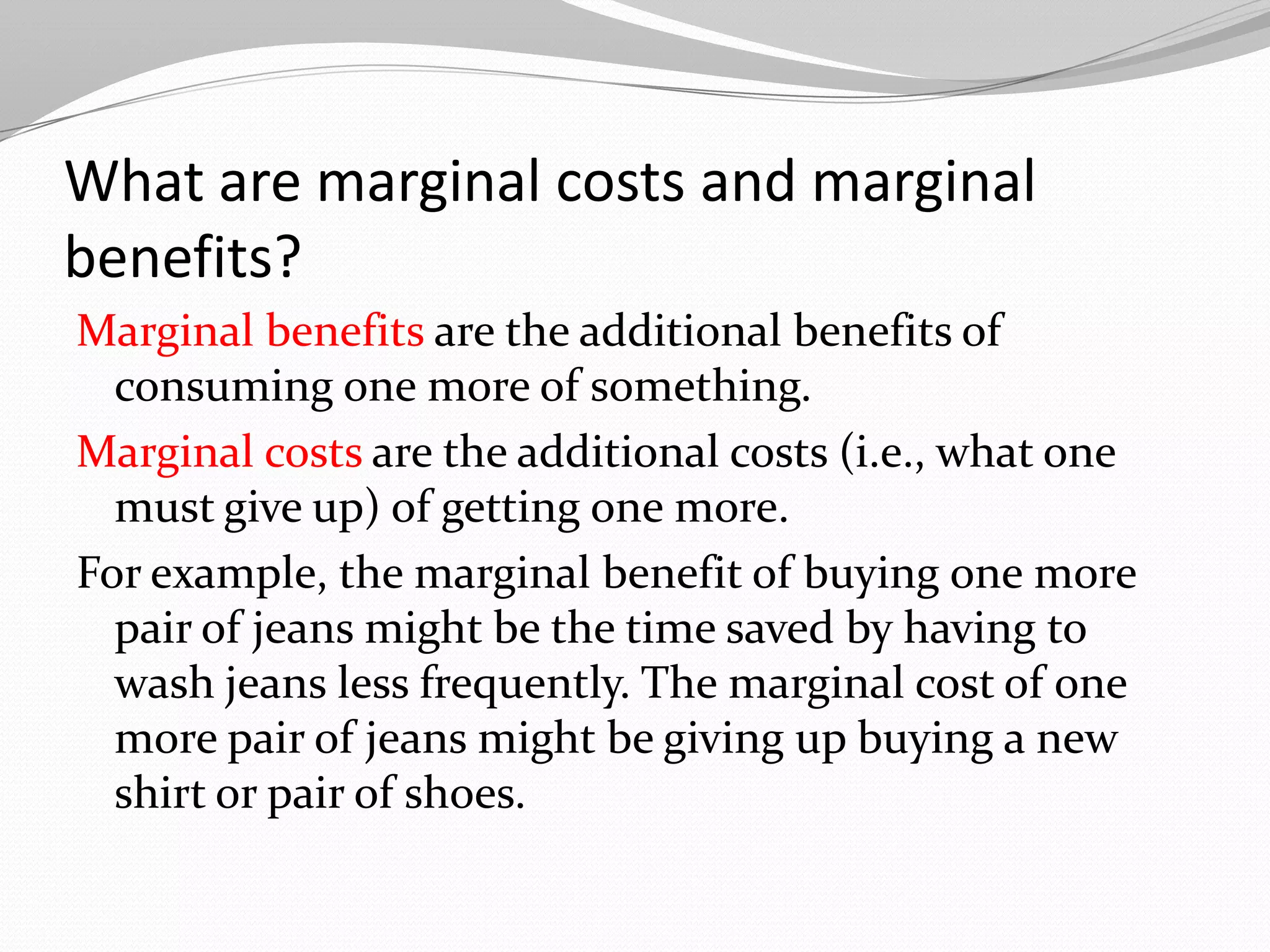
What are marginal costs and marginal
benefits?
Marginal benefits are the additional benefits of
  consuming one more of something.
Marginal costs are the additional costs (i.e., what one
  must give up) of getting one more.
For example, the marginal benefit of buying one more
  pair of jeans might be the time saved by having to
  wash jeans less frequently. The marginal cost of one
  more pair of jeans might be giving up buying a new
  shirt or pair of shoes.
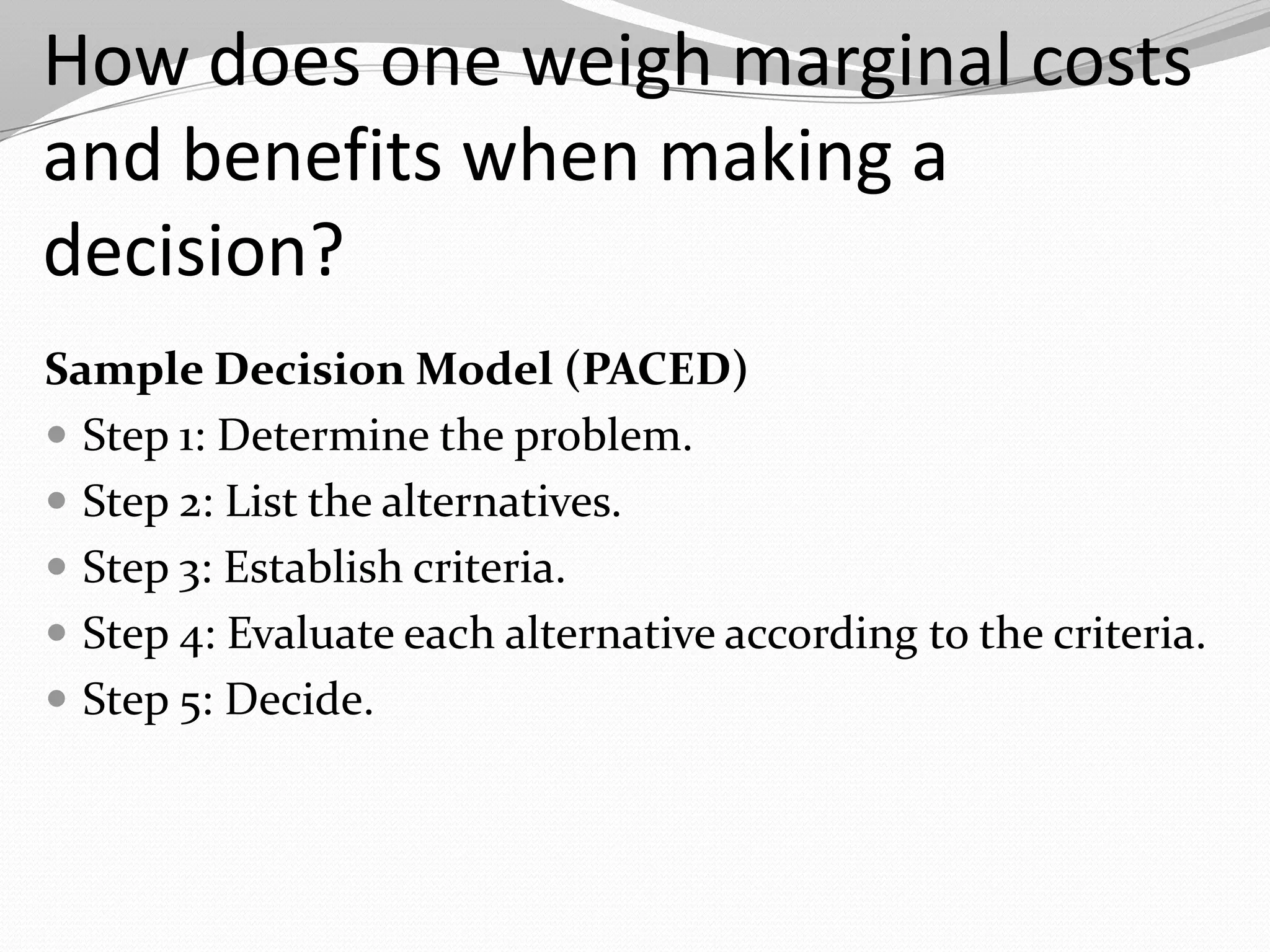
How does one weigh marginal costs
and benefits when making a
decision?
Sample Decision Model (PACED)
 Step 1: Determine the problem.
 Step 2: List the alternatives.
 Step 3: Establish criteria.
 Step 4: Evaluate each alternative according to the criteria.
 Step 5: Decide.
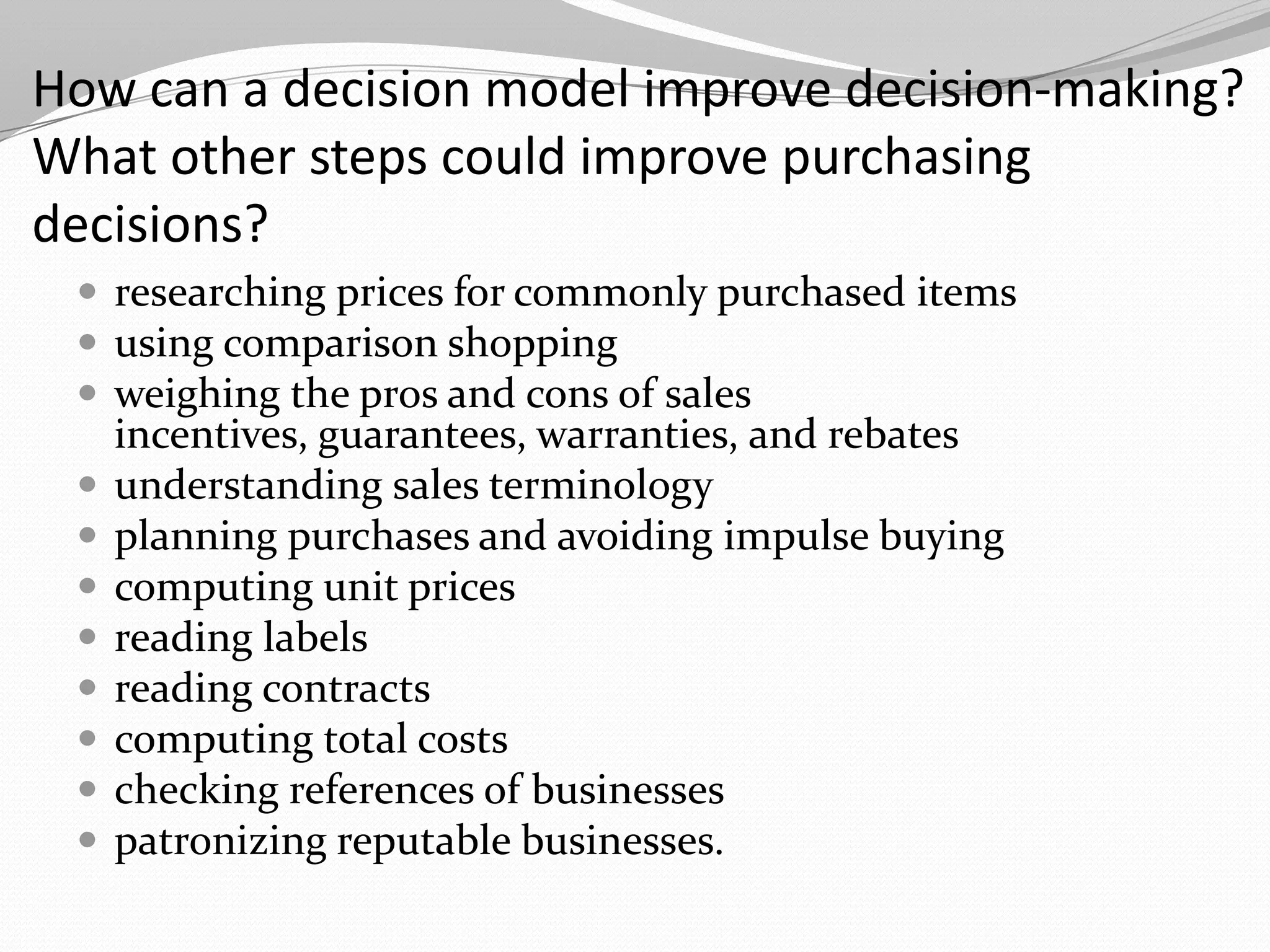
How can a decision model improve decision-making?
What other steps could improve purchasing
decisions?
  researching prices for commonly purchased items
  using comparison shopping
  weighing the pros and cons of sales
     incentives, guarantees, warranties, and rebates
    understanding sales terminology
    planning purchases and avoiding impulse buying
    computing unit prices
    reading labels
    reading contracts
    computing total costs
    checking references of businesses
    patronizing reputable businesses.
Conspicuous consumption can lead to financial troubles.
What is conspicuous consumption
and how can it lead to financial
problems?
 Conspicuous consumption refers to buying goods and
  services not for their intrinsic value but for the
  purpose of impressing others in hopes of improving
  one’s social status.
 Conspicuous consumption can lead to spending
  beyond one’s means. This requires borrowing, and
  excessive borrowing can lead to credit problems.
Advertising and marketing affect consumer demand and
decision-making.
How do advertising and marketing
affect consumer demand and
decision-making?
Advertising features may have features that may be
 misleading (e.g., infomercials, celebrity
 endorsements).

10 consumer skills

  • 1.
    EPF10a. Examine basiceconomic concepts and their relation to product prices and consumer spending EPF10c. Describe the steps in making a purchase decision EPF10d. Determine the consequences of conspicuous consumption EPF10h. Examine the impact of advertising & marketing on consumer demand and decision-making in the global marketplace
  • 2.
    Basic economic conceptscan be used to understand pricing of products. Basic economic concepts can be used to understand consumer spending.
  • 3.
    What economic conceptsimpact consumers?  Profit is an incentive for producers.  Businesses produce what consumers demand, a concept known as consumer sovereignty.  If the cost of production goes up, supply will decrease and prices will rise; if the cost of production goes down, supply will increase and prices will fall.  An increase in productivity lowers the cost of production and thus increases supply, leading to a decrease in price.  Competition among businesses affects consumer prices.
  • 4.
    What economic conceptscan be used to understand consumer spending?  Changes in income affect the demand for goods and services; an increase in income increases demand for most products, and vice versa.  Interest income is an incentive to save money.  Supply and demand for a product or service determine price.
  • 5.
    Purchase decisions aremade more easily when marginal benefit and marginal cost are considered. The use of decision models can improve purchase decision- making.
  • 6.
    What are marginalcosts and marginal benefits? Marginal benefits are the additional benefits of consuming one more of something. Marginal costs are the additional costs (i.e., what one must give up) of getting one more. For example, the marginal benefit of buying one more pair of jeans might be the time saved by having to wash jeans less frequently. The marginal cost of one more pair of jeans might be giving up buying a new shirt or pair of shoes.
  • 7.
    How does oneweigh marginal costs and benefits when making a decision? Sample Decision Model (PACED)  Step 1: Determine the problem.  Step 2: List the alternatives.  Step 3: Establish criteria.  Step 4: Evaluate each alternative according to the criteria.  Step 5: Decide.
  • 8.
    How can adecision model improve decision-making? What other steps could improve purchasing decisions?  researching prices for commonly purchased items  using comparison shopping  weighing the pros and cons of sales incentives, guarantees, warranties, and rebates  understanding sales terminology  planning purchases and avoiding impulse buying  computing unit prices  reading labels  reading contracts  computing total costs  checking references of businesses  patronizing reputable businesses.
  • 9.
    Conspicuous consumption canlead to financial troubles.
  • 10.
    What is conspicuousconsumption and how can it lead to financial problems?  Conspicuous consumption refers to buying goods and services not for their intrinsic value but for the purpose of impressing others in hopes of improving one’s social status.  Conspicuous consumption can lead to spending beyond one’s means. This requires borrowing, and excessive borrowing can lead to credit problems.
  • 11.
    Advertising and marketingaffect consumer demand and decision-making.
  • 12.
    How do advertisingand marketing affect consumer demand and decision-making? Advertising features may have features that may be misleading (e.g., infomercials, celebrity endorsements).