So…You want to be a 
                  Bill Collector?
             Collection Training 
                        Seminar

            Presented for:
            ACCESS Clients
Presented By:  Tom Gillespie & Pam Long
   ACCESS Receivables Management
So…You want to be a bill collector?
What does it take?

         • Ability to Learn and 
           Apply Procedures
         • Communication Skills
         • Professionalism
         • Work Ethic
         • Persuasion
         • Active Listening
         • Problem Solving
         • Developing Rapport
         • Multitasking
Ability to Learn and Apply 
Procedures 
•Understanding and 
complying with job related 
procedures and  systems 
•Understanding and 
complying with company 
policies
•Understanding and 
complying with legal 
regulations
•Offering solutions that 
remain within guidelines 
Communication Skills
•Expressing information in a 
clear and confident manner
•Speaking in a pleasant tone 
and volume
•Using effective tone 
inflection
•Creating reasonable answers 
to objections
•Solving the problem
•Preparing clear and concise 
summaries

Record yourself for Training Purposes. 
Keep a mirror at your desk!
Professionalism
•Maintaining composure even 
when dealing with difficult 
customers
•Keeping a positive attitude in 
spite of negative outcomes
•Maintaining the control of 
the call by asking questions
•Avoid the use of slang or 
jargon
•Maintain your professional 
distance yet be helpful to the 
customer.
Work Ethic
•Taking initiative on work 
tasks and responsibilities
•Working at a steady pace
•Setting personal goals and 
striving to achieve them
•Striving to achieve and 
exceed  organizational 
goals 
•Exhibiting reliable and 
dependable behavior
Persuasion
•Effectively responding to 
objections and arguments
•Being assertive rather 
than aggressive
•Creating a sense of 
urgency
•Conveying firm 
expectations
•Being persistent
•Negotiating a mutually 
acceptable agreement
Active Listening
•Develop your “7th sense”.
•Listen attentively to 
understand the customer’s 
point of view
•Allow customers to vent
•Refrain from interrupting
•Ask probing questions to 
discern the “REAL” facts
•Pay attention to subtle 
clues like the customer’s 
demeanor and tone 
inflection
Adaptability
•Adjusting collection 
techniques based on 
individual circumstances
•Responding appropriately 
to individual personality 
types
•Quickly adapting to 
changes in policies and 
procedures
•Maintaining overall 
productivity while treating 
each account call as a 
separate event 
Problem Solving
•Use available tools to 
accomplish tasks
•Identify ways of 
overcoming barriers
•Evaluate all relevant 
pieces of information
•Understanding the 
advantages and 
disadvantages of various 
options
• Present solutions based 
on realistic expectations
Developing Rapport
•Treating customers with 
respect
•Displaying empathy for 
personal situations
•Conveying an attitude of 
helpfulness
•Diffusing irate customers
•Keeping the tone friendly 
but businesslike
Multitasking
•Quickly and accurately performing 
multiple tasks simultaneously
      •Talking
      •Listening
      •Reviewing 
      information
      •Documenting the call
      •Managing the pace of 
      the call
      •Maintaining  
      attention to the 
      customer
      •Keeping the customer 
      focused on the 
      solution
Why Collections???
•In 2002 The Bureau of Labor 
Statistics predicted that the 
number of collection agents 
would increase between 21% 
and 35% by 2012.  
•We know now that this 
projection was significantly 
lower than reality
•Actual percentage increase in 
this industry could easily be 
100% between 2009 and 2012.
•Average turnover in the debt 
collection industry is historically 
30% per year.
•Successful and professional 
collection agents will have 
significant career opportunities 
in a difficult economy.
So I guess 
you want to be a bill collector!
Key Steps to Collection 
Success
•Review the account
•Dial for Dollars
•Verify Information
•The Talk‐Off
•Money Drops
•Subsequent Contact
•Consequences of no 
payment
Review The Account
•What was the last action?
•How old is the account?
•Have any payments been made 
on the account?
•Did the debtor make a promise?
•Do you have good contact 
information?
•Who is the responsible party?
•When was the account last 
worked?

This task can all be accomplished 
while you are dialing the number.
Dial for Dollars
Repeat this Statement:

I am not judged by the number of 
times I fail.  I am judged by the 
number of times I succeed AND the 
number of time I succeed is in direct 
proportion to the number of times I 
fail and keep trying.

The numbers at a glance:

100  attempts per day
 20 contacts per day
 10 promises per day
  5 payments per day
Verify The information
•Identify the responsible party
      •Student
      •Parent
      •Company 
•Verify the address 
      •Living at home?
      •Apartment
      •Owning or Renting
      •No PO Box – Street Address
•Verify Employment 
      •Are you currently employed
      •Full Time / Part Time
      •Position / How Long
      •If None, Source of Funds
•Verify contact information
      •Is your cell phone the best number 
      to call?  (GET CELL and permission)
      •Other contact numbers 
             •Home 
             •Business
      •EMAIL ADDRESS !!!
I

                  n
                  e
                  C
                  e
                  a
                  d
                  n

                  t
                  y
                  o
                  o
                  u
                  c
                  o
                  p
                          The Talk OFF
                  l
                  a
                  l
                  y
                  e
                  c
                  b
                  t
                  y
                  Y
                  N
                  t
                  A
                  E
                  O
                  h
                  C
                  S
                  e
                  H


   The secret to  Wb
                  ia
                  tl


   success in
                  ha
                  dn
                  rc
                  ae

   collections is to
                  w
                  ai
                  ln


   lead your
                  ?
                   f
                   u
                   l


   customer down
                   l


   the path to
   success.


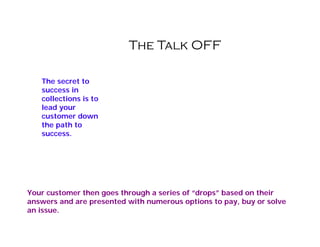
Your customer then goes through a series of “drops” based on their
answers and are presented with numerous options to pay, buy or solve
an issue.
The Talk Off
1. Verify the debtor 
2. State your name and 
   company name
3. Before I continue I need to 
   verify some information for 
   our records (update 
   information)
4. The Talk Off
     • State the purpose of 
         your call
5. Handle objections
6. Pitch payment options
7. Close for the payment
8. Thank the customer
ALTERNATE OF CHOICE CLOSE
Stating the purpose
I am calling today because we need to 
collect payment on your outstanding 
balance in our office in the amount of 
_______ representing tuition charges 
for the ______ semester of ________.  
We have 2 methods available for 
payment.  I can take a credit card for 
the balance or we can also take a 
check over the phone.  Which 
payment method would you prefer?

ALWAYS PITCH THE BALANCE IN 
FULL WITHOUT OPTIONS AND 
WITHOUT RESERVATION.  AFTER 
YOU STATE THE PURPOSE OF 
YOUR CALL


PAUSE…THE NEXT PERSON 
WHO SPEAKS LOSES.
Handle Objections
Types of Objections
      •Circumstantial
      •Emotional
      •Intellectual
      •Fraudulent
•Circumstantial
      •Medical  Issues
      •Loss of Job
      •Divorce
      •Natural Disaster
•Emotional
      •These consumers believe that they 
      deserve the service even though they 
      are not able to afford it.  
                •It’s not my fault
•Intellectual
      •These consumers usually have the 
      ability to pay but have poor records or 
      do not budget their money 
      accordingly
•Fraudulent
      •These individuals never intended to 
      pay.
Money Drops                                         • Balance by Credit 
•Secure a down payment                                Card
      •Can you pay at least 50% down today 
      and the balance by the end of the       BIF   • Balance by ACH
      month?
•Liquidate the debt in the shortest 
possible time
•Be realistic
•Identify Money Sources                             • Post Dated Check 
      •Employment
      •Savings                                PDC
      •Parents 
      •Relative 
      •Loan
      •Life Insurance 
      •401K 
                                                    • Down Payment
      •Other                                        • Realistic Terms
                                              PPA
•Once the payment plan is set, make 
sure that the debtor understands that 
it is a one time accommodation, not 
the rule.
Subsequent Contact
•If at first you don’t succeed…
      •Was a promise broken?
      •Has there been a 
      change since the first 
      contact?
      •Does the debtor have a 
      proposed solution to the 
      problem?
      •Can the debtor get on a 
      temporary payment 
      plan?
Customer Consequences
•If no payment is received, 
what are the consequences?
      •Placement for Collection
      •Credit Bureau Reporting
      •Transcript Withholding
      •Registration 
      Withholding

•If there are no consequences 
for non‐payment, why should 
they pay the bill?
Would the world be better 
off without us?
The job you do is essential to the 
survival of the economic system.  
Without collections, there can be no 
credit.  
•Why do people pay bills?
      •Moral and Social Obligation
      •Civil Penalty
•Without collections there is no 
credit
•Without credit there can be no 
economic growth 
•Without economic growth, there 
can be no stability
•The collection function provides a 
backstop to the credit process in 
order to allow all companies to 
extend credit and do business.  
Without you, our entire future is at 
stake. 

Collection Training Seminar